1436
THE USE OF QUALITY, SECURITY AND TRUST FACTORS
TO IMPROVE THE ONLINE PURCHASE DECISION
1SFENRIANTO, 2WANG GUNAWAN, 3DHIRAJ S. KELLY, 4RISWAN E. TARIGAN Information Systems Management Department, Bina Nusantara University, Indonesia 11480 E-mail: 1[email protected], 2[email protected], 3[email protected], 4[email protected]
ABSTRACT
Apparel industry is one of the largest business that serves online customers around the world. Indonesia as a country with the huge apparel industries enjoys the growth of online business. With the consistent growth of middle class economy, apparel industry has become the most promising online business in Indonesia. Due to its huge supplies and demands, have created complex business environment for apparel industry in Indonesia. It combines with online issues such as we b quality, security and trust, are the main issues haunting major Indonesian customers, which are developing their knowledge about online business. The paper uses a case study of the largest online apparel vendor in the South-East Asia, Zalora, where it has strong customer bases in greater Jakarta area. The paper examines the important factors of website quality, security and trust and relates them to the purchasing decision.
Keywords: Website Quality, Security, Trust, e-Commerce, Online Purchase Decision.
1. INTRODUCTION
This AC Nielsen [1] [2] has reported that the clothing accessories and shoes have reached around 46% for the consistent browse and buy rates category amongst the internet users. The figure represents major 60 countries that have active internet users. PWC Indonesia outlook estimated the total sales of apparel can reach US$ 14 billions in 2016, with average 7.2% growth every year [3]. McKinsey reported there are additional 5 million middle classes are created in Indonesia every year [3]. PWC estimated the e-commerce transactions were worth US$1-2 billion in 2013, compared with total retail sales of US$330 billion. The value of online sales has more than tripled in the past two years [4].
Although with the fast growth, the contribution of online sales still less than 1% of the national GDP [3]. There are many factors concerned Indonesian users especially related to online business, such as: the low trust between seller and buyer, and the payment processes are quite tedious [2]. Nevertheless, the banks are lowering down their barriers, and the awareness apparel vendors are getting better about online business. As a result, the number of credit cards users are rising sharply and online retailers are gaining a greater understanding amongst the Indonesian shoppers [3].
Other classical issues concerned the Indonesian online users are: web security and vulnerable online transaction, lack of e-commerce law and security enforcements [5] [6]. All these issues are contributing to lowering the trust to the online transactions.
The paper uses the largest apparel site in the South-East Asia, Zalora that has consistent growth and strong customer bases. The paper is based on the study of Prattisya [7], addressing the low customer satisfaction related to the web design and identifying the ways to improve on it. The low customer satisfaction is believed may lead to the purchasing decision. The study addresses this issue, through examining the major customer bases in greater Jakarta area that contributes the major profits for the Zalora Indonesia.
2. THEORETICAL FOUNDATION
1437 unique symbolic value. It distinguishes the company's identity from competitors, and motivate the purchasing decision process. The image of strong brands should be associated with the high quality of web design [11] [12].
2.1. Quality.
[image:2.612.95.295.266.489.2]Apparel business is about serving the “visual” interest to the customer, and it always associated with the presentation of the web. The design of web quality for the apparel should comply the major indicators as follows:
Table 1: Quality Variable and its indicators.
Variables Indicators References
Web Quality
1. Ease of use.
[13] [14] 2. Usefulness.
3. Entertainment (visual appeal) 4. Complementary
Relationship (enabling complete
transaction online)
5. Service Quality [14] [15] 6. Innovative design [13] [16] 7. Aesthetic design
[16] 8. Information
Quality 9. Consistent
Images. [13]
10. System Quality [14]
2.2. Security management
The paper uses the security management from the user perspectives, with aims at four security principles such as [17] [18]: (1) confidentiality, the privacy of data stored in the web application should not be divulged under any circumstance; (2) integrity, the data contained in the web application should be consistent and should not be modified by any unauthorized users; (3) availability, the site should be accessible by the authorized user within a certain period depending on demand; (4) nonrepudiation, the authorized user is recorded in the undeniable log history.
There are many apparel vendors competing each other in complex business environment either in online and offline business. Unethical business practices [11] relates with web attacks has received special attentions for both online vendor and customers. The common security issues frequently
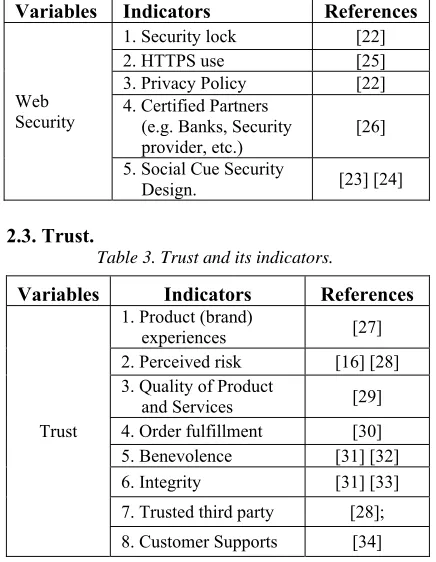
occur especially related with the attacker competence, technological advances, vulnerability exploitation opportunities, etc. Its techniques include: buffer overflow, SQL injection, spamming, packet sniffing, spoofing/masquerade [19], abuse of cookies, phishing [20], DNS hacking [21], etc. In order to secure the transaction, the security measurement should involve with [22], security lock, HTTPS use, emphasizing the privacy policy, established good relationships with certified partners, and promoting social security awareness [23] [24]. The social security design is also considered important for many customers to shop online, where the customer needs special referrals from the third parties or through the word of mouths. The indicators for security are summarized as follows:
Table 2. Web Security and its indicators.
Variables Indicators References
Web Security
1. Security lock [22]
2. HTTPS use [25]
3. Privacy Policy [22]
4. Certified Partners (e.g. Banks, Security
provider, etc.) [26]
5. Social Cue Security
Design. [23] [24]
2.3. Trust.
Table 3. Trust and its indicators.
Variables Indicators References
Trust
1. Product (brand)
experiences [27]
2. Perceived risk [16] [28]
3. Quality of Product
and Services [29]
4. Order fulfillment [30]
5. Benevolence [31] [32]
6. Integrity [31] [33]
7. Trusted third party [28];
8. Customer Supports [34]
[image:2.612.310.528.305.586.2]1438 consumers [38]. The indicators for the trust are summarized in the Table 3 above.
2.4. Purchase decision
[image:3.612.316.528.90.268.2] [image:3.612.92.297.356.583.2]The Zalora stores run both off-line and on-line to capture the Indonesia markets. With the off-line, Zalora stores has been well established in the fancy malls and competes with other well-established brands and apparel vendors. With the off-line, the paper measures the decision to buy based on the perceived ease of both product use and information usefulness [37], perceived low cost product and service, purchase experience related with the site and new products, compatibility with customer’s value, norm and belief, getting direct personal influence and external influence, facilitating necessary conditions such as financial supports, etc., and familiarity with online search and purchasing (self-efficacy). It is illustrated in the Table 4.
Table 4. Purchase decision and its indicators.
Variables Indicators References
Purchase Decision
1. Perceived ease of use and usefulness
[34] 2. Perceived Low
Cost 3. Purchase
experience 4. Compability (with
value, norm and belief)
5. Interpersonal influence
6. External influence [39] [40] 7. Facilitating
conditions (e.g. Financial supports, etc.)
[41]
8. Self-Efficacy (e.g. familiarity with
internet search) [42]
2.5. Zalora
Zalora is a popular apparel vendor in In Indonesia. Zalora's product comprised of man and woman clothes, shoes, accessories, and beauty products. Every year Zalora attracts more than 150 thousand Indonesia customers to visit and shop. Zalora was established in 2012 and has served the major market of South-East Asia such as: Singapore, Indonesia, Malaysia and Brunei, Filipina, Thailand, Vietnam, and Hong Kong, and Australia.
Fig.1. Zalora (http://www.zalora.co.id)
3. RESEARCH DESIGN
3.1. Research Model
[image:3.612.313.527.370.513.2]Based on the theories above, the article proposed the research model as follow:
Fig. 2. Impact of Quality, Security and Trust to the Purchase Decision.
The hypothesis formulation for the research model above are summarized as follows:
1. H1: web quality affects the purchase decision. 2. H2: web security affects the purchase decision. 3. H3: trust affects the purchase decision.
4. H4: website quality, website security and trust simultaneously affect the purchase decision.
3.2. Data Gathering Method
1439 validated for further analysis. Further interviews, focus groups, and observation had been to explore the findings.
[image:4.612.318.516.146.275.2]There were 250 respondents participated in the study. They were comprised of: 128 men and 122 women (See Table 5 below).
Table 5. Distribution of the respondents.
Sex Valid respondents Percentage
Male 128 51.2
Female 122 48.8
Total 250 100
[image:4.612.96.294.192.244.2]The distribution of respondents was summarized into 6 categories comprised of: employees and professionals, students, housewives, unemployed and business owners. The largest number were college students. They were the main target since they were well educated with high familiarity with IT. Employees, housewives and professionals occupied the second, third and fourth of the percentage. Table 6 showed there is increasing awareness amongst young generation to develop online purchasing attitudes. The trend also followed by business owners. Our observation showed there is increasing trend of business owners to get used with online purchase.
Table 6. Description of the respondents.
Description Respondents Valid Percentage
Employees 33 13.2
Students 139 55.6
Professionals 23 9.2
Housewives 28 11.2
Unemployed 11 4.4
Business owners 16 6.4
Total 250 100
Table 7 showed college students and high school students were the active online customers. It can be understood they are digital native generation, develop high familiarity with internet technology and advance electronic gadget use. They are also important part of strong middle-income families. Vocational students had the lowest respondents. It can be understood, that they are not the target customer of Zara (middle up income families).
Table 8 showed the distribution of respondents that purchased during the period of July-Dec 2015. The table inferred that Zara customers were active and repeating customers with at least one
transaction per month. They seemed develop strong brand loyalty offered by Zara.
Table 7. Distribution of Education.
Education Respondents Percentage
High Schools/
Others 68 27.2%
Vocational 5 2.0%
Bachelor 132 52.8%
Master 35 14.0%
Doctorate 10 4.0%
Total 250 100.0%
Table 8. Transaction per month (Period July-Dec 2015).
Transaction
per month Respondents Percentages
1 65 26
2-4 65 26
5-7 80 32
>7 40 16
Total 250 100
4. FINDINGS AND DISCUSSION
[image:4.612.318.517.269.353.2]The data has been tested against the validity and reliability test, have been done using SPSS ver. 22, with confidence level 95%. Then, in Table 9 show than Skewness and Kurtosis ration are -1,766 and 1,224, they are between range -2 and +2, it means the data is normally distributed.
Table 9. Descriptive Statistics
N Skewness Kurtosis
Statis-tics
Statis-tics
Std. Error
Statis -tics
Std. Error
Unstand ardized
Residual 250 -0.272 0.15 0.376 0.307
[image:4.612.100.290.438.548.2] [image:4.612.312.526.484.556.2]1440
Table 10. Multi-Collinearity Tes.
Model
Unstandardized Coefficients
Standardized Coefficients
t Sig.
Collinearity Statistics
B Error Std. Beta Tolerance VIF
Constant 0.5 0.54 0.9 0.36
X1- Quality 0.23 0.03 0.344 7.21 0 0.512 1.95
X2- Security 0.19 0.01 0.484 10.5 0 0.555 1.8
X3- Trust 0.07 0.02 0.14 3.21 0 0.613 1.63
Significant at p<0.05 level*
[image:5.612.139.475.273.375.2]Dependent Variable: Y- Purchase Decision.
Table 11. Heteroscedasticity Test.
Model
Unstandardized Coefficients
Stan- dardized Coefficients
T Sig. B Error Std. Beta
Constant 2.03 0.33 6.1 0
X1- Quality -0.04 0.02 -0.17 -1.9 0.407
X2 - Security 0 0.011 -0.01 -0.1 0.894
X3 - Trust -0.02 0.013 -0.1 -1.2 0.206
a. Dependent Variable: abresid
Table 12. Auto-Correlation Test.
Model R R Square Adjusted R Square Std. Error of the Estimate Durbin-Watson
1 .845a 0.713 0.71 1.072 1.95
[image:5.612.184.431.500.598.2]Predictors: (Constant), X3-Trust, X2-Security, X1-Quality. Dependent Variable: Y- Purchase Decision.
Table 13. Coefficients.
Model
Unstandardized Coefficients B Std. Error
1
(Constant) 0.5 0.549
X1- Quality 0.235 0.033
X2- Security 0.193 0.018
X3- Trust 0.071 0.022
[image:5.612.156.460.643.715.2]Dependent Variable: Y- Purchase Decision.
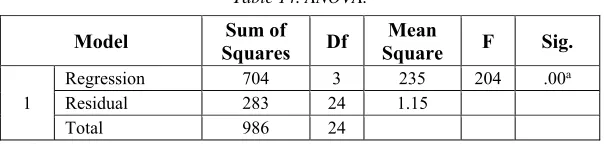
Table 14. ANOVA.
Model Squares Sum of Df Square Mean F Sig.
1
Regression 704 3 235 204 .00a
Residual 283 24 1.15
Total 986 24
Significant at p<0.05 level*
1441
Table 15. R Square Test.
Model R Square R Adjusted R Square Std. Error of the Estimate
1 .845a 0.713 0.71 1.072
Predictors: (Constant), X3-Trust, X2-Security, X1-Quality. Dependent Variable: Y- Purchase Decision.
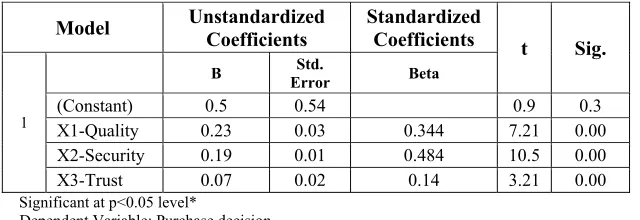
Based on Table 15 above, the Adjusted R-Square shows 71% explained by the Quality, with others 29%. T-test is used to measure the independent variables (X1-Quality, X2-Security, dan X3-Trust) and their influences on dependent variables (Y-Web Quality). Decision process is based on probability significant values. If significant values > 0.05, the hypothesis is rejected; and the hypothesis is accepted when significant values < 0.05.
The T-test in Table 16 below confirms with the
findings, that purchasing decision has strong correlations with the web design, security and trust [43]. It can be understood that online apparel industry is still relative new and competing directly with well-established conventional vendors requires different approaches of thinking [44].
The study confirms each visual presentation (quality website) and confidence (security and
trust) is essential to drag the user’s attention to influence purchasing decision [45]. Scholars addressed the important impact of visual presentation to provoke the customer’s attention and lead to purchasing decision [46] [47] [48]. The confidence issues are important to ensure the consumers with limited internet knowledge ready to make online purchasing decision [49]. Internet business is still in early stage for Indonesian customers where they are experiencing with trial and alert [50][51] [52].
[image:6.612.147.467.424.643.2]The online apparel business is increasing significantly along other online business, has made the traditional vendors to consider switching to their online service. Then, the overall hypotheses test are summarised in Table 17 below.
Table 16. T-test
Model Unstandardized Coefficients Standardized Coefficients
t Sig.
1
B Error Std. Beta
(Constant) 0.5 0.54 0.9 0.3
X1-Quality 0.23 0.03 0.344 7.21 0.00
X2-Security 0.19 0.01 0.484 10.5 0.00
X3-Trust 0.07 0.02 0.14 3.21 0.00
Significant at p<0.05 level*
Dependent Variable: Purchase decision.
Table 17. Hypothesis Results
Hypothesis Results
H1: web quality affects the purchase decision. Supported
H2: web security affects the purchase decision. Supported
H3: trust affects the purchase decision. Supported
H4: website quality, website security and trust simultaneously
affect the purchase decision. Supported
Table 17 summarized that Zalora website was considered attractive. It can be understood since there were many transactions have been done through online stores. Zalora’s online business grows along with the increasing trends of online business in Indonesia [53][43]. Zalora’s products
[image:6.612.148.468.429.539.2]1442 innovative design, aesthetic design, information quality, consistent images, and system quality.
Many of Zalora’s online customers based their preference on ease of use and usefulness features to enable them in carrying online shopping. They found the layout design was updated, interactive and informative. The interactive and eye-catching design are one of mandatory requirements for apparel industry [55] [56]. Quick response strategy provided by Zalora to its customers enabled to increase trust and confidence levels to shop in Zalora. Forza et.al. examined the importance of quick response strategy that involved organizational, management and supported with technological conditions are important factors to increase the whole textile-apparel chain [57] and by the end will increase the level of confidence of trust
and security levels [58].
5.2. Website Security
The trust issue in online context is quite different compared to traditional business; The trust issues in online business is more dependent on the technology (or website) rather than physical interaction between buyers and sellers [59]. Interview sessions with respondents of social media shown that they agreed Zalora enabled to provide good web security management system such as: secrecy of personal data. It was shown in significant values of website security variables. The findings supported the purchasing decision in social networking sites was acceptable.
With increasing trends of education amongst youngsters and improving security management system amongst e-vendors have made internet users are getting more confidences with the security levels provided by e-vendors. Respondents perceived good web security management system enabled to promote worth-of-mouth marketing (WoM) [60] and promotion [61]. Sukma [62] examined security factor influenced significantly decision to purchase online.
One of Zara’s feature concerned the respondents were pop-up ads and other promotional stuffs. Major respondents felt annoyed by these marketing campaign. Edwards et.al [63], explored the pop-up ads on the internet and come to define ads as irritating and recommend avoiding them.
Major respondents appreciated the Zalora’s policy to provide full security guarantee access that enabled customers to maintain their privacy in shopping. Zalora also provides loss recovery whenever fraud transaction takes place with online purchase. This feature gets good acceptances for all
Indonesian customers where privacy issues are commonly ignored [64]. The fraudulent and credit cards abuse are the common cases that can easily be found in Indonesian online transaction and many loop holes in law enforcements [65] [66]. To provide maximum security access, Zalora has cooperated with major credit card providers and ensure the customers with maximum security levels.
5.2 Trust
Internet business in Indonesia has started around 10 years ago, however, until now, many customers are skeptical or suspicious about the functional mechanism of online business. Trust is a complex social phenomenon reflecting technological, behavioural, social, psychological, and organizational interactions among human and non-human technological agents [59]. Trust mechanism helps people cope with the risks inherent in specific types of relationship [67]. Salam [67] further addressed whenever trust mechanism is built, customers tend to develop deep dependence in which customers expect certain behavior from web vendor. Web vendors will get advantages in providing more customized products and services. Major respondents agree that Zalora takes advantages of the customers through introducing more customized apparel products and services including supporting accessories.
Grabner [68] addressed the perspective of trust should be treated as potential coexisting mechanism for reducing the uncertainty and complexity of transactions and relationships in electronic markets. Grabner examined the two types of uncertainty to highlight: system-dependent and transaction-specific problems. System-dependent refers to the deep dependence of customers to the web, while transaction specific problems refer to common problems faced by Indonesian users to conduct online purchase. Major respondents agreed Zara has advantages of addressing these issues.
Mukherjee examined there is a strong positive linkage between trust and relationship commitment especially in online business [59]. Mukhrjee highlighted maintaining privacy issues to be the most significant determinant of customer trust.
5. CONCLUSION
1443 wide customers in Indonesia, and established greater Jakarta area as its strong customer bases. As a new entrance, Zalora faces the challenging market that is developing knowledge about the online business, and needs to find a way to cope with the internet issues.
The article based the study on customer satisfaction issues, and links the factor of web quality, security and trust to the purchase decision. Those issues are the major issues faced by major Indonesian customers when dealing with internet sales. The findings of the study confirm the hypotheses that web quality, security and trust are the essential factors that affect the purchase decision. It can be understood that internet sales are still in infant stages and there is complex business environment surround Indonesian e-market places especially for the apparel industry.
REFERENCES
[1] L. Mila, “Konsumen Indonesia Lebih Optimis di Permulaan 2016,” 2016.
[2] Nielsen and The Nielsen Company, “E-commerce: Evolution or revolution in the fast-moving consumer goods world?,”
Nielsen Co., no. August, pp. 1–21, 2014.
[3] McKinsey Global Institute, “The archipelago economy : Unleashing Indonesia ’ s potential,” no. September, pp. 1–101, 2012.
[4] PwC, “Indonesia - set for rapid spending growth powered by Internet-based segments,” 2014.
[5] H. Choi, M. J. Park, J. J. Rho, and H. Zo, “Rethinking the assessment of e-government implementation in developing countries from the perspective of the design--reality gap: Applications in the Indonesian e-procurement system,”
Telecomm. Policy, vol. 40, no. 7, pp. 644–
660, 2016.
[6] H. T. A. Susanto and Y. Chang, “Determinants of initial trust formation in electronic commerce acceptance in Indonesia,” in Systems, Process and Control (ICSPC), 2014 IEEE Conference on, 2014, pp. 96–100.
[7] N. E. Prattisya, “Analisis Kepuasan Pengunjung Zalora memakai Dimensi Kualitas Website,” Telkom University, 2014.
[8] D. G. Gregg and S. Walczak, “The relationship between website quality, trust and price premiums at online auctions,”
Electron. Commer. Res., vol. 10, no. 1, pp.
1–25, 2010.
[9] B. Beck, “Key strategic issues in online apparel retailing,” Retrieved December,
vol. 28, p. 2004, 2004.
[10] Z. Zhou, “Evaluating websites using a practical quality model.,” 2009.
[11] M. A. Achouri and N. Bouslama, “The Effect of the Congruence between Brand Personality and Self-Image on Consumers’ Satisfaction and Loyalty: A Conceptual Framework,” IBIMA Bus. Rev., 2010.
[12] J. Park and L. Stoel, “Effect of brand familiarity, experience and information on online apparel purchase,” Int. J. Retail
Distrib. Manag., vol. 33, no. 2, pp. 148–
160, 2005.
[13] E. T. Loiacono, R. T. Watson, D. L. Goodhue, and others, “WebQual: A measure of website quality,” Mark. theory
Appl., vol. 13, no. 3, pp. 432–438, 2002.
[14] M. Cao, Q. Zhang, and J. Seydel, “B2C e-commerce web site quality: an empirical examination,” Ind. Manag. Data Syst., vol.
105, no. 5, pp. 645–661, 2005.
[15] V. S. Moustakis, C. Litos, A. Dalivigas, and L. Tsironis, “Website Quality Assessment Criteria,” Proc. Ninth Int. Conf. Inf. Qual.,
pp. 59–73, 2004.
[16] S. J. Barnes and R. T. Vidgen, “An integrative approach to the assessment of e-commerce quality.,” J. Electron. Commer. Res., vol. 3, no. 3, pp. 114–127, 2002.
[17] A. Liska, The practice of network security: Deployment strategies for production
environments. Prentice Hall Professional,
2003.
[18] R. Werlinger, K. Hawkey, and K. Beznosov, “An integrated view of human, organizational, and technological challenges of IT security management,” Inf.
Manag. Comput. Secur., vol. 17, no. 1, pp.
4–19, 2009.
[19] R. Slade, Dictionary of information
security. Syngress, 2006.
[20] M. Niranjanamurthy and D. R. D. Chahar, “The study of e-commerce security issues and solutions,” Int. J. Adv. Res. Comput.
Commun. Eng., vol. 2, no. 7, 2013.
[21] A. Dimoka, “What does the brain tell us about trust and distrust? Evidence from a functional neuroimaging study,” Mis Q.,
1444 [22] L. Khoshaim, “The Impact of Web Design
Dimensions on Consumer Trust at Different Price Ranges,” 2013.
[23] Y. D. Wang and H. H. Emurian, “An overview of online trust: Concepts, elements, and implications,” Comput.
Human Behav., vol. 21, no. 1, pp. 105–125,
2005.
[24] J. Zhang, “An Empirical analysis of online shopping adoption in China,” Lincoln University, 2011.
[25] R. C. Mayer, J. H. Davis, and F. D. Schoorman, “An integrative model of organizational trust,” Acad. Manag. Rev.,
vol. 20, no. 3, pp. 709–734, 1995.
[26] Z. Saleem and K. Rashid, “Relationship between customer satisfaction and mobile banking adoption in Pakistan,” Int. J.
Trade, Econ. Financ., vol. 2, no. 6, p. 537,
2011.
[27] A. Chaudhuri and M. B. Holbrook, “The chain of effects from brand trust and brand affect to brand performance: the role of brand loyalty,” J. Mark., vol. 65, no. 2, pp.
81–93, 2001.
[28] V. D. V. Velarde, “Determinants of online purchasing behavior: An empirical investigation using an extension of the Theory of Planned Behavior,” Malaysia
Aarhus Univ., 2012.
[29] F. Li and P. W. Miniard, “On the potential for advertising to facilitate trust in the advertised brand,” J. Advert., vol. 35, no. 4,
pp. 101–112, 2006.
[30] G. Bhaduri, “Trust/distrust, perceived quality, perceived price, and apparel purchase intention,” University of Missouri--Columbia, 2011.
[31] C. P. Wah, M. R. Lyu, and P. Wah, “Building Reliable Web Services: Methodology, Composition, Modeling and Experiment,” 2008.
[32] M.-J. Kim, N. Chung, and C.-K. Lee, “The effect of perceived trust on electronic commerce: Shopping online for tourism products and services in South Korea,”
Tour. Manag., vol. 32, no. 2, pp. 256–265,
2011.
[33] E. P. Becerra and P. K. Korgaonkar, “Effects of trust beliefs on consumers’ online intentions,” Eur. J. Mark., vol. 45,
no. 6, pp. 936–962, 2011.
[34] I. Phau and S. Meng Poon, “Factors influencing the types of products and services purchased over the Internet,”
Internet Res., vol. 10, no. 2, pp. 102–113,
2000.
[35] S. J. Barnes and R. T. Vidgen, “An integrative approach to the assessment of e-commerce quality,” J. Electron. Commer. Res., vol. 3, no. 2, pp. 114–127, 2002.
[36] P. A. Pavlou and D. Gefen, “Psychological contract violation in online marketplaces: Antecedents, consequences, and moderating role,” Inf. Syst. Res., vol. 16,
no. 4, pp. 372–399, 2005.
[37] M. U. Sultan and M. N. Uddin, “Consumers ’ Attitude towards Online Shopping Factors influencing Gotland consumers to shop online Online,” Master Thesis Bus. Adm., p.
56, 2011.
[38] A. Gurung, X. Luo, and M. K. Raja, “An empirical investigation on customers privacy perceptions, trust and security awareness in E-commerce environment,” J.
Inf. Priv. Secur., vol. 4, no. 1, pp. 42–60,
2008.
[39] L. Hayden, IT Security Metrics: A Practical Framework for Measuring Security &
Protecting Data. McGraw-Hill Education
Group, 2010.
[40] S. Bellman, G. L. Lohse, and E. J. Johnson, “Predictors of online buying behavior,”
Commun. ACM, vol. 42, no. 12, pp. 32–38,
1999.
[41] W. K. Darley, C. Blankson, and D. J. Luethge, “Toward an integrated framework for online consumer behavior and decision making process: A review,” Psychol.
Mark., vol. 27, no. 2, pp. 94–116, 2010.
[42] M. K. Chang, W. Cheung, and V. S. Lai, “Literature derived reference models for the adoption of online shopping,” Inf. Manag.,
vol. 42, no. 4, pp. 543–559, 2005.
[43] M. Kartiwi, “Case studies of e-commerce adoption in Indonesian SMEs: The evaluation of strategic use,” Australas. J.
Inf. Syst., vol. 14, no. 1, 2006.
[44] C. Zott, R. Amit, and L. Massa, “The business model: recent developments and future research,” J. Manage., vol. 37, no. 4,
pp. 1019–1042, 2011.
[45] J. Xu and M. Quaddus, E-business in the 21st Century: Realities, Challenges and
Outlook, vol. 2. World Scientific, 2010.
[46] N. Mehta and P. K. Chugan, “The impact of visual merchandising on impulse buying behavior of consumer: a case from Central Mall of Ahmedabad India,” 2013.
1445 in the textile and apparel industry,” Cloth.
Text. Res. J., vol. 8, no. 3, pp. 7–13, 1990.
[48] F. Mete, “The creative role of sources of inspiration in clothing design,” Int. J. Cloth.
Sci. Technol., vol. 18, no. 4, pp. 278–293,
2006.
[49] G. Häubl and V. Trifts, “Consumer decision making in online shopping environments: The effects of interactive decision aids,” Mark. Sci., vol. 19, no. 1,
pp. 4–21, 2000.
[50] S. A. Pratminingsih, C. Lipuringtyas, and T. Rimenta, “Factors influencing customer loyalty toward online shopping,” Int. J.
Trade, Econ. Financ., vol. 4, no. 3, p. 104,
2013.
[51] M. D. D. Dharmesti and S. S. Nugroho, “The antecedents of online customer satisfaction and customer loyalty,” J. Bus.
Retail Manag. Res., vol. 7, no. 2, 2013.
[52] J. Gao, C. Zhang, K. Wang, and S. Ba, “Understanding online purchase decision making: The effects of unconscious thought, information quality, and information quantity,” Decis. Support Syst.,
vol. 53, no. 4, pp. 772–781, 2012.
[53] R. P. Nirmala and I. J. Dewi, “The Effects of Shopping Orientations, Consumer Innovativeness, Purchase Experience, and Gender on Intention to Shop for Fashion Products Online.,” Gadjah mada Int. J. Bus., vol. 13, no. 1, 2011.
[54] H. B. Putro and B. Haryanto, “Factors affecting purchase intention of online shopping in Zalora Indonesia,” Br. J. Econ.
Manag. trade, vol. 9, no. 1, pp. 1–12, 2015.
[55] A. Shum, T. Foxen, and J. Meschter, “Interactive gaming apparel for interactive gaming.” Google Patents, 2012.
[56] C. L. Istook and S.-J. Hwang, “3D body scanning systems with application to the apparel industry,” J. Fash. Mark. Manag.
An Int. J., vol. 5, no. 2, pp. 120–132, 2001.
[57] C. Forza and A. Vinelli, “Quick response in the textile-apparel industry and the support of information technologies,” Integr.
Manuf. Syst., vol. 8, no. 3, pp. 125–136,
1997.
[58] X. Shang, X. Liu, G. Xiong, C. Cheng, Y. Ma, and T. R. Nyberg, “Social manufacturing cloud service platform for the mass customization in apparel industry,” in Service Operations and
Logistics, and Informatics (SOLI), 2013
IEEE International Conference on, 2013,
pp. 220–224.
[59] A. Mukherjee and P. Nath, “Role of electronic trust in online retailing: A re-examination of the commitment-trust theory,” Eur. J. Mark., vol. 41, no. 9/10, pp.
1173–1202, 2007.
[60] I. B. Hong and H. Cho, “The impact of consumer trust on attitudinal loyalty and purchase intentions in B2C e-marketplaces: Intermediary trust vs. seller trust,” Int. J.
Inf. Manage., vol. 31, no. 5, pp. 469–479,
2011.
[61] F. Swistiani, “Pengaruh Persepsi Harga, Efektivitas Iklan Internet dan Promosi Penjualan Terhadap Minat Beli Konsumen Pada Toko Online Zalora,” Fakultas Ekonomi, 2015.
[62] A. A. Sukma, “Analisis faktor-faktor yang mempengaruhi keputusan pembelian melalui social networking websites,” 2012. [63] S. M. Edwards, H. Li, and J.-H. Lee,
“Forced exposure and psychological reactance: Antecedents and consequences of the perceived intrusiveness of pop-up ads,” J. Advert., vol. 31, no. 3, pp. 83–95,
2002.
[64] S. Candra and F. E. Gunawan, “The impact of e-Procurement practice in Indonesia government: A Preliminary Study (The case of Electronic Procurement Service at Bekasi District),” in Journal of Physics:
Conference Series, 2017, vol. 801, no. 1, p.
12023.
[65] C. Surjoputro and T. Melinda, “The Influence of Ability, Benevolence, and Integrity On Consumers Trust in Yao2Shop,” Held by Ciputra Univ. Collab. With, p. 193, 2015.
[66] D. U. Rahmany and J. E. J. C. Prins, “Towards Community Framework on Electronic Signatures and Indonesia Legal Framework,” MLaw Technol. thesis, Univ.
van Tilbg., 2011.
[67] A. F. Salam, L. Iyer, P. Palvia, and R. Singh, “Trust in e-commerce,” Commun. ACM, vol. 48, no. 2, pp. 72–77, 2005.
[68] S. Grabner-Kraeuter, “The role of consumers’ trust in online-shopping,” J.
Bus. Ethics, vol. 39, no. 1–2, pp. 43–50,