1323
WHO’S LEADING CHINA’S E-COMMERCE INDUSTRY?
THE ANTECEDENTS AND CONSEQUENCES OF
E-WOM FOCUSING ON ONE PERSON MEDIA
1KYUNGYOUNG OHK, 2MIYEA KIM
1Professor, Sookmyung Women’s University, Department of Consumer Economics, Korea
2Adjunct Instructor, Sookmyung Women’s University, Department of Consumer Economics, Korea
E-mail: 1[email protected], 2[email protected]
ABSTRACT
The study explores the antecedents and the consequences of e-WOM focusing on one person media, Wanghong which is a new form of one-person media in the China’s e-commerce market. The study was carried out by classifying the factors that has impacts on the e-WOM of one-person media to the characteristics of Wanghong (trust and attractiveness), and the characteristics of content made by Wanghong (flow and usefulness). The study conducted a structural equation model to find out the impact of antecedents on the e-WOM of one person media, and also the impact of the e-WOM on the intention to purchase. The study has taken a look on the relationship through the Structural Equation Model after conducting a survey on 308 Chinese consumers. The results indicate that all four characteristics have positive impacts on e-WOM of one person media. In the end, it was concluded that the e-WOM has positive impacts on the intention to purchase.
Keywords: E-Commerce, E-WOM, China Market, One Person Media, Wanghong
1. INTRODUCTION
China’s e-commerce market is leading the world market. In 2017, China’s e-commerce market has reached the size of 24 trillion RMB, and onlinshopping accounts for 23.3% of the total e-commerce market [1]. China’s online shopping market is expected to reach 5.6 RMB, and it is expected that the market size will expand further in the future. The leading companies in the e-commerce market are Alibaba’s ‘Tmall’ and ‘JD.com’. These two companies are leading the China’s e-commerce market by integrating B2C with traditional distribution method. Recently, Wanghong, a form of one-person media that produces commercial value through SNS platforms such as Weibo and Tencent, is receiving high attention in China with the rise of e-commerce market.
One-person media using social media platforms are becoming gaining popularity, as these on-line based platforms are being integrated to a part of daily life. Especially, as Wanghong (Chinese Internet Celebrities), the main agents of Chinese one-person media, begin to lead the consumption trends of female consumers in their 20-30s, they are
gaining huge interest as a new subject of marketing strategy utilized by overseas firms wishing to enter the Chinese market.
The study aims to observe the three topics regarding Wanghong’s leading role of consumption trend in China, based on the characteristics of one person media, Wanghong and reviews of existing studies. First, we aim to observe the antecedent factors of e-WOM of one-person media based on Wanghong, the sender of one-person media. Second, we aim to discover the antecedents of e-WOM of one-person media based on the characteristics of content produced by one-person media. Lastly, we aim to observe how the e-WOM of one person media influences the purchase intention of consumers, based on the existing studies which suggest that the reviews of on-line content lead to the positive opinion on the final decision to make the purchase [2, 3].
1324 one person media, into the characteristics of Wanghong (trust and attractiveness), and the characteristics of Wanghong’s content (flow and usefulness). Using the research model, the study will observe what impacts these antecedents pose on e-WOM, and how the e-WOM of Wanghong’s content ultimately influences purchase intention of consumers.
2. DEVELOPING HYPOTHESIS
As the internet developed, the concept of Web 2.0, which can be summarized into ‘sharing, participation, and openness’ became widespread in the internet environment. Especially, with social media becoming a general means of communication, the basis for consumers to develop their own content was provided. Due to such changes in platforms, consumers became capable of making one’s original content, and one-person media is a new type of content created by users, based on such changes [4]. While the difference between the producer and the viewer was distinct in the existing media, one-person media, based on social media platforms such as Twitter and Facebook, developed into a horizontal structure in which the producer can be a viewer at the same time, and vice versa.
While the producers and consumers had to communicate with slight delays through blogs or mini-homepage in the earliest forms of one-person media, nowadays the producers and consumers of content are able to communicate and interact real-time. Thanks to such developments in these platforms, China has developed business models based on one-person media, which enables real-time purchase, through which Wanghongs gained huge popularity and influence.
Wanghong means ‘internet star’ in Chinese, and refers to figures who became highly popular by presenting one’s individuality and attractiveness to the public through social media, real-time streaming, and video sharing [5]. Wanghongs are influencing huge number of people who use on-line media, by providing variety of one-person content on cosmetics, clothing, and food via Chinese social media (e.g. Sina Weibo, Weixin, Tencent). The influence of Wanghongs on the consumption culture of younger generation is gaining interest of companies in and out of Korea planning to enter the Chinese market. Nowadays, Wanghongs actively communicate with fans about their own individuality, style and content through various platforms, including Sina Weibo, Weixin, Tencent,
Youku, and Renren. Wanghongs dominate consumption trend, based on the reliability established through continuous sharing of information and communication. On this, the study focused on Wanghong as the subject which triggers e-WOM.
The hypotheses deduced based on the characteristics of Wanghong are as follows. It has been known that consumers show trust to, and sympathize with information [6] which were provided spontaneously [7]. As Wanghongs are content producers, and at the same time consumers, the viewers will find the review streams of Wanghong quite reliable. Therefore, the trust of Wanghong is expected to positively influence e-WOM (Hypothesis 1). Moreover, as Wanghongs themselves are human brands which influence the public, the attractiveness, which is one of the antecedents of human brand attachment [8, 9], is also expected to positively influence e-WOM (Hypothesis 2).
The hypotheses deduced based on the characteristics Wanghong provide are as follows. The content provided by Wanghong leads to the flow of consumers via media [10]. Especially, as flow of content may influence e-WOM (Hypothesis 3), the study aims to apply the hypothesis onto Wanghong’s one-person media. Also, as higher usefulness of the content leads to more positive influence on the acceptance and diffusion of e-WOM [11], the usefulness of one-person media content is expected to positively influence e-WOM (Hypothesis 4).
1325 hypotheses, based on the characteristics of Wanghong, and existing literature.
Hypothesis 1: The trust of Wanghong will positively influence e-WOM of one-person media.
Hypothesis 2: The attractiveness of Wanghong will positively influence on e-WOM of one-person media.
Hypothesis 3: The flow of Wanghong’s content will positively influence e-WOM of one-person media.
Hypothesis 4: The usefulness of Wanghong’s content will positively influence e-WOM of one-person media.
Hypothesis 5: The e-WOM of one-person media will pose positive impact on purchase intention.
Hypothesis 6: The e-WOM of one-person media will pose positive impact on purchase intention for products with extended brand line.
Figure 1: Research Model
3. METHODS
3.1 Data
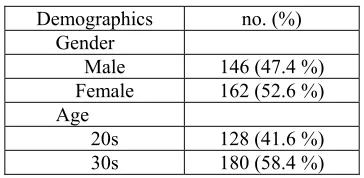
The survey was conducted on Chinese in their 20s and 30s who use social media. The responses of 308 subjects who know about Wanghong streams were analyzed. The demographics of the respondents are as follows. The percentage of female participants was higher, with 162 females (52.6%) and 146 males (47.4%) participating in the survey. Of the participants, 128 (41.6%) of them were in their 20s (from 20 to 29), and 180 (58.4%) were in their 30s (from 30 to 39). The cities with the highest number of participant were Shanghai (25.6%) and Beijing (25.3%), followed by other cities including Hangzhou (4.2%), Guangzhou (15.3%), Shenzhen (2.9%), Chengdu (6.5%), Wuhan (5.2%), Chongqing
[image:3.612.325.507.140.229.2](1.9%), Wenzhou (1.0%), Ningbo (1.0%) and other regions (11.0%).
Table 1: Demographic Information
Demographics no. (%)
Gender
Male 146 (47.4 %)
Female 162 (52.6 %)
Age
20s 128 (41.6 %)
30s 180 (58.4 %)
The majority of the participants (32.5%) reported using SNS more than five times a week in their lives. Usage patterns are presented on Table 2. Of the participants, 38 (12.3%) of them were using SNS less than once a week, 66 (21.4%) of them were using SNS 1 or 2 times a week, 85 (27.6%) of them were using SNS 3 or 4 times a week in their lives.
Table 2: Frequency of SNS Usage
Frequency no. %
Never used 19 6.2
Less than once a week 38 12.3
1 or 2 times a week 66 21.4
3 or 4 times a week 85 27.6
More than five times a week 100 32.5
The study has revealed that 34 people (11.0%) have seen Wang-Hong show 1-2 times, 94 people (30.5%) has seen the show 3-4 times, 59 people (19.2%) have seen the show 5-6 times, and 121 people (39.3%) have seen the show more than 7 times. Also, 41 people (13.3%) have replied that they had no intention to purchase, 76 people (24.7%) have replied that they had purchased once, 150 people (48.7 %) have replied 2-5 times, 29 people (9.4%) have replied 6-10 times, and 12 people (3.9%) have replied more than 10 times.
Table 3: Summary of the Experience of Wanghong Broadcast
variables no. %
Exposure of wanghong show
1-2 34 11.0
3-4 94 30.5
4-5 59 19.2
More than 7 121 39.3
Purchase times 1 76 24.7
2-5 150 48.7
6-10 29 9.4
1326
3.2 Measurement
The study used structural equation model, in order to observe the relationship between the antecedents and consequences of e-WOM of one person media, Wanghong. For this, the following question items were used in the survey for the analysis.
The antecedent factors which influence the e-WOM of Wanghong’s content are as follows. First, the trust and attractiveness of Wanghong was constructed as variables [8, 9, 12], as the personal characteristics of Wanghong is important due to the nature of one-person media. The question items used to measure the trust of Wanghongs were “The Wanghong I like is honest.” “The Wanghong I like is sincere,” “The Wanghong I like is trustworthy,” and the items used to measure attractiveness were “The Wanghong I like is attractive,” “The Wanghong I like is stylish.” “The Wanghong I like is interesting”.
Also, the flow of content and usefulness were constructed as variables which explain Wanghong’s content. Flow was assessed with question items such as “I see Wang-Hong show often,” “I tend to listen to Wang-Hong’s words,” and “I focus on the actions of Wang-Hong.” and usefulness was assessed with “because I can do shopping conveniently,” “because I can do shopping anytime,” and “because I can purchase various types of products.” [10, 13, 14]
The following question items were e-WOM of one person media, Wanghong: “I would share information learnt from Wanghong with other people,” “I would tell others what I felt after listening to Wanghong,” “I would share my opinion about the information I acquired through Wanghong” [11].
The following items were used to assess the dependent variables, which include purchase intention: “I intend to purchase products via Wanghong’s stream in the future,” “I plan to purchase products via Wanghong’s stream in the future,” [15, 16].
Also, Purchase intentions for products with extended brand line: “I intend to purchase products or participate in services launched by Wanghong with his/her name on the label, which are related to his/her expertise,” “I would consider purchasing products or participating in services launched by Wanghong with his/her name on the label, which are related to his/her expertise”. “I would positively consider purchasing products or participating in services launched by Wanghong with his/her name
on the label, which are related to his/her expertise” [9].
4. RESULTS
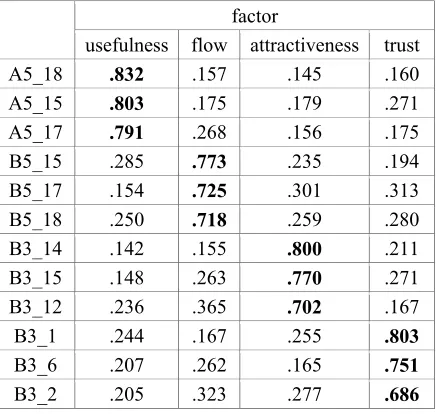
[image:4.612.310.528.469.676.2]The study has conducted a factor analysis to explore the structure of the antecedents that have impacts on the word-of-mouth of one-person media. The factor analysis was carried out by using principal component analysis and varimax method, and by using items with factor loading over 0.6. Total of 4 factors were extracted, and the factors are as the following. Factor 1 was named as usefulness with mentions like “because I can do shopping conveniently,” “because I can do shopping anytime,” and “because I can purchase various types of products.” Factor 2 was named as flow with mentions like “I see Wang-Hong show often,” “I tend to listen to Wang-Hong’s words,” and “I focus on the actions of Wang-Hong.” Factor 3 was named as attractiveness with mentions like “attractive, stylish, and interesting.” Factor 4 was named as trust with mentions like “honest, sincere, and trustworthy.” If we take a look at the % of variance on the antecedents of word-of-mouth of one-person media, Factor 1 accounts for 51.342%, Factor 2 accounts for 10.127%, Factors 3 accounts for 6.896%, Factor 4 accounts for 5.948%. The parts that can be explained with 4 components are 74.312% of the total.
Table 4: Results of Exploratory Factor Analysis
factor
usefulness flow attractiveness trust
A5_18 .832 .157 .145 .160
A5_15 .803 .175 .179 .271
A5_17 .791 .268 .156 .175
B5_15 .285 .773 .235 .194
B5_17 .154 .725 .301 .313
B5_18 .250 .718 .259 .280
B3_14 .142 .155 .800 .211
B3_15 .148 .263 .770 .271
B3_12 .236 .365 .702 .167
B3_1 .244 .167 .255 .803
B3_6 .207 .262 .165 .751
B3_2 .205 .323 .277 .686
1327 relationship between the variable characteristics and the variables before conducting structural equation model. Skewness represents the level of asymmetry of a distribution. Kurtosis represents how focus data are to the middle compared to the shape of a normal distribution, and was measured to confirm the hypothesis of normal distribution of the observed variables. The analysis confirmed that the hypothesis is valid as all the variables match the standard value. (Skewness < │2│, Kurtosis < │4│). It was confirmed that the correlation between all variables are meaningful at the level of
p<.005.
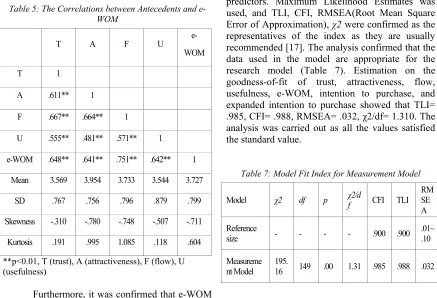
[image:5.612.306.524.107.281.2]In order to investigate the relationship between antecedents of e-WOM and e-WOM of one person media, we carried out the correlation between them. Table 5 presents the correlation coefficients and their significance levels between them. The study was able to confirm a meaningful positive correlation between antecedents and e-WOM: trust (r=.648, p=.000), attractiveness (r =.641, p=.000), flow (r =.751, p=.000), usefulness (r =.642, p=.000).
Table 5: The Correlations between Antecedents and e-WOM
T A F U
e-WOM
T 1
A .611** 1
F .667** .664** 1
U .555** .481** .571** 1
e-WOM .648** .641** .751** .642** 1
Mean 3.569 3.954 3.733 3.544 3.727
SD .767 .756 .796 .879 .799
Skewness -.310 -.780 -.748 -.507 -.711
Kurtosis .191 .995 1.085 .118 .604
**p<0.01, T (trust), A (attractiveness), F (flow), U (usefulness)
Furthermore, it was confirmed that e-WOM has positive correlation with intention to purchase (r =.678, p=.000) and expanded intention to purchase (r =.672, p=.000) at the same time.
Table 6: The Correlations between e-WOM and Consequences
e-WOM PI EPI
e-WOM 1
PI .678** 1
EPI .672** .714**. 1
Mean 3.727 3.621 3.647
SD .799 .887 .810
Skewness -.711 -.553 -.553
Kurtosis .604 .157 .607
**p<0.01, PI (purchase intention), EPI (extended purchase intention)
Before conducting an analysis of the research model, the study has carried out a confirmatory factor analysis to check the validity of predictors. Maximum Likelihood Estimates was used, and TLI, CFI, RMSEA(Root Mean Square Error of Approximation), χ2 were confirmed as the representatives of the index as they are usually recommended [17]. The analysis confirmed that the data used in the model are appropriate for the research model (Table 7). Estimation on the goodness-of-fit of trust, attractiveness, flow, usefulness, e-WOM, intention to purchase, and expanded intention to purchase showed that TLI= .985, CFI= .988, RMSEA= .032, χ2/df= 1.310. The analysis was carried out as all the values satisfied the standard value.
Table 7: Model Fit Index for Measurement Model
Model χ2 df p χf 2/d CFI TLI RM SE A
Reference
size - - - - .900 .900
.01~ .10
Measureme nt Model
195.
16 149 .00 1.31 .985 .988 .032
4.2. Reliability, Validity, and Goodness of Model Fit
[image:5.612.87.524.355.653.2]1328 and validity of the items. The Cronbach’s α values of all items used in the analysis was over .8, indicating that all constructs were statistically reliable.
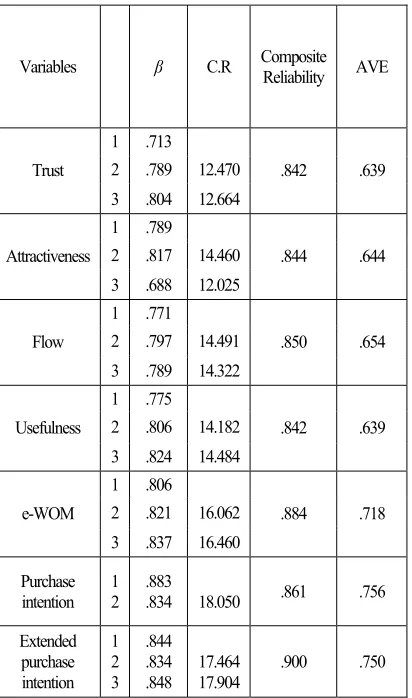
The study also found out that the reliability coefficient for trust is .808, for attractiveness is .807, for flow is .828, for usefulness is .842, for e-WOM is .861, for purchase intention is .848, and for extended purchase intention is 880. Also, the composite reliability of all constructs was higher than .6, ensuring internal consistency, while the AVE value was usually higher than .5, ensuring reliability of the constructs.
[image:6.612.313.524.335.429.2]In order to verify the goodness of fit of the research model, the study used GFI, CFI, TLI, IFI, NFI, and χ2/df, which are commonly used. The results of the fit analysis were: GFI=.900, CFI=.933, TLI=.916, IFI=.933, NFI=.899, and χ2/df= 2.743, indicating that the model was generally fit. Hypothesis testing was conducted after the model fit analysis.
Table 8: Result of Confirmatory Factor Analysis
Variables β C.R Composite Reliability AVE
Trust
1 .713
.842 .639 2 .789 12.470
3 .804 12.664
Attractiveness
1 .789
.844 .644 2 .817 14.460
3 .688 12.025
Flow
1 .771
.850 .654 2 .797 14.491
3 .789 14.322
Usefulness
1 .775
.842 .639 2 .806 14.182
3 .824 14.484
e-WOM
1 .806
.884 .718 2 .821 16.062
3 .837 16.460
Purchase
intention 1 2 .883 .834 18.050 .861 .756
Extended purchase intention
1 2 3
.844 .834 .848
17.464 17.904
.900 .750
4.3 Hypothesis Test
The study conducted structural equation analysis using AMOS to test the key hypotheses suggested by the study. The results show the findings from path analysis, the antecedent factors which influence e-WOM of one-person media are: trust, attractiveness, flow, and usefulness, all of which were found positive significant influence on e-WOM (trust: β=.131, t=1.911, p=.056, attractiveness: β=.242, t=3.829, p=.000, flow: β=.610, t=9.484, p=.000, usefulness: β=.250,
t=4.055, p=.000). Also, the e-WOM of one-person media was found positive influence on all dependent variables, which are: purchase intention, and purchase intention for products with extended brand line (purchase intention: β=.874, t=10.337,
[image:6.612.87.293.365.714.2]p=.000, purchase intention for products with extended brand line: β=.881, t=10.692, p=.000).
Figure 2: Result of Structural Equation Model
As Figure 2 shows, all of the main hypotheses were supported. Specifically, the trust and attractiveness in Wanghong have significant effects on the e-WOM as expected. The significant values of β coefficients statistically prove that trust and attractiveness with Wanghong significantly affect e-WOM. As for positive effects, stronger trust and attractiveness in Wanghong lead to a higher level of e-WOM, which leads to higher level of the purchase intention and extended purchase intention.
1329 Table 9: Result of the Analysis
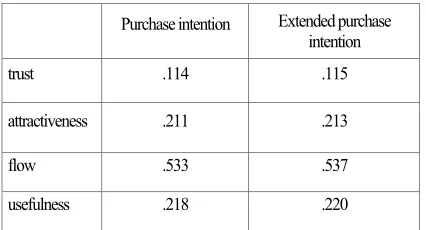
Table 10: Result of the Total Effect
A big benefit of using a structural equation analysis is that we can compare the relative strength of each antecedent’s (trust, attractiveness, flow, usefulness) influence on consequences (purchase intention and extended purchase intention). The total effect of the trust in Wanghong influence on the purchase intention is .114 (.131*.874) and attractiveness of Wanghong influence on the purchase intention is .211 (.242*.874). The total effect of the flow of Wanghong’s contents influence on the purchase intention is .533 (.610*.874) and usefulness of Wanghong’s contents influence on the purchase intention is .218 (.250*.874). In the same way, the total effect of each antecedent’s influence on the extended purchase intention as above Table 10. The analysis shows that flow has the greatest effect on consequences.
4.4 Discussions
The study explored the antecedents and consequences of e-WOM by focusing on Wanghong. The study attempted to suggest factors as human brand and factors as content which can be achieved by Wanghong. The study would like to discuss few important issues gained from the study result.
First, Wanghong’s trust and attractiveness were suggested as the antecedents that influence the word-of-mouth of onperson media in the e-commerce platform. According to Value-Attitude-Behavior model [18], consumer behavior differentiates with the attitude of consumers, and the attitude changes with the value the consumer possesses. It can be said that Wanghong’s attitude of value do have impacts on the behavior of Chinese e-commerce consumers. The study has selected trust and attractiveness on Wanghong and the variables on attitude towards Wanghong as the study focused on Wanghong.
‘Highly reliable’ in the e-commerce may mean that the person is less nervous about unpredictable behavior, and this leads to the absence of uncertainty in online shopping. Therefore, trust of Wanghong has impacts on positive word-of-mouth. Also, trust on e-commerce refers to the action taking risks on the seller by the buyer along with the consumer’s intention to rely, the study was able to confirm that trust is an important antecedent in forming positive word-of-mouth. The study carried out in the past also suggested trust as a variable that has a meaningful impact on acceptance or intention to purchase in e-commerce market [19]. The study was also able to confirm that attractiveness is an important factor for positive e-WOM. Attractiveness, a characteristic of human brand, can be an important antecedent in forming positive word-of-mouth as Wanghong has the characteristics as a human brand.
Second, the study revealed that positive flow of content has positive impacts on the intention to purchase after measuring the intensity of attitude on Wanghong content. It seems that positive reaction towards products or services suggested by Wanghong is created by repetition and flow of Wanghong content [20]. Flow is a main concept in relationship marketing, and the study once again confirmed immersion as a powerful antecedent of intention to purchase.
Third, usefulness for one-person media content is necessary for effective communication with consumers and effective operation of online shopping mall. The study confirmed that the
Path B β SD. C.R p
trust->e-WOM .123 .131 .064 1.911 .056
attractiveness->e-WOM .258 .242 .067 3.928 .000
flow->e-WOM .545 .610 .057 9.484 .000
usefulness->e-WOM .225 .250 .056 4.055 .000
e-WOM->PI .962 .874 .093 10.337 .000
e-WOM->EPI .935 .881 .087 10.692 .000
Purchase intention Extended purchase intention
trust .114 .115
attractiveness .211 .213
flow .533 .537
[image:7.612.86.299.349.464.2]1330 provision of usefulness in the form of real-time purchasing process leads to positive impact on online word-of-mouth [21, 22].
Lastly, it was revealed that the e-WOM of one-person media can have positive impacts on the intention to purchase and the expanded intention to purchase. In case of Wanghong, reviews on specific product can not only heighten the intention to purchase but can also heighten the intention to purchase on the brand expanded with the name of Wanghong.
The study was able to clarify the antecedents with the characteristics of Wanghong and their content. In other words, trust and attractiveness of Wanghong, flow and usefulness of Wanghong content have positive impacts on online word-of-mouth. Moreover, as e-WOM of one-person media has positive impacts on the intention to purchase and the expanded intention to purchase, the study once again confirmed the importance of managing word-of-mouth on e-commerce in China.
4.5 Difference from prior work
Even with high attention on Wanghong that brought the term ‘Wanghong Economy’, research models that can apply Wanghong marketing were not suggested in academic area. Thus, the research is different from prior works in the follow three aspects.
First, the research may be differentiated from prior works in the aspect that the research has connected the relationship between one person media with e-WOM by clarifying that the characteristics of Wanghong as sender and the characteristics of content as antecedents of e-WOM. Few researches have started to clarify the types of Wanghong and the characteristics of the industry by exploring Wanghong business [23], and the other researches started observing the relationship between Wanghong and brands while academically defining Wanghong by applying the characteristics as human brand [24].
Prior works classified Wanghong into three types including e-commerce-based revenue-generating Wanghong, Content Wanghong, SNS-based socially-renowned Wanghong [23] (Celebrity, Entrepreneur, Scholar, Writer and others) and approached Wanghong as an online-based one person media program. The perspective was included in a research that focused on analyzing how intention of watching Wanghong program influences the satisfaction of content and viewer’s attitude [25]. However, analysis on the characteristics of Wanghong and the characteristics
of content provided by Wanghong which are needed to see the influence of word-of-mouth through Wanghong on the product purchase intention has yet been made.
As only few prior works approach one-person media Wanghong academically, the research tried to define Wanghong theoretically by suggesting a structural model that shows the influence of trust and attractiveness which are the characteristics of Wanghong as one persone media sender on the use intention through e-WOM. Also, the research observed antecedents and consequences based on one-person media e-WOM after classifying the characteristics of content into flow and usefulness. The research is expected to contribute to academia by suggesting an empirical structural model that shows the influence of human brand characteristics and content characteristics on use intention through e-WOM.
Second, e-WOM created by one person media Wanghong can have positive influence on the purchase intention of certain product brand. It may also have positive influence when expanded to Wanghong’s brand. Prior works focused on the extension of product brand and service brand [26, 27, 28]. Previous research [29] handled celebrity brand extensions but it rather focused on the moderating effects of celebrity worship. Therefore, it was not possible for the research to directly understand the purchase intention of consumers on the expansion of human brand product. Recently, spread of one-person media can be observed with the advent of Social Network Services and YouTube, and the research data confirmed that attractivenessof human brand and content provided by human brand can have positive influence on the purchase intention expanded through positive word-of-mouth. The research is meaningful in a way that it suggested the possibility of the expansion of human brand as product brand.
Lastly, the research is refreshing in a way that it handled e-WOM on recently-changing content business. Prior works on e-WOM focused on products and services that have positive or negative statements created by consumers [30, 31]. The research showed that such consumer’s content can have positive influence on e-WOM while also showing that such content which are not products or services suggested by a product developer can be the subject of consumption.
1331 research expects that the development of home robots and artificial intelligence would bring large changes in consumer’s lifestyle, but content that are delivered to people do not change in this rapid change in device setting. For example, devices that play Beethoven’s Emperor Concerto changes time to time from LP to CD to MP3 to streaming applications to artificial intelligent devices. However, people still listen to Beethoven’s music, and that never changes. This means that consumer’s mind that wishes to consume content does not change even when the industry and the media that delivers such content changes time to time. The research is meaningful in a way that it suggested the characteristics of content that moves consumer’s heart in the era overflowing with content.
5. CONCLUSION
The study explored the antecedents and consequences of e-WOM by focusing on Wanghong in China’s e-commerce marketing. The study was carried out by classifying the factors that have impacts on one-person media’s online word-of-mouth to Wanghong’s characteristics (trust and attractiveness) and Wanghong content’s characteristics (flow and usefulness). It was confirmed that all four factors have positive impacts on e-WOM with the result of trust (β =.131, t=1.911, p=.056), attractiveness (β =.242,
t=3.829, p=.000), flow (β =.610, t=9.484, p=.000), and usefulness (β =.250, t=4.055, p=.000). It was confirmed that e-WOM can have impacts on the intention to purchase (β =.874, t=10.337, p=.000) and expanded intention to purchase (β =.881,
t=10.692, p=.000).
It was found through structural equation analysis that the trust and attractiveness of Wanghong, and the flow and usefulness of content created by Wanghong were antecedent factors which influence e-WOM of one-person media. It was also discovered that e-WOM of one-person media positively influences not only the purchase intention of the product reviewed, but also that of the products with extended brand line.
The influence of Wanghong in Chinese market is immense, hence the term ‘Wanghong economy.’ The growth factor of Wanghong can be identified as follows: 1) the dispersion of platforms, mainly social media, which allow interactive communication between content producers and consumers; 2) an open production environment, which allows anyone to produce content; and, 3) Chinese business model which allows the access to
immediate purchase of the products. Despite numerous researches on e-WOM, the research on the e-WOM of one-person media is still in its earliest stages.
Therefore, the study conducted surveys on Chinese consumers who had previously watched Wanghong, and analyzed the antecedent and consequence factors which influence the e-WOM of one-person media, using structural equation modelling.
The study suggested antecedents with the focus on Wanghong and their content to clarify the antecedents that drive e-WOM of one-person media, but limits do exist in explaining the whole online word-of-mouth. First, since this study used a survey method, further studies may want to confirm the results using controlled experiments for greater precision. Second, to see if our results are generalizable, expanding the Wanghong’s characteristics and Wanghong content’s characteristics would make an interesting and meaningful future research. Lastly, as people spend more time on and feel strongly attached to Wanghong, they may want to watch Wanghong’s broadcast as a way to increase their quality of life. In this sense, future research should examine mediations, attachment to Wanghong, that can strengthen positive effects of purchase intention.
Future studies can give insights for China’s e-commerce market if the studies classify the influence of Wanghong and the characteristics of content made by Wanghong.
REFRENCES:
[1] iResearch, “2017 China’s Brand E-commerce Service Industry Report”, Aug, 2017.
[2] R. Filieri and F. McLeay, “e-WOM and Accommodation: An Analysis of the Factors that Influence Travelers’ Adoption of Information from Online Reviews”, Journal of
Travel Research, Vol. 53, No. 1, 2014, pp.
44-57.
[3] L. Hatzithomas, Christina Boutsouki, Vassilis Pigads, and Yorgos Zotos, “PEER: Looking into Consumer Engagement in e-WOM”,
Advances in Advertising Research, Vol. VI,
2016, pp. 11-24.
1332 [5] J. D. Kim and Jung Joo Kim, “China Online
Marketing, Wanghong”, Trade Focus, Institute for International Trade, Vol. 46, 2016.
[6] B. Bickart and Robert Schindler, “Internet Forms as Influential Sources of Consumer Information”, Journal of Interactive Marketing, Vol. 15, No. 3, 2001, pp. 31-40.
[7] S. C. Chu, “Viral Advertising in Social Media: Participation in Facebook Groups and Responses among College-Aged Users”,
Journal of Interactive Advertising, Vol. 12, No.
1, 2011, pp. 30-43.
[8] V. Rindova, Timothy G. Pollock and Mathew L. A. Hayward, “Celebrity Firms: The Social Construction of Market Popularity”, Academy
of Management Review, Vol. 31, 2006, pp.
50-71.
[9] E. J. An and Hyong Tark Lee, “Influential Factors and the Results of Human Brand Attachment”, Journal of Korean Marketing
Association, Vol. 29, No. 1, 2014, pp. 119-146.
[10] S. U. Yang and Minjeong Kang, “Measuring Blog Engagement: Testing a Four-dimensional scale”, Public Relations Review, Vol. 35, No. 3, 2009, pp. 323-324.
[11] N. F. Awad and Arik Ragowsky, “Establishing Trust in Electronic Commerce through Online Word of Mouth: An Examination across Gender”, Journal of Management Information
Systems, Vol. 24, No. 4, 2008, pp. 101-121.
[12] D. J. Park and Bruce K. Berger, “The Presentation of CEOs in the Press, 1990-2000: Increasing Salience, Positive Valence, and a Focus on Competency and Personal Dimensions of CEO Image”, Journal of Public
Relations Research, Vol. 16, Issue 1, 2004, pp.
93-125.
[13] J. C. Park, “The Effect of Internet Shopping Mall User’s Customer Satisfaction on Trust, Commitment, and Customer Loyalty Behaviors”, Asia Pacific Journal of
Information Systems, Vol. 13, No. 3, 2003,
131-149.
[14] I. H. Cho and Chun-Gon Kim, “A Study on the Effect of the Consumer Immersion by the TV Home Shopping Show Host’s Demonstration on the Product Purchase Motive”, Journal of the Korea Entertainment Industry Association,
Vol. 10, No. 3, 2016, pp. 115-127.
[15] P. Hartmann and Venessa Apaolaza-Ibáñez, “Consumer Attitude and Purchase Intention toward Green Energy Brands: The Roles of Psychological Benefits and Environmental
Concern”, Journal of Business Research, Vol. 65, Issue 9, 2012, pp. 1254-1263.
[16] G. Khongorzul, Jeong Suk Noh, Hyeongyu Jang, “The Influence of Temporal Distance on Consumer’s Uncertainty, Preference and Purchase Intention in New Products Adoption: RNP vs INP, Art vs Non-Art”, International Journal of u - and e - Service, Science and
Technology, Vol. 8, No.12, 2015, pp. 207-216.
[17] S. B. Moon, Basic Concepts and Application of Structural Equation Modeling, 2009, Seoul: Hakjisa Press.
[18] P. M. Homer and Lynn R. Kahle, “A Structural Equation Test of the Value-attitude-behavior Hierarchy”, Journal of Personality and Social
Psychology, 54, 1988, pp. 638-646.
[19] M. K. Lee and E. Turban, “A Trust Model for Consumer Internet Shopping”, International
Journal of Electronic Commerce, Vol. 6, No. 1,
2001, pp. 75-91.
[20] K. Ohk and Miyea Kim, “A Study on the Effect of One Person Media: Focus on the Chinese Communication Platform”,
Proceedings of the 2nd International
Conference on Computing Convergence and
Applications, Aug, 2017, pp. 99-102.
[21] P. A. Pavlou, H. Liang, and Y. Xue, “Understanding and Mitigating Uncertainty in Online Exchange Relationships: A Principle Agent Perspective”, MIS Quarterly, Vol. 31, No. 1, 2007, pp. 105-136.
[22] Z. J. Jiang and I. Benbasat, “The Effects of Presentation Formats and Task Complexity on Online Consumers’ Product Understanding”,
MIS Quarterly, Vol. 31, No. 3, 2007, pp.
475-475.
[23] E. Y. Yun, “A Study on Wanghong Business in China”, Journal of Cultural Product and
Design, 49, 2017, pp. 115-124.
[24] D. S. Shin, Miyea Kim, Sodong Lee, and Kyungyoung Ohk, “A Study on China’s One Person Media”, The 1st International
Conference on Convergent Research Theory
and Technology, 2017, pp. 22-23.
[25] Y. Xiao and Jong-moo Kim, “A Study on Watching One-man Broadcasting Program as Chinese Online Entertainment”, Journal of
Communication Design, 60, 2017, pp. 391-400.
[26] D. A. Aaker and K. L. Keller, “Consumer Evaluations of Brand Extensions”, The Journal
1333 [27] K. A. O’Reilly, Alhassan G. Mumuni, Stephen
J. Newell, Branden J. Addicott, “Parent Brand Quality, Service Intensity and Consumers’ Usage Consideration of Service-to-Service Brand Extensions”, Journal of Product and
Brand Management, Vol. 26, No. 7, 2017,
pp.690-703.
[28] V. Swaminathan, Richard J. Fox, Srinivas K. Reddy, “The Impact of Brand Extension Introduction on Choice”, Journal of Marketing, Vol. 65, No. 4, 2001, pp. 1-15.
[29] C. M. Kowalczyk and M. B. Royne, “The Moderating Role of Celebrity Worship on Attitudes toward Celebrity Brand Extensions”,
Journal of Marketing Theory and Practice,
Vol. 21, No. 2, 2013, pp. 211-220.
[30] P. Gupta and J. Harris, “How e-WOM Recommendations Influence Product Consideration and Quality of Choice: A Motivation to Process Information Perspective”, Journal of Business Research, Vol. 63, No. 9, 2010, pp. 1041-1049.
[31] C. W. Yoo, G. L. Sanders and J. Moon, “Exploring the Effect of e-WOM Participation on e-Loyalty in e-commerce”, Decision
Support Systems, Vol. 55, No. 3, 2013, pp.