ORIGINAL RESEARCH ARTICLE
EFFECT OF MOUNTING FITS ON THE PERFORMANCE OF ROLLING BEARINGS
(ANALYTICAL STUDY)
1, *
Badr S. Azzam,
1Badr H. Bedairi,
2Mustafa H. Abidi and
2Ahmed M. El-Sherbeeny
1College of Engineering, Taibah University, Madinah Al Monawarra, KSA 2College of Engineering, King Saud University, Riyadh, KSA
ARTICLE INFO ABSTRACT
Rolling bearings are considered as the inspection monitor for the performance of machines. There are many parameters affecting the performance of this type of bearings, including type of rolling bearings, applied loads (radial or axial), type of lubricating medium, type of mounting fits between the bearing and its shaft (and housing) and the temperature of the environment. The study of this paper has focused on investigating the effect of mounting fits on bearing performance. The study concentrates on determining the effective clearance between the various elements of bearing (inner ring, outer ring, and rolling elements). The importance of the effective clearance lies in its ability to affect the load distribution throughout the bearing rings and subsequently, affecting its operational life. It can also affect the noise and vibration raised from the bearing elements during operation. Moreover, it can change the motion of the rolling elements in the bearing from rolling to sliding which increases the friction in the bearing. The study has also manipulated the effect of temperature differences between the bearing rings on its performance and concluded that it is influenced only by values of high temperature differences. The results showed also that it is better to make the fit between the inner rings with their shafts be of more tight (press fit) than the fit between the outer rings and their housings (loose transition fit) such that at high values of temperature difference between the bearing components.
Copyright © 2019, Badr S. Azzam et al. This is an open access article distributed under the Creative Commons Attribution License, which permits unrestricted use, distribution, and reproduction in any medium, provided the original work is properly cited.
INTRODUCTION
Bearings are considered among the most important elements of power transmission in machines. The main purpose of using bearings is to carry or support rotating shafts in machines to transmit the reaction loads from the shafts to the housings with low friction. They are classified as either sliding or rolling bearings. Rolling bearings are more efficient, and therefore much more widely used in various engineering applications than the other bearing types due to their low friction, low maintenance, and high indication signals before failure. The performance of rolling bearings depends on many parameters. Some of these parameters are related to the mounting process (as the mounting fits, assembly process,…etc.) and the others are related to the operation and condition monitoring process (as the applied loads, temperatures, vibrations,..etc.) [1]. The bearing mounting fit is considered as one of the most important parameter affecting the performance of the rolling bearings. Normally, the general fit which is used for mounting these rolling bearings is transition (or light interference) fit, where, the inner rings are fitted on their shafts by press fit
(tight fit). Whereas, the outer rings are fixed on their housings by a transition fit (low tight fit). The more tight fit may so prevent the relative motion between the fitted parts during the operation that may increase the friction between the bearing moving parts. Most of the bearing manufacturers [1-3] recommend to mount the bearings on their shafts with a tight transition fit (light interference fit), and to insert the bearing outer rings on their housings with a slight transition fit. The advantage of the tight fit between the inner rings and shafts is that it provides a uniform load support over the entire ring circumference without any loss of load-carrying capacity [4]. Although this tight fit is necessary for the proper performance of the bearing, it may cause a difficulty in the assembly and disassembly processes of the bearing rings on shafts and housings. It may also cause an increase in the friction induced in the bearing elements. For this reason, a proper fit must be carefully chosen during the process of mounting the bearings. Although the bearing rings are fitted on their mounted parts (shafts and housings), a proper clearance between the rings and the rolling elements is necessary for smooth running. This clearance may be in the radial, axial or both directions. The internal radial clearance is considered to be among the most
ISSN: 2230-9926
International Journal of Development Research
Vol. 09, Issue, 10, pp. 30652-30658, October, 2019
Article History: Received 17th July, 2019 Received in revised form 04th August, 2019
Accepted 11th September, 2019 Published online 23rd October, 2019
Key Words:
Rolling bearings, Transition fits, Stresses, Noise,
Effective clearance.
*Corresponding author: Badr S. Azzam
Citation: Badr S. Azzam, 1adr H. Bedairi, Mustafa H. Abidi and Ahmed M. El-Sherbeeny, 2019. “Effect of mounting fits on the performance of rolling bearings (Analytical Study)”, International Journal of Development Research, 09, (10), 30652-30658.
important factors affecting the performance of rolling bearings. This clearance is important to account for the relative radial motion between the outer and inner rings of the bearing as they are lightly pushed in opposite directions. Radial internal clearance is rather important for rolling bearings since it influences their performance and operation. Due to the additional tightening of fits between bearing rings and their mating parts, the radial clearance, sometimes called effective clearance, may change under the applied loads that may be encountered during operation. Moreover, due to the loads supported by the bearings, there is an elastic deformation which may occur in both bearing rings leading to further change in the effective radial clearance [3]. Additionally in some applications, an improper fit may cause damage and so shorten the bearing life. Therefore, it is necessary to carefully select a proper fit while assembling the bearing on the shaft and housing. Examples of some of the bearing failures caused by improper fits include: raceway cracks, raceway early flaking and displacement [4]. Regarding the effect of bearing fit on the vibration occurred in it, paper [5] gives an example of a vibration mode in which the outer raceway ring (considered as an elastic body) is failed due to the high induced vibration. Where, the vibration mode in that paper has been divided into two modes; radial and axial modes. In that two vibration modes, the outer ring has become a problem more frequently raised in bearings. The results of that paper has concluded that the vibration and sound generated by rolling bearings is relatively low compared to other machine components. For this reason, continued research, not only on selecting the bearing type, but also on their mounting fits. Regarding the effect of the environmental temperature on the bearing performance, a thermal model was developed by M. Chandra S. Reddy [6]. That model has studied the rate of heat generation, temperature distribution, deformation and thermal stresses occurred in the bearing system at various rotational speeds and different applied loads. A thermal stress simulation has been conducted and it was observed from that simulation that the temperature in the bearing has increased with the increase of the heat generation developed in bearing, The author of that paper found also that at the rotational speed of 5000 rpm, there is no considerable temperature difference between the inner and outer rings (the maximum temperature in the inner ring is 41.90 oC and in the outer ring is 40.750 oC). He found also that the rotational speed has influenced the radial stiffness of the bearing which tends to decrease with increasing the shaft speeds.
Problem definition
Bearing internal radial clearance is the total radial distance through which the two rings can move each relative to other in the radial direction. This radial clearance changes before mounting and after mounting the bearing on its mating elements (shaft and housing). The before-mounting internal clearance has a value more than its value after mounting due to the effect of mounting loads and the thermal expansion of both the bearing rings [4]. The main factors affecting that radial clearance can be summarized as: the dimensional accuracy of both the rings and the rolling elements, the temperature of operation of the bearings, the materials of all bearing elements, as well as the mounting fits of the bearing rings. In this section, the influence of these parameters on the effective radial clearance will be considered in details to see what factors have the main predominant influence on the bearing performance and which can be ignored.
Determination of the internal clearance
The internal effective clearance, shown in figure (1) can be determined using the following equation [2]:
= − ( + + ) (1)
Where;
o = the theoretical internal clearance (geometric clearance)
between the rings and rolling elements (recommended by the manufacturer of the bearing).
fo = the clearance reduction due to the mounting fit between
the outer ring and housing.
fi = the clearance reduction due to the mounting fit between
the inner ring and shaft.
t = the clearance reduction due to the temperature difference
[image:2.595.311.556.263.553.2]between the bearing and ambient.
Figure 1. Radial types of clearances that exist in the bearing
Other Affecting Clearances [3]
i- Operating Clearance; the operating clearance is the actual clearance when the bearing is mounted and operated under loading, where the effect of elastic deformation is included, as well as the effect of mounting fits and temperature changes. Generally, the operating clearance is not used in the design calculation of bearing due to its very little value [2].
ii- Elastic Radial Clearance; this is the clearance resulted from the elastic deformation of the inner ring, outer ring and rolling elements under loads. Since this elastic radial clearance is very complex and has also a small value compared to the other types of clearances, therefore it can be neglected [2].
bearing having an effective clearance, , of slightly negative value will give the longest life [4]. Where, this slightly negative clearance means that this clearance will turn into positive by the effect of bearing loads. Since it is impossible to make the clearance of all the bearings has the ideal effective clearance, therefore the minimum value of that effective clearance must be zero or of slightly negative value [4]. To achieve this zero or slightly negative value, the radial clearance due to the mounting fits must be accurate determined. In this study, this effective clearance will be used as the main criterion for evaluating the mounting fits of different types of bearings.
Mounting Fit Selection
The selection of the proper fit depends on the shaft and housing material, bearing dimensions, surface finish accuracy, etc. It also depends on the machinery operating conditions; nature and magnitude of load, rotational speed and temperature difference. The bearing fit is governed by the selection of tolerances for the bearing shaft diameter and housing bore diameter [1]. Widely used fits for bearing rings with shafts and housing bore include light interference and transition fit, respectively.
Tight fit vs. Loose fit [4]
[image:3.595.38.288.447.719.2]A tight fit is necessary for raceways under rotating loads. On the other hand, for race ways under static loads (or low speed shafts), a loose fit is sufficient. For non-separable bearings, such as deep groove ball bearings, it is generally recommended that either the inner ring or the outer ring be given a loose fit.
Figure 2. State of fits between bearing rings and mating parts [4]
Minimum and Maximum Values of Tolerances [4]
Selecting the reasonable mounting fit of the bearing rings on shaft and housing requires taking the following considerations into account:
1. The applied radial loads may decrease the clearance fit between bearing elements.
2. The temperature differences between bearing surface and ambient may reduce the clearance fit between the bearing elements.
3. The variation in the surface finish of fitted surfaces may also affect that clearance fit.
4. The upper limit value for the tolerance of inner ring should not exceed 1/1000 of the shaft diameter [4].
The various types of fits which are recommended by the manufactures of bearings for both the bearing rings and shafts/and housings are shown in figure (2) below.
METHODOLOGY
In this section, the radial internal clearance between the bearing elements will be calculated before mounting and after mounting the bearing on its mating elements (shaft and housing). The bearing mounting fits will be considered for two cases; without temperature differences and with temperate differences effect.
Bearings Mounting with Different Types of Fits (without considering the effect of temperature difference between bearing and ambient)
In this study, a rolling bearing with designation SKF 6206 single row deep groove ball bearing [7] has been chosen for studying the effect of different mounting fits. This bearing has the following dimensions, as shown in figure (3) and table (1):
Bore (inner diameter) of bearing (d)= 30 mm Outer diameter of bearings (D)= 62 mm Face width (B)= 16 mm
Figure 3. Deep groove ball bearing dimensions [7]
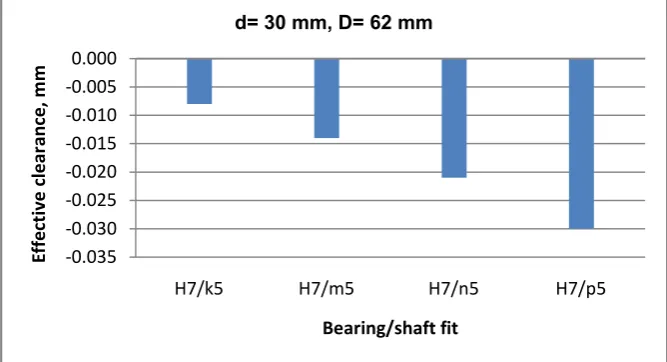
Effect of changing the fits between the bore of the inner ring and shaft: Four different fits are used between the inner ring bore and shaft (hole-based system); two of light transition;
[image:3.595.307.559.471.649.2]Table 1. Bearing Designation and dimensions [7]
Table 2. Fits and tolerance limits of bearing rings with the effective clearance for different fits between inner rings and shafts
Fit designation for inner ring Shaft tolerance Inner ring bore tolerances Max. interference*, fi Effective Clearance***,
30 H7/k5 ∅30 .. ∅30 .. 0.011 mm -0.008 mm
30 H7/m5 ∅30 .. 0.017 mm -0.014 mm
30 H7/n5 ∅30 .. 0.024 mm -0.021 mm
30 H7/p5 ∅30 .. 0.033 mm -0.030 mm
Fit designation for outer ring Outer ring olerances Housing tolerances Maximum transition**,fo
N8/h7 ∅62 .. ∅62 .. 0.050 mm
*Maximum interference between the shaft and bearing inner ring (inner ring clearance reduction),
fi= maximum shaft - minimum hole (inner ring bore)
**Maximum transition between the housing bore and bearing outer ring,
[image:4.595.135.462.422.565.2]fo= minimum hole - maximum shaft (outer ring). ***Effective clearance, = − ( + + )
Table 3. Radial internal clearance in deep groove ball bearings [1]
[image:4.595.131.465.602.783.2]Where, C2,CN, C3….etc. are clearance classes, the smaller values should be used for bearings with minimum clearance and the larger values for bearings near the maximum clearance range [1].
Figure 4. Effective clearance for different inner ring/shaft fits
-0.035 -0.030 -0.025 -0.020 -0.015 -0.010 -0.005 0.000
H7/k5 H7/m5 H7/n5 H7/p5
Effective
clear
anc
e,
m
m
Bearing/shaft fit
d= 30 mm, D= 62 mm
The internal radial clearance, o = depends on the clearance
class of bearing and its maximum value could be get from table (3) for deep groove ball bearings as o= 0.053 mm.
Note that the radial internal clearance caused by temperature difference changes between bearing and
ambient (t) has been ignored in this comparison.
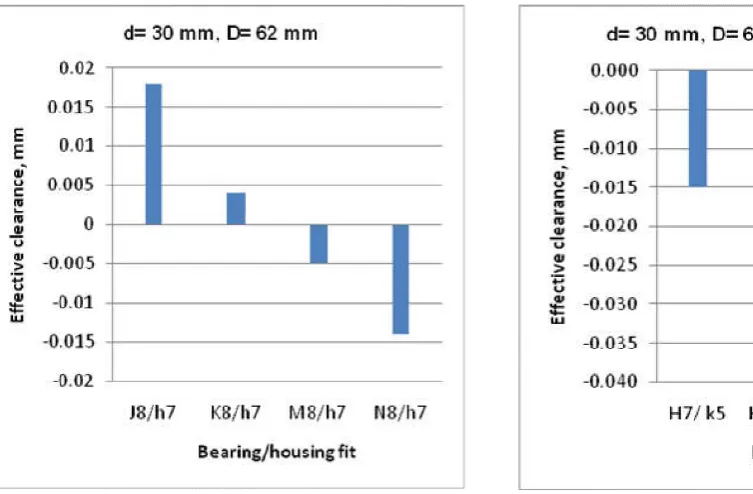
Effect of changing the fits between the outer ring and the housing: Four different fits are proposed between the outer ring and housing (shaft-based system); two light transition,
J8/h7, K8/h7, and the other two are heavy transition (press fit); handh. Conversely, the fit between the inner ring and shaft (hole-based system) is kept at
/m5. Table (4) and figure (5) show the variation of the effective clearance with different bearing/housing fits.
Bearings Mounting with Different Types of Fits (with considering the effect of temperature difference between bearing and ambient)
In addition to the mounting fits of bearing rings, the internal effective clearance between the bearing rings is also influenced by a reduction in the radial clearance caused by the bearing and ambient temperature differences. During the operation of the bearing under loads, the temperature of the entire bearing (including inner ring, rolling elements and outer ring) increases. Since the magnitude of this temperature change is very difficult to measure or estimate, all the bearing elements (in this manner) is generally assumed to be as a single unit having same value of temperature as the inner ring. The reduction in the radial clearance caused by the effect of a temperature difference between the bearing and ambient can be determined using the following equation [2]:
= ∆ D (2)
Where;
De= Effective diameter of bearing =
4D+d
5 for ball bearings
= 3D+d
4 for roller bearings
= the linear thermal expansion coefficient
t = the temperature difference between bearing and ambient
D= the outside diameter of outer ring
d= the inside diameter of the inner ring (bore diameter).
Effect of changing the fits between the inner ring bore and shaft with temperature difference: As in section 3.1.1, the same four different fits are proposed between the inner ring and shaft (hole-based system); two of light transition; 30 H7/k5 and 30 H7/m5, and the others of heavy transition (press fit); 30 H7/n5 and 30 H7/p5. The fit between the outer ring and housing (shaft-based system) is kept at 62 N8/h7. However, here, the temperature effect has been taken into consideration. The temperature difference (t) has been
assumed to be 10 oC and the linear thermal expansion coefficient () to be 12.5 x 10⁻⁶ /oC [2]. The bearing equivalent diameter (De) is determined as: De = =4D+d5 = 55.6 mm (ball
bearing) and the thermal clearance due to the effect of temperature difference as: = ∆ D = 0.00695 mm. Table (5) and figure (6) show the variation of the effective clearance with different fits between inner rings and shafts with temperature differences of bearing elements.
Effect of changing the fits between the outer ring and the housing with temperature difference: As in section 3.1.2, four different fits are used between the outer ring and housing (shaft-based system); two light transition, J8/h7,
K8/h7, and the other two are heavy transition (press fit);
handh. The fit between the inner ring and shaft (hole-based system) is kept at /m5. However, here, the temperature difference effect has been taken into consideration (t is assumed to be 10
o
C) and to be 12.5 x 10⁻⁶ /oC. t is as before= 0.00695 mm. Table (6) and figure (7)
show the variation of the effective clearance with different fits between outer rings and housings with temperature differences of bearing elements.
Effect of Bearing Temperature Differences on the Bearing Effective Clearance
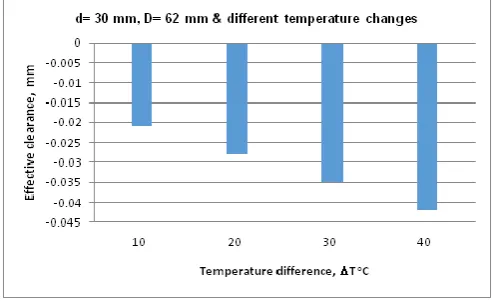
In this section, the fit between the inner ring and shaft is kept fixed at 30 H7/m5 and also the fit between the outer ring and housing is also kept fixed at 62 N8/h7. The effect of temperature difference between bearing and ambient has been taken into consideration at different values, t = 10, 20, 30, 40 o
C. The maximum variation in bearing temperature is taken as 40 oC since the maximum allowed temperature for bearing surface is 70 oC, otherwise the bearing grease will be liquefied and leak out during operation. The coefficient of linear thermal expansion is taken also as 12.5 x 10⁻⁶ /oC. Table (7) and figure (8) show the variation of the effective clearance with different temperature changes of bearing elements.
RESULTS AND DISCUSSION
Figure 5. Effective clearance for different outer ring/housing fits Figure 6. Effective clearance for different inner ring/shaft fits with temperature difference
Table 4. Fits and tolerance limits of bearing rings with the effective clearance for different fits between outer rings and housings
Fit designation for inner ring Outer ring tolerances Housing tolerances Maximum transition,fo Effective Clearance,
J8/h7
∅62 ..
∅62 .. 0.018 mm +0.018 mm
K8/h7 ∅62 .. 0.032 mm +0.004 mm
62 M8/h7 ∅62 .. 0.041 mm -0.005 mm
62 N8/h7 ∅62 .. 0.050 mm -0.014 mm
Fit designation for outer ring Shaft tolerance Inner ring tolerances Max. interference*, fi
[image:6.595.40.555.223.325.2]/m5 ∅30 .. ∅30 .. 0.017 mm
Table 5. Fits and tolerance limits of bearing rings with the effective clearance for different fits between inner rings and shafts with temperature differences of bearing elements
Fit designation for inner ring
Shaft tolerance Inner ring bore tolerances Max. interference, fi Effective Clearance,
30 H7/ k5 ∅30 ..
∅30 ..
0.011 mm -0.015mm
30 H7/m5 ∅30 .. 0.017 mm -0.021 mm
30 H7/n5 ∅30 .. 0.024 mm -0.028 mm
30 H7/p5 ∅30 .. 0.033 mm -0.037 mm
Fit designation for inner ring
Outer ring tolerances Housing tolerances Maximum transition,fo
[image:6.595.36.561.370.477.2]N8/h7 ∅62 .. ∅62 .. 0.050 mm
Table 6. Fits and tolerance limits of bearing rings with the effective clearance for different fits between outer rings and housings with temperature differences between the bearing and ambient
Fit designation for outer ring
Outer ring tolerances Housing tolerances Maximum
transition,fo
Effective Clearance,
J8/h7
∅62 ..
∅62 .. 0.018 mm +0.003 mm
K8/h7 ∅62 .. 0.032 mm -0.022 mm
62 M8/h7 ∅62 .. 0.041 mm -0.020 mm
62N8/h7 ∅62 .. 0.050 mm -0.029 mm
Fit designation
Shaft tolerance Inner ring bore tolerances Max. interference, fi
[image:6.595.52.429.524.771.2]/m5 ∅30 .. ∅30 .. 0.017 mm
Table 7. Effective clearance for different temperature changes of bearing elements
[image:6.595.303.558.524.769.2]Figure 7. Effective clearance for different outer ring/housing fits with temperature difference
Figure 8. Effective clearance for different temperature differences of bearing elements
Conclusion
Throughout the analytical study performed in this paper on the rolling bearings mounted by different fits on their shafts and housings and under different temperature changes, the following conclusions can be withdrawn:
1. The inner ring fit has more effect on the effective radial clearance induced in the bearing parts than the outer ring fit.
2. It is worthy to make the fit of the inner rings with their shafts to be of a heavy transition grades (press fit grades), while making the outer rings to be of light transition fits with their housings.
3. The small temperature difference value between the bearing and ambient has very little effect on the effective clearance, such that of bearings fitted with heavy fitted inner rings.
4. On the other hand, high temperature differences between the bearing and ambient may cause a decrease in the effective clearance, such that in bearings used under high applied loads.
REFERENCES
1. NSK_CAT_E1102m_A82_95, “Chapter 9-Fits and internal Clearance”, https://www.scribd.com/document/384510461/ NSK-CAT-E1102m-A82-95
2. NSK_CAT_E728g_4, “Chapter 4- Internal Clearance”, https://www.scribd.com/document/256075808/nsk-cat-e728g-4
3. Navajo-Technical-University Self-Study_Electrical-Engineering, “Chapter 7-Bearing Fits”, https://www. ntnglobal.com/en/products/catalog/pdf/2202E_a07.pdf. 4. NTN Technical Information Series, “Chapter 7, Bearing
Fits”, http://www.ntnamericas.com/en/pdf/ 2200/brgfits. pdf.
5. T. Momono and B. Noda, “Sound and Vibration in Rolling Bearings”, Motion & Control Journal, NSK, No. 6 — 1999.
6. M. C. S. Reddy, ”Thermal Stress Analysis of a Ball Bearing by Finite Element Method”, International Journal of Advanced Research in Engineering and Technology, (IJARET), Vol. 6, Issue 11, Nov 2015, pp. 80-90, Article ID: IJARET_06_11_008, http://www.iaeme.com/IJARET/ issues.asp.
7. SKF General Catalogue for Rolling Bearings, p.p.306, 2003.
[image:7.595.39.287.262.414.2]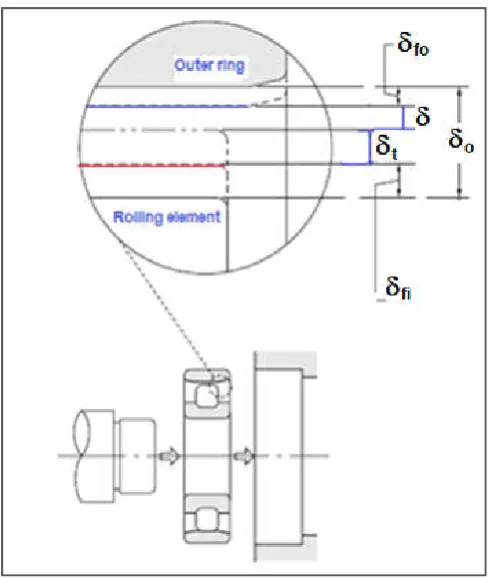
![Figure 3. Deep groove ball bearing dimensions [7]](https://thumb-us.123doks.com/thumbv2/123dok_us/8886466.948580/3.595.38.288.447.719/figure-deep-groove-ball-bearing-dimensions.webp)