RESEARCH ARTICLE
Changes in
cis
-regulatory elements of a key floral regulator are
associated with divergence of inflorescence architectures
Elske Kusters1,*,**, Serena Della Pina1,‡,**, Rob Castel1,§, Erik Souer1,¶and Ronald Koes1,2,‡‡ABSTRACT
Higher plant species diverged extensively with regard to the moment (flowering time) and position (inflorescence architecture) at which flowers are formed. This seems largely caused by variation in the expression patterns of conserved genes that specify floral meristem identity (FMI), rather than changes in the encoded proteins. Here, we report a functional comparison of the promoters of homologous FMI genes fromArabidopsis, petunia, tomato andAntirrhinum. Analysis of promoter-reporter constructs in petunia andArabidopsis, as well as complementation experiments, showed that the divergent expression ofLEAFY(LFY) and the petunia homologABERRANT LEAF AND FLOWER(ALF) results from alterations in the upstream regulatory network rather thancis-regulatory changes. The divergent expression ofUNUSUAL FLORAL ORGANS(UFO) fromArabidopsis, and the petunia homologDOUBLE TOP(DOT), however, is caused by the loss or gain ofcis-regulatory promoter elements, which respond to trans-acting factors that are expressed in similar patterns in both species. Introduction of pUFO:UFO causes no obvious defects in Arabidopsis, but in petunia it causes the precocious and ectopic formation of flowers. This provides an example of how a change in a cis-regulatory region can account for a change in the plant body plan.
KEY WORDS: Inflorescence, Cyme, Raceme, Evo-Devo
INTRODUCTION
Flowering plants (Angiosperms) display an enormous morphological diversity and, because many species are amenable to genetic analysis and transgenesis, they offer excellent possibilities to study the evolution of developmental mechanisms and morphological change (Benlloch et al., 2007; Castel et al., 2010; Moyroud et al., 2010; Della Pina et al., 2014). Angiosperms differ widely with regard to the moment (i.e. the season and age of the plant) they switch from vegetative growth to flowering, as well as the number of flowers that are formed and their position on the plant body (Weberling, 1989; Castel et al., 2010). Distinct species may form solitary flowers or inflorescences that bear many flowers in a variety of different patterns (Rickett, 1954). Compound inflorescences are divided into three major classes depending on the
position where flowers and shoots are formed. In (open) racemes, the apical meristem remains undifferentiated and flowers derive from lateral meristems that form at its periphery. In cymes, flowers are formed from apical meristems, and inflorescence growth continues from lateral meristems, called sympodial inflorescence meristems (SIMs), which ultimately will also acquire floral identity after having formed a subsequent lateral SIM. Panicles go through several rounds of producing lateral meristems before each meristem ends in a flower (Rickett, 1954; Prusinkiewicz et al., 2007; Castel et al., 2010).
Distinct inflorescence architectures are associated with differences in the expression patterns of floral meristem identity (FMI) genes that specify floral meristem (FM) fate (Benlloch et al., 2007; Moyroud et al., 2010). In racemes, FMI genes, such as LEAFY (LFY) and APETALA 1 (AP1) of Arabidopsis, and FLORICAULA(FLO) ofAntirrhinum majus, are expressed in lateral meristems, which develop into flowers, but not in the apical meristem, which remains meristematic (Coen et al., 1990; Huijser et al., 1992; Mandel et al., 1992; Weigel et al., 1992). Mutations in LFY and/or AP1 ( partially) convert lateral flowers into shoots (Mandel et al., 1992; Weigel et al., 1992), whereas constitutive expression results in precocious flowering and conversion of apical meristems into flowers (Mandel and Yanofsky, 1995; Weigel and Nilsson, 1995). Hence, inArabidopsis, the time and place where flowers form are primarily regulated via the transcription ofLFYand its direct target AP1(Wagner et al., 1999; Benlloch et al., 2007; Moyroud et al., 2010).
Also, in species with cymose inflorescences, such as the nightshades (Solanaceae) Nicotiana spp. (tobacco), Solanum lycopersicum (tomato) and Petunia hybrida ( petunia), LFY homologs specify floral identity (Souer et al., 1998; Molinero-Rosales et al., 1999; Ahearn et al., 2001). The encoded proteins are structurally and functionally highly similar to LFY, but are expressed in different patterns (Souer et al., 1998, 2008; Molinero-Rosales et al., 1999; Ahearn et al., 2001; Maizel et al., 2005). In tomato, for instance, FALSIFLORA (FA) is already expressed during the vegetative phase in (incipient) leaf primordia, and during reproductive development in both (apical) FMs and (lateral) SIMs (Molinero-Rosales et al., 1999). In petunia inflorescences, the LFY-homolog ABERRANT LEAF AND FLOWER (ALF) is first activated in the apical FM and with a slight delay in the lateral SIM (Souer et al., 1998). However, the transcription ofALFis not the limiting factor that determines when and where flowers form in petunia, because (i) ectopic ALF expression does not trigger the formation of precocious or ectopic flowers, and because (ii)ALFis, likeFAin tomato, expressed prior to flowering in leaf primordia (Souer et al., 1998).
The limiting factor that controls the formation of flowers in petunia is DOUBLE TOP (DOT), which is orthologous to Antirrhinum FIMBRIATA, Arabidopsis UNUSUAL FLORAL ORGANS(UFO) and tomatoANANTHA(AN) (Souer et al., 2008). Received 8 January 2015; Accepted 14 July 2015
1
Department of Molecular Cell Biology, VU-University, de Boelelaan 1087, Amsterdam 1081HV, The Netherlands.2Department of Plant Development and (Epi)Genetics, Swammerdam Institute of Life Sciences, University of Amsterdam, Science Park 904, 1098XH Amsterdam, The Netherlands.
*Present address: Department of Clinical Chemistry and Laboratory Medicine, Leiden University Medical Center, Leiden, The Netherlands.‡Present address: Department of Plant Developmental Biology, Max Planck Institute, Cologne, Germany.§Present address: Clinical Chemistry Laboratory, Albert Schweitzer Hospital, Dordrecht, The Netherlands.¶Present address: DNA Green Group-Fides, de Lier, The Netherlands.
**These authors contributed equally to this work
‡‡
Author for correspondence ([email protected])
DEVEL
O
UFO and DOT are interchangeable F-Box protein components of an SCF ubiquitin-ligase complex that bind to LFY and ALF to promote the transcription of downstream genes (Wang et al., 2003; Chae et al., 2008; Souer et al., 2008). Inactivation ofDOTorAN leads to complete loss of floral identity, whereasufoandfimhave more subtle floral meristem identity defects (Levin and Meyerowitz, 1995; Ingram et al., 1997; Hepworth et al., 2006). Expression of DOTand AN strictly coincides with the development of flowers. Both genes become first expressed upon the onset of flowering young FMs, initially as a stripe at the adaxial side of the first emerging sepal primordium that subsequently expands into a ring as the other sepal primordia initiate (Lippman et al., 2008; Souer et al., 2008; R. Castel, PhD Thesis, VU University Amsterdam, 2009) (supplementary material Fig. S1). Constitutive expression ofDOT (orUFO) in petunia causes the precocious formation of flowers in ectopic positions, apparently via the post-translational activation of ALF in vegetative tissues (Souer et al., 2008). In Arabidopsis, however,UFOis not limiting for flower formation, as it is expressed from embryogenesis onwards in virtually all aerial meristems (Lee et al., 1997; Long and Barton, 1998), and ectopic UFO expression does not alter flowering time or inflorescence architecture (Lee et al., 1997). Souer et al. (2008) postulated that the time and place of simultaneous expression of LFY and UFO or their homologs determine the flowering time and position of flowers, and that alterations in the expression of bothLFYandUFOhomologs were involved in the divergence of flowering time and inflorescence architecture (Souer et al., 2008).
Curiously, the expression pattern ofUFO,FIMandDOTwithin the flowers also diverged (supplementary material Fig. S1), even though they are thought to have a similar role in the activation of organ-identity genes (Lee et al., 1997; Schultz et al., 2001; Souer et al., 2008). In young FMs,UFOandFIMmRNA are expressed throughout the meristem dome and in later stages become confined to the petal/sepal boundary (Simon et al., 1994; Lee et al., 1997). DOTandANmRNA, however, are never expressed in the FM center (Lippman et al., 2008; Souer et al., 2008).
What caused the changes in the expression patterns of these FMI genes, however, remains unknown. To address whether the FMI gene expression patterns were altered bycis-regulatory mutations and/or by changes in the upstream trans-regulatory network, we compared the activity of homologous FMI gene promoters from Arabidopsis,Antirrhinum, tomato and petunia by swapping them between Arabidopsis and petunia. It appeared that the divergent expression ofLFYhomologs is caused by alterations in the upstream trans-regulatory network. Conversely, the divergent expression of UFOhomologs is due to cis-regulatory differences, which make these genes responsive to distinct sets of transcription factors that appear largely conserved between species.
RESULTS
Promoter regions sufficient for correct spatio-temporal expression
To study the genetic basis of the different expression patterns of homologous FMI genes in petunia andArabidopsis, we compared the activity of their promoters. We isolated 5′non-coding regions of ALF and DOT by PCR-based methods, fused the 2.8 kb ALF promoter (pALF) and 3.1 kbDOTpromoter (pDOT3.1) to theALF
andDOTcDNAs, and introduced thepALF:ALFandpDOT3.1:DOT
genes (supplementary material Fig. S2) in petunia alfW2167 and
dotA2232null mutants.
Inalfanddotmutants, apical FMs develop as a SIM, which forms another sympodial unit instead of a flower (Souer et al., 1998, 2008).
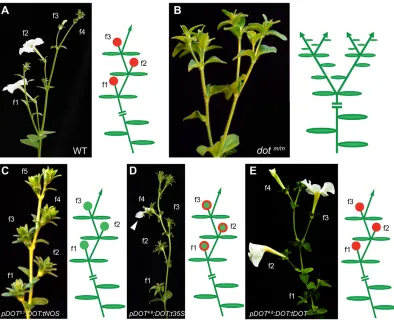
The reiteration of this process results in a green bushy structure lacking flowers (Fig. 1A,B; supplementary material Fig. S3A,B). In two out of 19 independent transgenic lines, pALF:ALF fully complemented the alf phenotype (supplementary material Fig. S3B), whereas eight lines formed imperfect ‘green flowers’, having sepaloid organs in place of petals and stamens (supplementary material Fig. S3C). NinepALF:ALF alflines displayed no rescue of the mutant phenotype at all. Nevertheless, the two fully complementing lines showed that the transgene could complement the mutant, indicating that the 2.8 kb pALF fragment contains sufficient regulatory information for wild-type function ofALF.
In pDOT3.1:DOT dot transformants, cymose branching was
restored in seven out of 15 independent lines: apical meristems often formed a‘green flower’that lacked petals and stamens, but usually had a wild-type carpel, and occasionally mosaic organs in the second whorl containing sepaloid and petaloid tissue (Fig. 1C). The remaining eight plants showed no complementation of dot. Extending pDOT with another 1.5 kb (pDOT4.6:DOT) clearly
improved the rescue of thedotorgan identity defect (Fig. 1D). In eight of 15 independent transformants, cymose branching was restored similar to dot pDOT3.1:DOT, but, in addition, more
complete flowers with sepaloid and petaloid tissues and fertile stamens and carpels were produced. The remaining seven plants showed no complementation. Next, we replaced thet35Sterminator, which is often used (Karimi et al., 2002), with 1 kb of the 3′ flanking region ofDOT(tDOT) and repeated the complementation. In eight of 15 independentdot pDOT4.6:DOT:tDOTtransformants,
both the cymose branching and floral organ development were fully restored (Fig. 1E). Four lines showed partial complementation, that is, complete restoration of cymose branching but formation of imperfect flowers similar to those in pDOT4.6:DOT:t35S
transformants.The remaining three plants were not complemented. These results indicated that the 3.1 kb pDOT3.1 fragment was
sufficient to restore floral meristem identity but not the organ identity defects indot, similar to the Cauliflower Mosaic Virus 35S promoter (Souer et al., 2008). The addition of 1.5 kb of 5′promoter region improved thedotcomplementation compared withpDOT3.1,
but the full restoration of alldotdefects was reached only when we added 1 kb of 3′region as well.
The 2.3 kb region upstream ofLFY(pLFY) used in this study, when fused to theLFYcDNA, was able to rescue the stronglfy-26 mutant (Blazquez et al., 1997), and the 3.8 kb UFO promoter (pUFO) drives GUSexpression in a pattern identical to that of endogenous UFO (Lee et al., 1997). This indicates that these promoter regions contain all regulatory sequences necessary for promoter swap studies.
Comparison ofpALFandpLFY
pLFYcontains proximal and distal regions necessary for the correct expression of the gene (Blazquez and Weigel, 2000), and several transcription factors have been identified that interact with known regulatory regions inLFY(Lee et al., 2008; Yamaguchi et al., 2009). Alignments ofpLFY, using the Phytozome portal (Goodstein et al., 2012), revealed sequence conservation in distal and proximal regions in LFY homologs from other Brassicaceae, but little or none in LFY homologs from other species, including pFA from tomato (supplementary material Fig. S4A). In a complementary approach, we comparedpALF(2.8 kb) withpFA(3.8 kb) andpLFY (3.8 kb), using mVISTA (Frazer et al., 2004). These pairwise alignments showed thatpALFandpFAshare four conserved regions, whereas no clear similarity was seen with pLFY (supplementary material Fig. S4B). This suggests that pLFYand pALFshare few
RESEARCH ARTICLE Development (2015) 142, 2822-2831 doi:10.1242/dev.121905
DEVEL
O
cis-regulatory elements or that such elements are too small, or too different in sequence, to be detected by sequence comparison.
To distinguish between these possibilities, we generated stable Arabidopsisand petunia transformants containingβ-glucuronidase (GUS) reporter genes driven by the pALF and pLFY fragments described above to the GUS coding sequence (pALF:GUSand pLFY:GUS; supplementary material Fig. S2) (Jefferson et al., 1987) and analyzed ten independent transformants for each gene/species combination, using histochemical GUS staining. Although the expression level varied between distinct transformants, the expression pattern was highly similar.
pALF:GUSandpLFY:GUSare expressed in seemingly identical patterns during vegetative growth both in a petunia and in an Arabidopsis background. That is, emerging petunia and Arabidopsis leaves expressed GUS, which quickly faded when the leaves grew older (Fig. 2A-D). We could observepLFY:GUS expression from the third leaf on in Arabidopsis, but could not discern the gradual increase of pLFY:GUS expression during vegetative development (Blazquez et al., 1997). However, the rather small quantitative changes involved are difficult to distinguish by histochemical staining, in particular because the vegetative phase lasted rather short under the long-day conditions used.
Analysis ofpALF:GUSandpLFY:GUSplants after the switch to flowering (Fig. 2E-H) showed that in a petunia inflorescence both transgenes were expressed in a similar pattern as the endogenous ALFgene, whereas inArabidopsisinflorescences their expression patterns were similar to that ofLFY. In petunia, both promoters are
highly active in the apical FMs and also in the SIMs (Fig. 2E,F). The slightly delayed expression of endogenousALFin SIMs compared with the apical FM (Souer et al., 1998) was not observed with the limited resolution ofGUSassays. This is not surprising because (i) the SIM emerges as a very small region between the bract and the apical FM, which both expressALF, and because (ii)ALFexpression in the SIM is only briefly delayed (Souer et al., 1998; Castel et al., 2010). InArabidopsisinflorescences, however, expression ofpLFY: GUSandpALF:GUSwas restricted to lateral FMs (Fig. 2G,H), the only difference being that pALF:GUS expression faded more quickly thanpLFY:GUSactivity at later stages. More importantly, pALF:GUSandpLFY:GUSare, like endogenousLFY, never active in the apical meristems ofArabidopsis.
These data indicate that pALFand pLFYare functionally very similar, indicating that the ALF and LFY expression patterns diverged through changes in upstreamtrans-regulatory factors.
Expression ofpLFY:LFYin petunia andpALF:ALFin Arabidopsis
[image:3.612.108.502.56.376.2]To obtain further evidence that pALF and pLFY have similar expression patterns, we performed functional assays in transgenic plants. Previous results revealed that the ALF and LFY proteins are functionally similar and interchangeable (Maizel et al., 2005; Souer et al., 2008). In Arabidopsis, ectopic expression of LFYor ALF triggers precocious flowering and transforms the apical IM into an FM, which converts the open raceme into a solitary flower (or a closed raceme) (Weigel and Nilsson, 1995; Souer et al., 2008). This Fig. 1. Complementation ofdotbypDOT3.1:DOT:tNOS,pDOT4.6:DOT:t35SandpDOT4.6:DOT:tDOT.(A) Cymose inflorescence of wild-type petunia showing four consecutive flowers (f1, f2, f3, f4), with diagram showing the reiteration of modular sympodial units with flowers (red dots). (B)dotmutant in hybrid W138/W115 background, with diagram showing the conversion of flower-to-shoot (green arrows). (C-E) Complementation ofdotbypDOT3.1:DOT:tNOS
(C) producing‘green flowers’(green dots in the diagram),pDOT4.6:DOT:t35S(D) with partial developed flowers (white arrow in the picture and green dots with red perimeter in the diagram) and full complementation ofpDOT4.6:DOT:tDOT(E), respectively.
DEVEL
O
predicts that if an ALF (trans)gene retains ( part of ) its wider petunia expression pattern, when introduced in Arabidopsis, this should alter the flowering time and/or inflorescence architecture. Hence, we introducedpLFY:LFYandpALF:ALF into wild-typeArabidopsis Columbia. We found that none of the 20 primary transformants analyzed for each construct displayed aberrations in inflorescence architecture or flowering time (supplementary material Fig. S5A-C). This underlines that in Arabidopsis pALF is not expressed ectopically when compared withpLFY.
The same reasoning predicts that if pLFY were expressed in a more restricted pattern thanpALF, when introduced in petunia, a pLFY:LFYtransgene would not be able to fully rescuealfmutants. Therefore, we transformed alf with a pLFY:LFY transgene. We found that in six out of 12 independentpLFY:LFY alflines floral identity of the apical meristem was restored, resulting in a normal cymose architecture (supplementary material Fig. S6A-D). Two of these pLFY:LFY lines had aberrant ‘green flowers’ with supernumerary whorls containing only sepals, two other lines had flowers with near-perfect flowers, except that the third whorl
consisted of petaloid stamens, whereas two transformants had perfect wild-type flowers with only a few small sections of petal tissue on the stamens (supplementary material Fig. S6C-H). These findings provide further support that in petunia pLFY is indeed active in the appropriate regions to compensate for the loss ofALF activity.
Functional comparison ofpDOTandpUFO
A GUS gene driven bypDOT3.1showed no expression during the
seedling stage, neither in petunia nor inArabidopsis(Fig. 3A,B), showing that pDOT3.1 reproduces the expression of the parental
gene, independently of the host plant species. The same was observed forpDOT4.6:GUS(Fig. 3C,D).
In the petunia inflorescence,pDOT3.1:GUSwas expressed within
the apical FMs only, on the adaxial side of the sepal primordia, but never in the center of FMs, nor in the emerging SIM (Fig. 4A). In pDOT4.6:GUStransformants,GUSexpression was much stronger and
stained the entire FM, whereas no expression at all was seen in the emerging SIM (Fig. 4B). Even when stained briefly (30 min), a strong GUS signal was seen in the entire flower dome. However, when we analyzed pDOT4.6:GUS expression by in situ hybridization, we
observedGUSmRNA only at the sepal/petal boundary (Fig. 4C). This suggests that the strong GUS activity seen in the center of the FM does not reflect theGUSmRNA expression pattern, but might result from intercellular movement of the GUS enzyme or an X-gluc reaction product or from transmission of (cytosolic) GUS protein through cell division into daughter cells, which becomes more evident at high GUS expression levels. Evidently, the extra promoter sequences included in the pDOT4.6 construct contain some enhancers that
drastically increase its activity compared with pDOT3.1, without
[image:4.612.82.267.56.414.2]altering its expression pattern.
Fig. 2.pALF:GUSandpLFY:GUSexpression patterns in petunia and
Arabidopsis.(A,B) In young petunia (Ph) and in (C,D)Arabidopsis(At) seedlings,pALF:GUSandpLFY:GUSare active in emerging leaves, but not in the vegetative meristem. (E-H) In the reproductive stage,pALF:GUS(E) and
pLFY:GUS(F) stained both sympodial inflorescence and young flowers of petunia, whereas inArabidopsis(G,H), they were both expressed in FM, but excluded from the apical inflorescence meristem. Dashed lines indicate the outlines of organs that are poorly visible, subsequent flowers are indicated from young to old (f1, f2). C, cotyledon; asterisk, sympodial (E,F) or apical (G,H) meristem; fm, floral meristem; b, bract; s, sepal.
Fig. 3. Expression ofpDOT3.1:GUS, DOT4.6:GUSandpUFO:GUSin
vegetative meristems.(A-D) Transgenic petunia (Ph) andArabidopsis(At) seedlings do not expresspDOT3.1:GUSorpDOT4.6:GUS. (E,F)pUFO:GUSis expressed in the SAM of young petunia andArabidopsisseedlings, respectively. Dashed lines outline the youngest visible leaves. C, cotyledon.
RESEARCH ARTICLE Development (2015) 142, 2822-2831 doi:10.1242/dev.121905
DEVEL
O
[image:4.612.349.527.417.684.2]InArabidopsis,pDOT3.1:GUSwas expressed in lateral FMs and
excluded from the apical meristem (Fig. 4E,F). In weakpDOT4.6:
GUSexpressors, GUS activity was restricted to the FM exactly at the sepal/petal boundary and was never seen in the IM (Fig. 4G). In strong expressors, GUS signal was present in both apical inflorescence and lateral flower meristem, in the whole dome rather than in a ring shape (supplementary material Fig. S7A). The different results between weak versus strong expressors probably reflect a quantitative difference in GUS staining rather than qualitative. Indeed, detection of GUS mRNA by in situ hybridization of strong expressors showed that mRNA expression was most strongly expressed at the sepal/petal primordia boundary, whereas a weaker signal was observed throughout the FM and the apical IM (supplementary material Fig. S7B). The latter might either result from aspecific binding of the probe, or might reflect low activity ofpDOT4.6in the IM and center of the FM inArabidopsis.
We also introduced pDOT4.6:GUS:tDOT in petunia and
Arabidopsis. However, among 90 stable petunia transformants, which were generated in four independent transformation experiments, none showed any GUS expression, whereas 32 transformants had the typical dot loss-of-function phenotype, indicating that the transgene(s) silenced the endogenous DOT gene and itself. When we transformed the same construct into Arabidopsis, none of the 30 independent transformants showed any GUSexpression, but mutant (ufo) phenotypes were not seen. This suggests that, for unknown reasons, the pDOT4.6:GUS:tDOT
constructs triggers RNA interference at high frequency.
InArabidopsis,UFOmRNA is already expressed in heart-stage embryos (Long and Barton, 1998) and persists in seedlings in a cup-shaped domain surrounding the central part of the SAM (Lee et al., 1997). When fused to GUS, pUFO was already active during embryogenesis of petunia in a ring around the root meristem and in the apical meristem (supplementary material Fig. S8), and in the seedling
stage,pUFO remained active in the vegetative SAMs both in an Arabidopsisand petunia background (Fig. 3E,F). This means that pUFOreproduces during the vegetative phase the expression of the parental gene from which it is derived, irrespective of the host plant species. Within the petunia inflorescencepUFO:GUSwas strongly expressed in both the IM and FM (Fig. 4D), and inArabidopsisin both the apical IM and lateral FMs, similar to UFO (Fig. 4H). Moreover, we observed that in allArabidopsisand petuniapUFO: GUStransformants (i.e. in both weak and strong expressors) GUS activity localized in young FMs throughout the entire meristem dome, whereas in expanding flowers the signal faded from the center (Fig. 4D,H). These data imply that the divergent expression ofDOT andUFOwithin FMs also results from differences in their promoters. In summary, pDOT3.1:GUS, pDOT4.6:GUS and pUFO:GUS
largely recapitulate the divergent expression patterns of the corresponding endogenous DOT and UFO genes, regardless of the host species. This implies that their different expression patterns in vegetative meristems, IMs and FMs are caused by alterations in cis-regulatory elements (CREs; that is, individual transcription factor bindings sites, or clusters of such sites, known as enhancers).
Functional heterologous complementation
To obtain direct evidence that the changes in the CREs ofpUFOand pDOT are important for the divergent racemose and cymose inflorescence architectures, we introduced promoter:cDNA constructs (pUFO:UFOandpDOT3.1:DOT) intoArabidopsisand
petunia. Based on the above results and because UFOand DOT encode functionally interchangeable proteins (Souer et al., 2008), we expected that pDOT3.1:DOT, which is sufficient to restore
[image:5.612.106.510.57.259.2]inflorescence architecture in petunia, would not alter flowering time in wild-type Arabidopsis, whereas pUFO:UFO would cause precocious flowering and inflorescence architecture defects in wild-type petunia.
Fig. 4. Expression ofpDOT3.1:GUS,pDOT4.6:GUSandpUFO:GUSin the inflorescences.(A)pDOT3.1:GUSin petunia (Ph) inflorescence. GUS expression is first seen as a stripe at the base of the first emerging sepal primordium and at a later stage, when all sepal primordia are visible, as a pentagon. (B)pDOT4.6:GUS
petunia inflorescence. GUS activity is seen in the entire FM, but not in the SIM (asterisk). (C)In situhybridization of apDOT4.6:GUSpetunia inflorescence section,
showing thatGUSmRNA is restricted to the sepal/petal boundary. (D)pUFO:GUSin petunia inflorescence, showing expression in both SIM (asterisk) and young flower primordia (f1, f2). (E) Side view and (F) top view of anArabidopsis(At)pDOT3.1:GUSinflorescence: GUS activity was observed only in FM. (G) In
Arabidopsis, the expression ofpDOT4.6:GUSis seen between sepals end petals of FMs but is excluded from the apical IM. (H) In floweringpUFO:GUS Arabidopsis, both the apical IM (asterisk) and young flowers primordia strongly expressedGUS. In older flowers blue staining was confined to the base of the flower. Dashed lines indicate the outlines of organs that are poorly visible, subsequent flowers are indicated from young to old (f1, f2). asterisk, sympodial (A,B,D) or apical (E-H) meristem; fm, floral meristem; b, bract; s, sepal.
DEVEL
O
About 20 primaryArabidopsistransformants of each construct were investigated, and none of them showed any aberrant phenotypical features or altered flowering time compared with empty vector controls (supplementary material Fig. S5). By contrast, the introductionpUFO:UFOin wild-type petunia always resulted in early flowering (Fig. 5A,B) and conversion of the cymose inflorescence (Fig. 5C) into a solitary flower with supernumerary petals and stamens subtended by extra leaf-like organs (bracts) directly under the sepal whorl (Fig. 5D; supplementary material Fig. S9A,B). When pUFO:UFO was transformed into a dotbackground, a solitary‘green flower’was formed – as early as in a wild-type background (supplementary material Fig. S9C,D)–that consisted of whorls of sepals around a central carpel lacking petals and stamens (supplementary material Fig. S9C,D). This indicates thatpUFOcould not drive transgene expression at sufficiently high levels during later stages of FM development, when floral organs are formed. When pUFO:UFO transformants were crossed to plants expressing 35S:LFY, the precocious flowering was enhanced (Fig. 5E).
ANANTHAandFIMBRIATAactivity in petunia and Arabidopsis
Arabidopsis and petunia are distantly related eudicot species that belong to the Rosids and Asterids, respectively. To study at which time point during evolution pDOT and pUFO diverged, we analyzed homologous promoters from Antirrhinum (pFIM; 3.6 kb) and tomato (pAN; 5 kb), which are both Asterids. Antirrhinumis a member of thePlantaginaceae(order Lamiales) and has a racemose inflorescence, whereas tomato belongs, like petunia, to theSolanaceae(order Solanales).
In tomato,ANis expressed in a very similar pattern asDOTin petunia (Lippman et al., 2008). During the vegetative stagepAN: GUS did not show any activity in a petunia or Arabidopsis background (Fig. 6A,B), identical to the native expression pattern of AN in tomato. In petunia inflorescences, the expression ofpAN: GUS was similar to that of pDOT4.6. That is, in low pAN:GUS
expressors GUS activity was seen in a pentagonal domain on the sepals/petals boundary (supplementary material Fig. S10A), in strong expressors it was seen in the entire FM, and in both cases it was never seen in the SIM (Fig. 6E). In weak Arabidopsis
expressors, pAN:GUS expression was visible in the FM in the sepals/petals boundary and not in the apical IM (Fig. 6F). In strong expressors GUS stained both FM and IM (supplementary material Fig. S10A,B).
InAntirrhinum,FIMis already expressed during the vegetative phase (supplementary material Fig. S11), and during reproductive growth its expression is restricted to the (lateral) FM and excluded from the apical IM (Simon et al., 1994). In petunia seedlings we never observed expression of pFIM:GUS (Fig. 6C), whereas in Arabidopsis seedlings pFIM:GUS was expressed at the base of newly formed leaves (Fig. 6D). The expression pattern ofpFIM: GUSin inflorescences was highly similar to that ofpDOT4.6:GUS. In
weak petuniapFIM:GUSexpressors, we observed GUS activity in emerging flower primordia first as a stripe at the base of incipient sepals (supplementary material Fig. S10C) and slightly later, when all sepal primordia were visible, as a ring in the flower dome (Fig. 6G). In strong expressors GUS activity stained the whole flower dome, including the FM center (supplementary material Fig. S10D). However, we never observed GUS activity in the emerging inflorescence meristem. Also in the Arabidopsis inflorescence, pFIM:GUSexpression was confined to the typical ring pattern at the sepal/petal boundary, and was never observed in the FM center or in the apical meristem (Fig. 6H), similar toDOT4.6:GUS.
In summary, these data indicate thatpANandpDOTcontain very similar, if not identical, regulatory sequences, because they are active in indistinguishable patterns, whereas those inpFIMare very similar, but not fully identical, because pFIM responds to transcription activators in the base of young Arabidopsis leaves, whereaspDOTdoes not.
[image:6.612.48.370.511.742.2]Pairwise sequence comparisons revealed four regions inpDOT (blocks 1-4) that have high similarity to pAN. Blocks 1 and 3, which contain predicted binding sites for MADS-box and SQUAMOSA PROMOTER BINDING PROTEIN (SBP)-like transcription factors, are also found inpFIMand homologs from diverse Rosid species, but not inpUFOand homologs from other Brassicaceae (Fig. 6I and supplementary material Figs S12 and S13). A similar analysis forpUFOrevealed conservation of several regions among Brassicaceae, but no similarity with any of the other Asterids or Rosids in Phytozome (supplementary material Fig. S13B).
Fig. 5.pUFO:UFOconverts the cymose petunia inflorescence to a single flower.(A) Wild-type petunia plant during the vegetative phase, with diagram showing the production of leaves. (B)pUFO: UFOtransformant of the same age, which flowers early and produces a terminal flower (red dot in the diagram). (C) Cymose inflorescence of wild-type petunia, showing three consecutive flowers (f1, f2, f3), with diagram showing the reiteration of modular sympodial units with flowers (red dots). (D) InpUFO: UFOpetunia, the cymose inflorescence was reduced to a solitary flower with extra organs (red dot in the diagram). (E) Double-transgenic35S:LFY pUFO: UFOpetunia flowers extremely early, after forming two true leaves. The first whorl contains petaloid sepals (arrowhead).
RESEARCH ARTICLE Development (2015) 142, 2822-2831 doi:10.1242/dev.121905
DEVEL
O
DISCUSSION
Differences in the spatio-temporal regulation of meristem identity genes caused the divergence of inflorescences with regard to the positions where flowers and shoots are formed (Benlloch et al., 2007; Lippman et al., 2008; Souer et al., 2008). Here, we show that the modification of FMI gene expression patterns results from variation in their transcriptional regulation, due to alterations in CREs of FMI genes as well as alterations in the upstream regulatory genetic network.
Our data suggest that CREs involved in the transcriptional activation ofDOTreside in both the 3′and 5′flanking regions of the gene. The 3.1 kb promoter (pDOT3.1) fragment contains major
CREs that are sufficient to reproduce theDOTexpression pattern and to rescue FM identity when fused to theDOTcoding sequence, but not the identity of petals and stamens within the developing flower. The phenotype of weak dot mutants indicates that petal development is, of all DOT-regulated processes, the most dependent on full DOT activity, and is associated with an extremely high abundance ofDOTmRNA in the cells at the sepal/petal boundary (Souer et al., 2008). Given that pDOT3.1 is active in the correct
pattern, its inability to drive petal development is most likely due to an insufficiency to drive the very strong expression needed for petal development, rather than a shortcoming in the pattern of expression. Indeed, expression ofDOTin a wider pattern, either frompUFO (supplementary material Fig. S8D) orp35S(Souer et al., 2008), also results in ‘green flowers’ lacking petal and stamen identity. By contrast, expression frompDOT4.6, which is expressed in the same
pattern aspDOT3.1but at much higher levels, leads to partial rescue
of petal and stamen identity and, if combined with the 3′flanking sequence ofDOT, to full rescue. These findings suggest that the CREs in the distal promoter region (–3000 to–4600) are largely redundant with those in the proximal region (–1 to–3000), because
they both promoteDOTtranscription in the same tissues. This is in line with recent data obtained with a larger set ofpDOTconstructs (S. Della Pina, E. Souer and R. Koes, unpublished data). The same may hold true for the 3′flanking region ofDOT, although we cannot exclude that ( part of ) the effect of tDOTresults from enhanced mRNA processing and/or stability.
The most obvious difference betweenDOTandUFOis that the latter is expressed in all meristems during embryogenesis, vegetative and reproductive growth, whereas DOTexpression is restricted to a defined region in FMs. ThatpDOT:GUSandpUFO: GUSreproduce these different expression patterns, regardless of the host plant used, indicates that the divergent expression ofDOTin petunia andUFOinArabidopsisis caused by differences in their 5′ flanking sequences. Furthermore, it indicates that the CREs that activatepUFOin the apical meristem (SAM) of embryos, seedlings and inflorescences (IM) respond to conserved transcription factors that are expressed in the same tissues in petunia.
[image:7.612.49.430.57.370.2]The finding that in petunia, but not inArabidopsis, thepUFO: UFOtransgene causes precocious flowering, and the formation of solitary flowers provides direct evidence that alterations in CREs of a single gene may impinge major architectural differences. It is, however, difficult to link directly morphological changes during evolution to the regulatory divergence ofpUFOandpDOT. Many plant families contain species with inflorescences described as racemes and cymes (Watson and Dalwitz, 2007), suggesting that these structures evolved multiple times independently. However, the details are hard to reconstruct with certainty because inflorescence architecture is (often) misclassified for a variety of reasons (Castel et al., 2010). In addition, assessing when the regulatory differences inpDOTandpUFOarose during evolution requires data on the regulation of DOT/UFOhomologs in many more (related) species than currently available. Moreover, as floral
Fig. 6. Expression ofpAN:GUSand
pFIM:GUSin petunia andArabidopsis.
(A-D) Expression in the vegetative phase. (A)pAN:GUSis not expressed in petunia (Ph) or (B)Arabidopsis(At) seedlings. (C)pFIM:GUSis inactive in petunia seedlings, and is inArabidopsis(D) expressed at the base of young leaves (arrow). (E-H) Expression in reproductive phase. (E,F)pAN:GUSis expressed in a pentagonal pattern at the sepal/petal boundary in FMs of (E) petunia and (F)Arabidopsis. (G) Petunia expresses
pFIM:GUSin floral meristems at the sepal/ petal boundary, but not in the SIM. (H)ArabidopsisexpressespFIM:GUSin floral meristems, at the sepal boundary, but not in the apical IM. C, cotyledons; asterisk, sympodial (E,G) or apical (F,H) meristem. (I) Sequence comparsion from
pDOTfromPetunia axillariswithpAN
(S. lycopersicum), pUFO(A. thaliana) and
pFIM(A. majus), using mVISTA (Frazer et al., 2004). Sequence similarity is indicated with white peaks if 50-70% and beige peaks if above 70%. The four blocks that are conserved between petunia, tomato andAntirrhinumare highlighted by grey shading.
DEVEL
O
identity is specified by the combined action of several genes, not all changes in the expression of a single gene will necessarily alter development immediately, as outlined below.
The divergent expression patterns ofDOT,UFOandFIMwithin the FM are intriguing because they seem to have similar functions within the flower.UFOandFIMare initially expressed throughout the FM, overlapping with the expression of subordinate organ-identity genes that specify petal and stamen fate (Simon et al., 1994; Lee et al., 1997; Schultz et al., 2001), whereas in petunia and tomato FMs, theDOTandANmRNA expression patterns have little or no overlap with those of the downstream B and C-type genes (Schultz et al., 2001; Souer et al., 2008). Hence, we hypothesized that DOT protein moves between cells in the FM (Souer et al., 2008), which might also explain why (small) changes in their expression pattern in the flower have limited consequences for development. It is conceivable that the CREs and transcription factors drivingUFOexpression in the FM center are the same as those driving UFO expression in the other meristems, whereas UFOexpression at the sepal/petal boundary might reply on distinct CREs and transcription factors similar to those driving the expression of DOT, FIM and AN in the same domain in their hosts. In young FMs ofAntirrhinum,FIMis expressed in a thick, 8-cell-wide ring with only a small, 2-8-cell-wide hole in the center (Simon et al., 1994; Schultz et al., 2001), which is more similar to UFOthanDOTexpression. However, in petunia andArabidopsis flowers, pFIM:GUS is expressed in a thin ring at the sepal boundary, similar to DOTand pDOT:GUS, suggesting that this difference between FIM and DOT expression is mostly due to alterations in the upstreamtrans-regulatory network. Nevertheless, there are clear functional differences betweenpFIMandpDOT, as pFIM is active in leaves ofArabidopsisseedlings, in contrast to pDOT. Whether expression of the Impatiens UFO-homolog – which is expressed in leaf primordia, likepFIMinArabidopsisand within the petal primordia rather than at their boundary (Pouteau et al., 1998) – diverged from FIM and DOT by cis- or trans -regulatory changes remains to be established.
Variations in the expression patterns ofALF/LFYhomologs are as important for morphological divergence as those of DOT/UFO homologs, but, again, not all the variation relates necessarily to developmental changes. Many species, with few exceptions (Coen et al., 1990), express theirLFYhomologs in vegetative tissues with different spatio-temporal patterns, where they have no apparent (architectural) role that is obvious from mutant phenotypes (Weigel et al., 1992; Kelly et al., 1995; Souer et al., 1998; Molinero-Rosales et al., 1999), except for a clade of legumes whereLFYis involved in the development of compound leaves (Champagne et al., 2007). Several Brassicaceae with (rosette-flowering) indeterminate racemose inflorescences express theirLFYhomologs in the lateral (floral) meristems, and in the apical IM, which nevertheless remains indeterminate (Shu et al., 2000; Sliwinski et al., 2007). Transgenic experiments showed that the different expression of IacLFY in Ionopsidum acualecompared withLFYinArabidopsisis due to a difference in the upstream regulatory network, whereas inIdahao scapigeraandLeavenworthia crassait traced to divergence of their LFYpromoters, which prevents repression ofpIscLFYandpLcrLFY in the IM by TERMINAL FLOWER1 (TFL1) (Yoon and Baum, 2004; Sliwinski et al., 2007).
In this light, it is remarkable that the CREs inpALFandpLFYare so conserved, given thatArabidopsis and petunia are distantly related dicots with different inflorescence architectures and ALF/LFY expression patterns. This indicates that the divergent expression of ALFandLFYoriginates from differences in the upstream regulatory
network that remain to be identified, and thatpALFandpLFYare, despite the lack of obvious sequence similarity, functionally similar. The latter was unexpected, as it suggests that pALF still contains the CRE(s) for TFL1-mediated repression. In Arabidopsis, this repression persists from the vegetative to the reproductive phase (Bradley et al., 1997) and is conserved inAntirrhinum(Bradley et al., 1996, 1997), but apparently not in nightshades. TheTFL1homolog from petunia was never investigated, but homologs from tobacco and tomato, CENTRORADIALIS4 (CET4) and SELF PRUNING (SP), respectively, are expressed only in vegetative axillary meristems and not in the FM or SIMs (Amaya et al., 1999; Thouet et al., 2008). Moreover, inactivation of SP only affects the development of the vegetative sympodial meristems (Pnueli et al., 1998), which are lacking in petunia (Castel et al., 2010), but not the cymose flower truss. AsArabidopsisand petunia are distantly related species,pALF andpLFYmost likely represent the ancestral state in dicots, whereas variants likepLcrLFYandpIscLFYare probably derived. Because the latter variants do not affect the spatial FMI regulation, they are most likely accompanied by compensatory alterations in the expression of LcrUFO and IscUFO or other FMI genes that remains to be established.
MATERIALS AND METHODS
Isolation ofpALFandpDOT
The 5′flanking regions of ALF and DOTwere isolated using somatic transposon insertion-mediated PCR (SOTI-PCR) (Rebocho et al., 2008). To analyze sequence conservation across eudicot species we used the Phytozome portal (Goodstein et al., 2012) and a web-based version of mVISTA (Frazer et al., 2004).
Plant material
ThealfW2167anddotA2232dTPH1transposon insertion alleles were in the non-transformable petunia line W138, and have been described in detail previously (Souer et al., 1998, 2008).ALFW2167/+andDOTA2232/+were crossed to the transformable line W115.alfanddotmutants were selected by phenotype from F2 progenies, their genotype confirmed by PCR and used for transformation. The phenotypes ofalfanddotmutants in the hybrid W115/W138 background are comparable to those in line W138.
Construction of transgenes and plant transformation
The coding sequences ofALF,DOT,LFYandUFOwere amplified from the vectors described previously (Souer et al., 2008), theGUSsequence was amplified from pGreenK vector (Karimi et al., 2002), and 5′upstream/ downstream non-coding regions were amplified from petunia W138 line and
Arabidopsis thaliana Columbia genomic DNA. Phusion High-Fidelity
DNA Polymerase (Finnzymes) was used for all amplification steps. Further details on transgene construction and the primers that were used can be found in supplementary Materials and Methods and Table S1.
All transgenes were (re)sequenced before introduction into the transformable petunia line W115 or homozygous alf and dot mutants using Agrobacterium tumefaciens (strain AGL0)-mediated leaf disk transformation (Horsch et al., 1985).Arabidopsis thalianaColumbia was transformed withAgrobacterium tumefaciensstrain C58C1 (MP90) using the floral dip method (Clough and Bent, 1998), and transformants were selected on Murashige and Skoog medium (Duchefa) containing 50 mg/l kanamycin monosulfate.
All plants were grown in a greenhouse. For comparisons of phenotypes plants were grown side by side to exclude the possibility that any phenotypic differences resulted from variations in greenhouse conditions.
RNA extraction and quantitative real-time PCR
Total RNA was isolated from the SAM of 2-week-old seedlings or inflorescence apices ofArabidopsisandAntirrhinumusing an RNAeasy extraction kit (Qiagen) and treated with DNA-free DNase (Roche) to remove residual genomic DNA. Transcript levels were quantified with Eco Real-time PCR system (Illumina) using Power SYBR Green (Applied
RESEARCH ARTICLE Development (2015) 142, 2822-2831 doi:10.1242/dev.121905
DEVEL
O
Biosystems). The primers used are shown in supplementary material Table S2. Normalization was performed based on the expression ofACTIN.
Whole-mountGUSstaining
We accurately followed the whole-mount GUS staining protocol as described in Weigel and Glazebrook (2002). Untransformed W115 was always included as negative control. The stained tissue was examined under binoculars. The brightness of the digital images as a whole was adjusted for optimal visibility of the organs and blue staining using Adobe Photoshop software, when necessary.
Plant photography
Plant images were taken with a FujiFilm FinePix S2 Pro digital camera. In the figures, the background was blacked out using Adobe Photoshop.
Statistical analysis of flowering time
We measured the flowering times of primary Arabidopsis (Columbia) transformants by the number of rosette and cauline leaves at bolting. The plants were grown under a long-day regime (16 h light/8 h darkness). The counted leaf numbers were statistically analyzed using One-Way ANOVA in SPSS.
GenBank accession numbers
Sequences of the genes used in this study can be found in the EMBL/GenBank database under the following accession numbers: ALF promoter (JF274656),ALF(AF030171),DOTpromoter (JF274657),DOT (EU352681),LFY(NP200993) andUFO(NM102834).
Acknowledgements
We thank Pieter Hoogeveen, Daisy Kloos, Maartje Kuijpers and Martina Meesters for great plant care, Alexandra Rebocho for the initial studies on theDOTpromoter, Dr Raju Datla for kindly providing thepRD400plasmid, and Drs Rüdiger Simon and Enrico Coen for sending thepFIMsequence.
Competing interests
The authors declare no competing or financial interests.
Author contributions
R.K., E.K., S.D.P. and E.S. designed experiments. E.K. and S.D.P. carried out the majority of the experiments. E.K., S.D.P., R.C. E.S. and R.K. carried out experiments, analyzed and interpreted data. E.K., S.D.P. and R.K. wrote the paper. All authors read and commented on the manuscript prior to submission.
Funding
This work was supported by the Netherlands Organization for Scientific Research (NWO) [grants 865.03.004 and 819.02.018 to R.K.].
Supplementary material
Supplementary material available online at
http://dev.biologists.org/lookup/suppl/doi:10.1242/dev.121905/-/DC1
References
Ahearn, K. P., Johnson, H. A., Weigel, D. and Wagner, D. R.(2001).NFL1, a
Nicotiana tabacum LEAFY-like gene, controls meristem initiation and floral structure.Plant Cell Physiol.42, 1130-1139.
Amaya, I., Ratcliffe, O. J. and Bradley, D. J. (1999). Expression of CENTRORADIALIS (CEN) and CEN-like genes in tobacco reveals a conserved mechanism controlling phase change in diverse species. Plant Cell 11, 1405-1417.
Benlloch, R., Berbel, A., Serrano-Mislata, A. and Madueno, F.(2007). Floral initiation and inflorescence architecture: a comparative view.Ann. Bot. (Lond.)
100, 659-676.
Blazquez, M. A. and Weigel, D.(2000). Integration of floral inductive signals in
Arabidopsis.Nature404, 889-892.
Blazquez, M. A., Soowal, L. N., Lee, I. and Weigel, D.(1997).LEAFYexpression and flower initiation inArabidopsis.Development124, 3835-3844.
Bradley, D., Carpenter, R., Copsey, L., Vincent, C., Rothstein, S. and Coen, E.
(1996). Control of inflorescence architecture inAntirrhinum.Nature379, 791-797.
Bradley, D., Ratcliffe, O., Vincent, C., Carpenter, R. and Coen, E.(1997). Inflorescence commitment and architecture inArabidopsis.Science275, 80-83.
Castel, R., Kusters, E. and Koes, R.(2010). Inflorescence development in petunia: through the maze of botanical terminology.J. Exp. Bot.61, 2235-2246.
Chae, E., Tan, Q. K.-G., Hill, T. A. and Irish, V. F.(2008). AnArabidopsisF-box protein acts as a transcriptional co-factor to regulate floral development.
Development135, 1235-1245.
Champagne, C. E. M., Goliber, T. E., Wojciechowski, M. F., Mei, R. W., Townsley, B. T., Wang, K., Paz, M. M., Geeta, R. and Sinha, N. R.(2007). Compound leaf development and evolution in the legumes.Plant Cell19, 3369-3378.
Clough, S. J. and Bent, A. F. (1998). Floral dip: a simplified method for Agrobacterium-mediated transformation of Arabidopsis thaliana.Plant J. 16, 735-743.
Coen, E. S., Romero, J. M., Doyle, S., Elliott, R., Murphy, G. and Carpenter, R.
(1990). floricaula: a homeotic gene required for flower development inAntirrhinum majus.Cell63, 1311-1322.
Della Pina, S., Souer, E. and Koes, R.(2014). Arguments in the evo-devo debate: say it with flowers!J. Exp. Bot.65, 2231-2242.
Frazer, K. A., Pachter, L., Poliakov, A., Rubin, E. M. and Dubchak, I.(2004). VISTA: computational tools for comparative genomics.Nucleic Acids Res.32, W273-W279.
Goodstein, D. M., Shu, S., Howson, R., Neupane, R., Hayes, R. D., Fazo, J., Mitros, T., Dirks, W., Hellsten, U., Putnam, N. et al.(2012). Phytozome: a comparative platform for green plant genomics. Nucleic Acids Res. 40, D1178-D1186.
Hepworth, S. R., Klenz, J. E. and Haughn, G. W.(2006). UFO in the Arabidopsis inflorescence apex is required for floral-meristem identity and bract suppression.
Planta223, 769-778.
Horsch, R. B., Fry, J. E., Hoffmann, N. L., Eichholtz, D., Rogers, S. G. and Fraley, R. T.(1985). A simple and general method for transferring genes into plants.
Science227, 1229-1231.
Huijser, P., Klein, J., Lonnig, W. E., Meijer, H., Saedler, H. and Sommer, H.
(1992). Bracteomania, an inflorescence anomaly, is caused by the loss of function of the MADS-box genesquamosainAntirrhinum majus.EMBO J.11, 1239-1249.
Ingram, G. C., Doyle, S., Carpenter, R., Schultz, E. A., Simon, R. and Coen, E. S.
(1997). Dual role forfimbriatain regulating floral homeotic genes and cell division inAntirrhinum.EMBO J.16, 6521-6534.
Jefferson, R. A., Kavanagh, T. A. and Bevan, M. W.(1987). GUS fusions: beta-glucuronidase as a sensitive and versatile gene fusion marker in higher plants.
EMBO J.6, 3901-3907.
Karimi, M., Inzé, D. and Depicker, A. (2002). GATEWAY™ vectors for Agrobacterium-mediated plant transformation.Trends Plant Sci.7, 193-195.
Kelly, A. J., Bonnlander, M. B. and Meeks-Wagner, D. R.(1995). NFL, the tobacco homolog of FLORICAULA and LEAFY, is transcriptionally expressed in both vegetative and floral meristems.Plant Cell7, 225-234.
Lee, I., Wolfe, D. S., Nilsson, O. and Weigel, D.(1997). A LEAFY co-regulator encoded by UNUSUAL FLORAL ORGANS.Curr. Biol.7, 95-104.
Lee, J., Oh, M., Park, H. and Lee, I.(2008). SOC1 translocated to the nucleus by interaction with AGL24 directly regulates leafy.Plant J.55, 832-843.
Levin, J. Z. and Meyerowitz, E. M.(1995). UFO: anArabidopsisgene involved in both floral meristem and floral organ development.Plant Cell7, 529-548.
Lippman, Z. B., Cohen, O., Alvarez, J. P., Abu-Abied, M., Pekker, I., Paran, I., Eshed, Y. and Zamir, D.(2008). The making of a compound inflorescence in tomato and related nightshades.PLoS Biol.6, e288.
Long, J. A. and Barton, M. K.(1998). The development of apical embryonic pattern inArabidopsis.Development125, 3027-3035.
Maizel, A., Busch, M. A., Tanahashi, T., Perkovic, J., Kato, M., Hasebe, M. and Weigel, D.(2005). The floral regulator LEAFY evolves by substitutions in the DNA binding domain.Science308, 260-263.
Mandel, M. A. and Yanofsky, M. F.(1995). A gene triggering flower formation in
Arabidopsis.Nature377, 522-524.
Mandel, M. A., Gustafson-Brown, C., Savidge, B. and Yanofsky, M. F.(1992). Molecular characterization of theArabidopsisfloral homeotic gene APETALA1.
Nature360, 273-277.
Molinero-Rosales, N., Jamilena, M., Zurita, S., Gomez, P., Capel, J. and Lozano, R.(1999). FALSIFLORA, the tomato orthologue of FLORICAULA and LEAFY, controls flowering time and floral meristem identity.Plant J.20, 685-693.
Moyroud, E., Kusters, E., Monniaux, M., Koes, R. and Parcy, F.(2010). LEAFY blossoms.Trends Plant Sci.15, 346-352.
Pnueli, L., Carmel-Goren, L., Hareven, D., Gutfinger, T., Alvarez, J., Ganal, M., Zamir, D. and Lifschitz, E. (1998). The SELF-PRUNINGgene of tomato regulates vegetative to reproductive switching of sympodial meristems and is the ortholog ofCENandTFL1.Development125, 1979-1989.
Pouteau, S., Nicholls, D., Tooke, F., Coen, E. and Battey, N.(1998). Transcription pattern of a FIM homologue in Impatiens during floral development and reversion.
Plant J.14, 235-246.
Prusinkiewicz, P., Erasmus, Y., Lane, B., Harder, L. D. and Coen, E.(2007). Evolution and development of inflorescence architectures. Science 316, 1452-1456.
Rebocho, A. B., Bliek, M., Kusters, E., Castel, R., Procissi, A., Roobeek, I., Souer, E. and Koes, R.(2008). Role ofEVERGREENin the development of the cymose petunia inflorescence.Dev. Cell15, 437-447.
Rickett, H. W.(1954). Materials for a dictionary of botanical terms-I.Bull. Torrey Bot.
Club81, 1-15.
DEVEL
O
Schultz, E., Carpenter, R., Doyle, S. and Coen, E.(2001). The gene fimbriata interacts non-cell autonomously with floral regulatory genes.Plant J.25, 499-507.
Shu, G. P., Amaral, W., Hileman, L. C. and Baum, D. A.(2000).LEAFYand the evolution of rosette flowering in violet cress (Jonopsidium acaule, Brassicaceae).
Am. J. Bot.87, 634-641.
Simon, R., Carpenter, R., Doyle, S. and Coen, E.(1994).Fimbriatacontrols flower development by mediating between meristem and organ identity genes.Cell78, 99-107.
Sliwinski, M. K., Bosch, J. A., Yoon, H.-S., von Balthazar, M. and Baum, D. A.
(2007). The role of two LEAFY paralogs from Idahoa scapigera(Brassicaceae) in the evolution of a derived plant architecture.Plant J.51, 211-219.
Souer, E., van der Krol, A., Kloos, D., Spelt, C., Bliek, M., Mol, J. and Koes, R.
(1998). Genetic control of branching pattern and floral identity during Petunia inflorescence development.Development125, 733-742.
Souer, E., Rebocho, A. B., Bliek, M., Kusters, E., de Bruin, R. A. M. and Koes, R.
(2008). Patterning of inflorescences and flowers by the F-box protein DOUBLE TOP and the LEAFY homolog ABERRANT LEAF AND FLOWER ofPetunia.Plant Cell20, 2033-2048.
Thouet, J., Quinet, M., Ormenese, S., Kinet, J.-M. and Perilleux, C.(2008). Revisiting the involvement ofSELF-PRUNINGin the sympodial growth of tomato.
Plant Physiol.148, 61-64.
Wagner, D., Sablowski, R. W. M. and Meyerowitz, E. M.(1999). Transcriptional activation of APETALA1 by LEAFY.Science285, 582-584.
Wang, X., Feng, S., Nakayama, N., Crosby, W. L., Irish, V., Deng, X. W. and Wei, N.
(2003). The COP9 signalosome interacts with SCF UFO and participates in
Arabidopsisflower development.Plant Cell15, 1071-1082.
Watson, L. and Dalwitz, M. J.(2007). The families of flowering plants: descriptions, illustrations, identification, and information retrieval. Version: 1st June 2007. (1992 onwards) http://delta-intkey.com.
Weberling, F.(1989).Morphology of Flowers and Inflorescences. Cambridge: Univ. Press.
Weigel, D. and Glazebrook, J.(2002).Arabidopsis: A Laboratory Manual. Cold Spring Harbor, NY: Cold Spring Harbor Laboratory Press.
Weigel, D. and Nilsson, O.(1995). A developmental switch sufficient for flower initiation in diverse plants.Nature377, 495-500.
Weigel, D., Alvarez, J., Smyth, D. R., Yanofsky, M. F. and Meyerowitz, E. M.
(1992).LEAFYcontrols floral meristem identity inArabidopsis.Cell69, 843-859.
Yamaguchi, A., Wu, M.-F., Yang, L., Wu, G., Poethig, R. S. and Wagner, D.
(2009). The microRNA-regulated SBP-Box transcription factor SPL3 is a direct upstream activator of LEAFY, FRUITFULL, and APETALA1. Dev. Cell 17, 268-278.
Yoon, H.-S. and Baum, D. A.(2004). Transgenic study of parallelism in plant morphological evolution.Proc. Natl. Acad. Sci. USA101, 6524-6529.
RESEARCH ARTICLE Development (2015) 142, 2822-2831 doi:10.1242/dev.121905