APPLICATION OF GENERAL AND SPECIFIC PROCESSES OF TARGET
COSTING
Manmeet Kaur
Assistant Professor in Commerce Govt.College, Sector -14, Gurgaon [India]
ABSTRACT
________________________________________________________________________
Most of the previous studies on target costing method provide insight into the adoption level
and perceived benefits of target costing. In this paper, concept of target costing and its
application processes for different products have been explained. This paper explains that
target costing method can be easily implemented for simple as well as for complex type
products of any manufacturing firm. Further, this paper presents the general process of
target costing and three levels of target costing as its specific process of application and the
paper reports that the general process is suitable for simple products while the specific
process or three levels of target costing is suitable for complex type products.
Introduction
In current competitive business environment target costing, is accepted as a modern cost management tool for reducing the manufacturing cost of a product. This method has been used by many leading firms such as Kodak, Boeing, Chrysler, Mercedes, and many others firms (Ansari & Bell, 1997; Cooper & Slagmulder, 1997; Kato, 1993). In previous studies on target costing various authors has explained process of target costing in their own ways. In previous studies mainly two types of processes of target costing have been explained. Like according to Gagne and Disenza (1995) has presented a general way of the application of target costing and Cooper & Slugmulder (1997) has described three levels of target costing. On the basis of previous studies processes of target costing application can be categorised in two parts general and specific. Although the both processes are used to take decision about the design and development of products but both processes have different scope and activities. Target costing has been noticed and used successfully for the development of new products. However, the application process of target costing is assumed similar for all products but due to the complex design and features of products the application processes can be separated. Thus, there was a good scope for understanding the general as well as special processes of target costing to make it suitable for different products. The paper explains that the general process of target costing can be applied for the production of any product but in the general process of target costing modification is needed for complex products therefore, the specific or three levels of target costing is suitable for complex type products. In this paper general and specific both processes have been described then finally suitability of both processes and related issues are described and commented upon.
Target Costing
cycle. In target costing a desired profit margin is subtracted from the estimated selling price to determine the target cost for the new product and its formula is:
Target Cost = Estimated Selling Price —Desired Profit Margin
Japan management accountants have worked hard to link their product costing systems to their companies‟ strategies and needs of customer for product innovation. Japanese accounting systems give more emphasize to achieve a desired performance level under market conditions. Management accountants help motivate market driven behaviour by using a market based allowable cost that has to be realized if the company is to be profitable in a competitive market (Hiromoto, 1991). Under this method the marketing department is able to make product decisions without accepting costs as given by current conditions which increase pressure on the sales force to operate within the parameters of the current market environment. Management sets the target cost for each product or service under consideration and these costs may be derived from a purely technical assessment of the resources required, a market oriented perspective or a combination of both. Market intelligence data are often used to help determining the target cost of each function and parts of product. Target costing is based on market information of customer as well as suppliers and supply chain partners. These combined estimates help to determine the target cost for the product and should reflect the perceived importance by the customer.
General Process of Target Costing Implementation
are launched and (3) manufacturing cost is managed carefully to attain the target cost. The previous studies like Sakurai (1989), Kato (1993), Tanaka (1993) and Ansari & Bell (1997) have described different steps of the target costing process. Some general but vital steps of target costing process have been identified and these steps are:
1. Establishing Target Price
Establishing target selling price is the starting point for the determination of target cost or first step in this process. Target price is the selling price of a product that the consumers or marketplace accepted to pay for the product, which is based on market analysis. Ansari & Bell (1997) pointed out that Japanese companies use four major factors in the price determination in the process of target costing and these factors are: (1) the consumer needs concerning the product performance and features, (2) the customer‟s willingness to pay for product features, (3) the estimated competitors‟ product price and (4) the required market share. This step considers firstly the market present and future needs, next is customers wants and how much they are actually willing to pay for product and lastly current and future products offered by competitors. Target selling price for a new product is set on the basis of market research (Cooper & Slagmulder, 1999; Kato, 1993). Thus firstly in this process target price is established in the context of market needs and competition. Ansari & Bell (1997) explained first step of target costing involves market analysis, customer surveys and competitors‟ analysis to determine the product attributes or demands and customers‟ needs.
1.1 Market Analysis for Setting Target Price:
between accurate, cheaper and quicker information. In whole the first step involves three aspects of information before setting target selling price as market analysis and these are:
Market surveys/research: This provides quantitative information regarding market fluctuations, expected changes, target customers and the needs and wants of customers for a particular product.
Customer surveys: Through customer surveys the data about customer‟s willingness to pay for each function/feature of product can be collected. The satisfactory price is decided through these surveys. Through this study the market core features of customers can be identified like their ages, family type, sizes and their incomes level. The ways to attract them to buy a product and upgrade the product can also be identified to satisfy customers.
Competitive analysis: This analysis helps to know the position of competitors, their product prices, product functionality and their ways to evaluate the products. This gives the company a hint to launch the product or not. Also company can take information about their future market share which helps them to lead over their competitors. Competitive analysis compares the products offered by the competitors currently to target customers, perception of customers‟ about these products and expected reaction of competitors after the introduction of the new products.
1.2 Setting Target Selling Prices for Different Products:
2. Establishing the Target Profit Margin
Afterthe target price has been decided, target profit margin is determined. The target profit is that amount which a firm wants to yield by selling product at a particular target price. Top management considers strategic and long term financial goals and the company‟s desired market share for the setting of profit margin and tries to design every product toachieve these goals. The target profit margin is based on the firm‟s profit planning and long-term strategic and financial objectives of the firm. According to Kato (1993) target profit margin for a product should be based on corporate strategic profit planning and medium-term profit plans. Sakurai (1989) argued that guidance of top management for target profits is needed in target costing process. The desired profit is usually based on the return on sales of the company and it is sensible for technical and strategic reasons. The total target profit is calculated as a ratio or percentage of sales. On the basis of return on sales total target profit for a new product is calculated in following manner.
Total Target Profit = Target Sales x Return on Sales Ratio
Target Sales = Expected or Target Selling Price Per Unit x Expected Sales Volume
The target profit margin for a future product is estimated during product planning. On the basis of profit determination some authors defined that target costing is a profit management technique.
3. Setting the Target Cost
different methods to set the target cost. The allowable cost is the maximum aspiration of the management and it is difficult to attain this cost in the short run (Monden, 1995). According to literature target cost and the allowable or acceptable manufacturing cost can be computed as:
(1) Allowable Cost = Target Selling Price – Desired Profit Margin
Target Cost = Allowable Cost - Expected Cost
OR
(2) Target Cost = Market Driven Selling Price – Desired Profit Margin
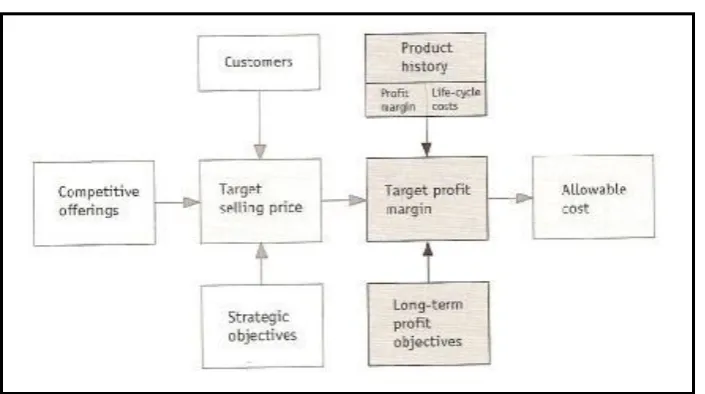
Some previous studies stated that both target cost and allowable cost are same. In the first equation allowable cost is the difference between the target selling price and the target profit margin and target cost is the gap between the allowable cost and expected or current cost. In second equation target cost is the difference between target selling price and the target profit. According to previous studies allowable and estimated cost are different costs. On the basis of return on sales the allowable cost can be compared with estimated cost because estimated cost is based on the current level of materials, labour and overhead cost. The gap between estimated cost and allowable costs is reviewed then attainable target cost is established. Allowable cost is set on basis of external factors and it does not consider design and production capabilities of company therefore, it is difficult for the company to achieve the allowable cost in short period. Thus, designers set target cost. Cost of existing products provides cost information for future products. Such cost estimation is called the current cost or ongoing cost. Actually the difference between allowable cost and target cost also is the key focus point of target costing process.
Figure 1: Setting target price, cost and profit in target costing process.
Source: Adapted from Cooper & Slagmulder (1997)
3.1 Different Cost Terms are used in Target Costing:
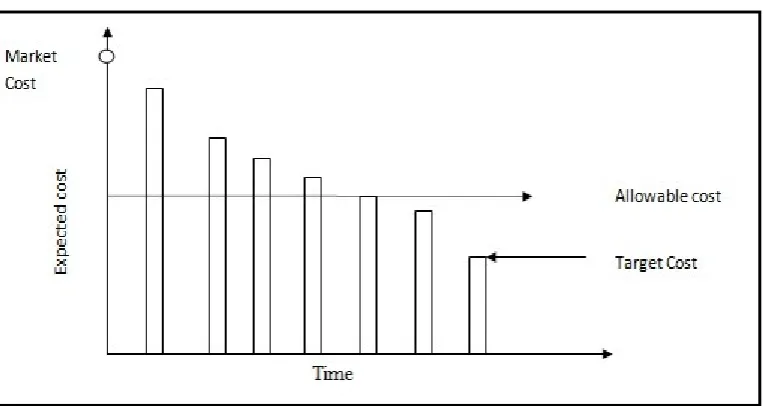
Operational and strategic efficiency can be taken with the use of strong strategic management method which is target costing (Feil et al., 2004). According to Cooper & Slagmulder (1997), Ansari et al. (1999) target costing is a proactive and price based system which starts before production. Target costing uses different cost terms which are considered during the entire process of target costing and these are:
• Market Cost
Market cost is the benchmark or standard cost. This cost is based on the current best practices or the existing price in the market for parallel products.
• Allowable Cost
• Expected Cost
Expected cost is the calculated or estimated cost of a product in its existing stage. Sakurai (1989) used the terms “drifting costs” or “ongoing cost” or “current costs for a future product. Current cost is also known in literature as the “drifting cost” or “estimated cost”. Kato et al. (1995) described the ongoing cost as the excellent estimate of the cost of future product and it is based on the actual cost of existing products. It represents the cost that would occur if existing process technologies and product designs are applied for a new product.
• Target Cost
Target cost has different mean for different authors. Some refer it is the gap between the target price and the target profit. Others refer it as the gap between the allowable cost and the current cost. Generally this is that cost which must be reducedto achieve the allowable costs.
Allowable Costs ≥ Expected Costs ≥ Target Costs
[image:10.595.74.456.357.560.2]The different terms of costs linked with target costing are depicted in following figure.
Figure 2: Differentcost terms linked with target costing
Source: Adapted from Rybkowski (2009)
3.2 Equation Based Relation and Calculations:
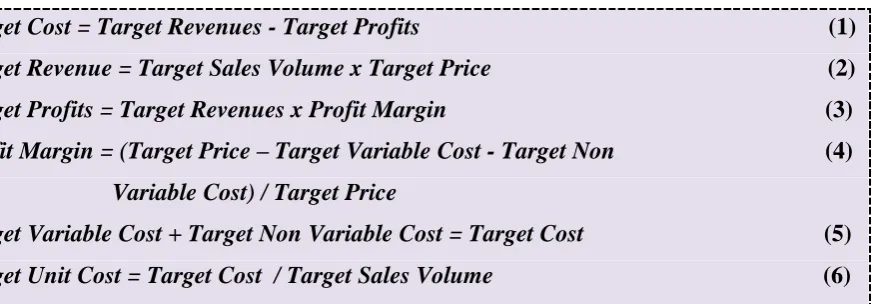
Monden & Hamada (1991) presented that the ratio of direct or variable costs to total manufacturing costs has increased up to 90% and direct material costs to total variable costs ratio is about 85% in the automobile industry which is the main cause of target costing adoption. Target costing is a mean to manage especially direct material costs (Monden & Hamada, 1991). Tani et al. (1994) stated that in the computation of target costs generally all direct costs are included. Fixed manufacturing costs are excluded from target costing because fixed manufacturing costs stand for long period; these are for overall production capacity and not covered under value engineering. Several authors stated that target costing often begins in the purchase department. Negotiation plays important role in every step of target costing process such as negotiations about the assignment or decomposition of the target cost among different functions or components of the product. The following equations explain the relationship between different terms profits, sales and target cost. Formulas regarding target cost calculation are presented in the following table as under:
Target Cost = Target Revenues - Target Profits (1)
Target Revenue = Target Sales Volume x Target Price (2)
Target Profits = Target Revenues x Profit Margin (3)
Profit Margin = (Target Price – Target Variable Cost - Target Non (4)
Variable Cost) / Target Price Target Variable Cost + Target Non Variable Cost = Target Cost (5)
[image:11.595.94.531.391.543.2]Target Unit Cost = Target Cost / Target Sales Volume (6)
Table 1: Target costing calculation formulas
Source: Adapted from Bayou & Reinstein (1998)
3.3 Methods for Setting Target Cost:
more or less is imposed on product development team. The bottom-up method is also called adding-up method. In this method, setting of target cost starts from the product development team or department itself. Kato (1993) described that in bottom up method cost is estimated for each component on the basis of actual or current cost then total target cost is set by adding up all individual parts or subassemblies target costs. In adding up method target cost for each component or activity or function is anticipated on the basis of current cost level with considering all potential cost reductions. By reducing components costs companies can reduce the cost of product. This method is based on the past cost data and existing technologies of the company. The basic idea of the deductive method according to Kato (1993) is:
Target Cost = Expected Selling Price – Target Profit
This method focuses two important elements namely the target price and the target profit. The basic thought of the adding-up method is under stated:
Target Cost = Sum of Costs of all Components of Product
According to Kato (1993) the deductive method is better than the adding-up method because the adding up method does not provide a logical connection between profit and business plans of the company (Kato, 1993). Bayou & Reinstein (1997) pointed out two reasons of the superiority of deductive method which are: (1) it connects the target cost of product to the target profit and (2) it uses the mechanism of value engineering. The adding up method is simple than deductive method (Kato, 1993). Sakurai (1989) argued that combination of both deductive and bottom-up methods would direct best results.
4. Establishing Cross-Functional Team
research & development and cost planning to reduce the overall product cost. The top managers who have knowledge of the company‟s strategic plans and goals lead cross-functional team. Target costing process is a collective effort. The team members have to coordinate in their activities and prepare an overall achievable plan. Kato (1993) argued that target costing has positive impact on new product design and development and it should be used with caution, also for creative products design engineers should be worked under relaxed conditions not under time pressure. In the target costing process designers of products are the main persons who reduce costs, because they identify the most appropriate actions for product design and cost reduction.
5. Determine the Drifting Cost
Actual or present cost of manufacturing also known as drifting cost. This cost is estimated by the cross functional team with the assistance of the engineering department. It is determined to get the desired functions of new product which can be provided or adjusted up to the limit of target cost. The current cost of product is reduced to achieve the target cost by applying target costing tools like value engineering.
6. Use of Tool Value Engineering
According to previous studies the function oriented, the component oriented and cost assignment methods are used for target cost decomposition. In the function-oriented method the total target cost is allocated for different functions of the product. In component method the target cost is allocated for different components or parts of the product. Cooper & Slagmulder (1997) pointed out that component method of target costs decomposition should be set only when the components of product can be clearly identified. Component method is suitable when new product has design or features like old product because this method is based on historical cost information. It has been stated in previous studies that the component method is suitable for complex and innovative products because designers can be used their creativity for product design. Monden & Hamada (1991) mentioned that cost assignment method allocates target cost into cost items such as material cost, direct labour cost and purchase cost etc.
7. Achievement of Target Cost or Comparison
Kato (1993) described that cost information must be provided anytime the designers require them and not only during product development and design process. In this step estimated cost of future product is compared with its target cost during product development. Cooper & Slagmulder (1997) argued that top management constantly monitored the work progress of design engineers towards achieving the target cost. Companies use a standard system for summarizing cost data (Kato et al., 1995). Team members use their cost documents at any time according to their requirements. Cooper & Slagmulder, (1997) stated that the chief engineer continuously check the progress of cost reduction. Through continuous monitoring corrective actions can be taken to achieve the target cost.
8. Final Decision
engineering process. This is done by design team members through investigating the need of each component cost. Second drop the idea of production of that particular product. When the target cost is achieved then company can take final decision of manufacturing the product.
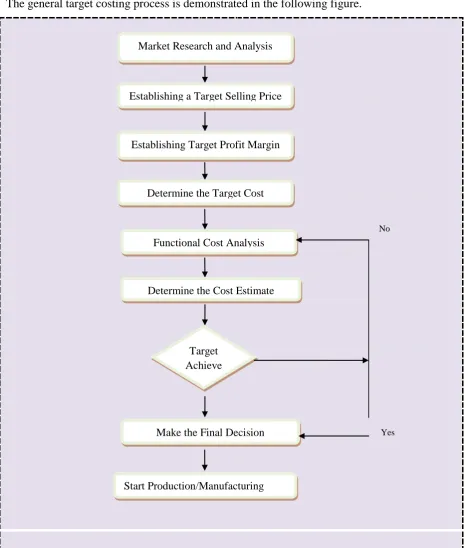
The general target costing process is demonstrated in the following figure.
No
[image:15.595.66.537.159.708.2]Yes
Figure 3: General target costing process
Source: Modified from Gagne & Discenza (1995)
Market Research and Analysis
Establishing a Target Selling Price
Establishing Target Profit Margin
Determine the Target Cost
Functional Cost Analysis
Make the Final Decision
Start Production/Manufacturing Target
Achieve d
Three Phases / Levels of Target Costing Process
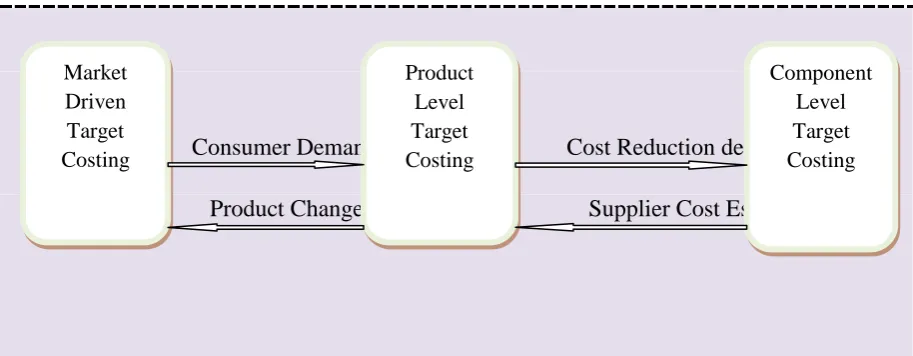
[image:16.595.73.430.265.462.2]The target costing process focuses on cost reduction or attainment of target cost without sacrificing functionality, value and quality of product. Target costing process is human-based thus, it depends on personnel or members intelligence and creativeness. The target costing process is different according to different authors. Cooper & Slagmulder (1997) described three main levels of target costing process as: (1) Market driven costing, (2) Product level target costing and (3) Component-level target costing. The following figure shows the sequence of three phases of target costing.
Figure 4: Three levels of target costing
Source: Adapted from Cooper & Slagmulder (1997)
The general process of target costing is broadly divided into these three steps. This elaboration is mainly suitable for construction industry. The general target costing process may be applied for different products and services industries.
level provides as well as takes some information from third level. This is demonstrated in the following figure.
Consumer Demands Cost Reduction demands
[image:17.595.72.529.130.308.2]Product Changes Supplier Cost Estimates
Figure 5: Relationship between three levels of target costing
Source: Adapted from Cooper & Slagmulder (1999)
1. Market Driven Target Costing
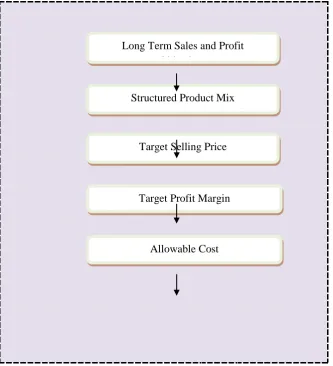
In this phase of target costing “allowable cost” is introduced. Allowable cost is that cost at which product must be produced to take desired profit. This cost is based on the customer expectations. The target selling price is expected by the market and it is decided after functionality and quality analysis. Target profit margin is expected by the firm and it must cover the cost of product. In target costing process main part is attainment of target cost which is the gap between the allowable cost and expected cost. Once the allowable cost for a new product is set the first level of target costing process is completed which is called market-driven costing (Cooper & Slagmulder, 1997). Finally Cooper & Slagmulder (1997) includes following five steps in market driven costing process.
(1). Decide long-term sales and profit objectives (2). Constitution of the product lines
(3). Set the target selling price of product (4). Establish the target profit margin (5). Determine the allowable cost
These five steps of market driven costing are explained through following figure.
Market Driven Target Costing
Product Level Target Costing
Figure 6: Market driven target costing for a single product
Source: Adapted from Cooper & Slagmulder (1997)
Cooper & Slagmulder (1997) stated that nature of the customers and intensity of competition are two major factors that affect market driven costing and these factors help in collecting information about market, customers, competitors and ensuring the problems about the new product. According to Cooper & Slagmulder (1997) following factors influence market driven costing.
Intensity of competition: Number of competitors in market.
Degree of customer sophistication: Sophisticated customers are those customers who are highly knowledgeable about available product offerings and they can detect minor differences between competitive products. Target costing is beneficial in the environment of more sophisticated customers (Cooper & Slagmulder, 1997).
Rate of customer requirements change: Customer expectations lead product‟s design modification and the requirement of new products to increase probability of
Long Term Sales and Profit Objectives
Structured Product Mix
Target Selling Price
Target Profit Margin
success. This happens mainly in automobile industry. Target costing is more suitable in the environment where preference of customers change rapidly (Cooper & Slagmulder, 1997).
Degree of understanding the future product requirements of customer:
Companies pay more attention for those consumers who have less knowledge regarding their future product requirements. Target costing is less beneficial in such market where there is complexity in predicting future customer requirements (Cooper & Slagmulder, 1997).
2. Product Level Target Costing
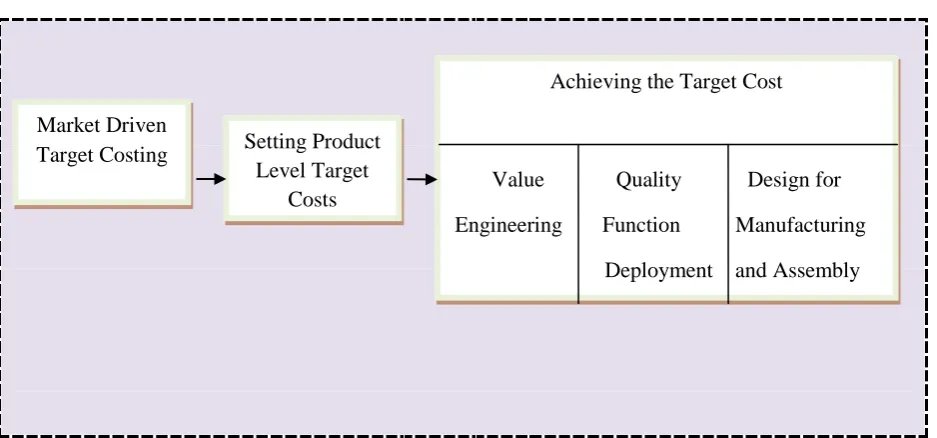
In this step, product level target cost is determined and this cost is achievable due to the product designers‟ considerable efforts and creativity. This is related with product level cost management and it includes product strategy and the uniqueness of the product. Based on the firm‟s conditions and capabilities the target cost can be less than or equal to the allowable cost. The current cost is the actual cost of product without using any improvement or cost control technique. In this phase the excess cost over current cost is reduced, with the help of value engineering. Target cost attainment is a strategic cost reduction challenge. If the actual cost exceeds the target cost of product then actions are taken to reduce that cost. Manufacturing costs can be decreased by taking various actions like re-engineer the manufacturing process. In product level target costing step, product designers find new ways of developing product at target cost to satisfy customers (Cooper & Slagmulder, 1997). The target cost of product is determined at that level, where company can sensibly expect to achieve the target cost with its and suppliers capabilities. The cardinal rule of target costing follows discipline throughout the product design process (Cooper & Slagmulder, 1997). Finally the process of product level target costing has following steps.
(1). Set target cost of product:
It is determined as the gap between allowable cost and expected cost of product.
(2). Discipline the process:
When company has established target cost of product. This step follows designing the product at target cost and chief design engineer checks the progress toward achieving the target cost.
If target cost is achieved then next step is manufacturing product carefully but products those costs exceed their target costs are not launched.
Cooper & Slagmulder (1997) pointed out that two major factors product strategy and characteristics of the product influence the product level target costing and these factors help in collecting and determining information regarding the trend of historical cost and customer requirements.According to Cooper & Slagmulder (1997) following factors influence product level target costing.
Product strategy: Number of products in the product line, the frequency of redesign of product and the level of innovation are considered under product strategy. Target costing is more beneficial in case of high rate of product innovation (Cooper & Slagmulder, 1997).
Product complexity: It determines the problems in managing the process of product design. Product complexity is affected by factors such as the number of components of the product, production process, difficulty of manufacturing product components and the variety of technologies required for the production of the product (Cooper & Slagmulder, 1997). Target costing is more beneficial where product complexity increases (Cooper & Slagmulder, 1997).
Product development duration: It refers time required for the product development from its conception stage to its final stage of production. Cooper & Slagmulder (1997) noted that target costing is more beneficial for the longer product development cycle products.
Magnitude of investments: It includes production start up, launching and research & development costs. Target costing is more suitable for high investment products (Cooper & Slagmulder, 1997).
Figure 7: Product level target costing
Source: Adapted from Cooper & Slagmulder (1997)
3. Component Level Target Costing
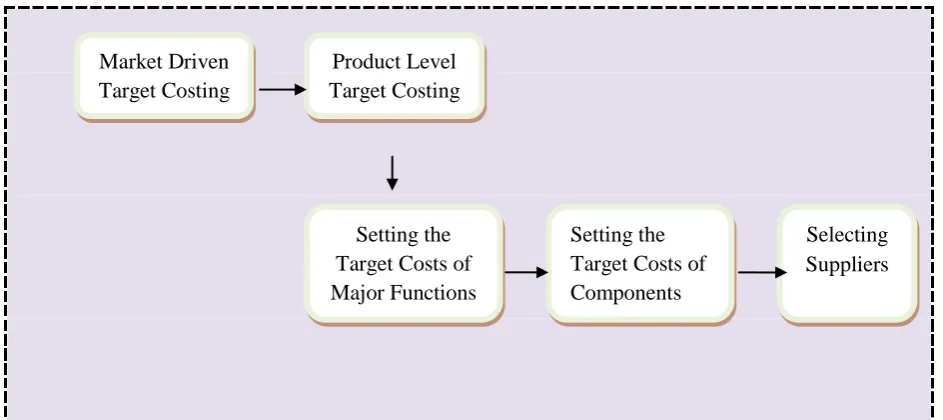
In this step, total target cost is divided into target costs for product components. After the accomplishment of second phase component level target costing starts. In this phase the components of product are examined. The input from suppliers and construction process are included under this level. After the establishment of the target cost of product, target cost for the suppliers of company is decided. Cooper & Slagmulder (1997) called this step „component-level‟ costing. Therefore, transmitting the cost pressure of product to the suppliers is very important for firms. Relations with supplier are extremely critical for the success of the company.
Cost and quality of items provided by the suppliers are two very important factors in the selection of suppliers. This phase handles the costs associated with components of product. It includes the cost of the components and costs of these components are charged by suppliers. Firms that depend on imported raw materials must have flexible supplier based strategy. Cost reduction is done when it is allocated across the component level. Component level target costing is the last step. It is estimated that the suppliers of the company find ways to provide components or parts of product at their target costs (Cooper & Slagmulder, 1997). This level of target costing also includes the significant ideas given by the supply chain partners on the
Achieving the Target Cost
Value Quality Design for
Engineering Function Manufacturing
Deployment and Assembly Market Driven
Target Costing Setting Product Level Target
design and technology changes, for the final production of the product. According to Cooper & Slagmulder (1997) following four steps are in the process of component level target costing.
(1). Decompose target costs of major functions:
The product design teams identify key functions of product. Functions are related with the performance of product. These teams are responsible for every key function of product and the team involves persons from product design, engineering, manufacturing and purchasing departments. The first step is the use of components historical cost as the starting point for determination of the component level target costs of new products.
(2). Set target costs of components:
Chief engineer after negotiation about product design with product design team members sets target cost of each major function then total target cost is decomposed for appropriate components of product (Cooper & Slagmulder, 1997). Components are mainly related with the parts of product and target cost of component depends on factors like its need, nature etc.
(3). Select suppliers:
The step is related with the selection of suppliers for different product components. Selection process of suppliers starts with the quotation price given by suppliers to provide product. The quoted prices of product given by suppliers are compared with components level target costs. If quoted prices are satisfactory then company selects suppliers otherwise further negotiations are made by company. The selection of suppliers is often based on their competitive bids, reputation in market and their degree of innovation.
(4). Reward supplier creativity:
To motivate suppliers companies use incentive plans. To enable suppliers efficient and innovative companies should manage their suppliers actively. This step is related with maintaining supplier relations and motivates suppliers to increase their creativity. Target costing can be applied in proper manner with cooperation and long-term supplier relations.
Figure 8: Component level target costing
Source: Adapted from Cooper & Slagmulder (1997)
According to Cooper & Slagmulder (1997) following factors influence the component-level target costing.
Supplier base strategy
Power or control over suppliers Supplier creativity
Degree of integration with suppliers and departments Co-operative relation between firm and suppliers
Conclusion
The use of new cost management method target costing is increasing in current competitive market environment. It is an emerging costing method which is being used by many manufacturing firms not only in Japan but in other countries also. Target costing is implemented in both ways in companies. The general process has common steps and with these steps target costing can be easily implemented in any manufacturing firm and for simple products. The specific process of target costing includes its three levels. Three levels of target costing have three main areas which are focused in the whole process of target costing and the specific process of target costing covers all steps of its general process. The specific process focuses on different functions performed in each level and this process is more suitable for complex type products and for large scale production. The general and
Market Driven Target Costing
Product Level Target Costing
Setting the Target Costs of Major Functions
Setting the Target Costs of Components
specific processes of target costing have all most similar activities but the specific process is improved form of its general process. Finally it can be concluded that the target costing method can be implemented either through its general or specific process but general process is comparatively a simple way for the application of target costing in any big and small firm but three levels of target costing as a specific process for the implementation of target costing is more useful for complex type products.
References
Ansari, S. L. & Bell, J. E. (1997). Target costing: the next frontier in strategic cost
management. New York: McGraw-Hill.
Ansari, S., Swenson, D., Bell, J. & Kim, W. (1999). Target costing: Lesson from Japan.
International Journal of Strategic Cost management, Vol. Autumn, pp. 3-11.
Bayou, M. E. & Reinstein, A. (1997). Formula for success: target costing for cost-plus
pricing companies. Journal of Cost Management, Vol. September-October 1997, pp.
30-34.
Bayou, M. E. & Reinstein, A. (1998). Three routes for target costing. Managerial
Finance, Vol. 24, No. 1, pp. 28-45.
Cooper, R. & Chew, W. B. (1996). Control tomorrow‟s costs through today‟s designs.
Harvard Business Review, Vol. 74, No. 1, pp. 88-98.
Cooper, R. & Slagmulder, R. (1997). Target costing and value engineering. Portland: Productivity Press, IMA Foundation for Applied Research.
Cooper, R. & Slugmulder, R. (1999). Develop profitable new products with target costing. Sloan Management Review, Vol. 40, No. 4, pp. 23-35.
Everaert, P., Loosveld, S., Acker, T. V., Schollier, M. & Sarens, G. (2006). Characteristics of target costing: theoretical and field study perspectives. Qualitative
Research in Accounting and Management, Emerald, Vol. 3, No. 3, pp. 236–263.
Feil, P., Yook, K. & Kim, I. (2004). Japanese target costing: a historical perspective.
International Journal of Strategic Cost Management, Spring.
Fisher, J. (1995). Implementing target costing. Journal of Cost Management, Vol. 9, No. 2, pp. 50-59.
Gagne, M. L. & Discenza, R. (1995). Target costing. Journal of Business and Industrial
Hiromoto, T. (1991). Restoring the relevance of management accounting. Journal of
Management Accounting Research, Vol. 3.
Kato, Y. (1993). Target costing support systems: lessons from leading Japanese companies. Management Accounting Research, Vol. 4, No. 4, pp. 33-47.
Kato, Y., Boer, G. & Chow C. W. (1995). Target costing: an integrative management process. Journal of Cost Management, Spring, pp. 39-51.
Monden, Y. (1995). Cost reduction systems: target costing and Kaizen costing. Portland: Oregon, Productivity Press.
Monden, Y. & Hamada, K. (1991). Target costing and kaizen costing in Japanese automobile companies. Journal of Management Accounting Research, Vol. 3, pp. 16-34. Rybkowski, Z. K. (2009). The application of root cause analysis and target value design
to evidence-based design in the capital planning of healthcare facilities. Dissertation,
University of California, Berkeley.
Sakurai, M. (1989). Target costing and how to use it. Journal of Cost Management for the
Manufacturing Industry, Vol. 3, No. 2, pp. 39-50.
Tanaka, T. (1993). Target costing at Toyota. Journal of Cost Management, Spring, pp. 4-11.
Tani, T. (1995). Interactive control of target costing. Management Accounting Research, Vol. 6, pp. 399-414.
Tani, T., Okano, H., Shimizu, N., Iwabuchi, Y., Fukuda, J. & Cooray, S. (1994). Target
cost management in Japanese companies: current state of the art. Management
Accounting Research, Vol. 5, pp. 67-81.