International Research Journal of Human Resources and Social Sciences Vol. 2, Issue 11, Nov 2015 IF- 2.561 ISSN: (2394-4218)
© Associated Asia Research Foundation (AARF)
Website: www.aarf.asia Email : [email protected] , [email protected]
THE APPLICABILITY OF THE CONVENTIONAL MANAGEMENT
MODEL IN MOSQUE MANAGEMENT: AN EVALUATION
Fadzila Azni Ahmad
Centre for Islamic Development Management Studies (ISDEV) School of Social Sciences
Universiti Sains Malaysia, 11800 Pulau Pinang, Malaysia
ABSTRACT
Lately, numerous parties have voiced out their concern about returning the function of
the mosque as the main centre for developing the ummah. Numerous suggestions were
adduced about expanding the functions of a mosque from solely being a house of
worship. Among the suggestions was to assimilate the conventional management model
into the present mosque management system. This suggestion intended to make the
mosque a more dynamic centre of development for the Islamic ummah. The McKinsey 7S
management framework founded by Peters and Waterman as well as the 4M management
concept adduced by Ishikawa are among the management models suggested for adoption
into the present mosque management. Besides that, it was suggested that the mosque
make the ISO 9000 quality series management recognition as a benchmark for the
management model that has been and will be practiced. From an operational aspect, the
implementation of this matter appears very positive. However, evaluation from solely the
operational aspect is inadequate. Examination from the philosophical aspect that
includes tasawwur, epistemology and ontology is also needed so that a truly effective
management model according to Islam is adduced. Hence, this paper would evaluate the
applicability of conventional management models based on evaluation from an Islamic
perspective by concentrating on its tasawwur, epistemology, ontology and operational
aspects. Thus, it is hoped that a method for managing mosques according to Islam would
be found.
INTRODUCTION
The mosque is an important development institution in the lives of Muslims. According to historical anecdotes, the mosque was the first institution built during the Prophet‟s s.a.w.1 migration (hijrah). Besides that, the mosque plays the role of a centre for developing the relationship between humans and Allah s.w.t. and also amongst humans. For example, during the era of the Prophet s.a.w. the mosque‟s role among others was a place of worship, centre for propagating Islamic poetry, centre for administration and governance, centre for building morality, a warehouse of knowledge, centre for finance and defrayment, a place to seek justice and rights, army post and defence as well as welfare2. However, after the 14th century, that is after the fall of the Ottoman Empire, the function and role of the mosque started to depreciate and become decreasingly less dynamic (BAHEIS, 1996)3. In other words, the mosque as an institution was referred to as a place of certain particular worship, such as performing mandatory prayers and iktikaf only. Only lately have people come to realize and make efforts to return the role of the mosque to a centre for development and activity for Muslims. For this purpose, numerous suggestions and propositions were made so that the institution of the mosque is able to plays its original role. Among them were changes to the most critical aspect, which is the management of the mosque4. To make changes from a managerial aspect, a management model that is truly suitable and effective is needed. Thus, by applying a suitable and effective management model, the actual and proper role and functions of the mosque could be attained and optimized (MUIS, 2000: 74). The question now is which suitable and effective management model should be applied towards managing the mosque.
Lately, the conventional management models applied by most institutions and organizations were found to be management models from Japan and the West. For example, the Quality Control Circle (QCC) management model, the 5-S management practice (Seiri, Seiton, Seiso,
Seiketsu dan Shitsuke) and the Total Quality Management (TQM) method, which have been
dominantly applied in Malaysia today, had originated either from Japan or from the West5. The use of these conventional management models are widespread in this country so much so that it is proposed to be applied in every department in the country‟s public service (PKPA, 2003 and NPC, 2002).
effective and established role (Muhammad Rais Abdul Karim, 2001). Among the conventional management models suggested for managing the mosque are the 7S McKinsey Management Framework and the 4M Management Concept (Muhammad Rais Abdul Karim, 2001; and Md Rusly Haji Bahazim, 2001). Besides that, it is suggested that mosque management make the ISO 9000-series quality management recognition as a benchmark for the management model that has and will be practiced6. The question now is whether the suggested management model is suitable for application in the management of mosques.
From an operational aspect, applying conventional models of management seems like a positive step. However, evaluating from solely an operational aspect is not enough. Consideration from a philosophical aspect, which includes tasawwur, epistemology and ontology, is also needed. This is because a management model that is truly effective according to Islam is than adduced to the mosque. For this purpose, this paper intends to evaluate the applicability of conventional management models based on evaluations from both the philosophical and operational aspects. However, this paper will only focus on discussions about the 7S McKinsey Management Framework or better known as the 7S model. This model was chosen because it is widely used in Malaysia. Besides that, the 7S model is also a model suggested by the Malaysian Administrative Modernisation and Management Planning Unit (MAMPU) to be applied in managing mosques in Malaysia (Muhammad Rais Abdul Karim, 2001).
G UNIT
In a more specific tone, evaluation of the 7S model in this paper would focus on aspects such as tasawwur, epistemology, ontology and its operations. Thus, for this purpose, this paper is divided
into three main sections. Firstly, this paper would look into the background of the formation of the model and the basic concepts of the 7S model. The next section would witness the evaluation of the model based on the aspects of tasawwur, epistemology, ontology and its operations. Lastly, this paper would form conclusions about the applicability of the 7S model used in managing mosques.
THE CONCEPT AND PHILOSOPHY OF THE 7S MODEL
The History of the 7S Model
building the model. The building of the 7S model was based on research that was fully funded by McKinsey & Co9. Two consultants, namely Tom Peters and Jim Bennett (Pascale and Athos, 1981: 9), initially led the research.
Based on their research, Peters and Bennett summarised that the factor that caused American companies to fail when competing with Japanese companies was the over emphasis on company strategies and structure. This caused companies to neglect other elements in the company (Saunders and Wong, 1985: 121) although these elements were equally important in ensuring the effectiveness of the company10. Based on the guidance provided by the Japanese companies, Peters and Bennett next adduced three more elements that were thought needed emphasis when managing companies, especially when ensuring the effectiveness of a company. These elements were Style, System and Superordinate Goals11. At this stage, Robert Waterman, the Director of McKinsey & Co. at that time, got involved in the study. He felt that the idea by Peters and Bennett was very useful. However, the idea was too difficult to be translated into a form that could be implemented. He then invited two management experts, Richard Tanner Pascale from Stanford University and Anthony Athos from Harvard University, to join the team of researchers (Pascale and Athos, 1981: 11).
In June 1978, all the members of the research team decided to rearrange the elements so that their inter-relationships and effect on the organization would be easier understood and practiced12. Consequently, the 5S model was introduced consisting of Strategy, Structure, System, Style and `Superordinate Goals’. However, for the purpose of improving the 5S model,
Peters, Athos and Pascale later suggested the addition of one more element, namely `Sequencing‟. This element was added with the view that it would enhance the company‟s level of management, especially from the aspects of time and production efficiency (Pascale and Athos, 1981: 11).
Hard ‘S’ Components
Soft ‘S’ Components
not have any significant relations with the other elements (Pascale and Athos, 1981: 12). McKinsey & Co. eventually introduced the newly formed 7S model to American companies with the intention that it would be applied in managing the companies. Until now, seventy companies have applied the 7S model under the supervision of McKinsey & Co.
Basic Concepts of the 7S Model
In principle, this model has outlined seven elements that influence the effectiveness of organizational management. The elements are Structure, Strategy, Systems, Skills, Staff, Style and Shared Values. These elements are divided into two components. First is the Hard `S’ component comprising the elements of Structure, Strategy and System. Second is the Soft `S‟ component consisting of Skills, Style and Shared Values (Ten Have et.al., 2003: 138). All the elements in the 7S model are interrelated. This is clearly shown in Diagram 1 below.
Diagram 1: The 7S Model
Source: Ten Have et.al. (2003, 138) and Harding and Long (1998: 181)
the organization and could further jeopardise the effectiveness of the organization (Harding and Long, 1998: 181).
As explained earlier, elements in this model are divided into two components, Hard `S‟ and Soft `S‟ components (Refer to Diagram 1). Elements in the Hard `S‟ component are clearer and easily identified and could be obtained from company documents such as strategic statements, corporate planning and the company‟s organizational chart. Meanwhile, the Soft `S‟ component is rather an implied feature and difficult to explain because these elements are prone to changes. It also heavily depends on the members of the organization itself. Thus, based on this basis, the elements in this component could be involved in the company‟s plans. This was the reason most companies in America were more focused on the Hard `S‟13 components. However, Peters and Waterman stressed that all the seven elements in the 7S model need equal focus because each element provides an effect on the achievements of the organization (Peters and Waterman, 1982, 9).
Description of the Elements in the 7S Model
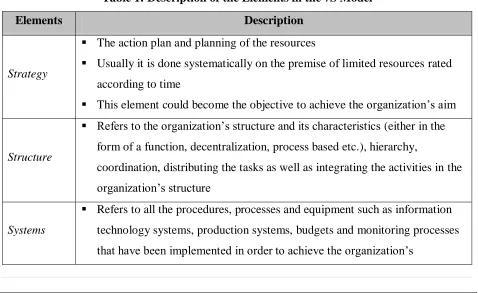
[image:6.612.69.547.474.767.2]The relationship between the elements in the 7S model and the organization‟s achievement and effectiveness can be seen in more detail in the elaborated definition of each element. Hence, Table 1 below outlines the elaborated definition for each element in the 7S model.
Table 1: Description of the Elements in the 7S Model
Elements Description
Strategy
The action plan and planning of the resources
Usually it is done systematically on the premise of limited resources rated according to time
This element could become the objective to achieve the organization‟s aim
Structure
Refers to the organization‟s structure and its characteristics (either in the form of a function, decentralization, process based etc.), hierarchy,
coordination, distributing the tasks as well as integrating the activities in the organization‟s structure
Systems
objectives.
Staff
The main personnel in the organization
This element involves the issue of recruiting staffs that are qualified, skilled and experienced for the organization and provide training and career
development so that the staffs function according to the organization‟s objectives. Besides that, this element also involves description of the staff‟s demographics (example: number of staffs, compensation, working
environment, perception about work and staffs) and the socialization process for staffs.
Style
The type of management collectively implemented towards achieving the organization‟s objectives.
Comprises organizational culture (example: distribution of tasks, proactive and reactive focusing, professionalism and evaluation orientation)
Skills
Refers to characteristics of preferred capabilities that should be inherent in every member of the organization (example: skills and efficiency training, transfer of knowledge, skills inventory)
Shared
Values
It is the basis that builds confidence and hope amongst the members of the organization.
It is also a principle or concept held by organizations and a value planted in every personnel (example: client oriented, service oriented, profit oriented, recognition, honour, endowment, justice, good-will, team work and welfare) Sources: Ten Have et.al. (2003: 138), and Harding and Long (1998: 181), Pascale and Athos (1981: 81) and http://www.ismonline.com/
The description in Table 1 shows that each element in the 7S model has a specific role in enhancing the effectiveness of the organization. All the seven elements are said to represent each aspect in the management of the organization in a holistic fashion. Based on this premise the model was positively accepted, especially among the company‟s managers.
CONTEMPORARY CRITICISM ABOUT THE 7S MODEL
those who view this model as unsuitable for application. Among the main criticism voiced by those who are of that view was the limitations of the model when applied to an unstable environment (Llinitch et. al., 1998: 86). Moreover, Richard A. D‟Aveni, as a response to the earlier criticism, built a model that was a modification of the 7S model14. Besides that, there were also those who were of the view that the 7S model is too complicated. It also did not focus on elements of quality, technology and humans, which are actually important elements that ensure the effectiveness of the organization, especially in organizational competitiveness strategies (Bremer, 2002)15.
EVALUATION OF THE 7S MODEL FROM AN ISLAMIC PERSPECTIVE
Considering the 7S model is a management model that is suggested for use in mosque management, it is important to examine its applicability according to Islam. Examination according to Islam includes examination from a philosophical aspect comprising aspects of tasawwur16, epistemology17 and ontology18 of the model. In addition, examination from an operational aspect is also needed so that practical implementation of this model could be evaluated.
Evaluation from the Tasawwur Aspect
The main objective of building the 7S model was to enhance the performance and effectiveness of the organization, especially in a competitive environment. More specifically, this model was built with the intention to instil changes to American companies, which at that time had failed to withstand the competition at a world level (Pascale and Athos, 1982: 16 and Saunders and Wong, 1985: 123). Enhancing the performance and effectiveness of the company, especially in a competitive environment, leads towards the objective to enhance productivity followed by the company‟s profit. Least of all the use of this model would maintain the company‟s resilience in a competitive environment.
client satisfaction actually stand on the premise that natural resources are limited while human needs are unlimited (Muhammad Syukri Salleh, 1994). This presumption is actually in line with the presumption of conventional philosophy, which says that natural resources are limited and it needs to be exploited the best as possible in order to fulfil the insatiable human need.
The aim and premise of this model actually contradicts the three main basis of tasawwur Islam, which is Allah SWT as the Creator and both human kind and nature as creatures of the Creator (Muhammad Syukri Salleh, 2003a: 21). Based on the first and second basis, which states that Allah is the Creator and human kind is a creature created by HIM, profit maximization should not be the eventual aim of the organization and its members. The eventual aim should be to obtain the blessing of Allah SWT, the Creator of all creatures in this world (Muhammad Syukri Salleh, 2003a: 18). Moreover, the „limited resources‟ and „unlimited human wants‟ premises contradict all three basics of tasawwur Islam. The issue of limited resources would not have arisen if considered from the tauhid perspective, which is the relationship of Creator-Subject between Allah SWT and natural resources. Implementing the distribution method in Islam is a manifestation of man‟s status as a subject and is also able to overcome the issue of limited natural resources. In addition, human wants can also be limited when humans, as subjects of Allah SWT, endeavour to achieve better control of natural inclinations (nafsu) in order to receive the blessing from Allah SWT (Muhammad Syukri Salleh, 2003a: 13).
Evaluation from an Epistemological Aspect
The 7S Model is a product by a group of consultants from McKinsey & Co and contemporary management thinkers from the West. According to Islam, it is not wrong to adopt the product of human thinking as a source of knowledge (Syed Muhamad Dawilah Al-Edrus, 1993: 40). However, to accept the product of human thinking as the only source of knowledge is not acceptable. This is because the human mind and senses have limited ability, especially in perceiving something that is not materialistic and abstract, such as matters that are spiritual or metaphysical (Muhammad Syukri Salleh, 2002: 22). In order to perceive matters in such form it needs a level of knowledge that is higher than common knowledge and cognitive reasoning20. An advanced level of knowledge referred to here is ‘nadhari‟ knowledge and religious reasoning based on the al-Qur‟an and Hadith (naqli)21.
and problem solving using this model become superficial and not holistic. For example, the reason for the organization not being able to achieve the actual performance can only be related to external elements. It cannot be perceived that Allah SWT, being the Creator, would have sanctioned every effort made by humans, whether it ends in success or failure. It would be more complicated since using this model does not help to analyse or solve management problems at the grass-roots level, for example management problems due to matters pertaining to Satan and natural inclinations or impulses (hawa nafsu) (Muhammad Syukri Salleh, 2003a: 11). The perception of spiritual and metaphysical matters requires a high level of knowledge. Therefore, the management model for mosques should emerge by combining both the common and „nadhari‟ knowledge and sourced from sources of knowledge in Islam, such as the al-Qur‟an, al-Hadith, Ijmak Ulama and Qiyas.
Evaluation from the Ontological Aspect
The 7S model stands on the premise that a company or an organization comprises seven elements, such as Structure, Strategy, System, Skill, Staff, Style and Shared Values. Although this model tries to outline all the variables or elements that influence the management of the organization; hence, it is still not complete because it only considers quantitative measurements. In other words, this model is strongly influenced by values that are materialistic and external to humans. For example, an organization‟s measure of success, as outlined by this model, is the ability to compete. The manifestation of the ability to compete is measured by the level of production and profit attained when the actual success according to Islam cannot be measured through material elements only. Conversely, success in Islam is measured by the level of the iman and taqwa possessed by the members of the organization22.
Evaluation from an Operational Aspect
The 7S model was specifically built for profit-oriented business organizations so that they could withstand a competitive environment, whereas the mosque is a non-profit oriented service institution. Based on this premise, as an operational model, this model was found to be unsuitable for mosque management, as it needed a management model that operated according to its concept and role.
In addition, although the concept of a mosque has changed to a profit-oriented business organization or also known as tijari, applying the 7S model is still not a suitable choice. This is because the philosophy of the 7S model contradicts the philosophy of the mosque itself. The mosque is an Islamic-based developmental institution, which has its own philosophy and is very different from conventional philosophy.
APPLICABILITY OF THE 7S MODEL IN MOSQUE MANAGEMENT
Based on the study done on the 7S model, it could be concluded that this model is not suitable for application in mosque management. The unsuitability of the application was measured based on four aspects, namely tasawwur, epistemology, ontology and the operations of the model. The examination from the tasawwur aspect showed that the 7S model was based on the same philosophy as the conventional social science philosophy. Examination from an epistemological aspect showed that the 7S model relied on common knowledge (ilmu daruri) that is based solely on arguments by the human mind. Examination from an ontological aspect showed that concepts found in this model, such as the concepts of „success‟ and „humankind‟, are not similar to that adduced by Islam. Lastly, the examination from an operational aspect found that this model was unsuitable with the mosque concept, which is basically a non-profit oriented service institution.
(mardhatillah) (Muhammad Syukri Salleh, 2002: 49). All the essence of the management model must actually be in accordance with Islamic tasawwur and epistemology by itself and different from the tasawwur and epistemology of conventional social science philosophy.
Specifically, the mosque management model must be pivoted on tasawwur Islam, which specifies that Allah SWT is the Creator while humankind and nature are creations created by HIM. It must always be based on Islamic epistemology with its main source being the al-Qur‟an, al-Hadith, Ijmak Ulama and Qiyas. Next, building the concept or ontology and the method of implementation or operating the management model by the mosque needs to be based on Islamic tasawwur and epistemology.
CONCLUSION
As a conclusion, when applying management models for the purpose of managing mosques, detailed studies should first be initiated. This implementation is very important in order that the management model that is adopted is ascertained to be suitable for application in the management of mosques. Thus, to evaluate the applicability of the management models the measurement needs to be made according to the aspects of tasawwur, epistemology, ontology and its operations. By applying a management model that is truly established based on the measurements mentioned above, it is hoped that mosques would return to the role played during the glamorous and esteemed era of Islam.
ACKNOWLEDGEMENT
This paper is part of the various output from the research entitled Islamic-Based Development [(RUT)1001/CISDEV/856001] and was funded by Research University Team (RUT) Grant, Universiti Sains Malaysia
1 The mosque here refers to the Quba‟ mosque built by Rasulullah s.a.w. himself and His
companions in the year 1 Hijrah or 622 AD in Quba‟, which was 5 km south-east of Madinah. The al-Qur‟an states that this mosque was built based on the taqwa towards Allah swt (At-Taubah 9: 108).
2
There are numerous explanations in the al-Qur‟an and al-Hadith on the functions and roles of the mosque during the era of Rasulullah s.a.w. Please refer to Muhammad Syukri Salleh et.al. (2002: 151 – 181).
3
MUIS (2000: 65) however, was of the opinion that the role of the mosque began to shrink to solely a center for worship only after 1900.
4
This matter was suggested by Muhammad Rais Abdul Karim (2000), MUIS (2000: 74) and Sukiman Bohari (1996:iii)
5
For example, QCC was founded by Kaoru Ishikawa di Japan. The QCC concept was then expanded to the West by Joseph M. Juran (Mahoney and Thor, 1994: 62). The 5-S practice or other words “Sort, Arrange, Sweep, Uniform and to Always Practice” is a management model that increases productivity and quality. It was first introduced in Japan based on Total Productive Maintenance (TPM) concept adduced by Taiichi Ohno (Reithmayr, 2002). TQM evolved from the Quality Control (QC) Techniques concept founded by Walter Shewart in America (Thomas, 1995: 17). The QC Technic concept was eventually expanded by scholars specializing in quality such as Edwards Deming, Joseph M. Juran, Armand Feigenbaum, Kaoru Ishikawa, Philip Crosby and Genichi Taguchi until lastly the TQM was formed (Besterfield et.al., 2003: 4).
6
This could be seen through the Curriculum and Examination Syllabus of the Efficiency Level Course for Islamic Affairs Officers (Grade S44 and S48) that includes Imams of mosques. Quality Management MS ISO 9001: 2000 had become one of course modules meant for evaluating officer‟s competence, which is a condition for salary increments.
7
Originally, this model was called the Diagnostic Model for Organizational Effectiveness. The name was then changed to the 7S McKinsey Framework Model in honour of the firm McKinsey & Co. Please refer to http://www.themanager.org (Accessed on 1 August 2004)
8
McKinsey & Co. is a famous consulting firm with its headquarters in New York, USA. It was founded by James O. McKinsey in 1926, has more than 7000 consultants in 44 countries worldwide and provides consultancy to senior managers. Consulting Magazine named it the second best consulting firm in 2003. For further information, see http://www.mckinsey.com.
9
One of the objectives of this research was to study the factors that influence the effectiveness of the organization (Pascale and Athos, 1981: 9)
10
Refer to http://www.management-survival.com/mba/manage/manage/7-S_Framewok/ (Accessed on 1 August 2004)
11
12
At this stage, the research team consisted of five members, namely Peters, Bennett, Waterman, Pascale and Athos (Pascale and Athos, 1981: 10). Eventhough all the five were involved in building the 7S model, the individual who was frequently referred to as the founder of this model was Peters and Waterman (Kumar Amit, 2003 and Ten Have et.al., 2003: 140).
13
Refer to http://www.themanager.org (accessed on 1 August 2004)
14
This model was called the New 7S Model and contained three main components, namely vision, capability and tactics. There were two elements in the ‟vision‟ component, namely ‟Superior Stakeholder Satisfaction’ and „Strategic Soothsaying’. Whereas, the capability component has two „S‟ elements, namely „Positioning for Speed’ and „Positioning for Surprise’. Next, the tactics component has three „S‟ elements, as in Shifting the rules for competition, Signaling strategic intent, Simultaneous and sequential strategic thrusts. Refer to http://www.worksys.com/ (accessed on 1 August 2004) for a detailed explanation about the 7S Model founded by Richard D‟Aveni.
15
Besides the forwarded criticisms, there are views that say applying this model was one of the factors that caused the fall and loss of profit of several companies in the US, such as Kodak, Texas Instrument, Atari, Avon, Hewlett-Packard, Revlon and Johnson & Johnson (Saunders and Wong, 1985: 124)
16
Tasawwur referred to in this paper is the comprehensive or actual presumption related to Islam and the relations between humans that eventually becomes a philosophy or view about life (Mohd Kamal Hassan, 1993).
17
Epistemology is the theory about knowledge. More specifically, epistemology relates to the examination of the source, authenticity, method of expansion and limitations of knowledge.
18
Ontology refers to the characteristics of the existence of something and the relationship between those characteristics
19
Social science philosophy comprises two common development philosophies, which are the Capitalist and Marxists philosophies.
20
Common knowledge (ilmu daruri) is the lowest category of knowledge and it is easily understood without needing much arguments or debate. Mental reasoning are arguments that are based on thinking and rationality (Muhammad Syukri Salleh, 2003b: 16)
21 „Nadhari‟ is knowledge that needs a more abstract form of thinking and debate guided by religious reasoning. Religious reasoning is reasoning based on the al-Qur‟an and as-Sunnah (Muhammad Syukri Salleh, 2003b: 17)
22
REFERENCE
BAHEIS (Islamic Affairs Section) Prime Minister‟s Department (1996), “Paradigme Baru Masjid” sermon delivered at Khutbah Jumaat Masjid Negara Kuala Lumpur on 13 December.
Besterfield, Dale H., Berterfield-Michna, Carol, Besterfield Glen H. and Besterfield-Sacre, Mary (2003).
Total Quality Management, New Jersey: Pearson Education Inc.
Bremer, Michael (2002), McKinsey 7-S Framework, http://www.learning-org.com on 1 August 2004.
D‟Aveni, Richard A. (1994). Hypercompetition: Managing the Dynamics of Strategic Maneuvering, New York: The Free Press.
Harding, Sue and Long, Trevor (1998). MBA Management Models, Burlington, USA: Gower Publishing Company.
Kumar Amit (2003), In Search of Excellence: A Review, http://www.hrfolks.com/ knowledgebank/history of mgmt/in search of excellence.htm on 1 August 2004.
Llinitch Anne Y., Lewin Arie Y. and D‟Aveni, Richard (1998). Managing in Times of Disorders:
Hypercompetetive Organisational Responses, New York: Sage Publications
Mahoney, Francis X. and Thor, Carl G (1994), The TQM Trilogy: Using ISO 9000, The Deming Prize
and the Baldridge Award to Establish A System for Total Quality Management, New York, USA:
American Management Association (AMACOM).
Md. Rusly Haji Bahazim (2001), Sejauh Manakah Sistem Pengurusan Moden Boleh Diterapkan Dalam
Institusi Masjid a paper presented at Institusi Latihan Islam Malaysia on 11 July.
Mohd Kamal Hassan (1991), “The Islamic World View” kertas yang dibentangkan di Conference on
Islamic World-View anjuran Institut Kefahaman Islam Malaysia (IKIM) dan The Malaysian – American
Comission On Educational Exchange di Pan Pacific Hotel, Kuala Lumpur on 19 August.
Muhammad Rais Abdul Karim, Datuk (2001), “Bagaimana Membawa Unsur-Unsur Pemodenan dan Pembaharuan Dalam Pengurusan Masjid” a paper presented at Seminar Kebangsaan: Penglibatan
Pegawai Daerah Dalam Pengurusan Masjid anjuran Jabatan Kemajuan Islam Malaysia (JAKIM) at
Hotel Dynasty Kuala Lumpur on 6 – 8 November.
Muhammad Syukri Salleh (1994), "Total Quality Management (TQM) From Islamic Perspective", a lecture delivered at The Conference of Managers of Bank Islam Malaysia Berhad, organized by Bank Islam Malaysia Berhad di Ferringhi Beach Hotel, Pulau Pinang, 29 May.
Muhammad Syukri Salleh (2002), Pembangunan Berteraskan Islam, Kuala Lumpur: Utusan Publications & Distributors Sdn Bhd dan Pulau Pinang: Islamic Development Management Project, School of Social Sciences, Universiti Sains Malaysia.
Muhammad Syukri Salleh (2003a), Tujuh Prinsip Pembangunan Berteraskan Islam, Kuala Lumpur: Zebra Editions Sdn Bhd dan Pulau Pinang: Projek Pengurusan Pembangunan Berteraskan Islam.
Muhammad Syukri Salleh (2003b), Pengurusan Pembangunan Berteraskan Islam: Konsep dan
Perkaedahan, Pulau Pinang: Penerbit Universiti Sains Malaysia.
Muhammad Syukri Salleh, Haji Haroon Awang, Shahidan Shafie dan Wan Asna Wan Mohd Nor (2002),
Laporan Akhir Kajian Menjadikan Masjid Putra di Putrajaya Sebagai Masjid Model Negara A Report
MUIS (Majlis Ugama Islam Singapura) (2000), Seminar Masjid 2000: Pengukuhan Keberkesanan Masjid
di Abad ke-21, Singapura: MUIS.
NPC (Perbadanan Produktiviti Negara) (2002), Productivity and Quality Enhancement Programmes 2003, Kuala Lumpur: NPC. Accessed from http://domninoapp.npc.org.my/ npc/npcweb.nsf on 26 June 2004.
Ovitz, Taylor dan Gates (t.t), 7-S Framework. Accessed from http://www.management-survival.com/mba/manage/manage/7-S_Framework on 1 August 2004
Pascale, Richard T. dan Athos, Anthony G. (1981), The Art of Japanese Management: Applications for
American Executives, New York: Warner Books Edition
Peters, Thomas J. dan Waterman, Robert H. (1982), In Search of Excellence: Lessons from America’s
Bestrun Companies, United States: Harper & Row.
PKPA (Pekeliling Kemajuan Pentadbiran Awam) (2003), Undang-Undang Malaysia: Pekeliling
Kemajuan Pentadiran Awam – Pindaan Hingga November 2003, Kuala Lumpur: MDC Publishers Sdn
Bhd.
Recklies, Dagmar (2001), The 7-S Model. Accessed from http://www.themanager.org on 1 August 2004
Reithmayr, Mary (2002), Preventive Maintenance. Accessed from http://www.freequality.org on 30 June 2004.
Saunders, John dan Wong, Veronica (1985), “In Search of Excellence in the UK” in Journal of Marketing
Management Vol 1, pp. 119 – 137.
Sukiman Bohari, Haji (1996), “Prakata” in. Lokman Ab. Rahman dan Musa Ahmad, Pengantar Sains
Pengurusan Masjid, Melaka: Majlis Agama Islam Melaka dan Kolej Islam Melaka.
Syed Muhamad Dawilah Al-Edrus (1993), Epistemologi Islam: Teori Ilmu dalam al-Quran, Kuala Lumpur: Dewan Bahasa dan Pustaka.
Ten Have, S.,Ten Have, W., dan Stevens, F. (2003), Key Management Models, Great Britain: Pearson Education Limited.
Thomas, Brian A. (1995), The Human Dimension of Quality, United Kingdom: McGraw-Hill International (UK) Ltd.