Real Stereopsis Test Using a Three-Dimensional Display
with Tridef Software
Jinu Han,
1So Young Han,
1Seung Koo Lee,
2Jong Bok Lee,
1and Sueng-Han Han
1 1Institute of Vision Research, Department of Ophthalmology, Yonsei University College of Medicine, Seoul;2Department of Radiology, Yonsei University College of Medicine, Seoul, Korea.
Received: December 19, 2013 Revised: February 9, 2014 Accepted: February 12, 2014
Corresponding author: Dr. Sueng-Han Han, Institute of Vision Research,
Department of Ophthalmology, Gangnam Severance Hospital, Yonsei University College of Medicine, 211 Eonju-ro, Gangnam-gu, Seoul 135-720, Korea.
Tel: 82-2-2019-3442, Fax: 82-2-3463-1049 E-mail: [email protected]
Meeting presentation: the European Strabis-mological Association Annual Meeting, Sep 4–7, 2013, Marseille, France.
∙ The authors have no financial conflicts of interest.
© Copyright:
Yonsei University College of Medicine 2014 This is an Open Access article distributed under the terms of the Creative Commons Attribution Non-Commercial License (http://creativecommons.org/ licenses/by-nc/3.0) which permits unrestricted non-commercial use, distribution, and reproduction in any medium, provided the original work is properly cited.
Purpose: To investigate horizontal image disparity in three-dimensional (3-D) perception using 3-D animations in normal control patients and patients with inter-mittent exotropia, anisometropic amblyopia, and partially accommodative esotro-pia. Materials and Methods: A total of 133 subjects were included. Stereopsis was measured using the Titmus Stereo test (Stereo Optical Inc., Chicago, IL, USA) and a 3-D stereopsis test with a 15 inch 3-D display laptop, adjusting 3-D parameters of 0 mm horizontal disparity to 15 mm horizontal disparity. Results:
When compared with normal controls, the average threshold of the 3-D stereopsis test was significantly reduced for esotropia patients (p<0.001) and for anisometric amblyopia patients (p<0.001), compared to normal controls. No significant differ-ence was observed between normal controls and intermittent exotropia patients (p=0.082). The 3-D stereopsis test was correlated with the Titmus Stereo test (Spearman’s rho=0.690, p<0.001). Mean difference in stereoacuity was 1.323 log seconds of arc (95% limits of agreement: 0.486 to 2.112), and 125 (92.5%) pa-tients were within the limits of agreement. Conclusion: This study demonstrated that a 3-D stereopsis test with animation is highly correlated with the Titmus Ste-reo test; nevertheless, 3-D steSte-reopsis with animations generates more image dis-parities than the conventional Titmus Stereo test. The 3-D stereopsis test is highly predictive for estimating real stereopsis in a 3-D movie theater.
Key Words: Depth perceptions, vision disparity, imaging, three dimensional
INTRODUCTION
Recently, three-dimensional (3-D) devices, such as 3-D laptop computers, 3-D televisions, and 3-D surgical devices (da Vinci robot system), have been developed and are becoming widely used.1 As a result, demand for 3-D displays has
in-creased, resulting in rapid growth of the 3-D industry. Moreover, with greater numbers of 3-D televisions and computers in the home and with the success of the movie “Avatar,” more movies are being released in 3-D.
viation, 9.99±3.52 years; age range, 4 to 22 years) were studied, consisting of normal controls and patients with in-termittent exotropia, anisometric amblyopia, and partially accommodative esotropia. This research adhered to the te-nets of the Declaration of Helsinki and was approved by the Institutional Review Board of Gangnam Severance Hospi-tal, Seoul, South Korea. Informed consent was obtained from either patients or parents. We certify that all applicable institutional and governmental regulations concerning the ethical use of human volunteers were followed during this research. The inclusion criteria were as follows: 1) ability to perform the Titmus Stereo test, 2) no manifest vertical tropia at distance or near fixation with prism cover tests, and 3) no history or presence of anterior segment or retinal disorders. A comprehensive ophthalmic evaluation was performed for all subjects, including best-corrected visual acuity, prism cover test, Worth 4-dot test, the near Titmus Stereo test (Ste-reo Optical Inc., Chicago, IL, USA), and the near 3-D stere-opsis test using a 3-D laptop with Tridef software (DDD Inc., Los Angeles, CA, USA). In addition, any previous ex-perience watching 3-D movies was noted.
Titmus Stereo test
Stereopsis was quantitatively assessed with the Titmus Ste-reo test with fly, animal, and graded circles. Subjects viewed the stereogram at a distance of 40 cm while wearing polariz-ing glasses. The examiner used his/her index fpolariz-inger to guide fixation. The subject was asked to grab the wings of the fly and point to the circle that seemed to “jump” out of the book. When a mistake was made, the immediately preced-ing target was repeated. If a correct response was made on the preceding target, that target’s disparity was used as the measurement. If that response was incorrect, steps farther back from the target series were made until the correct re-sponse was obtained. The last correct target identified was used as the patient’s stereopsis measurement. This test is a Polaroid vectograph-based near stereo test that is sensitive to disturbances or changes of near binocularity. Stereoacu-ity was recorded as “nil” if the largest disparStereoacu-ity could not be passed. A score for nil stereopsis in the Titmus Stereo test was regarded as 6000 seconds of arc (arcsec) for statistical analysis.
3-D stereopsis test
A 15 inch 3-D liquid crystal display (LCD) laptop (LG A530, Seoul, Korea) was utilized. At a distance of 66 cm, each subject watched the 3-D animation “Ice Age 2” with the Titmus, TNO, and Randot Stereo test have been used
to evaluate stereoacuity in patients with strabismic disor-der and amblyopia:2,3 numerous reports have shown that
patients with amblyopia or strabismus have reduced ste-reoacuity.4-6 These tests facilitate assessment of stereopsis
and evaluation of sensory outcomes following treatment for strabismus or amblyopia. Additionally, use of stereo-acuity testing as a method to evaluate 3-D depth percep-tion has been emphasized. In the tests, static images with vectographic or anaglyphic methods are used to produce stereoscopic images. However, these images are not identi-cal to watching a 3-D movie, because more dynamic imag-es with large disparitiimag-es are used in moviimag-es, and informa-tion other than image disparities, such as moinforma-tion parallax, are also present. In our practice, we have examined pa-tients who could not perceive depth perception in the 3-D movie theater, but had fair stereopsis results on conven-tional stereopsis tests, such as the TNO or Titmus Stereo test. In contrast, some patients with poor results in conven-tional stereopsis tests nonetheless enjoyed 3-D movies or games.
Accordingly, we were intrigued as to why some people with fair stereopsis, as assessed by a traditional stereo test, do not perceive 3-D stereopsis in the movie theater. The conventional stereopsis tests ask the viewer to select one stereoscopic image different from the others, although all images in 3-D animations have some degree of image dis-parity. Moreover, monocular clues exist in the Titmus Ste-reo test. Even in the Randot or TNO tests, it is possible to correctly respond to a random dot stereogram on the basis of decorrelation of the central dots.7 All these tests illustrate
the potential weaknesses of conventional stereo tests in evaluating real stereopsis. In addition, little is known about the minimum angular image disparity required to perceive stereopsis in 3-D animations in patients with reduced ste-reoacuity. Therefore, we decided to investigate the mini-mum horizontal disparities perceived by 3-D image percep-tion of 3-D displays containing animapercep-tions to investigate associations between the Titmus Stereo test and 3-D stere-opsis test results.
MATERIALS AND METHODS
Patients
de-when p-values were less than 0.05.
RESULTS
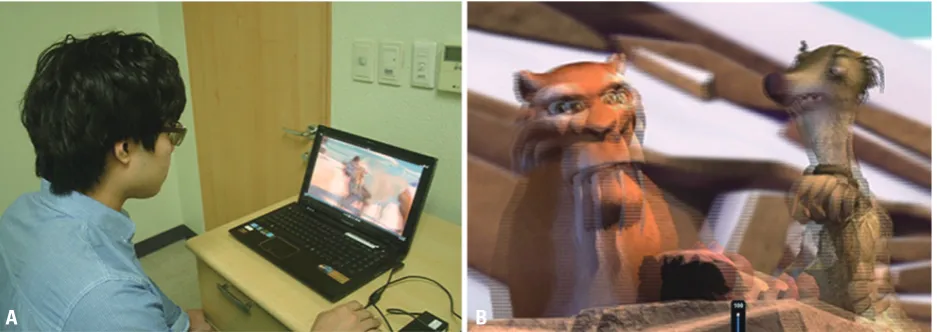
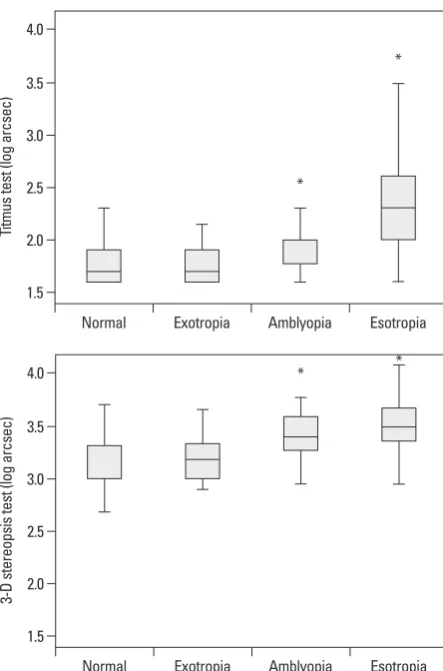
A total of 135 subjects were evaluated and separated into four groups, comprising 37 normal controls, 37 intermittent exotropia patients, 31 amblyopia (anisometric amblyopia) patients, and 30 esotropia (partially accommodative esotro-pia) patients. The mean stereoacuity threshold scores were 409.8±1210.5 arcsec (range, 40 to 6000 arcsec) using the Tit-mus Stereo test and 2532.6±1977.5 arcsec (range, 481.6 to 12029.2 arcsec) on the 3-D stereopsis tests for all subjects. Stereoacuity threshold scores were better with the Titmus Stereo test, which was statistically significant (p<0.001, Wil-coxon matched pairs test). The 3-D movie watching experi-ence was assessed, and 27 (20.0%) subjects had no previous experience, 86 (63.7%) subjects had previously watched 3-D movies in a theater, and 22 subjects said they were not sure or could not remember. Fig. 2 shows the results of compar-ing the Titmus Stereo test and 3-D stereopsis test in each group. When compared with normal controls, the average threshold of the Titmus Stereo test was significantly reduced for esotropia patients (p<0.001) and anisometric amblyopia patients (p=0.001), but not for intermittent exotropia patients (p=0.778). The average threshold of the Titmus Stereo test for esotropia patients was significantly reduced compared to intermittent exotropia patients (p<0.001), and anisometric amblyopia patients (p<0.001). Average threshold of the Tit-mus Stereo test for anisometric amblyopia patients was sta-tistically reduced compared to intermittent exotropia patients (p<0.001). When compared with normal controls, the aver-age threshold of the 3-D stereopsis test was significantly re-Tridef software for 2 minutes (Fig. 1). The re-Tridef software
created 3-D images on polarizing film that coated the LCD and the images on the display had the same image ties. All images on the display had the same retinal dispari-ties. The examiner slowly increased the 3-D parameter from 0 (0 mm image disparity) to 100 (15 mm image dis-parity). When the subjects perceived stereopsis for the first time, the minimum value of the 3-D parameter was recorded as the 3-D stereopsis score. If patients could not perceive the 3-D image, the 3-D stereopsis score was recorded as nil ste-reopsis. The 3-D stereopsis score was expressed in arcsec using the following stereopsis formula.8 Arcsec=pupillary
distance×Δd/D2×(206265) (Δd=distance between the front
object and the back object, D=distance between the observ-er and the front object).
Statistical analysis
Continuous values were expressed as mean±standard devi-ation. Stereoacuity values were transformed to log arcsec for the purpose of analysis. If the patient had no measurable stereoacuity, the next log level (0.3 log arcsec progression) above the largest disparity for that test was assigned as “nil.” The assignment of the next log level to nil is com-monly used in analysis of stereoacuity data.9,10 The
[image:3.595.58.527.545.711.2]Bland-Altman plot was used to evaluate agreement between the near 3-D stereopsis and the Titmus Stereo tests. The Wil-coxon matched pairs test was used to compare stereoacuity test scores between the Titmus stereo and 3-D stereopsis tests. Due to the noncontinuous scale of Titmus Stereo test scores, Spearman’s correlation test was used to test the va-lidity of the 3-D stereopsis test. Statistical analysis was per-formed using STATA 13.0 (StataCorp, College Station, TX, USA). Results were interpreted as statistically significant
Fig. 1. (A) Subject watches the 3-dimensional (3-D) movie displayed by a 15 inch 3-D laptop computer. (B) The video clip was converted into a 3-D movie by a TriDef 3-D media player.
stereoacuity was 1.323 log arcsec (95% limits of agree-ment: 0.599 to 2.047), and 124 (93.2%) of the subjects were within the limits of agreement.
Using a simple linear regression model, age was not asso-ciated with the Titmus Stereo and 3-D stereoacuity test re-sults (p=0.122 and p=0.375, respectively). For esotropia pa-tients, the amount of prism diopters (PD) at near was not associated with the Titmus Stereo test (log arcsec) (p=0.211) and 3-D stereoacuity test (log arcsec) (p=0.168). In addi-tion, for intermittent exotropia patients, the amount of PD at near was not associated with the Titmus Stereo test (log arcsec) (p=0.154), but was associated with the 3-D stereo-acuity test (log arcsec) (p=0.016). Using simple linear re-gression, previous experience watching 3-D movies was positively associated with high levels of stereoacuity for the Titmus Stereo and 3-D stereoacuity tests (p=0.011 and duced for esotropia patients (p<0.001) and for anisometric
amblyopia patients (p<0.001). No significant difference was observed between normal controls and intermittent exotropia patients (p=0.082). The average threshold of the 3-D stereop-sis test for esotropia patients was significantly lower than that for intermittent exotropia patients (p<0.001), but not for an-isometric amblyopia patients (p=0.091). The average thresh-old of the 3-D stereopsis test for anisometric amblyopia pa-tients was lower than that for intermittent exotropia papa-tients (p=0.006).
Correlation between the Titmus Stereo test and the 3-D stereopsis test was evaluated. Using Spearman’s correlation test, which included 135 individuals, the Titmus Stereo test score was correlated with the 3-D stereo score (Spearman’s rho=0.690, p<0.001). Fig. 3 shows the distribution using a scatter plot.
[image:4.595.72.294.63.399.2]The 95% limits of agreement using a Bland-Altman plot are shown in Fig. 4. The plot suggests that the difference between the 3-D stereopsis test and the Titmus Stereo test is independent of the level of stereoacuity. Mean difference of
[image:4.595.309.540.64.231.2]Fig. 2. Box plot illustrating the results of the Titmus Stereo and three-dimen-sional (3-D) stereopsis tests for each group of patients. *Statistical signifi-cance compared to normal controls. arcsec, seconds of arc.
Fig. 3. Scatter plot showing the association between the Titmus Stereo and
three-dimensional (3-D) stereopsis tests (Spearman’s rho=0.690, p<0.001).
arcsec, seconds of arc.
Fig. 4. Bland-Altman plot showing differences between the three-dimension-al (3-D) stereopsis and Titmus Stereo tests for 133 subjects. Gray area shows 95% limits of agreement with 95% confidence intervals. Mean difference be-tween the 3-D stereopsis and Titmus tests was 1.323 log arcsec. arcsec, sec-onds of arc.
1.5 1.5 2.0 2.0 2.5 2.5 3.0 3.0 3.5 3.5 4.0 4.0 Tit m us te st (l og a rc se c) 3-D st er eo ps is te st (l og a rc se c) Normal Normal Exotropia Exotropia Amblyopia Amblyopia Esotropia Esotropia * * * * 2.5 -0.5 3.0 1.0 0.5 0 3.5 1.5 4.0 2.0 3-D st er eo ps is te st (l og a rc se c) Di ffe re nc e (3 -D st er eo ps is-Tit m us ) ( lo g ar cs ec ) 1.5 2.0 2.5 3.5 3.5 2.0 2.5 3.0 3.0 4.0 Titmus Stereo test (log arcsec)
Average of 3-D stereopsis and Titmus test (log arcsec) Agreement between 3-D stereopsis and Titmus test 9/133=6.77% outside the limits of agreement Mean difference 1.323
[image:4.595.312.538.274.441.2]fered with the test results would be minimal because the viewing time was short and the study was conducted at near distance.
In normal controls, minimum fixation disparity in the Tit-mus Stereo test (68.86±65.88 arcsec) was better than that in the 3-D stereopsis test with animations (1502.5±904.8 arc-sec). The lower level of stereoacuity of the 3-D stereopsis test reflected differences between stereoacuity in the forced choice test and stereoacuity in the 3-D animations. Many stereoacuity tests such as the TNO, Lang, and Titmus Ste-reo tests have been used in clinical settings. However, poor results using conventional stereoacuity tests do not represent the patient’s inability to perceive 3-D stereopsis in the movie theater or poor stereopsis in real life. In our study, 5 patients (1 patient with intermittent exotropia, 1 patient with amblyo-pia, 3 patients with esotropia) with nil stereopsis in the Tit-mus Stereo test reported that they could perceive stereopsis in the movie theater, and showed fair stereopsis using the 3-D stereopsis test. Therefore, it would be inappropriate to tell patients with poor stereoacuity using conventional stereo tests that they will probably have some difficulty watching a 3-D movie.
The present study found that age was not associated with stereopsis results. Most previous studies on maturation of fine stereopsis revealed that fine stereopsis is still immature at 5 years of age, but reaches an adult level between 6‒9 years of age.15 In this study, the mean age was
approximate-ly 10 years, so age in this study population may not have been a significant factor affecting stereopsis results. In sub-group analysis, ocular deviations at near in intermittent exotropia and partially accommodative esotropia patients were not associated with stereopsis in the Titmus Stereo test. Only ocular deviations at near in intermittent exotropia patients were associated with 3-D stereopsis with anima-tions. Angle of deviation was considered as a contributing factor affecting stereopsis. In the present study, many pa-tients had underwent strabismus surgery; therefore, it is ex-pected that the angle of deviation before surgical correction would not be a significant factor affecting stereopsis results.
This study has some limitations. First, we measured 3-D stereoacuity with a 3-D display of a 15 inch laptop comput-er at a distance of 66 cm. The principle gencomput-erating 3-D technology in a laptop computer is similar to a 3-D movie theater or 3-D TV, but near stereopsis results in this study may not be the same as distance stereopsis in a 3-D movies theater. Second, we did not evaluate the near conventional stereopsis test with random dots such as the TNO test. The
p=0.003, respectively).
DISCUSSION
In the current study, we demonstrated that more image dis-parity was needed to perceive stereopsis in 3-D animations than the conventional Titmus Stereo test. A 3-D animation is neither a static image nor a test to find one stereoscopic image that is different from others. The average horizontal image disparity in the 3-D stereopsis test is regarded as a value of coarse stereopsis in the conventional stereo test. These differences may be due to dynamic image disparities in the animations. Also, the large disparity used in 3-D me-dia may be a major contributing factor of 3-D asthenopia.
This study confirmed that patients with partially accom-modative esotropia need more image disparity to perceive the 3-D perception than normal controls, intermittent exotro-pia patients, and anisometropic amblyoexotro-pia patients. As pre-vious studies found consistent results in stereopsis,11
inter-mittent exotropia patients had normal stereopsis, but patients with partially accommodative esotropia showed poorer ste-reopsis.6,12 Some children with esotropia, who had been
di-agnosed as “stereoblind” on the basis of conventional stereo tests, perceived stereopsis for 3-D animations that used dy-namic images with large disparites.13 Consistent with this
study, larger image disparities were required to perceive ste-reopsis in 3-D animations than static images in convention-al stereo tests. The Titmus Stereo test requests finding one stereoscopic image based on a vectograph image with Pola-roid spectacles, which is a different situation from watching dynamic 3-D animations. Therefore, this new 3-D stereop-sis test based on 3-D animations provides more reliable in-formation on whether or not a subject can perceive stereop-sis for 3-D animations.
Some people can watch 3-D movies without any difficul-ty, while others suffer from headaches, dizziness, and asthe-nopia.14 This phenomenon may be due to discrepancies in
inter-be a useful tool to detect nil stereopsis in patients with stra-bismus or amblyopia, and could play an important role in the treatment of strabismus and amblyopia.
REFERENCES
1. Wardle SG, Gillam BJ. Phantom surfaces in da Vinci stereopsis. J Vis 2013;13:16.
2. Wallace DK, Lazar EL, Melia M, Birch EE, Holmes JM, Hopkins KB, et al. Stereoacuity in children with anisometropic amblyopia. J AAPOS 2011;15:455-61.
3. O’Connor AR, Fawcett SI, Stager DR, Birch EE. Factors influenc-ing sensory outcome followinfluenc-ing surgical correction of infantile esotropia. Am Orthopt J 2002;52:69-74.
4. Lee SY, Isenberg SJ. The relationship between stereopsis and vi-sual acuity after occlusion therapy for amblyopia. Ophthalmology 2003;110:2088-92.
5. Adams WE, Leske DA, Hatt SR, Mohney BG, Birch EE, Weak-ley DR Jr, et al. Improvement in distance stereoacuity following surgery for intermittent exotropia. J AAPOS 2008;12:141-4. 6. Birch EE, Wang J. Stereoacuity outcomes after treatment of
infan-tile and accommodative esotropia. Optom Vis Sci 2009;86:647-52. 7. Cooper J. Clinical stereopsis testing: contour and random dot
ste-reograms. J Am Optom Assoc 1979;50:41-6.
8. Westheimer G. Clinical evaluation of stereopsis. Vision Res 2013; 90:38-42.
9. Fawcett SL, Birch EE. Interobserver test-retest reliability of the Randot preschool stereoacuity test. J AAPOS 2000;4:354-8. 10. Adams WE, Leske DA, Hatt SR, Holmes JM. Defining real change
in measures of stereoacuity. Ophthalmology 2009;116:281-5. 11. Birch EE. Marshall Parks lecture. Binocular sensory outcomes in
accommodative ET. J AAPOS 2003;7:369-73.
12. Stathacopoulos RA, Rosenbaum AL, Zanoni D, Stager DR, Mc-Call LC, Ziffer AJ, et al. Distance stereoacuity. Assessing control in intermittent exotropia. Ophthalmology 1993;100:495-500. 13. Fujikado T, Hosohata J, Ohmi G, Tano Y. A clinical evaluation of
stereopsis required to see 3-D images. Ergonomics 1996;39:1315-20.
14. Yang SN, Schlieski T, Selmins B, Cooper SC, Doherty RA, Cor-riveau PJ, et al. Stereoscopic viewing and reported perceived im-mersion and symptoms. Optom Vis Sci 2012;89:1068-80. 15. Tomaç S, Altay Y. Near stereoacuity: development in preschool
children; normative values and screening for binocular vision ab-normalities; a study of 115 children. Binocul Vis Strabismus Q 2000;15:221-8.
16. Köhler L, Stigmar G. Vision screening of four-year-old children. Acta Paediatr Scand 1973;62:17-27.
Titmus Stereo test has monocular clues, so even stereoblind patients could perceive the image differences in the stereo-acuity range from 800 arcsec to 200 arcsec in a circle. Third, the 3-D stereopsis test was based on a patient’s subjective feelings about stereopsis in 3-D animations. A patient’s in-attention or general composure might therefore influence the 3-D stereopsis results. Finally, a two minute dynamic animation video clip was used in the study. Therefore, the results may depend on the characters’ dynamic range of motions. To reduce this effect, we used the same two min-ute video clip with a different range of motions in the 3-D animations at each response time.
Our new test has many advantages. Use of a 3-D monitor with animations provides natural viewing conditions, which is conducive to a child’s visual attention. This 3-D stereop-sis test provides reliable information about how a subject would perceive 3-D movies in a theater. If a subject cannot perceive any stereopsis in the largest disparity in this 3-D stereopsis test, the subject probably would have no percep-tion of stereopsis when he or she watches a 3-D movie. The Titmus Stereo test is capable of indicating an artifactual ste-reo capability when none actually exists;16 therefore, our test
has advantages in visual attention and a realistic situation. Moreover, unlike a conventional stereo test, which requires a forced choice with a discontinuous level of stereoacuity (i.e., 800, 400, and 200 arcsec), this real stereopsis test pro-vides a continuous level of stereoacuity with animations.