Correlation between Soluble Triggering Receptor Expressed
on Myeloid Cells-1 and Endoscopic Activity
in Intestinal Behçet’s Disease
Hyun Jung Lee,
1* Hye Sun Shin,
1* Hui Won Jang,
1Seung Won Kim,
1Soo Jung Park,
1Sung Pil Hong,
1Tae Il Kim,
1Won Ho Kim,
1,2and Jae Hee Cheon
1,21Department of Internal Medicine and Institute of Gastroenterology, Yonsei University College of Medicine, Seoul;
2Brain Korea 21 Project for Medical Science, Yonsei University College of Medicine, Seoul, Korea.
Received: June 28, 2013 Revised: October 16, 2013 Accepted: October 17, 2013
Corresponding author: Dr. Jae Hee Cheon, Department of Internal Medicine, Institute of Gastroenterology, Yonsei University College of Medicine, 50-1 Yonsei-ro, Seodaemun-gu, Seoul 120-752, Korea.
Tel: 82-2-2228-1990, Fax: 82-2-393-6884 E-mail: [email protected]
*Hyun Jung Lee and Hye Sun Shin contributed equally to this work.
This content was presented at the 8th Congress of European Crohn’s and Colitis Organization, Vienna, Austria.
∙ The authors have no financial conflicts of interest.
© Copyright:
Yonsei University College of Medicine 2014
This is an Open Access article distributed under the terms of the Creative Commons Attribution Non-Commercial License (http://creativecommons.org/ licenses/by-nc/3.0) which permits unrestricted non-commercial use, distribution, and reproduction in any medium, provided the original work is properly cited.
Purpose: The serum levels of soluble triggering receptor expressed on myeloid cells-1 (sTREM-1) have recently been shown to be correlated highly with disease activity in patients with intestinal Behçet’s disease (BD). However, it remains un-clear whether sTREM-1 levels reflect endoscopic activity in intestinal BD. This study aimed to evaluate the correlation of sTREM-1 levels with endoscopic activi-ty in intestinal BD. Materials and Methods: A total of 84 patients with intestinal BD were enrolled. Endoscopic activity was compared with sTREM-1 levels as well as other laboratory findings, including erythrocyte sedimentation rate (ESR) and C-reactive protein (CRP). Results: sTREM-1 levels were significantly in-creased in intestinal BD patients compared with controls (37.98±27.09 pg/mL vs.
16.65±7.76 pg/mL, p=0.002), however, there was no difference between
endo-scopically quiescent and active diseases (43.53±24.95 pg/mL vs. 42.22±32.68 pg/ mL, p=0.819). Moreover, serum sTREM-1 levels did not differ in terms of num-ber, shape, depth, size, margin, or type of ulcer in patients with intestinal BD. However, mean ESR and CRP levels in patients with active disease were signifi-cantly higher than those in patients with quiescent disease (p=0.001, p<0.001, re-spectively). In addition, endoscopic activity scores for intestinal BD were correlat-ed significantly with both CRP levels (γ=0.329) and ESR (γ=0.298), but not with
sTREM-1 levels (γ=0.166). Conclusion: Unlike CRP levels and ESR, serum
sTREM-1 levels were not correlated with endoscopic activity in patients with in-testinal BD.
Key Words: C-reactive protein, endoscopic activity, erythrocyte sedimentation rate, intestinal Behçet’s disease, triggering receptor expressed on myeloid cells-1
INTRODUCTION
MATERIALS AND METHODS
Patients
Between July 2006 and December 2009, 84 patients with intestinal BD seen at Severance Hospital, Yonsei Universi-ty, Seoul, Korea were enrolled in our study. Intestinal BD was diagnosed according to the previously established cri-teria, based on colonoscopic features and clinical manifes-tations, using a modified Delphi process.20 Patients
classi-fied as definite, probable, and suspected were included in this study. The exclusion criteria were as follows: 1) coex-isting infectious or ischemic colitis, 2) other coexcoex-isting lo-calized or systemic infections, 3) a diagnosis of liver cirrho-sis, 4) a history of administration of anti-tumor necrosis factor-α (TNF-α) antibodies, and 5) a history of bowel re-section. The control group included six healthy individuals who had no gastrointestinal symptoms, took no regular medications, and had a normal complete blood count and a normal biochemical profile, including ESR and CRP levels. All control subjects underwent colonoscopy for routine check-up, which revealed grossly normal findings.
Samples
At the time of colonoscopy, sTREM-1 levels as well as other laboratory findings including ESR and CRP were measured and compared with endoscopic activity. Serum sTREM-1 levels were measured using a commercialized, specific, en-zyme-linked immunosorbent assay kit (R&D systems, Min-neapolis, MN, USA) according to the manufacturer’s proto-col. Briefly, samples were incubated in wells coated with a TREM-1-specific monoclonal antibody for 2 h at room temperature (RT). After washing the wells four times, a peroxidase-conjugated anti-TREM-1 polyclonal antibody was added to the wells, and the samples were incubated for 2 h at RT. After washing an additional four times, the sub-strate solution was added, and after a 30-min incubation at RT, the stop solution was added to terminate the enzyme re-action. Absorbance was measured at 450 nm using a micro-plate reader, with the wavelength corrected by measuring and comparing the absorbance to 540 nm. Measurements were performed in triplicate. ESR was determined from whole blood according to the Westergren method (Alifax, Padova, Italy). Serum CRP concentrations were assessed using a nephelometric method (Beckman Coulter, Fuller-ton, CA, USA). This study was approved by the Institutional Review Board of Severance Hospital and all subjects pro-remission.1 Therefore, the timely objective assessment of
disease activity is indispensable in patients with intestinal BD to administer appropriate therapies and monitor the ef-fect of treatment. In IBD, along with the clinical parameters, endoscopy is traditionally used to measure disease activity by directly evaluating the severity and extent of mucosal le-sions.2,3 As mucosal healing has emerged as a key treatment
goal in IBD,4,5 the role of endoscopy in monitoring disease
activity has been highlighted. However, because endoscopy is an invasive and expensive procedure, non-invasive, surro-gate biomarkers are also actively being explored to predict the degree of inflammation and monitor disease activity.6,7
Among such biomarkers, erythrocyte sedimentation rate (ESR) and serum concentrations of C-reactive protein (CRP) have been the most studied, but these biomarkers have shown only a modest performance yet.
Although intestinal BD shares many clinical features with IBD and treatment is largely based on the strategies of IBD, recurrence and surgical intervention rates are reported to be even higher in patients with intestinal BD than with Crohn’s disease (CD).8 In this regard, therefore, there is a
critical need to develop accurate tools to measure disease activity for intestinal BD. However, data regarding the ob-jective means of determining disease activity of intestinal BD are extremely limited. We have recently reported the disease activity index for intestinal BD that assesses clinical activity9 and an endoscopic severity model, respectively,10
but no biomarkers were identified to be associated with in-testinal BD.
Triggering receptor expressed on myeloid cells-1 (TREM-1) is a member of the immunoglobulin superfamily and is constitutively expressed on the surfaces of neutrophils and monocyte/macrophages; it triggers the synthesis and secretion of proinflammatory cytokines.11 Levels of soluble TREM-1
(sTREM-1) were found to be elevated, not only in acute in-flammatory conditions such as pneumonia and sepsis,12,13
but also in chronic inflammatory disorders such as rheuma-toid arthritis.14 Moreover, recent studies found that
TREM-1 was upregulated in the inflamed mucosa of patients with IBD15 and sTREM-1 correlated with both clinical and
en-doscopic disease activities of ulcerative colitis (UC),16-18
im-plicating the potential role of sTREM-1 to assess disease activity in IBD patients. Because we earlier showed that sTREM-1 correlated better with clinical disease activity than either ESR or CRP,19 in the present study, we aimed to
All statistical analyses were performed using SPSS soft-ware (ver. 18.0; SPSS Inc., Chicago, IL, USA).
RESULTS
Baseline characteristics and serum sTREM-1 levels in patients with intestinal BD
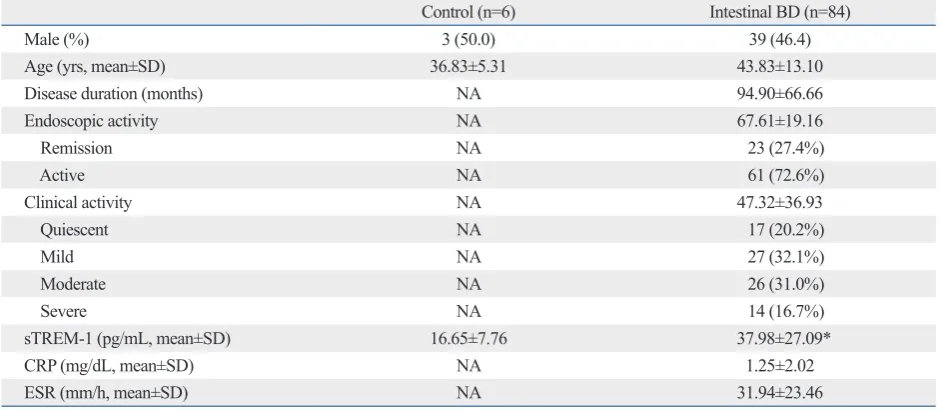
Table 1 shows the clinical characteristics and laboratory findings of the 84 intestinal BD patients and 6 control sub-jects enrolled in the study. There were no statistically signif-icant differences between the two groups with respect to demographic properties such as gender or age. Of the 84 patients with intestinal BD, 17 (20.2%) showed quiescent disease activity, 27 (32.1%) had mild activity, 26 (31.0%) had moderate activity, and 14 (16.7%) showed severe dis-ease activity.
Concentrations (mean±SD) of sTREM-1 in patients with intestinal BD (37.98±27.09 pg/mL) were significantly high-er than those of healthy controls (16.65±7.76 pg/mL) (p= 0.002), consistent with our previous data (Fig. 1).19
Correlation of endoscopic activity with serum sTREM-1, CRP, and ESR in intestinal BD
The number of patients with endoscopically active disease was 61 (72.6%) and that with quiescent disease was 23 (27.4%). The mean CRP and ESR levels in patients with ac-tive disease were significantly higher than those in patients vided written informed consent.
Correlations between 3 biomarkers and endoscopic activity
Endoscopic disease activity was divided into two categories as quiescent and active disease according to the ulcer status to investigate the relationship between endoscopic activity and biomarkers. In patients with active ulcers, variable en-doscopic factors, including location, number, depth, shape, and size of ulcer, were measured to assess their correlations with sTREM-1. In addition, endoscopic activity was ad-junctively determined in patients with intestinal BD using a recently developed, novel endoscopic severity model.10
Statistical analysis
[image:3.595.56.528.493.698.2]Variables are expressed as means±standard deviation (SD). Continuous variables were compared using an independent t test or a Mann-Whitney U test, and categorical variables were compared with a chi-square test or Fisher’s exact test. Associ-ations between endoscopic disease activity and sTREM-1, CRP, or ESR were assessed using Spearman’s rank correla-tion coefficients (γ) for nonparametric correlacorrela-tions. The mul-tivariate logistic analysis was performed to determine bio-markers associated with endoscopically active disease. Serial receiver operating characteristic (ROC) curves [±95% confi-dence interval (CI)] were used to define the diagnostic accu-racy of sTREM-1, ESR, and CRP to predict endoscopically active disease. p<0.05 was considered statistically significant.
Table 1. Baseline Characteristics of Healthy Subjects and Patients with Intestinal BD
Control (n=6) Intestinal BD (n=84)
Male (%) 3 (50.0) 39 (46.4)
Age (yrs, mean±SD) 36.83±5.31 43.83±13.10
Disease duration (months) NA 94.90±66.66
Endoscopic activity NA 67.61±19.16
Remission NA 23 (27.4%)
Active NA 61 (72.6%)
Clinical activity NA 47.32±36.93
Quiescent NA 17 (20.2%)
Mild NA 27 (32.1%)
Moderate NA 26 (31.0%)
Severe NA 14 (16.7%)
sTREM-1 (pg/mL, mean±SD) 16.65±7.76 37.98±27.09*
CRP (mg/dL, mean±SD) NA 1.25±2.02
ESR (mm/h, mean±SD) NA 31.94±23.46
BD, Behçet’s disease; NA, not applicable; sTREM-1, soluble triggering receptor expressed on myeloid cells-1; CRP, C-reactive protein; ESR, erythrocyte sedimentation rate.
flares and poor overall prognosis in intestinal BD,8
assess-ment of disease activity is inevitable to decide an appropri-ate treatment plan and evaluappropri-ate response. Although there are few studies to show high CRP level as a poor prognostic factor22 and association of anti-Saccharomyces cerevisiae
antibody positivity with increased surgical rate,23 data on
which biomarkers could predict disease activity of intesti-nal BD are extremely limited.
Recently, as increased levels of sTREM-1 were observed in patients with moderate or severe IBD,15,16 sTREM-1 was
evaluated as a promising biomarker to monitor disease activ-ity in IBD. sTREM-1 levels were correlated most accurately with clinical and endoscopic disease activities in UC re-gardless of disease extent.17,18 Jung, et al.19 also showed the
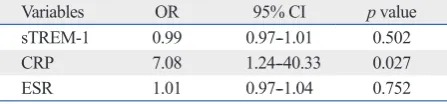
with quiescent disease (1.60±2.28 mg/dL vs. 0.31±0.23 mg/ dL, p<0.001 and 36.18±24.62 mm/h vs. 20.70±15.54 mm/ h, p=0.001, respectively), whereas the mean sTREM-1 lev-els in patients with active disease did not differ from those in patients with quiescent disease (43.53±24.95 pg/mL vs. 42.22±32.68 pg/mL, p=0.819) (Table 2). Endoscopic activity score for intestinal BD correlated significantly with both CRP levels (γ=0.329, p=0.002) and ESR (γ=0.298, p=0.006), but not with sTREM-1 levels (γ=0.166, p=0.132). Among these, CRP levels showed the highest correlation (Supple-mentary Fig. 1, only online). The results of multiple linear regression analyses for the three biomarkers associated with endoscopically active disease are shown in Table 3. Only CRP level was independently correlated with endo-scopic activity after adjusting for other biomarkers (OR 7.08, CI 1.24--40.33, p=0.027).
Using ROC curves, CRP had the best discriminatory power [area under receiver operating characteristic (AU-ROC) 0.737, p=0.001] in detecting endoscopically active
disease, followed by ESR (AUROC 0.695, p=0.006) and
sTREM-1 (AUROC 0.553, p=0.455) (Supplementary
Ta-ble 1, only online).
Differential expression of serum sTREM-1 levels according to endoscopic factors
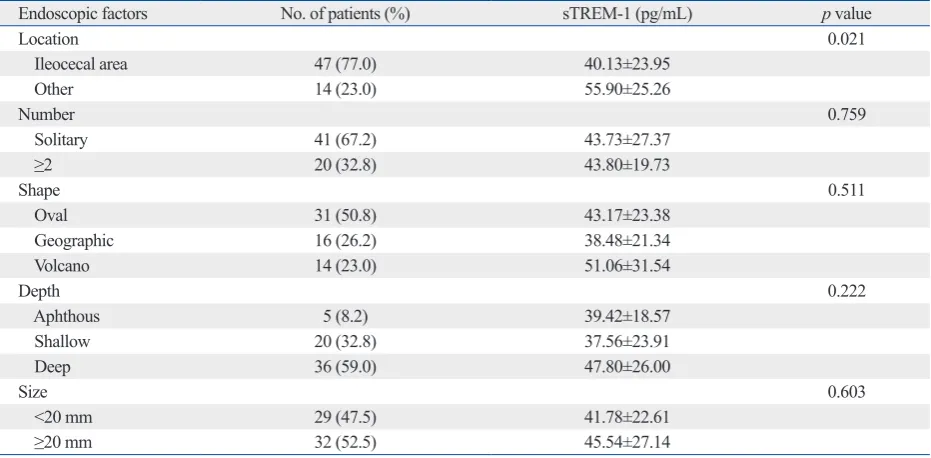
To determine whether serum sTREM-1 levels differ accord-ing to endoscopic factors, we analyzed 61 patients with en-doscopically active disease. Serum sTREM-1 levels did not differ in terms of number, shape, depth, size, margin, or type of ulcer. However, serum sTREM-1 levels in patients with ileocecal area ulcer were significantly lower than those in patients with colonic ulcers (40.13±23.95 vs. 55.90±25.26, p=0.021) (Table 4).
DISCUSSION
Biomarkers have been investigated in IBD for assessment of disease activity, prediction of disease course and outcome, and monitoring effects of therapy. In addition to ESR and CRP, fecal markers have also been studied recently in IBD because they would be more specific in the absence of en-teric infection.6,7 However, no single marker has so far been
proven to be ideal, since ESR takes several days to decline due to long half lives even when rapid clinical improvement occurs,7 and CRP correlates less well with disease activity in
[image:4.595.312.542.65.234.2]UC compared to CD.21 Considering unpredictable disease
[image:4.595.316.540.316.380.2]Fig. 1. Serum sTREM-1 levels were significantly higher in patients with in-testinal BD than in controls. BD, Behçet’s disease; sTREM-1, soluble trig-gering receptor expressed on myeloid cells-1.
Table 2. Comparison of Serum sTREM-1, CRP, and ESR Lev-els among the Patients with Endoscopically Inactive or Ac-tive Disease
Active
(n=61) Quiescent (n=23) p value sTREM-1 43.53±24.95 42.22±32.68 0.819
CRP 1.60±2.28 0.31±0.23 <0.001
ESR 36.18±24.62 20.70±15.54 0.001
sTREM-1, soluble triggering receptor expressed on myeloid cells-1; CRP, C-reactive protein; ESR, erythrocyte sedimentation rate.
Table 3. Multivariate Analysis of Biological Markers Associ-ated with Endoscopically Active Disease
Variables OR 95% CI p value
sTREM-1 0.99 0.97--1.01 0.502
CRP 7.08 1.24--40.33 0.027
ESR 1.01 0.97--1.04 0.752
OR, odds ratio; CI, confidence interval; sTREM-1, soluble triggering recep-tor expressed on myeloid cells-1; CRP, C-reactive protein; ESR, erythrocyte sedimentation rate.
0 50 100 150 200
sT
RE
M
-1
(p
g/
m
L)
Control Intestinal BD
[image:4.595.314.538.439.491.2]were no statistical differences in the intestinal complica-tions and extraintestinal manifestacomplica-tions between the two groups in our study (data not shown), it is possible that sTREM-1 might be more specific and sensitive for intesti-nal mucosa than either CRP or ESR in reflecting subclinical inflammation of intestinal BD. Such findings imply that sTREM-1 could play a role in discriminating intestinal BD from other functional disorders like irritable bowel syn-drome (IBS), which often share clinical similarities and cause difficulties in diagnosis.28,29 Further studies are
need-ed to identify the potential value of sTREM-1 as a differen-tial diagnostic marker.
In patients with intestinal BD, we did not find any corre-lation between sTREM-1 levels and endoscopic activity, which was contradictory to our previous study that showed the highest correlation between sTREM-1 and clinical ac-tivity.19 The reasons for this discrepancy are not clear,
nev-ertheless, it might be attributable to the different release pattern of TREM-1. Previously, S100A9 protein, which ex-pression levels were significantly correlated with TREM-1 levels,24 was found to be lower in ileal CD than colonic
in-flammation because of degradation during the passage from the ileum, which should be further tested.30 Since most
pa-tients with intestinal BD have lesions in the ileocecal re-gion,8 sTREM-1 levels might not accurately reflect disease
activity in intestinal BD. These hypotheses were verified in this study in that higher sTREM-1 levels were observed in other colonic areas than ileocecal areas in patients with en-most close correlation between sTREM-1 and clinical
ac-tivity among serum biomarkers, including CRP and ESR in intestinal BD. Because there are no decisive conclusions about the role of sTREM-1 in IBD, we aimed to identify whether sTREM-1 was elevated in intestinal BD with en-doscopically active disease and whether sTREM-1 could be a reliable marker to assess disease activity in patients with intestinal BD.
In the present study, we demonstrated that sTREM-1 lev-els were significantly upregulated in intestinal BD patients compared to normal controls, the finding similar to data previously reported in IBD.15,17,24 Our findings thus suggest
that sTREM-1 might be involved in the pathogenesis of in-testinal BD, leading to increased proinflammatory media-tors and contributing to sustained inflammation and disease exacerbation. However, among patients with intestinal BD, sTREM-1 was also elevated in endoscopically quiescent disease to similar levels as in active disease. Similarly, two interesting articles reveal the disparities in the relationship of sTREM-1 level with disease activity in IBD.24,25 One of
the possible explanations is that, even in patients with qui-escent disease, subclinical inflammation may be enough to cause bacterial translocation that may initiate the release of sTREM-1. It is also possible that since up to 50% of pa-tients with intestinal BD have frequent intestinal complica-tions, such as bowel perforation, fistula, and abscess forma-tion,26,27 extraintestinal manifestations can affect sTREM-1
[image:5.595.59.525.81.310.2]levels irrespective of endoscopic activity. Because there
Table 4. Serum sTREM-1 Levels According to the Endoscopic Factors in Patients with Endoscopically Active Disease
Endoscopic factors No. of patients (%) sTREM-1 (pg/mL) p value
Location 0.021
Ileocecal area 47 (77.0) 40.13±23.95
Other 14 (23.0) 55.90±25.26
Number 0.759
Solitary 41 (67.2) 43.73±27.37
≥2 20 (32.8) 43.80±19.73
Shape 0.511
Oval 31 (50.8) 43.17±23.38
Geographic 16 (26.2) 38.48±21.34
Volcano 14 (23.0) 51.06±31.54
Depth 0.222
Aphthous 5 (8.2) 39.42±18.57
Shallow 20 (32.8) 37.56±23.91
Deep 36 (59.0) 47.80±26.00
Size 0.603
<20 mm 29 (47.5) 41.78±22.61
≥20 mm 32 (52.5) 45.54±27.14
Technology R&D Project, Ministry of Health & Welfare, Republic of Korea (grant number A120176).
This study was also supported by a faculty research grant of Yonsei University College of Medicine for 2012 (4-2012-0680).
REFERENCES
1. Ebert EC. Gastrointestinal manifestations of Behçet’s disease. Dig Dis Sci 2009;54:201-7.
2. Allez M, Lémann M. Role of endoscopy in predicting the disease course in inflammatory bowel disease. World J Gastroenterol 2010;16:2626-32.
3. Cheon JH, Kim WH. Recent advances of endoscopy in inflamma-tory bowel diseases. Gut Liver 2007;1:118-25.
4. Frøslie KF, Jahnsen J, Moum BA, Vatn MH; IBSEN Group. Muco-sal healing in inflammatory bowel disease: results from a Norwe-gian population-based cohort. Gastroenterology 2007;133:412-22. 5. Neurath MF, Travis SP. Mucosal healing in inflammatory bowel
diseases: a systematic review. Gut 2012;61:1619-35.
6. Vermeire S, Van Assche G, Rutgeerts P. Laboratory markers in IBD: useful, magic, or unnecessary toys? Gut 2006;55:426-31. 7. Desai D, Faubion WA, Sandborn WJ. Review article: biological
activity markers in inflammatory bowel disease. Aliment Pharma-col Ther 2007;25:247-55.
8. Grigg EL, Kane S, Katz S. Mimicry and deception in inflammato-ry bowel disease and intestinal behçet disease. Gastroenterol Hep-atol (N Y) 2012;8:103-12.
9. Cheon JH, Han DS, Park JY, Ye BD, Jung SA, Park YS, et al. De-velopment, validation, and responsiveness of a novel disease ac-tivity index for intestinal Behçet’s disease. Inflamm Bowel Dis 2011;17:605-13.
10. Lee HJ, Kim YN, Jang HW, Jeon HH, Jung ES, Park SJ, et al. Correlations between endoscopic and clinical disease activity indi-ces in intestinal Behcet’s disease. World J Gastroenterol 2012;18: 5771-8.
11. Bouchon A, Dietrich J, Colonna M. Cutting edge: inflammatory responses can be triggered by TREM-1, a novel receptor ex-pressed on neutrophils and monocytes. J Immunol 2000;164: 4991-5.
12. Gibot S, Cravoisy A, Levy B, Bene MC, Faure G, Bollaert PE. Soluble triggering receptor expressed on myeloid cells and the di-agnosis of pneumonia. N Engl J Med 2004;350:451-8.
13. Gibot S, Le Renard PE, Bollaert PE, Kolopp-Sarda MN, Béné MC, Faure GC, et al. Surface triggering receptor expressed on myeloid cells 1 expression patterns in septic shock. Intensive Care Med 2005;31:594-7.
14. Collins CE, La DT, Yang HT, Massin F, Gibot S, Faure G, et al. Elevated synovial expression of triggering receptor expressed on myeloid cells 1 in patients with septic arthritis or rheumatoid ar-thritis. Ann Rheum Dis 2009;68:1768-74.
15. Schenk M, Bouchon A, Seibold F, Mueller C. TREM-1--express-ing intestinal macrophages crucially amplify chronic inflammation in experimental colitis and inflammatory bowel diseases. J Clin Invest 2007;117:3097-106.
16. Tzivras M, Koussoulas V, Giamarellos-Bourboulis EJ, Tzivras D, Tsaganos T, Koutoukas P, et al. Role of soluble triggering receptor
doscopically active disease. Furthermore, we previously re-ported that the correlation between endoscopic and clinical activity was unexpectedly weak,10 possibly explaining these
contradictory results. Further research is required to evalu-ate the relationship between sTREM-1 and disease activity in intestinal BD.
In contrast to the results regarding sTREM-1, both CRP and ESR levels were found to be correlated highly with en-doscopic activity in intestinal BD patients. Among them, CRP showed the best performance in assessing endoscopic activity in intestinal BD. There are limited number of stud-ies demonstrating that patients with elevated CRP levels have an increased risk of recurrence and repeat surgery,22,31
and that CRP and ESR levels are correlated with clinical activity in intestinal BD.19 More studies are necessary to
validate the role of CRP.
Our study has several limitations. First, we could not in-vestigate whether sTREM-1 could predict disease relapse, because long-term follow-up data were not measured. Sec-ond, we could not identify the association between sTREM-1 and changes in endoscopic activity, because serial sTREM-1 levels according to various clinical courses were not deter-mined in this study. Finally, standardized methods to assess disease activity for the use in predicting disease course and monitoring treatment responses in intestinal BD are yet to be established. Although we recently reported an endoscopic severity model,10 it has yet to be validated and be reproduced
in the prospective study. In addition, further studies are war-ranted to develop a reliable tool to evaluate disease activity that can precisely predict the prognosis of intestinal BD.
In conclusion, the present study demonstrated that sTREM-1 levels were significantly increased in intestinal BD patients compared to normal controls, but did not differ between en-doscopically quiescent and active disease. In addition, se-rum sTREM-1 levels did not show any significant correla-tion with endoscopic activity, unlike CRP levels or ESR, in patients with intestinal BD. Taken together, we suggest that serum sTREM-1 level might not be an appropriate biomark-er for the assessment of endoscopic activity in intestinal BD and further investigations are mandatory to identify a reli-able marker to predict both clinical and endoscopic disease activities in intestinal BD.
ACKNOWLEDGEMENTS
49:1849-59.
24. Saurer L, Rihs S, Birrer M, Saxer-Seculic N, Radsak M, Mueller C, et al. Elevated levels of serum-soluble triggering receptor ex-pressed on myeloid cells-1 in patients with IBD do not correlate with intestinal TREM-1 mRNA expression and endoscopic dis-ease activity. J Crohns Colitis 2012;6:913-23.
25. Billioud V, Gibot S, Massin F, Oussalah A, Chevaux JB, Williet N, et al. Plasma soluble triggering receptor expressed on myeloid cells-1 in Crohn’s disease. Dig Liver Dis 2012;44:466-70. 26. Kasahara Y, Tanaka S, Nishino M, Umemura H, Shiraha S,
Kuyama T. Intestinal involvement in Behçet’s disease: review of 136 surgical cases in the Japanese literature. Dis Colon Rectum 1981;24:103-6.
27. Moon CM, Cheon JH, Shin JK, Jeon SM, Bok HJ, Lee JH, et al. Prediction of free bowel perforation in patients with intestinal Be-hçet’s disease using clinical and colonoscopic findings. Dig Dis Sci 2010;55:2904-11.
28. Ginsburg PM, Bayless TM. How can IBD be distinguished from IBS? Inflamm Bowel Dis 2008;14 Suppl 2:S152-4.
29. Grundmann O, Yoon SL. Irritable bowel syndrome: epidemiology, diagnosis and treatment: an update for health-care practitioners. J Gastroenterol Hepatol 2010;25:691-9.
30. Foell D, Wittkowski H, Ren Z, Turton J, Pang G, Daebritz J, et al. Phagocyte-specific S100 proteins are released from affected mu-cosa and promote immune responses during inflammatory bowel disease. J Pathol 2008;216:183-92.
31. Park JJ, Kim WH, Cheon JH. Outcome predictors for intestinal Behçet’s disease. Yonsei Med J 2013;54:1084-90.
expressed on myeloid cells in inflammatory bowel disease. World J Gastroenterol 2006;12:3416-9.
17. Park JJ, Cheon JH, Kim BY, Kim DH, Kim ES, Kim TI, et al. Correlation of serum-soluble triggering receptor expressed on my-eloid cells-1 with clinical disease activity in inflammatory bowel disease. Dig Dis Sci 2009;54:1525-31.
18. Jung YS, Park JJ, Kim SW, Hong SP, Kim TI, Kim WH, et al. Correlation between soluble triggering receptor expressed on my-eloid cells-1 (sTREM-1) expression and endoscopic activity in in-flammatory bowel diseases. Dig Liver Dis 2012;44:897-903. 19. Jung YS, Kim SW, Yoon JY, Lee JH, Jeon SM, Hong SP, et al.
Expression of a soluble triggering receptor expressed on myeloid cells-1 (sTREM-1) correlates with clinical disease activity in in-testinal Behcet’s disease. Inflamm Bowel Dis 2011;17:2130-7. 20. Cheon JH, Kim ES, Shin SJ, Kim TI, Lee KM, Kim SW, et al.
Development and validation of novel diagnostic criteria for intes-tinal Behçet’s disease in Korean patients with ileocolonic ulcers. Am J Gastroenterol 2009;104:2492-9.
21. Solem CA, Loftus EV Jr, Tremaine WJ, Harmsen WS, Zinsmeis-ter AR, Sandborn WJ. Correlation of C-reactive protein with clini-cal, endoscopic, histologic, and radiographic activity in inflamma-tory bowel disease. Inflamm Bowel Dis 2005;11:707-12. 22. Jung YS, Yoon JY, Lee JH, Jeon SM, Hong SP, Kim TI, et al.
Prognostic factors and long-term clinical outcomes for surgical patients with intestinal Behcet’s disease. Inflamm Bowel Dis 2011;17:1594-602.