A STUDY OF PERFORMANCE APPRAISAL IN GOVERNMENT
SECTOR ORGANIZATION
Dr. G. Kanaka Mahalakshmi.
M.Com.,Mba.,Mhrm, Ph.D. Principal, Vips College, Visakhapatnam.
ABSTRACT
The government has a critical role to play in the development of the country. It acts as a planner,
regulator, catalyst, controller and investor. Its policies and practices directly determine the
nature and direction of HRD activities in institutions and organizations under the direct control
of government such as the administrative machinery and public sector organizations. Indirectly,
the policies and practices of the government set the tone and create an environment which may
discourage or encourage the HRD activities of other organizations in the non-governmental sectors as well. Thus, HRD in government has a strategic role. The government’s policies and
practices have a ripple effect with wide ranging impact on other sectors of society. This is
especially so in a partially controlled economy like India where the government regulates the
activities of even private sector organizations. With the advent of Liberalization, Privatization
and globalization era, the focus of HRD has shifted to establishing direct links with business strategies in today’s competitive world. Human Resource Development has become a business
necessity. To meet the challenges, to stand in front of competitors and to meet the impact of
change private sector organizations have started to adopt effective HRD practices which should
influence financial and other performance indicators by generating employee satisfaction which
is turn can influence customer satisfaction.
International Research Journal of Management and Commerce
ISSN: (2348-9766) Impact Factor- 5.564, Volume 4, Issue 9, September 2017 Website- www.aarf.asia, Email : [email protected] , [email protected]
INTRODUCTION
In present globalised scenario Human Resource Development plays a vital in every
organization which leads towards economic development. HRD should plan for human resources
not only for present jobs and roles but also for the future. Further, human resource planning
should plan for potentialities. Recruitment for HRD refers to searching for prospective
employees having skills, talents and potentials to carry out the present and future jobs and also to
develop and motivate them to apply for jobs. Selection for HRD refers to designing the selection
techniques like written test, selection tests, interviews, etc., fit for selecting the candidates
suitable for further development. These base sectors influence the analysis of roles of employees
as individuals, as members of teams and organization, along with the ever changing
environment. The positive base factors exert positive influence on the analysis of roles. Analysis
of roles of employees as individuals, members of teams and members of organization helps the
organization to know the employees, present capabilities and potentials. Performance appraisal
and potential appraisal techniques help to evaluate the present capabilities, performance and
potentials more accurately.
Appraisal is the evaluation of worker, quality or merit. In the organizational context,
performance appraisal is a systematic evaluation of personnel by superiors or others familiar
with their performance. Performance appraisal is also described as merit rating in which one
individual is marked as better or worse in comparison to others. The basic purpose of merit rating is to ascertain an employee’s eligibility for promotion. However performance appraisal
would be used to decide training and development, salary increase, transfer and discharge also,
performance appraisal is the process of evaluating the performance and qualifications of the
employee in terms of the requirements of the job for which he is employed, for the purposes of
administration including placement, selection for promotion, providing financial rewards and
other actions which require differential treatment among the members of a group as
distinguished from actions affecting all members equally.
OBJECTIVES
2. To probe in to the system of performance appraisal process, its contribution to HRD
practices and also to know the opinions on the part of the employees in respect to the
measures taken by the organizations towards appraisal process.
METHODOLOGY Primary Data
The primary data was collected through structured questionnaire on direct personal investigation
method. The main source of primary data is the opinions of the employees at operational and
administrative level in Government sector.
Secondary Data
The secondary data and information was collected from the annual reports, office records,
documents, action plans and booklets of Industries Department. Study relevant data was also
procured from journals, periodicals, reference books, reports, records and other useful published
and unpublished reports.
For survey of literature the researcher visited various libraries which include Andhra
University Library, Visakhapatnam, Osmania University Library and administrative staff college
library in Hyderabad.
Sample Units for the Study
In Government Sector the study covers the Industries Department , located at Hyderabad,
which has been playing a major role in setting up of the industries and its 10 District industries
centres which are located at Mahaboobnagar, Rangareddy, Medak, Nizamabad, KarimNagar,
Adilabad, Warangal, Khammam, Nalgonda, and Hyderabad.
Sample Size of the study
There are 1252 employees working at operational and administrative level in the head
random sampling technique.. To make better study the researcher took a 10 percent of uniform
sampling limiting the number to 125. It was felt that the sample size of the employees at
operational and administrative level chosen from the Industries Department is adequate and
significant for analysis.
REVIEW OF LITERATURE
It has been noted, by William P.A in his book "Strategic Human Resource Management", that a major paradigm shift has taken place with the evolution of the concept of
Human Resources Development. The growing recognition of HRD in the management area has
brought a revolutionary change in the total scenario of performance appraisal. It has been
reflected in terms of use of word to indicate performance Appraisal and the purpose of
performance Appraisal and corrective measures used.
It has been pointed out, by Chakraborthy S.K. in his book "Human Resource Development",1995, that here in respect to orientation in the context of HRD that all the
employees recruited are put through a well structured orientation programme to help them
understand what the organisation stands for in terms of its basic philosophy and culture, their
role and what is expected of them as also what they can expect from the company. At the
orientation training, specific inputs on correct behaviour and courtesies required at the work
place are imparted to help the participants make a smooth transition from the institute to the
company. At every orientation programme, the trainees are asked to group themselves and
understand their life style as it was at the institute. They are asked to visualize life in orientation.
The HRD specialist along with the senior member of the organisation then help to understand
various processes that go on in the company and the expectations of the organisation of the
trainee.
Sinha: in his book "Human Resource Development",1992, expressed that various aspects of human resource development such as human approach, people as a resource in the organization,
development and functions of human resource development. Many studies were conducted with
a focus on Indian Industrial Environments and the HRD function. A comparative assessment of
Rao T.V: In his book " The HRD missionary" 1992, analyzed HRD instruments, process and out comes structuring of HRD function, qualities and competence requirements of HRD managers,
their development, traps and temptation.
Chandra.S: In his book "Human Resource Management Policy " 1997, attempted to present a blue print of HRD policy and argues that an efficient and satisfied workforce is the most
significant factor in organizational effectiveness.
D.Souza: In his book "Human Resource Development", intended to give some insight into the structure of Human Resource Development function.
Rao.T.V.: In his book "Human Resource Development" outlined the role played by chief executives for a successful Human Resource Development.
Soni,M.M.: In his book " Human Resource Development" 1997, felt that HRD is necessary for the purpose of imparting required job knowledge to the manpower and developing in them
necessary skills and aptitude.
Dayal.Iswar: In his article "Training Of The Employees and Executives", 1999, suggests that a detailed study of jobs and skill analysis is absolutely necessary to help the employee adjust to
that job requirements.
Srinivasan,G.: In his article "Executive Development In India"1997, recommends that the training programmes should focus on corporate planning, organizational development and
management.
Dayal.I.: In his article "A Survey Of Research In Management" 1973, observes that most of the issues confronting the field of training in India are not dissimilar to those felt abroad.
Bhatia,S.K.: In his article "Trends In Training And Development" 1981, sees a shift from knowledge to attitude as the main objective of training. He identifies three areas of training
technical skills and knowledge, knowledge of organisation and external system and conceptional
Saxena, A.P.: In his article "Training In Government Sector",1973, suggests that the organization and development techniques can be most useful for training employees in
Government. HRD techniques can help in improving organizational design, introducing
organizational flexibility, reducing impersonality, improving interpersonal relations and
differentiate operational decision making from policy decision making.
Basha.,M.M.: In his article "Training Techniques In Verying Cultures",1971, takes the stand that the some tested training techniques of multi nationals operating in India do not have the
same impact here due to differences in various environmental factors. He opined that, in the
Indian context, the lecture-cum-disscussed method would be most useful.
Seth.,P.: In his article "Import On Training",1984, suggested that training for employees should be directed towards attitudes and beliefs underlying employee’s philosophy and their
interrelatedness. The studies on the identification of training needs emphasis not only the
organizational analysis as well.
Singh.N.K.: In his book "HRD In Indian Public Sector", 1987, examined the training and development practices and employee appraisal systems in the public sector undertakings at
length.
Rao,T.V.: In his book "Appraising And Development Managerial Performance", 1988, believes that the performance appraisal system can help preparing the employees for performing
higher-level jobs by continuously reinforcing the development of behavior and qualities required. The
need for making executive appraisal effective was elaborately discussed by him. He suggested
that it is useful to separate the appraisal process that aims at development from the process that
aims at monitoring control.
Beament, B.P.: in his book "Human Resource Management", found that several organisations in Britain had began in the mi-eighties, to move towards performance appraisal for the manual
group of employees, often as a part of some change towards performance related pay
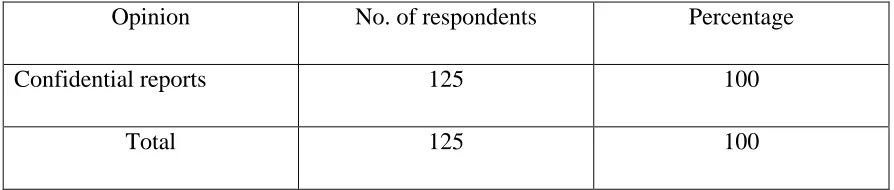
IMPORTANCE OF PERFORMANCE APPRAISAL IN GOVERNMENT SECTOR Table no. 1 : Awareness of the employees on existing performance appraisal in Industries
Department
Opinion No. of respondents Percentage
Confidential reports 125 100
Total 125 100
Source: Survey
The percentage in the above table is reflected in the below diagram.
Diagram 1 : Awareness of the employees on existing performance appraisal in Industries Department
When the researcher asked the question, whether performance appraisal exists in the
Industries Department, all the respondents opined that they have known about existing
performance appraisal and they have opined that, the present existing performance appraisal
method was confidential report which is a traditional technique of the performance appraisal. 100
Table no. 2 : Opinion of the respondents towards frequency of the performance appraisal
Frequency of the programme
No. of respondents Percentage
Yearly once 125 100
6 months - -
3 months - -
Total 125 100
Source: Survey
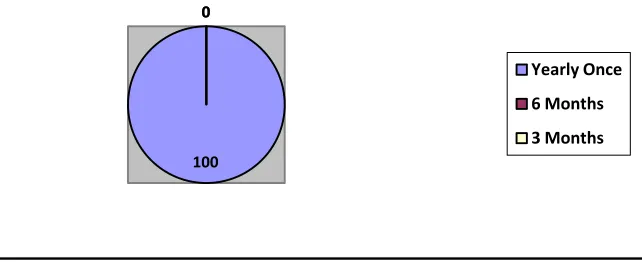
The following diagram explains the above percentage graphically.
Diagram 2 : Opinion of the respondents towards frequency of the performance appraisal
All the respondents (100%) have said that, the performance of the employees is evaluated
once in a year. It may be observed that, the performance appraisal has been taking place once in
[image:8.612.146.467.298.429.2]a year in Industries Department which is acceptable to the employees.
Table no. 3 : Level of satisfaction of the employees on performance review Level of satisfaction No. of respondents Percentage
Highly Satisfied 7 5.6
Satisfied 9 7.2
Dissatisfied 65 52.0
Highly Dissatisfied 44 35.2
Total 125 100
Source: Survey
100 0 0
Yearly Once
6 Months
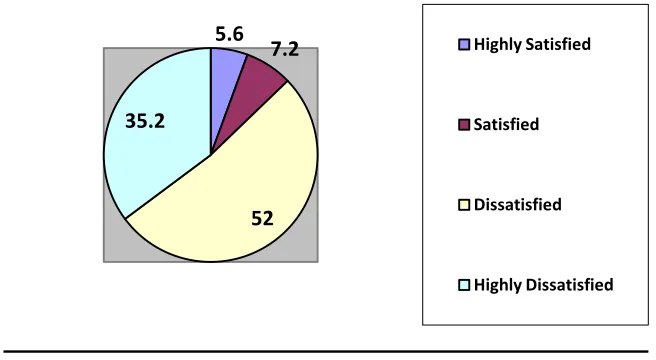
The Percentages in the above table are reflected in the diagram given below.
Diagram 3 : Level of satisfaction of the employees on performance review
From the above table it can be observed that, about 5.6% of the respondents have opined
that they were highly satisfied with performance review, and 7.2% of the respondents have
opined that, they were satisfied and 52% of the respondents have opined that they were
dissatisfied and the remaining 35.2% of the respondents have opined that they were highly
dissatisfied with performance review in Industries Department. Nearly 87% of the respondents
were not satisfied with performance review in Industries Department. The researcher also
collected the reasons for satisfaction and dissatisfaction on performance review. The researcher
has taken the ratings of highly satisfied and satisfied as satisfied rating and the ratings of
[image:9.612.143.471.125.305.2]dissatisfied and highly dissatisfied as dissatisfied rating to understand effectively.
Table no. 4 : Reasons for satisfaction of the employees on performance review
Reasons No. of respondents Percentage
It brings co-ordination between superior and
subordinate 9 56.2
It gives opportunity to establish mutual agreed
goals 3 18.8
It gives opportunity to review the progress and
activities on performance plan 4 25.0
Total 16 100
5.6 7.2
52 35.2
Highly Satisfied
Satisfied
Dissatisfied
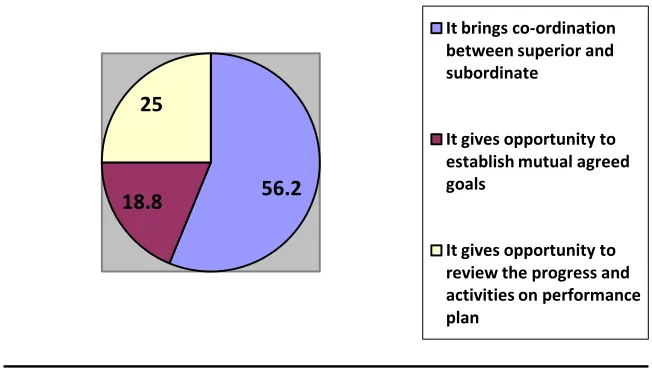
The Percentages in the above table are reflected in the diagram given below.
Diagram 4 : Reasons for satisfaction of the employees on performance review
From the above table it can be observed that, In Industries Department about 56.2% of
the respondents have satisfied as performance review brings coordination between superior and
subordinate, about 18.8% of the respondents have satisfied with performance review as it gives
opportunity to establish mutual agreed goals and the remaining 25% of the respondents have
satisfied as performance review gives opportunity to review the progress and activities on their
[image:10.612.143.469.125.311.2]future performance.
Table no. 5 : Reasons for dissatisfaction of the employees on performance review
Reasons No. of respondents Percentage
Employees are not provided opportunity in
the performance review 32 29.4
It does not give motivation to the
employees 38 34.9
It is not a systematic process 39 35.7
Total 109 100
Source: Survey
56.2 18.8
25
It brings co-ordination between superior and subordinate
It gives opportunity to establish mutual agreed goals
The following diagram explains the above values graphically at a glance.
Diagram 5 : Reasons for dissatisfaction of the employees on performance review
From the above table it can be observed that, about 29.4% of the respondents have
dissatisfied as performance review not provided opportunity to the employees to assess their
performance and 34.9% of the respondents have dissatisfied as performance review does not give
motivation to the employees and 35.7% of the respondents have dissatisfied as performance
review is not a systematic process.
Opinion of the Respondents towards Feedback System
Feed back system is playing an important role in performance appraisal process. After
the appraisal process, if the employees are rated high, naturally they are happy and feel their self
esteem is high. On the other if they are rated low, then they are unhappy but the fact is fact, and
the fact should be known to them. Their plus points should be listed out and their weaknesses
may be put clearly through counselors.
Feed back system helps the talented employees to prove their performance and there is a
chance to improve their performance in an efficient and effective manner. It helps low talented
employees to enhance their skills and talent.
29.4
34.9 35.7
Employees are not provided opportunity in the performance review
It does not give motivation to the employees
Table no. 6 : Level of satisfaction of the employees on feed back system
Level of satisfaction No. of respondents Percentage
Highly satisfied 14 11.2
Satisfied 27 21.6
Dissatisfied 61 48.8
Highly dissatisfied 23 18.4
Total 125 100
Source: Survey
The Percentages in the above table are reflected in the diagram given below
Diagram 6 : Level of satisfaction of the employees on feed back system
From the above table it can be observed that, about 11.2% of the respondents have opined
that they were highly satisfied with feedback system and 21.6% of the respondents were opined
that they have satisfied with feedback system and 48.8% of the respondents have opined that
they were dissatisfied with feedback system and the remaining 18.4% of the respondents have
opined that, they were highly dissatisfied with feedback system in Industries Department.
The researcher also collected the reasons for satisfaction and dissatisfaction of the
employees on feed back system in Industries Department. To make better understanding the
researcher has taken highly satisfied and satisfied ratings as satisfied. Dissatisfied and highly
dissatisfied ratings as dissatisfied.
11.2
21.6
48.8 18.4
Highly Satisfied
Satisfied
Dissatisfied
Table no. 7 : Reasons for satisfaction of the employees on feed back system
Reasons No. of respondents Percentage
It assists to know favourable and
unfavourable remarks 29 70.7
It assists to increase quality and
effectiveness of the work 10 24.4
It assists to develop the skills and
performance 2 4.9
Any other - -
Total 41 100
Source: Survey
The Percentages in the above table are reflected in the diagram given below:
Diagram 7 : Reasons for satisfaction of the employees on feed back system
From the above table it can be observed that about 70.7% of the respondents have
satisfied as feedback system assists to know favourable and unfavourable remarks of the
performance, and 24.4% of the respondents have satisfied as feedback system assists to increase
70.7 24.4
4.9 0 It assists to know favourable and
unfavourable remarks
It assists to increase quality and effectiveness of the work
It assists to develop the skills and performance
quality and effectiveness of the work and 4.9% of the respondents have opined that they have
[image:14.612.107.511.391.576.2]satisfied as feedback system assists to develop the skills and performance.
Table no. 8 : Reasons for dissatisfaction of the employees on feed back system
Reasons No. of respondents Percentage
Partiality in feedback system 34 40.5
Delay in communicating to the employees 21 25.0
It does not give encouragement 29 34.5
Any other - -
Total 84 100
Source: Survey
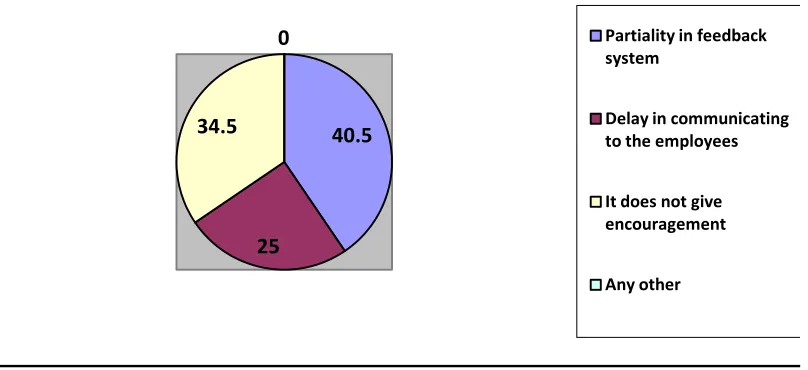
The Percentages in the above table are reflected in the diagram given below:
Diagram 8 : Reasons for dissatisfaction of the employees on feed back system
From the above table it can be observed that in Industries Department about 40.5% of the
respondents have dissatisfied as superiors have partiality to make feed back of the employees and
25% of the respondents have dissatisfied because delay in communicating the feed back to the
employees and 34.5% of the respondents have dissatisfied because feedback system does not
40.5
25 34.5
0 Partiality in feedback
system
Delay in communicating to the employees
It does not give encouragement
FINDINGS
It is found the present existing performance appraisal method was confidential report
which is a traditional technique of the performance appraisal.
It is found that all the respondents (100%) have said that, the performance of the
employees is evaluated once in a year. It may be observed that, the performance
appraisal has been taking place once in a year in Industries Department .
It is found that, about 5.6% of the respondents have opined that they were highly satisfied
with performance review, and 7.2% of the respondents have opined that, they were
satisfied and 52% of the respondents have opined that they were dissatisfied and the
remaining 35.2% of the respondents have opined that they were highly dissatisfied with
performance review in Industries Department. Nearly 87% of the respondents were not
satisfied with performance review in Industries Department.
It can be found that, about 11.2% of the respondents have opined that they were highly
satisfied with feedback system and 21.6% of the respondents were opined that they have
satisfied with feedback system and 48.8% of the respondents have opined that they were
dissatisfied with feedback system and the remaining 18.4% of the respondents have
opined that, they were highly dissatisfied with feedback system in Industries Department.
SUGGESTIONS
Performance appraisal has been taking place once in a year in both Government . Hence,
it is suggested that, to have a continuous improvement in qualities and skills of the
employees, it is better to conduct performance appraisal once in a six months.
In Government sector majority of the employees were dissatisfied with performance
review because employees were not provided opportunity in the review process and it did
not give motivation to the employees. Hence it is suggested that, employee should be
involved in the review process.
In Government sector partiality in feedback system is highly prevalent. It leads to
collapse of Industrial relations in the organisation and there should not be any delay in
Confidential reporting system which is traditional method of performance appraisal has been adopted in Government sector. Most of the measures used in confidential reporting
system making difficult to measure the performance of employees and also there is often
a lot of bias and subjectivity is involved in the ratings given by the superior. Hence, it is
suggested that, either redesign the confidential reporting system with challenging task,
objectives and with new measures or change the system and adopt modern technique
which is suitable to the organisation goal as practiced in private sector.
CONCLUSION
The HR Department should take sufficient care in the administration and designing content of
HRD policies in respect of training and performance appraisal. It is suggested that, the H.R.
Department in Government sector to take the feedback of the employees on implementation of
HRD activities at regular intervals in order to take corrective measures to win the confidence of
the employees. Finally, it has been recommended that, despite fast growing globalization,
importance of involvement of human element in Government sector is found to be prominent and
hence due priority be given to H.R. management in formulating effective HRD policies and
strategies.
Performance appraisal is one of the important tools of Human Resource Development practices
which assist the employees to find out their strength and weakness and to improve their
performance. The commitment to the performance appraisal system in Government sector is very
low. Low commitment and lack of accountability are the major reasons for the low
institutionalization of the performance appraisal process in Government sector. The main
limitation of the appraisal system in Government sector is the post appraisal actions such as
increments, promotions, bonus, punishments, demotions not directly linked to the performance
appraisal. Hence, it should be changed post appraisal actions should be linked performance
appraisal.
It is to be suggested that, performance appraisal policy which is confidential report system being
adopted the Government sector has many deficiencies and also it is an oldest system. As per the
system. As per change in an economy our Government sector also should change the
performance appraisal policy.
The need of performance appraisal is felt to create a climate which will improve the work life by
overcoming monotony, ensuring better communication and creation of a familiar sort of work
conditions where creativity of all the members comes into full play. The focus of performance
appraisal essentially is an enabling people to self actualize through a systematic process of
developing their existing potentialities of people both in the present and in the
future.Performance appraisal facilities the integrated growth employees. It helps employees to
know their strengths and weaknesses and enable them to improve their performance.
REFERENCES
Beardwell, Holden Len. : Human Resource Management, Macmillan India Ltd.,
New Delhi. (1996)
Bhagoliwal, T.N. : Personnel Management and Industrial Relations, Sahitya
Bhawan, Agra. (1987)
Biswanth Ghosh. : Human Resource Development and Management, Vikas
Publishing House, New Delhi. (2009)
Bolar Malti : Performance Appraisal, Vikas Publishing House, New
Delhi. (1979)
Brech, E.F.L.B. : The principles and Practice of Management, Longman,
Brown Andrew. M. : Management Development and Management by
Objectives, Somiya Publications, Bombay. (1970)
Calhoon, Richard : Managing Personnel, Harper and Row Company. (1964)
Chakraborthy S.K. : Human Resource Development (1995)
Chanra, S. : Human Resource Management Policy, Ramat
Publications. (1997)
Edwin B. Flippo. : Personnel Management, Tata Mc Graw Hill Publishers.
(1984)
Eligizberg. : Managing People at Work, Macmillan Publishing, New
York. (1980)
Etzioni, A. : Modern Organization, Prentice Hall of India Pvt. Ltd.,
New Delhi. (1965)
Eyzenek, H.J. : Experiments in Motivation, Macmillan, New York. (1964)
Fombrum et al. : Strategic Human Resource Management, Wiley
Fowler. : Personnel Management, Prentice Hall of India. (1987).
George Strauss Leonard
R.Sayles
: Personnel The Human Problems of Management, Prentice
Hall of India Pvt. Ltd., New Delhi. (1982)
George. T. Mikovich : Human Relations Management, Irwin, Inc, Home Wood.
(1990)
Gopalji : Personnel Management in Indian Industries, Ashis
Publishing House, New Delhi. (1985)
Halloram, J. : Human Resource Management, Prentice Hall Publishers.
(1986)
Haire, M. : Psychology in Management, McGraw Hill, New York,
(1956)
Hampton, David R. : Modern Management, Prentice. Hall of India. New Delhi.
(1974)
Heneman, Herbert, G. : Human Resource Management, Universal Book Stall,
Herzberg, Fredrick. : Work and the Nature of Man, World Publishing Co.,
Cleveland. (1966)
Herzberg, F., Mausner, B. : The motivation work, John Viley and Sons, New York.
(1959)
Hukku, V.N. and Lalwani, S.J. : HRD in Banking Sector, Jodhpur: Books Treasure. (1993)