http://ijmms.hindawi.com © Hindawi Publishing Corp.
ON IDEALS OF IMPLICATIVE SEMIGROUPS
YOUNG BAE JUN and KYUNG HO KIM
(Received 2 October 2000)
Abstract.We introduce the notion of ideals in implicative semigroups, and then state the characterizations of the ideals.
2000 Mathematics Subject Classification. 20M12, 06F05, 06A06, 06A12.
1. Introduction. The notions of implicative semigroup and ordered filter were in-troduced by Chan and Shum [3]. The first is a generalization of implicative semilattice (see Nemitz [6] and Blyth [2]) and has a close relation with implication in mathematical logic and set theoretic difference (see Birkhoff [1] and Curry [4]). For the general development of implicative semilattice theory the ordered filters play an important role which is shown by Nemitz [6]. Motivated by this, Chan and Shum [3] established some elementary properties, and constructed quotient structure of implicative semi-groups via ordered filters. Jun et al. [5] discussed ordered filters of implicative semi-groups. In this paper, we introduce the notion of ideals in implicative semisemi-groups. By introducing special subsets of an implicative semigroups, we provide a condition for the special subset to be an ideal. We establish two characterizations of ideals.
2. Preliminaries. We recall some definitions and results. By anegatively partially ordered semigroup(briefly,n.p.o. semigroup) we mean a setSwith a partial ordering ≤and a binary operation·such that for allx, y, z∈S, we have
(1) (x·y)·z=x·(y·z),
(2) x≤yimpliesx·z≤y·zandz·x≤z·y, (3) x·y≤xandx·y≤y.
An n.p.o. semigroup(S;≤,·)is said to beimplicativeif there is an additional binary operation∗:S×S→Ssuch that for any elementsx, y, zofS,
(4) z≤x∗yif and only ifz·x≤y.
The operation∗is calledimplication. From now on, an implicative n.p.o. semigroup is simply called animplicative semigroup.
An implicative semigroup(S;≤,·,∗)is said to becommutativeif it satisfies (5) x·y=y·xfor allx, y∈S, that is,(S,·)is a commutative semigroup. In any implicative semigroup(S;≤,·,∗),x∗x=y∗yfor everyx, y∈S and this element is the greatest element, written 1, of(S,≤).
Proposition2.1(see [3, Theorem 1.4]). LetS be an implicative semigroup. Then
≤ ∗
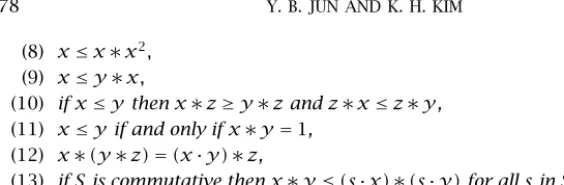
(10) ifx≤ythenx∗z≥y∗zandz∗x≤z∗y, (11) x≤yif and only ifx∗y=1,
(12) x∗(y∗z)=(x·y)∗z,
(13) ifSis commutative thenx∗y≤(s·x)∗(s·y)for allsinS.
Now we note important elementary properties of a commutative implicative semi-group, which follows from (5), (6), and (12).
Observation2.2. IfSis a commutative implicative semigroup, then for anyx, y,
z∈S,
(14) x∗(y∗z)=y∗(x∗z), (15) y∗z≤(x∗y)∗(x∗z), (16) x≤(x∗y)∗y.
3. Ideals of implicative semigroups. In what follows letS denote an implicative semigroup unless otherwise specified. We begin by defining the notion of ideals ofS.
Definition3.1. A subsetIofSis called anidealofSif
(I1) x∈Sanda∈Iimplyx∗a∈I,
(I2) x∈Sanda, b∈Iimply(a∗(b∗x))∗x∈I.
Example3.2. Consider an implicative semigroupS := {1, a, b, c, d,0}with Cayley
tables (Tables3.1and3.2) and Hasse diagram (Figure 3.1) as follows:
Table3.1
· 1 a b c d 0
1 1 a b c d 0
a a b b d 0 0
b b b b 0 0 0
c c d 0 c d 0
d d 0 0 d 0 0
0 0 0 0 0 0 0
Table3.2
∗ 1 a b c d 0
1 1 a b c d 0
a 1 1 a c c d
b 1 1 1 c c c
c 1 a b 1 a b
d 1 1 a 1 1 a
0 1 1 1 1 1 1
[image:2.516.76.358.63.155.2] [image:2.516.173.326.514.600.2]0
d c
1
a
b
Figure3.1
Lemma3.3. Every ideal ofScontains1.
Proof. The proof follows from (6) and (I1).
Lemma3.4. IfIis an ideal ofS, then(a∗x)∗x∈Ifor alla∈Iandx∈S.
Proof. The proof follows by takingb=aanda=1 in (I2).
Corollary3.5. LetIbe an ideal ofS. Ifa∈Ianda≤x, thenx∈I.
Proof. Leta∈Iandx∈S be such thata≤x. Using (6) andLemma 3.4, we have
x=1∗x=(a∗x)∗x∈I. This completes the proof.
Lemma3.6. LetIbe a subset ofS such that
(I3) 1∈I,
(I4) x∗(y∗z)∈Iandy∈I implyx∗z∈Ifor allx, y, z∈S. Ifa∈Ianda≤x, thenx∈I.
Proof. Leta∈Iandx∈S be such thata≤x. Thenx∗(a∗1)=x∗1=1∈Iby
(6) and (I3), and sox=x∗1∈Iby (I4). This completes the proof.
The following is a characterization of ideals.
Theorem3.7. LetSbe a commutative implicative semigroup. A subsetIofS is an
ideal ofSif and only if it satisfies conditions (I3) and (I4).
Proof. LetIbe an ideal ofS. Then 1∈IbyLemma 3.3. Letx, y, z∈Sbe such that
x∗(y∗z)∈Iandy∈I. UsingLemma 3.4, we get(y∗z)∗z∈I. It follows from (6), (15), and (I2) that
x∗z=1∗(x∗z)=(y∗z)∗z∗(x∗(y∗z)∗(x∗z)∗(x∗z)∈I. (3.1)
Conversely, assume thatIsatisfies conditions (I3) and (I4). Letx∈S anda∈I. Since x∗(a∗a)=x∗1=1∈Iby (I3), it follows from (I4) thatx∗a∈I, that is, (I1) holds. Since(a∗x)∗(a∗x)=1∈I, we have(a∗x)∗x∈Iby (I4). Note from (15) that
(a∗x)∗x∗b∗(a∗x)∗(b∗x)=1, (3.2)
that is,
(a∗x)∗x≤b∗(a∗x)∗(b∗x) (3.3)
S(u, v)= {z∈S|u∗(v∗z)=1}. (3.4)
InExample 3.2, the setS(1, a)= {1, a}is not an ideal ofS. Hence we know thatS(u, v) may not be an ideal ofSin general.
Theorem3.8. LetSsatisfy the left self-distributive law under∗, that is,x∗(y∗z)=
(x∗y)∗(x∗z)for allx, y, z∈S. For anyu, v∈S, the setS(u, v)is an ideal ofS.
Proof. Letx∈S anda, b∈S(u, v). Then
u∗v∗(x∗a)=u∗(v∗x)∗u∗(v∗a)=u∗(v∗x)∗1=1,
u∗v∗a∗(b∗x)∗x=u∗v∗a∗(b∗x)∗u∗(v∗x)
=u∗(v∗a)∗u∗v∗(b∗x)∗u∗(v∗x) =1∗u∗(v∗b)∗u∗(v∗x)∗u∗(v∗x) =u∗(v∗x)∗u∗(v∗x)=1.
(3.5)
Hencex∗a∈S(u, v)and(a∗(b∗x))∗x∈S(u, v), which shows thatS(u, v)is an ideal ofS.
Lemma3.9. LetS be an implicative semigroup. Ify∈S satisfiesy∗z=1for all
z∈S, thenS(x, y)=S=S(y, x)for allx∈S.
Proof. The proof is straightforward.
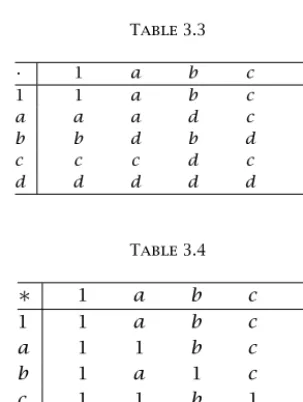
Example3.10. LetS:= {1, a, b, c, d}be an implicative semigroup with Cayley tables
(Tables3.3and3.4) and Hasse diagram (Figure 3.2) as follows:
Table3.3
· 1 a b c d
1 1 a b c d
a a a d c d
b b d b d d
c c c d c d
d d d d d d
Table3.4
∗ 1 a b c d
1 1 a b c d
a 1 1 b c d
b 1 a 1 c c
c 1 1 b 1 b
[image:4.516.172.324.442.643.2]d c a
1
b
Figure3.2
It is easy to check that S satisfies the left self-distributive law under∗, that is, x∗(y∗z)=(x∗y)∗(x∗z)for all x, y, z∈S. ByLemma 3.9we have S(x, d)= S(d, x)=Sfor allx∈S. Furthermore we know thatS(1,1)= {1},S(1, a)=S(a,1)= S(a, a)= S(a, b) = {1, a}, S(1, b)= S(b,1)= S(b, b)= {1, b}, S(1, c)= S(a, c)= S(c,1)=S(c, a)= S(c, c)= {1, a, c}, S(b, a)= {1, a, b},and S(c, b)=S are ideals ofS.
Using the setS(u, v), we describe a characterization of ideals.
Theorem3.11. LetS be a commutative implicative semigroup and letI be a
non-empty subset ofS. ThenIis an ideal ofS if and only ifS(u, v)⊆Ifor allu, v∈I.
Proof. Assume thatIis an ideal ofSand letu, v∈I. Ifz∈S(u, v), thenu∗(v∗
z)=1∈Iand soz=1∗z=(u∗(v∗z))∗z∈Iby (I2). HenceS(u, v)⊆I.
Conversely, suppose thatS(u, v)⊆Ifor allu, v∈I. Note that 1∈S(u, v)⊆I. Let x, y, z∈S be such thatx∗(y∗z)∈Iandy∈I. Since
x∗(y∗z)∗y∗(x∗z)=y∗(x∗z)∗y∗(x∗z)=1, (3.6)
we havex∗z∈S(x∗(y∗z), y)⊆I. ApplyingTheorem 3.7, we conclude thatIis an ideal ofS.
Theorem3.12. LetS be a commutative implicative semigroup. IfIis an ideal ofS,
then
I= ∪u,v∈IS(u, v). (3.7)
Proof. LetIbe an ideal ofS and letx∈I. Obviously,x∈S(x,1)and so
I⊆ ∪x∈IS(x,1)⊆ ∪u,v∈IS(u, v). (3.8)
Now lety∈ ∪u,v∈IS(u, v).Then there exista, b∈Isuch thaty∈S(a, b). It follows
fromTheorem 3.11that y∈I. Hence∪u,v∈IS(u, v)⊆I.This completes the proof.
Corollary3.13. IfIis an ideal of a commutative implicative semigroupS, then
[1] G. Birkhoff,Lattice Theory, 3rd ed., American Mathematical Society Colloquium Publica-tions, vol. 25, American Mathematical Society, Rhode Island, 1967.MR 37#2638. Zbl 153.02501.
[2] T. S. Blyth,Pseudo-residuals in semigroups, J. London Math. Soc. 40 (1965), 441–454. MR 31#1211. Zbl 136.26903.
[3] M. W. Chan and K. P. Shum,Homomorphisms of implicative semigroups, Semigroup Forum 46(1993), no. 1, 7–15.MR 93g:20127. Zbl 776.06012.
[4] H. B. Curry, Foundations of Mathematical Logic, McGraw-Hill Book, New York, 1963. MR 26#6036. Zbl 163.24209.
[5] Y. B. Jun, J. Meng, and X. L. Xin,On ordered filters of implicative semigroups, Semigroup Forum54(1997), no. 1, 75–82.MR 98a:06022. Zbl 862.06005.
[6] W. C. Nemitz,Implicative semi-lattices, Trans. Amer. Math. Soc. 117 (1965), 128–142. MR 31#1212. Zbl 128.24804.
Young Bae Jun: Department of Mathematics Education, Gyeongsang National Uni-versity, Jinju660-701, Korea
E-mail address:[email protected]
Kyung Ho Kim: Department of Mathematics, Chungju National University, Chungju 380-702, Korea