PRE AND POST LIBERALIZATION FOREIGN TRADE PERFORMANCE OF INDIA Dr. A. V. Padmini (M.B.A, Ph D)
Acharya Nagarjuna University, Guntur, Andhra Pradesh, India.
ABSTRACT
India once regarded as most populous and poor country has gained the attention from all over the world with its magnificent and sustainable growth rates of its Gross Domestic Product in 21 st century. Most of the historical studies reveal that India is one of the glorious economies of ancient times. Trade has started as early as Indus valley civilizations. Exquisite trade opportunities of ancient India has attracted many foreign traders to engage in trade with India.
With the domination of British traders it has been exploited unscrupulously for few hundred years without any concern for the development of the country. Thus, India was left as a poor economy without any infrastructure by the time it got its independence. However, with the initial protective policies of our nation, the economy has slowly started to deteriorate until the severe balance of payments crunch in 1990. This initiated the government to infuse fresh policies to boost up the external trade with simplifying and liberalizing the stringent regulations on exports and imports.
The ‘Opening Up’ of the Indian economy has expanded exports and imports as well as
foreign direct investments. These in turn facilitated industrial development creating employment opportunities which elevated the living standards of Indians and economic growth as a whole. India has emerged as an ‘Asian Giant’ with a palatial growth spurt soon after its liberalization of economy. Liberalization played an important role in outstanding growth of India’s external
trade. Now, India emerged as an important player in the international trade and competing International Research Journal of Management and Commerce
ISSN: (2348-9766) Impact Factor- 5.564, Volume 4, Issue 7, July 2017 Website- www.aarf.asia, Email : [email protected] , [email protected]
ardently for potential markets. It also evolved as the most favorite destination for global FDIs. India’s trade turnover after liberalization is one of the brilliant accomplishments in recent times.
Introduction:
Foreign trade is a significant determinant of economic growth of any country. The
exchange of goods and services between countries enhances the domestic industrial activities
which in turn generates employment opportunities, thus alleviating the living standards of the
people in a country. Thus, the global economies has identified foreign trade as an important
developmental strategy for overall economic growth and initiated the process of liberalization to
integrate them into world economy.
India, being one of the oldest and richest economies has reduced to a mere poverty
stricken most populous countries in the world by the time it attained independence from British
rule in 1947. Initially, India followed import substitution strategy to improve its domestic
industries with stringent regulatory mechanism. This has led India to severe macroeconomic
crisis by 1990, with aggravated balance of payments position that instigated the government to
initiate necessary structural adjustments in its policy on foreign trade, foreign direct investments
and tariffs.
In 1991, the then Prime Minister of India Mr. P.V.Narasimha Rao introduced the “New
Economic Reforms” in a series of policies. The primary objective of these policies was to
liberalize Indian economy, to promote exports as well as to attract foreign investments1. In 1991,
the Indian government introduced an array of reforms to liberalize and globalize Indian economy
which started outward oriented strategy in order to integrate with the world economy. From then
onwards Indian trade policy adapted various adjustments such as simplification of licensing
procedures, removal of quantitative restrictions and reduction of tariffs2.
Since then, India‟s foreign trade has been growing tremendously and it is one of the
fastest growing economies with glorious GDP growth rates and emerged as Asian power
liberalization to observe the growth pattern of India‟s foreign trade. In this context, an
attempt has been made in this paper to focus attention on the following objectives:
To examine the reasons behind the economic liberalization of India in 1991 as well as observe India‟s trade performance before liberalization of the economy.
To briefly study the various policies initiated under New Economic Reforms in 1991. To evaluate India‟s trade performance post economic liberalization.
The required data for the purpose of analysis have been collected from the statistical data
base of World Trade Organization. The present study covers few years since independence of
India till the latest available data. To study the effect of liberalization policies introduced in
1991 the data has been collected and studied in two time series viz. from 1948 to 1990 and
from 1991 to 2015.
The scope of the present study is limited. It focuses mainly on India‟s trade performance
before and after liberalization. A brief account of various policy reforms introduced in 1991
under the “New Economic Reforms” has also been made.
The present paper has been divided into three sections, containing a separate section for
each of the above objectives.
I. India’s Foreign Trade before Liberalization:
Indian foreign trade began as early as with the Indus valley civilization, which depended
significantly on trade with the developed transportation facilities. During the Mauryan Empire
trade and commerce flourished along with increased agricultural productivity. Trade was
enhanced with improved infrastructure, increased security and unified measurements along with
extensive usage of coins as currency.
Foreign trade was further stimulated by Mughal emperors who encouraged both inland
and seaborne trade through establishing efficient transport system as well as abolishing tolls and
manufactured articles and cotton cloth and imported luxury goods such as gold, horses and so
on3.
However, foreign trade of India picked up momentum only during the latter half of the
19th century. During 1900-1914 Indian foreign trade has evidenced enhancement. The First
World War however, hindered India‟s trade with foreign countries. In the subsequent post-war period, India‟s exports eventually increased due to rise in demand for raw materials as result of
relaxation of war time restrictions. The imports, too, increased to satisfy the domestic demand.
India‟s foreign trade was severely affected by the great depression of 1930s, because of decline
in commodity prices, reduced purchasing power of consumer and discriminatory trade policies
adopted by the British government.
The exploitation of Indian resources by the British Empire along with frequent famines,
the once magnificent economy was reduced to one of the poorest economies in the world till it
achieved its independence. After independence India faced decline in the exports of agricultural
products along with severe balance of payments crunch which was due to increased imports for
domestic consumption and industrial as well as developmental activities, which necessitated the
stringent import policy4.
The bureaucratic and stringent controls of India deteriorated the balance of payments
position further, which necessitated the liberalization of economy. Although, the liberalization
process started in 1970s, only after late 1980s and early 1990s serious policies were introduced
to boost up the foreign trade.
India‟s foreign trade performance before liberalization from 1948 to 1990 has been
presented in Table 1.
India‟s exports were only US $ 1295 Million soon after independence which grew to US
$ 17969 Million by 1990. However, its share in world exports was about 2.23 per cent that
declined massively to a mere 0.51 percent of total world exports. Likewise, India‟s imports also
increased from US $ 1427 Million in 1948 to US $ 23580 Million by 1990. The share of Indian
imports in total world imports has also declined from 2.30 per cent in 1948 to 0.65 by the end of
1990. India‟s total trade too declined during this period of study from 2.27 per cent to 0.59 per cent by 1990. Thus, it was evident from this study that India‟s foreign trade performance has
deteriorated post independence necessitating the instigation of economic reforms by the then
[image:5.612.94.522.204.431.2]government of India.
Table 1 : India's Foreign trade performance before liberalization 1948-1990 ( US $ Millions)
Year India's exports to World Total World exports India's share in World Exports India's imports Total World imports India's share in World Exports India's share in world total trade turnover
1948 1295 58000 2.23 1427 62000 2.30 2.27
1950 1145 62000 1.85 1091 64000 1.70 1.77
1955 1263 95000 1.33 1356 99000 1.37 1.35
1960 1332 130000 1.02 2303 137000 1.68 1.36
1965 1687 190000 0.89 2838 199000 1.43 1.16
1970 2026 317000 0.64 2124 329000 0.65 0.64
1980 8586 2036000 0.42 14864 2077000 0.72 0.57
1985 9140 1953000 0.47 15928 2016000 0.79 0.63
1990 17969 3490000 0.51 23580 3600000 0.65 0.59
Source: Compiled using WTO trade data.
II. Few Major reforms of 1991 Liberalization policy:
Few significant economic reforms introduced under “New Economic Reforms” have
been briefly illustrated in this section.
Fiscal reforms were initiated to streamline the fiscal imbalance of Indian economy. The fiscal deficit for 1990-1991 was as high as 8.4 per cent of GDP. The major fiscal reforms
introduced were reducing subsidies and disinvesting in important public undertakings Monetary and fiscal reforms were aimed to rationalize interest rates and lending rates of
banks. Statutory Liquid Rate and Cash Reserve Ratios were reduced. Stringent
Capital market reforms were in the form of withdrawal of direct government monitoring and allocating the supervision to an independent regulatory body i.e., SEBI (Securities &
Exchange Board of India) to enhance transparency and effortless operations of capital
markets.
Foreign trade reforms were the prime focus for the liberalization of Indian economy. The
major reforms under Trade policy were aimed to boost up the exports along with simplify
the stringent regulation and licensing controls. Imports were also liberated which made
imports of capital and intermediate goods more accessible. Tariffs were simplified along
with removal of quantitative restrictions. Government of India encouraged setting up of
trading houses to enhance exports.
For the first time the Indian government has allowed foreign direct investment up to 51
percent in some specified high technology sectors, which was subsequently raised to 100
percent for many industries over these years.
II. India’s Foreign Trade after Liberalization:
Following a weak external payment position and hike in oil prices due to gulf war, India
approached for IMF aid which was granted on conditionality of liberalizing the economy with
various economic reforms. Eventually in July, 1991, the Indian government announced a set of
primary economic reforms such as removal of rigid licensing procedures, non tariff barriers on
imports of capital and other intermediate goods along with significant reduction in the quotas and
tariffs of various imports5. This liberalization of Indian economy has brought tremendous change
in the Indian foreign trade since 1991.
In 1991, the Indian government introduced an array of reforms to liberalize and globalize
Indian economy which started outward oriented strategy in order to integrate with the world
economy. Since then, Indian trade policy adapted various adjustments such as simplification of
licensing procedures, removal of quantitative restrictions and reduction of tariffs6.
The liberalization of Indian economy has brought tremendous change in the Indian
aimed at macro-economic stabilization as well as structural adjustment to the global economic
trends. These reforms were designed to achieve immediate stabilization of then balance of
payment crisis as well as to strengthen the Indian economy in the long run.
Since the „Opening up‟ of Indian economy the external trade has achieved phenomenal
growth in both exports as well as imports. The export and import performance of India has been
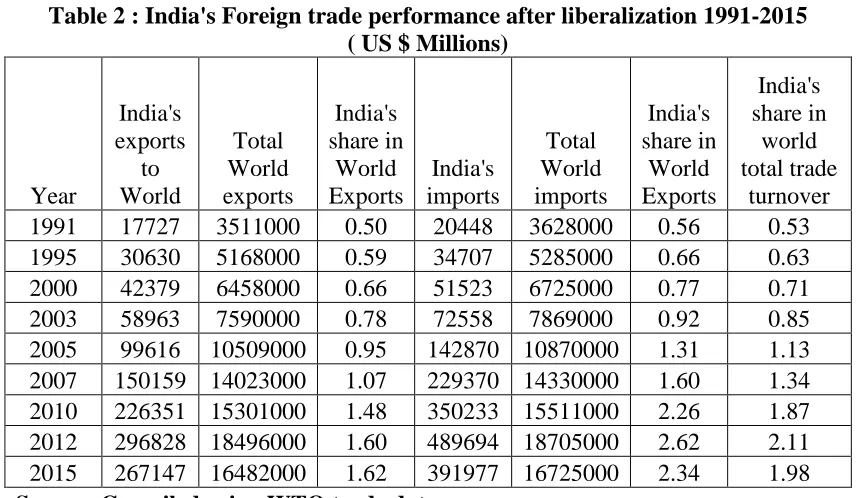
studied in a time series from 1991 to 2015 which has been depicted in Table 2.
India‟s exports were US $ 17727 Millions in 1991 which surged to US $ 267147 Million
by 2015 and their share in total world exports has also been improved from 0.50 percent in 1991
to 1.62 per cent by the end of 2015. Similarly, imports were about US $ 20448 Million 1991 that
increased to US $ 391977 Million by 2015. The share of Indian imports in world imports was
0.56 during 1991 which improved to 2.34 per cent by the end of period of study. Likewise the
total trade turnover of India has also increased from 0.53 per cent in 1991 to 1.98 per cent by
2015. To sum up it is evident from this study that India was successful in reviving its economy
[image:7.612.92.520.371.620.2]through a series of strategic economic reforms through all these years.
Table 2 : India's Foreign trade performance after liberalization 1991-2015 ( US $ Millions)
Year India's exports to World Total World exports India's share in World Exports India's imports Total World imports India's share in World Exports India's share in world total trade turnover
1991 17727 3511000 0.50 20448 3628000 0.56 0.53
1995 30630 5168000 0.59 34707 5285000 0.66 0.63
2000 42379 6458000 0.66 51523 6725000 0.77 0.71
2003 58963 7590000 0.78 72558 7869000 0.92 0.85
2005 99616 10509000 0.95 142870 10870000 1.31 1.13
2007 150159 14023000 1.07 229370 14330000 1.60 1.34
2010 226351 15301000 1.48 350233 15511000 2.26 1.87
2012 296828 18496000 1.60 489694 18705000 2.62 2.11
2015 267147 16482000 1.62 391977 16725000 2.34 1.98
Suggestions and Conclusion:
India is one of the oldest civilizations of the world. It has been engaged in trade and
cultural activities since ancient times. It was abundant with various natural resources which
attracted the attention of foreign traders. India eventually went under the administration of a
trading company and has been extremely exploited for so many years. The once wealthy country
has been left as the most populous and poverty stricken country by the time India got its
independence.Initially India struggled with few macroeconomic issues such as poverty,
population and unemployment; however, it has revived its economy through a series of economic
reforms since 1991. The once closed economy which has concentrated on achieving self
sufficiency eventually recognized the importance of global integration of its economy and
initiated the liberalization policy in 1991.
With liberalized trade and industrial policies, India‟s foreign trade has been improved
magnificently constituting about 2 percent of world total exports and imports by the end of 2015,
which was only around 0.5 per cent before the liberalization. Trade played a vital role in
transforming the image of India from poorer economy to one of the fastest growing economies.
In this context it can be suggested that-
Indian government should encourage export oriented industries and establish special
economic zones in less developed regions which may enhance the regional development.
Government of India should initiate educational and entrepreneurial programmes for
youth and women directed towards export promotion.
Small and village industries should be encouraged to export their products such as
handicrafts and execute extensive promotional activities overseas to elicit demand for our
ethnic products.
The import procedure should be simplified further with reduced tariffs and duties.
Now India is a key player in world trade and evolved itself as Asian hub to so many
foreign organizations. India has even emerged as a strong competitor for FDIs along with China
REFERENCES
1. Basu, K. (2004). The Indian economy: Up to 1991 and since. India’s Emerging
Economy–Performance and Prospects in the 1990s and Beyond, The MIT Press, Cambridge, MA, 3-31.
2. Bhat, T. P. (2011). Structural changes in India‟s foreign trade. A study report prepared as a part of Research Programme on Structural Changes, Industry and Employment in the Indian Economy: Macro-economic Implications of the Emerging Pattern, sponsored by the Indian Council of Social Science Research (ICSSR), New Delhi.
3. Ikram, S. M. (1989). History of Muslim civilization in India and Pakistan: a political and
cultural history. Institute of Islamic Culture
4. Kaur, A. (2012). Pattern of India's Foreigh Trade in Pre and Post Reform Era: An
Empirical Investigation. International Journal of Advancements in Research &
Technology, 1(5), 170-199.
5. Krishna, P., & Mitra, D. (1998). Trade liberalization, market discipline and productivity
growth: new evidence from India. Journal of development Economics, 56(2), 447-462
6. Nagaraj, R. (2000). Indian economy since 1980: Virtuous growth or
polarisation?. Economic and Political Weekly, 2831-2839.
7. Singh, A. P. Performance of Foreign Trade in India in the Post Liberalisation Era.