practice with purpose. Assessment, Teaching and Learning Journal, 5. 9 - 12. ISSN 1756-8781
Link to Leeds Beckett Repository record: http://eprints.leedsbeckett.ac.uk/1132/
Document Version: Article
The aim of the Leeds Beckett Repository is to provide open access to our research, as required by funder policies and permitted by publishers and copyright law.
The Leeds Beckett repository holds a wide range of publications, each of which has been checked for copyright and the relevant embargo period has been applied by the Research Services team.
We operate on a standard take-down policy. If you are the author or publisher of an output and you would like it removed from the repository, please contact us and we will investigate on a case-by-case basis.
8. Give choice in the topic, method, criteria, weighting or timing of assessments 9. Involve students in decision-making about
assessment policy and practice 10. Support the development of learning
communities
11. Encourage positive motivational beliefs and self-esteem
12. Provide information to teachers that can be used to help shape their teaching.”
(Nicol, 2008, pp. 6-7)
In order to facilitate wide-scale pan-university engagement with the principles they were refined by the project director to ten elements of successful first level learning which can be represented and remembered by means of a simple FIRST LEVEL principles list:
F Friendships
I Interaction and dialogue
R Reflection and building on feedback S Self-belief
T Teaching shaped by assessment
L Lifelong learning skills E Efficient, value-added marking
V Valued diversity reflected through choice E Engaging and enjoyable
L Learning through experimentation
These elements have been further grouped into four areas of focus for supporting first level learning: Feelings:to provide appropriate social experiences to instil a sense of belonging:
Friendships: Designing assessments that provide opportunities to develop peer friendships, student-tutor relationships and learning communities
Self-belief: Providing feedback in a way that encourages positive motivational beliefs and self-esteem
Fit:to empower students to develop a sense of control over their own learning:
Teaching shaped by assessment: Using assessment diagnostically to shape teaching Interaction and dialogue:Regularly giving and receiving individual feedback to clarify
First-year assessment: aligning perceptions and practice
with purpose
Ruth Pickford, Janice Priestley and Mandy Asghar
National Student Surveys indicate that assessment and feedback across the HE sector are perceived as significantly less satisfactory than all other areas of the student experience. Student experiences of assessment and feedback in their first year are also critical for retention (Yorke, 2001). This project aims to improve assessment for first-year students at Leeds Metropolitan University (Leeds Met) and more widely in the following ways. First, we aim to close the gap between students’ pre-entry
expectations and their perceptions of assessment/ feedback during their first year. Second, we aim to raise student and staff awareness of the purposes of assessment/feedback and disseminate
techniques to help staff achieve better student engagement with assessment/feedback. Lastly, we aim to elicit student and staff perceptions of assessment/feedback before, during and after the first year to inform the redesign of practice. The overall aim of the project is therefore to align expectations, perceptions and practice more closely to enable us to understand how we may improve the student learning experience.
The underlying principles
Nicol (2008), building on findings of the Re-Engineering Assessment Practices project (REAP, 2007), and drawing on the QAA Code of Practice on Assessment (QAA, 2006) recommends 12 principles of good formative assessment and feedback practice in the first year:
“Good assessment and feedback practice should: 1. Help clarify what good performance is (goals,
criteria, standards)
2. Encourage ‘time and effort’ on challenging learning tasks
3. Deliver high quality feedback that helps learners self-correct
4. Provide opportunities to act on feedback (to close any gap between current and desired
performance)
5. Ensure that summative assessment has a positive impact on learning
6. Encourage interaction and dialogue around learning (peer and teacher-student)
7. Facilitate the development of self-assessment and reflection in learning
The first stage was to develop questions, as part of the preliminary study, to allow us to survey
students to determine their perceptions upon starting at university. The questions were designed around the FIRST LEVEL principles and sought to determine their thoughts on what first level assessment should and would be like.
We also needed to determine what the current assessment practices are at the first level. A survey for staff was designed, again using the FIRST LEVEL principles, to determine what staff believed was happening in their area and also the extent to which they agreed with the FIRST LEVEL principles. Care was taken to ensure that the staff survey was presented in a non-judgemental manner which allowed staff to be open and honest about current practice in the area where they worked. It did not specifically ask about their personal assessment practice.
In addition to surveying students and staff, a number of meetings have been held with Student Liaison Officers and the Students’ Union to seek their assistance in identifying any assessment areas that students identify as being problematic.
Project website
We have established a project website to
disseminate information about the project. The site contains details of the project aims and also has reflections from students about assessment: www.leedsmet.ac.uk/flap
Coaching staff
A series of coaching sessions on designing first-year assessment is underway to assist staff in
re-designing their assessment in line with FIRST LEVEL principles or to discuss ideas relating to assessment practice. It is anticipated that this will result in exemplar case studies illustrating good assessment and feedback practice from across Leeds Met being made available on the FLAP website.
Developing guides
Two students have been recruited to support the project and are engaged to work in developing a guide for pre-entry students to give them advice on Valued diversity reflected through choice:
Working in partnership with students to design assessments, giving choice in the topic, method and criteria and flexibility in the timing of feedback and assessments Formative activity:to support learning and the development of academic skills:
Reflection and building on feedback: Building in opportunities for students to use feedback shortly after receiving it, to reflect on learning and to close the gap between current and desired performance Lifelong learning skills: Designing
assessments that develop underpinning skills for lifelong learning
Fun:to engage students in learning:
Efficient marking:Designing assessments that are non-onerous to mark and manage and that have a positive impact on learning Engaging and enjoyable: Focusing on engaging students through enjoyable assessment tasks
Learning through experimentation: Designing assessments that are
challenging and that encourage students to take risks in a non-threatening
environment and learn through failure. The basic premise of the First Level Assessment and Feedback Project (FLAP) is that through engagement with these principles in our
assessment and feedback practice we may impact significantly on the first level learning experience. The principles are being used as a framework to:
•develop staff and student resources produced as part of this project
•stimulate discussion with Leeds Met students and staff
•change Leeds Met practice.
Methodology
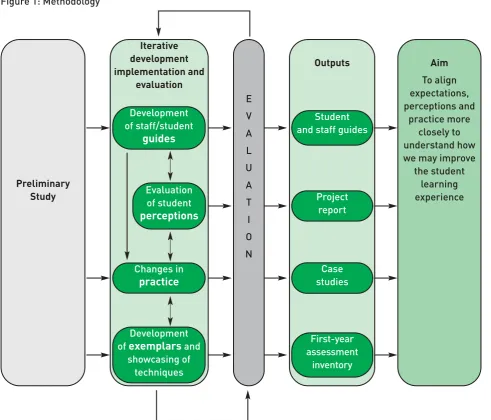
The study is adopting a co-ordinated, informed, University-wide response to the issues (Figure 1).
Outputs
11
ALT JOURNAL NUMBER 5: SPRING 2009
Preliminary Study
Iterative development implementation and
evaluation
Development of staff/student
guides
Evaluation of student
perceptions
Changes in
practice
Development of exemplarsand
showcasing of techniques
E
V
A
L
U
A
T
I
O
N
Student and staff guides
Project report
First-year assessment
inventory Case studies
Aim
To align expectations, perceptions and
practice more closely to understand how we may improve
[image:4.595.56.548.145.565.2]the student learning experience Figure 1: Methodology
what to expect from first level university assessment. They will seek feedback on this, prior to publication, from students in partner schools and colleges. Collaboration with partners
We are working collaboratively with Skipton Girls’ High School to explore the mentoring of students in schools in making the transition from school to university.
Lessons and challenges
Early lessons from the project are possible limitations in the student survey questions. For example, a question on whether one assignment should link to another to allow students to build on
existing skills caused some students to wonder whether poor performance in one assignment would be carried through, to their detriment, in subsequent assignments. This perception was not foreseen when compiling the questions. Also, in seeking to avoid students automatically selecting the obvious answer, some questions were asked in the negative. Where this occasionally produced a response that was perhaps not anticipated, e.g. that assessment should not be fun, we cannot be truly confident that the students had seriously read and considered their answers.
feedback: Enhancing integration and empowerment in the first-year success: Integration and Empowerment. Glasgow: Quality Assurance Agency, Scotland. Prosser, M. (2005) Why we shouldn’t use student surveys of teaching as satisfaction ratings. York: Higher Education Academy. Available at:
www.heacademy.ac.uk/assets/York/documents/ou rwork/research/Interpretingstudentsurveys_Nov_ 2005doc
Quality Assurance Agency for Higher Education (2006) Code of Practice for the assurance of quality and academic standards in higher education. Section 6: Assessment of students.Available at:
www.qaa.ac.uk/academicinfrastructure/codeOfPra ctice/section6/default.asp
REAP (2007) Assessment Principles: some possible candidates.Available at:
www.reap.ac.uk/resourcesPrinciples.html
Yorke, M. (2001) Formative Assessment and its Relevance to Retention. Higher Education Research and Development20(2), 115-126.
Ruth Pickford, Janice Priestley and Mandy Asghar Office of the Pro-Vice-Chancellor:
Assessment, Learning and Teaching Leeds Metropolitan University academics, which launched the project and has
successfully raised its profile within the University. The integration of first-year assessment and feedback into Leeds Met’s assessment, learning and teaching (ALT) strategy and the institutional ALT priorities has been valuable in promoting discussion about the project at senior levels. The challenges of the project at present are two-fold: 1. Identification of modules where improvement
would have significant and early impact upon the student experience
2. Engagement of current Leeds Met students in the mentoring of pre-entry students.
Prosser (2005) argued that:
“Students on a course experience the same teaching and the same course, but they experience them in different ways. Becoming aware of those differences, and trying to understand them, is the key to improving students’ experiences of learning. The issue is then how to bring students’
experiences into line with the ways in which we design and teach our courses.”
It follows that the distinctive contribution that embedding this project will make to the student learning experience is to focus both on helping first-year students to understand
assessment/feedback practice and also to address the way staff assess and feed back to first-year students. Students are more likely to drop out of university in their first year than at any other time. Our work seeks to prevent attrition, not just so that we meet targets, but to avoid the long-lasting human costs to the individuals concerned.
12
ALT JOURNAL NUMBER 5: SPRING 2009
For more information on this project see: http://flap.teams.leedsmet.ac.uk/