Citation:
Stoppani, T (2008) Grid effects. Architectural Research Quarterly, 12 (3-4). 255 - 262. ISSN
1359-1355 DOI: https://doi.org/10.1017/S1359135508001188
Link to Leeds Beckett Repository record:
http://eprints.leedsbeckett.ac.uk/550/
Document Version:
Article
This item has been migrated from an earlier iteration of the Leeds Beckett Repository and was
originally archived when use of the published PDF was permitted by the CUP self-archiving policy.
The aim of the Leeds Beckett Repository is to provide open access to our research, as required by
funder policies and permitted by publishers and copyright law.
The Leeds Beckett repository holds a wide range of publications, each of which has been
checked for copyright and the relevant embargo period has been applied by the Research Services
team.
We operate on a standard take-down policy.
If you are the author or publisher of an output
and you would like it removed from the repository, please
contact us
and we will investigate on a
case-by-case basis.
Architectural Research Quarterly
http://journals.cambridge.org/ARQ
Additional services for
Architectural Research Quarterly:
Email alerts: Click here
Subscriptions: Click here
Commercial reprints: Click here
Terms of use : Click here
Grid effects
Teresa Stoppani
Architectural Research Quarterly / Volume 12 / Issue 3-4 / December 2008, pp 255 - 262 DOI: 10.1017/S1359135508001188, Published online: 25 February 2009
Link to this article: http://journals.cambridge.org/abstract_S1359135508001188
How to cite this article:
Teresa Stoppani (2008). Grid effects. Architectural Research Quarterly, 12, pp 255-262 doi:10.1017/S1359135508001188
Request Permissions : Click here
http://journals.cambridge.org Downloaded: 28 Jul 2014 IP address: 160.9.192.64 Soft grid (2006)
Zaha Hadid’s Kartal Pendik Masterplan (2006)1
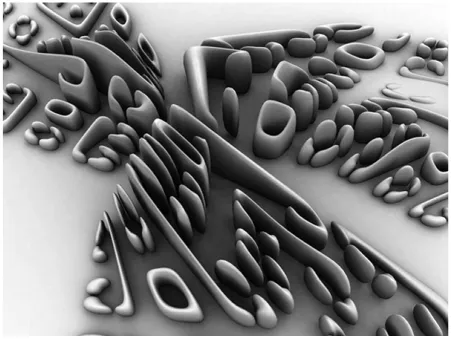
for a new city centre on the east bank of Istanbul proposes the redevelopment of an abandoned industrial site located in a crucial infrastructural node between Europe and Asia as a connecting system between the neighbouring areas of Kartal in the west and Pendik in the east. The project is organised on what its architects call a soft grid, a flexible and adaptable grid that allows it to articulate connections and differences of form, density and use within the same spatial structure [1].
Its final overall design constitutes only one of the many possible configurations that the project may take in response to the demands of the different areas included in the masterplan, and is produced from a script that is able to generate both built volumes and open spaces, skyscrapers as well as parks. The soft grid in fact produces a ‘becoming’ rather than a finite and definitive form: its surface space does not look like a grid, but is derived from a grid operation which is best explained by the project presentation in video animation. The grid here is a process of ‘gridding’, enacted according to ancient choreographed linear movements of measuring, defining, adjusting, reconnecting spaces through an articulated surface rather than superimposed on an ignored given like an indifferent colonising carpet.
Grid operations (intersect, striate, connect)
The masterplan’s first step in approaching its site is the identification of a horizontal axis (decumanus maximus) peripheral to the project area but fundamental for its connections. This first line is (quasi) perpendicularly intersected by a north-south link that becomes the spine of the project area (cardo maximus). The new mundusof this intersection is the existing motorway cloverleaf intersection at the northern margin of the site. Not only is this not the geometric centre of the system, but this system has no centre. And yet, its soft grid begins with the intersection of two lines. The system generated by this intersection remains open and proceeds by successive secondary striations as repetitions (quasi) parallel to the two main axes. The prevailing process of horizontal striation determined by the extension of the path of existing roads provides the suture between two existing areas. In the following step of ‘interlacing interference’ the projected east-west routes vibrate and adjust to reconnect the existent
theory arq . vol 12 . no 3/4 . 2008 255
theory
Zaha Hadid’s masterplan for a new centre in Istanbul provides
the stimulus for a far-reaching investigation of the role of the
grid in structuring urban and architectural space.
Grid effects
Teresa Stoppani
1 Zaha Hadid Architects, Kartal Pendik Masterplan, Istanbul (2006-present). Plan. Soft grid as grid effect
built fabric and road system on either side. The lines of the project stray from the rectilinearity of an orthogonal grid, and follow the process of their making and the adaptation to given conditions rather than a given preconfigured form. Bent, curved and interwoven, these lines occasionally touch or cross over each other in synapses that enable the presence of irregular elements in the project; like superimposed waves, their movements produce higher peaks and lower troughs, in a three-dimensional wave pattern that generates different options of configuration.
Further oscillations are produced to adapt the lines to the site topography, whose condition is already reflected and accommodated by the existing road system. Through a process of linking, siting, and adapting, rather than superimposing a preconfigured foundational tabula rasa, the project produces a non-centralised system characterised by porosity, accessibility and merged continuity. Open and generated – scripted rather than designed – from the outside, this grid is soft not because of its curvilinear shape but due to its generative forming process.
The next step is the construction of the grid itself, not by infill but through a thickening of its ‘field’.2
A pulsating system with peaks and voids that reach the Bosporus, this grid remains capable of becoming form, of fading away in some areas, as well as of corroding the softly contoured blocks it defines [2].
The end result of the volumetric masterplan does not look like a grid, but more like a labyrinth or an arabesque. But it still is, operationally, a grid. In what way? Is a grid still a grid when it does not
approximate a predefined figure but operates by performing a set of spatial operations? Is a grid still a grid when it is defined in such a way as to accept and incorporate external variables and change, without restricting a final formal outcome in terms of both its elements or overall envelope, and of its outer limits? The questioning of the formal outcome of the grid shifts the emphasis onto the process of gridding, its operation. What gridding produces is not a grid form but a grid effect.
Arabesque
A definition and understanding of the grid effect in architecture and in urban and territorial planning cannot take place without relating it to the abstraction performed by the grid in modern painting and to the material implications of the making of the grid. Germano Celant has linked the complexity and interweaving of experiences in the obsessive paintings of Agnes Martin – grids, grids and grids again – to the image of the arabesque as labyrinthine space. In Martin’s paintings, he writes, ‘there is no possibility of ordering the hierarchy of reason and emotion, of perception and imagination. We are led to a different term: “arabesque”. In Islamic architecture, the arabesque, which designates the indefinite negation of closed geometric forms, also connotes the Creator – not as a stable, eternal presence, but as an absence, in a guise that is fragile, incomplete and precarious.’3
‘Negation of closed geometric forms’, ‘absence’ or ‘incomplete and precarious’ presence: what occurs here is the bypassing of the consideration of form (a grid can also be an arabesque) in favour of a spatial organisation that beyond its appearance refuses both hierarchical structuring and the closing of form. If an organised and yet open structure and an open forming process characterise both the grid and the arabesque, it seems necessary to reconsider the grid in terms of its operation rather than of its form. In this sense it is possible to argue that Zaha Hadid’s Istanbul masterplan, both a grid (operation) and an arabesque (figure) perform a grid effect [3].The
project offers a point of entry into a reconsideration of the grid in relation to architecture and to the design (as planning) of the city and the territory, in a way that opens connections to previous cases of grid effects. It allows us to reframe an understanding of the grid that reaches beyond (or underneath) the
tabula rasaof Modernism and also beyond the reactions and criticisms to it produced in the 1960s
and 1970s.4
Because the grid is used not only in the design of architecture, the city, the territory, it is necessary to consider it as an abstract system that is applied also in areas that range from the political to
arq . vol 12 . no 3/4 . 2008 theory 256
Teresa Stoppani Grid effects
http://journals.cambridge.org Downloaded: 28 Jul 2014 IP address: 160.9.192.64
the legislative, to representation in general (from perspective to geography), to the visual arts. To understand what the grid doesin architecture and in the organisation of the territory it is necessary to leave architecture, the city, the territory, and move to the canvas, and there look beyond the visual.
Abstract grids (modern painting)
In the seminal essay Grids5
(1978), Rosalind Krauss
examines the operative role of the grid in the redefinition of pictorial space in the early twentieth century. For Krauss, the emergence of the grid marks the separation of the visual arts from narrative and discursive structures and establishes a purely relational order that proclaims the autonomy and self-referentiality of space in art. This argument is relevant in a reconsideration of the grid in
architectural, urban and territorial systems, because it offers a reading of the grid beyond the figurative and the descriptive, proposing it not as a form or as a device for representation but as an agent of the
making of space. This becomes crucial when we come to consider the grid in the urban field and concentrate on the complications of the operationof the grid – what I call here the ‘grid effect’ – when it is employed as an organising system in the urban space and the territory. Unlike the modern pictorial grid, the ‘grid effect’ does not produce a separation from the world but, inseparable from its implementation, it produces a dynamic and evolving space rather than a bi- or three-dimensional form.
It is necessary to work through Krauss’ argument first, in order to depart from it. Krauss’ conclusion is that the grid of modern art is intrinsically anti-developmental – in the sense that it can only be repeated and experimented within endless variations and still remain a grid, or else it can be escaped from. ‘As the experience of Mondrian amply demonstrates’, writes Krauss, ‘development is precisely what the grid resists.’6
[image:5.612.48.500.69.419.2]The urban and territorial ‘grid effect’ by contrast cannot but develop, its form always already compromised (with the ground for example), and its rules flexible. Compromise and flexibility allow the urban and territorial grid to be, and to develop. That is, the urban and territorial grid is also and inevitably implicated with time and becoming, and for the grid to exist the changes it undergoes must be always already embedded in its rules. In other words, the figure of the grid is always already corrupted in its implementation, and for it to succeed the rulesof the grid – that is, the grid before the grid – must be able to incorporate change.
theory arq . vol 12 . no 3/4 . 2008 257
Grid effects Teresa Stoppani 3
2 Zaha Hadid Architects, Kartal Pendik Masterplan, Istanbul (2006–present). Seaview. The soft gridding process generates peaks and depressions that accommodate different densities and functions
A further digression into painting: for Krauss, the surfacing of the grid in pre-war Cubist painting announces modern art’s ‘hostility to literature, to narrative, to discourse’; it is ’successful in walling the visual arts into a realm of exclusive visuality and defending them against the intrusion of speech’.7
This is a fundamental step in the visual arts, as it makes them independent from superimposed narratives, and allows them to ab-stract(that is, ‘to draw away’) from a reality that exists outside of painting and its materiality. Painting is enabled to question and experiment with its own tools and to redefine itself and its autonomy, and with this it is also liberated from figuration. And yet the grid of painting ‘flattened, geometricised, ordered, antinatural, antimimetic, antireal’,8
autonomous and self referential, liberates a space that is itself never pure, never uncontaminated and always and immediately available to be occupied by other orders and forces that with the autonomy and definition of the grid compete. Never neutral, the grid is in fact always a site of tensions and can be read in all its contradictions.
Aftergrids (1960s painting)
‘It’s supposed to be indexical of all that is rational, but I think it’s as mad as many logical things turn out to be – artificial, hysterical, subsuming its own version of chaos. It’s rigid but flexible, a measure of scale but scaleless, it’s flat with imitations of depth, democratic about space but really absolutist, stamped with rigidity but alert with permutational virtuosity. It’s a container that contains itself, that is both form and content.’9
In the painting of the 1960s, the use of the grid
begins to show slippages, complications and contradictions, in explorations that divorce the grid of painting from the geometrical idea of a flat, homogeneous, neutral extension. It is not only the tension with the frame of the canvas that is explored. The flatness and the neutrality of the surface are questioned. The grid is inhabited by significations, by cultural and bodily traces, or – as Lucy Lippard puts it – by ‘sensuous or cerebral games’.10
In the work of Patrick Ireland (Irish artist Brian O’Doherty), the line remains removed from ‘description or illusion, nor is it autographic or expressive’,11
and yet the grids of his Vowel Drawingsare culturally marked by his reinterpretation of the letters of the Irish Celts’ Ogham alphabet, whose presence on the checkerboard produces not only infinite possible permutations of sound (and this is a culturally marked sound), but also the construction of words, possible different meanings and expressions. These are enacted when Ireland’s Structural Playsare ‘performed’ by actors who move and ‘sound’ on a grid. On the grid here is performed an ‘act of mapping, in that it plots a conceptual space and proposes hypothetical movements based on constructed systems’.12
In Ireland’s Dot Drawingsthe grid is often ‘implied (left blank) rather than drawn’ and ‘the scatter effect seems to keep all the dots in motion’ ‘bouncing with various velocities off the walls of the grid’, constructing the fields of tension that hold them together.13
Both figure and ground, grid and field, the drawings explore the
space between system and freedom.
In the obsessive, repetitive and yet always different grids of Agnes Martin the trace of the artist’s hand is always present. It produces the difference that brings into the grid the body and its temporality.14
‘The effect,’ observes Germano Celant, ‘is not impersonal but highly tactile. Hence, the abstraction aspires not to neutrality but, in skeletonizing, to accidentality: it tries to test the possibilities of a subjective
experience’, boiled down to its minimal terms.15
The perfection of the grid is never attained. The grid remains within the realm of the human, and it is therefore mediated and redefined by tactility and the body. ‘The work’, declares Martin, ‘is aboutperfection as we are aware of it in our minds, but the paintings are very far from being perfect – completely removed, in fact – even as we ourselves are.’16
In the early work of Bridget Riley the grid, invisible and only suggested by the points of its possible intersections, defines a field of static tension ready to be released and explode. Orientational and
suspended in an only momentary order, the elliptical grid-‘points’ pin down an already non-neutral surface that is about to ply and fold and explore its spatial depth. Reduced to magnetised points, the grid moves with the surface, conceived as an ‘open area space’ that ‘demands a shallow push-pull situation and a fluctuating surface’.17
In their different ways these grid-works challenge the grid of modern painting, its antinarrative (Ireland), antinatural (Martin), and flattened (Riley) nature. They open up the question of the
relationship between the figure of the grid and the generative rules of its making. If this is translated to the question of the design of architectural, urban, territorial space, the issue is not to liberate the grid from external narratives (or to occupy it with them). An urban or territorial grid inevitably intersects external narratives. The issue is rather to redefine the relationship between the figureand the generative rulesof the grid itself. In other words: in what does the autonomy of the urban and territorial grid consist, while it remains inextricably linked to its application on (or implication with) the physical forms of the city and the territory, and to the processes of delay and negotiation that this entails?
Architecture
What I argue here is that while the move toward the grid in painting liberates painting from an exterior referentiality and allows it to focus on itself and its own materials, the use of the grid in the city and the territory liberates the grid from the grid, that is, it exposes and implements the operationof the grid (its per-forming) beyond the appearanceof the grid (its form). The grid effectis the operation of gridding once it is divested of the prefigured formal resolution of the grid (gridiron). The grid effect, in other words, does not necessarily produce always ‘grids’. The urban grid (with the term I mean to include the whole range of scales from the architectural to the territorial) opens up the space between the representation of the grid and its implementation, between the figure of the gridiron
arq . vol 12 . no 3/4 . 2008 theory 258
http://journals.cambridge.org Downloaded: 28 Jul 2014 IP address: 160.9.192.64
as a given and the effect of the grid as a process. It questions the form of the grid. Speaking of grid effect removes the operation of the grid from its appearance and allows us to concentrate on what the grid ‘does’ in the architectural, the urban and the territorial.
Opening up the form of the grid – that is, opening up the space between the figure of the grid and its implementation – the grid effectproduces an indirect critique of the very nature of architecture and urban and territorial planning. Always impure, never solely geometrical, always drawn on a canvas that, unlike that of modern art, is always already compromised, changing and negotiated, architecture (architecture at large, and with it the design of the territory) remains a ‘dirty’ discipline, necessarily open to the ‘other’, and by definition always already working between practice and theory. This is nothing new in architecture, and we can go as far back as Vitruvius to find confirmation of this definition of the discipline.
‘The architect should be equipped with knowledge of many branches of study and varied kinds of learning, for it is by his judgement that all work done by the other arts is put to test. This knowledge is the child of practice and theory. Practice is the continuous and regular exercise of employment where manual work is done with any necessary material according to the design of a drawing. Theory, on the other hand, is the ability to demonstrate and explain the productions of dexterity on the principles of proportion.’18
What needs to be challenged here, in a reconsideration of form in contemporary architecture, is what
Vitruvius calls the ‘principle of proportions’ –
eurythmia, intended as order and arrangement based on numerical ratios, but also as ‘visiblecoherence of form’.19
Readdressing the grid as an effect, beyond its form, is a partial contribution to this argument. The ‘visible coherence’ of its form needs to be separated here from the numerical (and legal) ratios that produce it. Beyond Vitruvian eurythmia, the grid effect becomes part of a discourse on a ‘neo-rythmia’, whose geometry exceeds the conventions of Euclidean geometry and the definition of the properly
‘proportioned’ object. It is important to point out here that with the grid the ‘effect’ occurs already before the (architectural) dismissal of Euclidean geometry and within the very form of the orthogonal modular rectilinear grid, and is determined by the interference of other normative rules in the making of the urban and territorial grid – the ratios of the legal, military, agricultural, economic, social, geographical, etc. That is why the grid effect aims to separate figure and rule and understand the complexity of the operation of the grid that is already present before its form and geometry are challenged by contemporary architecture.
A reconsideration of the grid as effect exposes not the grid’s visual abstraction and autonomy but, on the contrary, its compromises and its involvements. This grid contains in itself, in being the inevitable failure of its ideal, the impossibility of a geometric (Platonic) perfection. It incorporates the failure of its geometry and of its autonomy, and in doing so makes itself actual: the failure of the grid as an absolute is
what makes it possible in the sense of implementable on the territory. It is because it changes and adapts, because it moves around and away from its own figure (and in this sense it ab-stracts, it draws away), that the grid can be and operate and organise space. ‘Effect’ here means the result (outcome) or the consequence of an action, but also the implications of the action itself. Considering the grid effect then means to consider the grid as an action or acting system, that is, its operative state rather than the exclusively figurative one. It is then important to distinguish between the figurative-descriptive representation and the operative representation in the sense of per-formance or enactment. Descriptive representation produces the reproduction of a thing, it refers to it through description or image, it portrays and presents to the senses and to the mind the appearance of the thing itself. Active
representation – performing or enactment – is instead the performing of an action, the carrying forward, but also indicates the operating or functioning in itself. Representation and performance need to be separated.
Archegrid (I–VI c. AD)
An examination of the production of grids in the system of the Roman limitatioor centuriatioallows us to explain the operation of the grid effect. By
combining abstract, normative and methodological elements with the practical needs of a productive system (agriculture, land control), the Roman
limitatioconstitutes a rigid and inexorable system that is in fact able to incorporate complex articulations and adsorb contrasting and
contradictory elements. The limitatiois a system of prediction, of land control and management, and an enabling matrix for future developments. It is also a flexible tool of adherence and adaptation to the given conditions of a territory. For its statute, which is at the same time both formal and normative, the system of the limitatioallows us to consider and always keep at play (or at work) the two aspects of the grid: its operation and its figure. In this context it is then possible to consider, together, space-making systems that are apparently different, did operate or are operating in different times and in different political and economical contexts, and work at different scales. Here the explicit shift between the rules and the forms (the final but always finally unfinished configurations of the territory) allows us to identify the operative nature of the grid (effect) as a system that embraces in its making not only rules and figures but also the exceptions and the margins of non-control that result from the differences of the two.
Before Sanford Kwinter’s consideration of the notion of field20
in architecture was expanded by Stan Allen’s introduction of the idea of field conditions21
as a possibility of the project of architectural design, before Albert Pope’s analysis of the involution of the American grid in the insular partialisations of the
ladder-shaped territorial structures – discontinuous enclave systems that break the continuity, openness and multi-directionality of the grid22
– the case of the
theory arq . vol 12 . no 3/4 . 2008 259
Roman territorial limitatiopresents a system that, because it is open and adaptable and it operates according to rules rather than closed figures, remains effectively at work and adaptable still today. The Roman limitatioproduces a flexible grid in which rule and form remain clearly distinguished: its forms derive only in part from the application of the generative rules (legal, numeric, geometric); its rules never achieve a total control of the minute structure of the form. Not a figure but a method, the limitatiois an incomplete system that becomes and takes form only in its realisation. It is a ‘weak’ system, capable of interrupting, deforming and adjusting in the presence of even the slightest natural obstacle. For this reason it is also a powerful flexible system: adaptable, it is able to accept and incorporate exceptions, differences and obstacles, and to comprehend (include and understand) that which it cannot determine or measure.
Grid operations (divide, allot, delimit)
According to Max Weber23
the genera agrorumof the Roman land surveying system include: the ager divisus et assignatus (divided and allotted); the ager per extremitatem mensura comprehensus (measured in its outer dimensions), of which the cadastral map shows only the outer boundaries, without documenting the single assigned plots of land; and the ager arcifinus, qui nulla mensura continetur(the
immeasurable ‘extremely fine’) – that is, the natural, the non controllable, the non measurable, are also considered and included in the organisational and normative system.24
Importantly, all these systems coexist in the forma(form).
The ager divisus et assignatusincludes the rectangular system of theager per scamna et strigas divisus et assignatus, divided in rectangles of north-south (strigas) or east-west (scamna) orientation, and the ager limitatus, per centurias divisus et assignatus
(limited, divided and allotted in centurias) –
commonly known as centuriatioand organised in the squares of the centurias. The two systems produce different forms corresponding to different regimes of land ownership but are generated by the same process of linear subdivision. The foundational moment of the ager limitatusis the determination and tracing of the decumanus maximus(the east-west divider that follows the cycle of the sun) and of its perpendicular the cardo. What is important here is that once the foundational operation is in place, the different systems of subdivision can not only coexist but also overlap. The limitatiotherefore is not only a process of linear division of the land, but also a process that establishes relations by combination and repetition of linear systems. The limitatiois not a homogeneous surface, but the outcome of the intersections, overlaps and scaling of two orientated rectilinear systems, organised through repetition and inter-scalar articulation. Through its linear divisions and subdivisions, it constructs a hierarchy of elements, some of which remain only virtual, and are not necessarily traced on the land. Centric, the
limitatiois defined by its foundational centre, the generating point of its subdivision as intersection of
orthogonal rectilinear traces (mundus). The resulting grid is not the juxtaposition of predefined modular units or iterated tassels, but the result of combined linear operations of striation.25
The true centre of the system then is not the geometric centre of a defined figure, neither the generating point of intersection of decumanusand cardo, but the non-figurative rule of measurement and repetition.
Forming versus forma
The rule of the grid precedes the tracing of theager limitatus. Only after the system is traced on the land is it transferred onto a cadastral map – significantly called forma– which records the form in which the colonisation plan is concretely and systematically implemented. This is not a representation but a mapping in the sense that it remains open and incomplete in its definition.26
Much more than a figure, it is an all-inclusive, non-figurative forma mentis. The formacontains also the subsiciva, the leftover land that remains at the margins of the ager, between its end orthogonal plots and its outer delimitation; it includes the ager extra clauses, the excess land whose surface is not plotted, subdivided and assigned; and it includes also the loca exceta et relicta– the plots that have not yet been assigned but whose boundaries are recorded in the forma. The
forma,that is, includes both the grid and the irregular residues that result from its
implementation. Here orthogonal subdivision and external delimitation remain two distinct elements, separate or separable by the space that is not (or cannot be) controlled. That is, the form of the
limitatiohas a double boundary of definition: one is linearly and proportionally defined by the
generative rules of the grid, the other is contextually defined by local restrictions (topographical,
economical, political, military, legislative) most frequently represented by natural impediments or physical obstacles.
The resulting two figures most often do not coincide, and consequently the formacontains, represents and measures also the discrepancy (the space of the difference) between the measuring system (land surveying) and the land itself. Between the artificial precinct and the natural boundaries are defined spaces that are irregular and yet surveyed (acknowledged), which lie within the measuring system (the ruleof the grid) but outside the orthogonal system (the figureof the grid). The natural limit results from the difference, it emerges because it is laid out, it is indeed literally a margin of difference. Far from being antinatural, timeless and absolute, far from being an indifferent
homogeneous carpet, the form of the limitatio
derives from a careful relation with the land.
Supersystem
The subdivisions of the limitatioorganise a communication and accessibility network that is potentially homogeneous, but in fact incorporates and structures within itself a series of temporal and dimensional differences (exceptions and inclusions). Apparently non-permeable and all-controlling, its
arq . vol 12 . no 3/4 . 2008 theory 260
http://journals.cambridge.org Downloaded: 28 Jul 2014 IP address: 160.9.192.64
field in fact includes elements that it cannot ‘know’ and that it can measure only on their outer perimeter: pre-existing estates, sacred woods, religious spaces, natural obstacles, communal lands. The very definition and rules of the system require that the limitatioincludes in itself the exception, as a vital element for its functioning (programmed discontinuity). An overlaid measuring system, the
limitatioworks by inserting artificiality and control among pre-existent elements (natural as well as artificial), and it includes and contains them. This is the aspect in which the limitatiomost clearly mirrors the organisation of the domination policy of the Roman empire, which controls difference and otherness by absorbing and isolating them within itself. It is a total project at vast scale, capable of containing vast parts of the territory, whole cities, rules and exceptions, holding together productive land and wilderness, infrastructures and
architectures with extraordinary coherence. Variously modulated at different scales, its soft control at the extra-large scale of the territory enables it to accept heterogeneous materials, preexistent elements and transformations in time.
At the extra-large scale the limitatiois constructed by discontinuities: while the single limitatiois defined at the edges by its site conditions, the general system is constructed as a summation of different elements – different systems defined by the same norms applied in different ways and contexts – adjusted to construct different layouts. The overall network of limitationesis a linearly connected supersystem of planned discontinuity. The system remains open as a network of territorial connection: the delimitations of the limitatiocan be read as the tracing of a relational connective system rather than the definition of enclosures or enclaves. The limitatio
does not enclose, it does not define a specific content for the figures it traces, but it divides and connects at once. It is this open nature that makes its survival and alternative occupations and uses still possible today, as an active and adaptable flexible system capable to accommodate new uses and regimes of land ownership.
Constructed as a combination of orientated linear systems (striations), the limitatiois a composition of discontinuity and connection in which the boundaries – formaand land ownership, agerand
limitatio– do not coincide. Organised by the linear space of its relational limits (rather than by
predefined forms), it can generate an endless variety of forms and organisations. The overflowing of the property lines outside the boundaries of the limitatio
are always already foreseen by the system itself: here the exception – that which is taken out (from the Latin excipere,‘take out’, from ex-, ‘out’ and capere, ‘to take’) – is always already part of the rule (and of its implementation). The success of the system lies in its capacity of combination and mediation: theoretically endless and unlimited, the method is universal but its implementations can only be partial and discontinuous in space and time. In fact, the overall figure of the Roman grid network is a discontinuous system of continuously articulated systems that
works through inclusions and connections to produce an overall centre-less centrifugal grid effect. Permanent on the land and susceptible to infinite subdivisions and articulations, the traces of the Roman grid remain an open and available framework for developments that respond to the changing needs of different territorial economies. Open and
interconnected in its main structure, the grid, with its many possible inner subdivisions and
articulations, provides a flexible matrix for ongoing developments. Form here persists because change is embedded in the rules of its definition, and it is these, and not only the geometry of the quadra,that perform the grid effect.
Supergrid? (1972)
Geometrically relentless and socially liberating, the ‘perfect’ grid returns in Superstudio’s
non-architectural utopia of the 1970s. In Supersurface27
the superurban supernomad roams an invisibly infrastructured territory that allows no domesticity, no rootedness, no control (not his control). The glass-thin grid that glazes over the earth remains a non-answer. It does not address the architectural, it just surfs over it. Its thickness resides somewhere else, in the ideological. For this reason, the interruptions caused by nature, the mountains (which in the
Continuous Monumentproject can become a skyscraper) are not a spatial concern of this grid, which remains instead a concern for the Roman
centuriatio. ‘Superthin’ this grid is ideological rather than architectural – it is even non-spatial.
Geometrical, regular, modular, visible,
organisational, it remains unconcerned with the dirty guts of space. While the Roman space of the
arcifinus(the extremely fine), although non-measurable, was included in the overall
organisational system of the territory, Superstudio’s measurable, selfsame, potentially endless supergrid glides over it, measuring nothing and organising nothing. In fact, it liberates architecture not only from form, but from space itself, as well as from the relations that structure it – that is, from the political dimension of space.
Zaha Hadid’s Istanbul project produces a grid surface(what I have called a ‘grid effect’) that is not an occupied grid but the thickening of the grid space itself. Its outcome does not ‘look like’ a grid, but it performs grid operations that define and organise relations in space in dynamic, contextual and negotiated terms. Superstudio’s grid – totalising, continuous but broken and non-negotiable – remains ideological rather than political, in the sense that it remains a formal statement that does not address space and its political implications. This superthin supergrid does not perform those grid operations that produce, organise and enable the flexibility of what I have called here ‘grid effects’, and which occur in different ways in Hadid Architects’
2006masterplan as well as in the Roman limitationes.
The surface grid, the operational grid, does not need to look like a grid (although it may look like the grid), but it needs to operate as a relational system that both divides and connects.
theory arq . vol 12 . no 3/4 . 2008 261
Ferdinand Enke, 1891). See now the
authoritative edition by Jürgen Deininger, MWG I/2(Tübingen: J. C.
B. Mohr, 1986).
24. Respectively: ager divisus et assignatus, divided and allotted land; ager per extremitatem mensura comprehensus, land defined by the measurement of its outer boundaries; ager arcifinus, qui nulla mensura continetur, superfine land, not defined by any measurement.
25. For a definition of the operation of
striation, also in relation to the subdivison and organisation of the territory, see Gilles Deleuze and Félix Guattari, ‘The Smooth and the Striated’, in A Thousand Plateaus: Capitalism and Schizophrenia
(London: The Athlone Press, 1988),
pp. 474–500.
26. I have discussed this in Teresa
Stoppani, ‘Mapping. The Locus of the Project’, Angelaki, 9.2(2004), The
Politics of Place (ed. by A. Benjamin and D. Vardulakis), 181–196, where I
reconsider mapping as an open project in light of a philosophical thinking linked to the dynamic.
27. Superstudio’s Supersurfaceappears
in their project ‘Fundamental Acts: Life, Supersurface’ (1972). See the
chapter ‘1972–73. Superexistence:
Life and Death’ in Peter Lang, William Menking, Superstudio. Life Without Objects(Milan: Skira, 2003),
pp. 175–212.
Illustration credit
arqgratefully acknowledges: Zaha Hadid Architects, all images
Biography
Teresa Stoppani (MArch IUAV Venice, PhD Florence) is Senior Lecturer in Architecture at the University of Greenwich, London, where she coordinates Histories and Theories and directs the MSc Architectural Studies programme. Recent publications include the edited monograph Antipodes/Measuring the World, Haecceity Papers, 2.1(2006),
and the essays ‘Unfinished Business: The Historical Project after Manfredo Tafuri’, in Critical Architecture
(Routledge, 2007) and ‘Venetian Time
and The Meander’, in log, 12(2008).
Author’s address
Teresa Stoppani University of Greenwich School of Architecture and
Construction
Avery Hill Campus, Mansion Site Bexley Road, Eltham
London se9 2pq
UK
[email protected] Notes
1. Zaha Hadid’s Kartal Pendik
Masterplan. See Zaha Hadid, GA Document, 99(2007).
See also <http://www.arcspace.com /architects/hadid/kartal_pendik/kp. html> [accessed 2December 2007]. 2. Stan Allen, ‘Field Conditions’, in
Points + Lines: Diagrams and Projects for the City(New York: Princeton Architectural Press, 1999), pp. 90–103. Available online on
<http://www.hum.ku.dk/visuelkultu r/efteraar2002/digvis/allenfieldcond
ition.html> [accessed 2December 2007].
3. ‘Furthermore [continues Celant]
the arabesque, is the form of a creation ex nihilo, tending towards supreme beauty and extreme harmony. Its linear structure triggers a profound revision of our mental and cognitive attitudes. There is the particular case of the possible and the impossible. Agnes Martin looks for the same synthesis of absolute contraries, she tries to depict the undepictable, to see the unseeable, to feel the unfeelable […].’ Germano Celant, ‘Perceiving as Receiving as Responding: Agnes Martin’s Secret’, in Agnes Martin: Paintings and Drawings 1977–1991(London: Serpentine Gallery, 1993), p. 9.
4. Here I do not consider the
implications of the grid as it was applied in the North American city and territory, a topic which deserves complex and ample consideration beyond the scope of this essay. The North American grid, although different in its scopes and applications, shares with the Modern grid the idea of the tabula rasaas a virgin, totally available, measurable and controllable territory. Here instead I ‘look’ before (and underneath) the tabula rasa, at grids that are always already compromised with reality, not only in their actuation, but in the very definition of their processes of ‘gridding’. And yet, ‘to look’ is the wrong word here, because if one only ‘looks’ one only sees grids (or non-grids). What I want to suggest here is indeed a reconsideration of the grid beyond the visual and the formal. For the political
implications of the grid in relation to democracy see Joan Copjec, ‘The Grid and the Logic of Democracy’, in Mario Gandelsonas, The Urban Text
(Chicago: Institute for Architecture and Urbanism; Cambridge: MIT Press, 1991), pp. 13–15.
5. Rosalind E. Krauss, ‘Grids’ (1979), in The Originality of the Avant-Garde and Other Modernist Myths(Cambridge
and London: MIT Press, 1985),
pp. 9–22. 6. Ibid., p. 9. 7. Ibid. 8. Ibid.
9. Patrick Ireland, in Patrick Ireland: Language Performed / Matters of Identity
(Derry: Orchard Gallery, 1986), p. 21. 10. Lucy Lippard, in Patrick Ireland:
Drawings 1965–1985(Washington DC: Smithsonian Institution Press, 1986),
p. 17.
11. Elizabeth Broun, in Patrick Ireland: Drawings 1965–1985, p. 8.
12. Ibid., p. 8. 13. Ibid., p. 11.
14. ‘My formats are square, [explains
Martin] but the grids never are absolutely square; they are rectangles, a little bit off the square, making a sort of contradiction, a dissonance, though I didn’t set out to do it that way. When I cover the square surface with rectangles, it lightens the weight of the square, destroys its power.’ Agnes Martin quoted in Lucy Lippard, ‘Homage to the Square’, Art in America, 55.4
(1967), 55. 15. Celant, p. 9.
16. Agnes Martin quoted in Celant, p. 8. 17. Bridget Riley,Bridget Riley: Collected
Writings 1965–1999(London: Thames and Hudson, 1999), p. 62.
18. Marcus Vitruvius Pollio, The Ten Books on Architecture(De Architectura), trans. by Morris Hicky Morgan (New York: Dover Publications, 1960), I, p. 5. 19. Harry Francis Mallgrave, Architectural
Theory. Volume I. An Anthology from Vitruvius to 1870(Oxford: Blackwell Publishing, 2006), p. 6.
20. Sanford Kwinter, ‘La Città Nuova:
Modernity and Continuity’, in Zone 1/2(New York: Zone Books, 1986), pp. 88–89.
21. Stan Allen, ‘Field Conditions’ 22. Albert Pope, Ladders(Houston: Rice
University Press, 1996). The book
analyses the recent transformations of the North American territorial and urban grids, focusing in particular on the breaking of the grids’ links and interconnections into what Pope calls ‘ladder’ structures. Partial, centripetal, and enclosed, the ‘ladders’ that both host and are determined by the enclave systems of large private developments such as industrial parks, shopping complexes and gated housing communities, break the continuity, openness and multi-directionality of the centrifugal grid of the American foundation and colonial expansion.
23. Max Weber, Die römische
Agrargeschichte in ihrer Bedeutung für das Staats- und Privatrecht (Stuttgart:
arq . vol 12 . no 3/4 . 2008 theory 262