OF THE CONVERGENCE OF MESH-BASED APPROXIMATION
KEVIN SCULLYReceived 3 January 2005 and in revised form 23 May 2005
To categorize the convergence properties of mesh-based approximations to manifolds and surfaces, this paper defines these approximations as “Wk,p-manifolds” and “Wk,p
-surfaces.” In particular, this paper examines the importance of these classifications in the convergence inL1-norm of interpolants, built on the approximate manifold or surface, of functions defined on the approximated manifold or surface. To provide context, the applicability of an interpolation framework established by N´ed´elec involving the con-vergence of metric determinants is examined. An extension of N´ed´elec’s framework to Wk,p-surfaces is presented.
1. Introduction
The paper [16] presents a framework for measuring error in mesh-based approximations of functions across multiple coordinate systems of a manifold or surface. That paper also points out the need to clarify the role “weak”Wk,p-differentiability plays in such
approx-imation. To fill this need, this paper definesWk,p-manifolds and surfaces and discusses
where they fit into mesh-based approximation. Thus, we will review the convergence measuring framework of [16]. We will then discuss the need forWk,p-manifolds and
Wk,p-surfaces within this framework and present definitions. To provide context, we will
discuss the importance of N´ed´elec’s approximation framework [14] in measuring con-vergence and examine when this framework applies. We then extend this framework to Wk,p-surfaces and present numerical results verifying this extension.
2. Background
While the most common error estimates for mesh-based approximation on surfaces and manifolds are local orL∞-estimates (a commonly used L∞-estimate appears in Sheng and Hirsch [17]. The work [15] provides a survey of error estimates for mesh-based ap-proximation on surfaces and manifolds), the work [16] provides a globalL1-estimate. We now review the framework for measuring the convergence of mesh-based interpolants of functions on surfaces and manifolds from [16].
Copyright©2005 Hindawi Publishing Corporation
Mesh-based approximation on a manifold or surface involves three separate approx-imations. The first step is the approximation of the different, local coordinate domains with triangulated sets. The second step is the approximation of the maps from the local coordinate domains to the global set (i.e., the surface or underlying manifold). The final step is the approximation of the desired function with a mesh-based interpolant (e.g., piecewise-linear finite elements). Each step produces approximation error.
The difference between a function f on a manifoldMand an approximation fhof f
on a triangulated approximationMhofMis measured via a “metric”dM,Mh(f,fh). This metric essentially sums theL1-norms of the differences of f and f
h(both weighted with
their manifolds’ respective metric determinantsgandghand partition of unity functions
φiandφh,i) over the setsDi, triangulated approximations ofCi, the coordinate patches of
M. The following estimate governs the convergence of fhtof in this metric:
dM,Mh
f,fh
≤K
i
φi−φh,iL1(D i)+
f−fh
L1(D i)+
|g| −gh
L1(D i)+Jh
r,
(2.1)
whereKis a constant andJis the number ofDi, which do not exactly coincide with their
respectiveCi·r,r=1 or 2, refers to the piecewise,Wr,1-differentiability of the boundary
curves ofCi, andhrefers to the maximum length of the side of a triangle.
Thef −fhterm reflects how well the mesh-based interpolant fh approximates f
on each triangle. Theφi−φh,iandJhr terms reflect how well the triangulated setsDi
approximateCi, which in turn reflect the differentiability of the transition functions. The
metric term|g| − |gh|reflects the quality of approximation of the maps from the
co-ordinate patches to the global set, which in turn reflects the differentiability of the chart-to-surface maps.
3. The need forWk,p-manifolds andWk,p-surfaces
The classical definitions of manifolds and surfaces and the differentiability of these quan-tities do not address important considerations in the approximation of these quanquan-tities via mesh-based interpolation. Further, to understand the convergence of such approx-imations, we must remember the often overlooked point that the differentiability of a surface and the differentiability of the same structure, viewed as a manifold, are related, but different, quantities. These issues become apparent when one examines the partition of unity and metric determinant terms of the preceding estimate.
The partition of unity term in the preceding estimate is bounded by theWk,1- diff eren-tiability of the transition functions. The effects ofWk,1-differentiability, as opposed toCk
but is “well behaved” under the integral sign. Similarly, infinite derivatives in the transi-tion functransi-tion occur in the two-patch example given by George and Borouchaki [8] and studied in [16]. The convergence of an integral of a mesh-based approximation spanning these respective patches will be governed by thisW1,1-differentiability, as demonstrated by the numerical results in [16].
To introduceWk,1-differentiability to manifolds and surfaces, we examine the classical definitions of differentiability of manifolds and surfaces.
Definition 3.1 (adapted from [19]). Ad-dimensional, Ck-manifoldM,k≥1, is a set,
together with a collection of subsets{Oα}satisfying the following:
(i) the{Oα}coverM;
(ii) for eachα, there exists a one-to-one onto mapψα:Oα→Uα, whereUαis an open
subset ofRd. (U
αandψα−1are both often called “charts” or “coordinate systems”);
(iii) ifOα∩Oβis nonempty, then the mapψβ◦ψα−1fromψα[Oα∩Oβ]⊂Rdtoψβ[Oα∩
Oβ]⊂RdisCk-continuous.
Definition 3.2(adapted from [7]). A subsetS⊂R3is aCk-surface if, for eachp∈S, there
exist a neighborhoodVinR3and a mapx:U→V∩Sof an open setU⊂R2ontoV∩S such that
(i) the components ofxareCk-differentiable maps fromR2toR; (ii)xhas a continuous inverse;
(iii)xinduces a nonsingular metric onU, that is,|(xu·xu)(xv·xv)−(xu·xv)2|>0.
Note that in the definition of surface, the degree of differentiability is defined by the local-to-global coordinate maps, whereas in the definition of manifold, the degree of dif-ferentiability is defined by the local-to-local coordinate transition functions. As these quantities play important roles in the convergence measuring framework, the distinc-tion is crucial. To examine the reladistinc-tionship between these two quantities, considerC1 -differentiability. The neighborhoodsV∩Sform a covering of the surface and correspond to{Oα}in the manifold definition. The mapxcorresponds toψα−1. Now, ifψβ◦ψα−1isC1
-continuous,Swill be aC1-manifold. Via the chain rule, the derivatives of this transition function will consist of products of derivatives ofψβ andψα−1. Sinceψα−1has continuous
derivatives by assumption, we need to establish thatψβ, the inverse of some chart mapx,
isC1-continuous. The following claim provides a sufficient condition for aC1-surface to be aC1-manifold.
Claim3.3. AC1-surfaceSdefines aC1-manifold if whenever a chart setU⊂R2, where S=(f1(u,v),f2(u,v),f3(u,v))onU, overlaps another chart set, the functions fisatisfy the following condition: for all pairsi,j∈ {1, 2, 3},i=j,∂(fi,fj)/∂(u,v)=0, where∂(fi,fj)/
∂(u,v)=(∂ fi/∂u)(∂ fj/∂v)−(∂ fi/∂v)(∂ fj/∂u).
Proof. The inverse of the chart map will have bounded, continuous first derivatives if the implicit function theorem is satisfied for all three equations F1=x−f1(u,v)=0, F2=y−f2(u,v)=0, andF3=z−f3(u,v)=0. Requiring these three functions to be zero produces an overdetermined system. Thus, the implicit function theorem must be satis-fied for all pairsFi,Fj,i,j∈ {1, 2, 3},i= j. If∂(fi,fj)/∂(u,v)=0, the implicit function
This claim emphasizes the important point that aC1-surface is not necessarily aC1 -manifold. As we have seen, the spherical coordinates (cosθcosφ, sinθcosφ, sinφ) and (sinα, sinβcosα, cosβcosα) can form aC∞-surface which is not aC1-manifold. The infi-nite derivatives of the transition functions prevent the surface from being aC1-manifold. The following claim helps set a context for when such an infinite derivative can occur.
Claim3.4. Let U be a chart set with a chart map f(u,v)=(f1(u,v),f2(u,v),f3(u,v)),
where the derivatives of f are continuous onU. Suppose that there exist points nz andz in the parameter set(u,v)such that(∂(fi,fj)/∂(u,v))(nz)=0and(∂(fi,fj)/∂(u,v))(z)=
0. Suppose further that∂(fi,fj)/∂(u,v)is not constant in a neighborhood of z, and that
(∂ fj/∂u)(z)=0 or (∂ fj/∂v)(z)=0. Assume that f has continuous, well-defined inverse functionsh=(h1,h2), whereu=h1(x1,x2,x3)andv=h2(x1,x2,x3). Then,
lim
np→f(z),np∈U ∂hk
∂xi
np= ∞ (3.1)
holds fork=1if(∂ fj/∂v)(z)=0, and fork=2if(∂ fj/∂u)(z)=0.
Proof. We suppose that|(∂ fj/∂v)(z)| =K=0 and note that the proof will work similarly
in the other case. By the continuity of the derivatives of f,∂(fi,fj)/∂(u,v) is
continu-ous. So, asnp→f(z), (∂(fi,fj)/∂(u,v))(h(np))→0 and|(∂ fj/∂v)(h(np))| →K. Further,
by assumption, we may choosenpso that (∂(fi,fj)/∂(u,v))(h(np))=0,np=z. Now, fix
npclose enough to f(z) that|(∂(fi,fj)/∂(u,v))(h(np))|<and|(∂ fj/∂v)(h(np))|> K/2.
Now, apply the implicit function theorem to a small neighborhood ofnp. We then have
a well-defined inverse function, which, by uniqueness, must beh1. Further,h1has a con-tinuous derivative which satisfies
∂h1
∂xi
np=
∂ fj
∂v
hnp
/∂
fi,fj
∂(u,v)
hnp
>2K. (3.2)
Thus, asnp→ f(z),→0 and|(∂h1/∂xi)(np)| → ∞.
From this claim, we see, if we apply this inverse functionh1to an overlapping chart (r1(a1,a2),r2(a1,a2),r3(a1,a2)), the potential for a transition function with an infinite de-rivative. In fact, unless the derivatives{∂ri/∂ak}cancel out the unboundedness of|∂h1/ ∂xi|, a transition function will have an infinite derivative.
Transition functions with infinite derivatives should integrate to finite values. Since we know their antiderivatives, the transition functions are finite. Thus, the transition functions are inW1,1. This fact leads us to considerWk,p-manifolds andWk,p-surfaces.
Manifolds are treated as though they have been decomposed into polygonal, nonoverlap-ping (overlap occurs only on the boundaries of the polygons) chart sets and the overlap, which still occurs if the chart sets are not exactly polygonal, is ignored. While Munkres [13] has shown that all manifolds may be exactly partitioned into measurably disjoint, polygonal charts sets, others have observed that such chart sets are often difficult to find or give rise to complicated chart maps [12,15]. Thus, mesh-based surface modeling tech-niques in engineering and computer graphics generally partition manifolds and surfaces into chart sets “disjointly,” via boundary curves, often called “trimming curves.” Exam-ples of this approach appear in Shimada et al. [18], Anglada et al. [1], Cho et al. [4,5], Klein [11], George and Borouchaki [8], and Borouchaki et al. [2]. The disjoint coverings used in this approach are insufficient to define aCk-manifold or surface. This type of
partitioning corresponds to discontinuous, characteristic functions as partition of unity functions and as such fits more naturally withWk,p-differentiability.
In summary, we extend these definitions of surfaces and manifolds to the spacesWk,p
for the following reasons:
(i) many PDEs and finite element approximations to PDEs are naturally posed on these spaces;
(ii) surfaces implemented in existing applications often have transition functions with unbounded derivatives;
(iii) finite element methods and surface modeling techniques in engineering and com-puter graphics generally favor measurably disjoint partitions which fit better with Wk,p-differentiability.
4.Wk,p-manifolds andWk,p-surfaces
Definition 4.1. Ad-dimensional,Wk,p-manifoldMis a set, together with a collection of
subsets{Oα}satisfying the following:
(i) the{Oα}coverM;
(ii) for eachα, there exists a one-to-one onto mapψα:Oα→Uα, whereUαis a closed,
connected subset ofRdwith piecewiseWk,p-boundary;
(iii) ifOα∩Oβis nonempty, then the mapψβ◦ψα−1fromψα[Oα∩Oβ]⊂Rdtoψβ[Oα∩
Oβ]⊂Rdis inWk,p.
Definition 4.2. A subsetS⊂R3is aWk,p-surface if, for eachp∈S, there exist a setV in
R3and a mapx:U→V∩Sof a setU⊂R2(Uis a closed connected set with piecewise Wk2,p-boundary) ontoV∩Ssuch that
(i) the components ofxareWk,p-differentiable maps fromR2toR; (ii)xhas a continuous inverse;
(iii)xinduces a nonsingular metric onU, that is,|(xu·xu)(xv·xv)−(xu·xv)2|>0.
of intersection of the two distinct surfaces will be boundary curves of the correspond-ing charts. An open covercorrespond-ing would require a chart containcorrespond-ing a neighborhood of points on the boundary curves, which would require one surface’s coordinate system to be de-fined on the other surface. The relaxation of the open set requirement is a natural devel-opment from the substitution ofWk,pwithCk, as boundary curves are sets of measure
zero, which do not affect theWk,p-differentiability of a function (e.g.,|x| ∈C1((0, 1)) but
|x|∈/ C1([0, 1]); however,W1,1((0, 1)) andW1,1([0, 1]) are the same space). We also note that the change to the conventional definition of a surface may allow for surfaces with self-intersections and cusps (curves where the tangent plane is discontinuous), provided their metric determinants are still bounded away from zero at these points.
We require the chart sets to have piecewiseWk,p
-boundaries. The boundaries of these chart sets will generally come from applying transition functions to piecewise smooth boundaries of other chart sets. Thus, the differentiability of the boundaries should reflect the differentiability of the transition functions. Thus, in the Wk,p-manifold definition,
k=k. In theWk,p-surface definition,k=k
2, wherek2 may be different fromk, as the chart-to-surface maps and the transition functions need not have the same level of dif-ferentiability.
The functions used to define the manifolds and surfaces determine the values ofkand k2. However, the value ofpis arbitrary, depending on the norm in which one wishes to measure functions on the surface. Because we use the globalL1-estimate of [16], we use p=1 in this paper.
Earlier in this paper, we discuss cases, detailed in [16], where theW1,1-differentiability, of the transition functions and thus the manifold, limits the convergence of mesh-based interpolants. TheWk,p-manifold differentiability governs the convergence in the
parti-tion of unity term and theJhr term of the convergence estimate.Wk,p-surface diff
eren-tiability, on the other hand, governs the convergence of the metric determinant term. To see how surface differentiability affects the metric determinant term|g| − |gh|of the
convergence estimate, we examine the applicability of the approximation framework of N´ed´elec.
5. Approximation in the N´ed´elec framework
N´ed´elec [14] provides a framework for analyzing the convergence of the metric determi-nant of an approximate surface to the metric determidetermi-nant of the desired, “true” surface. Provided the true surface is “sufficiently differentiable,” N´ed´elec demonstrates a rate of convergence one degree higher than would be expected from standard interpolation the-ory (such a lower order estimate, using standard interpolation thethe-ory, of the convergence of the metric determinant appears in [6]). More specifically, if we build the approximate metric determinant|gh|from the derivatives of piecewise, degreelpolynomial
approx-imations of the chart-to-surface mapsΦi, standard interpolation theory predictsO(hl)
convergence in theL∞-norm (and by extension, theLp-norm, 1≤p <∞, since we
re-strict ourselves to finite measure chart sets),
|g| −gh
N´ed´elec provesO(hl+1) convergence |g| −gh
L∞≤Chl+1Dl+1ΦiL∞. (5.2)
Using degreelpolynomials to approximate both the mapsΦi and the function f, we
would obtainO(hl+1) convergence in both thef −f
hterm and the metric term in our
estimate. Given an exact, disjoint partition of the manifoldMinto polygonal chart sets, the partition of unity term andJhrterm vanish, allowing the approximate integral of f
to converge atO(hl+1).
This framework depends on the properties of a map (the mapΨdiscussed below in the sketch of the proof ofClaim 5.1) between the approximate surface and the true sur-face that allows us to identify points on the approximate sursur-face with points on the true surface in a one-to-one, well-behaved manner. Subsequent authors, for example, Kalik and Wendland [10], Kalik et al. [9], and Brodzik [3] have recognized and exploited the faster convergence granted by this correspondence to build surface triangulation algo-rithms with good convergence properties. These authors, like N´ed´elec, rely upon the true surface being sufficiently smooth to give this correspondence without investigating just what the smoothness requirements on the true surface are. Because the role of surface differentiability in the convergence of mesh-based approximation lies at the heart of this paper, we will examine these requirements. To understand more fully the smoothness requirements onMwhich give this faster convergence, we present the following claim.
Claim5.1. Consider a surfaceM, consisting of chart mapsΦi:Ti→M,Ti⊂R2,M⊂R3. Consider also a series of triangulated surfacesMh, built fromTiand polynomial interpolants ofΦi, converging toMashgoes to 0. The accelerated convergence of the metric determinant ofMhto the metric determinant ofMin N´ed´elec’s framework holds whenMis aG1-surface (i.e., tangent plane continuous) with the mapsΦihaving L∞-bounded second derivatives and the chart setsTiare polygonal.
Sketch of proof. In [14] where N´ed´elec presents his proof of the accelerated convergence, he invokes the mapΨfromMh toMsuch that for eachxonM,Ψ−1(x) is the point of
Mh intersecting the unit normal toM atx. The correspondence ofMh toM underΨ
represents the key to N´ed´elec’s proof. More specifically, N´ed´elec’s proof depends on the following key assumptions:
(i)Ψas a well-defined bijection; (ii) the mapV=Φ−1
i ·Ψand its first derivatives are Lipschitz-continuous.
To ensure thatΨis a well-defined bijection, we require the surface to have polygonal chart sets and a continuous normal vector across chart boundaries (i.e.,M must beG1 -continuous). A discontinuity in the normal vector would either omit points ofM from the range ofΨor causeΨto be ambiguous (i.e., a distribution rather than a function). Similarly, if the sets Ti are not polygonal, then these sets must be approximated with
polygonal sets to constructMh and in this approximation, the one-to-one
correspon-dence between points ofMand points ofMhwill likely be lost.
We prove that the second requirement holds. Consider the functionU( r,x):Mh×Ti→
R2, where (U( r,x))
i=( r−Φ( x))·∂Φ/∂xi. The set{( r,x) :U( r,x)=0}defines therand
will give rise to our understanding ofV. Thus, we now examine the derivatives ofU to show thatUsatisfies the requirements of the implicit function theorem.
Note that as a degree-one polynomial,Uis differentiable with respect tor. And be-causeΦis twice differentiable with respect tox,Uis differentiable with respect tox. For fixedr, consider the 2-by-2 differentialD( r,x) with respect to the componentsxi ofx.
Observe that
Di j=
∂U( r,x)i ∂xj = −
∂Φ ∂xi·
∂Φ ∂xj+
r−Φ( x)·∂x∂2Φ i∂xj
. (5.3)
Thus,
Di j= −gi j+
r−Φ( x)· ∂2Φ ∂xi∂xj
. (5.4)
So,
det(D)=D11D22−D212
=g11g22−g122 −g11r−Φ( x)·∂ 2Φ
∂x2 2
−g22r−Φ( x)·∂ 2Φ ∂x2 1 +
r−Φ( x)·∂2Φ ∂x22
r−Φ( x)·∂2Φ ∂x21
+ 2g12
r−Φ( x)· ∂2Φ ∂x1∂x2
−
r−Φ( x)· ∂2Φ ∂x1∂x2
2 .
(5.5)
Therefore, if the first and second derivatives ofΦare bounded, we have
det(D)≥det(g)−C1|r−Φ| −C2|r−Φ|2 (5.6)
(and a comparable inequality if det(g)<0). Thus, if the metric is nonsingular andMh is
close toM(i.e.,|r−Φ|is small),Dwill be nonsingular.
Thus, in the neighborhood of a point (r0,x0) such thatU(r0,x0)=0, the requirements of the implicit function theorem are satisfied. We know thatV exists and thatV is con-tinuously differentiable. We will examine the derivatives ofV to determine whenV and its derivatives are Lipschitz.
For the points ( r,V( r)), U=0. Differentiating this equation produces ∂U/∂ri+
(∂U/∂x1)(∂V1/∂ri) + (∂U/∂x2)(∂V2/∂ri)=0 (here,∂U/∂rirefers only to the derivative of
Uwith respect to its components inr, not to the appearance ofriinV( r)). Solving for
∂V /∂ri produces (∂V /∂ri)( r)= −D( r,V( r))−1(∂U/∂ri)( r,V( r)). We may conclude that
the first derivatives ofVare bounded from the boundedness of the derivatives ofΦand, therefore,Vis Lipschitz. Further, if−D( r,V( r))−1(∂U/∂r
i)( r,V( r)) is Lipschitz, then the
bounded. And since∂U/∂riis linear in r, it is Lipschitz. Thus, the derivatives ofV are
Lipschitz.
We now have a clearer picture of when the accelerated convergence of N´ed´elec’s frame-work occurs. We can now ask if a weakened version of this convergence holds when the second derivatives of the chart maps do not lie inL∞.
6. The extension of N´ed´elec’s framework toWk,1-surfaces
To start, we consider surfaces whose chart maps have bounded first derivatives, and sec-ond derivatives which have singularities but are bounded inL1-norm.
Theorem6.1. Letα:C→R3, letα∈W2,1(C)be a chart map on a polygonal setC. Suppose
that inC,D2αhas a singularity given by the curveϕ(x,y)=0, whereϕis an affine function
ofxandy. Now, suppose that there existsb,0< b <1, such thatϕbD2α∈L∞(C), but for> 0,ϕb−D2α /∈L∞(C). Then, using the standard piecewise linear interpolation framework,
the approximate metric determinant will converge to the true metric determinant at rate of at leastO(h2−b).
Proof. We consider the setNof all triangles which share a point with the set{|ϕ| ≤h/2},
C
g−gh=
N
g−gh+
Nc
g−gh. (6.1)
OnN, we do not have the N´ed´elec framework. We do, however, have the estimate which comes from viewing the components ofgas dot products of first derivatives ofα. Thus,
N
g−ghd y dx≤Kh
N
D2αd y dx. (6.2)
Since|D2α| ≤K/|ϕ|balmost everywhere, we have
N
g−ghd y dx≤Kh
N
1
|ϕ|bd y dx. (6.3)
Recall that the values whichϕmay take inN are ofO(h), and the maximum length of the level curves ofϕis independent ofh. Therefore,mN=O(h). Additionally, we may parametrizeNbyϕand a variablezalong the normal lineϕ=0,
N
g−ghd y dx≤Kh
z
h
0 1 |ϕ|bdϕ
dz≤KOh2−b. (6.4)
We now turn toNc. Since, by definition, all points in this set lie a distance of at least
O(h) away from any singular point, we know that|ϕ|b≥chb. Thus,|D2α| ≤K/hb. Hence,
onNc, we haveL∞-bounded, second derivatives of the chart map and we may use the N´ed´elec framework. Thus,
Nc
g−gh≤Kh2
Nc
Using the bound on|D2α|, we have
Nc
g−gh≤Kh2
1 hb
mNc≤Kh2−b(mC). (6.6)
Combining our estimates forNandNccompletes the proof.
The above theorem generalizes to the following.
Theorem6.2. In the statement of the previous theorem, letα∈Wk,1(C)and replaceD2α
withDkα. Use piecewise polynomials of degreelto approximateα. Then, the approximate metric determinant will converge at a rate of at leastO(hl+1−b), wherel+ 1≤k. (Set a max-imum ofk−1for lbecause surface differentiability limits the effectiveness of quadrature precision. Ifα /∈Wr,1(C),r > k, using polynomials of degree higher thank−1will not
ac-celerate convergence.)
7. Numerical results
This section provides numerical results from experiments to verify the predictions of the foregoing theorems. Consider an approximation of1 across a two-chart surface. Each chart set is the square [0, 1]×[0, 1]. The first chart map isσ1(x,y)=(xs+x,y,xs+x). The second chart map isσ2(x,y)=((xs+x)(ey−1),y−1, (xs+x)(ey−1)). This surface does not have continuous first derivatives across the mutual edgey=0 in chart 1, andy=1 in chart 2, but does have a continuous tangent plane (i.e., the surface isG1-smooth). For a positive integers, the chart maps have bounded second derivatives. For 1< s <2, the chart maps lie inW2,1, as the chart maps have unbounded second derivatives. Likewise, for 2< s <3, the chart maps lie inW3,1, as the chart maps have unbounded third derivatives. The singularities of these derivatives behave likexs−2for 1< s <2, andxs−3for 2< s <3, and occur on the linex=0 in each chart.
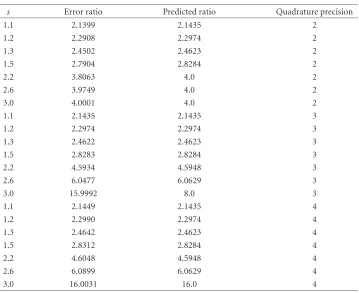
Since the chart sets will be triangulated exactly, only one term in the convergence es-timate from [16] will form an obstacle to convergence: the metric determinant term. For s≥3, because the surface isG1-continuous and has bounded second derivatives, N´ed´elec’s framework applies and we expectO(hl+1) convergence where piecewise polyno-mials of degreelapproximate the chart maps. For 1< s <2, the modified N´ed´elec frame-work forW2,1-functions applies and we expectO(hl−1+s) convergence wherel≤1. For
2< s <3, the modified N´ed´elec framework for W3,1-functions applies and we expect O(hs) convergence forl≥2, andO(h2) convergence ifl=1.
Table 7.1lists the error ratios for different values ofs, obtained on uniform triangu-lations of [0, 1]×[0, 1], along with the relevant prediction of the error ratio. Here, the degreelof the approximating polynomials is reflected in the quadrature precision, which will bel+ 1. The ratios compare the error ath=0.031250 to the error ath=0.015625.
8. Conclusion
In definingWk,p-manifolds andWk,p-surfaces and examining the role of these definitions
Table 7.1. Approximation of1 onG1-surfaces.
s Error ratio Predicted ratio Quadrature precision
1.1 2.1399 2.1435 2
1.2 2.2908 2.2974 2
1.3 2.4502 2.4623 2
1.5 2.7904 2.8284 2
2.2 3.8063 4.0 2
2.6 3.9749 4.0 2
3.0 4.0001 4.0 2
1.1 2.1435 2.1435 3
1.2 2.2974 2.2974 3
1.3 2.4622 2.4623 3
1.5 2.8283 2.8284 3
2.2 4.5934 4.5948 3
2.6 6.0477 6.0629 3
3.0 15.9992 8.0 3
1.1 2.1449 2.1435 4
1.2 2.2990 2.2974 4
1.3 2.4642 2.4623 4
1.5 2.8312 2.8284 4
2.2 4.6048 4.5948 4
2.6 6.0899 6.0629 4
3.0 16.0031 16.0 4
The hope is that this formalism will prove useful to biological and physical applications, where approximating solutions to evolution equations may require modeling functions on highly curved surfaces.
References
[1] M. V. Anglada, N. P. Garcia, and P. B. Crosa,Directional adaptive surface triangulation, Comput. Aided Geom. Design16(1999), no. 2, 107–126.
[2] H. Borouchaki, P. Laug, and P.-L. George, Parametric surface meshing using a combined advancing-front generalized Delaunay approach, Internat. J. Numer. Methods Engrg. 49
(2000), no. 1-2, 233–259.
[3] M. L. Brodzik,The computation of simplicial approximations of implicitly definedp-dimensional manifolds, Comput. Math. Appl.36(1998), no. 6, 93–113.
[4] W. Cho, T. Maekawa, N. M. Patrikalakis, and J. Peraire,Topologically reliable approximation of trimmed polynomial surface patches, Graph Models Im. Proc.61(1999), no. 2, 84–109. [5] W. Cho, N. M. Patrikalakis, and J. Peraire,Approximate development of trimmed patches for
surface tesselation, Comput. Aided Design30(1998), no. 14, 1077–1087.
[6] P. Destuynder and M. Sala¨un,Approximation of shell geometry for nonlinear analysis, Comput. Methods Appl. Mech. Engrg.152(1998), no. 3-4, 393–430.
[8] P.-L. George and H. Borouchaki,Delaunay Triangulation and Meshing. Application to Finite Elements, Editions Herm`es, Paris, 1998.
[9] K. Kalik, R. Quatember, and W. L. Wendland,Interpolation, triangulation and numerical inte-gration on closed manifolds, Boundary Element Topics (Stuttgart, 1995), Springer, Berlin, 1997, pp. 395–417.
[10] K. Kalik and W. L. Wendland,The approximation of closed manifolds by triangulated manifolds and the triangulation of closed manifolds, Computing47(1992), no. 3-4, 255–275.
[11] R. Klein,Linear approximation of trimmed surfaces, Proceedings of the 6th IMA Conference on the Mathematics of Surfaces, Clarendon Press, New York, 1994, pp. 201–212.
[12] K. Lin,Coordinate-independent computations on differential equations, Master’s thesis, Mas-sachusetts Institute of Technology, MasMas-sachusetts, 1997.
[13] J. R. Munkres,Elementary Differential Topology, Annals of Mathematics Studies, no. 54, Prince-ton University Press, New Jersey, 1966.
[14] J.-C. N´ed´elec,Curved finite element methods for the solution of singular integral equations on surfaces inR3, Comput. Methods Appl. Mech. Engrg.8(1976), no. 1, 61–80.
[15] K. Scully,Finite element approximation over multiple coordinate systems, Ph.D. thesis, University of California, California, 2003.
[16] ,Mesh-based interpolation on 2-manifolds, Int. J. Math. Math. Sci.2005(2005), no. 7, 1067–1083.
[17] X. Sheng and B. E. Hirsch,Triangulation of trimmed surfaces in parametric space, Comput. Aided Design24(1992), no. 8, 437–444.
[18] K. Shimada, A. Yamada, and T. Itoh,Anisotropic Triangular Meshing of Parametric Surfaces via Close Packing of Ellipsoidal Bubbles, Proceedings 6th International Meshing Roundtable, Sandia National Laboratories, 1997, pp. 375–390.
[19] R. M. Wald,General Relativity, University of Chicago Press, Illinois, 1984.
Kevin Scully: The Aerospace Corporation, M4-960, P.O. Box 92957, Los Angeles, CA 90009–2957, USA