Health Psychology, 23 (3). pp. 334-351. ISSN 1359-107X DOI: https://doi.org/10.1111/bjhp.12291 Link to Leeds Beckett Repository record:
http://eprints.leedsbeckett.ac.uk/4655/
Document Version: Article
The aim of the Leeds Beckett Repository is to provide open access to our research, as required by funder policies and permitted by publishers and copyright law.
The Leeds Beckett repository holds a wide range of publications, each of which has been checked for copyright and the relevant embargo period has been applied by the Research Services team.
We operate on a standard take-down policy. If you are the author or publisher of an output and you would like it removed from the repository, please contact us and we will investigate on a case-by-case basis.
Appearance-based interventions to reduce UV exposure: A systematic review
Abstract
Purpose: As a majority of skin cancer cases are behaviourally preventable, it is crucial to
develop effective strategies to reduce UV exposure. Health-focused interventions have not proved to be sufficiently effective, and it has been suggested that people might be more susceptible to information about the negative effects of the sun on their appearance.
Method: This systematic review of 30 separate papers, reporting 33 individual studies published between 2005 and 2017 assesses the overall effectiveness of appearance
interventions on participants’ UV exposure and sun protection behaviour.
Results: Appearance-based interventions have positive effects on sun exposure and sun protection, immediately after the intervention as well as up to 12 months afterwards. The
meta-analysis found a medium effect size on sun protection intentions for interventions which combined UV photography and photoaging information: r+ = .424; k = 3, N =319, CI
= .279 - .568, p = .023.
Conclusions: We provide a review of current research on the effectiveness of appearance-based interventions to reduce UV exposure. As well as highlighting methodological issues we
recommend that practitioners administer a UV photo intervention in combination with photo-aging information to reduce UV exposure. Furthermore, the review specifically recommends
that future research focuses on the use of theoretical constructs to enhance photoaging
information, and is conducted with older participants and in countries where people have less opportunity for sun exposure.
Appearance-based interventions to reduce UV exposure: A systematic review
Deaths from skin cancer are an increasing problem around the world; the World Health Organization (2015) reports that up to 2 million new cases occur globally each year. In the
UK, non-melanoma skin cancers are by far the most common type of cancer with around 102, 000 new cases diagnosed annually (Cancer Research UK, 2016). There is an established link between ultraviolet (UV) radiation exposure and all types of skin cancer; this includes
intentional (e.g. indoor and outdoor tanning) and incidental exposure (WHO, 2016). It is estimated that UV radiation causes 86% of malignant melanoma cases in the UK (Cancer
Research UK, 2016). Thus, skin cancer is to a large degree behaviourally preventable, meaning that developing strategies to reduce UV exposure could be effective in limiting new incidences (Jackson & Aiken, 2006).
Although the health-related costs of UV exposure and the benefits of sun protection are relatively well known (Miles et al., 2005), interventions that highlight these consequences
are not sufficiently effective (Mahler et al., 2006). A possible reason for this is that tanning behaviour is primarily motivated by a desire to improve appearance, and, as such, it is perhaps less responsive to health warnings (McWhirter, 2015). Research on both men and
women suggests that focusing on the appearance-related costs of UV exposure is effective in reducing UV exposure (Grogan et al., 2015). A review by Dodd and Forshaw (2010) found
that appearance-based interventions were generally successful in improving UV protective behaviours (e.g. sun protection use), but only moderately successful in altering behaviours relating to UV exposure. Another systematic review by McWhirter (2015) found that visual
images, e.g. UV photography (i.e. showing participants current level of UV damage to their skin), were successful in promoting sun protection and reducing UV exposure.
Williams et al. (2013) found an overall positive impact of appearance-based interventions on
reducing UV exposure, and the meta-analysis indicated that UV photo (i.e. demonstrating actual UV damage to a participant’s face) and/or photoaging information (i.e. providing
participants with information about the ageing effect of the sun), had a significant effect on sun protection intentions and future indoor tanning behaviour. The authors identified a number of problems with the data set, including limited long-term follow-ups, homogeneity
of settings, and limited priori power analysis. The current study aims to provide an updated review of the literature, which is considered relevant as the last data search was executed
over five years ago. This is particularly important as research into appearance-focused interventions has developed significantly since this time, for instance by including novel techniques such as facial morphing (a type of intervention demonstrating potential future UV
damage, by morphing a current image of the person using a specialised software). The current study also includes a larger meta-analysis.
1. Do appearance-based interventions reduce UV exposure immediately after the intervention and/or long-term?
2. What does new research (i.e. the studies not included in the Williams et al., 2013
paper) add to current understanding of the efficacy of appearance-related
interventions to reduce UV exposure, and has the quality of research improved?
Method
Protocol and registration
A review protocol was not used, however, the review has been reported in accordance with
the PRISMA guidelines. See appendix for the PRISMA checklist.
Eligibility criteria
or in comparison with another intervention (or control condition); and were required to adopt
a pre-test and post-test design, but not necessarily a randomised controlled design (RCTs). Correlational studies were not included. An appearance-based intervention was defined as an
intervention that highlighted negative effects of UV exposure on appearance, such as UV photography or photoaging information. Furthermore, studies had to assess the effects of the intervention on sun seeking and/or sun protective behaviours or intentions. Sun seeking
behaviours were defined as behaviour that increased UV exposure, and included spending time in the sun or using indoor tanning booths; sun protective behaviours were defined as
behaviour intended to decrease UV exposure, such as sun lotion use or protective clothing. Finally, studies were required to administer a post-test measure to assess the effectiveness of the intervention.
Information sources
The primary source of articles was Web of Knowledge (Science Citation Index Expanded,
Social Sciences Citation Index, Arts & Humanities Citation Index, Conference Proceedings Citation Index – Science and Social Science, Emerging Sources Citation Index); in addition to this seven other electronic databases (CINAHL, ZETOC, PsycARTICLES, PsycINFO,
Medline, OVID, Proquest theses) were accessed to search for studies. To ensure the searched databases provided a relevant literature base, it was confirmed that the list of studies included
in the William’s et al. (2013) paper were found. An ancestry search, i.e. identifying references that cited the identified papers, was also carried out to identify any missing studies.
Search
The current study used the same search terms as Williams et al’s. (2013), to ensure
OR protect*OR tan* OR expos*OR prevent*OR behav*)’, and included studies conducted
Jan 1st 2005 – May 16th 2017. The search was conducted by the first author. 2005 was used as
a starting point as research up until this point was sufficiently covered in previous reviews.
Study selection and data collection process
Eligibility assessment was performed by the first author (see PRISMA flow chart), but agreed upon by all authors. A total of 170 records were identified through database searches, and a
total of 532 records were identified through the ancestry search, yielding a total of 702 screened records. Following this, 655 records were excluded based on irrelevancy and
duplicity, leaving a total of 47 papers to be examined. In addition, six studies were excluded because the intervention focused on health consequences of UV exposure (Cheng et al., 2011; Dykstra, 2007; Hernandez et al., 2014; Lazovich et al., 2013; Olson et al., 2008
[included in the William’s et al. (2013) review]; Thomas et al., 2011), three due to not examining relevant research questions (Cox et al., 2009; Hillhouse et al., 2010; Walsh et al.,
2014), and seven for not containing an intervention (Cheetham & Ogden, 2016; Hillhouse et al., 2016; Noar et al., 2015; Pagoto et al., 2009; Taylor et al., 2016; Welch et al., 2016;
Williams et al., 2013b). To identify potential prominent authors in this field were contacted
(e.g. authors of the William’s et al., 2013 study) and asked whether they had any unpublished material. Additionally, ProQuest theses was searched for unpublished material. An extraction
table was designed based on the main elements reported in the Williams et al. (2013) study. Data were extracted by the first author, with 10% checked blind (i.e. independently extracted by another member of the team and then compared to the data extraction conducted by the
first author) by the sixth author during April – May 2017. Due to the high level of agreement (88%), the remainder of the data were checked non-blind by the same author, with agreement
independent studies, as some articles reported more than one study); 18 of these papers (20
individual studies) were not included in the Williams et al. (2013) article. Information extracted from the studies included participant characteristics, study location and settings;
intervention characteristics, outcome measures, and which, if any, theoretical constructs were utilised to inform the intervention, and methodological issues.
A formal tool was not utilised to assess methodological bias, but the first author
assessed risk of bias in each study by examining the methodology (i.e. study design, proposed analyses, type of intervention, comparison groups etc.), randomization process, quality of the
outcome measures (e.g. Cronbach’s alpha), and research funding. No studies were deemed to be biased, aside from the Bae et al. (2017) paper, as it was neither controlled nor randomised, and did not compare the intervention with a control condition. However, this risk of bias did
not adversely impact the meta-analysis, as it was excluded due to lack of sufficient details for effect-size calculation, and was therefore only commented on in the systematic review. In
addition, small study bias and publication bias were assessed utilising Egger’s regression (Stern & Egger, 2000) and trim and fill analyses (Duval & Tweedie, 2001). This was reviewed and agreed upon by the second and last authors. In sum, the main outcomes of
interest included sun seeking behaviours and intentions (i.e. indoor and outdoor tanning), and sun protective behaviours and intentions (i.e. use of protective clothing or sun tan lotion).
Meta-analytical strategy
The meta-analysis employed a random effects model. All but one of the studies included in the review were also included in the meta-analysis. Bae et al. (2017) was not included as the
main author declined a request for additional data to facilitate effect size calculations. Three studies (Mahler et al., 2006; Mahler et al., 2007; Mahler et al., 2013) included separate UV
according to the type of appearance intervention, creating four separate data-sets:
interventions with UV photo, photoaging information, UV photo in combination with photoaging information, and interventions that could not be classified as either, for instance
facial morphing or group discussions. Due to the heterogeneous nature of the final category, it was not possible to further distinguish between these interventions. The process of
categorisation into types of interventions enabled the inclusion of the same participants in
separate analyses. In addition, studies described in Gibbons (2005) were originally analysed as one by that paper’s authors, resulting in a total of 34 independent studies included in the
meta-analysis. For each of these studies, correlation coefficient r was calculated to assess the relationship between the appearance-based intervention and the outcome variable, which was classified as sun protection or UV exposure. Following Cohen's (1992) recommendations, r
= .10 was taken to represent a ‘small’ effect size, r = .30 a ‘medium’ effect size and r = .50 a
‘large’ effect size. Long-term (i.e. any follow-up longer than immediately following the
intervention, ranging from one week to six months) effects of the interventions are
commented on in the systematic paper review as there was not enough studies with similar levels of follow-ups to include this as a moderator analysis.
Where studies contained two (or more) conditions, the appearance-focused condition was defined as the one with the strongest focus on appearance, and the control condition
contained, where possible, active element (e.g. another intervention, as compared to a passive control being waitlist only). Where studies contained more than one appearance-focused intervention, these were compared separately to a control condition, creating separate effect
sizes. Where studies lacked relevant statistics, authors were contacted to provide additional information that could facilitate the effect size calculations. All authors except one (Bae et
al., 2017) responded with the requested information (Christensen et al., 2014; Cornelis et al.,
Sontag & Noar, 2017; Stapleton et al., 2010). These authors were also asked about any
unpublished material they might have. As the majority of the studies included a follow-up immediately after the intervention, where possible, this point in time was used to calculate
effect sizes to ensure homogeneity of the data. For studies that did not have an immediate follow-up (N = 7), or did not report sufficient data for this point, effect sizes were calculated for the nearest available time following the intervention.
The meta-analysis assessed the effectiveness of the intervention on four specific outcome variables: sun protective intentions, sun protective behaviour, UV exposure
intentions, and UV exposure. In addition, effectiveness was also assessed as a weighted-mean for multiple outcome variables, henceforth referred to as a combined outcome variable. If multiple outcomes were measured for one of the categories above, e.g., both sun exposure
and sun lotion were measured to examine sun protective behaviour, an overall effect size was calculated as the weighted-mean of these measures. Random effect sizes were computed
using SPSS version 22, and the macros developed by Wilson (2005). Effect sizes were weighted by sample, with a 95% confidence interval, and an estimate of heterogeneity. Publication bias and small study bias were also assessed (Duval & Tweedie, 2000; Stern &
Egger, 2000)
Results
Descriptive features of the studies
Participants and settings
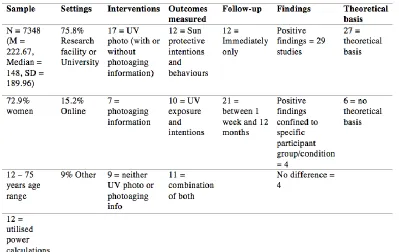
Across all samples, there were 7348 participants, with sample sizes ranging from 50 to 965
participants. Twelve studies specifically targeted females, whereas four studies targeted males. The remainder had a mixed-gender participant group. Twelve studies based their
group such as indoor tanners or highway workers A majority (75.8%) of the interventions
were implemented in a research facility or University setting, with the remainder (24.2%) being administered online or in a community setting (e.g. a public beach).
Appearance-based interventions
The most common type of intervention (N=17) was UV photography, either in isolation or combined with information about photoaging. Three of the UV photo studies (Mahler et al.,
2006; Mahler et al., 2007; Mahler et al., 2013) administered two separate interventions on UV-photo and photoaging. The second most common type of intervention (N=7) was
photoaging information. The remainder of the studies utilised alternative types of interventions, such as discussing and challenging the tanned ideal, manipulating media images or implementing facial morphing. Twenty-one of the studies based their interventions
fully or in part on theory. See Table S1 for full details of the theoretical basis and critical points for each of the studies.
Measures employed
All studies administered post-intervention measures to assess the effect of an appearance-based intervention on UV exposure intentions and/or behaviours. All but one (Bae et al.,
2017) of the studies compared this to a control condition (passive control in six of the studies). All of the papers utilised some form of self-report measure to assess intervention
efficacy. An alternative method to assess behavioural efficacy of the intervention examines skin colour. It involves the use of a skin reflectance spectrophotometer which, when based on hue lightness and saturation on various skin sites, can indicate level of UV exposure (Mahler
et al., 2006). This technique was utilised by four studies.
Descriptive results from systematic review
majority (N= 29) of the studies reported that an appearance-focused intervention had a
positive effect on reducing UV exposure and/or increasing sun protection. Interestingly, four of the studies that reported positive findings only found this effect when examining a
particular participant group or combination of conditions; Cornelis et al. (2014) found that an appearance intervention decreased intentions to tan when the argument against tanning was two-sided, but not when it was one-sided; Stapleton et al. (2010) found that their intervention
decreased indoor tanning frequency among a sub-group of tanners with previously low knowledge of the health or appearance costs of tanning; and Walsh and Stock (2012) found
than UV photo increased sun protection willingness among masculine men. Finally, Morris et al. (2014b) found that UV photo had a positive effect on sun protection intentions only when
participants were primed with mortality.
For the studies including a longer (i.e. longer than immediately following the intervention) follow-up, the findings were generally positive. Up until a month after the
intervention, participants reduced indoor and outdoor sunbathing frequency and increased use of sun protection (Chait, 2015; Gibbons, 2005a; 2005b). These effects were evident for up to six months, including reduced intentions to tan and increased intentions to use sun protection
(Hillhouse et al., 2008; Jackson & Aiken, 2006).
Three studies did not find an effect of the appearance based intervention on the main
measured outcome; Christensen et al. (2014) found that participants in the UV photo condition did not progress in UV-protective stages of change long-term, and the health-oriented intervention was significantly more effective in increasing immediate sun-protective
intentions; and Hevey et al. (2010) found no significant difference between a health and appearance-framed message on intentions to use sunscreen and sunbeds. Similarly, Sontag,
Pertaining to the second research question regarding the contribution of the 20
studies published since 2012 (i.e. those not included in William’s et al., 2013), there was a similar selection of interventions, apart from the inclusion of two studies utilising facial
morphing (Owen et al., 2016; Williams et al., 2013). This technique had positive results on participants’ sun protection intentions and behaviour when compared to a health literature intervention. Moreover, three of the five studies specifically targeting a male population were
found in this sample. Although most research is still conducted on a female sample, this suggests that research into UV exposure is increasingly considering men’s motivation to tan
and their barriers to sun protection. The majority of these studies reported modest results, or positive findings confined to a particular combination of conditions (e.g. mortality priming or two-sided arguments). This suggests that appearance-focused interventions to reduce UV
exposure may need to consider drawing on other aspects of behaviour change or persuasion theory to enhance efficacy.
Results of meta-analysis
Table 2 presents the summary of the meta-analyses results (with combined effect sizes), and figure 1 plots effect sizes and Standard Errors. The meta-analysis was carried out on four
sub-sets categorised according to the type of intervention utilised; this because some participants took part in more than one intervention, thus is was not possible to analyse the
sample as one.
Ten studies (Christensen & Cooper, 2014; Dwyer, 2014; Heckman et al., 2013; Mahler et al., 2013a, Mahler et al., 2006; Mahler et al., 2007a; Morris et al., 2014a, 2014b;
Pagoto et al., 2010; Walsh & Stock, 2012) examined the effectiveness of UV photo on the combined outcome variable, and on sun protective intentions specifically. For the overall
effect of this intervention on all outcomes, the combined effect size was small: r+ = .19; k =
only was also small r+ = .165; k = 8, N = 1,251, 95% CI: .036 to .295, p = .012. Effect sizes
were heterogeneous, Q(9) = 35.38 , p <.001.
Four studies (Mahler et al., 2006b; Mahler et al., 2007b, Mahler et al., 2013b, Tuong
& Armstrong, 2014) examined the effectiveness of photoaging information on sun protective behaviour and intentions combined, and sun protective intentions separately. For the overall effects of photoaging on all of the above outcome variables, the combined effect size was
medium r+ = .327; k = 4, N = 836, 95% CI: .206 to .447, p <.001. On sun protection
intentions only the effect size was small r+ = .272; k = 3, N = 813, CI = .203 to .341, p = .039.
Effect sizes were heterogeneous, Q(9) = 7.65 , p = .054, using Higgins et al’s (2003) proposed significance level of .10.
Six studies (Gibbons et al., 2005; Mahler et al., 2008; Mahler et al., 2010c; Mahler et
al., 2005; Sontag & Noar, 2017; Stock et al., 2009) examined the effectiveness of UV photography combined with photoaging information on a combination of three outcome
variables: sun protective behaviour and intentions, and UV exposure, and sun protective intentions separately. For the effectiveness of this intervention on the above outcome
variables, the combined effect size was small, r+= 0.261; k = 6, N = 918, CI = .047 to .475, p
= .017. The combined effect size on sun protection intentions only was medium, r+ = .424; k = 3, N = 319, CI = .279 - .568, p = .023. Effect sizes were heterogeneous, Q(13) = 54.89 , p
<.001.
Fourteen studies (Chait et al., 2015; Cooper et al., 2014; Cornelis et al., 2014; Hevey et al., 2010; Hillhouse et al., 2008; Hillhouse et al., 2017; Heckman et al., 2017; Jackson &
Aiken, 2006; Mahler et al., 2010a, 2010b; Stapleton et al., 2010; Stapleton et al., 2015; Williams et al., 2013; Owen et al., 2016) examined the effectiveness of interventions not
these interventions on the above outcome variables, the combined effect size was small, r+ =
.191; k = 14, N = 3895, CI = .117 to .265, p < .001. On UV exposure intentions only, the combined effect size was small, r+ =.235; k = 7, N = 1798, CI = .133 to .371, p < .001. On
actual UV exposure, the effect size was small, r+ = .1542, k = 6, N = 1878, CI = .007 to .302,
p = .040. Finally, the effect on sun protection intentions was small but non-significant, r+ =
.223; k=5, N=773, CI = -.015 to .461, p = .067. Effect sizes were heterogeneous, Q(6) =
26.67 , p <.001.
Summary of risk of bias scores
As only two unpublished studies were included in the analysis, it was not possible to assess publication bias by directly comparing effect sizes of published and unpublished studies. Thus, a trim and fill analysis was performed (Duval & Tweedie, 2000) using STATA version
11 (STATA Corp, 2009). Results revealed that there was no bias in interventions utilising UV photo, photoaging information or interventions classed as neither. It did, however, reveal
a publication bias in interventions utilising UV photo in combination with photoaging information, filling three studies, rendering the results non-significant, p = .410. To ensure the meta-analytical effect sizes were not adversely impacted by underpowered studies from
relatively small samples, an Egger’s regression was also performed (Stern & Egger, 2001) using STATA version 11 (STATA Corp, 2009). Results revealed no small-study bias in any
of intervention types.
Discussion
Summary of evidence
The current study provides a valuable contribution to the existing literature, as it includes 20
analysis of current directions within research on appearance-based interventions.
Furthermore, as the meta-analysis contains more individual studies, it represents a more reliable reflection of the effectiveness of these interventions. Additionally, the current review
includes two unpublished papers, a factor that goes some way towards counteracting publication bias.
Appearance-based interventions were generally successful in reducing UV exposure,
supporting the findings reported by Williams et al. (2013). The inclusion in the current review of research utilising facial-morphing indicates that this could be an effective
intervention for behaviour change. However, three studies did not find an effect of
appearance-based intervention when compared to a health-based intervention, which was not identified by William’s et al. (2013). One observation made in the current review is that two
of these studies used active rather than passive control. This therefore calls for further investigation.
The results of the meta-analyses indicate that appearance based interventions were associated with a small positive effect on intentions and behaviours. The largest effect sizes were associated with UV photography combined with photoaging information. These results
may indicate that providing individuals with two sources of information - visual and
descriptive - with subjective and objective focus, could be an effective way to influence
UV-related behaviours. The component of photoaging information can also be manipulated according to theory, which may be beneficial, as it could enhance health interventions with theoretical constructs. For instance, Mahler et al. (2005) utilised Theory of Alternative
Behaviours (Jacard, 1980) by aiming to alter participants’ perceptions of UV exposure and providing an alternative to tanning (sun-less tanning products). Other effective theoretical
in reducing UV exposure and increasing sun protection among students as well as the general
public, it is likely they could be widely implemented. However, due to the issue of
publication bias in this sample, it is difficult to draw definitive conclusions. Future research
could benefit from investigating this issue further, to determine whether two sources of information could increase the effectiveness of appearance-focused interventions in reducing UV exposure.
There are a number of things to consider when interpreting the results of the meta-analysis. The most common outcome variable was sun protective intentions, which limits the
conclusions that can be drawn on other variables. Given the relatively small number of studies, it was not possible to include follow-up length as a mediator in the analysis, it is therefore difficult to determine whether the techniques used would have long term effect on
behaviour, as well as immediate effect on intentions. Considerable variability of research methodologies (e.g. control group conditions and inclusion/exclusion of darker skin tones)
and reporting style (e.g. inclusion of baseline comparisons and non-significant variables) between the studies makes it difficult to directly compare results between the studies. Furthermore, there was a wide span of effect sizes in the sub-set of the meta-analysis which
included any intervention that did not utilise UV photo or photoaging information. This suggests that some of these interventions are more effective than others, and should be further
investigated in future research. Lastly, the meta analysis identified a publication bias among studies utilising UV photo in combination with photoaging information. We would therefore encourage researchers and journals alike to consider null results for publication.
Sample limitations and recommendations for future research
While skin cancer incident rates do not differ significantly between genders (Skin Cancer
benefit from including men in the study population, particularly as men also value a tanned
appearance (Cancer Research UK, 2016; Day et al., 2016). As men may perceive tanning and appearance norms in different terms than women, such as reluctance to engage in practices
regarded as feminine (Grogan, 2016), future appearance interventions with men may need to consider the role of masculinity. Moreover, study samples were overwhelmingly young (16-35 years); as age increases, the risks of skin damage build-up, so it therefore seems relevant
to include an older population in future studies (Cancer Research UK, 2016). Most participants were white; as populations with darker skin are by no means immune to skin
cancer, future research would benefit from more ethnically diverse samples (Skin Cancer Foundation, 2016). Finally, some studies included a sample where a large number of participants had experienced skin cancer themselves, or known a family member to do so
(Mahler et al., 2013), whereas others did not include this as a variable in the analyses; this is a factor that could skew results, and should be considered in future studies.
The majority of the studies were conducted in the USA, raising concerns about generalisability of findings to other areas; they were also conducted in locations with high level of sun exposure (such as Florida), and it might therefore be difficult to predict whether
interventions are effective in countries with fewer days of sun. Qualitative research has indicated that people living in locations with fewer hours of sun (such as the UK) associate
UV exposure with leisure time and holidays; this may affect the effectiveness of an
intervention to impact motivations to reduce UV exposure among these participants (Persson et al., 2017).
Twelve studies based their sample size on a priori power calculations, with the remaining studies stating a lack of power, or not specifying power calculations. This is
the intervention, particularly in combination with publication bias (Charles et al., 2009;
Minarik et al., 2016). It is therefore recommended that future research consistently include a priori power calculations, as well as comparing any intervention with an active, rather than a
passive, control condition. Conclusions
This review and meta-analysis provides a valuable perspective on current research on
appearance-based interventions to reduce UV exposure. The findings suggest that
appearance-based interventions are associated with small positive effects on reducing
sun-seeking behaviours and/or increasing sun protective behaviours. These results were generally supported by a meta-analysis. With the previously discussed high levels of skin cancer rates across Western Europe and the US, this would suggest that implementation of these
interventions could have scope to prevent skin cancer in a large number of people. We recommend that practitioners who are looking to increase sun protection intentions
administer UV photo in combination with photo-aging information, as this was associated with the largest effect size. These interventions could be administered to men and women alike, over a wide age-span, and they appear to be effective when implemented in a clinical
and/or research setting.
A number of methodological issues may limit the conclusions that can be drawn from
the results. However, within the current context, this review contributes significantly to the existing body of research into appearance-based interventions to reduce UV exposure, and recommends that future research consistently employ a rigorous methodology (e.g. inclusion
of power calculations) and focus on more varied outcomes and a diverse sample population from a wider array of cultures. As motivations for UV exposure might differ in populations
recommends that additional future research on the effectiveness of appearance-focused
interventions is conducted in places such as the UK and Northern Europe.
References
* = paper included in review.
Ajzen, I., & Madden, T. J. (1986). Prediction of goal-directed behaviour:
Attitudes, intentions, and perceived behavioural control. Journal of Experimental
Social Psychology, 22(5), 453 – 474
*Bae, Y. C., Bae., E. J., Wang, J. & Gilchrest, B. (2017) Changes in self-perceptions of
photoaging severity and skin cancer risk after objective facial skin quality analysis. Journal of Drugs in Dermatology, 16(5), 435-459.
Beck, A. T. (1967) Depression – Clinical Experimental and Theoretical Aspects,
New York: Harper and Row
453-474. doi: http://dx.doi.org/10.1016/0022-1031(86)90045-4.
Cancer Research UK. (2016) Skin Cancer – non Melanoma. Retrieved on
October 18th 2016 from
http://www.cancerresearchuk.org/about-cancer/type/skin-cancer/.
*Chait, S. R., Thompson, J. K., & Jacobsen, P. B. (2015). Preliminary development and evaluation of an appearance-based dissonance induction intervention for reducing UV
exposure. Body Image, 12, 68-72. doi:10.1016/j.bodyim.2014.09.004
Charles, P., Giraudeau, B., Dechartres, A., Baron, G., & Ravaud, P. (2009). Reporting of sample size calculation in randomised controlled trials: review. BMJ, 338.
doi:10.1136/bmj.b1732
Cheetham, I., & Ogden, J. (2016). Enhancing sun safety in young women: The relative
Cheng, S., Guan, X., Cao, M., Liu, Y., & Zhai, S. (2011). Randomized trial of the impact of a
sun safety program on volunteers in outdoor venues. Photodermatology Photoimmunology & Photomedicine, 27(2), 75-80.
doi:10.1111/j.1600-0781.2011.00567.x, 75 - 80
*Christensen, K., Champion, J., & Wagner, C. (2014). The Effects of Appearance-Based and Health-Based Interventions on Sun Protection Attitudes, Intentions, and Behaviours
of College Students. Psycho-Oncology, 23, 317-317.
Cialdini, R. B., Kallgren, C. A., & Reno, R. R. (1991). A focus theory
of normative conduct. Advances in Experimental Social Psychology, 24, 201–234 Cohen, J. (1992). A power primer. Psychological Bulletin, 112, 155–159. doi:
10.1037/0033-2909.112.1.155
*Cooper, D. P., Goldenberg, J. L., & Arndt, J. (2014). Perceived efficacy, conscious fear of death and intentions to tan: Not all fear appeals are created equal. British Journal of
Health Psychology, 19(1), 1-15. doi:10.1111/bjhp.12019
*Cornelis, E., Cauberghe, V., & De Pelsmacker, P. (2014). Being healthy or looking good? The effectiveness of health versus appearance-focused arguments in two-sided
messages. Journal Of Health Psychology, 19(9), 1132-1142. doi:10.1177/1359105313485310
Cox, C. R., Cooper, D. P., Vess, M., Arndt, J., Goldenberg, J. L., & Routledge, C. (2009). Bronze Is Beautiful but Pale Can Be Pretty: The Effects of Appearance Standards and Mortality Salience on Sun-Tanning Outcomes. Health Psychology, 28(6), 746-752.
doi:10.1037/n0016388
Ain't necessarily so: Review and critique of recent meta-analyses of behavioural
medicine interventions in health psychology. Health Psychology, 29(2), 107. doi:10.1037/a0017633
Day, A. K., Wilson, C. J., Hutchinson, A. D., & Roberts, R. M. (2016). Australian young adults’ tanning behaviour: The role of ideal skin tone and sociocultural norms. Australian Journal of Psychology, n/a-n/a. doi:10.1111/ajpy.12121
Dodd, L. J., & Forshaw, M. J. (2010). Assessing the efficacy of appearance-focused interventions to prevent skin cancer: a systematic review of the literature. Health
Psychology Review, 4(2), 93-111. doi:10.1080/17437199.2010.485393
*Dwyer, L. A. (2014). Enhancing UV photography among men with choice-promoting information. (3607894 Ph.D.), The George Washington University, Ann Arbor.
Retrieved from ProQuest Dissertations & Theses A&I database.
Dykstra, J. L. (2007). Avoiding reactance: The utility of ultraviolet photography, persuasion,
and parental protectiveness in improving the effectiveness of a UV exposure
intervention. (3274866 Ph.D.), Iowa State University, Ann Arbor. Retrieved from
ProQuest Dissertations & Theses A&I database.
Duval, S. & Tweedie, R. (2000). Trim and fill: A simple funnel-plot-based method of testing and adjusting for publication bias in meta-analysis. Biometrics, 56(2), 455-463.
Festinger, L. (1957). A theory of cognitive dissonance. Evanstone, IL: Row, Peterson Fishbein, M. Hennessey, M., Yzer, M. & Douglas, J. (2003). Can we explain why some
people do and some people do not act on their intentions? Psychology Health &
Medicine, 8 (1), 3-18. DOI: http://dx.doi.org/10.1080/1354850021000059223
Gibbons, F.X. & Gerrard, M. (1995). Predicting young adults' health risk behavior. Journal
of Personality and Social Psychology, 69, 505-517. DOI: 10.1037//0022-
Gibbons, F. X., Gerrard, M., Blanton, H., & Russell, D. W. (1998). Reasoned Action and Social
Reaction: Willingness and Intention as Independent Predictors of Health Risk. Journal of Personality and Social Psychology, 74(5), 1164-1180. doi:10.1037/0022-3514.74.5.1164
*Gibbons, F. X., Gerrard, M., Lane, D. J., Mahler, H. I. M., & Kulik, J. A. (2005). Using UV photography to reduce use of tanning booths: A test of cognitive mediation. Health Psychology, 24(4), 358-363. doi:10.1037/0278-6133.24.4.358
Greenberg, J., Pyszczynski, T., & Solomon, S. (1986). The Causes and Consequences of a Need for Self-Esteem: A Terror Management Theory. In R. F. Baumeister (Ed.), Public Self and
Private Self (pp. 189-212). New York, NY: Springer New York.
Grogan, S. (2016). Body Image. London: Routledge.
Grogan, S., Loosemore, E. (2015). Men’s Accounts of Reactions to Two Sources of
Information on Negative Effects of UV Exposure: Facial Morphing and a Health Promotion Fact Sheet. International Journal of Men's Health, 14(2).
*Heckman, C., Zhu, F., Manne, S. Kloss, J., Collins, B., Bass, S., Lessin, S. (2013). Process and outcomes of a skin protection intervention for young adults. Journal of Health Psychology, 18(4), 561-573. doi: 10.1177/1359105312449193
*Heckman, C., Handorf, E., Darlow, S., Ritterband, L. & Manne, S. (2017). An online skin cancer tisk-reduction intervention for young adults: Mechanisms of effect. Health
Psychology, 36 (3), 215-225.
Hernandez, C., Wang, S., Abraham, I., Angulo, M. I., Kim, H., Meza, J. R., . . . Uddin, S. (2014). Evaluation of Educational Videos to Increase Skin Cancer Risk Awareness
and Sun-Safe Behaviours Among Adult Hispanics. Journal of Cancer Education, 29(3), 563-569. doi:10.1007/s13187-014-0624-z
Sunscreen. Journal Of Health Psychology, 15(4), 553-559.
doi:10.1177/1359105309355335
Higgins, J., Thompson, S., Deeks, J. & Altman, D. (2003). Measuring inconsistency in
meta-analyses. BMJ, 327(7414), 557-560.
*Hillhouse, J., Turrisi, R., Stapleton, J., & Robinson, J. (2008). A Randomized Controlled Trial of an Appearance-focused Intervention to Prevent Skin Cancer. Cancer,
113(11), 3257-3266. doi:10.1002/cncr.23922
Hillhouse, J., Turrisi, R., Stapleton, J., & Robinson, J. (2010). Effect of Seasonal Affective
Disorder and Pathological Tanning Motives on Efficacy of an Appearance-Focused Intervention to Prevent Skin Cancer. Archives Of Dermatology, 146(5), 485-491. Hillhouse, J., Turrsi, R., Cleveland, M. Scaglione, N., Baker, K. & Florence, C. (2016).
Theory-driven longitudinal study exploring indoor tanning initiation in teens using a a person-centered approach. Annals of Behavioral Medicine, 50(1), 48-57. doi:
10.1007/s12160-015-9731-2
*Hillhouse, J., Turrsi, R., Scaglione, N., Cleveland, M., Baker K. & Florence, C. (2017). A web-based intervention to reduce indoor tanning motivations in adolescents: A
randomised controlled trial. Prevention Science, 18(2), 131-140. doi: 10.1007/s11121-016-0698-4
Jaccard, J. (1981). Atttudes and behaviour: Implications of attitudes toward behavioural alternatives. Journal of Experimental Social Psychology, 17(3), 286-307.
doi:http://dx.doi.org/10.1016/0022-1031(81)90029-9
Jackson, K. M., & Aiken, L. S. (2000). A Psychosocial Model of Sun Protection and Sunbathing in Young Women: The Impact of Health Beliefs, Attitudes, Norms, and
*Jackson, K. M., & Aiken, L. S. (2006). Evaluation of a multicomponent appearance-based
sun-protective intervention for young women: Uncovering the mechanisms of program efficacy. Health Psychology, 25(1), 34-46. doi:10.1037/0278-6133.25.1.34
Kahneman, D., & Tversky, A. (1979). Prospect theory: An analysis of decisions under risk. Econometrica, 47, 313–327.
Lazovich, D., Choi, K., Rolnick, C., Jackson, J. M., Forster, J., & Southwell, B. (2013). An
Intervention to Decrease Adolescent Indoor Tanning: A Multi-Method Pilot Study. Journal of Adolescent Health, 52(5), S76-S82. doi:10.1016/j.jadohealth.2012.08.009
Löckenhoff, C. E., De Fruyt, F., Terracciano, A., McCrae, R. R., De Bolle, M., Costa, P. T., . . . Yik, M. (2009). Perceptions of Aging across 26 Cultures and their Culture-Level Associates. Psychology and aging, 24(4), 941-954. doi:10.1037/a0016901
Maddux, J.E., & Rogers, R. W. (1983). Protection motivation theory and
self-efficacy: A revised theory of fear appeals and attitude change. Journal of
Experimental Social Psychology, 19, 469-479.
*Mahler, H. I. M., Beckerley, S. E., & Vogel, M. T. (2010). Effects of Media Images on Attitudes Toward Tanning. Basic and Applied Social Psychology, 32(2), 118-127.
doi:10.1080/01973531003738296
*Mahler, H. I. M., Kulik, J. A., Butler, H. A., Gerrard, M., & Gibbons, F. X. (2008). Social
norms information enhances the efficacy of an appearance-based sun protection intervention. Social Science & Medicine, 67(2), 321-329.
doi:10.1016/j.socscimed.2008.03.037
*Mahler, H. I. M., Kulik, J. A., Gerrard, M., & Gibbons, F. X. (2006). Efffects of two appearance-based interventions on the sun protection behaviours of southern
*Mahler, H. I. M., Kulik, J. A., Gerrard, M., & Gibbons, F. X. (2007). Long-term effects of
appearance-based interventions on sun protection behaviours. Health Psychology, 26(3), 350-360. doi:10.1037/0278-6133.26.3.350
*Mahler, H. I. M., Kulik, J. A., Gerrard, M., & Gibbons, F. X. (2010). Effects of upward and downward social comparison information on the efficacy of an appearance-based sun protection intervention: a randomized, controlled experiment. Journal Of Behavioural
Medicine, 33(6), 496-507. doi:10.1007/s10865-010-9279-3
*Mahler, H. I. M., Kulik, J. A., Gerrard, M., & Gibbons, F. X. (2013). Effects of photoaging
information and UV photo on sun protection intentions and behaviours: A cross-regional comparison. Psychology & Health, 28(9), 1009-1031.
doi:10.1080/08870446.2013.777966
Martin, J. M., Ghaferi, J. M., Cummins, D. L., Mamelak, A. J., Schmults, C. D., Parikh, M., Liégeois, N. J. (2009). CHANGES in SKIN TANNING ATTITUDES Fashion
Articles and Advertisements in the Early 20th Century. American Journal of Public Health, 99(12), 2140-2146. doi:10.2105/AJPH.2008.144352
McWhirter, J. E., & Hoffman-Goetz, L. (2015). Systematic review of population-based
studies on the impact of images on UV attitudes and behaviours. Health Promotion International, 30(2), 397-410. doi:10.1093/heapro/dat031
Miles, A., Waller, J., Hiom, S., & Swanston, D. (2005). SunSmart? Skin cancer knowledge and preventive behaviour in a British population representative sample. Health Educ Res, 20(5), 579-585. doi:10.1093/her/cyh010
Minarik, T., Berger, B., Althaus, L., Bader, V., Biebl, B., Brotzeller, F., . . . Sauseng, P. (2016). The Importance of Sample Size for Reproducibility of tDCS Effects.
*Morris, K. L., Cooper, D. P., Goldenberg, J. L., Arndt, J., & Gibbons, F. X. (2014).
Improving the efficacy of appearance-based sun exposure interventions with the terror management health model. Psychology & Health, 29(11), 1245-1264.
doi:10.1080/08870446.2014.922184
Noar, S. M., Myrick, J. G., Zeitany, A., Kelley, D., Morales-Pico, B., & Thomas, N. E. (2015). Testing a Social Cognitive Theory-Based Model of Indoor Tanning:
Implications for Skin Cancer Prevention Messages. Health Communication, 30(2), 164-174. doi:10.1080/10410236.2014.974125
Olson, A. L., Gaffney, C. A., Starr, P., & Dietrich, A. J. (2008). The impact of an
appearance-based educational intervention on adolescent intention to use sunscreen. Health Education Research, 23(5), 763-769 767p. doi:her/cym005
*Owen, A. (2016). Effects of an appearance-focussed versus a health-focussed intervention on men's attitudes towards UV exposure. International Journal of Men's Health.
*Pagoto, S. L., Schneider, K. L., Oleski, J., Bodenlos, J. S., & Ma, Y. (2010). The Sunless Study A Beach Randomized Trial of a Skin Cancer Prevention Intervention
Promoting Sunless Tanning. Archives Of Dermatology, 146(9), 979-984.
Pagoto, S. L., Schneider, K. L., Oleski, J., Bodenlos, J. S., Merriam, P., & Ma, Y. (2009). Design and methods for a cluster randomized trial of the Sunless Study: A skin cancer
prevention intervention promoting sunless tanning among beach visitors. Bmc Public Health, 9. doi:10.1186/1471-2458-9-50
Persson, S., Benn, Y., Dhingra, K. & Grogan, S. (2017). "It's a bit of an eye opener": A
qualtitative study of women's attitudes towards tanning, sun protection and a facial morphing intervention. Psychology & Health, 1-17, doi:
http://dx.doi.org/10.1080/08870446.2017.1357815
Persuasion. Advances in Consumer Research, 11, 668.
PRISMA (2011). Transparent Reporting of Systematic Reviews and Meta-Analyses. Retrieved on October 18, 2016 from http://www.prisma-statement.org/index.htm
Prochaska, J. O., & DiClemente, C. C. (1983). Stages and processes of self-change of smoking: Toward an integrative model of change. Journal of Consulting & Clinical Psychology, 51(3), 390-395.
Rosenstock, I. M. (1974). Historical Origins of the Health Belief Model. Health Education & Behaviour, 2(4), 328-335. doi:10.1177/109019817400200403.
Skin Cancer Foundation. (2016). Skin Cancer Facts & Statistics. Retrieved October, 18th
2016 from http://www.skincancer.org/skin-cancer-information/skin-cancer-facts#ethnicity
*Sontag, J. & Noar, S. (2017). Assesing the potential effectiveness of pictoral messages to deter young women from indoor tanning: an experimental study. Journal of Health
Communication, 22(4), 294-303. doi: 10.1080/10810730.2017.1281361
*Stapleton, J., Turrisi, R., Hillhouse, J., Robinson, J. K., & Abar, B. (2010). A comparison of the efficacy of an appearance-focused skin cancer intervention within indoor tanner
subgroups identified by latent profile analysis. Journal Of Behavioural Medicine, 33(3), 181-190. doi:10.1007/s10865-009-9246-z
*Stapleton, J. L., Manne, S. L., Darabos, K., Greene, K., Ray, A. E., Turner, A. L., & Coups, E. J. (2015). Randomized Controlled Trial of a Web-Based Indoor Tanning Intervention: Acceptability and Preliminary Outcomes. Health Psychology, 34, 1278-1285.
doi:10.1037/hea0000254
StataCorp. (2009). Stata statistical software (11th edition). Dallas, TX: College Station.
Efficacy of UV Photography and Skin Cancer Information on Men's Protective
Cognitions and Behaviour. Annals of Behavioural Medicine, 38(3), 225-236. doi:10.1007/s12160-009-9151-2
Taylor, M., Westbrook, D. & Chang, P. (2016). Using UV photoaged photography to better understand Western Australian teenagers' attitudes towards adopting sun-protective behaviours. International Journal of Adolescent Medicine and Health, 28(1), 45-53.
doi: 10.1515/ijamh-2014-0071
Thomas, K., Hevey, D., Pertl, M., Ni Chuinneagain, S., Craig, A., & Maher, L. (2011).
Appearance matters: The frame and focus of health messages influences beliefs about skin cancer. British Journal of Health Psychology, 16, 418-429.
*Tuong, W., & Armstrong, A. W. (2014). Effect of appearance-based education compared
with health-based education on sunscreen use and knowledge: A randomized controlled trial. Journal of the American Academy of Dermatology, 70(4).
*Walsh, L. A., & Stock, M. L. (2012). UV photography, masculinity, and college men's sun protection cognitions. Journal Of Behavioural Medicine, 35(4), 431-442.
Walsh, L. A., Stock, M. L., Peterson, L. M., & Gerrard, M. (2014). Women's sun protection
cognitions in response to UV photography: the role of age, cognition, and affect. Journal Of Behavioural Medicine, 37(3), 553-563.
Welch, M., Chang, P. & Taylor, M. (2016). Photoaging photopgraphy: Mothers' attutides toward adopting skin-proective measuers pre-and post -viewing photoaged images of their and their child's facial sun damage. Sage Open, 6(4). doi:
10.1177/2158244016672906.
Williams, A. L., Grogan, S., Buckley, E., & Clark-Carter, D. (2013). Men's experiences of an
Williams, A. L., Grogan, S., Clark-Carter, D., & Buckley, E. (2013). Appearance-based
interventions to reduce ultraviolet exposure and/or increase sun protection intentions and behaviours: a systematic review and meta-analyses. British journal of health
psychology, 18(1), 182.
*Williams, A. L., Grogan, S., Clark-Carter, D., & Buckley, E. (2013). Impact of a facial-ageing intervention versus a health literature intervention on women's sun protection
attitudes and behavioural intentions. Psychology & Health, 28(9), 993-1008. Wilson, D. B. (2005). SPSS macros for meta-analytic data. Retrieved May 15, 2016,
from http://mason.gmu.edu/~dwilsonb/ma.html
[image:29.595.78.477.396.648.2]World Health Organization (WHO). (2016). Skin Cancers. Retrieved October 18, 2016, from http://www.who.int/uv/faq/skincancer/en/index1.html.
Table 2. Meta-analyses results
Relationship between UV photo interventions and outcome variables
Outcome variable r+ p 95% confidence interval k (studies) N (participants)
Combined .19 <.001 084 - .296 10 1564 outcome
variable
SPI1 .165 .012 .036 - .295 8 1251
Relationship between photoaging interventions and outcome variables
Outcome variable r+ p 95% confidence interval k (studies) N (participants)
Combined .327 <.001 .206 - .447 4 863 outcome
variable
SPI1 .272 .039 .203 - .341 3 840
Relationship between UV photo combined with photoaging information and outcome variables
Outcome variable r+ p 95% confidence interval k (studies) N (participants)
Combined .261 <.017 .047- .475 6 918 outcome
variable
SPI .424 .023 .279 - .568 3 319
Relationship between other interventions and outcome variables
Outcome variable r+ p 95% confidence interval k (studies) N (participants)
Combined .191 <.001 .117 - .265 14 3895 outcome
variable
SPI .223 .067 -.015 - .461 5 836
UV exposure .154 .040 .007 - .302 6 1878
UVEI2 .235 <.001 .133 - .371 7 1798
1 Sun protection intentions 2 UV exposure intentions
[image:30.595.70.526.431.557.2]