International Research Journal of Mathematics, Engineering and IT Vol. 2, Issue 10, Oct 2015 IF- 2.868 ISSN: (2349-0322)
© Associated Asia Research Foundation (AARF)
Website: www.aarf.asiaEmail : [email protected] , [email protected]TEMPERATURE DISTRIBUTION WHILE GRINDING Al / SiC
PCOMPOSITES
B. Shanmugasundaram1 R. Prathipa2
1
Department of Mech. Engg., KIT – Kalaignar Karunanidhi Institute of Technology, India
2
Department of Chemistry, Sree Sakthi Engineering College, India
ABSTRACT
The grinding process requires a high energy input per unit volume of material
removed which is converted to heat at the grinding zone. This results in increased
temperature and possible thermal damage. An attempt has been made to study the
temperature involved while grinding composite material with different grinding wheels in
both dry and wet conditions. Experiments were carried out in a surface grinding machine.
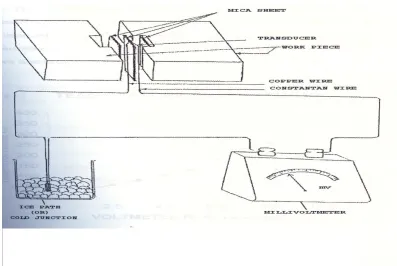
Temperature measurements were made using copper constantan thermocouple wires.
Grooves were made in the workpiece and the thermocouple was installed in the workpiece
with mica insulators between the wire and the workpiece. Prior to carry the tests the
thermocouple was calibrated. The workpiece material was LM 25 Aluminium Silicon Carbide
particulate metal matrix composites. Different types of wheels like Silicon Carbide (SiC),
Cubic Boron Nitride (CBN) and Diamond Wheels were used. The influence of grinding
parameters like work speed, wheel speed and depth of cut were studied while grinding
composites with different types of wheels .The measured interface temperature between the
wheel and workpiece is not more than 110˚C. The diamond wheel exhibits low temperature
followed by CBN wheel and SiC wheel. The temperature increases with increase in grinding
parameters. The temperature distribution in the workpiece was limited to a very small depth
and it can be assumed that thermal damage to the subsurface layers may not be considerable.
The influence of coolant is also studied and the effect is marginal.
KEYWORDS – COOLANT, DEPTH OF CUT, THERMOCOUPLE, WHEEL SPEED,
1. INTRODUCTION
Grinding is one of the major manufacturing process which accounts for about 20-25% of the total machining operations. All the energies expended by grinding is converted into heat which is concentrated within the grinding zone. One of the most common types of thermal damage is workpiece burn while grinding plain carbon and alloy steels. Workpiece burn is characterized by bluish temper colour on the workpiece which are consequence of oxide layer formation .At the onset of burning there is a tendency of increased adhesion of metal particles to the abrasive grains thereby causing the forces to grow, the work piece surface deteriorates and the rate of wheel wear to increase. Another thermal damage is tempering of steels by grinding heat which softens the workpiece near the finished surface. The grinding surface also produces residual stress in the finished surface, which affects the mechanical behaviour of the materials.
2. EXPERIMENTAL SETUP
FIGURE 1: ARRANGEMENT OF THERMOCOUPLE IN THE WORKPIECE
3. EXPERIMENTAL MEASUREMENT OF TEMPERATURE
3.1. INFLUENCE OF DEPTH OF CUT
FIGURE 2: TEMPERATURE Vs DEPTH OF CUT
3.2. INFLUENCE OF WORK SPEED
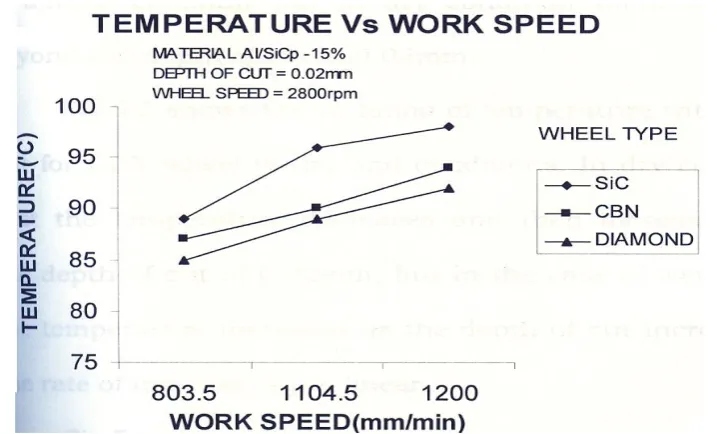
The wheel speed and depth of cut is kept constant and the work speed is varied and the measured values are shown if Figure 3 shows the variation of temperature against work speed. For CBN and diamond the rate of increase in temperature is almost linear. For SiC after a certain stage the rate of increase in temperature decreases.
[image:4.595.118.477.437.654.2]3.3. EFFECT OF COOLANT
There are various types of oils which can be used as a coolant. In our experiment we have selected as a coolant for study.
3.3.1. INFLUENCE OF DEPTH OF CUT
The wheel speed and work speed is kept constant and the depth of cut is varied and the measured values and variation of temperature against depth of cut in dry and wet condition is given in Figure 4 to Figure 6.
For SiC wheel the rate of increase in wet condition is almost linear but in dry condition the rate of increase decreases beyond a certain limit. For CBN wheel the rate of increase in dry condition is almost linear, but in wet condition the temperature increases but the rate of increase is not linear. For Diamond wheel the rate of increase in dry condition is almost linear, but in wet condition the temperature increases almost linearly.
3.3.2. INFLUENCE OF WORK SPEED
increase in both wet condition and in dry condition the rate of increase in temperature is almost the same.
CONCLUSIONS
While grinding composite material the temperature is low which is around 100˚C which is very much low to that of grinding steel and ceramics in which the temperature is around 500˚C. When coolant is used the temperature is reduced to about 45%. Increase in work speed, depth of cut and wheel speed increases the temperature to certain extends.
REFERENCES
1. S. Maikin, and R.B. Anderson, Thermal Aspects of Grinding, Part 1 – Energy Partition, Journal of Engineering for Industry, 1974, 1177-1191.
2. J.A. Kovach, and S. Malkin, Thermally Induced Grinding Damage in Superalloy materials, Annals of the CIRP, 37(1), 1988, 309-313.
3. W.B. Rowe, S.C.E. Black, B. Mills, H.S. QI, and M.N. Morgan, Experimental Investigation of Heat Transfer in Grinding, Annals of the CIRP, 44(1), 1995, 329-332. 4. B. Zhu, C. Guo, J.E. Sunderland, and S. Malkin, Energy Partition to the Workplace for
Grinding of Ceramics, Annals of the CIRP, 44(1), 1995, 267-271.
5. W.B. Rowe, M.N. Morgan, S.C.E. Black, and B. Mills, A Simplified approach to control Thermal Damage in Grinding, Annals of the CIRP, 45(1), 1996, 299-302.
6. M.C. Shaw, Energy Conversion in Cutting and Grinding, Annals of the CIRP, 44(1), 1995, 101-104.
7. N.R. Des Ruiseaux, and R.D. Zerkle, Thermal Analysis of the Grinding Process, Journal for Engineering Industry, 1970, 428-434.
8. A.S. Lavine, S. Malkin, and T.C. Jen, Thermal Aspects of Grinding with CBN Wheels, Annals of the CIRP, 38(1), 1989, 557-560.
9. Takashi Veda, Akina Horokawa, and Akina Yamamoto, Studies on Temperature of Abrasive Grains in Grinding – Application of Infrared Radiation Pyrometer, Journal of Engineering for Industry, 107, 1985, 127-133.
10.W.B. Rowe, M.N. Morgan, and S.C.E. Black, Validation of Thermal Properties in Grinding, Annals of the CIRP, Vol. 47(1), 1998, 275-312.