PROBLEMS AND PROSPECTS OF MICRO, SMALL AND MEDIUM
ENTERPRISES
Mohammed Roshif
Asst. Professor in Management Studies J M College of Arts and Science
(University of Calicut-Kerala) Parannekkad, Tirur,Kerala, 676101
ABSTRACT
Micro, Small and Medium Enterprises play a crucial role in the economy of a country especially developing countries. Their contribution to the domestic economy due to their high contribution to GDP, employment and exports are unexplainable. In OECD economies the MSMEs account for more than 95 per cent of their total firms, 60-70 per cent of employment,60 per cent of their exports while in developing economies MSMEs represent 90 per cent of the total firms other than agriculture sector, high portion of their GDP.MSME sector is one of key drivers of Indian economy. It helped the Indian economy to change its agrarian root economy to an industrial root economy. The salient feature of Indian MSMEs is that more than 50 per cent is owned and managed by underprivileged groups which indicate the role of Indian MSMES to improve the entrepreneurship of such group and the economic empowerment of such group which was one of the visions of India government.
Key Words; GDP, OECD, MSME, MNC
1. Introduction:
especially developing economies. It promotes major share of employment potential in an economy. MSMEs are attributable to its low capital investment, low technical expertness, employment of traditional or heritage skill, application of local skill, high export potential and mobilization of local resources.
Presently, the SMEs in India are at a crossroad and intense debate is centered on questions like what would be the future of the small enterprises? How these enterprises can survive in the international trade arena? What role can the government play in making these SMEs more competitive? In this context, it is important to re-look into the basic issues of SMEs, past, present and future prospects, especially in the policy framework.
1.1Definitions of Micro, Small & Medium Enterprises:
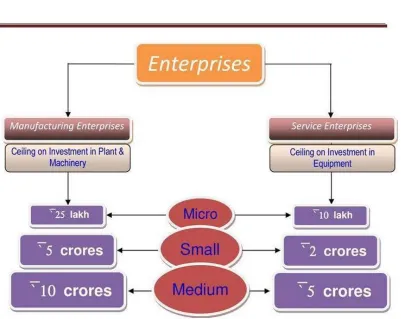
As the provision of Micro, Small and Medium Enterprises Development Act (MSMED) Act 2006 the Micro, Small and Medium Enterprises (MSME) are classified in to two classes.
(1) Manufacturing Entities and (2) Service Entities.
1.1.1 Manufacturing Enterprises: The enterprises engaged in the manufacture of goods pertaining to any industry mentioned in the first schedule to the industries (Development and regulation) Act, 1951) or plant and machinery in the process of value addition to the final product having a distinct name or character or use.
Fig 1
2 Objectives of the Study:
The objectives of the study are:
i. To Understand the growth and performance MSMEs,
ii. Growth of Employment, promotion of Exports of MSMEs in India
iii. To Find out the contribution of MSMEs to the growth of the GDP and
[image:3.612.65.466.132.451.2]v. To Study the steps taken by the Government to revitalize the MSMEs
Performance of Micro, Medium and Small enterprises sector is assessed by the All India Census board. The last census was made in the Fourth All India Census of MSME.1. The data collected
from 2006-07 till 2009 and the result was published in the year 2011-12. The Fourth All India census of MSME is the first census conducted after the implementation of MSMED Act of 2006. Before the commencement of this Act the industrial Development and Regulation Act 1951 was followed for defining the MSMEs.
Table 1
Performance of MSME, Employment and Investments
Sl. No. Year Total Working Enterprises (in Lakh) Employment (in Lakh)
Market Value of Fixed Assets (Rs. in Crore)
I II III IV V
1. 2006-07 361.76 805.23 868,543.79
2. 2007-08# 377.36 842.00 920,459.84
3. 2008-09# 393.70 880.84 977,114.72
4. 2009-10# 410.80 921.79 1,038,546.08
5. 2010-11# 428.73 965.15 1,105,934.09
6. 2011-12# 447.64 1,011.69 1,182,757.64
7. 2012-13# 447.54 1,061.40 1.268,763.67
8. 2013-14# 488.46 1,114.29 1,363,700.54
Source : Annual Report 2014-15 Govt of India Ministry of Micro, Small and Medium Enterprises
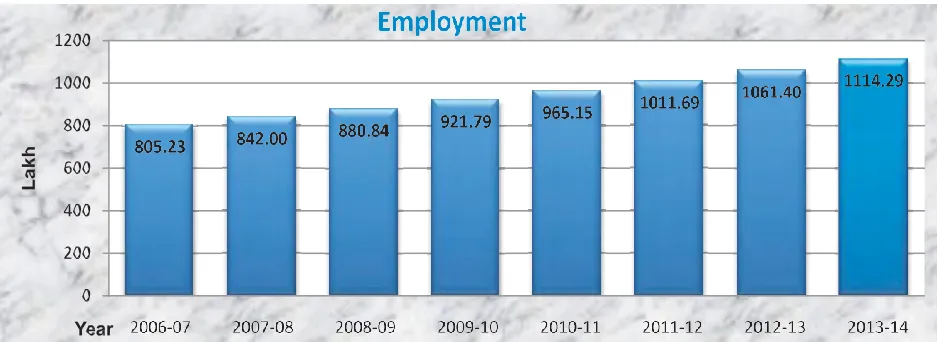
The total number of MSMEs has increased remarkably from 361.76 Lakh in 2006 to 488.46 Lakh in 2013-14.
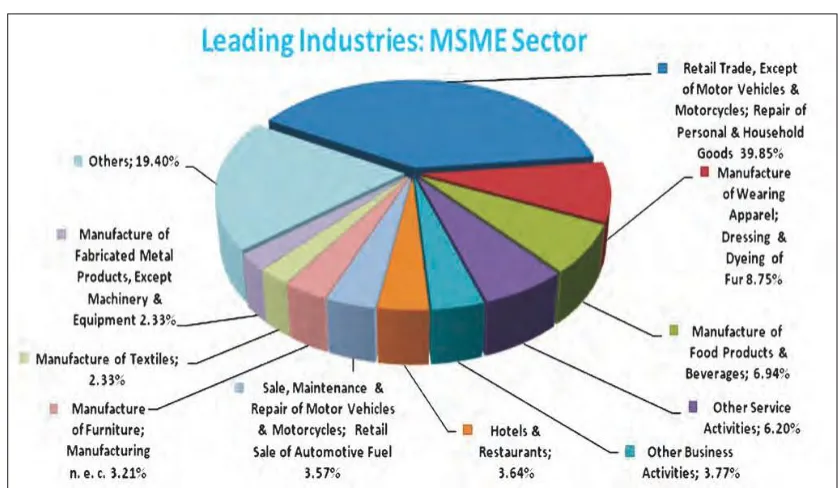
Fig 2
Source: Annual Report 2014-15 Govt of India Ministry of Micro, Small and Medium Enterprises
[image:5.612.95.514.117.361.2]One of the importances of MSME sector is its high contribution to the GDP. Around 94 per cent of micro, small and medium firms are unregistered; the contribution of the sector to India's GDP has been growing steadily at 11.5 per cent annually, which is higher than the overall GDP growth of 8 per cent.
Table 2
CONTRIBUTION OF MANUFACTURING OUTPUT OF MSME IN GDP
Year
Gross Value of Output of MSME Manufacturing
Sector (` in crore)
Share of MSME sector in total GDP (%)
Share of MSME Manufacturing
output in total Manufacturing
Output (%) Manufacturing
Sector MSME
Services Sector MSME
Total
2006-07 1198818 7.73 27.40 35.13 42.02
[image:5.612.70.578.553.688.2]2008-09 1375589 7.52 28.60 36.12 40.79
2009-10 1488352 7.45 28.60 36.05 39.63
2010-11 1653622 7.39 29.30 36.69 38.50
2011-12 1788584 7.27 30.70 37.97 37.47
2012-13 1809976 7.04 30.50 37.54 37.33
Source: 1. Fourth All India Census of MSME 2006-07, 2. National Accounts statistics (2014), CSO, MOSPI and 3. Annual Survey of Industries, CSO MOSPI
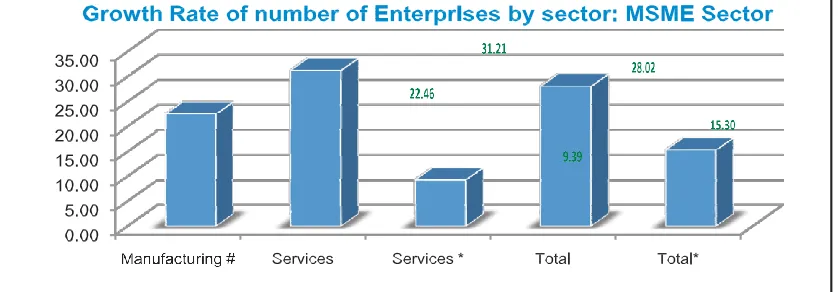
As per the census made, the growth recorded between 2001-02 to 2006-07 in the manufacturing sector was 22.46 per cent and the growth rate of employment was
18.49 per cent. In the service sector the growth rate recorded was 31.21 per cent while the growth of employment was 18.49 per cent. Specifically it raised from
Fig 3
Source: Annual Report 2014-15 Govt. of India Ministry of MSME
[image:6.612.75.494.343.489.2]Fig 4
Source: Annual report 2014-15 Ministry of MSME, Govt. of India
Due to the high demand for the MSME products from the western and emerging markets, it is estimated the MSME share in India’s exports would increase by 50 percent by 2017, it being 36 per cent now .It was 40 per cent earlier.
3. Findings: The Indian MSMEs face many challenges at midst of their prospective growth. Some of them are:
3.1. Absence of timely and adequate finance
Whatever may be the opinion of the govt. authorities, it is very difficult to get loans or financial support from banks. Banks always demand high documents and securities for granting loans. The process of loan sanctioning is very slow and waits for unnecessary formalities
3.2 Non –Availability of materials: Due to constraints for getting quality raw materials for production, entrepreneurs have to adhere to low quality materials which will affect the quality of product and thus affect market. On the other hand, if they go for high end scarce materials, it will increase the cost of production ,as the material value is very high, and thus increase the price which will affect the competiveness of the products.
[image:7.612.77.546.130.301.2]where the cost of capital is very high.
3.4 Competition from MNCs: Due to high technological developments in the production of plant and machinery, it is very easy for the large scale industries to produce even the tiny products of MSMEs at very low prices because of the advanced production technology they are using. Ultimately, it leads to closing down of small scale industries.
3.5 Unscientific marketing techniques: Normally, MNCs have large networks of marketing techniques. The utilization of media in the present scenario will make a bad product good and vice versa. The distribution channels of MSMEs are very small and investing in them is very expensive
3.6 Non-availability of skilled workers at affordable salaries: The boom and hike in the salary structure of Indian workers recently is one of the bottlenecks of Indian MSMEs. More organized working class with unbelievable bargaining capacity made the labour force costly. At the same time skilled workers in certain sectors are very rare, for instance in gems business which was almost traditional until now.
3.7 Less mechanism to tap government support: Though MSMEs have different organizations and committees to assist them to get government aids, individually; they lack knowledge about the different schemes especially about financial supports form the government.
4. Government Support
The Micro, Small and Medium Enterprises Development (MSMED) Act 2006
was passed to enhance the competitiveness of MSMEs. defined the medium enterprises for the first time. This Act divided the entire enterprises in to tow categories namely manufacturing and service industries. The Act envisaged active consultative mechanism for all stakeholders at national level especially for the three, Micro, small and medium enterprises. Creation of Special funds for promotion, increasing the competitiveness of enterprises, special programmes, advanced credit policies, new practices, rules for procuring goods and services by the govt. special mechanism for solving grievances at govt. level are some of the highlights of this Act.
4.1 Foreign Direct Investment Policy: The investment of MSMEs is defined on the basis of plant and machinery in case of manufacturing enterprises while in the case service industry it is on the basis of equipments. Formerly, there was ceiling of 24 per cent equity, this has been waved by the 2006 MSMED Act.
co-operation among the entrepreneurs.
4.3 De-reservation: This is a matter of contention for the last many years in the industrial sector. De-reserved list are enhanced by the govt. and it augmented the MSMEs to enter in a wide range of manufacturing products.
4.4 Priority sector lending : credit to MSME is become a part of priority sector lending by the banks.40 per cent of net bank credit(NBC) is set aside for priority sector by the national banks while it is 32 per cent by the foreign banks.
4.5 credit linked Capital subsidy system: 15 per cent capital subsidy for technology up gradation to manufacturing MSEs
4.6 National manufacturing competiveness programme :A programme sponsored by Govt.of India to improve the competitiveness MSMEs in India
5. Suggestions:
5.1 Mutual Supply of Technologies: MSMEs have different technologies for the production of same product. Some of them are developed through the research and development system. Most of the enterprises keep their production secret as trade secrets. If they disseminate the knowhow among them, it will be beneficial.
5,2 Constitution of a Panel of Consultants:
Constitution of individual consultants will be a financial Burdon for individual enterprises. Therefore, constitution of a panel of consultants will be a good relief to the industry.
5.3 Determination of Technological Needs: There should be detailed survey to assess the technical and financial needs of the MSME. So that, the proper arrangement could be make to fulfill the needs of the MSME’S.
5.4. Training and development, awareness programs: There must be conduction of training and development programs by the MSME ministry. The currently running programs are not so effective and sufficient. One of the important reasons for slow intake in the utilization of schemes is the ignorance about schemes and their benefits. The current knowledge passing system is limited in its outreach. There is a need to develop a better communication strategy and use of new age media tools.
of credit to fulfill their requirement of establishment of MSME and as well as not for the operational activities. Therefore, there must be availability of credit according to the requirement at cheaper rate.
5.6. Relaxation in labor laws and red tape- There should be relaxation in complex labour laws to avoid the inconvenience in compliance. There should not be equal labour rules to each MSME. The must be sooth running of the concern not to create a problem for them. Every effort must do to avoid the unnecessary red tape.
5.7. Proper research and development: There should proper research and development in respect of innovative method of production and service rendering. The innovative products will provide the cheaper products. There should be proper research and development in respect of innovative method of production and service rendering. The innovative products will provide the cheaper products and the MSME’S will be able cope up with the situation.
6. Conclusion;
There is vital importance for MSMEs in India. It promotes the key drivers like employment to all sections whether skilled, unskilled, backward, upper class, it need less capital investment, it is the big contributor of GDP .The empower of women through different women enterprises is made through MSMEs.
This sector is rife with many problems like lack of capital, good infrastructure, less marketing strategies, shortage of raw materials, lack of research and development. It needs improvement in production technology and production quality. Govt. policy should be changed to promote the competitiveness of this sector.
References: .
1. Annual Report 2012-13, Govt. of India, Ministry of Micro, Small and Medium Enterprises,
2. Morris,S. R. Basant; K. Das; K. Ramachandran; and A. Koshy. (2001). The Growth and Transformation of Small Firms in India. New Delhi: Oxford University Press.
3. MSME Development Act.( 2006). Ministry of the District Industry Centers (DIC) MSME,Government of India.
Organised Banking Services By The Small And Medium Enterprises- An Indian
Perspective." Scholedge International Journal of Management & Development ISSN 2394-3378 [Online], 2.5 (2015): 9-20.
5. Sonia and Kansai Rajeev (2009), “Globalisation and its impact on Small Scale Industries India” , PCMA Journal of Business, Vol. 1, No. 2 (June, 2009) pp. 135-146.
6. MSMEs seen as engines of growth by planning commision deputy chairman M.S.Alluwalia published in Economic Times February 16th 2009.
7. Bansal, Parveen. "Critical Analysis of SME Profitability in Indian Island
States." Scholedge International Journal of Management & Development ISSN 2394-3378 [Online], 2.5 (2015): 40-47.