THE EFFECT OF SMALL AND MEDIUM ENTERPRISES ON
POVERTY REDUCTION IN AFGHANSITAN
Mahmood Hassaas
ABSTRACT
This paper explores the effect of SMEs (Small Medium Enterprises) on poverty reduction in
Afghanistan through alleviation and database. The role of SME is very important in employment
generation, poverty alleviation, Gross Domestic Product (GDP) and economic growth which
automatically reduce poverty in a country. Annual data used to examine the impact of SMEs on
poverty reduction in Afghanistan. This article aims at finding out that which small medium scale
and enterprise with use of activities of employment helped to reduce poverty reduction and it is
recognized that SMEs is a powerful tool to poverty reduction and economic growth.
After three decades of war in Afghanistan, the system and infrastructure of Afghanistan is
completely destroyed and after create of temporary government in Afghanistan in 2001,
Afghanistan is involved into many protocol and aids program to rescue this country from poverty
and raise the poverty line. They raise many tools, regulation and innovation to decrease poverty
from Afghanistan and this is a very effective topic to decrease the problem of poverty through
SMEs which is corporate with the help of World Trade Organization (WTO), World Bank (WB),
United Nation (UN), Japan International Corporation Agency (JICA) and many other
organization or Non-Government Organizations (NGOs).
Keywords:JICA, NGOs,Poverty Reduction,SMEs, Taliban,UN, WB.
1 This study contains the effect of small and medium enterprises on poverty reduction in Afghanistan.
2 Institute of Social Science, Department of Business, Business Management Program,
International Research Journal of Marketing and Economics
ISSN: (2349-0314) Impact Factor- 5.779, Volume 4, Issue 10, October 2017
Website-www.aarf.asia, Email:[email protected], [email protected]
Istanbul Aydin University, Turkey.
1. Introduction
Reduction of poverty is process which their target is only to decrease poverty from a country or
nation. There are some progresses on strategies which their target is only to the poor people.
Those who bear or suffer from social, political and economic growth in their family and it is the
reason which is poverty reduction become the main central for plans of development. If poverty
aimed to be decreased, it is definitely needed to increase economic growth and we have some
tips for poverty reduction and economic growth.Poverty is a condition of living in which people
fight against that with political, social and environmental problem. Poverty reduction has become
the goal and aims of universe and institution even government, private and development
institution for growth economic to reduce poverty. There are many ways that the universal can
decrease and flush Poverty which are more belong to national economy where economy of a
country getting larger on other side of the people of a country will get and earn more money and
the government will spend their all money to build schools, hospital and social welfare for better
services for poor people (Wan and Sebastian, 2011).
Growth of economic in a country is implies that there is many more opportunities in jobs. In this
case people will find jobs and the income will increase, by this income which is find from job
and good opportunities they can afford for better life of themselves. Growth economic is always
will not good for the poor people of society, because when there is develop in economy, develop
and revenue which is trickle down to poor people of society in which some organization is who
is member of organization in poverty is disagree with this. When economics is growth and this
growth should be trickle down to poorest people of society because they need first for that.
Afghanistan government cannot provide any enough facilities of environment to make easy life
for them. Afghanistan Research Evaluation (ARED) is completed the recently research regarding
the urban poverty and they informed that the people are really facing with poverty (AREU,
2006).
Growth of economic is regarded for poverty reduction and it should be develop equally among
the poor and rich people of the society and increase in activity of economic which they can
provide more money and this money need to be distribute equally to rich and poor people and it
include of man and women at the local level, government should include all the people in their
strategy and they should be very loyal about their occupation (Wan and Sebastian, 2011).
The variable change which is dependent to analysis and it should be use the calculation of
economic growth. A change in inequality of income will be a change in reduction of poverty.
The poor growth of income is equal to the growth of annual average in GDP. Over the period of
average per capita, the poor growth of income is equal to the annual growth rate of GDP which is
the lowest quantity of income. Measuring the effect of different size of SMEs on the quintile of
lowest income which is further effect the rate of growth and overall level of GDP (Beck and
Levine, 2005).
According to UN statistics estimation in 2005 approximately 3.5 billion people are staying in
urban part in the world and 1 billion are account for resident in part of slum and it is increasing
day by day which is 2.2% in a year. Unfortunately, it is higher than the growth of global
population.For sake of this, poverty Urban became an important issue for challenge of assistance
institution for the WB and UN. Now the WB and UN assistance with many other corporations of
public and private sector which they work together to improve a social environment to reduce
poverty, they want to raise the social, Political culture, economic growth and capabilities of
human of poor people (Afghan Research Evaluation Unit (AREU), 2006).
Thediscussion about poverty alleviation in year 2010 about the role of Micro Small Medium
Enterprise (MSMEs) in reduction of poverty in Ghana. The view is that town and rural based on
MSMEs aid to provide jobs and make high the level outcome of people. This progress outcome
donates the people to get good health, school facilities and stand on their feet to fight against
poverty. In addition, progress on SMEs also provide capital of human through job (Abor and
Quarter, 2010).
2. Methodology and Approach
Data methodology is the very significant and aims part of thesis and the most effective part of
research about a thesis. An area of studies is statistical tool and model theoretical, tools of
collection data, sampling technique and size of the sample. The primary data analysis is based on
this study data. Hence, this data is separated in two types of data. One part is the effect of SMEs
on employment and especially for poverty alleviation reduction and the other part is which
According to the research requirement the purpose of questionnaire research is involve of this
part of research, the sample Random technique is used for this purpose and different kind of
SMEs by their class of labor were choose to show their society used through this technique of
sampling and researcher are selected SMEs through sampling random. The work number is
which is chosen from SMEs in which the select worker number is not fixed because of the
employee number which it is change in every part of unit (Ali and Rashid, 2014).
And this research is calculated by analysis of Regression to find the results from this calculation
and analysis which is the first thing of poverty reduction and alleviation is employment which is
depend most on increase of variable of employment. The increase of employment is very
important as like SMEs which is reduce the poverty reduction. And the only issue which can be
decrease the poverty is employment and that is only create by SMEs.Suppose, if sufficient of
SMEs income that impact to employment, it atomically increases the income of people which
reduce poverty by passing time. More than 70% OF GDP is calculated from agriculture, GDP is
very positive and useful variation of employment in Afghanistan. There are three kinds of GDP,
the part one which is effect to employment is Manufacturing Gross Domestic Product (Mg
GDP),the second part is Agriculture Gross Domestic Product (Ag GDP) and the very important
of employment is second metal GDP (Oregwu and Chima, 2011).
3. Theoretical Framework
The choose of SMEs as poverty reduction was very significant for the many academic and
organization to apply these theories in their part for development of economic growth as well as
employment through intensive of capital and large scale, for better sustainable of economic,
economist will enjoy the growth of economic.
The aims principle of this paper is to make strong and give strength to SMEs for poverty
reduction through many ways which are going to discuss about this as follows.
In Nowadays, role of technology is no longer in dispute. Technology should be present is such a
way that it should have main objectives and it should be effective in whatever it is applied.
Technology should be considered having following properties (Mukras,2003):
Technology should be friendly considering entrepreneur’s capabilities.
Technology should not be provided in such a way that it should cost operational
Technology should be presented in such a way that it should be soft for Administration
demand.
After presenting technology it should raise the employment capacity and it should generate
the income.(Mukras, 2003).
4. Poverty Reduction in Afghanistan
As a war of decades and inequality in Afghanistan and due to this instability and war, the
economics of this country is down for 30 years and almost 40 % of population is under poverty
line and they are suffering through extreme poverty and most poor people is in rural area of
Afghanistan, and this country is the second poorest country in the Asia after Bangladesh.Poverty
is neither accidental nor inevitable but in Afghanistan, it reflects the way society is organized,
the way decisions – including by the international community are taken and resources
allocated(United Nation, 2010).
The WB found that higher income of human capital will make people life better and to remove
poverty from this country and Afghanistan should increase school enrollment rate. The
Afghanistan country less of children are in primary school, 35 % of poorest people children is
attend primary school while 46% of richest people are enrolled to primary school (NRVA, 2010).
In case of Gents and Ladies, 43% of boys enrolled to school and 31% of girls are attend to
school. In 7 provinces out of 34 province in Afghanistan there is only 1 % of children are
enrolled in primary school that even the capital of Afghanistan Kabul has an illiteracy rate of 47
%.Afghanistan have 1 million widow which they have 3 to 4 children and without husband
protection and these widows suffer from poverty and social issue and even they don't have any
choice or became bigger in the street due to lack of income and more expense of children.
Afghanistan children are at the age of 5 and under 5 are most suffer from this poverty and
vulnerable of this society. The 1.5 million Kuchi which lived in rural area are nomadic herder
where their life is depend all in trip and migration. As an insecurity in Afghanistan 15 % Kuchi
people families forced to live in separate part of Afghanistan without any migration route and
now they called the poorest people in Afghanistan (NRVA, 2010).
Many of Afghans people almost 85 % remain on value of old and they saying that women should
only works in female school a reader or servicer and it is a very acceptable job in Afghanistan
2015 described that the Asian survey foundation are agreed to a third of women are working in
private sector or companies(Nairobi and Ritchie, 2015).
War has affected insecurity in the country and has been beneficial to the poverty reduction.
Furthermore, almost 6 million Afghans fled the country and displaced to other countries, and
about one million Afghans were emigrant within the country. In addition, in some areas both the
private and public assets were looted and increasing poverty day by day in Afghanistan. In
Afghanistan poverty is different between provinces. In percentage of to 70% and the most area
which more suffer from poverty is in northwest and a part of southeast, many other province like
Zabul, Paktia, Badakhshan, and Daikundi province are most suffer from a big amount poverty in
Afghanistan (Rahimi, 2015).
4.1Profile Poverty of Afghanistan
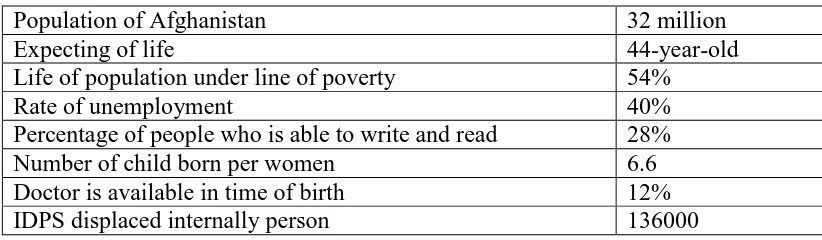
In Afghanistan, poverty is involved in many things different and it is a briefly overview of
[image:6.612.94.505.380.500.2]poverty in different types in Afghanistan.
Table 1: Profile of Poverty
Population of Afghanistan 32 million
Expecting of life 44-year-old
Life of population under line of poverty 54%
Rate of unemployment 40%
Percentage of people who is able to write and read 28%
Number of child born per women 6.6
Doctor is available in time of birth 12%
IDPS displaced internally person 136000
Source:Purves, 2005
4.2Small Medium Enterprise in Afghanistan
Instead of this specification, SMEs enterprise have also play as innovation in the economy which
SME e growth provide and increase specialization,hence a professional network or system of
SMEs in Afghanistan is a requirement for the founding of healthy industrialization. Government
of Afghanistan has confirmed SMEs is one of four significant of growth for the Afghanistan
production. Afghanistan SMEs sector is extremely worker manual and this part make
employment to the main part of non- agriculture worker force in Afghanistan.(Naithani, 2007).
The huge and infinite mass of are local individual and family outlets, more than 90% of this
enterprise are retailer which automatically raise the worker in which they are busy with that and
the employment rate will be affected by those retailer shop which member of family are involved
for that. The classification of SMEs business is different in case of a country. For example, if it
discuss about the effect of SMEs on employment,a huge business element in Afghanistan may
utilize the same number of citizens as a small. The International Finance Corporation (IFC)
department of SMEs discuss the level of business.
SMEs in Afghanistan are the place of promote and sell of actual and realities of Afghanistan. In
Afghanistan, the formulation of SMEs is different from place to place. Naturally, SMEs activities
are very vital and well in Kabul, Jalalabad and Herat province, other side like business outlet,
workshops, repair by the road side, Groceries, office supplier, tailor shop, pharmacies, dry
cleaner, restaurant, barber shop and retailer stores, these are maybe the most useful enterprise of
today in Afghanistan.(Naithani, 2007, pp. 3-4).
[image:7.612.84.526.399.588.2]All below information which categorized are take place effectively to all afghan enterprise
Table 2: Sectors of Investment of Machinery and Plant
Enterprise Number of Employee
Manufacturing Sector
Investment on Machinery and Plant
Service Sector Investment of equipment
Large > 100 > 10 million Afghani > 5 million Afghani
Medium 20 to 99 5 up to 10 million Afghani 2>, = 5 million
Afghani
Small 5o up to 9 2.5 up to 5 million Afghani 2>,= 5 million
Afghani
Micro < 5 <2.2 million Afghani 1 million Afghani
Source: Ministry of Commerce of Afghanistan (MOCA) and AISA, www.moca.gov.af/viewed on 200
5. CONCLUSION
Because of three decade of war in Afghanistan, the emergence of strong private sector, which is
pervert remained as a main challenge in front of Afghan Government, among others. Big
companies and enterprises are established in economies which are very strong and stable.
Unfortunately, Afghanistan is neither economically strong nor politically and economically
stable that’s why Afghanistan failed to attract the investment by big enterprises which are very
important in creation of jobs and also creation of middle class population that is the main factor
and stimulus for an emerging economy.
Because of above reasons, Afghanistan economy and poverty reduction can be possible with
facilitating and supporting the emergence of strong and big number of SMEs. Afghanistan’s
economy, socio-political environment is very suitable for a strong SME as one of the most
important and major factors for job and wealth creation and reduction of poverty. There is no
doubt that SME sector is one of main factors in poverty reduction however there are many
obstacles for the development and creation of strong SME sector. At macro level, the major
players that can support the creation of strong SME sector to reduce poverty are the Government
of Afghanistan, International Community and major donor organizations.
The Government of Afghanistan should develop a very comprehensive and pervasive SMEs
Strengthening and Support Strategy with clear goals for major players within the economy.
Obstacles towards registration of SMEs should be removed and bureaucratic processes needs to
be simplified to attract investment in this important sector for poverty reduction within
Afghanistan. Bureaucracy paves the way for manipulation of processes and corruption that’s
why all the activities that somehow link with SMEs, needs to be simplified. Special attention
needs to be paid to reduction and illumination of corruption within the business registration and
operation procedures. It is consequently very important that strategists and role makers within
the government and their representative must be determined and committed towards creation and
supporting of strong SME sector. Infrastructures, including the use of technological and latest
trends must be adopted and provided for the investors who wish to invest in SMEs sector in
Afghanistan. These will allow and encourage SMEs to establish itself as major player in terms
strengthening economy and reduction of poverty within Afghan economy.
The international community including neighbors of Afghanistan need to be brought in to the
table to support newly emerged Afghan SME sector as major factor for poverty reduction and
linkage between the nations for multi-lateral beneficial relationship. Poverty results in conflict
and insecurity and by reduction of poverty, the neighbors of Afghanistan, countries of the region
play a major role in linking Central Asia with the South Asian countries. The SME sector in
Afghanistan can be very successful by having access to major markets within the region apart
from Afghan markets and can create thousands of jobs for reduction and illumination of poverty
in Afghanistan. The SMEs will help Afghanistan in its mission to be among the countries of the
region with relatively very low poverty rate.
The donor agencies, which are the most important factors in maintaining and developing current
Afghan economy, always desire to create a sustainable and progressive economy for
Afghanistan. Afghan Government must coordinate the activities of the donor agencies to better
utilize the use of financial resources extended and committed to Afghanistan by donor countries
and organizations in supporting SME sector in Afghanistan.
During the study of the subject, apart from above mentioned points, I specifically suggest the
following:
The strategy always target to calculate the at cheering small local firms to accept up to date
product blueprint, manufacture method and sale of technical for increasing the manufacture,
outcomes and life style principles and values . Conversely, we must see at the possible effect of
transformation on joblessness circumstances as too. The collection of right strategy and rule
calculate at which assist in changing the elderly good and with new goods. Particularly quality
superior and cost aggressive harvest ought to end up growing job service indirectly and directly.
The SME and this policy require to make certain that it is not discourage the employment in a
customary division. The solution feature in shaping the final crash and effect of these progress
would be the generally expansion in the economic as in a rising economic which is the job
service generate the belongings of transformation are to be expected to be bigger than the
employment falling property.
On the source of the experiential data from many countries in which we can with assurance
stated that recent little engineering can make a payment to further service and revenue provide
the main sector of the growth of economy in cycle with the whole economic. The subsequent
procedures are recommended for exclusion in the original SME strategy.
SME institutions enclose to beside with favorable economy situation. The right of entry to
organizational investment are the center and essential circumstances for the encouragement of
SMEs. As said before, the institute of finance competence barely reach the very little firm
trouble has its derivation in the absence of an obvious and purposeful classification and
explanation of medium and small firms. The government supervision has to obviously describe
the medium and small on an enduring foundation.
ACKNOWLEDGMENTS
I would like to thanks my thesis advisor Asst. Prof. Dr. Emine Zeytinli in every moment of step
of my research thesis. In addition, a good thanks to Mr. Halit Topçu and Asst. Prof. Dr. Nurgün Komşuoğlu Yılmaz, the head of the department, for their help in my thesis research and a warm
thanks to my all teachers and friends. And I appreciated to my great father Abdulhaq Hassas for
their support and my kind mother believe on me and for moral and supporting me on my
decision.
Reference
Wan Guanghua and Sebastes Iva (2011). Asian Development Bank. (Poverty in Asiaand Pacific), Economic and Research Department, Asian Development Bank, Mandaloyung City, 1550 Metro Manila, Philippines
Ali S. and Rashid H (2010). The Role of Small and medium enterprise and Poverty in Pakistan: An empirical analysis. Theoretical and applied economists, Volume XXI (2014), No 4 (593),68-72
Afghanistan Research and Evaluation Unit (AREU) (2006). European CommissionWorkshop (Urban Poverty Reduction in Afghanistan). Theme: Institutional and programmatic barriers to reducing, in a sustainable way. Kabul, Afghanistan
Mukras, M.S (2003). “Poverty Reduction through Strengthening Small and Medium Enterprise, Employment Creation in Botswana, “Botswana Journal of African StudiesVol.17(2).(9-16)
Oba, Oregwa V. and Chima B. (2011). The role of small and medium scale enterprise in poverty reduction in Nigeria. An International Multidisciplinary Journal, Ethiopia. Vol. (4), Serial No. 31. ISSN 1994-9057,(8-15).
Rahimi Farid Ahmad Farzam(2015). The impact of security and regional integration on poverty reduction in Afghanistan. (Journal of International Studies), Vol. 8, No 1, 2015. DOI: 10.14254 183-184
Purves Ruth (2008). A Plain language guide to poverty in Afghanistan.(Afghanistan without Poverty) USAID (from the American people) Agency coordinating for Afghan Relief (ACBAR), Kabul, Afghanistan.
Naithani Saurabh (2007). The case for Small and Medium Enterprises in Afghanistan. Small and medium enterprise economic growth and civil Society involvement in Afghanistan. (Agency coordinated body for Afghan Relief) ACBAR, Kabul, Afghanistan
NRVA (2010). Afghanistan Poverty Statue Updates.http://www.af.undp.org/content/dam/afghanistan/docs/,Viewed on September 2, 2017.
UN(2010). Human Rights Dimension of Poverty in Afghanistan. (United Nation office of the High Commissioner for Human Rights),http://www.refworld.org/, viewed on August 9, 2017
Abor J. and Quartey Peter.(2010).Issues in SME Development in Ghana and South Africa”. International Research Journal of Finance, Economics, ISSN.1450 2887, Issue 39 (2010), 219-224.
Nairobi and Ritchie H. (2016). Addressing the obstacle for afghan SMEs to employ women and support the economic improvement. Commissioned by Ministry of Foreign Affairs, Prinses Beatrixlaan 2, 2509 AC The Hague, Netherland Beck T, Kunt A.S and Levine R. (2005). SME, Growth and Poverty. Poverty statue Updates. Cross Country Evidence