Application of Protein-Rich Oriental Diet
in a Community-Based Obesity Control Program
Nam-Seok Joo,
1Yong-Woo Park,
2Kyung-Hee Park,
3Chan-Won Kim,
1and Bom-Taeck Kim
1 1Department of Family Practice and Community Health, Ajou University School of Medicine, Suwon; 2Dr. Park’s Reset Clinic, Seoul;3Department of Family Medicine, Hallym University College of Medicine, Anyang, Korea.
Received: May 14, 2010 Revised: June 28, 2010 Accepted: July 2, 2010
Corresponding author: Dr. Bom-Taeck Kim, Department of Family Practice and Community Health, Ajou University School of Medicine, San 5 Woncheon-dong, Yeongton-gu, Suwon 443-721, Korea.
Tel: 82-31-219-5309, Fax: 82-31-219-5218 E-mail: [email protected]
∙ The authors have no financial conflicts of interest.
© Copyright:
Yonsei University College of Medicine 2011 This is an Open Access article distributed under the terms of the Creative Commons Attribution Non-Commercial License (http://creativecommons.org/ licenses/by-nc/3.0) which permits unrestricted non-commercial use, distribution, and reproduction in any medium, provided the original work is properly cited.
Purpose:To evaluate the efficacy, safety and availability of a 12-week, community-based obesity control program called the Protein-Rich Oriental Diet (PRO Diet) and to compare it to a conventional diet. Materials and Methods: A total of 515 over-weight people (55 men and 460 women; mean age 41.9 ± 9.8 years; body mass in-dex (BMI) 28.1 ± 3.6 kg/m2) participated in the program at two public health centers.
PRO Diet was offered as the main diet recommendation for 12 weeks. As a control group, we selected a population who had followed a conventional diet program con-ducted at a public health center in 2006. Results:177 subjects (34.3%) completed the 12-week PRO Diet program. In a per protocol (PP) analysis, the mean changes in anthropometry were (conventional program vs. PRO Diet; weight, - 2.3 kg vs. - 4.7 kg, p < 0.001; BMI, - 1.1 kg/m2 vs. - 1.9 kg/m2, p < 0.001; waist circumference, - 3.3
cm vs. - 6.8 cm, p < 0.001; fat mass, - 2.0 kg vs. - 4.2 kg, p < 0.001; fat % mass, - 1.8% vs. - 3.9%, p < 0.001). The triglyceride reduction was significantly greater (- 30.16 mg/dL, p < 0.001) in the PRO Diet group after intervention compared to the conventional group. Conclusion: The PRO Diet was an effective tool for weight loss in a community-based weight control program and well-tolerated.
Key Words: Protein Rich Oriental Diet, community-based obesity program, obe-sity
INTRODUCTION
The growing overweight and obese population has become a major health issue in United States, and obesity has reached epidemic proportions.1,2 In Korea, the 3rd
National Health and Nutrition Survey3 in 2005 reported that overall prevalence of
obesity among adults, which is defined as having a body mass index (BMI) ≥ 25.0 kg/m2, was 31.7% (35.2% in men and 28.3% in women), and that it had increased
(overall 29.6%, 31.2% in men and 27.9% in women) when compared to the sur-vey from 2001. Overweight individuals have increased risk of developing hyper-tension, type 2 diabetes, hypercholesterolemia, cancers, and dying prematurely, which calls for urgent intervention to curve the continuous increase of obese popu-lation.4 In practice, 5 to 10% weight loss in obese patients improves their
visited the public health center of their choice at intervals of one or two weeks for a total of 12 weeks. Participants were instructed by registered nurses, nutritionists, and exercise trainers on behavior modification, nutrition, and exercise throughout the 12-week program at one of the public health centers. We certify that all applicable institutional and gov-ernmental regulations concerning the ethical use of human volunteers were followed during this research. The Institu-tional Review Board of Ajou University Hospital in Su-won, South Korea, approved this study.
Subjects
Inclusion criteria were: BMI ≥ 25.0 kg/m2; age: 20-64 years
old; waist circumference: men ≥ 90 cm, women ≥ 85 cm; exercise: at least 30 minutes, 4 times a week of aerobic ex-ercise. Exclusion criteria were: uncontrolled type 2 diabe-tes, hypertension, habitual alcohol consumption, cancer, past stroke and renal disease. A total of 515 obese subjects (men 55, women 460, mean age of 41.9 ± 9.8) participated in this program voluntarily. Three-hundred and two subjects who completed at least four weeks of the program were clas-sified into the intention to treat (ITT) group. Among them, 34.3% (177 subjects, 24 men, 153 women, mean age: 44.2 ± 9.3 year-old) completed the 12 week program, which were defined as per protocol (PP) group. One hundred and eight subjects participated in the conventional diet program at the public health center of Ansan in 2006. Among them, 78 subjects (12 men, 66 women, mean age: 44.7 ± 6.2) completed the 12 week program.
Program details
In this study, we applied a special diet program called the PRO Diet which was originally designed by Dr. YW Park. The PRO Diet aims to reduce consumption of refined starch-es (cooked rice, noodlstarch-es, white bread) and to encourage the consumption of high protein. Additionally, the PRO Diet encourages the intake of “favorable” carbohydrates with a low glycemic index (GI) and “favorable” fats with high un-saturated fatty acids, while avoiding “unfavorable” carbo-hydrates with high GI and “unfavorable” fats such as high saturated fatty acids or trans fats. Furthermore, the partici-pants were provided with the following weekly assignments for the 12-week program: see appendix.
Web-based education and tips were also provided through a website (www.prodiet.co.kr). In addition, we collected the data of the 78 subjects who followed the 12-week conven-tional diet program at the public health center of Ansan Traditional Korean meals consist of steamed rice, soup,
and a variety of side dishes including vegetables, mush-rooms, seaweeds, legumes, soybean curd, fish, seafood, and chicken. However, modern Asians, including Koreans, are increasing their consumption of fast food, refined rice prod-ucts, trans-fats, meats containing saturated fat, and other unhealthy foods.11 Modern Koreans are also less physically
active than their ancestors. Changes in their staple diet and reduced physical activity12 may be contributing to the trend
of increasing obesity prevalence. Therefore, consumption of steamed rice, Korea’s staple food, should be reduced and foods lower in saturated fat and high in protein should be included in the traditional diet. For this reason, we have de-veloped the Protein-Rich Oriental Diet (PRO Diet), a modi-fied protein-enriched diet program that encourages the con-sumption of low-saturated fat, high-protein oriental foods cooked with legumes, soybean curd, soy milk, mushrooms, nuts, seafood, fish, chicken breast, lean meat, and vegeta-bles, while refraining from foods that are high in simple sugars, refined starches and saturated fats, without calorie calculation. Furthermore, there are no previous studies us-ing PRO Diet application in the field of community-based obesity control programs. In this aspect, we applied the PRO Diet to a preliminary 12-week community-based obe-sity control program at two different centers located in Gyeonggi Province. The aim of this study, therefore, was to evaluate the efficacy, safety and availability of the commu-nity-based obesity control PRO Diet program.
MATERIALS AND METHODS
Study design
PMS Instruments, Higashi-Ikebukuro, Toshima-ku, Tokyo, Japan), and checked their nutritional status every 4 weeks. The body composition of each participant was analyzed us-ing the Body Impedance Analysis (In body 7.0, Biospace Co, Seoul, Republic of Korea). Additionally, all subjects un-derwent a blood test [standard enzymatic measurements of total cholesterol, high-density lipoprotein cholesterol, tri-glycerides and fasting glucose in fresh serum samples (TBA-200FR, Toshiba, Tokyo, Japan)] at the beginning and end of the 12-week program. We also analyzed changes in macronutrient intake, using a three day recall food diary, with the CAN-Pro 3.0 nutrition analyzer (Seoul, Korea).
Statistics
We conducted ITT (subjects who had completed at least 4 weeks of the program) and PP (subjects who had completed all 12 weeks of the program) analysis to evaluate the results of this study by a paired t-test after 12 weeks. An indepen-dent t-test was also used to evaluate the changes between the PRO-Diet and conventional diet program groups after the 12-week program as well as a baseline comparison. All signifi-cant values were defined by p < 0.05 as determined by SPSS version 11.5 (SPSS Inc., Chicago, IL, USA).
RESULTS
The mean BMI of the PRO Diet program participants was 28.1 ± 3.6 kg/m2, and their waist circumference was 92.4 ±
(South Korea), which was carried out in 2006, and com-pared anthropometry and nutritional changes between the conventional diet and PRO Diet in PP groups. The conven-tional diet program stated that all the subjects were educat-ed to increase their daily activity, practice and type of exer-cise, which they liked, for at least 30 minutes per day, more than three or four times a week, and that each individual un-derwent an initial nutrition assessment by a registered dieti-cian who educated the subjects about eating a low-calorie diet that would produce a 400-500 kcal daily energy deficit. Furthermore, a behavior modification program encouraged them to increase energy expenditure while reducing intake, with an emphasis on long-term behavior change. However, because there was limited data available on the convention-al program carried out by the heconvention-alth promotion department of the public health center and only anthropometric chang-es were measured, we were unable to have full comparison between the two programs, and were missing such details as macronutrient changes.
Measurements
The height and body weight of the participants were mea-sured while they wore light clothing without shoes. Weight was measured to the nearest 0.1 kg, and height was mea-sured to the nearest centimeter. BMI was calculated as the weight divided by height squared (BMI, kg/m2). Trained
nurses measured waist circumference between the lower rib and the iliac crest, as well as the blood pressure after the par-ticipants had been at rest for at least 15 minutes (TM-2655P; Appendix. 12 Weeks PRO Diet Program
Weeks Weekly main missions
1 Put an end to bad habits like smoking, nibbling snacking, and drinking too much coffee with cream and sugar. It is suggested that participants consume four meals a day this week.
2
Restrict starches. We recommended consuming a large amount of vegetables, mushrooms, seaweeds, and moderate amounts of legumes, soybean curd (tofu), egg, fish, seafood, poultry, and lean meat.
We recommended eating 4 meals and drinking more than 8 glasses of water a day. The following foods are prohibited: rice, bread, noodles, pasta, cereal, potatoes, fruit and dairy products.
3 Restrict carbohydrates except for rice, which is limited to half a bowl in the morning and afternoon. 4 Add a small amount of fruit and low-fat dairy product.
5 Add a small amount of fruit and low-fat dairy product. 6 Increase the amount of rice to one and a half bowls. 7 Sleep at least 6 hours every night.
8 Eat slowly and chew food enough to digest.
9 Set a ‘diet holiday’ once a week where you can eat anything you want. Eat anything you want once a week. 10 Permit cereal, whole wheat bread and starch.
11 Rice cake or noodle is permitted twice a week. 12 Check weight before eating breakfast
weight was reduced by 3.9 ± 1.3 kg, BMI by 1.6 ± 0.5 kg/m2,
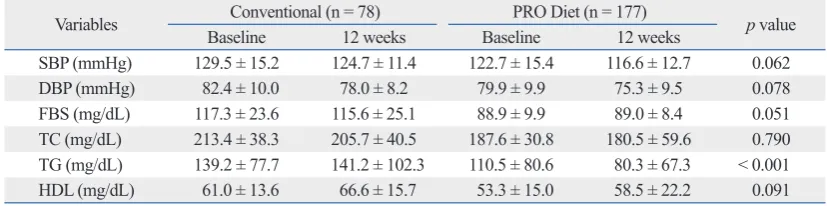
and waist circumference was reduced by 5.4 ± 1.7 cm. Fat mass (- 3.6 kg) and fat % mass (- 3.2%) were also reduced (Table 2). In the PP group of PRO Diet, secular anthropomet-ric measures also showed significant reduction after 12 weeks of intervention (Fig. 1). Both PRO Diet and the con-ventional program resulted in decreases in systolic and dia-stolic blood pressure, total cholesterol and triglyceride levels, and in increases in high-density lipoprotein. However, only triglyceride levels were significantly lower in the PRO Diet as compared to the conventional diet program (Table 3). The proportions of participants who lost more than 5% and 10% of initial body weight in the ITT group of PRO Diet were 7.8 cm; those of conventional diet program participants were
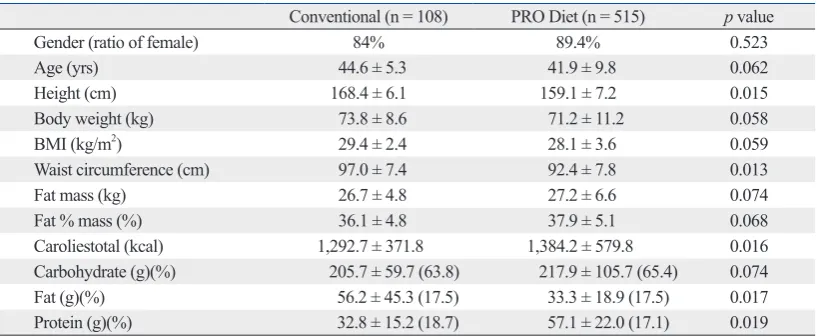
29.4 ± 2.4 kg/m2 and 97.0 ± 7.4 cm, respectively (Table 1).
Comparisons of anthropometry and nutritional changes be-tween the two programs showed that the PRO Diet (PP group) was more effective than the conventional program in terms of body weight, BMI, waist circumference, fat mass, and fat % mass reduction (conventional program vs. PRO Diet; weight, - 2.3 kg vs. - 4.7 kg, p < 0.001; BMI, - 1.1 kg/m2
vs. - 1.9 kg/m2, p < 0.001; waist circumference, - 3.3 cm vs.
[image:4.595.88.497.272.440.2]- 6.8 cm, p < 0.001; fat mass, - 2.0 kg vs. - 4.2 kg, p < 0.001; fat % mass, - 1.8% vs. - 3.9%, p < 0.001). Furthermore, total calorie and carbohydrate intake showed significant reduc-tions in PRO Diet. In the ITT group of PRO Diet, body
Table 1. Baseline Characteristics of the Conventional Diet and PRO Diet Groups (Mean ± SD)
Conventional (n = 108) PRO Diet (n = 515) p value
Gender (ratio of female) 84% 89.4% 0.523
Age (yrs) 44.6 ± 5.3 41.9 ± 9.8 0.062
Height (cm) 168.4 ± 6.1 159.1 ± 7.2 0.015
Body weight (kg) 73.8 ± 8.6 71.2 ± 11.2 0.058
BMI (kg/m2) 29.4 ± 2.4 28.1 ± 3.6 0.059
Waist circumference (cm) 97.0 ± 7.4 92.4 ± 7.8 0.013
Fat mass (kg) 26.7 ± 4.8 27.2 ± 6.6 0.074
Fat % mass (%) 36.1 ± 4.8 37.9 ± 5.1 0.068
Caroliestotal (kcal) 1,292.7 ± 371.8 1,384.2 ± 579.8 0.016 Carbohydrate (g)(%) 205.7 ± 59.7 (63.8) 217.9 ± 105.7 (65.4) 0.074 Fat (g)(%) 56.2 ± 45.3 (17.5) 33.3 ± 18.9 (17.5) 0.017 Protein (g)(%) 32.8 ± 15.2 (18.7) 57.1 ± 22.0 (17.1) 0.019
SD, standard deviation; BMI, body mass index; PRO Diet, Protein-Rich Oriental Diet.
All subjects (n = 515) including baseline enrollment were analyzed within 4 weeks. BMI: body mass index by kg/m2, Body composition
analysis was from Body Impedance Analysis, p values were from independent t-test.
Table 2. Comparison of Anthropometry and Calorie Changes between the Conventional Diet Program and PRO Diet Application in Per Protocol Group
Variables Conventional (PP, n = 78) PRO Diet (PP, n = 177) PRO Diet (ITT, n = 302)
Age (yrs) 44.7 ± 6.2 44.2 ± 9.3 42.3 ± 10.1
ΔBwt (kg) - 2.3 ± 0.7 - 4.7 ± 2.5* - 3.9 ± 1.3
ΔBMI (kg/m2) - 1.1 ± 0.3 - 1.9 ± 0.1* - 1.6 ± 0.5
ΔWc (cm) - 3.3 ± 1.1 - 6.7 ± 0.3* - 5.4 ± 1.7
ΔFM (kg) - 2.0 ± 0.1 - 4.2 ± 0.2* - 3.6 ± 0.8
ΔF%M (%) - 1.8 ± 0.9 - 3.9 ± 0.5* - 3.2 ± 1.1
ΔCaloriestotal (kcal) 53.2 ± 98.5 - 235.7 ± 619.3* - 231.6 ± 675.7
ΔCarbohydrate (g)(Δ%) - 1.5 ± 13.4 (- 2.4) - 58.8 ± 123.1 (- 7.9)* - 56.2 ± 137.2 ΔFat (g)(Δ%) 3.0 ± 29.4 (0.1) 1.11 ± 24.8 (4.0)* 0.41 ± 27.1 ΔProtein (g)(Δ%) 6.1 ± 10.5 (2.2) 0.63 ± 22.90 (3.9)* - 1.15 ± 25.19
ΔBwt, change in body weight; ΔBMI, change in BMI; ΔWc, change in waist circumference; ΔFM, change in fat mass; ΔF%M, change in fat % mass; ΔCaloriestotal, change in total calorie intake; ΔCarbohydrate, change in carbohydrate intake; ΔFat, change in fat intake;
ΔProtein, change in protein intake; Δ%, change in %; PRO Diet, Protein-Rich Oriental Diet; PP, per protocol; ITT, intertion to treat; BMI, body mass index.
[image:4.595.85.497.513.654.2]management program.
There are some diet programs for obese individuals that are low in carbohydrates and high in protein. A meta-analy-sis13 of five trials with 447 participants and a recent 1-year
tri-al14 involving 311 obese women suggest that a
low-carbohy-drate diet is a feasible alternative to a low-fat diet to lose weight, and may also have favorable metabolic effects. An-other study15 evaluated a low-carbohydrate, high-protein,
high-fat (Atkins) diet and a low-calorie, high-carbohydrate, low-fat diet (conventional diet), and found that the low-car-bohydrate diet resulted in more weight loss than the conven-tional diet after the first six months, but the differences were not significant after 1-year. Furthermore, adherence was poor and attrition was high for both diets. Diets that are lower in carbohydrates and higher in protein and fat are not associated with increased risk of coronary heart disease in women.16 As
for protein consumption, a relatively high percentage of ener-gy intake comes from protein. 20% higher protein intake dur-ing the weight maintenance phase after the initial weight loss results in a 50% lower weight regain consisting of only fat-free mass, which is linked to increased satiety and decreased energy efficiency.17 A recent study18 suggested that energy
expenditure is higher when protein is derived from animal 50% and 13.5%, respectively, whereas the proportions in the
PP group of PRO Diet were 66.1% and 22%, respectively. In the PP group of conventional program, the percentages of participants who lost more than 5% and 10% of their initial body weight were 33.3% and 13.3%, respectively (Fig. 2). The overall satisfaction index in the PP group of PRO Diet was over 90%, and there was no report of adverse events (data not shown).
ca
DISCUSSION
In this study, we applied the PRO Diet to conduct a com-munity-based obesity control program for 12 weeks. 177 subjects (34.3%) among 515 participants completed the 12 weeks program despite a lack of rewards or enforcement. The 12-week PRO Diet group experienced greater weight loss than the conventional diet group (Weight loss: - 4.7 vs. - 2.4 kg; BMI: - 1.9 vs. - 1.1 kg/m2; Waist
[image:5.595.88.529.408.517.2]Circumfer-ence: - 6.7 vs. - 3.3 cm), suggesting that the PRO Diet is relatively easy for Koreans to practice without professional intervention and showing that the PRO Diet itself was an effective tool for conducting a community-based obesity
Table 3. Effect on Cardiovascular Risk Factors between Conventional Program (n = 78) and PRO Diet after 12-week Intervention in Per Protocol Group (n = 177)
Variables BaselineConventional (n = 78)12 weeks BaselinePRO Diet (n = 177)12 weeks p value SBP (mmHg) 129.5 ± 15.2 124.7 ± 11.4 122.7 ± 15.4 116.6 ± 12.7 0.062
DBP (mmHg) 82.4 ± 10.0 78.0 ± 8.2 79.9 ± 9.9 75.3 ± 9.5 0.078
FBS (mg/dL) 117.3 ± 23.6 115.6 ± 25.1 88.9 ± 9.9 89.0 ± 8.4 0.051 TC (mg/dL) 213.4 ± 38.3 205.7 ± 40.5 187.6 ± 30.8 180.5 ± 59.6 0.790 TG (mg/dL) 139.2 ± 77.7 141.2 ± 102.3 110.5 ± 80.6 80.3 ± 67.3 < 0.001 HDL (mg/dL) 61.0 ± 13.6 66.6 ± 15.7 53.3 ± 15.0 58.5 ± 22.2 0.091
PRO Diet, Protein-Rich Oriental Diet; PP, per protocol; SBP, systolic blood pressure; DBP, diastolic blood pressure; FBS, fasting blood sugar; TC, total cholesterol; TG, triglyceride; HDL, high-density lipoprotein.
[image:5.595.97.511.595.698.2]All data are expressed as mean ± standard deviation. p values are from independent t-test between the two groups.
Fig. 1. Secular changes of anthropometric parameters for 12-week intervention in per protocol group (n = 177) of PRO Diet. Each figure shows the changes
of proportion in body weight, body mass index (BMI), and waist circumference for the 12-week intervention. Error bar indicates standard error. PRO Diet, Protein-Rich Oriental Diet
0 week 4-week 8-week 12-week 0 week 4-week 8-week 12-week 0 week 4-week 8-week 12-week
-9 -9 -9
-8 -8 -8
-7 -7 -7
-6 -6 -6
-5 -5 -5
-4 -4 -4
-3 -3 -3
-2 -2 -2
-1 -1 -1
Bo
dy
w
ei
gh
t c
ha
ng
es
(%
)
W
ai
st
c
irc
um
fe
re
nc
e
ch
an
ge
s (
%
)
BM
I (
kg
/m
2) c
ha
ng
es
(%
)
0 0 0
- 3.4 - 3.4 - 2.9
- 5.1 - 5.3 - 5.2
- 6.7 - 6.8 - 7.3
0 0
ual. Another study, aiming to evaluate the effect of a com-munity-based program on coronary risk reduction, showed that well-designed community-based intervention programs could improve lifestyle choices and health habits.27
There-fore, the effects of this 12-week PRO Diet on weight loss, BMI and waist circumference were comparable to other previous community-based obesity management programs.
The effect of PRO Diet on cardiovascular risk factors was a significant reduction in blood pressure and triglycer-ide levels. High-density lipoprotein (HDL) was increased, but this difference was not significant. Blood pressure and triglycerides are components of metabolic syndrome. Many studies23,28 have shown that community-based intervention
programs could affect metabolic parameters such as blood pressure, triglycerides, low-density lipoprotein, and HDL concentration. The favorable effects on lipids (with a low-carbohydrate diet) and on glycemic control (with the Medi-terranean diet) suggest that personal preferences and meta-bolic considerations may be used to tailor individualized dietary interventions.29
In Korea, as the economy continues to grow, consumption of processed foods including simple sugars, refined carbo-hydrates, and trans fats has been increasing, resulting in a tremendous prevalence of obesity. As far as we are aware, obesity is the result of an improper diet, lack of exercise, and sedentary behavior; obese subjects experience difficulty in gaining control of their environment and poor habits. Among others, diet is considered to be the most difficult modifiable factor, as it is not easy to reduce the amount of food, especially carbohydrates. Steamed rice is a staple food for Koreans. In the past, Koreans consumed unrefined rice with a variety of vegetables, cereals, legumes, and fruits. Modern Koreans still eat refined white rice according to the traditional custom, but along with many processed foods, in-cluding simple sugars and refined carbohydrates. In order to reduce body weight, obese Koreans should reduce their con-sumption of carbohydrates, especially simple sugars and re-fined carbohydrates. Concurrently, Koreans’ favorite pro-teinaceous foods, such as legumes, soy-bean curd, soy milk, mushrooms, nuts, seafood, fish, chicken breast and lean meat, should be encouraged. This is the core nutritional con-cept of PRO Diet. This diet may appear similar to other very low-carbohydrate diets (such as Atkins), but PRO Diet rec-ommends a diet low in saturated fat, high in oriental protein foods as described above, and avoiding simple sugars and refined starches. PRO Diet also encourages the consumption of a variety of vegetables, mushrooms, seaweeds, and low-proteins rather than plant low-proteins. However, existing data
in-dicates that a diet using plant-derived proteins may also lead to a considerable weight loss, and that a high-soy-protein and low-fat diet can improve the body composition of over-weight and obese people by helping them lose fat while pre-serving muscle mass.19 In addition to these findings, a major
concern exists regarding using diets that contain animal prod-ucts for maintaining higher protein content, because of the association of cholesterol and saturated fatty acids with car-diovascular disease. This possible disadvantage could be eliminated by using plant-derived proteins that may have the added benefits of fibers and photochemicals. However, lon-ger-term studies are lacking, and common limitations of di-etary trials include high attrition rates (15-50% within a year), small sample size, short duration, lack of adherence as-sessment, and unequal intervention intensities.20-22
A retrospective database analysis23 of a community-based
weight management program for weight loss and modifica-tion of cardiovascular risk factors during a 6-month inter-vention showed an average weight loss of 7.3% (- 9.6 kg) in men and 4.7% (- 4.6 kg) in women. In this program, the guidelines applied were those established by the National Institutes of Health (NIH) and included in the Clinical Guidelines on the Identification, Evaluation, and Treatment of Overweight and Obesity in Adults24 and position
state-ments from the American Dietetic Association and the American College of Sports Medicine.25,26 Practically, they
applied a low calorie diet, meaning calorie restriction to --1,200 to 1,800 calories daily as appropriate to the
individ-Fig. 2. Proportion of participants who had weight reduction over 5% or 10%
of initial body weight in the PRO Diet ITT (n = 302) & PP (n = 177) groups and the conventional public health center program PP group (n = 78). This fig-ure shows the proportion of participants who had weight reduction of over 5% or 10% of their initial body weight compared to baseline body weight in the PRO Diet ITT and PP (n = 177) groups and the conventional public health center obesity control program PP group (n = 78). PRO Diet, Protein-Rich Oriental Diet; PP, per protocol; ITT, intertion to treat.
Proportions of subjects
> 5%
Bidy weight reduction> 10% 50
60 70 %
40
30
20
10
0
33.3
13.3 50
13.5 66.1
[image:6.595.75.267.67.232.2]tively short duration of the intervention and the high attri-tion rate, which may have derived from the lack of rewards and compulsion for participation in the program. Another limitation is the small number of subjects and the absence of a proper control group, other than the previous conven-tional diet program, in order to evaluate the effects of the PRO Diet. As for protein consumption, although we in-structed subjects to increase their daily protein intake, these results were not significantly different. Furthermore, there was a lack of variety in age, income level or socioeconomic status of the participants. Nevertheless, this is the first clini-cal application trial of the PRO Diet in a community-based obesity control program in public health centers in Korea. Community-based obesity control programs are usually used by middle-aged men and women, especially women, and for this reason most public health programs for obesity control are geared towards middle-aged women. Additional long-term and large population-based application of PRO Diet is needed in order to evaluate its long-term efficacy, tolerability and safety, and to determine its effect on weight maintenance as compared to other diet programs.
In conclusion, the PRO Diet, as recommended by the community-based obesity control program, is a well-tolerat-ed and effective tool for weight management. The low carbo-hydrate component of the PRO Diet was effective in reduc-ing body weight. PRO Diet is not only a nutritional program, but also contains many methods for proper behavior modifi-cation. Therefore, PRO Diet, if properly applied to the public health business, may contribute to a decrease in the preva-lence of obesity in Korea.
ACKNOWLEDGEMENTS
This community-based obesity control program was funded by the Gyeonggi Provincial Office in 2007, and was con-ducted in two public health centers in the cities of Dongdu-cheon and Ansan City in Gyeonggi-do, Republic of Korea. We would like to thank the registered nurses, dietitians, ex-ercise trainers and secretaries at the two public health cen-ters who contributed to this study.
REFERENCES
1. Flegal KM, Carroll MD, Ogden CL, Johnson CL. Prevalence and trends in obesity among US adults, 1999-2000. JAMA 2002;288:
GI carbohydrates without considering the total calorie count. In the case of total calorie reduction, it is possible for appe-tite to increase as basal metabolic rate decreases; therefore, we educate the participants not to decrease total calories, but to increase protein consumption while decreasing total car-bohydrates. Furthermore, if the participants avoid simple sugars, and exchange refined carbohydrates, trans-fats, and saturated animal fat for complex carbohydrates, plant fat, unsaturated fish fat or other protein-enriched oriental healthy food, it is quite likely that calculating calories will no longer be necessary. The main concept of PRO Diet is that by fol-lowing its principles, the total number of calories will be naturally reduced. Indeed, the present PP group showed sig-nificantly reduced total calories and carbohydrate consump-tion even though they were told not to do so. Following the guidelines of the PRO Diet program, we educated partici-pants to increase daily protein consumption; however, con-sumption of protein increased but not significantly after 12 weeks of intervention. We are not sure why protein con-sumption did not increase significantly even when the par-ticipants were instructed to do so, suggesting that it is very difficult to intentionally increase protein consumption in modern city daily life. In the early stages of the PRO Diet protocol, which consists of a low carbohydrate diet, most of the participants might have gotten used to reduced carbohy-drates, rather than increasing the protein content. Thus, they would rather have reduced overall calorie intake via low carbohydrate than high protein consumption. This may im-ply that a low carbohydrate diet is effective as a short-term obesity intervention program.
PRO Diet includes not only a nutritional program, but also behavioral modification and exercise intervention. In order to encourage behavioral modification, obese subjects were asked to visit their local public health center every week or two to obtain information about diet and exercise as well as tips on how to overcome the bad habits that led to their weight gain. In addition to direct education on behav-ioral modification, which the participants received from trained nurses, we used also mobile phones to send short weekly messages to all of the service subjects enrolled, and encouraged them to use our web site to obtain more informa-tion on obesity, nutriinforma-tion and exercise. Our previous study of a community-based obesity control program30 showed that
the mobile phone short message service only slightly modi-fied the participants’ behavior; nevertheless, it may still have helped somewhat to control the subjects’ body weight.
rela-16. Halton TL, Willett WC, Liu S, Manson JE, Albert CM, Rexrode K, et al. Low-carbohydrate-diet score and the risk of coronary heart disease in women. N Engl J Med 2006;355:1991-2002. 17. Flechtner-Mors M, Boehm BO, Wittmann R, Thoma U,
Ditsc-huneit HH. Enhanced weight loss with protein-enriched meal re-placements in subjects with the metabolic syndrome. Diabetes Metab Res Rev 2010;26:393-405.
18. Mikkelsen PB, Toubro S, Astrup A. Effect of fat-reduced diets on 24-h energy expenditure: comparisons between animal protein, vegetable protein, and carbohydrate. Am J Clin Nutr 2000;72: 1135-41.
19. Deibert P, König D, Schmidt-Truckasess A, Zaenker KS, Frey I, Landmann U, et al. Weight loss without losing muscle mass in pre-obese and obese subjects induced by a high-soy-protein diet. Int J Obes Relat Metab Disord 2004;28:1349-52.
20. Malik VS, Hu FB. Popular weight-loss diets: from evidence to practice. Nat Clin Pract Cardiovasc Med 2007;4:34-41.
21. Dansinger ML, Tatsioni A, Wong JB, Chung M, Balk EM. Meta-analysis: the effect of dietary counseling for weight loss. Ann In-tern Med 2007;147:41-50.
22. Thomas H. Obesity prevention programs for children and youth: why are their results so modest? Health Educ Res 2006;21:783-95. 23. Graffagnino CL, Falko JM, La Londe M, Schaumburg J, Hyek
MF, Shaffer LE, et al. Effect of a community-based weight man-agement program on weight loss and cardiovascular disease risk factors. Obesity (Silver Spring) 2006;14:280-8.
24. Clinical Guidelines on the Identification, Evaluation, and Treat-ment of Overweight and Obesity in Adults--The Evidence Report. National Institutes of Health. Obesity Res 1998;6 Supple 2:51S-209S.
25. Cummings S, Parham ES, Strain GW; American Dietetic Associa-tion. Position of the American Dietetic Association: weight man-agement. J Am Diet Assoc 2002;102:1145-55.
26. Jakicic JM, Clark K, Coleman E, Donnelly JE, Foreyt J, Melanson E, et al. American College of Sports Medicine position stand. Ap-propriate intervention strategies for weight loss and prevention of weight regain for adults. Med Sci Sports Exerc 2001;33:2145-56. 27. Englert HS, Diehl HA, Greenlaw RL, Willich SN, Aldana S. The
effect of a commnuty-based coronary risk reduction: the Rockford CHIP. Prev Med 2007;44:513-9.
28. La Londe MA, Graffagnino CL, Falko JM, Snow RJ, Spencer K, Caulin-Glaser T. Effect of a weight management program on the determinants and prevalence of metabolic syndrome. Obesity (Sil-ver Spring) 2008;16:637-42.
29. Shai I, Schwarzfuchs D, Henkin Y, Shahar DR, Witkow S, Green-berg I, et al. Weight loss with a low-carbohydrate, Mediterranean, or low-fat diet. N Engl J Med 2008;359:229-41.
30. Joo NS, Kim BT. Mobile phone short message service messaging for behavior modification in a community-based weight control programme in Korea. J Telemed Telecare 2007;13:416-20. 1723-7.
2. Kereiakes DJ, Willerson JT. Metabolic syndrome epidemic. Cir-culation 2003;108:1552-3.
3. Korean Ministry of Health and Welfare. Report on National Health and Nutrition Survey 2005. Seoul: Korean Ministry of Health and Welfare; 2006.
4. Oh SW. Body-mass index and mortality in Korean men and wom-en. N Eng J Med 2006;355:2701; author reply 2701-2.
5. Shikany JM, Phadke RP, Redden DT, Gower BA. Effects of low- and high-glycemic index/glycemic load diets on coronary heart disease risk factors in overweight/obese men. Metabolism 2009; 58:1793-801.
6. de las Fuentes L, Waggoner AD, Mohammed BS, Stein RI, Miller BV 3rd, Foster GD, et al. Effect of moderate diet-induced weight loss and weight regain on cardiovascular structure and function. J Am Coll Cardiol 2009;54:2376-81.
7. Avenell A, Brown TJ, McGee MA, Campbell MK, Grant AM, Broom J, et al. What are the long-term benefits of weight reducing diets in adults? A systematic review of randomized controlled tri-als. J Hum Nutr Diet 2004;17:317-35.
8. Ford ES. The metabolic syndrome and mortality from cardiovas-cular disease and all-causes: findings from the National Health and Nutrition Examination Survey II Mortality Study. Atheroscle-rosis 2004;173:309-14.
9. Hu G, Qiao Q, Tuomilehto J, Balkau B, Borch-Johnsen K, Pyorala K; DECODE Study Group. Prevalence of the metabolic syndrome and its relation to all-cause and cardiovascular mortality in nondia-betic European men and women. Arch Intern Med 2004;164: 1066-76.
10. Thomson D, Brown JB, Nichols GA, Elmer PJ, Oster G. Body mass index and future healthcare costs: a retrospective cohort study. Obes Res 2001;9:210-8.
11. Misra A, Khurana L, Isharwal S, Bhardwaj S. South Asian diets and insulin resistance. Br J Nutr 2009;101:465-73.
12. Kromhout D, Bloemberg B, Seidell JC, Nissinen A, Menotti A. Physical activity and dietary fiber determine population body fat levels: the Seven Countries Study. Int J Obes Relat Metab Disord 2001;25:301-6.
13. Nordmann AJ, Nordmann A, Briel M, Keller U, Yancy WS Jr, Brehm BJ, et al. Effects of low-carbohydrate vs low-fat diets on weight loss and cardiovascular risk factors: a meta-analysis of ran-domized controlled trials. Arch Intern Med 2006;166:285-93. 14. Gardner CD, Kiazand A, Alhassan S, Kim S, Stafford RS, Balise
RR, et al. Comparison of the Atkins, Zone, Ornish, and LEARN diets for change in weight and related risk factors among over-weight premenopausal women: the A TO Z Weight Loss Study: a randomized trial. JAMA 2007;297:969-77.