INFLUENCING ASPECTS OF INFORMATION COMMUNICATION
TECHNOLOGY IN RESEARCH AND DEVELOPMENT LIBRARIES
A.Senthamilselvi1, Janakiraman Amirthalingam2
1
Librarian, Saranathan College of Engineering, Trichy.
2
Librarian, M S Swaminathan Research Foundation, Chennai.
ABSTRACT
Information and communication technology (ICT) is one of the influencing factor in
building new global economy and construct swift changes in society. The effective application of
ICT in research development libraries and information centres has improved the ways and
techniques of research information controlling. The main objective of Research and
Development Institutions (R&D) libraries is to employ appropriate methods to retrieve the
information and to make available the much-required information to the research community.
This study reveal the implementation and utilisation of Information Communication and
Technology (ICT) methods in R&D libraries in Chennai region, and the level of the extent of ICT
in these libraries and also suggested the modern techniques to be implemented. The results show
that ICT could play an important role in the library system, to be used broadly in the R&D
libraries. Government and Government aided institutions standards can improve drastically
through this ICT enabled libraries and will help the researchers. As per the survey conducted
among the librarians in the R&D Libraries in Chennai region , this paper suggests that more
modern technology can be used in the R&D libraries which can augment the research
community.
KEY WORDS : ICT librarians, Inforamation, Information Communication Technology, R&D
Libraries, User studies.
International Research Journal of Human Resources and Social Sciences Vol. 3, Issue 11, November 2016 Impact Factor- 5.414 ISSN(O): (2349-4085) ISSN(P): (2394-4218)
© Associated Asia Research Foundation (AARF)
Introduction
The Information and Communication Technologies (ICTs) have great role in all areas of research and development libraries. Users feedback are accommodated in the day-to-day activities of library ; especially R&D library depends upon the success of a user getting the right resource at the right time. The librarians have to adopt all modern tools of ICT based on user’s expectation & future needs.
The ICT tools have nowadays become an important technology in R&D libraries as it plays a very significant role in meeting information requirements of the research communities and institution as a whole. The success of good research and development in R & D institutions largely depends upon the information sources available and their usage in Libraries
Review of Literature
In their study on survey of the use and application of information and communication technology in research and development libraries in Tamil Nadu, Murugesan & Balasubramani (2011), suggested that the research and development institutions should give priority to consortia based subscription and boost the funds and recruitment ofinformation technology trained staff for better ICT based services and product to their library users. Krubu & Osawaru (2011) had in their own study tried to ascertain the impact of ICT on Nigerian academic libraries. The researcher arrived at a conclusion that ICT has fulfil edits promise in academic libraries, that there is remarkable rise in the use of ICT. This has led to the speed on library operations. ICT has also help to cub the problem of information explosion in this information era. Quadri (2012) also opined that today libraries are shifting their role from the custodian of traditional information resources to the provider of service oriented digital information resources. Widespread use of computers, increased reliance on computer networks, rapid growth of the internet and explosion in the quality and quantity of information has compelled libraries to adopt new means and methods for the storage, retrieval and dissemination of information.
Objectives of the Study
2. To understand the use of modern information communication technologies in Research and development libraries.
3. Identify the constraints in acquiring information and communication technology (ICT) skills by library professionals working in Research and Development Libraries in Chennai.
4. To assess the current state-of-the-art of ICT Infrastructure and physical facilities in the research and development libraries in Cennai region.
Research Methodology
There are 60 Research and Development libraries located in Chennai region. The study population consists of all the Government and Private R&D libraries in Chennai region. The researcher received responses from 48 out of 60 R&D Libraries .Questionnaire method was used for the present study to collect the necessary data. The rate of response was 80%.
Analysis of Data
This chapter deals with the analysis and interpretation of collected data, employing appropriate statistical tools and techniques wherever necessary. The collected data were classified, analysed and arranged under certain aspects which are discussed in the following paragraphs.
[image:3.612.68.546.519.720.2]Analysis of data collected from the Library Professionals:
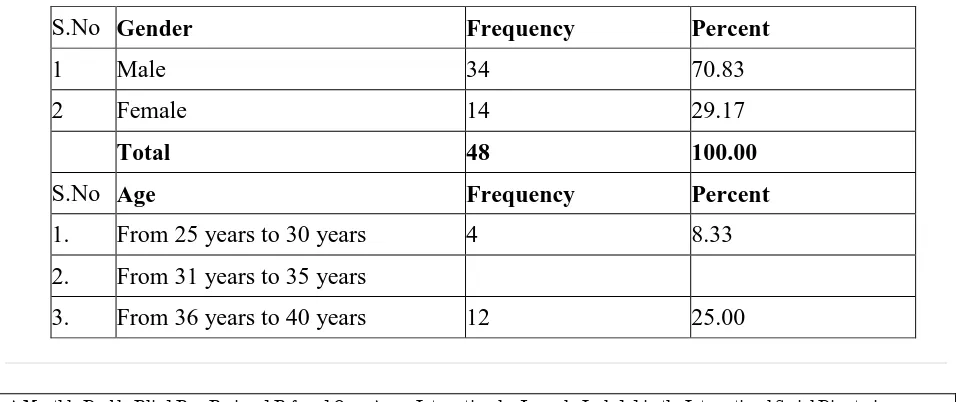
Table 5.1Demographic Profile of the librarians under study
S.No Gender Frequency Percent
1 Male 34 70.83
2 Female 14 29.17
Total 48 100.00
S.No Age Frequency Percent
1. From 25 years to 30 years 4 8.33
2. From 31 years to 35 years
4. From 41 years to 45 years 18 37.50
5. Above 45 years 10 20.83
Total 48 100.00
S.No Educational Qualification Frequency Percent
1. Doctorate 17 35.42
2. M.Phil 5 10.42
3. Post Graduate 17 35.42
4. Post Graduate Diploma 9 18.75
Total 48 100.00
S.No Experience Frequency Percent
1. From 0 years to 5 years 2 4.17
2. From 6 years to 10 years 4 8.33
3. From 11 years to 15 years 10 20.83
4. From 16 years to 20 years 19 39.58
5. Above 21 years 13 27.08
Total 48 100.00
S.No Subject area of the organization Frequency Percent
1. Engineering 17 35.42
2. Medicine 15 31.25
3. Science 6 12.50
4. Social Science & Economics 6 12.50
5. Agriculture 4 8.33
Total 48 100.00
Nature of Institution Frequency Percent
1. Private 24 50.00
2. State Govt 24 50.00
Total 48 100.00
between 36 and 40 years. In this analysis, 70.83 percent of the library professionals are male and remaining 29.17 percent of them are female. Domination of male over female is the general trend prevailing in all types of study is applicable in this study also. It is very impressive point to note that the maximum of 35.42 percent each of the library professionals (17) are Doctorates and also post graduates. While analyzing the experience of the library professionals, it is found from the table that the maximum of 39.58 per cent of them (19) are having the rich experience between 16 and 20 years. 13 librarians are having the experience of more than 21 years of service. It is also found that, among the 48 institutions, 24 are managed by the Government and remaining 24 are managed by the Private. Out of 48 R&D Institutions 17 are belongs to Engineering, 15 are medicine, 6 of the institutions are Science and social science and 4 from Agriculture.
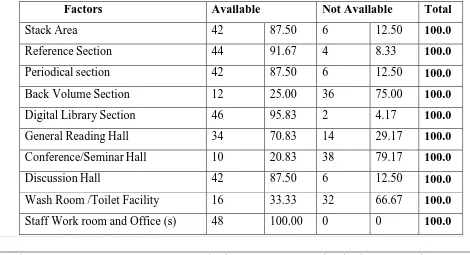
Table 5.2 Library basic facilities
Factors Available Not Available Total
Stack Area 42 87.50 6 12.50 100.0
Reference Section 44 91.67 4 8.33 100.0
Periodical section 42 87.50 6 12.50 100.0
Back Volume Section 12 25.00 36 75.00 100.0
Digital Library Section 46 95.83 2 4.17 100.0
General Reading Hall 34 70.83 14 29.17 100.0
Conference/Seminar Hall 10 20.83 38 79.17 100.0
Discussion Hall 42 87.50 6 12.50 100.0
Wash Room /Toilet Facility 16 33.33 32 66.67 100.0
Staff Work room and Office (s) 48 100.00 0 0 100.0
35%
31% 13%
13% 8%
Library sections are identified in this table. All the libraries are having staff room and office. 95.8 percent of the research libraries are having the digital library facilities. 91.6 percent of the libraries are having reference sections. 87.5 percent each of the libraries are having stack area, periodical section and discussion hall. 25 percent of the libraries are maintaining the back volume section.
Table 5.3 Other General facilities
Factors Available Not Available Total
Generator Facilities / UPS 46 95.8 2 4.2 100.0
Drinking Water 48 100.0 0 0 100.0
Telephone/Intercom /Fax 46 95.8 2 4.2 100.0
Reprography 46 95.8 2 4.2 100.0
Fire extinguisher 48 100.0 0 0 100.0
Suggestion Box 46 95.8 2 4.2 100.0
Others 47 97.9 1 2.1 100.0
It is observed from the table that the basic facilities such as drinking water (100%) Generator/UPS (95.8%), Telephone/Intercom/FAX (95.8%) are provided in the libraries of the surveyed research institutions. The safety measure of fire extinguishers is provided in all the libraries under survey,
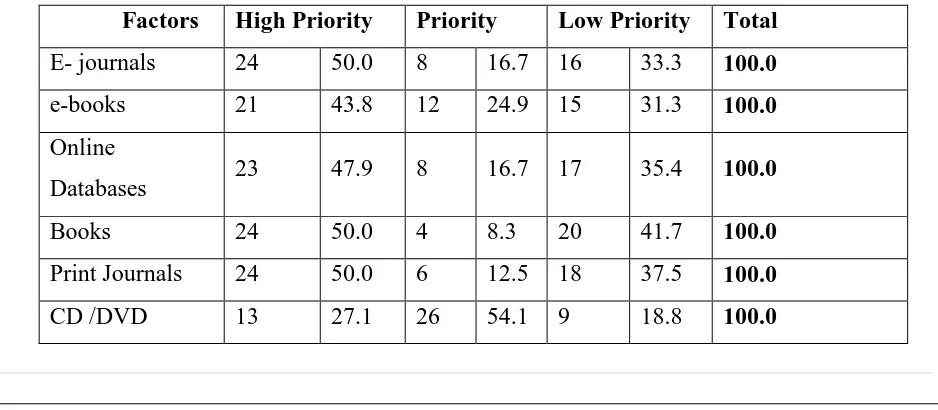
Table 5.4 Collection of library Resources
Factors High Priority Priority Low Priority Total
E- journals 24 50.0 8 16.7 16 33.3 100.0
e-books 21 43.8 12 24.9 15 31.3 100.0
Online
Databases 23 47.9 8 16.7 17 35.4 100.0
Books 24 50.0 4 8.3 20 41.7 100.0
Print Journals 24 50.0 6 12.5 18 37.5 100.0
Among the various library resources and its collection, high priority is being given to e-journals, printed books and print journals with 50 percent of its total collections. Priority is given to procure CDs/DVDs with 54.1 percent. Now a days, low priority is given to purchase books (41.7%) print journal (37.5%) etc. Even though the e-resources and online resources are mostly used by the researchers, the existence of printed books and journals are also used at the maximum level and it is inevitable.
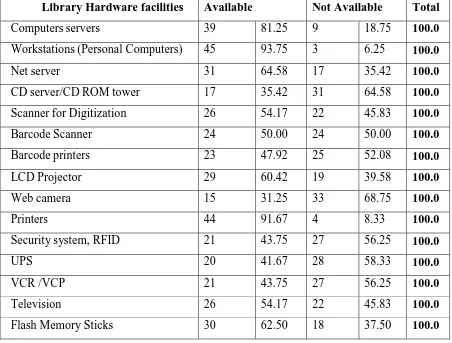
Table 5.5 Infrastructure in library - Hardware
Library Hardware facilities Available Not Available Total
Computers servers 39 81.25 9 18.75 100.0
Workstations (Personal Computers) 45 93.75 3 6.25 100.0
Net server 31 64.58 17 35.42 100.0
CD server/CD ROM tower 17 35.42 31 64.58 100.0
Scanner for Digitization 26 54.17 22 45.83 100.0
Barcode Scanner 24 50.00 24 50.00 100.0
Barcode printers 23 47.92 25 52.08 100.0
LCD Projector 29 60.42 19 39.58 100.0
Web camera 15 31.25 33 68.75 100.0
Printers 44 91.67 4 8.33 100.0
Security system, RFID 21 43.75 27 56.25 100.0
UPS 20 41.67 28 58.33 100.0
VCR /VCP 21 43.75 27 56.25 100.0
Television 26 54.17 22 45.83 100.0
Flash Memory Sticks 30 62.50 18 37.50 100.0
having CD Server/CD Scanner and 68.75 percent of institutions are not provided with web camera
Table 5.6 Status of library automation
Factors Frequency Percent
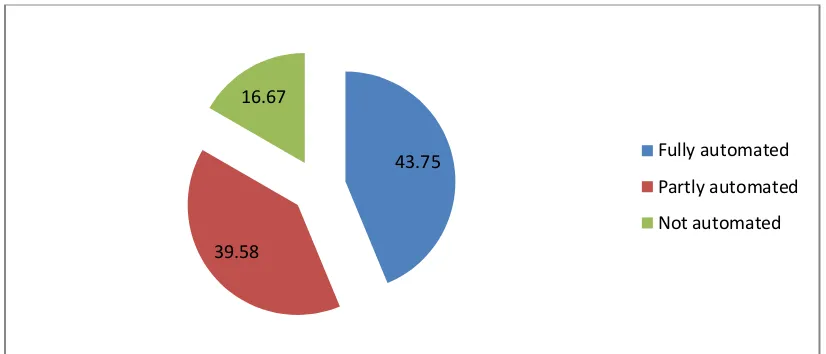
Fully automated 21 43.75
Partly automated 19 39.58
Not automated 8 16.67
Total 48 100.00
[image:8.612.71.484.327.504.2]It is found from the table that 43.75 percent of the libraries are fully automated and 39.58 percent of the Research libraries are partly automated and it is in progress. It is also found that eight libraries are not yet automated
Table 5.7 Category of Automation software
Factors Frequency Percent
Commercial software 31 64.58
In house develop software 17 35.42
Total 48 100.00
43.75
39.58 16.67
Fully automated
Partly automated
The above table explains about the nature of the library software being used by these libraries. It is found that 64.58 percent of the libraries are using commercial software and rest of the institutions is using in-house software prepared by them.
Table 5.8 Automation software used in library
Automation software Frequency Percent
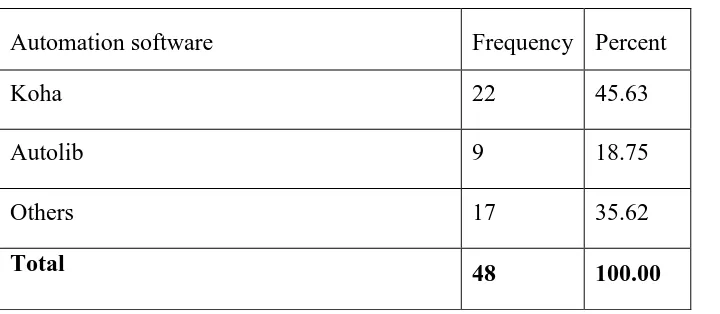
Koha 22 45.63
Autolib 9 18.75
Others 17 35.62
Total 48 100.00
[image:9.612.67.427.136.293.2]While enquiring about the software being used by the libraries, 45.63 percent of the libraries are using Koha software and 18.75 percent of them are using Autolib software. Remaining 17 libraries are using the different software prepared by them.
Table 5.9 Operating System used in library
Operating System Frequency Percent
Linux 29 60.42
Windows 19 39.58
Total
48 100.00
Table 5.10 Module used for Library Automation
Module used for library
automation
Yes No Total
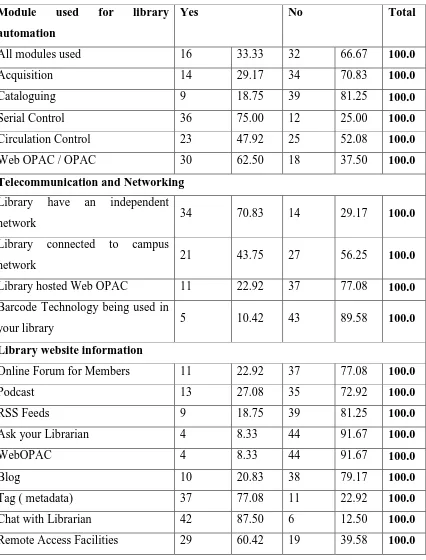
All modules used 16 33.33 32 66.67 100.0
Acquisition 14 29.17 34 70.83 100.0
Cataloguing 9 18.75 39 81.25 100.0
Serial Control 36 75.00 12 25.00 100.0
Circulation Control 23 47.92 25 52.08 100.0
Web OPAC / OPAC 30 62.50 18 37.50 100.0
Telecommunication and Networking
Library have an independent
network 34 70.83 14 29.17 100.0
Library connected to campus
network 21 43.75 27 56.25 100.0
Library hosted Web OPAC 11 22.92 37 77.08 100.0
Barcode Technology being used in
your library 5 10.42 43 89.58 100.0
Library website information
Online Forum for Members 11 22.92 37 77.08 100.0
Podcast 13 27.08 35 72.92 100.0
RSS Feeds 9 18.75 39 81.25 100.0
Ask your Librarian 4 8.33 44 91.67 100.0
WebOPAC 4 8.33 44 91.67 100.0
Blog 10 20.83 38 79.17 100.0
Tag ( metadata) 37 77.08 11 22.92 100.0
Chat with Librarian 42 87.50 6 12.50 100.0
Remote Access Facilities 29 60.42 19 39.58 100.0
module. It is also noted that 81.25 percent of the libraries are not maintaining the cataloguing system with the existing library software. 62.5 percent of the libraries are using OPAC/WebOPAC.
Table 5.11Library connected with other network resources
Description Yes No Total
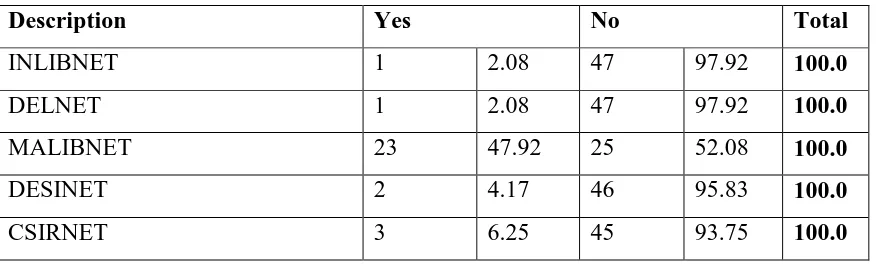
INLIBNET 1 2.08 47 97.92 100.0
DELNET 1 2.08 47 97.92 100.0
MALIBNET 23 47.92 25 52.08 100.0
DESINET 2 4.17 46 95.83 100.0
CSIRNET 3 6.25 45 93.75 100.0
It is observed from the table that 47.92 percent of the libraries 923) are connected with MALIBNET and 6.25 percent of the libraries (3) are using CSIRNET. Two libraries (4.17%) are using DESINET.
Table 5.12 Library Consortium
Description Yes No Total
UGC INFONET 12 25.00 36 75.00 100.0
CSIR –DST Consortium 7 14.58 41 85.42 100.0
Library Consortium of ISRO 11 22.92 37 77.08 100.0
ISI Library Consortium 5 10.42 43 89.58 100.0
IIM Library Consortium 6 12.50 42 87.50 100.0
FORSA (Forum for Resource
Sharing in Astronomy) 7 14.58 41 85.42 100.0
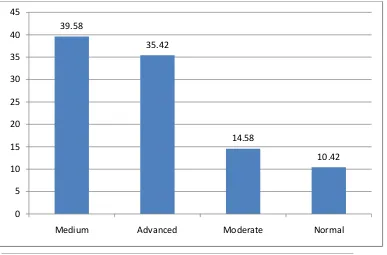
[image:11.612.68.505.388.563.2]Table 5.13 Current ICT status or level of the Library / Information centre
Description Frequency Percent
Advanced 17 35.42
Moderate 7 14.58
Medium 19 39.58
Normal 5 10.42
Total 48 100.00
Level of usage of ICT facilities are enquired from the librarians about the users of the libraries. It is obtained that 39.5 percent of them are using these facilities in medium level and 35.42 percent of them are using these facilities in advanced level.
Findings &Conclusion
It is clear from the finding of the current study that the emerging trends of the research and development libraries of Tamilnadu, India appreciate the services provided by the library but at
39.58
35.42
14.58
10.42
0 5 10 15 20 25 30 35 40 45
the same time expect more. It is very impressive point to note that the maximum of 35.42 percent each of the library professionals (17) are Doctorates and also post graduates. While analyzing the experience of the library professionals, it is found from the table that the maximum of 39.58 per cent of them (19) are having the rich experience between 16 and 20 years. 13 librarians are having the experience of more than 21 years of service. It is also found that, among the 48 institutions, 24 are managed by the Government and remaining 24 are managed by the Private. Out of 48 R&D Institutions 17 are belongs to Engineering, 15 are medicine, 6 of the institutions are Science and social science and 4 from Agriculture. . It is found that 64.58 percent of the libraries are using commercial software and rest of the institutions is using in-house software prepared by them. It is found from the table that 43.75 percent of the libraries are fully automated and 39.58 percent of the Research libraries are partly automated and it is in progress. Level of usage of ICT facilities are enquired from the librarians about the users of the libraries. It is obtained that 39.5 percent of them are using these facilities in medium level and 35.42 percent of them are using these facilities in advanced level. The study pointed out that greater part of the researchers working in these institutions has shown positive preference toward application of ICT.
References
1. Murugesan, N. and Balasubramani, R (2011).Application of ICT Based Resources and Services in Research and Development Libraries in Tamilnadu: An Analytical Study, European Journal of Social Sciences,23(1),2011, 157-164.
2. Olaifa Taye Paul1, Oyeniyi J. Oluwakemi Research Library Development in Nigeria: The Role of Information Communication and Technology (ICT).International Journal of science and Research (IJSR) 256-259
3. Kumar,K Knowledge on ICT Skills among LIS Professionals of Engineering Institutions of Andhra Pradesh State: A Survey. DESIDOC Journal of Library & Information Technology, 33(6) 2013, 480-487.
5. Shahnaz Khademizadeh Use of Information and Communication Technology (ICT) in
Collection Development in Scientific and Research Institute Libraries in Iran: A study International Journal of Advancements in Research & Technology, 1(3), 2012, 1-12