Citation:
Daly-Smith, A and Quarmby, T and Archbold, V and Routen, A and Morris, J and Gammon, C and Bartholomew, J and Resaland, GK and Llewellyn, B and Allman, R and Dorling, H (2019) Implementing physically active learning: future directions for research, policy and practice. Journal of Sport and Health Science. ISSN 2095-2546 DOI: https://doi.org/10.1016/j.jshs.2019.05.007 Link to Leeds Beckett Repository record:
http://eprints.leedsbeckett.ac.uk/5926/
Document Version: Article
Creative Commons: Attribution-Noncommercial-No Derivative Works 4.0
The aim of the Leeds Beckett Repository is to provide open access to our research, as required by funder policies and permitted by publishers and copyright law.
The Leeds Beckett repository holds a wide range of publications, each of which has been checked for copyright and the relevant embargo period has been applied by the Research Services team.
We operate on a standard take-down policy. If you are the author or publisher of an output and you would like it removed from the repository, please contact us and we will investigate on a case-by-case basis.
Title: Implementing physically active learning: future
directions for research, policy and practice.
Running title: Implementing PAL: research, policy and practice
Andy Daly-Smitha, Thomas Quarmbya, Victoria S.J. Archbolda, Ash C. Routenb, Jade L. Morrisa, Catherine Gammonc,d, John B. Bartholomewe, Geir Kåre Resalandf, Bryn Llewellyng, Richard Allmana, Henry Dorlingh
a School of Sport, Leeds Beckett University, Leeds, United Kingdom.
b School of Sport, Exercise and Health Sciences, Loughborough University, United Kingdom. c Eastern Michigan University, Ypsilanti, Michigan, United States of America.
d Centre for Diet and Activity Research, MRC Epidemiology Unit, University of Cambridge, Cambridge, United Kingdom.
e Department of Kinesiology and Health Education, The University of Texas at Austin, Austin, Texas, United States of America.
f Center for Physically Active Learning, Faculty of Education, Arts and Sports. Western Norway University of Applied Sciences, Sogndal, Norway.
g Tagtiv8 Ltd and Co-Director of Move & Learn, Leeds, United Kingdom.
h School of Sport, Health and Social Science, Solent University, Southampton, United Kingdom
Corresponding author
Dr Andy Daly-Smith; [email protected]
Leeds Beckett University, School of Sport, 112A Fairfax Hall, Headingley Campus, Leeds, LS17 7TL, United Kingdom.
E-mail addresses
Dr Thomas Quarmby: [email protected] Dr Victoria Archbold: [email protected] Dr Ash Routen: [email protected]
Jade Morris: [email protected] Dr Catherine Gammon: [email protected] Professor John Bartholomew: [email protected] Professor Geir Kåre Resaland: [email protected]
Bryn Llewellyn: [email protected]
Richard Allman: [email protected] Henry Dorling: [email protected]
1
Abstract
Objective. Identify co-produced multi-stakeholder perspectives important for successful
widespread physically active learning (PAL) adoption and implementation.
Method. Thirty-five stakeholders (policy-makers, n=9; commercial education sector, n=8;
teachers, n=3; researchers, n=15) attended a design-thinking PAL workshop. Participants
formed five multi-disciplinary groups with at least one representative from the different
stakeholder groups. Each group, facilitated by a researcher, undertook two tasks (i) using
post-it notes: within the school day, what are the opportunities for learning combined with
movement? (ii) washing line task: how can we establish PAL as the norm? All discussions
were audio recorded and transcribed. Inductive analyses were conducted by four
authors. Once complete, main and sub themes were assigned to four predetermined
categories; (i) PAL implementation, and priorities for (ii) practice, (iii) policy and (iv)
research.
Results. PAL implementation main themes: opportunities for PAL within the school day,
delivery environments, learning approaches, intensity of PAL. Priorities for practice main
themes: teachers confidence and competence, resources to support delivery, community
of practice. Policy priorities main themes: self-governance, The Office for Standards in
Education, Children's Services and Skill (Ofsted), policy investment in initial teacher
training and curriculum reform. Research priorities main themes: establishing a strong
evidence base, school-based PAL implementation, whole-systems-approach.
Conclusion. The study is the first to identify PAL implementation factors using a
combined multi-stakeholder perspective. To achieve wider PAL adoption and
2
implementation factors at the classroom- (e.g approaches and delivery environments),
3
1.0 Introduction
The majority of youth do not accumulate the recommended 60 minutes of daily physical
activity (PA).1,2 With increasingly sedentary pursuits dominating leisure-time,3 the World
Health Organisation4 has identified the essential role that schools play in creating a more
active society. Concurrently, schools present the only setting where all youth, irrespective
of social background, can be engaged for an extended period of time.5
Unfortunately, a school day largely consists of seated lessons. In response, physically
active learning (PAL), the integration of PA into lessons in learning areas other than
physical education,6 has grown in prominence to reduce time spent sedentary and
“expand” PA into normal curriculum lessons.7 Systematic reviews and meta-analyses
suggest there are beneficial effects of acute8 and chronic6,9–11 PAL interventions on PA,
health, cognition and academic performance. Moreover, unlike other segment specific
school-based PA interventions,12 a recent large-scale randomised controlled trial (RCT)
has established that PAL can benefit all demographic subgroups.13
As such, the use of PAL has expanded internationally to increase PA across the school
day, and is often employed as a part of a whole-school approach.14 One of the earliest
examples was Action Schools! BC, which began with a case study, expanded to a large
RCT, and was later distributed throughout the province of British Columbia.15 A similar
4
whose ASK program17,18 has lead to the establishment of a Center for PAL to support
schools and teachers with competence, resources and equipment.
Despite these initiatives, the broader uptake of PAL is disappointing. Even in RCTs, more
than a third of teachers fail to implement 15 minutes of PAL/day.19 This occurs despite
the fact that teachers recognise the benefits and degree to which students enjoy PAL.20–
22 Barriers to implementing PAL include concern for class disruption, lack of time to
prepare and implement, lack of knowledge and training, resistance from parents, and a
shortage of appropriate space for delivery.21,23–26 These barriers are consistent with
previous curricular changes attempted in schools, such as, increased problem solving for
mathematics27 and the inclusion of special education students in mainstream
classrooms.28 Both initiatives have required substantial modification of teaching
approaches, new teacher training, and increased investment. Yet, they have been fully
embraced in countries across the world. This successful uptake of educational innovation
raises the question as to how a similar change in the implementation of PAL can be
achieved.
Previous research has used the socio-ecological framework29 to establish factors that
influence PAL implementation at each layer of the school environment.25,26 Yet, the
outcomes are generated from teachers only,21,24–26 which may present a limited
understanding of factors beyond their classroom. To provide insights into the broader
contexts needed to create the most effective PAL interventions, there is a need to capture
5
researchers who are in a position to support PAL efforts.14,30,31 Further to this, rather than
capturing the understanding of each stakeholder group in isolation, for a whole-systems
perspective,30,32 these insights should be produced collaboratively. Therefore, the aim of
this study was to identify multi-stakeholder perspectives deemed important for successful
widespread PAL implementation and adoption.
2.0 Method
2.1 Participants
Participants were invited to a PAL symposium and workshop at the lead author’s
institution in October 2017. The event was advertised through a regional PA network, on
social media platforms and through word of mouth. Attendees were notified prior to the
event, and again on the day of the event, that the workshop would be recorded and used
for data collection. Participants were informed that participating in the research was
optional. In total 35 participants consented. Prior to commencement of the study, ethical
clearance was provided by the Leeds Beckett University Ethics Committee (No 38830).
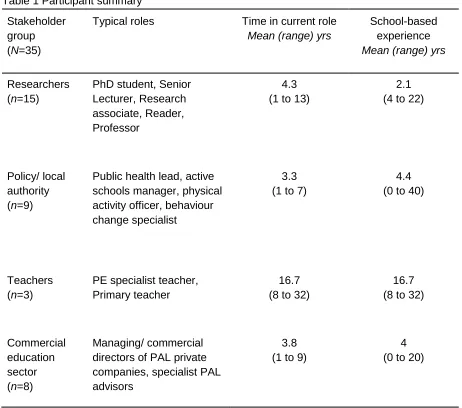
The participant sample included researchers, policy-makers, teachers and the
commercial PAL sector (Table 1). In total eight participants were qualified teachers with
6
aligned to education (n=8, total=139 years school-based teaching experience). A further
nineteen participants actively supported schools with their PA, physical education and
school sport provision.
ADD TABLE 1 HERE
2.2 Methods
Following the symposium, participants took part in a workshop that explored key and
emerging questions around national-level implementation and adoption of PAL lessons
within the UK. The workshop was informed by a design thinking approach, a method that
provides a solution-based approach to solving problems.33 Rather than being problem
focused, it is an action oriented approach toward creating a desired future.33 Comprising
of five phases, this study drew primarily from the ideation phase of design thinking, placing
a strong emphasis on brainstorming.
Within the workshop, participants were arranged into five heterogenous and
multi-disciplinary groups (e.g., Group 1 (G1), Group 2 (G2)….), each with a minimum of one
representative from the different stakeholder groups. Each group, facilitated by a
researcher, was asked to introduce themselves and their background before being invited
7
Task one, post-it notes: “within the school day, what are the opportunities for learning
combined with movement?”.
Participants were provided with post-it notes in order to identify opportunities for learning
combined with movement within the school day. Participants were encouraged to share
and discuss these amongst the group. During brainstorming no idea was dismissed as
being too far-fetched or rejected, a central feature of a design thinking approach.33 Once
complete, subsequent discussions were recorded in an informal focus group setting.
Resulting post-it notes were presented for viewing by other groups during a period of
sharing and reflection. Following this viewing, participants reconvened with their group
and were (i) able to add further ideas to their original list and (ii) were asked to denote the
PA intensity and school context of the identified activity opportunities.
Task two, washing line task: “how can we establish physically active learning as the
norm?”
Following task one, participants wrote key objectives for policy-makers (red pen),
researchers (black pen) and practitioners (green pen) on postcards. Each card was hung
on the lowest of three horizontal string lines. Once complete, groups ranked the objectives
from highest priority (top line) to lowest priority (bottom line). To encourage critical
discussion, a maximum of one-third of the responses were allowed on the top line. Once
complete, groups were encouraged to view the lines of other groups. On returning to their
re-8
prioritise if appropriate. Finally, groups ranked their top line - highest priority - objectives.
All of the discussions during these activities were recorded on dictaphones.
2.3 Data analysis
Group discussions were transcribed verbatim and analysed inductively.34 Four authors
(AD-S, TQ, VSJA, JLM) read the transcripts and coded the data via a process of open
coding.35 Following this, authors met to discuss their independent analysis and emerging
patterns. This process involved the data being coded into main themes and sub-themes,
with each author describing their justification.35 Discussions between authors resulted in
a consensus regarding theme selection. These patterns were identified in primarily an
inductive (‘bottom up’) approach, which ensured emergent themes were strongly linked
to the data themselves without trying to fit them into a pre-existing coding frame. As part
of this process, negative cases were sought to expand, adapt or restrict the emerging
themes,35 though none were identified. Once complete, the emergent themes were
assigned to four predetermined categories; (i) PAL implementation, (ii) priorities for
practice, (iii) priorities for policy and (iv) priorities for research. These categories were
chosen by the requirements of a whole-system approach to co-designing an active
lifestyles intervention.30 The main themes are highlighted within each category and then
9
3.0 Results and Discussion
3.1 PAL design and implementation
Four sub-themes emerged: (i) PAL opportunities, (ii) delivery environment, (iii) learning
approaches and (iv) intensity of PAL (Appendix A, Table 1).
(i) PAL opportunities
“Is the outcome of active learning to use learning or education to get people more
active or is it to help people to learn whilst being active? Which way round is it, or is it both?” (G1)
Participants suggested multiple opportunities for PAL delivery, including outside the
classroom. Opportunities beyond the classroom were framed around questioning if PAL
is a means of integrating PA into the school day, or a tool to enhance learning through
PA. It could be argued that this is a false dichotomy - PAL provides the means to achieve
a dose of PA sufficient to improve health,17,19 while also improving the approach to
learning.36 Further discussion identified when opportunities might occur within the school
day. This reflects the flexibility inherent in PAL. Implementation could focus on curriculum
10
consensus that delivery could occur throughout the school day, and that a chronological
structure is useful for framing delivery opportunities, especially to those new to PAL.
Delivery opportunities identified across the school day included classroom lesson time,
break/recess and lunch time, homework, before/after school clubs, school trips, sports
days, celebration days, and school challenges.
(i) Delivery environment
“so changing the word ‘classroom’ but without necessarily changing the classroom.
So, yeah, just moving in different environments of the school, taking our association of what the classroom is.” (G2)
For PAL delivery within the classroom, discussions focussed on tensions between the
desire to achieve higher PA intensity and to increase learning. To enhance PA and
overcome typical classroom barriers,25 suggestions included making small adaptations to
the classroom such as “chucking the chairs away”(G3) or introducing “exercise balls”(G1).
Group One were keen to stress such changes “immediately changed the way the children
learnt.” While the above approaches likely reduce time spent sedentary and enhance light
PA,8 in agreement with previous research, it was suggested more intense activity could
be achieved if PAL was implemented outside the classroom.37
Embracing non-traditional learning spaces was a novel insight: “We’ve got specialist
11
whole thing of not hanging round corridors, it doesn’t exist in this school.” (G2). While
challenging the typical use of corridors, these were still seen as confined spaces. Greater
potential was seen in the entire school being used as a learning space to include halls,
playgrounds and green space.
(iii) Learning approaches
Suggested classroom-based approaches mirrored previous research;9 summarised as
drill and practice of (new) factual information, answering questions using physical
responses and active quizzes.36 While lacking research evidence, the group also
discussed other approaches, including learning circuits:
“So I did a history lesson with primary school kids….…there was one table where I
buried artefacts in sand, then they had to solve an Egyptian puzzle with
hieroglyphics. It was such a nice lesson, even though it was quite labour intensive to set up, it ran itself perfectly. And every time the music started they’d move on, so
if we could have more lessons like that.” (G2)
The approach to PAL appears to vary with the setting. For example, participants
suggested that environments beyond the classroom provide a greater opportunity for
12
(G2), “matching games in the hall” (G2) and “computing skills games through moving”
(G3). In addition, green space was highlighted as an approach to achieve learning
objectives: “go outside and measure lengths of grass.” (G2). In this case, PA was seen
as a byproduct of the outdoor lesson rather than a key outcome for the lesson. Thus, the
matching of the approach to the environment was central to the expected dose of PA,
defined by duration and intensity.
(iv) Intensity of PAL
Stakeholders discussed the intended outcome of PAL as a factor that influences the
intensity of delivery: “Sometimes you only have it as a light activity, sometimes you may
want to have it as a vigorous activity” (G5). There was a recognition that the intensity
required to deliver health benefits is important. However this was tempered by an
appreciation that it may not be feasible for schools to focus on meeting intensity targets
when starting to implement PAL, e.g., “ to try to contribute to sixty minutes of MVPA” (G1).
Moreover, the intended intensity level may be dependent upon the desired learning
outcome: “the classroom constraint is it’s not a physical environment and if most activities
are moderate to vigorously active you're not going to be able to learn” (G3). These
aforementioned issues related to the intensity of PAL is a particularly novel finding that
13
Finally, one participant stated that the intensity of delivered PAL may be dependent upon
the school culture towards PA, and the “capability and the confidence of the teachers”
(G5) to deliver varying levels of intensity.
3.2 Priorities for practice
This second category discusses the main emergent themes for practice and practitioners,
and explicitly explores challenges associated with (i) teachers confidence and
competence, (ii) resources to support delivery and (iii) a community of practice (Appendix
A, Table 2).
(i) Teacher confidence and competence
Despite an awareness of the potential positive experiences that PAL can facilitate for
pupils,38 in agreement with previous studies, there was recognition among participants
that a lack of awareness and knowledge about how to effectively introduce PA into
classroom learning was a potential barrier and area for future consideration.20,23,25,26 This
appeared to centre around a lack of competence due to minimal training or continuing
professional development:
“Teachers could have all the knowledge in the world about the benefits of physical
activity but if they don’t know how to implement it then there's just no point having
14
Alongside a lack of awareness about how PAL might be implemented, where and when
to use it, and how it might be sustained throughout a period of time, participants also
identified a lack of teacher confidence as a central barrier to implementation, e.g.,:
“knowledge, passion, skill base, confidence, the main thing is confidence isn’t in?” (G2).
This lack of confidence was central and, in agreement with previous research, stemmed
from worries around classroom management.23,25 For teachers and teaching assistants
to employ more PAL methods it seemed imperative that they feel confident with a more
‘chaotic’ classroom and with being less ‘in control’ of the pupils.23,25
These findings are reflective of the broader literature which suggests that the integration
of PA into classroom lessons could pose problems for teachers who lack confidence.25,39
Similarly, self-efficacy is suggested as a key barrier to integrating activity into classroom
contexts.40,41 In addition, results point to reasons why the ‘table-centric’ concept
consistently prevails in classrooms, with an inhibition and fear to deliver PAL methods
leading to a lack of creativity and innovation in teacher practice.2540
(ii) Resources
In line with developing teachers confidence and competence, participants recognised the
availability of resources as a potential barrier, highlighting the need to support
15
“It’s a little bit of understanding but for me where that falls down is we don’t
necessarily have the resources for teachers to be able to implement that in lessons. So, we’ll give all this information, but then it’s up to the teacher to go on
and write the lesson plans and maybe that’s something…” (G1)
“I suppose for practitioners it could be incorporation with schemes of work. So
every scheme of work or schemes of work has to have an active learning component in a scheme of work” (G4)
Hence, in order to support teachers confidence and competence and provide them with
the knowledge of how to incorporate PA into their lessons, resources and ready-made
schemes of work could be made available. Providing resources to support the facilitation
of PA may also reduce the time required for preparation, which may act as an additional
barrier for practitioners.21,25,26
(iii) A community of practice
Finally, participants spoke about the need for practitioners to engage in a community of
practice (CoP).42 They identified the need for teachers to share their passion and
enthusiasm for PAL with colleagues in a supportive environment, and one in which they
16
“A sharing of best practice yeah, I think that’s something that’s always, you know
leaders, lead practitioners, leaders or active learning within an authority. Lead
schools? Active learning lead school? Like we have active learning, like we have sport colleges, so we’re an active lead. Oh and also practitioners, an active
leader… a champion active teacher, champion” (G4)
These findings, while PAL specific, reflect the use of CoP within the broader whole-school
physical activity literature. 43–45 Similar to whole-school PA implementation participants
recognised the need for an in-school “PAL champion”, at the micro-level, to actively lead
PAL provision.26,46 At the macro level, connecting to the wider PAL community was
deemed important. However, widening the CoP beyond trusted networks has previously
proved challenging due to a lack of trust and familiarity. One solution is the use of private,
tailored virtual networks.45 Yet, at present, there is a limited understanding about the
essential characteristics required to create successful virtual PAL multi-stakeholder
networks.
3.3 Priorities for policy
This third category explores key emergent themes of (i) self governance: the role of senior
management teams, (ii) Ofsted (The Office for Standards in Education, Children's
Services and Skill; UK Schools Inspectorate): their power in governance, accountability
& competence, and (iii) need for policy investment in initial teacher training (ITT) and
17
(i) Self governance: the role of senior management teams
”With the head teacher on board it helps massively. It really does yeah…
outstanding schools have an active policy within their curriculum. So they have active aspects of what they're actually doing, which is huge.” (G5)
The UK National Activity Plan47 came into effect in 2011, offering educational authorities
the opportunity to integrate PAL within schools. Coupled with the Primary PE and Sports
Premium Scheme allocation of £320 million per year (approximately £16,000 to £20,000
per school)48 this provides a prime opportunity for UK schools to adopt PAL. However, as
previously identified, embracing PAL across the core curriculum and creating policy
reforms is a significant challenge.26
Encouragingly, the Department for Education48 (DfE) have now recognised PAL (under
the caveat of ‘active teaching’) within the Sports Premium guidance. However, in
agreement with previous literature, delegates stressed the extent to which successful PAL
can, or does occur, is still subject to the “systems, support, permission or even obligation”
(G4) by the senior management team - ultimately the head teacher.20,26,49 While the
Teacher Standards Framework (standard 2, 4 & 5) emphasises the need for schools to
self-govern their approach,50 a schools focus is often determined by the policy direction
18
(ii) Ofsted– their power in governance, accountability & competence
“Certainly the academic performance is the driver, and Ofsted are increasingly
looking at health and well-being. So if you can have an additional offer in your school it can give you… well it won’t be measured officially, it’s one of those
additional things that they…The impact measured might be improved academic
grading, but it will also increase activity levels as well.” (G1)
The current UK-based Ofsted Assessment Framework51 and inspectorate provides
judgements on overall effectiveness of leadership and management, quality of teaching,
learning and assessment, personal development, behaviour and welfare, and outcomes
for pupils.51 In agreement with previous literature,26 most discussions supporting this
theme emphasised that if PAL did “not directly support academic results then it was
questionable whether it would be likely to be supported by the educational setting” (G4).
A need for PAL to be compatible with Ofsted criteria was considered and discussed
extensively within the workshop. Concurrently, delegates also highlighted their concerns
with the lack of training inspectorates currently hold when assessing PE or PAL as
highlighted below:
“The inspectorate aren’t probably the people that would be, shouldn’t be looking at
PA.... part of my role was tracking Ofsted reports over the last couple of years with regard to Ofsted comments around P.E. and Sport Premium and PA and sport….
19
Moreover, delegates stressed a need for top down curriculum reform by the DfE: “The
government… where it all comes from ultimately… where the DfE will say ‘right..like you
have to…’, it has to be a national (strategy)” (G2). Additionaly, solution focussed
discussions around current DfE enforcements were also suggested “get rid of SAT(s)...So
policy, remove what’s the barrier, which then has a knock on effect” (G5). Finally, on top
of the recognition of Ofsted being essential in PAL implementation, the requirement for
PAL to be embedded in ITT programmes was emphasised.
(iii) Need for policy investment in ITT and curriculum reform.
“Students who are going into teacher training, they're getting a minimal amount of
P.E. training. They get two hours out of the full… that sort of needs to be changed
so they can have a better understanding” (G1)
Investment in more hours for PAL within ITT was seen as a policy that could positively
impact PAL implementation. Integration of PAL within ITT has previously shown promise
in increasing teachers confidence and creating more in-service PAL opportunities.31
However, as there continues to be limited ‘accountability’ of policy benchmarks, it is
questionable how sustainable this may be after ITT.
In conclusion, a re-think of the Ofsted inspectorate ‘accountability” framework is needed.
20
school management teams and teachers to adopt PAL within school strategies,20 with
self-governance at the school-level. The School Sports Premium funding also offers
schools an opportunity to move beyond the historic ‘sports’ discourse and effectively
implement PAL across the whole-school system.
3.4 Key research priorities
The final category explores two main research themes (i) establishing a strong evidence
base of PAL benefits, and (ii) exploring how PAL can be implemented in schools. In
addition, the overarching theme of a whole-systems approach by researchers,
policy-makers and practitioners to support the implementation and sustainability of PAL within
schools has been discussed (Appendix A, Table 4).
(i) Need for a strong evidence base
“if you haven't got the evidence to demonstrate that it’s going to work then are you
21
Discussions indicated that practitioners and policy-makers wanted evidence on the
effectiveness and sustainability of PAL, particularly for outcomes of relevance to them,
e.g., academic achievement. Several studies have reported positive effects of PAL
including improved PA, learning outcomes, on-task behaviour, enjoyment during lessons,
and reductions in student BMI.6,8,9,10,52 Consistent with workshop discussions, previous
research identifies a need for more high-quality studies (to strengthen the evidence base),
longer term follow-up measures (to understand sustainability), and more studies
conducted in real-world settings to understand the external validity of PAL benefits
observed in controlled settings.53
Workshop attendees identified that measures of program effectiveness relevant to
policy-makers and practitioners (e.g., academic achievement and mental health) may facilitate
greater buy-in and adoption.54,55 Analysis of differential effects of PAL interventions may
also provide evidence for the value of PAL, particularly if found to benefit demographic
groups commonly identified as priority targets for public health or educational
interventions, e.g., low socio-economic status groups or overweight children.13 Further, it
was identified that more effective dissemination strategies may be required to draw the
attention of policy-makers and practitioners to the current evidence base on PAL
effectiveness.56
22
“Teachers could have all the knowledge in the world about the benefits of physical
activity… if they don’t know how to implement it then there's just no point” (G5)
Workshop discussions indicated a need for evidence on how teachers and schools can
effectively implement PAL. Research on PAL implementation is in its infancy.55 The few
studies exploring implementation of PAL strategies have identified predictors (e.g.,
teacher’s perceived competence) and challenges (e.g., standardised testing pressures)
and suggest that intervention among pre-service teachers could increase the
implementation of PAL.57,58 Initial findings on predictors and barriers provide valuable
guidance for the design/delivery of PAL interventions, but more evidence on effective
implementation is needed, particularly given the wide range of PAL strategies and
variation in school environments. For greater insights, future studies should progress
beyond retrospective process evaluations and collect context-specific information on
implementation throughout the PAL programme.55
Workshop attendees expressed the need for specific guidance on how to implement PAL
within the classroom. More research on implementation and outcomes is needed before
evidence-based recommendations on the type, time, intensity and frequency of PAL
strategies for preschool, elementary/primary and high/secondary schools can be
recommended.58 The widely varying physical and social environments of schools means
23
evaluations capturing context-specific tailoring of PAL will be particularly helpful for
identifying effective strategies for integrating movement into the classroom.
In summary, evidence suggests benefits and/or no harm of PAL on children’s PA,
learning, attention and enjoyment during class, and weight status.6,8–10 More evidence is
needed on the benefits and sustainability of different types of PAL (e.g., active lessons
vs. movement breaks) across different school settings (e.g., preschools,
primary/elementary, high/secondary). PAL implementation research is emerging and has
the potential to elucidate differences in outcomes across settings and support the
effective introduction and maintenance of PAL. High-quality studies in real-world settings
are needed, and rigorous process evaluations that begin at initial implementation and
capture context-specific tailoring will be particularly helpful for informing the direction,
design and delivery of PAL interventions.
4.0 Summary
This is the first study to examine multi-stakeholder perspectives on a broad range of
challenges and opportunities regarding the design and implementation of PAL in schools.
The unique results move beyond teacher views that dominate the current literature,25,26
providing a co-produced perspective from policy-makers, teachers, the commercial
24
the classroom setting and raise the importance of school- and national-level contextual
factors e.g., the need for funding and national policies. While it is challenging to establish,
and then maintain, multi-stakeholder partnerships, the unique insights from each
stakeholder group are essential to the initial design and sustained implementation of PAL
interventions. To increase success, programs must address challenges at all levels of the
socio-ecological framework - class, school and national policy. 29
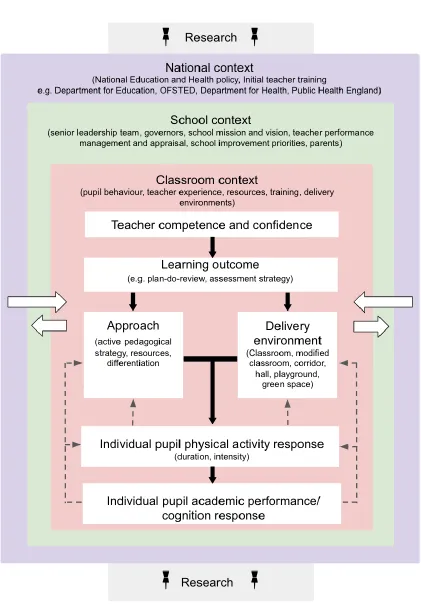
INSERT FIGURE 1
To enhance the translational impact of the current findings, we present a future directions
model that summarises the study outcomes in combination with the extant literature
(Figure 1). The model is underpinned by a socio-ecological framework; presenting key
implementation drivers within the context of the classroom, school and national policy. In
the classroom context, a teacher’s competence and confidence influences their
willingness to implement varied PAL approaches across different school environments.
Combined, the PAL approach and delivery environment influence the PA and learning
outcomes, which in turn determine the mode and level of implementation. A reflection on
these outcomes should inform future PAL delivery. In the school context, implementation
is influenced by the senior leadership team, governors, school mission and vision, teacher
performance management and appraisal, school improvement priorities and parents.25 In
the national context, national education and health policies and ITT are essential in
determining implementation. Arrows are included within the model to demonstrate the
25
for sustainable and effective systems change.32 Finally, the model is underpinned by
research, highlighting the importance of evidence-informed decision making.
This research supports, and expands upon, the current knowledge base on PAL adoption
and implementation, both within and beyond the classroom. The main strength of the
study is the engagement of policy-makers, the commercial education sector, researchers
and teachers in co-producing outcomes. While these are UK centric, they may be used
to influence PAL implementation in culturally similar countries. To deepen understanding
and address limitations of the current study, future work should (i) include head teachers,
governors, parents and pupils, (ii) capture the number of years of PAL expertise of the
participants and (iii) increase the number of practising teachers within the sample. In
conclusion the original findings, summarised in Figure 1, will inform future PAL
intervention design through (i) establishing the importance of cooperation and
communication between different PAL stakeholder groups, (ii) highlighting challenges
and opportunities for PAL implementation within the classroom, school and national
contexts and (iii) providing a model that can inform future research, policy and practice in
27
Acknowledgements
We would like to thank the following individuals for their assistance with the data
collection: Dr Peter Collins, Dr Jackie Hargreaves and Dr Danielle Powell. The research
symposium and workshop were supported by an internal research grant from the School
of Sport, Leeds Beckett University.
Author’s Contributions
ADS and TQ were the study coordinators and conducted the data collection. ADS, TQ,
VA and JM led the analysis of the transcripts, all authors checked the emerging main and
sub-themes. All authors contributed to writing at least one section of the manuscript. All
authors revised and edited the manuscript. All authors have read and approved the final
version of the manuscript, and agree with the order of presentation of the authors.
Competing Interests
28
References
1. Cooper A, Goodman A, Page A, Sherar L, Esliger D, van Sluijs E, et al. Objectively measured physical activity and sedentary time in youth: the International children’s accelerometry database (ICAD). Int J Behav Nutr Phys Act 2015;12:113.
2. Tremblay MS, Barnes JD, González SA, Katzmarzyk PT, Onywera VO, Reilly JJ, et al. Global Matrix 2.0: Report Card Grades on the Physical Activity of Children and Youth Comparing 38 Countries. J Phys Act Health 2016;13:S343–66.
3. Arundell L, Fletcher E, Salmon J, Veitch J, Hinkley T. A systematic review of the prevalence of sedentary behavior during the after-school period among children aged 5-18 years. Int J Behav Nutr Phys Act 2016;13:93.
4. World Health Organisation. Global action plan on physical activity 2018–2030: more active people for a healthier world [Internet]. Geneva: World Health Organisation, 2018. Available from: http://apps.who.int/iris/bitstream/handle/10665/272722/9789241514187-eng.pdf 5. Naylor P-J, Nettlefold L, Race D, Hoy C, Ashe MC, Wharf Higgins J, et al. Implementation
of school based physical activity interventions: a systematic review. Prev Med 2015;72:95– 115.
6. Watson A, Timperio A, Brown H, Best K, Hesketh KD. Effect of classroom-based physical activity interventions on academic and physical activity outcomes: a systematic review and meta-analysis. Int J Behav Nutr Phys Act 2017;14:114.
7. Beets M, Okely A, Weaver R, Webster C, Lubans D, Brusseau T, et al. The theory of
expanded, extended, and enhanced opportunities for youth physical activity promotion. Int J Behav Nutr Phys Act 2016;13:120.
8. Daly-Smith AJ, Zwolinsky S, McKenna J, Tomporowski PD, Defeyter MA, Manley A. Systematic review of acute physically active learning and classroom movement breaks on children’s physical activity, cognition, academic performance and classroom behaviour: understanding critical design features. BMJ Open Sport Exerc Med 2018;4:e000341. 9. Martin R, Murtagh EM. Effect of Active Lessons on Physical Activity, Academic, and Health
Outcomes: A Systematic Review. Res Q Exerc Sport 2017;88:149–68.
10. Norris E, Shelton N, Dunsmuir S, Duke-Williams O, Stamatakis E. Physically active lessons as physical activity and educational interventions: a systematic review of methods and results. Prev Med 2015;72:116–25.
11. Singh AS, Saliasi E, van den Berg V, Uijtdewilligen L, de Groot RHM, Jolles J, et al. Effects of physical activity interventions on cognitive and academic performance in children and adolescents: a novel combination of a systematic review and recommendations from an expert panel. Br J Sports Med 2018. https://doi.org/10.1136/bjsports-2017-098136.
29 13. Bartholomew JB, Jowers EM, Roberts G, Fall A-M, Errisuriz VL, Vaughn S. Active Learning
Increases Children’s Physical Activity across Demographic Subgroups. Transl J Am Coll Sports Med 2018;3:1–9.
14. McMullen J, Ní Chróinín D, Tammelin T, Pogorzelska M, van der Mars H. International Approaches to Whole-of-School Physical Activity Promotion. Quest 2015;67:384–99. 15. McKay HA, Macdonald HM, Nettlefold L, Masse LC, Day M, Naylor P-J. Action Schools! BC
implementation: from efficacy to effectiveness to scale-up. Br J Sports Med 2015;49:210–8. 16. Blom A, Tammelin T, Laine K, Tolonen H. Bright spots, physical activity investments that
work: the Finnish Schools on the Move programme. Br J Sports Med 2018;52:820–2. 17. Resaland GK, Moe VF, Aadland E, Steene-Johannessen J, Glosvik Ø, Andersen JR, et al.
Active Smarter Kids (ASK): Rationale and design of a cluster-randomized controlled trial investigating the effects of daily physical activity on children’s academic performance and risk factors for non-communicable diseases. BMC Public Health 2015;15:709.
18. Resaland GK, Aadland E, Moe VF, Aadland KN, Skrede T, Stavnsbo M, et al. Effects of physical activity on schoolchildren’s academic performance: The Active Smarter Kids (ASK) cluster-randomized controlled trial. Prev Med 2016;91:322–8.
19. Donnelly JE, Greene JL, Gibson CA, Smith BK, Washburn RA, Sullivan DK, et al. Physical Activity Across the Curriculum (PAAC): a randomized controlled trial to promote physical activity and diminish overweight and obesity in elementary school children. Prev Med 2009;49:336–41.
20. Dyrstad SM, Kvalø SE, Alstveit M, Skage I. Physically active academic lessons:
acceptance, barriers and facilitators for implementation. BMC Public Health 2018;18:322. 21. McMullen JM, Martin R, Jones J, Murtagh EM. Moving to learn Ireland--Classroom
teachers’ experiences of movement integration. Teaching and Teacher Education 2016;60:321–30.
22. Stylianou M, Kulinna PH, Naiman T. “… because there”s nobody who can just sit that long’ Teacher perceptions of classroom-based physical activity and related management issues.
Eur Phys Educ Rev 2016;22:390–408.
23. Gammon C, Morton K, Atkin A, Corder K, Daly-Smith A, Quarmby T, et al. Introducing physically active lessons in UK secondary schools: feasibility study and pilot cluster-randomised controlled trial. BMJ Open 2019.
24. McMullen J, Kulinna P, Cothran D. Chapter 5 physical activity opportunities during the school day: classroom teachers’ perceptions of using activity breaks in the classroom. J Teach Phys Educ 2014;33:511–27.
25. Quarmby T, Daly-Smith A, Kime N. “You get some very archaic ideas of what teaching is … ”: primary school teachers’ perceptions of the barriers to physically active lessons.
Education 3-13 2018:1–14.
30 Learning) Programme. Int J Educ Res 2018;88:48–59.
27. Hiebert J, Carpenter TP, Fennema E, Fuson K, Human, Piet, Murray H, et al. Problem Solving as a Basis for Reform in Curriculum and Instruction: The Case of Mathematics. Educ Res 1996;25:12–21.
28. Idol L. Toward Inclusion of Special Education Students in General Education: A Program Evaluation of Eight Schools. Remedial Spec Educ 2006;27:77–94.
29. Bronfenbrenner U. The ecology of human development Cambridge. MA: Harvard 1979. 30. Rütten A, Frahsa A, Abel T, Bergmann M, de Leeuw E, Hunter D, et al. Co-producing active
lifestyles as whole-system-approach: theory, intervention and knowledge-to-action implications. Health Promot Int 2017. https://doi.org/10.1093/heapro/dax053.
31. Webster CA, Russ L, Vazou S, Goh TL, Erwin H. Integrating movement in academic classrooms: understanding, applying and advancing the knowledge base. Obes Rev 2015;16:691–701.
32. Fullan M. Leadership & Sustainability: System Thinkers in Action. Corwin Press, 2005. 116 p.
33. Brown T. Design thinking. Harv Bus Rev 2008;86:84–92, 141.
34. LeCompte MD, Goetz JP. Ethnography and Qualitative Design in Educational Research, 2nd Edition. Emerald Group Publishing Limited, 1993. 425 p.
35. Cohen L, Manion L, Morrison K. Research Methods in Education. Routledge, 2017. 916 p. 36. Bartholomew JB, Jowers EM. Physically active academic lessons in elementary children.
Prev Med 2011;52 Suppl 1:S51–4.
37. Grieco LA, Jowers EM, Errisuriz VL, Bartholomew JB. Physically active vs. sedentary academic lessons: A dose response study for elementary student time on task. Prev Med 2016;89:98–103.
38. McMullen JM, MacPhail A, Dillon M. “I want to do it all day!”—Students’ experiences of classroom movement integration. Int J Educ Res 2018.
https://doi.org/10.1016/j.ijer.2018.11.014.
39. Welch M. Collaboration: Staying on the Bandwagon. J Teach Educ 1998;49:26–37.
40. Parks M, Solmon M, Lee A. Understanding Classroom Teachers’ Perceptions of Integrating Physical Activity: A Collective Efficacy Perspective. J Res Child Educ 2007;21:316–28. 41. Gibson CA, Smith BK, Dubose KD, Greene JL, Bailey BW, Williams SL, et al. Physical
activity across the curriculum: year one process evaluation results. Int J Behav Nutr Phys Act 2008;5:36.
42. Lave J, Wenger E, Wenger E. Situated learning: Legitimate peripheral participation. Vol. 521423740. Cambridge university press Cambridge, 1991.
31 Physical Activity in Schools. Am J Lifestyle Med 2013;7:324–32.
44. MacPhail A, Patton K, Parker M, Tannehill D. Leading by Example: Teacher Educators’ Professional Learning Through Communities of Practice. Quest 2014;66:39–56.
45. Webster C, Beets M, Weaver R, Vazou S, Russ L. Rethinking Recommendations for Implementing Comprehensive School Physical Activity Programs: A Partnership Model. Quest 2015;67:185–202.
46. Carson R, Castelli D, Beighle A, Erwin H. School-based physical activity promotion: a conceptual framework for research and practice. Child Obes 2014;10:100–6.
47. Department for Health. Start Active, Stay Active: A report on physical activity for health from the four home countries’ Chief Medical Officers [Internet]. 2011. Available from:
https://assets.publishing.service.gov.uk/government/uploads/system/uploads/attachment_d ata/file/216370/dh_128210.pdf
48. Department for Education. PE and sport premium for primary schools - GOV.UK [Internet]. 2017 [cited 2018 Feb 27]. Available from: https://www.gov.uk/guidance/pe-and-sport-premium-for-primary-schools
49. Mwaanga O, Dorling H, Prince S, Fleet M. Understanding the management challenges associated with the implementation of the physically active teaching and learning (PATL) pedagogy: a case study of three Isle of Wight primary schools. Managing Sport and Leisure 2019:1–14.
50. Department for Education. Teachers’ Standards: Guidance for school leaders, school staff and governing bodies [Internet]. 2013. Available from:
https://assets.publishing.service.gov.uk/government/uploads/system/uploads/attachment_d ata/file/665520/Teachers__Standards.pdf
51. Ofsted. School Inspection Handbook: Handbook for inspecting schools in England under section 5 of the Education Act 2005 [Internet]. 2018. Available from:
https://assets.publishing.service.gov.uk/government/uploads/system/uploads/attachment_d ata/file/730127/School_inspection_handbook_section_5_270718.pdf
52. Howie EK, Newman-Norlund RD, Pate RR. Smiles count but minutes matter: responses to classroom exercise breaks. Am J Health Behav 2014;38:681–9.
53. Daly-Smith A, McKenna J, Defeyter G, Manley A. A review of school-based studies on the effect of acute physical activity on cognitive function in children and young people. In: Meeusen R, Schaefer S, Tomporowski P, Bailey R, editors. Physical Activity and
Educational Achievements: Insights from Exercise Neuroscience. New York: Routledge, 2018.p.277–302. (ICSSPE Perspectives ).
54. Morton KL, Atkin AJ, Corder K, Suhrcke M, Turner D, van Sluijs EMF. Engaging stakeholders and target groups in prioritising a public health intervention: the Creating Active School Environments (CASE) online Delphi study. BMJ Open 2017;7:e013340. 55. Routen AC, Chalkley AE, Sherar LB. Getting a GRIP (getting research into practice) on
32 56. Tripathy JP, Bhatnagar A, Shewade HD, Kumar AMV, Zachariah R, Harries AD. Ten tips to
improve the visibility and dissemination of research for policy makers and practitioners. Public Health Action 2017;7:10–4.
57. Cothran DJ, Kulinna PH, Garn AC. Classroom teachers and physical activity integration. Teaching and Teacher Education 2010;26:1381–8.
58. Webster CA, Buchan H, Perreault M, Doan R, Doutis P, Weaver RG. An exploratory study of elementary classroom teachers’ physical activity promotion from a social learning perspective. J Teach Phys Educ 2015;34:474–95.
33 Table 1 Participant summary
Stakeholder group (N=35)
Typical roles Time in current role Mean (range) yrs
School-based experience Mean (range) yrs
Researchers (n=15)
PhD student, Senior Lecturer, Research associate, Reader, Professor
4.3 (1 to 13)
2.1 (4 to 22)
Policy/ local authority (n=9)
Public health lead, active schools manager, physical activity officer, behaviour change specialist
3.3 (1 to 7)
4.4 (0 to 40)
Teachers (n=3)
PE specialist teacher, Primary teacher
16.7 (8 to 32)
16.7 (8 to 32)
Commercial education sector (n=8) Managing/ commercial directors of PAL private companies, specialist PAL advisors
3.8 (1 to 9)