http://dx.doi.org/10.4236/alamt.2015.53008
A Subspace Iteration for Calculating a
Cluster of Exterior Eigenvalues
Achiya Dax
Hydrological Service, Jerusalem, Israel Email: [email protected]
Received 25 June 2015; accepted 29 August 2015; published 1 September 2015
Copyright © 2015 by author and Scientific Research Publishing Inc.
This work is licensed under the Creative Commons Attribution International License (CC BY). http://creativecommons.org/licenses/by/4.0/
Abstract
In this paper we present a new subspace iteration for calculating eigenvalues of symmetric ma-trices. The method is designed to compute a cluster of k exterior eigenvalues. For example, k ei-genvalues with the largest absolute values, the k algebraically largest eigenvalues, or the k alge-braically smallest eigenvalues. The new iteration applies a Restarted Krylov method to collect in-formation on the desired cluster. It is shown that the estimated eigenvalues proceed monotoni-cally toward their limits. Another innovation regards the choice of starting points for the Krylov subspaces, which leads to fast rate of convergence. Numerical experiments illustrate the viability of the proposed ideas.
Keywords
Exterior Eigenvalues, Symmetric Matrices, Subspace Iterations, Interlacing, Restarted Krylov Methods
1. Introduction
In this paper we present a new subspace iteration for calculating a cluster of k exterior eigenvalues of a given symmetric matrix, G∈n n× . Other names for such eigenvalues are “peripheral eigenvalues” and “extreme
ei-genvalues”. As with other subspace iterations, the method is best suited for handling large sparse matrices in which a matrix-vector product needs only 0
( )
n flops. Another underlying assumption is that k2 isdiscus-sions of these topics see, for example, [1]-[19].
The new iteration applies a Krylov subspace method to collect information on the desired cluster. Yet it has an additional flavor: it uses an interlacing theorem to improve the current estimates of the eigenvalues. This enables the method to gain speed and accuracy.
If G happens to be a singular matrix, then it has zero eigenvalues, and any orthonormal basis of Null (G) gives the corresponding eigenvectors. However, in many practical problems we are interested only in non-zero eigen-values. For this reason the coming definitions of the term “a cluster of k exterior eigenvalues” do not include zero eigenvalues. Let r denote the rank of G and assume that k < r. Then G has r non-zero eigenvalues that can be ordered to satisfy
1 2
ˆ ˆ ˆr 0
λ ≥ λ ≥≥ λ > (1.1)
or
1 2 r.
λ ≥λ ≥≥λ (1.2) The new algorithm is built to compute one of the following four types of target clusters that contain k ex-treme eigenvalues.
A dominant cluster
{
λˆ1, , λˆk}
. (1.3) A right-side cluster{
λ1, , λk}
. (1.4)A left-side cluster
{
λr+ −1 k, , λr−1,λr}
. (1.5)A two-side cluster is a union of a right-side cluster and a left-side cluster. For example,
{
λ λ1, r} {
, λ λ λ 1, ,2 r}
,and so forth.
Note that although the above definitions refer to clusters of eigenvalues, the algorithm is carried out by com-puting the corresponding k eigenvectors of G. The subspace that is spanned by these eigenvectors is called the
target space. The restriction of the target cluster to include only non-zero eigenvalues means that the target space is contained in Range(G). For this reason the search for the target space is restricted to Range(G).
Let us turn now to describe the basic iteration of the new method. The qth iteration, q=1,2,, is composed of the following five steps. The first step starts with a matrix n k
q
V ∈ × that contains “old” information on the target space, a matrix n
q
Y ∈× that contains “new” information, and a matrix , n k( ) q q q
X =V Y ∈ × + that
includes all the known information. The matrix Xq has p k= + orthonormal columns. That is
T p p.
q q
X X = ∈I × (Typical values for are =2k or =3k.)
Step 1: Eigenvalues extraction. First compute the Rayleigh quotient matrix
T .
q q q
S =X GX
Then compute k eigenpairs of Sq which correspond to the target cluster. (For example, if it is desired to compute
a right-side cluster of G, then compute a right-side cluster of Sq.) The corresponding k eigenvectors of Sq are
assembled into a matrix
T
, ,
p k k k
q q q
U ∈ × U U = ∈I × which is used to compute the related matrix of Ritz vectors,
1 .
q q q
V+ =X U
Step 2: Collecting new information. Compute a matrix n q
Step 3: Discard redundant information. Orthogonalize the columns of Bq against the columns of Vq+1. There
are several ways to achieve this task. In exact arithmetic the resulting matrix, Zq, satisfies the Gram-Schmidt
formula
(
T)
1 1 .
q q q q q
Z =B V− + V B+
Step 4: Build an orthonormal basis. Compute a matrix,
T
1 n , 1 1 ,
q q q
Y × Y Y I ×
+ ∈ + + = ∈
whose columns form an orthonormal basis of Range
( )
Zq . This can be done by a QR factorization of Zq (if( )
rank Zq is smaller than , then is redefined as rank
( )
Zq ).Step 5: Define Xq+1 by the rule
1 1, 1 ,
q q q
X + = V Y+ + which ensures that
T
1 1 p p.
q q
X X I ×
+ + = ∈
The above description is aimed to clarify the purpose of each step. Yet there might be better ways to carry out the basic iteration. The restriction of the search to Range(G) is important when handling low-rank matrices. However, if G is known to be a non-singular matrix, then there is no need to impose this restriction.
The plan of the paper is as follows. The interlacing theorems that support the new method are given in the next section. Let ( )q, 1, ,
j j k
λ = , and denote the Ritz values which are computed at Step 1 of the qth iteration. Then it is shown that each iteration gives a better approximation of the target cluster. Moreover, the sequence
( )q, 1,2, j q
λ = proceeds monotonously toward the desired eigenvalue of G. The rate of convergence depends on the information matrix Bq. Roughly speaking, the better information we get, the faster the convergence is.
Indeed, the heart of the algorithm is the computation of Bq. It is well-known that a Krylov subspace which is
generated by G gives valuable information on peripheral eigenvalues of G, e.g., [4] [5] [7] [13] [15]. The basic scheme of the new method uses this observation to define Bq, see Section 3. Difficulties that arise in the
compu-tation of non-peripheral clusters are discussed in Section 4. The fifth section considers the use of acceleration techniques; most of them are borrowed from orthogonal iterations. Another related iteration is the Restarted Lanczos method. The links with these methods are discussed in Sections 6 and 7. The paper ends with numerical experiments that illustrate the behavior of the proposed method.
2. Interlacing Theorems
In this section we establish a useful property of the proposed method. We start with two well-known interlacing theorems, e.g., [6] [7] [19].
Theorem 1 (Cauchy interlace theorem) Let G∈n n× be a symmetric matrix with eigenvalues
1 2 n.
λ ≥λ ≥≥λ (2.1) Let the symmetric matrix H∈k k× be obtained from G by deleting n k− rows and the corresponding n k−
columns. Let
1 2 k
η η≥ ≥≥η (2.2) denote the eigenvalues of H. Then
for 1, , ,
j j j k
λ ≥η = (2.3) and
1 1 for 1, , .
k i n i i k
η+ − ≥λ+ − = (2.4) In particular, for k n= −1 we have the interlacing relations
1 1 2 2 3 n1 n1 n.
λ η≥ ≥λ ≥η ≥λ ≥≥λ − ≥η− ≥λ (2.5)
T k k
V V I= ∈× . Let the matrix H V GV= T have the eigenvalues (2.2). Then the eigenvalues of H and G
sa-tisfy (2.3) and (2.4).
The next theorem seems to be new. It sharpens the above results by removing zero eigenvalues.
Theorem 3 Assume that the non-zero eigenvalues of G satisfy (1.2) where r=rank
( )
G . Let the matrix n kV∈× satisfy
( )
( )
T
, k k, and Range Range .
k r V V I< = ∈× V ⊆ G (2.6)
Let the matrix H V GV= T has the eigenvalues (2.2). Then the eigenvalues of G and H satisfy the inequalities
for 1, , ,
j j j k
λ ≥η = (2.7) and
1 1 for 1, , .
k i r i i k
η+ − ≥λ+ − = (2.8)
Proof. Let the matrix Y∈n r× be obtained by completing the columns of V to be an orthonormal basis of
( )
Range G . Then Y GYT is a full rank symmetric matrix whose eigenvalues are the non-zero eigenvalues of
G which are given in (1.2). Since the first k columns of Y are the columns of V, the matrix V GVT is obtained
by deleting from Y GYT the last r k− rows and the last r k− columns. Hence the inequalities (2.7) and (2.8)
are direct corollary of Cauchy interlace theorem.
Let us return now to consider the qth iteration of the new method, q=1,2,3,. Assume first that the algorithm is aimed at computing a cluster of k right-side eigenvalues of G,
{
λ λ1, , ,2 λk}
,and let the eigenvalues of the matrix
T
T , ,
q q q q q q q
S =X GX = V Y G V Y
be denoted as
( ) ( ) ( ) ( )
1q 2q kq pq.
λ ≥λ ≥≥λ ≥≥λ Then the Ritz values which are computed at Step 1 are
( ) ( ) ( )
1q 2q kq,
λ ≥λ ≥≥λ
and these values are the eigenvalues of the matrix
T
1 1.
q q
V GV+ + Similarly,
( 1) ( 1) ( 1)
1q 2q kq ,
λ − ≥λ − ≥ ≥λ −
are the eigenvalues of the matrix
T .
q q V GV
Therefore, since the columns of Vq are the first k columns of Xq, ( )q (q1) for 1, , .
j j j k
λ ≥λ − =
On the other hand from Theorem 3 we obtain that
( )q for 1, , .
j j j k
λ ≥λ =
Hence by combining these relations we see that
( )q (q1)
j j j
λ ≥λ ≥λ −
(2.9) for j=1, , k and q=2,3,.
{
λr+ −1 k, , λr−1,λr}
.Then similar arguments show that
( 1) ( )
1 1 1
q q
p i p i r i
λ − λ λ
+ − ≥ + − ≥ + − (2.10)
for i=1, , k, and q=2,3,.
Recall that a two-sides cluster is the union of a right-side cluster and a left-side one. In this case the eigenva-lues of Sq that correspond to the right-side satisfy (2.9) while eigenvalues of Sq that correspond to the left-side
satisfy (2.10). A similar situation occurs in the computation of a dominant cluster, since a dominant cluster is either a right-side cluster, a left-side cluster, or a two-sides cluster.
3. The Krylov Information Matrix
It is left to explain how the information matrices are computed. The first question to answer is how to define the starting matrix X1. For this purpose we consider a Krylov subspace that is generated by the vectors
2 3
, , , , p ,
G G Gr r rG r (3.1) where r is a “random” vector. That is, a vector whose entries are uniformly distributed between −1 and 1. Then X1 is defined to be a matrix whose columns provide an orthonormal basis for that space. This definition
ensures that range
( )
X1 is contained in range(G). The actual computation of X1 can be done in a number ofways.
The main question is how to define the information matrix
[
1, , ,2]
n qB = b b b ∈ ×
(3.2) which is needed in Step 2. Following the Krylov subspace approach, the columns of Bq are defined by the rule
1 1 , 1, , ,
j =G j− G j− j=
b b b (3.3) where ⋅ is some vector norm. In this way Bq is determined by the starting vector b0.
The ability of a Krylov subspace to approximate a dominant subspace is characterized by the Kaniel-Paige- Saad (K-P-S) bounds. See, for example, ([5], pp. 552-554), ([7], pp. 242-247), ([13], pp. 272-274), and the ref-erences therein. One consequence of these bounds regards the angle between b1 and the dominant subspace:
The smaller the angle, the better approximation we get. This suggests that b0 should be defined as the sum of
the current Ritz vectors. That is,
0 =Vq+1
b e (3.4) where vector of ones.
Another consequence of the K-P-S bounds is that a larger Krylov subspace gives better approximations. This suggests that using (3.2)-(3.3) with a larger is expected to result in faster convergence, since
( )
( )
1Range Bq ⊆Range Xq+ . (3.5) A different argument that supports the last observation comes from the interlacing theorems: Consider the use of (3.2)-(3.3) with two values of say <ˆ, and let Xq+1 and Xˆq+1 denote the corresponding orthonormal
matrices. Then the first columns of Xˆq+1 can be obtained from the columns of Xq+1. Therefore, a larger
value of is likely to give better approximations. However, the use of the above arguments to assess the ex-pected rate of convergence is not straightforward.
4. Treating a Non-Peripheral Cluster
Hence when treating a non-peripheral cluster we expect a slower rate of convergence.
A second difficulty comes from the following phenomenon. To simplify the discussion we concentrate on a left-side cluster of a positive semi-definite matrix that has several zero eigenvalues. In this case the target cluster is composed from the k smallest non-zero eigenvalues of G. Then, once the columns of Vq+1 become close to
eigenvectors of G, the matrices Bq and Zq turn out to be ill-conditioned. This makes Yq+1 vulnerable to
round-ing errors in the followround-ing manner. The orthogonality of Yq+1 is kept, but now Range
( )
Yq+1 may fail to stay inRange(G). The same remark applies to Xq+1, since Yq+1 is part of Xq+1. In this case, when Range
( )
Xq+1contains some vectors from Null(G), the smallest eigenvalues of the matrix T
1 1
q q
X GX+ + may be smaller than the smallest non-zero eigenvalue of G. Consequently the algorithm may converge toward zero eigenvalues of G. Hence it is necessary to take a precaution to prevent this possibility. (Similar ill-conditioning occurs when cal-culating a peripheral cluster, but in this case it does no harm.)
One way to overcome the last difficulty is to force Range
( )
Zq to stay inside Range(G). This can be done bythe following modification of Step 3.
Step 3*: As before, the step starts by orthogonalizing the columns of
q
B against the current Ritz vectors (the columns of Vq+1). This gives us an n× matrix Zq. Then the matrix GZq is orthogonalized against the Ritz
vectors, giving Zq.
A second possible remedy is to force Range
( )
Xq+1 to stay inside Range(G). This can be done by correctingStep 5 in the following way.
Step 5*: Compute the matrices
1 1, 1
q q q
X + = V Y+ + and Xˆq+1=GXq+1. Then Xq+1 is defined to be a matrix
whose columns form an orthonormal basis of Range
( )
Xˆq+1 . This can be done by a QR factorization of Xˆq+1.In the experiments of Section 8, we have used Step 3* to compute a left-side cluster of Problem B, and Step 5*
was used to compute a left-side cluster of Problem C. However the above modifications are not always helpful, and there might be better ways to correct the algorithm.
5. Acceleration Techniques
In this section we outline some possible ways to accelerate the rate of convergence. The acceleration is carried out in Step 2 of the basic iteration, by providing a “better” information matrix, Bq. All the other steps remain
unchanged.
5.1. Power Acceleration
In this approach the columns of Bq are generated by replacing (3.3) with the rule
1 1 , 1, , ,
m m
j =G j− G j− j=
b b b (5.1) where m≥2 is a small integer. Of course in practice the matrix Gm is never computed. Instead
j
b is com-puted by a sequence of m matrix-vector multiplications and normalizations. The above acceleration is suitable for calculating a dominant cluster. In other exterior clusters it can be used with a shift. The main benefit of (5.1) is in reducing the portion of time that is spent on orthogonalizations and the Rayleigh-Ritz procedure (see Table 4).
5.2. Using a Shift
The shift operation is carried out by replacing (5.1) with
(
)
m 1(
)
m 1 , 1, , ,j = G−αI j− G−αI j− j=
b b b (5.2)
where α is a real number. It is well known that Krylov subspaces are invariant under the shift operation. That is, for m=1 the Krylov space that is generated by (5.2) equals that of (3.3), e.g., ([7], p. 238). Hence the shift operation does not accelerate the rate of convergence. Yet, it helps to reduce the deteriorating effects of round-ing errors.
Assume first that G is a positive definite matrix and that we want to compute a left-side cluster (a cluster of the smallest eigenvalues). Then (5.1) is replaced by (5.2), where α is an estimate for the largest eigenvalue of
A similar tactic is used for calculating a two-sides cluster. In this case the shift is computed by the rule
( ) ( )
(
1q q)
2.α= λ +λ
In other words, the shift estimates the average value of the largest and the smallest (algebraically) eigenvalues of
G. A more sophisticated way to implement the above ideas is outlined below.
5.3. Polynomial Acceleration
Let the eigenvalues of G satisfy (2.1) and let the real numbers
1 2 m
α ≥α ≥≥α
define the monic polynomial
( ) (
θ θ α θ α1)(
2)
(
θ αm)
.Φ = − − −
Then the eigenvalues of the matrix polynomial
( ) (
G G α1I G)(
α2I)
(
G αmI)
Φ = − − −
are determined by the relations
( )
, 1, , .j j j n
ϕ = Φ λ =
Moreover, the matrices G and Φ
( )
G share the same eigenvectors: An eigenvector of G that corresponds to λjis an eigenvector of Φ
( )
G that corresponds to ϕj, and vice versa. In polynomial acceleration the basicscheme (3.3) is replaced with
( )
1( )
1 , 1, , .j = Φ G j− Φ G j− j=
b b b (5.3)
The idea here is to choose the points α1, , αm in a way that enlarges the size of ϕj when λj belongs to the
target cluster, and/or diminishes ϕj when λj is outside the target cluster.
As with orthogonal iterations, the use of Chebyshev polynomials enables effective implementation of this idea. In this method there is no need in the numbers α1, , αm. Instead we have to supply the end points of the
dimi-nishing interval. Then the matrix-vector product Φ
( )
G bj−1 is carried out by the Chebyshev recursion formula.See ([7], p. 294) for details. In our iteration the end points of the diminishing interval can be derived from the current Ritz values (the eigenvalues of Sq).
5.4. Inverse Iterations
This approach is possible only in certain cases, when G is invertible and the matrix-vector product 1
j G−b can be computed in 0
( )
n flops. In this case (3.3) is replaced with1 1
1 1 , 1, , .
j =G− j− G− j− j=
b b b (5.4) In practice G−1 is almost never computed. Instead the linear system
1
j
Gx b= − is solved for x. For this pur-pose we need an appropriate factorization of G.
The use of (5.4) is helpful for calculating small eigenvalues of a positive definite matrix. If other clusters are needed then G−1 should be replaced with
(
G−αI)
−1, where α is a suitable shift. This is possible when theshifted system
(
G−αI)
x b= j−1 is easily solved, as with band matrices.6. Orthogonal Iterations
keeps it a full rank well-conditioned matrix. Second, although we are interested in k eigenpairs, the iteration is applied on a larger matrix that has p columns, where p k> . This leads to faster convergence (see below). As before,
p k= +
where is a small multiple of k. The qth iteration of the resulting method, q=0,1,2,, is composed of the following three steps. It starts with a matrix n p
q
X ∈ × that has orthonormal columns.
Step 1: Compute the product matrix
.
q q
Y =GX
Step 2: Compute the Rayleigh quotient matrix
T T p p,
q q q q q
S =X Y =X GX ∈ × and its k dominant eigenvalues
( ) ( ) ( )
1q 2q kq .
λ ≥ λ ≥≥ λ
Step 3: Compute a matrix Xq+1 whose columns provide an orthonormal basis of Range
( )
Yq . This can bedone by a QR factorization of Yq.
Let the eigenvalues of G satisfy (1.1). Then for j=1, , k the sequence ( )q ˆ , 1,2,
j j q
λ −λ = , converges to zero at the same asymptotic rate as the sequence λˆp+1 λˆ ,jq q=1,2,. See, for example, ([4], p. 157) or
([5], p. 368). Therefore, the larger p is, the faster is the convergence. Moreover, let the spectral decomposition of
q
S have the form
T
q q q q S =V D V
where
( ) ( )
{
}
( ) ( ) ( )T
1 1 2
, diag q, , q , and q q q .
p p
q q q p p
V V = ∈I × D = λ λ λ ≥ λ ≥≥ λ
If at the end of Step 2 the matrix Yq is replaced with Y Vq q then the columns of Xq converge toward the
corresponding eigenvectors of G. However, in exact arithmetic both versions generate the same sequence of Ritz values. Hence the retrieval of eigenvectors can wait to the final stage. The practical implementation of ortho-gonal iterations includes several further modifications, such as skipping Steps 2 - 3 and “locking”. For detailed discussions of these options, see [1] [7]-[10].
A comparison of the above orthogonal iteration with the new iteration shows that both methods need about the same amount of computer storage, but the new method doubles the computational effort per iteration. The adaptation of orthogonal iterations to handle other peripheral clusters requires the shift operation. Another dif-ference regards the rate of convergence. In orthogonal iterations the rate is determined by the ratio λp+1 λk .
The theory behind the new method is not that decisive, but our experiments suggest that it is quite faster.
7. Restarted Lanczos Methods
The current presentation of the new method is carried out by applying the Krylov information matrix (3.2)-(3.4). This version can be viewed as a “Restarted Krylov method”. The Restarted Lanczos method is a sophisticated implementation of this approach that harnesses the Lanczos algorithm to reduce the computational effort per iteration. As before, the method is aimed at computing a cluster of k exterior eigenpairs, new information is gained from an -dimensional Krylov subspace, and
. p k= +
The qth iteration, q=1,2,, of the Implicitly Restarted Lanczos method (IRLM) is composed of the following four steps. It starts with a tridiagonal matrix, p p
q
T ∈ × , and the related matrix of Lanczos vectors,
T
, ,
n p p p
q q q
L ∈ × L L = ∈I ×
Step 1: Compute the eigenvalues of Tq. Let
( ) ( ) ( ) ( ) 1q , , kq , kq1, , pq ,
λ λ λ+ λ
denote the computed eigenvalues, where the first k eigenvalues correspond to the target cluster.
Step 2: Compute a p k× matrix with orthonormal columns,
T
, ,
p k k k
q q q
V ∈ × V V = ∈I ×
such that Range
( )
Vq equals an invariant subspace of Tq which corresponds to λ1( )q, , λk( )q. Thecomputa-tion of Vq is carried out by conducting a QR factorization of the product matrix ( )
(
)
(
( ))
1 .
q q
q k q p
T −λ+I T −λ I
Step 3: The above QR factorization is used to build a new k k× tridiagonal matrix, k k q
T ∈× , and the matrix .
n k q q q L =L V ∈×
This pair of matrices has the property that it can be obtained by applying k steps of Lanczos algorithm on G, starting from some (unknown) vector.
Step 4: Continue additional steps of Lanczos algorithm to obtain Tq+1 and Lq+1.
The IRLM iterations are due to Sorensen [11]. The name “Implicitly restarted” refers to the fact that the start-ing vector (which initiates the restarted Lanczos process) is not computed. For detailed description of this itera-tion, see ([1], pp. 67-73), and [11]. See also [13] [15].
A different implementation of the Restarted Lanczos idea, the Thick-Restarted Lanczos (TRLan) method, was proposed by Wu and Simon [17]. The qth iteration, q=1,2,, of this method is composed of the follow-ing five steps, startfollow-ing with Tq and Lq as above.
Step 1: Compute k eigenpairs of Tq which correspond to the target cluster. The corresponding k
eigen-vectors of Tq are assembled into a matrix
T
, ,
p k k k
q q q
U ∈ × U U = ∈I × which is used to compute the related matrix of Ritz vectors,
.
n k q q q X =L U ∈×
Step 2: Let λ1( )q , , λk( )q , and x1( )q, , xk( )p, denote the computed Ritz pairs. The algorithm uses these pairs to
compute a vector n q∈
r and scalars, σ1, ,σk, that satisfy the equalities ( )q ( )q , for 1, , , j j j j q
Gx −λ x =σ r j= k
and
T .
q q X r o=
Step 3:( ) The vector y1( )q =r rq q 2 is used to initiate a new sequence of Lanczos vectors. The second vector,
2q
y , is obtained by orthogonalizing the vector Gy1 against y1 and the columns of Xq.
Step 4: Continue −2 additional steps of the Lanczos process that generate y3, , y. At the end of this
process we obtain an n p× matrix
( ) ( ) ( ) ( ) ( )
1q , , q , 1q , 2q , , q ,
q k
L = x x y y y
that has mutually orthonormal columns and satisfy
T ,
q q q L GL =T
where Tq is nearly tridiagonal: The
(
k+ ×1) (
k+1)
principal submatrix of Tq has an “arrow-head” shape,with λ1( )q , , λk( )q , on the diagonal, and σ1, ,σk, on the sides.
Step 5: Use a sequence of Givens rotations to complete the reduction of Tq into a p p× tridiagonal matrix 1
q
T+ . Similarly Lq is updated to give Lq+1.
reor-thogonalization of the Lanczos vectors. The TRLan method computes the Ritz vectors while IRLM avoids this computation. Yet the two methods are known to be mathematically equivalent.
One difference between the new method and the Restarted Lanczos approach lies in the computation of the Rayleigh quotient matrix. In our method this computation requires additional p matrix-vector products, which doubles the computational effort per iteration.
A second difference lies in the starting vector of the dimensional Krylov subspace that is newly generated at each iteration. In our method this vector is defined by (3.4). In TRLan this vector is rq. Yet it is difficult to
reckon how this difference effects the rate of convergence.
A third difference arises when using acceleration techniques. Let us consider for example the use of power acceleration with Gm replacing G. In this case the Restarted Lanczos methods compute a tridiagonal
reduc-tion of Gm, and Ritz values of Gm, while our method computes Ritz eigenpairs of G. (Power acceleration
allows us to use smaller and reduces the portion of time that is spent on the Rayleigh-Ritz procedure. See the next section.) A similar remark applies to the use of Polynomial acceleration.
The new method can be viewed as generalization of the Restarted Lanczos approach. The generalization is carried out by replacing the Lanczos process with standard orthogonalization. This simplifies the algorithm and clarifies the main reasons that lead to fast rate of convergence. One reason is that each iteration builds a new Krylov subspace, using an improved starting vector. A second reason comes from the orthogonality requirement: The new Krylov subspace is orthogonalized against the current Ritz vectors. It is this orthogonalization that en-sures successive improvement. (The Restarted Lanczos algorithms achieve these tasks in implicit ways.)
8. Numerical Experiments
In this section we describe some experiments that illustrate the behavior of the proposed method. The test ma-trices have the form
T n n,
G VDV= ∈ ×
(8.1) where V∈n n× is a random orthonormal matrix, V V IT = , and D is a diagonal matrix,
{
1}
diag , , n n.
n
D= d d ∈ ×
(8.2) The term “random orthonormal” means that V is obtained by orthonormalizing the columns of a random ma-trix, R∈n n× , whose entries are random numbers from the interval
[
−1,1]
. The random numbers generator isof uniform distribution. All the experiments were carried out with n=200 and k=6. The values of
are specified in the coming tables. (The diagonal entries of D are the eigenvalues of G. Hence the structure of D is the major factor that effects convergence. Other factors, like the size of the matrix or the sparsity pat-tern, have minor effects.) The computations were carried out with MATLAB. We have used the following four types of test matrices:
Type A matrices, where
201 for 1, ,200.
j
d = − j j= (8.3)
Type B matrices, where
101 for 1, ,100, and 0 for 101, ,200.
j j
d = − j j= d = j= (8.4)
Type C matrices, where
1 101 for 1, ,50, and j 0 for 51, ,200.
d = − j j= d = j= (8.5)
Type D matrices, where
(
)
2 1j 51 , 2j 51 , for 1, ,50,
d − = − j d = − −j j= (8.6a)
and
0 for 101, ,200.
j
Let λ1, , λk denote the k eigenvalues of G which constitute the desired cluster. Let λ1( )q , , λk( )q , denote
the corresponding Ritz values which are computed at the qth iteration, q=0,1,2,. Then the average differ-ence between the corresponding eigenvalues is
( )
1 , 0,1,2, .
k
q
q j j
j k q
η λ λ
=
= − =
∑
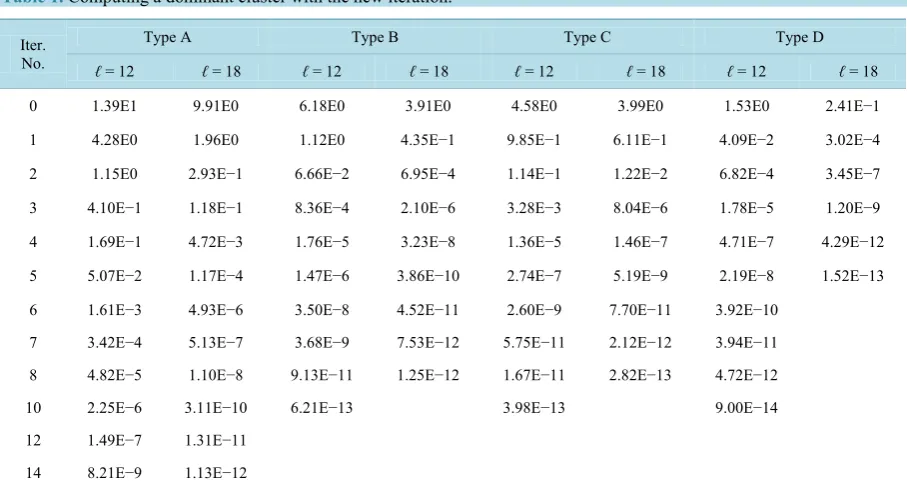
(8.7) The figures in Tables 1-4 provide the values of ηq. They illustrate the way ηq converges to zero as qincreases.
The new method is implemented as described in Section 3. It starts by orthonormalizing a random Krylov matrix of the form (3.1). The information matrix, Bq, is defined by (3.2)-(3.4). The Orthogonal iterations
[image:11.595.86.540.256.500.2]me-thod is implemented as in Section 6. It starts from a random orthonormal matrix, which is a common default op-tion, e.g., ([1], p. 55) and ([13], p. 60).
Table 1. Computing a dominant cluster with the new iteration.
Iter. No.
Type A Type B Type C Type D ℓ = 12 ℓ = 18 ℓ = 12 ℓ = 18 ℓ = 12 ℓ = 18 ℓ = 12 ℓ = 18 0 1.39E1 9.91E0 6.18E0 3.91E0 4.58E0 3.99E0 1.53E0 2.41E−1 1 4.28E0 1.96E0 1.12E0 4.35E−1 9.85E−1 6.11E−1 4.09E−2 3.02E−4 2 1.15E0 2.93E−1 6.66E−2 6.95E−4 1.14E−1 1.22E−2 6.82E−4 3.45E−7 3 4.10E−1 1.18E−1 8.36E−4 2.10E−6 3.28E−3 8.04E−6 1.78E−5 1.20E−9 4 1.69E−1 4.72E−3 1.76E−5 3.23E−8 1.36E−5 1.46E−7 4.71E−7 4.29E−12 5 5.07E−2 1.17E−4 1.47E−6 3.86E−10 2.74E−7 5.19E−9 2.19E−8 1.52E−13 6 1.61E−3 4.93E−6 3.50E−8 4.52E−11 2.60E−9 7.70E−11 3.92E−10
7 3.42E−4 5.13E−7 3.68E−9 7.53E−12 5.75E−11 2.12E−12 3.94E−11 8 4.82E−5 1.10E−8 9.13E−11 1.25E−12 1.67E−11 2.82E−13 4.72E−12 10 2.25E−6 3.11E−10 6.21E−13 3.98E−13 9.00E−14 12 1.49E−7 1.31E−11
14 8.21E−9 1.13E−12
Table 2. Computing a dominant cluster with orthogonal iterations.
Iter. No.
[image:11.595.86.539.524.716.2]Table 3. Computing a left-side cluster with the new iteration.
Iter. No.
Type A Type B Type C Type D ℓ = 12 ℓ = 18 ℓ = 12 ℓ = 18 ℓ = 12 ℓ = 18 ℓ = 12 ℓ = 18 0 3.19E1 2.94E1 1.11E1 9.97E0 4.99E0 4.70E0 6.29E0 2.55E0 1 1.30E1 7.68E0 4.93E0 2.83E0 7.45E−1 3.61E−1 1.17E0 5.72E−2 2 7.17E0 3.00E0 2.64E0 6.89E−1 4.49E−3 4.15E−5 7.38E−2 2.81E−5 3 3.13E0 8.79E−1 1.45E0 1.80E−1 4.52E−5 2.31E−7 9.17E−4 2.32E−8 4 1.37E0 1.28E−1 1.14E0 5.63E−2 4.03E−6 8.06E−9 1.69E−5 2.13E−11 5 6.58E−1 1.67E−2 4.80E−1 1.87E−3 1.80E−8 3.60E−10 3.68E−7 1.67E−13 6 1.05E−1 2.36E−4 6.56E−2 2.87E−4 9.35E−10 5.66E−11 8.31E−9 5.33E−14 7 1.30E−2 5.73E−6 2.69E−3 9.09E−5 3.65E−11 2.74E−12 1.91E−10
8 7.44E−4 5.95E−7 9.73E−4 2.06E−5 3.14E−12 7.61E−13 4.54E−12 10 3.67E−5 4.74E−10 2.14E−4 2.98E−6 2.75E−13 8.41E−14 12 6.94E−7 9.70E−12 5.66E−5 5.84E−7
[image:12.595.90.540.368.626.2]14 2.09E−8 2.47E−13 1.82E−5 2.72E−7
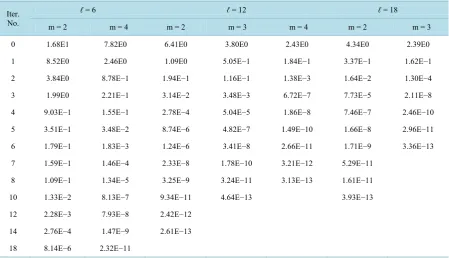
Table 4. The use of Power acceleration to compute a dominant cluster of Type A matrix.
Iter. No.
ℓ = 6 ℓ = 12 ℓ = 18
m = 2 m = 4 m = 2 m = 3 m = 4 m = 2 m = 3 0 1.68E1 7.82E0 6.41E0 3.80E0 2.43E0 4.34E0 2.39E0 1 8.52E0 2.46E0 1.09E0 5.05E−1 1.84E−1 3.37E−1 1.62E−1 2 3.84E0 8.78E−1 1.94E−1 1.16E−1 1.38E−3 1.64E−2 1.30E−4 3 1.99E0 2.21E−1 3.14E−2 3.48E−3 6.72E−7 7.73E−5 2.11E−8 4 9.03E−1 1.55E−1 2.78E−4 5.04E−5 1.86E−8 7.46E−7 2.46E−10 5 3.51E−1 3.48E−2 8.74E−6 4.82E−7 1.49E−10 1.66E−8 2.96E−11 6 1.79E−1 1.83E−3 1.24E−6 3.41E−8 2.66E−11 1.71E−9 3.36E−13 7 1.59E−1 1.46E−4 2.33E−8 1.78E−10 3.21E−12 5.29E−11
8 1.09E−1 1.34E−5 3.25E−9 3.24E−11 3.13E−13 1.61E−11 10 1.33E−2 8.13E−7 9.34E−11 4.64E−13 3.93E−13 12 2.28E−3 7.93E−8 2.42E−12
14 2.76E−4 1.47E−9 2.61E−13 18 8.14E−6 2.32E−11
Table 1 describes the computation of dominant clusters with the new method. The reading of this table is simple: We see, for example, that after performing 6 iterations on a Type B matrix, η6=3.50E−8 for =12,
and η6 =4.52E−11 for =18. (The corresponding values of p are p=18 and p=24, respectively.)
Table 2describes the computation of the same dominant clusters with orthogonal iterations. A comparison of the two tables suggests that the new method is considerably faster than Orthogonal iterations.
The ability of the new method to compute a left-side cluster is illustrated in Table 3. Note that the Type B matrix and the Type C matrix are positive semidefinite matrices, in which the left-side cluster is composed from the smaller non-zero eigenvalues of G. Both matrices have several zero eigenvalues. In the Type B matrix the eigenvalues in the left-side cluster are much smaller than the dominant eigenvalues, but the new method is able to distinguish these eigenvalues from zero eigenvalues.
The merits of Power acceleration are demonstrated in Table 4. On one hand it enables us to use a smaller , which saves storage. On the other hand it reduces the portion of time that is spent on orthogonalizations and the Rayleigh-Ritz process.
9. Concluding Remarks
The new method is based on a modified interlacing theorem which forces the Rayleigh-Ritz approximations to move monotonically toward their limits. The current presentation concentrates on the Krylov information matrix (3.2)-(3.4), but the method can use other information matrices. The experiments that we have done are quite en-couraging, especially when calculating peripheral clusters. The theory suggests that the method can be extended to calculate certain non-peripheral clusters, but in this case we face some difficulties due to rounding errors. Further modifications of the new method are considered in [3].
References
[1] Bai, Z., Demmel, J., Dongarra, J., Ruhe, A. and van der Vorst, H. (1999) Templates for the Solution of Algebraic Ei-genvalue Problems: A Practical Guide. SIAM, Philadelphia.
[2] Bauer, F.L. (1957) Das Verfahren der Treppeniteration und verwandte Verfahren zur Lösung algebraischers Eigen-wertprobleme. Zeitschrift für angewandte Mathematik und Physik ZAMP, 8, 214-235.
http://dx.doi.org/10.1007/BF01600502
[3] Dax, A. Restarted Krylov Methods for Calculating Exterior Eigenvalues of Large Matrices. Tech. Rep., Hydrological Service of Israel, in Preparation.
[4] Demmel, J.W. (1997) Applied Numerical Linear Algebra. SIAM, Philadelphia.
http://dx.doi.org/10.1137/1.9781611971446
[5] Golub, G.H. and Van Loan, C.F. (1983) Matrix Computations. Johns Hopkins University Press, Baltimore. [6] Horn, R.A. and Johnson, C.R. (1985)Matrix Analysis.Cambridge University Press, Cambridge.
http://dx.doi.org/10.1017/CBO9780511810817
[7] Parlett, B.N. (1980) The Symmetric Eigenvalue Problem. Prentice-Hall, Englewood Cliffs.
[8] Reinsch, C.H. (1971) Simultaneous Iteration Method for Symmetric Matrices. In: Wilkinson, J.H. and Reinsch, C.H., Eds., Handbook for Automatic Computation (Linear Algebra), Springer-Verlag, New York, 284-302.
[9] Rutishauer, H. (1969) Computational Aspects of F. L. Bauer’s Simultaneous Iteration Method. Numerische Mathema-tik, 13, 4-13. http://dx.doi.org/10.1007/BF02165269
[10] Rutishauser, H. (1970) Simultaneous Iteration Method for Symmetric Matrices. Numerische Mathematik, 16, 205-223.
http://dx.doi.org/10.1007/BF02219773
[11] Sorensen, D.C. (1992) Implicit Application of Polynomial Filters in a k-Step Arnoldi Method. SIAM Journal on Matrix Analysis and Applications, 13, 357-385. http://dx.doi.org/10.1137/0613025
[12] Stewart, G.W. (1969) Accelerating the Orthogonal Iteration for the Eigenvalues of a Hermitian Matrix. Numerische Mathematik, 13, 362-376. http://dx.doi.org/10.1007/BF02165413
[13] Stewart, G.W. (2001) Matrix Algorithms, Volume II: Eigensystems. SIAM, Philadelphia. [14] Trefethen, L.N. and Bau III, D. (1997) Numerical Linear Algebra. SIAM, Philadelphia.
http://dx.doi.org/10.1137/1.9780898719574
[15] Watkins, D.S. (2007) The Matrix Eigenvalue Problem: GR and Krylov Subspace Methods. SIAM, Philadelphia.
http://dx.doi.org/10.1137/1.9780898717808
[16] Wilkinson, J.H. (1965) The Algebraic Eigenvalue Problem. Clarendon Press, Oxford.
[17] Wu, K. and Simon, H. (2000) Thick-Restarted Lanczos Method for Large Symmetric Eigenvalue Problems. SIAM Journal on Matrix Analysis and Applications, 22, 602-616. http://dx.doi.org/10.1137/S0895479898334605
Thick-Restart Lanczos Method. ACM Transactions on Mathematical Software, 37, 1-18.
http://dx.doi.org/10.1145/1824801.1824805
[19] Zhang, F. (1999) Matrix Theory: Basic Results and Techniques. Springer-Verlag, New York.