Munich Personal RePEc Archive
Constant returns to scale and economic
theories of value
Naqvi, Nadeem
American University in Bulgaria
2007
Online at
https://mpra.ub.uni-muenchen.de/5306/
CONSTANT RETURNS TO SCALE AND ECONOMIC THEORIES OF VALUE
By
Nadeem Naqvi
American University in Bulgaria Blagoevgrad, Bulgaria
Phone: +1-202-470-0758 Phone: +359-73-888-494
Abstract
Jointly with Erkko Etula, Paul Samuelson [2006] claims that the “Leontief – Sraffa matrix equations for input/output must obey constant returns to scale”. However, in an unrelated work, Amartya Sen [2003] claims that Sraffa’s [1960] “analysis does not need any assumption of constant returns to scale.” In fact, Sraffa’s model cannot satisfy this property because it is impossible to define constant returns to scale in it. This claim is considerably stronger than Sen’s. The property of constant returns to scale is significant because it constitutes a line of demarcation between distinct, though interrelated, economic theories of value. (96 words)
Keywords: Constant returns to scale, Theory of Value, Relations of production, Counterfactual information, Exchange Values, Classical Political Economy, Neoclassical theory, Leontief technology
CONSTANT RETURNS TO SCALE AND ECONOMIC THEORIES OF VALUE
1. INTRODUCTION
When two economists, both Nobel Laureates, make very specific but contradictory
claims regarding a well-defined issue, it calls for careful scrutiny. In this note I report on the
result of an investigation of one such pair of conflicting claims. Amartya Sen [2003] writes (p.
1253),
Sraffa [1960] … draws exclusively on observed information, rather than having to invoke any
counterfactual presumptions. …. It also relates to other methodological features of Sraffa’s analysis, including his strenuous – but entirely correct – insistence that his analysis does not need any assumption of constant returns to scale.
Recently, on the other hand, jointly with Erkko Etula, Paul Samuelson [2006] claims to provide
multiple proofs1 (p. 183),
to confirm that Leontief – Sraffa matrix equations for input/output must obey constant returns to scale[.]
There is no question that there is a conflict between the position taken by Sen [2003] and the one
taken by Samuelson and Etula [2006] on the role of the Constant Returns to Scale Axiom (Axiom
CRS) in Sraffa. This is not new. Samuelson [1962] has held this position for almost half a
century. In this note, I attempt to put this matter to rest.
For clarification, in the next section I define the concept of CRS. I further argue that the
information content is so sparse in Sraffa’s model that it is impossible to define the concept of
CRS in his domain of discourse. This implies that Sen’s claim is true, and Samuelson and Etula’s
is, in fact, unfounded. In the remainder of the note I present an argument to demonstrate this
impossibility, and elucidate some of its consequences for at least two distinct economic theories
of value in economics.
1
Further, it would be a grave error to treat the argument I present here as an issue only in
the history of economic thought, important as that is. For, it has significant implications for two
distinct, existing, bone fide economic theories of value, one developed systematically by Arrow
and Debreu [1954], and the other developed perspicaciously by Piero Sraffa [1960], based, in
turn, on David Ricardo [1821] and Karl Marx [1867]. It is not that the death knell has sounded
for one and the other has won a resounding victory. Both theories of value are, in fact, alive and
kicking.
2.DEFINITIONS
Constant Returns to Scale is a property of a production activity. An activity that
transforms inputs of commodities and labor into outputs may or may not satisfy certain
pre-specified requirements or axioms. An activity could also be thought of as occurring by distinct
processes insofar as distinct quantities of the same inputs and outputs are involved in production.
Definition: A production activity is said to satisfy Axiom CRS if and only if, in any pair-wise
comparison of distinct production processes of this activity, if all inputs of one process are
proportionate positive multiples of the respective inputs of the other, then all outputs of the process will also be the same multiple of the other.
This definition is general enough to cover joint production in multi-product production
correspondences.2 In what follows, I shall take a production pattern as a specific distribution of
the quantities of all commodity outputs actually produced in an economy. If this is taken together
with the quantities of the various commodities actually used as inputs in this ‘pattern of
production’, then we have,
2
Definition (Sraffa): The set of all actually observed processes of production of all commodities by means of commodities and labor per period of time is called the set of relations of production.
It is noteworthy that, as defined here, the relations of production are based solely on observed
information. This plays a crucial role in the argument that follows. Further, the distribution of
income between workers and owners of capital springs, as it were, from a specific set of relations
of production, as has been brought out by the classical political economists, most prominently
Ricardo [1821], Marx [1867] and Sraffa [1960]. These relations of production constitute what
Karl Marx called, in his Prelude to a Critique of Political Economy, the “base” of every society
“on which rise legal and political superstructures, and to which correspond definite forms of
social consciousness.” This is the clearest statement of the primacy of economic forces (or of
relations of production and implicitly of distribution) in determining social behavior and political
and legal structures consistent with the collective set of beliefs of the persons who comprise a
society. Classical Political Economists investigate a given, single set of observed relations of
production, and deduce from these relations the exchange values and thus income distribution
inherent in them. In fact, both the commodity exchange values and the distribution of national
income between workers and owners of capital are jointly revealed by the relations of production
in the classical framework.
3.EXCERPTS FROM SRAFFA
Definitions aside, what does Sraffa himself have to say about the role of CRS in the
economic system that constitutes the object of his concern? Sraffa explicitly states,
Anyone accustomed to think in terms of supply and demand may be inclined, on reading these pages, to suppose that the argument rests on a tacit assumption of constant returns in all industries. If such a supposition is found helpful, there is no harm in the reader’s adopting it as a temporary working hypothesis. In fact, however, no such assumption is made.3 (p. v)
3
Given this clear statement, it cannot be, and it ought not to be, inferred that Sraffa has imposed
CRS on his model. A question could arise, however, as to whether CRS is entailed by Sraffa’s
model. In the same paragraph, Sraffa dispenses with this latter possibility by explaining,
No changes in output …. by an industry are considered, so that no question arises as to the variation or constancy of returns. The investigation is concerned exclusively with such properties of an economic system as do not depend on changes in the scale of production.4 (p. v)
“Change” here refers to a pair-wise comparison of two distinct production activities or relations
of production in an economy. By ruling out “change,” Sraffa effectively limits his investigation
to the consideration of exactly one profile of relations of production. Only one! But, as noted
above, the very definition of CRS requires the consideration of at least two distinct (in fact,
proportionate positive multiple) processes, and therefore two distinct profiles of relations of
production, which is a possibility denied by Sraffa in his analysis, in his own words, as quoted
above. Based on only one pattern of production, it is impossible to define CRS. CRS can thus
neither be imposed on, nor entailed by, Sraffa’s model. This is the fundamental point I make
here, and is the basis of my claims.
What, one might ask, is Sraffa’s motivation behind dealing with only one set of input and
output numbers? After all, in mainstream 20th and 21st centuries’ economic theory, every
neoclassical economist worth her salt automatically “believes in” CRS, especially since it is an
also an assumption of the Arrow-Debreu [1954, Theorem II] Walrasian competitive general
equilibrium Existence theorem (or model).5 However, according to Sraffa,
in a system in which, day after day, production continue[s] unchanged,6
including in the scale of an industry, one would find the same set of input and output quantities
that describe a particular set of relations of production in the economy – day after day or from
4
Emphasis added.
5
The proof of this theorem, that includes a primary factor of production, is considerably more complicated than the one for commodity endowments only, as in their Theorem I.
6
year to year. Since a distinct pattern of production never actually does occur – certainly not one
in which all inputs becoming proportionate multiples, Sraffa has no a priori theoretical basis for
conjecturing what would happen to the output of a commodity in that alternate reality. He,
therefore, does not take this non-existent outcome in to consideration at all. Sraffa thus “draws
exclusively on observed information, rather than having to invoke any counterfactual
presumptions,” in Sen’s words. That is, Sraffa is unwilling to consider any constitutively
counterfactual statement about the relations of production.7
On the other hand, those models that entertain CRS must, without fail, entertain the
content of alternate, though non-existent, positive-multiple production processes in the economy,
because two distinct processes of inputs and outputs are necessary for the very definition of CRS
while only one of them is observed. The second must be counterfactual.
This constitutes an important distinction. There can be no doubt that methodologically
there is a clear distinction between frameworks that permits the use of counterfactual information
and those which do not. Thus, two elementary points are worth noting. First, characterization or
not by constant returns to scale is one line of demarcation between models of an economy in to
two classes: CRS not definable, in to which falls Sraffa’s model, and , CRS imposed, that contain
Leontief, Neoclassical and Arrow-Debreu models.
Second, eschewing the use of counterfactual information (as in Sraffa’s model) or not (as
in many other models) is a second demarcating line that produces another partition. This is a
simple enough point, which Sraffa has stated, and on which Sen has elaborated perspicaciously.
In the Leontief model of an economy, on the other hand, not only is CRS imposed on
every production activity, but the production functions, usually taken to be single-output
7
functions, are further restricted to be of the exogenously fixed input-proportion coefficient
variety: they are invariant to the output levels of all commodities. In the light of these
fundamentally different informational structures of Sraffa on the one hand, and Leontief on the
other, with the Leontief model being based on a larger information set and based on more
restrictive assumptions, and the Sraffa model based on a smaller amount of information and less
restrictive assumptions, the concept of a “Leontief-Sraffa input-output matrix”, upon closer
examination, appears to be essentially a confused idea. It does not seem to have any
epistemological value.
4.CONCLUDING REMARKS
First, a comparison of alternative models of an economy reveals that the information
content is so sparse in Sraffa’s 1960 model that the concept of constant returns to scale in
production simply cannot be defined in it. It is therefore impossible to impose the requirement of
constant returns to scale on the economic structure investigated by Sraffa. Nor indeed can
constant returns to scale be entailed in a model in which the concept is impossible to define. A
second point to note is that, from an information analytic perspective, conclusions deduced on
the basis of strictly more restrictive assumptions, as from models that assume CRS, cannot
legitimately be used to refute any claims of another theory that is based on strictly less restrictive
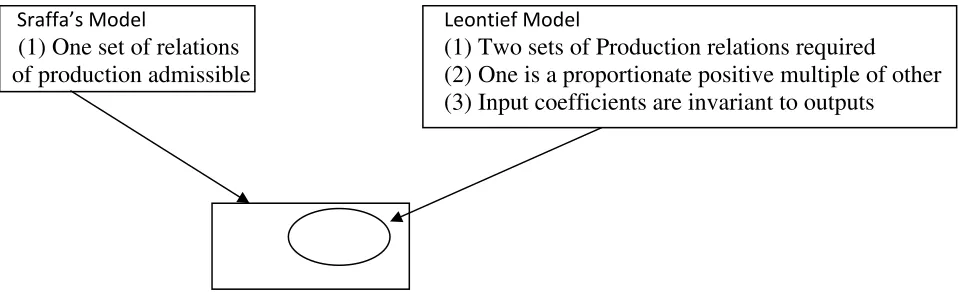
(or strictly more general) assumptions, as in Sraffa, as shown in the Venn diagram below.
Sraffa’s Model Leontief Model
[image:8.612.66.550.566.713.2](1) One set of relations (1) Two sets of Production relations required of production admissible (2) One is a proportionate positive multiple of other (3) Input coefficients are invariant to outputs
Note must be taken of the requirement that in both Sraffa and Leontief, the relations of
production refer not to stocks but to flows over any given period of time. Further, my remarks so
far pertain to two criteria only. Criterion I: Is the theory based on observed information only, or
does it also permit the use of constitutively counterfactual information? Criterion II: Is the theory
based on the assumption of constant returns to scale?
Second, there are clear-cut implications of the argument developed here for the
relationship between the theories of value based on models that assume CRS (and, in some cases,
also give play to utility and demand), and the theory of value based on Sraffa’s model in which
CRS cannot be defined.
Note that Arrow and Debreu’s [1954] Theorem II model, that is the basis of the
Arrow-Debreu theory of value, was published six years before Sraffa published his model, which is the
basis of the Classical Political Economy theory of value as developed by Ricardo [1821] and
Marx [1867]. So Arrow and Debreu could not have commented on Sraffa’s model, or on the
formal theory of value built thereupon. Moreover, Sraffa himself makes no claim about any
theory of value other than of classical political economy.
It is worth noting that the model of the Neoclassical Economic theory of value seeks to
aggregate the value of intermediate commodities in to capital, so that it is subject to the
strenuous (and entirely justified) classical-political-economy based criticism of incorrectly taking
market prices (exchange values) as determined independently of the distribution of national
income between workers and owners of capital. However, the model of the theory of value of
Arrow and Debreu does not attempt any such aggregation, so that their theory of value is exempt
The Neoclassical economic theory of value is a special case of the Arrow-Debreu theory
of value, and Axiom CRS is part of the structures of both. A special case of the Arrow-Debreu
theory is Leontief’s fixed-input-coefficients model in which production function coefficients are
invariant to output levels.
The three theories of value differ remarkably in other significant respects too. It is
precisely these other differences – with normative implications – that make this simple matter of
constant returns to scale so distressingly contentious. On the other hand, the analytical points of
logic I have raised here about the character of information entailed by constant returns to scale
are not the source of any controversy. They are purely descriptive in nature, and my remarks
would fall squarely in the domain of descriptive economic theory.
Sraffa’s, Leontief’s, Arrow-Debreu and the neoclassical models of an economy are quite
distinct. They are distinct conceptions of economic reality, and in terms of placing informational
restrictions, the Leontief structure is more special than the Arrow-Debreu model, which is more
special than Sraffa’s. When seen in the light of a two-criterion based classification, it is evident
that the these models support distinct economic theories of value, and much care must be
exercised in criticizing one while staying within the domain of discourse of the other. In fact,
some concepts that are well-defined in one model are simply not defined in another. In
particular, it is fruitless to use the axiomatic basis of a special case to make claims about a more
general domain of discourse.
An information analytic examination of the Arrow-Debreu, Sraffa and neoclassical
models of an economy also reveals that some of the debate in capital theory and re-switching of
the techniques of production in the 1960’s and 1970’s was not useful insofar as concepts
same concepts were sometimes not defined. However, Axiom CRS remains a line of demarcation
between distinct, though interrelated, economic theories of value. There is an “informational
famine” in Sraffa’s model that limits its scope and reach, while, at once, making it more general.
A critique of both Sraffa’s theory of value and that of Arrow-Debreu can indeed be formulated,
REFERENCES
Arrow, Kenneth, J. and Debreu, Gerard. “Existence of an Equilibrium for a Competitive Economy,” Econometrica, July 1954, 22 (3), pp. 265-90.
Leontief, Wassily, The Structure of the American Economy, 1919-29, Harvard University Press: Cambridge, MA, 1941.
Marx, Karl, Capital, Volume 1, The Process of Production of Capital, Progress Publishers: Moscow, 1867.
Ricardo, David, On the Principles of Political Economy and Taxation, London: John Murray, 1821, 3rd Edition.
Samuelson, Paul A. “Parable and Realism in Capital Theory: The Surrogate Production
Function,” Review of Economic Studies, 29 (3) (1962), pp. 193-206.
________. and Etula, Erkko M. “Testing to Confirm that Leontief-Sraffa Matrix Equations for Input/Output must obey Constancy of Returns to Scale,” Economics Letters, 90 (2006), 183-188.
Sen, Amartya, “Sraffa, Wittgenstein, and Gramsci,” Journal of Economic Literature, 41 (4), December 2003, pp. 1240-1255.
APPENDIX
RESTORATION OF OUTPUTS TO ORIGINAL DISTRIBUTION ACROSS INDUSTRIES
There is one other matter that is of some import in this context. In Chapter 1 of his book, Sraffa gives the following example (p. 3),
280 & 12 400 ,
(A1) and
120 & 8 20 .
Sraffa further notes that,
each commodity, which initially was distributed between the industries according to their needs, is found at the end of the year to be entirely concentrated in the hands of its producer. (p. 3)
and he seeks
a unique set of exchange-values which if adopted by the market restores the original distribution of products and makes it possible for the process to be repeated; such values spring directly from the relations of production. (p. 3)
As Sraffa points out, in these production relations, an exchange-value of 10 quarters of wheat for 1 ton of iron does, in fact, restore the distribution of products to industries, so that the production process can be repeated next year.
It is also noteworthy that Sraffa states without ambiguity, that “Both [commodities] are used, in part as sustenance for those who work, and for the rest as means of production – wheat as seed, and iron in the form of tools.”8
Referring to Sraffa [1960], Samuelson and Etula (p. 184) state, “For clarity, we replace the two-digit 1960 technical coefficiencies by small one-digit low numbers. Our self-explaining notations write out the bare subsistence Tableau I as follows”. They then proceed to give an example in their Tableau I, which, for lack of explanation of notation, admits of at least two distinct interpretations.
On one interpretation, in the wheat industry,
2 . & 2 . 2 . ,
(A2) and
0 . & 2 . 4 .
in the iron industry. Alternatively, on the second interpretation, in the wheat industry,
2 . & 0 . 2 . ,
(A3) and
2 . & 2 . 4 .
8
in the iron industry. Under both interpretations, their example is flawed, as I argue below.
Notice that in Sraffa’s original example, 120, 280 and 400 are three-digit numbers, 12 and 20 are two-digit numbers, and 8 is a one-digit number, so that Samuelson and Etula’s claim about the number of digits is not entirely accurate. And, they do quite a bit more than merely take “low” numbers in their example.
In the relations of production (A2), there are three problems. One, in the iron industry, 2 tons or iron are somehow transformed into 4 tons of iron, without any other input whatever.9 Two, in the iron industry, no labor can be employed, because, with no wheat at all, workers would die, and this violates Sraffa’s explicit assumption that “Both [wheat and iron] are used, in part as sustenance for those who work”.
The third problem with this (A2) interpretation of Samuelson and Etula’s example is the most disturbing of all. To see this, note that to make it possible for the iron production process to be repeated, at the end of the production cycle the iron industry is left with 2 extra tons of iron that it does not need. It might as well dispose of this iron for free, for if it got any wheat in exchange, it would not have any use for it to repeat its production cycle. On the other hand, the wheat industry does, in fact, need 2 tons of iron to repeat its production cycle, but has 0 quarters of wheat to spare for it, for it produces only 2 quarters of wheat, all of which is needed for it to repeat production. Of course, this is just as well, because, as noted above, the iron industry needs no wheat for it to transform 2 tons of iron in to 4. The disturbing problem is that, in the economic structure (A2), the exchange value that would redistribute products to industries for the same relations of production to be repeated is, in fact, 0 quarters of wheat per ton of iron. This makes iron a free commodity. A commodity exchange value of zero for a commodity is a very serious problem in any economy. Effectively, in the (A2) interpretation of Samuelson and Etulas’s example, there exists no positive exchange value that can restore the “original distribution of products” in industries. Market forces can therefore not bring about a repetition a “self-replacing” economy’s production cycle.
Turning next to the second interpretation of Samuelson and Etula’s Tableau I example, as in the relations of production (A3), notice again that to make it possible for the relations of productions to be repeated, at the end of the production cycle the iron industry would have to
exchange with the wheat industry 2 of its 4 tons of iron output for 2 quarters of wheat. The wheat producer in their example, however, is unwilling to engage in such an exchange. This is both (a) because 2 quarters of wheat are needed to repeat the wheat production cycle, and that is all the wheat that is produced at the end of the harvest, and (b) because the wheat industry uses 0 tons of iron in the wheat production process, and therefore needs no iron whatever. The iron industry, therefore, will simply not get the 2 quarters of wheat necessary to repeat the iron production process. Since the “original distribution of products” in industries cannot be restored, the economy’s production process again becomes impossible to repeat.
The moral of the story is that in Samuelson and Etula’s example in Tableau I, as in their Tableau I' example, there exists no positive commodity exchange-value that would permit the original distribution of products to be restored to industries, thereby making the production process impossible to repeat. This is a rather serious violation of the minimal requirement of repeatability of the economy’s production processes. Such cases as the examples in Tableau I
and I' do not belong to the admissible structures in Sraffa’s framework of analysis, simply
9
because they fails to reveal any positive exchange-values that restore the original distribution of products to industries according to their needs to repeat all of the production processes. From this, it is straightforward to conclude that conclusions drawn from such economic structures as employed by Samuelson and Etula can be used to prove many things, but the refutation of any claims made by Sraffa is not one of them.