http://dx.doi.org/10.4236/ijaa.2014.42029
Metric Expansion of Space Described by
Gravity Based on Electromagnetic Processes
Hans W. Giertz
Uppsa Research, Gnesta, Sweden Email: [email protected]
Received 12 February 2014; revised 10 March 2014; accepted 17 March 2014
Copyright © 2014 by author and Scientific Research Publishing Inc.
This work is licensed under the Creative Commons Attribution International License (CC BY).
http://creativecommons.org/licenses/by/4.0/
Abstract
The present study describes the metric expansion of space based on a novel understanding of gravity and its electromagnetic processes. A singularity in the universe emits electromagnetic energy, which is absorbed by atoms and re-emitted to other atoms. This results in mutual force of attraction, i.e. gravity. We assume that the distance R towards the singularity is constant and r is the distance between two bodies. Then the gravitational force decreases with the decrease of the re-emitted energy, i.e. as 1/r2, and in line with Newtonian gravity and General Relativity. However,
the universe orbits the singularity and hence R varies. R increases when a certain part of space travels from the singularity, and whereby the energy re-emitted by atoms decreases as 1/r2R2.
Consequently, the gravitational force between bodies decreases as 1/r2R2, resulting in increasing
distance between bodies, i.e. metric expansion of space. A theoretical model is presented. The theoretical model describes the mechanisms which results in gravity and expanding space. The study also displays how the electromagnetic characteristics of the singularity and gravity waves and the mechanism creating gravity are measured.
Keywords
Metric Expansion of Space, Gravity, Atom, Vis Viva, Gravitational Ellipse
1. Introduction
force of attraction, i.e. gravity where the gravitational force between two bodies decreases with the square of the distance r, i.e. as 2
1r , in line with Newtonian gravity and General Relativity [4].
In the present study it is assumed that the universe orbits the singularity. Two bodies orbiting the singularity receive TEM waves from the singularity where the energy flow density, described by the Poynting vector S0(R), decreases with the square of the distance R, i.e. as 2
1 R , where R is the distance to the singularity. This results in that the Poynting vectors S1(r)and S2(r) of re-emitted TEM waves from the two bodies with distance r de-crease as 2
1r ; however, also as 1/R2 and in total as 2 2
1r R . Hence, the gravitational force between the two bodies decreases faster than depicted by the visviva equation (describing elliptical orbital) [5]-[7], when they travel from the singularity, i.e. when R increases. It is now assumed that one body orbits the other. At increasing
R the orbiting body loses velocity less rapidly at increasing r, i.e. when it travels from the larger body (towards the apogee), resulting in that the semi-major axis increases, i.e. it travels in a larger ellipse. Consequently that planet system expands, its galaxy expands and the distances between galaxies increase. This may explain the metric expansion of space [8]-[10].
The objective with the present paper is to build on results already presented in a report [2]. This information is compiled into a theoretical model in Section 2, which describes the mechanisms behind the metric expansion of space. The theoretical model is based on state of the art electromagnetic theory [11]-[14], wave theory [15] [16] and the vis viva equation which describes elliptic orbital [5]-[7]. Comparison with the Standard Model is made [17]. The relation between energy flow density S0(R) and dark energy is discussed [18]. The present definition of gravity enables description of a number of unsolved issues within physics and astrophysics such as the photon [19], gravitational and inertial mass [20] as well as gravitational lensing [21]. Discussion and conclusions are found in Section 3.
The aim of the study is to present a theoretical model of the metric expansion of space.
2. Theoretical Model
2.1. Gravity
The theoretical model builds on the observation that atomic oscillators69.9, with natural frequency 69.9 Hz, ab-sorb TEM waves with frequency 69.9 Hz [2]. The TEM waves originate from a singularity in the universe and have been thoroughly described [1] [2]. The absorbed TEM waves are then re-emitted uniformly into space.
The behavior and characteristics of plane TEM waves is independent of their frequency. The field vectors E
and B or H B =
(
µ0H)
are linked and perpendicular. The field vector amplitudes relate as E = cB, where c is the speed of light. The electric and magnetic field vector amplitudes E and B decrease with the distance from the source as 1/r. The Poynting vector S describes the TEM energy flow density [11] [12].
×
S = E H (1)
The energy stored in the magnetic field is just equal to that in the magnetic field. The direction of energy flow is reversed for a wave travelling in the opposite direction because the phase of E and H is reversed.
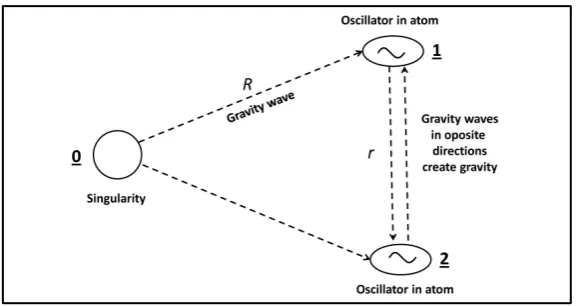
The theoretical model comprises a huge singularity in space, 0 in Figure 1. It emits vast amount of plane TEM waves with frequency 69.9 Hz. Its energy flow density at distance R is described by its Poynting vector
S0(R).
Figure 1. A singularity 0 generates gravity waves (low frequency plane TEM waves). Oscillators69.91 and 2 in atoms create resonance with gravity waves and re-emit them unaltered. This causes flow of gravity waves between atoms and their oscillators69.91 and 2. The flow of gravity waves in opposite direc-tions between oscillators69.9 results in mutual force of attraction, i.e. gravity.
interact because of the force between their synchronized field vectors. This also implies that there is energy transfer from TEM1 to TEM2 when TEM2 propagates towards Source 1. In equilibrium there is energy transfer in both directions, i.e. from TEM1 to TEM2 vice versa. Note that E and H are always perpendicular and hence
×
S = E H can be replaced by S= ⋅E H. Equilibrium is defined by the amount of energy that Source 1 is able to deliver at Source 2, e.g. at the distance r, S1(r), and the amount of energy that Source 2 is able to deliver at Source 1, i.e.S2(r). This results in back reaction force F(r), i.e. radiation reaction [11]. This creates mutual force of attraction F(r):
( )
· 1( ) ( )
· 2 .F r =γ S r S r (2)
It is here assumed that the distance R to the singularity is constant. Hence, S0(R) is constant and thus γ is a constant.
The entity which absorbs and re-emits TEM waves with frequency 69.9 Hz is an (forced damped) oscillator69.9 with natural frequency 69.9 Hz. It is now assumed that each source consists of many oscillators69.9 where each atomic oscillator69.9 re-emits TEM waves described by its Poynting vector δS r
( )
and where r denotes the dis-tance from the source and its oscillator69.9. E and H decrease linearly with the distance r implying that δS r( )
decreases with the square of the distance; δS r
( )
=δS( )
0 r2. The mutual force of attraction δF r( )
between two atomic oscillators69.9 with distance r is( )
( )
( )
2· 0 0 .
F r S S r
δ =γ δ ⋅δ (3)
In order to simplify δS
( )
0 is from now on denotedδS.It is now assumed that one oscillator69.9 acts on p collocated oscillators69.9, belonging to the set P of all oscil-lators69.9 at Source 2, and where each force can be described by δF r
( )
. These oscillators69.9 are synchronized resulting in the force( )
2(
)
2· · · .
p P p P
F r S S r S S p r
δ
=γ δ
δ
=γ δ δ
∑
∑
(4)
It is now assumed that n collocated oscillators69.9, belonging to the set N of all oscillators69.9 at Source 1, act on p collocated oscillators69.9, belonging to the set P of all oscillators69.9 at Source 2, resulting in the total force
F(r):
( )
2(
)
2· · · .
n N p P
F r =
γ
∑ ∑
δ
Sδ
S r =γ δ δ
S S n p r
(5)
·
S S
δ δ is a constantdescribed by the intrinsic characteristics of the oscillator69.9 and S0(R), therefore Equa-tion (5) is simplified into
( )
2· · ,
then approximately equal to the Newtonian geometric law of gravity, where FG is the gravitational force:
( ) ( )
2 2 21 2 Newton 1 2
· 0· 0 · · F .
G
F =γS S r =ξn p r ≈ =GM M r (7)
( )
1 0
S is the Poynting vector of Source 1 or body1 and S2
( )
0 is the Poynting vector of Source 2 or body2.ξ, G, S1
( )
0 and S2( )
0 in Equation (7) depend on the distance R between the singularity and body 1 respec-tively body 2, as described in Section 2.3.2.2. Classical Astrodynamics
In astrodynamics, the vis viva equation, also referred to as orbital energy conservation equation, is one of the fundamental and useful equations that govern the motion of orbiting bodies. It is the direct result of the law of conservation of energy, which requires that the sum of kinetic and potential energy is constant at all points along the orbit. Vis viva represents the principle that the difference between the aggregate work of the accelerating forces of a system and that of the retarding forces is equal to one half the vis viva accumulated or lost in the system while the work is being done. For any Kepler orbit (elliptic, parabolic, hyperbolic or radial), the vis viva equation [5] is as follows (Figure 2):
(
)
2
2 1 ,
GM r a
υ = − (8)
where:
• υ is the relative speed of the two bodies.
• r is the distance between the two bodies.
• a is the semi-major axis (a > 0 for ellipses, a= ∞ or a = 0 for parabolas, and a < 0 for hyperbolas).
• G is the gravitational constant.
• M is the mass of the central body.
2.3. Metric Expansion of Space
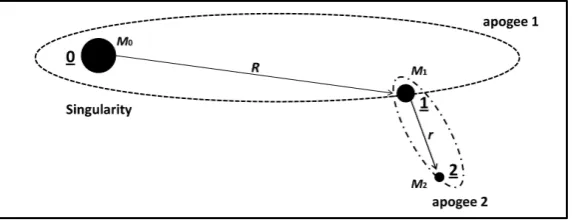
In the present theoretical model bodies in space orbit the singularity 0 with mass M0, as shown in Figure 3. In this case R is not constant and hence the absorbed energy at Source 1 decreases as S0
( )
R =α R2 , where α is a con-stant. Hence, the re-emitted energy flow density S1( )
0 from 1 and S2( )
0 from 2 are not constant but decreasesas 2
1R .
Bodies which orbit each other are illustrated in Figure 3, comprising the larger mass 1 and the smaller mass 2, described in Section 2.2. The smaller mass 2 orbits the larger mass 1. At constant distance R to the singularity, this orbit follows Equation (7) and Equation (8). However, 1 and 2 orbit the singularity 0 and R is not constant. Equ-ation (7) must be enhanced to include that S0
( )
R varies:( ) ( ) ( )
20 1 2
· · 0· 0 ,
G
F =βS R S S r (10)
where β is a constant and r is small compared to R. S0
( )
R decreases as 1 R2, hence FG decreases as 1R2
when 1 and 2 travels towards the apogee 1. This implies that when 2 orbits 1 its velocity decreases slower when 2
travel towards apogee 2, compared to the situation at smaller distance R to the singularity. This results in a larger ellipse, i.e. larger semi-major axis and semi-minor axis. Consequently, this planet system expands when 1 and 2
travels from the singularity 0. This is generally valid for orbital in space and thus galaxies expand and distance between galaxies increases.
Figure 2. According to classical astrodynamics a small body with mass M2 orbits a large body, with mass M1 in an ellipse, described by the vis viva equ- ation, Equation (8).
Figure 3. Two bodies 1 and 2 orbiting the singularity 0 experience smaller mu- tual gravitational force FG(r) when the distance R to the singularity increases. This results in that the planet system 1 and 2 is exposed to metric expansion. The semi major axis and semi minor axis increase when 1 and 2 travels from the singularity. This explains the metric expansion of space.
3. Discussion and Conclusions
We do not know the starting position, velocity or direction of our part of space relative to the singularity. How-ever, observations display that space that we can observe expands at an increasing speed [8]-[10]. The present theoretical model may explain this metric expansion of space. The model indicates that our part of space is in a position where it travels from the singularity, resulting in escalating expansion of space.
It has not been possible to detect any change in the gravitational constant G over time. This indicates that the relative change in R over measurable time is extremely small, and consequently the distance between the Milky Way galaxy and the singularity ought to be very large.
The strength of the present theory is a novel method facilitating measurement of relevant parameters [1]-[3]. TEM waves originating from the singularity have been measured to a degree which allows exact description of their characteristics such as direction of origin, amplitude, phase, frequencies and field vector behavior [1] [2]. Furthermore, TEM waves, absorbed and re-emitted by atoms, have been measured to a degree which reveals the atomic intrinsic mechanism; forced damped oscillators with natural frequencies 0.005 - 0.03 Hz [1] and 69.9 Hz [2]. The force of attraction between TEM waves has been measured [2]. The direction towards the singularity is towards north and roughly in line with the earth’s rotational axis, where these measurements are described in [2]. Hence, crucial parts of the present theory have been measured in laboratory and some parts have been simulated and reproduced in laboratory.
It is proposed that the energy flow density S(R) described in this paper and in [1] [2] is what is called dark energy [18]. In that case dark energy decreases as 2
1 R with the distance R to the singularity. In that case it is possible to measure dark energy as described previously [1] [2].
The platform of modern physics is elementary particle physics, described in the Standard Model [17]. The Standard Model lacks definition of gravity; hence, it falls short in describing the metric expansion of space.
[image:5.595.171.458.247.357.2]The geocentric model was replaced by heliocentric model in the middle ages. Today’s science is dominated by the atomcentric model where all forces and energy are believed to originate from the atom itself [17]. The ato- mcentric model will be replaced by the unicentric model where all atoms are controlled by energy originating from a singularity in the centre of the universe. The universe may be very logical, once we understand its sim-plicity.
References
[1] Giertz, H.W. (2013) Atoms Absorb Low Frequency Electromagnetic Energy. Open Journal of Microphysics, 3, 115- 120.
[2] Giertz, H.W. (2013) Gravity Caused by TEM Waves Operating on Dipoles in Atoms. International Journal of Astro- nomy and Astrophysics, 3, 39-50.
[3] Giertz, H.W. (2010) Extremely Low Frequency Electromagnetic Energy in the Air. Journal of Atmospheric and Solar- Terrestrial Physics, 72, 767-773. http://dx.doi.org/10.1016/j.jastp.2010.03.022
[4] Misner, C.W., Thorne, K.S. and Wheeler, J.A. (1973) Gravitation. W. H. Wheeler, San Fransisco.
[5] Logsdon, T. (1998) Orbital Mechanics: Theory and Applications. John Willey & Sons, Hoboken.
[6] D’Eliseo, M.M. (2009) The Gravitational Ellipse. Journal of Mathematical Physics, 50, 022901-022910. http://dx.doi.org/10.1063/1.3078419
[7] D’Eliseo, M.M. (2007) The First-Order Orbital Equation. American Journal of Physics, 75, 352-355. http://dx.doi.org/10.1119/1.2432126
[8] NASA (2013) Planck Mission Brings Universe into Sharp Focus.
[9] Bennet, C.L. (2006) Cosmology from Start to Finish. Nature, 440, 1126-1131. http://dx.doi.org/10.1038/nature04803 [10] Bunn, E.F. and Hogg, D.W. (2009) The Kinematic Origin of the Cosmological Redshift. American Journal of Physics,
77, 688-694. http://dx.doi.org/10.1119/1.3129103
[11] Melrose, D.B. and McPhedran, R.C. (1991) Electromagnetic Processes in Dispersive Media. Cambridge University Press, Cambridge. http://dx.doi.org/10.1017/CBO9780511600036
[12] Bleaney, B.I. and Bleaney, B. (1965) Electricity and Magnetism. Oxford University Press, Amen House, London.
[13] Alonso, M. and Finn, E.J. (1968) Fundamental University Physics Volume III: Quantum and Statistical Physics, Addi-son-Wesley.
[14] Serway, R.A. and Jewett, J.W. (2005) Principles of Physics. 4th Edition, Cengage Learning, Stamford.
[15] Ostrovsky, L.A. and Potapov, A.I. (2002) Modulated Waves: Theory and Application. Johns Hopkins University Press, Baltimore.
[16] Terras, A. (1999) Fourier Analysis on Finite Groups And Applications. Cambridge University Press, Cambridge.
[17] Burgess, C. and Moore, G. (2007) The Standard Model: A Primer. Cambridge University Press, Cambridge.
[18] Peebles, P.J.E. and Ratra, B. (2003) The Cosmological Constant and Dark Energy. Reviews of Modern Physics, 75, 559-606. http://dx.doi.org/10.1103/RevModPhys.75.559
[19] Giertz, H.W. (2013) Photons Are EM Energy Superpositioned on TEM Waves. Open Journal of Microphysics, 3, 71-80. http://dx.doi.org/10.4236/ojm.2013.33013
[20] Giertz, H.W. (2014) Inertial and Gravitational Mass Described by Their Electromagnetic Processes. Open Journal of Microphysics, 2, 7-14. http://dx.doi.org/10.4236/ojm.2014.42002