Mathematical Modelling of Joint Routing
and Scheduling for an Effective Load
Balancing in Cloud
Suriya Begum
Research Scholar
Visvesvaraya Technological University Belgaum, India
Prashanth C.S.R
, PhD Prof. & Head of Department Computer Science & Engineering New Horizon College of EngineeringBangalore, India
ABSTRACT
Due to the increasing adoption of the cloud in majority of the business, the level of traffic intensity is increasing leading to a challenging situation for traffic management in cloud. There were various algorithms in past that has discussed about the load balancing techniques concerning the cloud environment, but very few of them are found to be actually effective. The proposed system therefore presents a mathematical model exclusively considering virtual machine for performing load balancing. The system jointly addresses the routing as well as task scheduling and also focuses on the issues pertaining to resource allocation. The model is designed and compared with existing load balancing algorithms, where the simulation results shows better throughput by highlighting minimized waiting time for jobs with faster completion of task.
Keywords
Cloud Computing, Resource Allocation, Traffic.
1.
INTRODUCTION
Cloud computing can be illustrated as the deployment of computing resources including hardware and software that are delivered as a service over a large scale network [1]. The name ‘cloud’ has been originated from the use of a cloud-shaped symbol as an abstraction for the complex infrastructure that is contained in a system diagrams. The origination of the term ‘cloud computing’ is incomprehensible, but it seems to be derived from the practice of using schematic drawings of stylized clouds to denote networks in diagrams of computing and communications systems. The word cloud is used as a parable for the large scale network that is based on the standardized use of a cloud-like shape to denote a network on telephony schematics and later to depict the Internet in computer network diagrams as an abstraction of the underlying infrastructure it represents. The cloud symbol was used to represent the Internet as early as 1994 [1]. The fundamental concept of cloud computing basically dates back to the 1950s when there was an availability of large scale mainframe in institutions and corporations. Due to the expensive nature of mainframe, there arise a need to find an alternative solution for permitting the multiple users for accessing and sharing equivalent CPU time thereby truncating the possibility of periods of inactivity (also termed as time-sharing). As computers became more prevalent, scientists and technologists explored ways to make large-scale computing power available to more users through time sharing, experimenting with algorithms to provide the optimal use of the infrastructure, platform and applications with prioritized access to the CPU and efficiency for the end users. The high cost of these powerful computing systems has
forced many prime organizations to take an initiative to explore better cost effective solution using time sharing. The prime organization will include IBM, GE, National CSS etc who took the initiative to launch and marketed time sharing. With the rapid growth of internet technology and standards, various products and demands of distributed computing were on high escalation. The presence of pervasive high computing network, cost effective computing devices, storage devices along with large scale use of virtualization of hardware, service oriented architecture has paved the path for high demands in new technology, so called as ‘cloud computing.’
Since, with the scene of rapid use of cloud computing resources, the demand along with provisioning of the cloud resources has to be effectively design to claim better SLA (Service Level Agreement) with zero downtime claims. Currently, there is a presence of multiple vendors offering cloud services (Amazon, Microsoft, IBM, Google, Salesforce, HP, Oracle, Citrix, EMC etc.) and there are growing numbers of clientele too. Hence, it is quite obvious that catering the massive and dynamic requirements of such exponentially growing clients will become one of the most challenging issues. And to mitigate this issue, an effective load balancing technique should be explored. The proposed paper will introduce a thorough analysis of the evolution of cloud platform right from the origination of the initial distributed computing system. The paper will mainly focus on the research issues of load balancing. The main contributions of this paper are summarized below.
The system depicts the efficient region in cloud framework by incorporating its connection to the efficient region of the wireless system application. The efficient region of the cloud framework can be states to be group of the dynamic loads of traffic that can stabilize and manage the queue system.
The next contribution of the system is to use the best fit provisioning technique and thereby utilize frequently use MaxWeight algorithm in ideal scenario where incoming jobs can be preempted and possibly drift among the clusters where each clusters can perform auto re-configuration based on the incoming load. However, the system is less dependent on preemption and virtual machine migration, as it is an expensive process and hence the proposed system adopts non-preemptive policy that biases the allocation of new task to a cluster using optimal queuing mechanism and intermediate processing among the processing elements. The system represents the throughput of load balancing and exhibits that it can actually accomplish any random fraction of the efficient region if the framework parameters are wisely selected. The computation discussed in the previous state actually
requires central queues. However, much efficient technique is to direct the jobs to clusters exactly after the arrival. The system considers shortest queuing technique that directs the task to the cluster with the shortest queue. The shortest queuing mechanism is required to maintain a track of queuing length at all the clusters. The system also ensures the faster job swapping between the processing elements that can ensure shorter waiting time, less delay, as well as better processing speed. The system can be well-integrated within the racks of server to maintain the routing keeping the existing dynamic load of the uncertain users of the cloud services.
2.
RELATED WORK
Our previous paper [3] has discussed some of the lead balancing techniques with respect to cloud environment along with evidential based discussion on issues in cloud platform. This section discusses about the past work being carried out to present a framework that mitigates issues in load balancing in cloud. Xu et al. [4] introduced a better load balance model for
Nishant et al. [5] proposed an algorithm for load distribution of workloads among nodes of a cloud by the use of Ant Colony Optimization (ACO). This is a modified approach of ant colony optimization that has been applied from the perspective of cloud or grid network systems with the main aim of load balancing of nodes. This modified algorithm has an edge over the original approach in which each ant build their own individual result set and it is later on built into a complete solution.
Thazhathethil et al. [6] introduced a system which has main controller, balancers and servers. The main controller selects the appropriate balancer for a particular job. The balancer further selects the server having minimum load. Hence, this system will help dynamically allocate jobs (data) to the least loaded server which will result in an efficiently balanced cloud system.
Sethi et al. [7] presented the novel load balancing algorithm using fuzzy logic in cloud computing, in which load balancing is a core and challenging issue in Cloud Computing. The processor speed and assigned load of Virtual Machine (VM) are used to balance the load in cloud computing through fuzzy logic. Bhargava et al. [8] demonstrated a Load balancing is one of the major and important part in cloud computing which is necessary to share out the dynamic work load across numerous nodes to make sure that no single node is staggered. It helps in most favorable consumption of resources and hence in augmenting the performance of the system.
Tiwari et al. [9] introduced a better approach for public cloud load distribution using partitioning and game theory concept to increase the performance of the system. And also proposed the Load balancing is the process of distribution of workload among different nodes or processor. The purpose of load balancing is to improve the performance of a cloud environment through an appropriate distribution strategy. Game theory is the formal study of conflict and cooperation. Game theoretic concepts apply whenever the actions of several agents are interdependent.
Cheng et al. [10] formulated the problem as a constrained kmedoids clustering problem, and propose a novel Weighted Partitioning Around Medoids (wPAM) solution. They present a dissimilarity/similarity metric to facilitate the preservation of the social relationship. They compare their solution with other state-of-the-art algorithms, and the preliminary results show that it significantly decreases the access deviation in each cloud server, and flexibly preserves the social relationship. Priyadarshinee et al. [11] discussed only two divisible load scheduling algorithms that can be applied to clouds, but there are still other approaches that can be applied to balance the load in clouds. The performance of the given algorithms can also be increased by varying different parameters.
performance of any of the data centers or violating service level agreements (SLA) of users.
Mohana Priya and Subramani [14] proposed algorithm it uses the active monitoring load balancing algorithm and resource aware scheduling algorithm for improved resource utilization and scheduled load balancing for high performance in cloud systems. Galloway et al. [15] presented a load balancing approach to IaaS cloud architectures that is power aware. Since the cloud architecture implemented by local organizations tends to be heterogeneous, they take this into account in their design. Their Power Aware Load Balancing algorithm, PALB, maintains the state of all compute nodes, and based on utilization percentages, decides the number of compute nodes that should be operating.
Probhuling [16] discussed with the cloud computing requirements for access control, migration, security, data availability, trust issues and sensitive information. Beside this reviewed the algorithms used in the cloud computing for load balancing; weighted active monitoring load balancing algorithm, dynamic load balancing, static algorithms, dynamic algorithms, ant colony optimization algorithms, and load balancing in distributed systems. Mahapatra and g [17] proposed two alternate load balancing mechanisms that utilize the realtime network state information to achieve load balancing. Their experimental results indicate that these techniques can improve the performance over flow-level VLB in many situations. They also investigate the flow-level Valiant Load Balancing (VLB) technique that uses randomization to deal with highly volatile data center network traffics.
Adnan et al. [18] presented an offline formulation for geographical load balancing problem with dynamic deferral and give online algorithms to determine the assignment of workload to the data centers and the migration of workload between data centers in order to adapt with dynamic electricity price changes. They compare their algorithms with the greedy approach and show that significant cost savings can be achieved by migration of workload and dynamic deferral with future electricity price prediction. They validate their algorithms on MapReduce traces and show that geographic load balancing with dynamic deferral can provide 20-30% cost-savings.
3.
PROBLEM DESCRIPTION
Cloud computing services are emerging as an important resource for personal as well as commercial computing applications. The simplest architecture for serving the jobs is to queue them at a central location. In each time slot, a central scheduler chooses the configuration at each server and allocates jobs to the servers, in a preemptive manner. As discussed in the review of literature, this problem is then identical to scheduling in an adhoc wireless network with interference constraints. In practice, however, jobs are routed to servers upon arrival. Thus, queues are maintained at each individual server. It was shown that join-the-shortest queue-type algorithms for routing, along with the MaxWeight scheduling algorithm at each server is throughput optimal.
Characterizing the exact delay or queue length in general is difficult. The random arrival of load in such an environment can cause some server to be heavily loaded while other server is idle or only lightly loaded. Equally load distributing improves performance by transferring load from heavily loaded server. Efficient scheduling and resource allocation is a critical characteristic of cloud computing based on which the performance of the system is estimated. The considered characteristics have an impact on cost optimization, which can be obtained by improved response time and processing time. One of the major issues of cloud computing is load balancing because overloading of a system may lead to poor performance which can make the technology unsuccessful. So there is always a requirement of efficient load balancing algorithm for efficient utilization of resources.
Hence, the primary target of the proposed system is to address these issues of load balancing in the proposed system. The notations used in the proposed system are highlighted in the Table 1.
Table 1 List of Notation Used Notation Meaning
ηVM Number of VMs of M-dimension
Rep Amount of resource (e.g. memory) of
p-numbers of processing elements
SiRep Specific amount of type p-resource of ith server
Size Size of jobs for VM
t Time-slots
γm(t) Load Process
λm Number of jobs arrival rate
Prob Probability of random events
σ Expected value
θm(t) Quantity of type m-jobs
δm(t) Workload (or queue) of m-type
Fi Feasible configuration of VM in ith server
δmi Queue length of m-jobs at ith server
4.
PROPOSED MODEL
VM-1
VM-2
VM-n
V
ir
tu
a
l
m
a
c
h
in
e
N
e
tw
o
rk
Cloud Services
User Base
Request
W
o
rk
lo
a
d
Q
m
(t
)
t-T
im
e
S
lo
ts
Sj
F
e
a
s
ib
le
C
o
n
fi
g
u
ra
ti
o
n
o
f
V
M
s
Fig.1 Proposed Load Balancing Mechanism using Job Allocation for VMs
Let Rep be the amount of type-p resource (e.g. memory) required by a type-m VM (e.g., a standard extra large Virtual Machines). Further, we assume that the cloud system consists of L different servers. Let SiResp denote the amount of type-p resource at server i. Given a server, an M-dimensional vector η is said to be a feasible VM-configuration if the given server can simultaneously host η1 type-1 VMs, η2 type-2 VMs… and
ηM type-M VMs. In other words, η is feasible at i th
server if and only if,
Mm
p i p m
VM
S
1 )
(
Re
Re
(1)
For all p. We let ηmax denote the maximum number of VMs of
any type that can be served on any server. In the proposed system, a cloud system is considered that hosts VMs for clients. The request generated by VM by user represents the specification of the VM that is actually demanded by the client’s operational need. For easiness in computation, the study represents the term “jobs” for every request of VM. Fig.1 gives pictorial representation of this process. The system considers m-type jobs, if m number of specified request arrives at VMs. For better articulation of jobs, the proposed study considers time-slotted features whereby the size of the jobs arriving in VMs are considered as Size if the time required for hosting by the VM is also Size. Consider category
m
A j
j m
(
t
)
Size
(2)
In the above Eq.(2), Sizej can be signified as cumulative quantity of time-slots demanded by the arrived jobs in VMs. Therefore, expected value of the stochastic process can be said to be equivalent to jobs arrival rate of m-dimension (σ[γm(t)] = λm) . Similarly, the probability of random events
occurring at VM side should be more than corresponding stochastic methods w [i.e. Prob(γm(t) = 0) > ϵ w]. This is one
of the simplest processing of designing the stochastic method in our study. Consider quantity of the type-m jobs are represented by θm(t) served by the cloud environment, which tends to minimize by the advancement of end of the t-time slot. The workload owing to the jobs can be represented as the summation of the remnant jobs to be executed. Denoting δm(t) as the workload of jobs in the networking environment
before arrival of any jobs, the possible size of δm(t) can be
represented as
δm (t+1)= δm(t)+γm(t)- δM(t) (3)
With support of stochastic model formulation, it can be said that the cloud system is stable if
[
(
)
]
sup
can be indexed as supportable if there exist a resource allocation mechanism under which the cloud is stable. The group of supportable arrival rates is signified and a new set is formulated as follows,
}
)
(
,
:
{
1 ) ( ) (
L i i i iConv
Group
(5)In the above Eq.(5), ηi is operational configuration of VM in
ith server and Conv represents a convex hull in the stochastic
modelling process. The proposed system attempts to design a distributed solution by ensuring that once queues are formulated on the server side, it should be effectively processed as sooner as possible by routing the jobs to specific VMs. However, such issues of load balancing cannot be directly said to be eligible for scheduling or routing framework, but in our proposed system, it is showed that it is possible to use simple stochastic modelling for scheduling of the servers are well balanced by the load using effective and shortest queuing process as job routing role. In the proposed model, the study assumes that every server should maintain M discreet queues for specific and unique jobs arriving. The scheduling decision is formulated based on this queuing processing information with respect to size of the queue vector. For the purpose of mathematical formulation, we consider δ as the vector of jobs (or queue) where δ mi
represents length of queue of m-specific job at ith server. The algorithm is discussed below:
Algorithm 1 Load Balancing Algorithm Input: m, t, δ mi
Output: Load balancing with updated queue in traffic Start:
1. Define m-type of jobs in t-time slot. 2. Find the size of queue for m-type of jobs 3. Route jobs to shortest queue size using
server i*m(t) =argmin δ mi(t)
4. Formulate a condition of job arrival to Qmi as
otherwise
t
i
i
t
t
m mmi
0
)
(
)
(
)
(
*
5. Perform grouping for t-time slots.
6. Apply stochastic model before job arrival in VM using eq. (3)
7. Formulate a condition for feasible configuration of VM as
m m mi it
t
()(
)
arg
max
(
)
8. Update the feasible configuration for VM to perform load balancing using
m m mi iup
t
Q
t
()(
)
arg
max
(
)
9. Update the length of queue using
)
(
)
(
)
(
)
1
(
t
mit
mit
m(i)t
mi
End
In the above algorithm formulation, η (i)
(t-) is the configuration of jobs in ith server that are still in processing at the end of the previous time slot. As there are availability of multiple jobs, which are selected for processing from the queue upto maximum level of η(i)
m(t) jobs of type m. The formulations
also consider the constraint that a novel job of m-type is processed if that job can be executed and dispatched by the VM at the end of defined time slot. Therefore, only if Sizej ≤
T -(t |T|): Let
(
t
)
i m up
denote the actual number of type m jobs selected at ith server and mathematically represent as:)
(
)
(
)
(
() () ) (t
t
t
i up ii
up
(6)
Hence, step-9 of the algorithm updates the queue length using Eq.(6).
5.
RESULT ANALYSIS
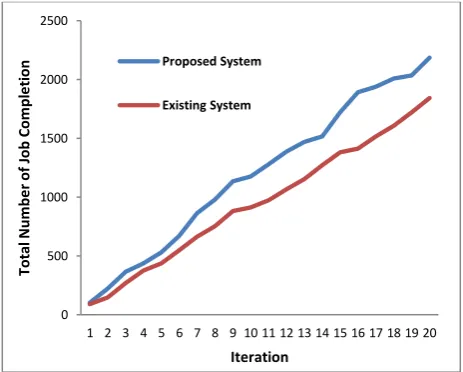
[image:5.595.316.548.446.632.2]The proposed algorithm which is an outcome of mathematical modelling is evaluated in open source platform Java for better supportability of networking APIs. The simulation is performed and the outcome of the proposed algorithm is compared with existing scheduling algorithm. The simulation study was carried out considering 100 similar types of servers where each server is assumed to have specific hardware profiles within 20 iterations. The analysis also considers that jobs arriving at VM are of specific types. For the purpose of performance comparison, we theoretically compared with the study of Pop et al.[19]. The authors have proposed an algorithm for dynamic load balancing in cloud using Monte Carlo simulation considering with and without check points. The proposed system is simulated for 20 iterations, where numbers of loads were on constantly increasing level. So, the analysis is carried out to see how the proposed algorithm performs.
Fig. 2 Total Number of Job Completion
The proposed study considers the variable size of the jobs being seeked by dynamic number of users over cloud. The proposed system performs the load balancing by an excellent switching mechanism among the processing elements, for which purpose the queuing time is highly reduced even with increasing number of traffic. The outcome exhibited in Fig.2 shows that proposed system is capable of undertaking and accomplishing higher number of jobs as compared to existing system. All the values of iterations and total number of job completed are recorded from the simulation study.The simulation was carried out by designing a task that is a
0 500 1000 1500 2000 2500
1 2 3 4 5 6 7 8 9 10 11 12 13 14 15 16 17 18 19 20
complete sequence of instructions. Task execution starts when a task is selected by task dispatcher and one of the system’s processors starts to run task’s instructions. Tasks are classified according to their deadline, priority, arrival characteristic, and computation cycles requests.
Fig.3 Rate of task Completion
Interestingly, processing speed of the proposed system is evaluated using rate of task completion. For this purpose, the simulation was carried out for maximum number of time-slots, where the study monitors the differences between dynamic routing selection and proposed routing selection by comparing their average rate of task completion at various traffic intensities. The outcome of the simulation study depicts that delay performance of both the algorithms is very discreet. The outcomes exhibited in Fig.2 and Fig.3 shows the serious attempt to prove specific dynamic, adaptive, and decentralized load balancing algorithms for cloud environment that are shown to be applicable in balancing loads depending on the efficiency of the underlying Virtual Machine. The application is basically a framework design where the user chooses to simulate for the multiprocessor application. The simulation results in display of the interface design considering all the parameters like waiting jobs, jobs in executions compared with diversified time span relation. The user selects the simulation results in multiple modes. The outcome exhibited in Fig.2 shows that proposed system processes the task very faster leading to smooth gradient in curve as compared to existing load balancing system. While Fig.3 exhibits that rate of task completion is pretty faster as compared to existing system.
Hence, proposed system can be also considered to have faster processing time. The initial phase of the study checks each processor performance along with the time span. It is basically design for much functional information for any uni-processor system in the network. Not only this, the simulation will ultimately furnish the all the fundamental information about this e.g. cloud IDs, user ID, status, start and finish time of total multiprocessor system. The system will also furnish the information pertaining to existing work status and also assist for overall simulated results in a very fast track. Since in a cloud environment, the network topology is varying, our model captures this constraint as well by considering an arbitrary topology. The data transfer rate is not fixed and varies from link to link. The processors that are directly
6.
CONCLUSION
The main aim of the project work is to design a framework application where a scheduling approach to arrange real-time periodic and non-periodic tasks in multiprocessor systems in order to balances task loads of the processors successfully while consider starvation prevention and fairness which cause higher priority tasks have higher running probability. We considered a stochastic model for load balancing and scheduling in cloud computing clusters. A primary contribution is the development of frame-based non-preemptive VM configuration policies. These policies can be made nearly throughput-optimal by choosing sufficiently long frame durations, whereas the widely used best fit policy was shown to be not throughput optimal. Simulations indicate that long frame durations are not only good from a throughput perspective but also seem to provide good delay performance.
7.
REFERENCES
[1] Buyya, R., Broberg, J., Goscinski, A. M.2010.Cloud Computing: Principles and Paradigms. John Wiley & Sons, Computers,pp.664.
[2] Membrey,P., Plugge,E., Hows, D.2012.Practical Load Balancing: Ride the Performance Tiger. Apress, pp.272.
[3] Begum, S., Prashanth.2013.Review of Load Balancing in Cloud Computing. International Journal of Computer Science Issues. Vol. 10, Issue 1, No 2
[4] Xu,G., Pang, J., Fu, X.2013.Load Balancing Model Based on Cloud Partitioning for the Public Cloud. IEEE Transactions on Cloud Computing
[5] Nishant,K., Sharma, P., Krishna, V., Gupta, C., Singh, K.P., Rastogi, R.2012.Load Balancing of Nodes in Cloud Using Ant Colony Optimization.14th International Conference on Modelling and Simulation
[6] Thazhathethil,D.,Katre,N.,Deshmukh,J.M.,Kshirsagar,M, Nadaph, A.2014. International Journal of Innovative Research in Computer and Communication Engineering. Vol. 2, Issue.1
[7] Sethi,S., Sahu, A.,Jena, S.K.2012. Efficient load Balancing in Cloud Computing using Fuzzy Logic. IOSR Journal of Engineering (IOSRJEN) ISSN: 2250-3021 Vol.2, Issue. 7, pp. 65-7
[8] Bhargava,S., Goyal,S. 2013. Dynamic Load Balancing in Cloud Using Live Migration of Virtual Machine. International Journal of Advanced Research in Computer Engineering & Technology (IJARCET) Vol. 2 Issue. 8
[9] Tiwari, M.N., Gautam, K.K.,Katare, R.K.2014. Analysis of Public Cloud Load Balancing using Partitioning Method and Game Theory.International Journal of Advanced Research in Computer Science and Software Engineering, Vol.4, Issue 2
[10] Cheng,X.,.Liu,J.2011.Load-Balanced Migration of Social Media to Content Clouds. NOSSDAV’11,Vancouver,
0 500 1000 1500 2000 2500
1 2 3 4 5 6 7 8 9 10 11 12 13 14 15 16 17 18 19 20
R
at
e
of
t
ask C
om
pl
e
ti
on
Iteration Proposed System
[12]Singhal,P., Shah, S. Load Balancing Algorithm over a Distributed Cloud Network.
[13]Mashaly,M., Kuhn, P.J.2012. Load balancing in cloud-based content delivery networks using adaptive server activation/deactivation.Engineering and Technology (ICET) International Conference, pp.1- 6
[14]Priya,S.M.,Subramani, B.2013. A new approach for load balancing in cloud computing. International Journal Of Engineering And Computer Science ISSN:2319-7242 Vol. 2, Issue. 5, pp. 1636-1640
[15]Galloway, J.M., Smith, K.L., Vrbsky, S.S.2011. Power Aware Load Balancing for Cloud Computing., Proceeding of the World Congress on Engineering and Computer Science, Vol Wcecs
[16] D P L.2013.Load Balancing Algorithms in Cloud Computing, International Journal of Advanced Computer and Mathematical Sciences, Vo.l4, Issue.3, pp.229-233
[17] Mahapatra,S.,Yuan,X.2010.Load balancing mechanisms in data center networks. In the 7th Int. Conf. & Expo on Emerging Technologies for a Smarter World (CEWIT)
[18] Adnan,M.A., Sugihara, R., Gupta,R.K.2012. Energy Efficient Geographical Load Balancing via Dynamic Deferral of Workload.IEEE Fifth International Conference on Cloud Computing