Cite as: J. Appl. Phys. 125, 064305 (2019); https://doi.org/10.1063/1.5086366
Submitted: 20 December 2018 . Accepted: 31 January 2019 . Published Online: 14 February 2019
Pierce Maguire , Clive Downing, Jakub Jadwiszczak , Maria O’Brien, Darragh Keane , John B. McManus , Georg S. Duesberg , Valeria Nicolosi, Niall McEvoy , and Hongzhou Zhang
ARTICLES YOU MAY BE INTERESTED IN
Photoresponsivity enhancement in monolayer MoS2 by rapid O2:Ar plasma treatment
Applied Physics Letters
114
, 091103 (2019); https://doi.org/10.1063/1.5086726
Subsampled STEM-ptychography
Applied Physics Letters
113
, 033104 (2018); https://doi.org/10.1063/1.5040496
Suppression of the shear Raman mode in
defective bilayer
MoS
2
Cite as: J. Appl. Phys.125, 064305 (2019);doi: 10.1063/1.5086366
View Online Export Citation CrossMark
Submitted: 20 December 2018 · Accepted: 31 January 2019 · Published Online: 14 February 2019
Pierce Maguire,1,2 Clive Downing,2,3Jakub Jadwiszczak,1,2 Maria O’Brien,2,3Darragh Keane,2,3
John B. McManus,2,3 Georg S. Duesberg,2,3,4 Valeria Nicolosi,2,3Niall McEvoy,2,3 and Hongzhou Zhang1,2,a)
AFFILIATIONS
1School of Physics, Trinity College Dublin, Dublin 2, D02 PN40, Ireland
2AMBER Centre, CRANN Institute, Trinity College Dublin, Dublin 2, D02 PN40, Ireland 3School of Chemistry, Trinity College Dublin, Dublin 2, D02 PN40, Ireland
4Institute of Physics, EIT 2, Faculty of Electrical Engineering and Information Technology, Universität der Bundeswehr München,
Werner-Heisenberg-Weg 39, 85577 Neubiberg, Germany
a)Electronic mail:[email protected]
ABSTRACT
We investigate the effects of lattice disorders on the low frequency Raman spectra of bilayer MoS2. The bilayer MoS2 was subjected to defect engineering by irradiation with a 30 keV Heþion beam, and the induced morphology change was character-ized by transmission electron microscopy. When increasing the ion dose, the shear mode is observed to red-shift, and it is also suppressed sharply compared to other Raman peaks. We use the linear chain model to describe the changes to the Raman spectra. Our observations suggest that the crystallite size and orientation are the dominant factors behind the changes to the Raman spectra.
Published under license by AIP Publishing.https://doi.org/10.1063/1.5086366
I. INTRODUCTION
As research on transition metal dichalcogenides (TMDs) blooms,1–4it is crucial to understand the interfacial dynamics of these layered semiconductors in the few-layer limit. Low-frequency interlayer vibrational Raman modes serve as a fingerprint of the interlayer interactions between van der Waals-bonded sheets in both homo- and heterostructures.5–8 The low-frequency Raman modes of MoS2include the in-plane shear mode (SM) and the out-of-plane layer breathing mode (LBM). Layer thickness, stacking order, and angular lattice mismatch can be directly probed in vertically-assembled heterostructures of TMDs by investigating changes to these modes.6,9–13 On the other hand, Raman spectroscopy has remained a high-throughput and non-destructive way of ana-lyzing defects in MoS2 flakes in the last decade. In particular, theE1
2g(385 cm1) andA1g(403 cm1) modes are routinely
used to identify layer thickness in exfoliated and deposited MoS2samples.10,14–17Relative changes in intensities, positions, or widths are used to characterise the lattice modification of
MoS2.18–21However, the effects of lattice defects on the low-frequency (,50 cm1) modes of few-layer MoS2have not been explored, even while low-frequency Raman spectroscopy should play a vital role in the characterization of interfacial dynamics of defective layered semiconductors.
Herein, we analyze the low-frequency modes of the Raman spectrum of bilayer MoS2as a function of increasing disorder introduced by Heþ irradiation at a beam energy of 30 keV. The helium ion microscope has been established as a tool for site-specific modification of 2D materials.18,22–27It has been used to precisely introduce defects,21fabricate nanorib-bons, and periodic arrays of nanodots,18,22 and introduce doping on the nanoscale.23
II. EXPERIMENTAL METHODS
at an energy of 30 keV and an angle of incidence of 0. These regions received doses ranging from 81013 to 21016 Heþcm2. Further details of the ion irradiation are provided in the supplementary material. Ex situ Raman and PL spectro-scopy was carried out using aWITec Alpha 300Rsystem (532 nm laser) with a 1800 lines/mm diffraction grating and a 100 objective (NA¼0:95) (spot size0:3μm). The instrument was equipped with a RayShield Coupler to detect the Raman signal close to the Rayleigh line. The laser power was170μW or less to minimise damage to the samples. Raman and PL maps were generated by taking four spectra perμm in both the x and y directions over large areas. The acquisition time for each spec-trum was 0.113 s. The spectra from each irradiated region were acquired by averaging. Raman, PL, and optical images are shown in Fig. S1 in thesupplementary material. Lorentzian distribu-tions werefitted to the Raman peaks as demonstrated in Fig. S4 in thesupplementary material.
[image:3.612.56.299.486.611.2]III. RESULTS AND DISCUSSION
Figure 1shows representative Raman spectra. In the low frequency region [Fig. 1(a)], the SM and LBM peaks are centred at23 cm1and41 cm1, respectively, which are in excellent agreement with the reported values for bilayer MoS2.9,17,30For an increasing dose, the SM is clearly observed to red-shift and broaden while the LBM does not appear to change. At higher doses (11016Heþcm2), the low fre-quency modes become indistinguishable from noise. In the high frequency region [Fig. 1(b)], the characteristicEgandA1g
peaks of bilayer MoS2are found at 384 cm1 and 406:6 cm1, respectively, thus exhibiting a high frequency peak separation of 22:6 cm1 typical of CVD bilayer MoS
2.14,31 With an increasing ion dose, theA1gpeak is observed to broaden, while
as has been reported before in similar conditions.21,32,33 Figure 2shows photoluminescence (PL) spectra acquired from the same regions of bilayer MoS2. We observe peaks at
1:85 eV and2:01 eV, corresponding toAandBdirect exci-tonic transitions, respectively.34 The increased disorder is strongly associated with a lower quantum efficiency. The decrease in theAexciton peak intensity is accompanied by a blue-shift which is attributed to strain caused by ion-induced defects.35 Above a dose of 21015Heþcm2, we can no longer observe a clearly defined emission peak.
Figures 3(a)and3(b)show the position and width, respec-tively, of the low frequency Raman peaks as a function of the ion dose (analysis of the high frequency peaks is presented in Fig. S3 in the supplementary material). The SM clearly shifts downward in position as it broadens. However, the LBM does not appear to change systematically in position or width. The measured SM frequency,ω, is given by
ω¼ω02:04108 ffiffiffi S p
, (1)
where ω0¼22:8 cm1 is the frequency of the non-irradiated bilayer MoS2andSis the ion dose (Heþcm2). The measured width,Γ, is given by
Γ¼Γ0þ0:247
ffiffiffi S p
, (2)
where Γ0¼1:9 cm1 is the width of the undamaged bilayer MoS2.
Figure 3(c) shows the heights of the low frequency modes,I(X), whereX¼SM or LBM, normalized to the respec-tive A1gintensity, I(A1g). While the intensity ofI(LBM)=I(A1g) is
virtually constant,I(SM)=I(A1g) is observed to diminish with an
increasing dose. The SM is clearly suppressed more rapidly than other peaks by increasing disorder. The SM intensity ratio varies with the doseI(SM)/I(A1g)=Sd, whered¼0:17 is a
fitting parameter.
Figure 4(a) is a high resolution transmission electron microscopy (HRTEM) image of mechanically exfoliated bilayer MoS2 showing clearly defined layers with uniform interlayer spacing (see Fig. S5 in the supplementary material for TEM sample preparation). Above and below the MoS2, the protec-tive platinum layer and the SiO2substrate are visible, respec-tively. Figure 4(b) shows a region of the same sample which has been irradiated with 61015Heþcm2 which is in the middle-to-high part of the range of doses used in our spec-troscopic experiments. An additional amorphous hydrocarbon layer of helium ion beam-induced deposition (IBID) is visible on top of the MoS2. A clear increase in the surface asperity is noted after irradiation. In certain regions, MoS2is still visibly present but separate layers cannot be resolved. This may suggest amorphization or local twisting of the layers such that they are imaged off-axis.
Figure 4(c)is a histogram of interlayer separation evalu-ated from the two TEM images, using a fitting process
described in thesupplementary material. There appears to be very little change in the mean layer separation after irradia-tion. However, the disordered distribution is clearly more diffuse and skewed toward higher values, reflected in the increased kurtosis and skewness, respectively.
A linear chain model (LCM) has been used to describe interlayer restoring forces by treating each layer as a rigid ball.17,36The model has accurately predicted the frequencies of the low frequency modes in pristine MoS2as a function of layer number. The single layer mass per unit area (μ0) of pris-tine MoS2is 3:031026kg A
2
. Since sputtering of specimen atoms is caused by the ion irradiation, the effects are accounted for in μ by applying an approximate correction related to the ion dose. However, as demonstrated in Figs. S8 and S9 in thesupplementary material, this effect would lead
to a very small blue shift which by calculation and experiment is indicated to be negligible.
Given the dose,S, and the sputter yield,γ (=0.007 from the previous reports21,37,38), then μ(S) for irradiated MoS
2 is given by μ(S)¼μ0(1γS=n), where n is the atomic density. This gives the sputtering-corrected LCM as
ω(S)¼ ffiffiffi1 2 p
πc
ffiffiffiffiffiffiffiffiffiffiffiffiffiffiffiffiffiffiffiffiffiffiα
μ0 1γnS
s ffiffiffiffiffiffiffiffiffiffiffiffiffiffiffiffiffiffiffiffiffiffiffiffiffi 1þcos π
N r
[image:4.612.110.242.99.231.2], (3)
[image:4.612.317.560.102.232.2]FIG. 2. PL spectra of the same regions with the same color-dose correspon-dence as inFig. 1.XAandXBlabel the A and B excitons, respectively. The A exciton emission is observed to decline rapidly with an increasing dose. The spectra are normalized to the maximum of each to allow comparison of the two peaks. The spectra are presented without normalisation in Fig. S2 in the supple-mentary material.
FIG. 3.Evolution of the low frequency Raman modes as a function of ion dose. Error bars are from thefitting error. (a) shows the change in frequency of the two low frequency modes. The shear mode frequency isfitted with Eq.(1). (b) shows the change in width of the two low frequency modes. The shear mode position isfitted with Eq.(2). (c) shows the ratio of the intensity of the two low frequency modes to theA1gpeak. The shear mode intensity ratio isfitted as described in the main text.
[image:4.612.64.558.444.658.2]wherecis the speed of light in cm s1,Nis the layer number (fixed at 2 in this work),αis the interlayer force constant per unit area which is related to the interlayer separation,t, and the shear modulus,Cbyα¼C=t. The shear modulus has been reported asC≃17:9 GPa.17ForS¼0, the shear mode position is calculated to be 23:2 cm1 which is consistent with our experimental value of 22:8 cm1. The separation of two non-irradiated layers in bilayer MoS2 measured from our TEM results ist¼0:65+0:04 nm, in good agreement with the lit-erature.17In the absence of other effects, the separation that would be required to explain the red shift is0:76 nm (see Fig. S9 in thesupplementary material). This is not consistent with the TEM results, so we cannot attribute the red shift to a change in separation.
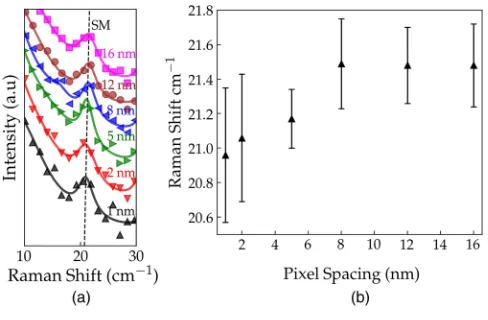
The two keyfindings of our Raman spectroscopy experi-ments clear fromFigs. 1and2are related to the shear mode, i.e., the drop in the normalized intensity (2:3) and the fre-quency red-shift (Δω≃1:8 cm1) with ion irradiation. Small twisting angles can introduce a periodicity mismatch between layers, altering the stacking configuration and causing a sharp decay of SM intensity and a downward shift in position.39,40 The twisting is evident in the TEM observation (Fig. 4). However, the twisting alone cannot explain the observed peak shift (see Fig. S10 in the supplementary material). Reductions in the shear modulus also contribute to a red-shift in the SM. This is due to the reduced crystallinity in MoS2under ion irradiation. The reduced crystallinity leads to better lubricating properties, attributed to a greater tendency to exfoliate and therefore a reduced shear modulus.41 To further corroborate this, we studied the effect of varying the pixel spacing on the SM with a new set of irradiation experi-ments. We used afixed dose of 61015cm2 but we varied the pixel spacing from 1 to 16 nm. The probe size was4 nm (see Fig. S7 in the supplementary material).42 The resulting Raman spectra are presented in Fig. 5(a). Figure 5(b) shows
observed to increase (the total effect is approximately 0:5 cm1). As pixel spacings decrease, the total undamaged area is reduced. This suggests that regions of defective MoS2 may have a reduced shear modulus in addition to the twisting effects.
IV. CONCLUSION
In conclusion, we explored the effects of increased disor-der on the low and high frequency Raman peaks of bilayer MoS2. In the low frequency range, we noticed that the shear mode red-shifted and dropped in intensity with an increased irradiation dose. We used TEM imaging to investigate and we suggest that these changes can be attributed to a mixture of local twisting of layers and a decline in the shear modulus due to reduced crystallite sizes.
SUPPLEMENTARY MATERIAL
See thesupplementary material for further information on the irradiation, Raman, PL, and TEM experiments, data treatment, and layer separation calculations.
ACKNOWLEDGMENTS
The authors thank the staff at the Advanced Microscopy Laboratory (AML), CRANN, Trinity College Dublin. We acknowl-edge support from the following grants: Science Foundation Ireland (Grant Nos. 12/RC/2278, 15/SIRG/3329, 11/PI/1105, 07/SK/I1220a, 15/IA/3131, and 08/CE/I1432) and Irish Research Council (Grant No. GOIPG/2014/972).
REFERENCES
1K. S. Novoselov, A. Mishchenko, A. Carvalho, and A. H. Castro Neto, Science353, aac9439 (2016).
2D. Jariwala, T. J. Marks, and M. C. Hersam,Nat. Mater.16, 170 (2016). 3K. Kang, K. H. Lee, Y. Han, H. Gao, S. Xie, D. A. Muller, and J. Park,Nature
550, 229 (2017).
4J. H. Sung, H. Heo, S. Si, Y. H. Kim, H. R. Noh, K. Song, J. Kim, C. S. Lee,
S. Y. Seo, D. H. Kim, H. K. Kim, H. W. Yeom, T. H. Kim, S. Choi, J. S. Kim, and M. H. Jo,Nat. Nanotechnol.12, 1064 (2017).
5M. Boukhicha, M. Calandra, M. A. Measson, O. Lancry, and A. Shukla,Phys. Rev. B87, 1 (2013).
6C. H. Lui, Z. Ye, C. Ji, K. C. Chiu, C. T. Chou, T. I. Andersen,
C. Means-Shively, H. Anderson, J. M. Wu, T. Kidd, Y. H. Lee, and R. He,
Phys. Rev. B91, 1 (2015).
7J. Zhang, J. Wang, P. Chen, Y. Sun, S. Wu, Z. Jia, X. Lu, H. Yu, W. Chen,
J. Zhu, G. Xie, R. Yang, D. Shi, X. Xu, J. Xiang, K. Liu, and G. Zhang,Adv. Mater.28, 1950 (2016).
8Y. Li, S. Lin, Y. S. Chui, and S. P. Lau,ECS J. Solid State Sci. Technol.5,
Q3033 (2016).
9Y. Zhao, X. Luo, H. Li, J. Zhang, P. T. Araujo, C. K. Gan, J. Wu, H. Zhang,
S. Y. Quek, M. S. Dresselhaus, and Q. Xiong,Nano Lett.13, 1007 (2013).
10X. Zhang, W. P. Han, J. B. Wu, S. Milana, Y. Lu, Q. Q. Li, A. C. Ferrari, and
P. H. Tan,Phys. Rev. B87, 115413 (2013).
11X. Zhang, X. F. Qiao, W. Shi, J. B. Wu, D. S. Jiang, and P. H. Tan,Chem. Soc. Rev.44, 2757 (2015).
12Z. Lin, B. R. Carvalho, E. Kahn, R. Lv, R. Rao, H. Terrones, M. A. Pimenta,
and M. Terrones,2D Mater.3, 022002 (2016).
13Q. J. Song, Q. H. Tan, X. Zhang, J. B. Wu, B. W. Sheng, Y. Wan, X. Q. Wang,
[image:5.612.54.298.100.260.2]L. Dai, and P. H. Tan,Phys. Rev. B93, 115409 (2016).
14C. Lee, H. Yan, L. E. Brus, T. F. Heinz, J. Hone, and S. Ryu,ACS Nano4,
2695 (2010).
15H. Li, Q. Zhang, C. C. R. Yap, B. K. Tay, T. H. T. Edwin, A. Olivier, and
D. Baillargeat,Adv. Funct. Mater.22, 1385 (2012).
16M. O’Brien, N. McEvoy, D. Hanlon, T. Hallam, J. N. Coleman, and
G. S. Duesberg,Sci. Rep.6, 19476 (2016).
17H. Zeng, B. Zhu, K. Liu, J. Fan, X. Cui, and Q. M. Zhang,Phys. Rev. B86,
241301(R) (2012).
18D. S. Fox, Y. Zhou, P. Maguire, A. O’Neill, C. O’Coileáin, R. Gatensby,
A. M. Glushenkov, T. Tao, G. S. Duesberg, I. V. Shvets, M. Abid, M. Abid, H. C. Wu, Y. Chen, J. N. Coleman, J. F. Donegan, and H. Zhang,Nano Lett. 15, 5307 (2015).
19T. Y. Ko, A. Jeong, W. Kim, J. Lee, Y. Kim, J. E. Lee, G. H. Ryu, K. Park,
D. Kim, Z. Lee, M. H. Lee, C. Lee, and S. Ryu,2D Mater.4, 014003 (2016).
20N. Choudhary, M. R. Islam, N. Kang, L. Tetard, Y. Jung, and
S. I. Khondaker,J. Phys. Condens. Matter28, 364002 (2016).
21P. Maguire, D. S. Fox, Y. Zhou, Q. Wang, M. O’Brien, J. Jadwiszczak,
C. P. Cullen, J. B. McManus, S. Bateman, N. McEvoy, G. S. Duesberg, and H. Zhang,Phys. Rev. B98, 134109 (2018).
22Y. Zhou, P. Maguire, J. Jadwiszczak, M. Muruganathan, H. Mizuta, and
H. Zhang,Nanotechnology27, 325302 (2016).
23G. Nanda, S. Goswami, K. Watanabe, T. Taniguchi, and P. F. A. Alkemade, Nano Lett.15, 4006 (2015).
24V. Iberi, L. Liangbo, A. V. Ievlev, M. G. Stanford, M. W. Lin, X. Li,
M. Mahjouri-Samani, S. Jesse, B. G. Sumpter, S. V. Kalinin, D. C. Joy, K. Xiao, A. Belianinov, and O. S. Ovchinnikova,Sci. Rep.6, 30481 (2016).
25M. G. Stanford, P. R. Pudasaini, A. Belianinov, N. Cross, J. H. Noh,
M. R. Koehler, D. G. Mandrus, G. Duscher, A. J. Rondinone, I. N. Ivanov, T. Z. Ward, and P. D. Rack,Sci. Rep.6, 27276 (2016).
26M. G. Stanford, P. R. Pudasaini, E. T. Gallmeier, N. Cross, L. Liang,
A. Oyedele, G. Duscher, M. Mahjouri-Samani, K. Wang, K. Xiao, D. B. Geohegan, A. Belianinov, B. G. Sumpter, and P. D. Rack,Adv. Funct. Mater.27, 1702829 (2017).
27G. Nanda, G. Hlawacek, S. Goswami, K. Watanabe, T. Taniguchi, and
P. F. A. Alkemade,Carbon119, 419 (2017).
28M. O’Brien, N. McEvoy, T. Hallam, H. Y. Kim, N. C. Berner, D. Hanlon,
K. Lee, J. N. Coleman, and G. S. Duesberg,Sci. Rep.4, 7374 (2014).
29A. Castellanos-Gomez, M. Barkelid, A. M. Goossens, V. E. Calado,
H. S. J. Van Der Zant, and G. A. Steele,Nano Lett.12, 3187 (2012).
30L. Liang, J. Zhang, B. G. Sumpter, Q. H. Tan, P. H. Tan, and V. Meunier, ACS Nano11, 11777 (2017).
31K. Liu, L. Zhang, T. Cao, C. Jin, D. Qiu, Q. Zhou, A. Zettle, P. Yang,
S. G. Louie, and F. Wang,Nat. Commun.5, 4966 (2014).
32S. Mignuzzi, A. J. Pollard, N. Bonini, B. Brennan, I. S. Gilmore,
M. A. Pimenta, D. Richards, and D. Roy,Phys. Rev. B91, 195411 (2015).
33J. Klein, A. Kuc, A. Nolinder, M. Altzschner, J. Wierzbowski, F. Sigger,
F. Kreupl, J. J. Finley, U. Wurstbauer, A. W. Holleitner, and M. Kaniber,2D Mater.5, 011007 (2018).
34A. Splendiani, L. Sun, Y. Zhang, T. Li, J. Kim, C. Y. Chim, G. Galli, and
F. Wang,Nano Lett.10, 1271 (2010).
35N. Scheuschner, O. Ochedowski, A. M. Kaulitz, R. Gillen, M. Schleberger,
and J. Maultzsch,Phys. Rev. B89, 125406 (2014).
36P. H. Tan, W. P. Han, W. J. Zhao, Z. H. Wu, K. Chang, H. Wang, Y. F. Wang,
N. Bonini, N. Marzari, N. Pugno, G. Savini, A. Lombardo, and A. C. Ferrari,
Nat. Mater.11, 294 (2012).
37S. Kretschmer, M. Maslov, S. Ghaderzadeh, M. Ghorbani-Asl,
G. Hlawacek, and A. V. Krasheninnikov, ACS Appl. Mater. Interfaces10, 30827 (2018).
38W. M. Parkin, A. Balan, L. Liang, P. M. Das, M. Lamparski, C. H. Naylor,
J. A. Rodríguez-Manzo, A. T. C. Johnson, V. Meunier, and M. Drndić,ACS Nano10, 4134 (2016).
39S. Huang, L. Liang, X. Ling, A. A. Puretzky, D. B. Geohegan,
B. G. Sumpter, J. Kong, V. Meunier, and M. S. Dresselhaus,Nano Lett.16, 1435 (2016).
40L. Liang, A. A. Puretzky, B. G. Sumpter, and V. Meunier, Nanoscale9,
15340 (2017).
41I. Lahouij, B. Vacher, J. M. Martin, and F. Dassenoy, Wear 296, 558
(2012).
42C. Rueden, J. Schindelin, M. Hiner, B. DeZonia, A. Walter, E. Arena, and