Vanessa Koch∗,a,bJohn Bulava,c Ben Hörz,d Francesco Knechtli,b Graham Moir,e Colin Morningstar,f Mike Peardona
aSchool of Mathematics, Trinity College Dublin, Dublin 2, Ireland
bDept. of Physics, University of Wuppertal, Gaussstrasse 20, D-42119 Germany
cCP3-Origins, University of Southern Denmark, Campusvej 55, 5230 Odense M, Denmark dPRISMA Cluster of Excellence and Institute for Nuclear Physics, Johannes
Gutenberg-Universität, 55099 Mainz, Germany
eDept. of Mathematics, Hurstpierpoint College, College Lane, Hassocks, West Sussex, BN6 9JS, United Kingdom
fDept. of Physics, Carnegie Mellon University, Pittsburgh, PA 15213, USA
E-mail:[email protected],[email protected],[email protected], [email protected], [email protected], [email protected],[email protected]
The static potentialV(r)between a static quark and a static antiquark separated by a distance r is defined as the energy of the ground state of the system. As a consequence of confinement, the energy between the quark-antiquark pair is contained inside a color flux tube, which will break due to pair creation as soon as the energy is high enough. String breaking is manifested as a quantum-mechanical mixing phenomenon between different states containing two infinitely heavy quarks. We investigate this phenomenon
withNf=2+1flavors of dynamical fermions in the stochastic LapH framework, using
an ensemble of gauge configurations generated through the CLS effort. We observe the effect of the third sea-quark flavor, which results in a second mixing-phenomenon.
The 36th Annual International Symposium on Lattice Field Theory - LATTICE2018 22-28 July, 2018
Michigan State University, East Lansing, Michigan, USA.
∗Speaker.
1. Introduction
String breaking, the transition of the static quark anti-quark string into a static-light meson-antimeson system, provides an intuitive example of a strong decay and is one of the defining characteristics of a confining gauge theory. Traditionally, in order to explore string breaking on the lattice, the Wilson loop was used as an observable. The breaking of the string should manifest itself by rendering the potential constant above a certain threshold, because it exhibits screening after the string is broken and saturates towards twice the static-light meson mass2EmB. But this phenomenon could not be observed in early simulations, even if the potential was calculated for distances bigger than the esti-mated string breaking distance, see for example [1, 2]. One problem is the small signal to noise ratio for distances beyond 1fm. However, the most important reason for the lack of evidence for string breaking using Wilson loops is that the Wilson line operator has a very small overlap with the ground state after the string is broken.
In the theory with dynamical quarks, string breaking is manifested as a quantum-mechanical mixing phenomenon. This means that the two states, the string state as well as the two-meson state, are both needed to describe the potential. After the string is broken, the meson state dominates the new ground state of this system. In the neighborhood of the critical separation, the two states mix. If there is mixing, the ground state and first excited state are superpositions of the string state and the two-meson state, as a consequence the system undergoes an avoided level crossing, giving rise to an energy gap between the energy eigenstates.
To examine the ground state and first excited state of the static potential as a mixing phenomenon, their energies are determined by a variational technique from a correlation matrix. Using this method, string breaking has been thoroughly investigated for the SU(2) Higgs model, e.g. [3–5]. For QCD withNf=2 quark flavors, the most recent study of string breaking was performed on a single ensemble [6], with sea quark mass slightly below the mass of the strange quark. So far, string breaking has not yet been observed for the Nf=2+1 theory. When the strange quark is included in the sea, two separate thresholds are expected, one for the decay into two static-light mesons and one for the decay into two static-strange mesons. We investigate the phenomenon with Nf=2+1 flavors of non-perturbatively O(a)-improved dynamical Wilson fermions using an ensemble of gauge configurations generated through the Coordinated Lattice Simulations (CLS) effort [7]. The N200 ensemble has a lattice size of Nt×Ns3=128×483 with an estimated isotropic lattice spacing of a≈0.064fm, pion massmπ=280MeV and kaon massmK=460MeV. We employ the stochastic LapH method [8] in order to facilitate all-to-all propagation and calculate correlation functions required for string breaking efficiently. A variational analysis is used to extract the ground state as well as the first and second excited state of the system containing two static quarks.
2. String breaking as a mixing phenomenon
a heavy anti-quarkQ(y,t)at point(y,t)in the static approximation. They are separated by a distancer=|y−x|, with conserved quantum numbersxandy. To examine the ground state of this system, i.e. the static potential, as well as the first and second excited state as a mixing phenomenon, the energies are determined by a variational technique from a correlation matrix. The matrix is built by correlation functions containing the interpola-tors for a Wilson loop, the two static-light and two static-strange meson state, where it is essential that the states have the same symmetries and thus carry the same quantum numbers. For every distance, a separate variational analysis has to be performed, so in order to extract the ground state as well as the first and second excited state a generalized eigenvalue problem (GEVP) [9, 10] is solved for eachr.
If the interpolatorsOW,OBBandOBsBscorrespond to the string state and the state con-sisting of two static-light and two static-strange mesons respectively, the mixing matrix is given by
C(r,t) =
CQQ=hOW(t)OW(0)i CBQ=hOBB(t)OW(0)i CBsQ=hOBsBs(t)OW(0)i CQB=hOW(t)OBB(0)i CBB=hOBB(t)OBB(0)i CBBs =hOBB(t)OBsBs(0)i CBQ=hOBB(t)OW(0)iCBsB=hOBsBs(t)OBB(0)i CBsBs =hOBsBs(t)OBsBs(0)i
= √ 2× √
2× 2× + √2×
√
2× +
, (2.1)
where the expectation value over gauge configurations is implicit in the pictorial rep-resentation of the diagrams. The diagonal entries are given by the correlation functions for the string, the two static-light and static-strange meson state. The wiggly lines corre-spond to light and strange quark propagators, where the up and down quark are mass-degenerate sea quark flavors. Mixing occurs when the physical energy eigenstates are not unit vectors in this operator basis, which is shown explicitly by non vanishing off-diagonal elements.
2.1 Steps towards string breaking
The mixing matrix employed for the analysis is a 4×4 matrix. It is an extension of 2.1, including 15 and 20 levels of spatial HYP smearing [11] for OW. Following the method presented in [12], all gauge-links, including temporal links, are smeared using HYP2 parameters [13, 14]: α1=1.0,α2=1.0,α3=0.5. This amounts to a change in the
The diagrams involving light and strange quark propagators are measured on evenly spaced configurations of the N200 ensemble, employing a subset of the data used in [16]. Quark propagation is estimated using the stochastic LapH method [8] with parameters listed in table1, which are chosen in a way that they result in a similar physical smearing as in previous studies [8]. The quark-field smearing makes use of stout-smeared gauge links [17] in order to spatially smooth the gauge field.
id Nev nρ×ρ line type dilution scheme Nr light/strange source time
N200 192 36×0.1 fixed (TF,SF,LI8) 5 / 2 32, 52
relative (TI8,SF,LI8) 2 / 1
-Table 1:Number of eigenvectors, stout-smearing parameters, dilution schemes, number of noise sources, and source times employed in this work. For definition of the LapH subspace and speci-fication of dilution schemes, see [8].
The GEVP is defined by
C(t)vn(t,t0) =λn(t,t0)C(t0)vn(t,t0), n=1, . . . ,N, t>t0, (2.2)
where λn andvn are the eigenvalues and eigenvectors of the correlation matrix, respec-tively. Fort→∞, the extracted eigenvalues are proportional to a single exponential func-tion [10]
lim t→∞
λn(t,t0) =exp(−En(t−t0)). (2.3)
After solving the GEVP, three states are extracted using a two-parameter correlated fit to a single-exponential ansatz. Statistical uncertainties are estimated using bootstrap resam-pling [18, 19] withNb=800samples and the uncertainty quoted for numerical values is given by1σ bootstrap errors. The covariance matrix was estimated on the original data
and is kept ‘frozen’on all samples.
In the case of the string breaking spectrum, we are interested in the difference be-tween the energies of the ground, first and second excited state and twice the energy of the static-light meson2EmB, which can be directly extracted from ratio fits. If correlations between weakly-interacting two static-light meson and single static-light meson corre-lation functions are taken into account, this allows for a more precise extraction of the energy difference. We define the ratio
Rn(t) =
λn(t,t0)
CB2(t) , (2.4)
whereCB(t)is the correlation function of the static-light meson.
0 5 10 15 20 25 −0.6
−0.5 −0.4 −0.3 −0.2 −0.1 0 0.1 0.2
r/a
a
(
V
(
r
)
−
2
EB
[image:5.595.131.469.94.341.2])
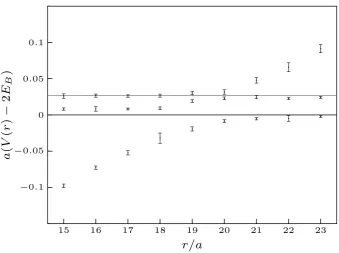
Figure 1: On-axis static potential determined using the full mixing matrix and renormalized by subtracting twice the energy of a light meson. The grey line corresponds to twice the static-strange mass, its error is too small to be visible. The error of the static-light meson mass is
auto-matically taken into account by using the ratio given in equation (2.4).
15 16 17 18 19 20 21 22 23 −0.1
−0.05 0.05
0 0.1
r/a
a
(
V
(
r
)
−
2
EB
)
[image:5.595.131.471.435.688.2]3. Results and outlook
Figure 1 and 2 show the preliminary results on 52 configurations for the diagrams involving light or strange quark propagators and Wilson loops measured on 1664 con-figurations, using only on-axis distances. The first and second excited state for the two smallest distances can not be reliably extracted, so there are no extracted energies shown for these states. For each distance r, we average over distinct permutations of(0,0,r)
in order to increase statistics by exploiting the cubic symmetry of the lattice. We do not observe any dependence on the direction in the data.
The results of the preliminary mixing analysis are in agreement with the expected string breaking distance [20] given by the analysis of the potential using 100 configu-rations of N200, employing only rectangular Wilson-loops. The avoided level crossing between the ground state and the first excited state can be observed, whereas the ex-pected second avoided crossing due to the formation of two static-strange mesons is not clearly visible using only on-axis distances. For distances beyond string breaking, the ground state tends towards the mass of two noninteracting static-light mesons, which cannot be observed if the potential is calculated from Wilson loops only. Apart from the string breaking region, the plot exhibits interesting behaviour for intermediate distances. The first excited energy differs from2EBfor intermediate distances smaller than the string breaking distance, which could be an indication of interaction between the two static-light mesons. For the second extracted energy level, we observe agreement with2EBs−2EBat intermediate distances and beyond string breaking, as expected.
The full mixing analysis with an enhanced spatial resolution as well as higher statis-tics is underway [21], utilizing a set of off-axis distances between17aand21.8ato ensure that we are able to map out the first as well as the second expected avoided level crossing.
Acknowledgements
The authors wish to acknowledge the DJEI/DES/SFI/HEA Irish Centre for High-End Computing (ICHEC) for the provision of computational facilities and support. We are grateful to our colleagues within the CLS initiative for sharing ensembles. The code for the calculations using the stochastic LapH method is built on the USQCD QDP++/Chroma library [22]. CJM acknowledges support by the U.S. National Science Foundation un-der award PHY-1613449. BH was supported by Science Foundation Ireland unun-der Grant No. 11/RFP/PHY3218. VK has received funding from the European Union’s Horizon 2020 research and innovation programme under the Marie Sklodowska-Curie grant agree-ment Number 642069.
References
[1] TXL collaboration, U. Glassner et al.,First evidence of N(f) dependence in the QCD interquark
potential,Phys.Lett.B383(1996) 98[hep-lat/9604014].
[2] U. M. Heller, K. M. Bitar, R. G. Edwards and A. D. Kennedy,The Heavy quark potential in QCD
[3] ALPHA collaboration, F. Knechtli and R. Sommer,String breaking as a mixing phenomenon in the SU(2) Higgs model,Nucl.Phys.B590(2000) 309[[hep-lat/0005021]].
[4] ALPHA collaboration, F. Knechtli and R. Sommer,String breaking in SU(2) gauge theory with
scalar matter fields,Phys.Lett.B440(1998) 345[[hep-lat/9807022]].
[5] O. Philipsen and H. Wittig,String breaking in nonAbelian gauge theories with fundamental matter
fields,Phys.Rev.Lett.81(1998) 4056[[hep-lat/9807020]].
[6] SESAM collaboration, G. S. Bali, H. Neff, T. Duessel, T. Lippert and K. Schilling, Observation
of string breaking in QCD,Phys.Rev.D71(2005) 114513[[hep-lat/0505012]].
[7] M. Bruno, D. Djukanovic, G. P. Engel, A. Francis, G. Herdoiza et al.,Simulation of QCD with
Nf =2+1 flavors of non-perturbatively improved Wilson fermions,JHEP1502(2015) 043
[[hep-lat/1411.3982]].
[8] C. Morningstar, J. Bulava, J. Foley, K. J. Juge, D. Lenkner et al.,Improved stochastic estimation
of quark propagation with Laplacian Heaviside smearing in lattice QCD,Phys.Rev.D83(2011)
114505[[hep-lat/1104.3870]].
[9] B. Blossier, M. Della Morte, G. von Hippel, T. Mendes and R. Sommer, On the generalized
eigenvalue method for energies and matrix elements in lattice field theory,JHEP0904(2009)
094[0902.1265].
[10] M. Lüscher and U. Wolff,How to calculate the elastic scattering matrix in two-dimensional
quantum field theories by numerical simulation,Nuclear Physics B339(1990) 222.
[11] A. Hasenfratz, R. Hoffmann and F. Knechtli,The Static potential with hypercubic blocking,
Nucl.Phys.Proc.Suppl.106(2002) 418[[hep-lat/0110168]].
[12] M. Donnellan, F. Knechtli, B. Leder and R. Sommer,Determination of the Static Potential with
Dynamical Fermions,Nucl.Phys.B849(2011) 45[[hep-lat/1012.3037]].
[13] A. Hasenfratz and F. Knechtli,Flavor symmetry and the static potential with hypercubic blocking,
Phys.Rev.D64(2001) 034504[[hep-lat/0103029]].
[14] M. Della Morte, A. Shindler and R. Sommer,On lattice actions for static quarks,JHEP0508
(2005) 051[[hep-lat/0506008]].
[15] E. Eichten and B. R. Hill,An Effective Field Theory for the Calculation of Matrix Elements
Involving Heavy Quarks,Phys.Lett.B234(1990) 511.
[16] C. Andersen, J. Bulava, B. Hörz and C. Morningstar,TheI=1pion-pion scattering amplitude
and timelike pion form factor fromNf=2+1lattice QCD,1808.05007.
[17] C. Morningstar and M. J. Peardon,Analytic smearing of SU(3) link variables in lattice QCD,
Phys.Rev.D69(2004) 054501[hep-lat/0311018].
[18] Bootstrap methods: Another look at the jackknife,The Annals of Statistics7(1979) 1.
[19] B. Efron and R. Tibshirani,Bootstrap methods for standard errors, confidence intervals, and other
measures of statistical accuracy, .
[20] V. Koch, J. Bulava, B. Hörz, F. Knechtli, G. Moir, C. Morningstar et al.,Towards string breaking
with 2+1 dynamical fermions using the stochastic LapH method,PoSLATTICE2015(2016) 100 [1511.04029].
[21] J. Bulava, B. Hörz, F. Knechtli, V. Koch, G. Moir, C. Morningstar et al., in preparation.
[22] SCIDAC, LHPC, UKQCD collaboration, R. G. Edwards and B. Joo,The Chroma software