Journal of Chemical and Pharmaceutical Research, 2012, 4(1):154-159
Research Article
CODEN(USA) : JCPRC5
ISSN : 0975-7384
A RP- HPLC method development and validation for the simultaneous
estimation of glimepiride and pioglitazone HCl in tablet dosage forms
M. S. V. Sakuntala*, S. V. U. M. Prasad, S. Sri Devi, S. Kishore Yadav, K. Srinivas Reddy
School of Pharmaceutical Sciences & Technologies, Jawaharlal Nehru Technological University,
KAKINADA
_____________________________________________________________________________________________
ABSTRACT
A simple, fast, economical, accurate, precise and reproducible RP – HPLC method was developed for the determination of Glimepiride (GLM) and Pioglitazone HCl (PIO) was developed on shimadzu HPLC systems with Inertsil ODS C18 column (150 × 4.6mm, 5µ) and using a mobile phase mixture containing mixed phosphate buffer and acetonitrile in the ratio of 40:60.The flow rate was 1.5 ml/min and the effluent was monitored at 225nm. The retention time of Glimepiride and Pioglitazone HCl were 3.06 and 1.97 min respectively .The method was validated in terms of linearity, precision accuracy, specificity and system suitability parameters. Linearity of Glimepiride and Pioglitazone HCl were in the range of 1.32 -7.92µg/ml and 10 - 60µg/ml .The percentage recoveries of both the drugs were 99.78% and 100.10% for GLM and PIO respectively from the tablet formulations .The proposed method’s results were found to be satisfactory and is suitable for simultaneous determination of Glimepiride and Pioglitazone HCl for routine quality control of drugs in bulk drug and formulation.
Keywords: Glimepiride, Pioglitazone, HPLC, method validation.
_____________________________________________________________________________________________
INTRODUCTION
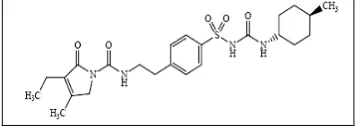
[image:1.595.217.399.583.647.2]Glimepiride is a Sulfonyl Urea derivative.Chemically it is [[p-[2-(3ethyl-4-methyl-2-oxo-3-Pyrroline-1-Oxamide) ethyl] phenyl] sulfonyl] 3-(Trans 4-methyl cyclohexyl) urea. It is widely used in type-2 diabetes. It is an oral Anti Diabetic with prolonged effect and it maintains a more physiological regulation of insulin secretion during physical exercise, which suggests during physical exercise which suggests that there may be less risk of hypoglycemia. [1]
Fig 1: Structure of Glimepiride; Mol wt. -490.616
Pioglitazone is a thiazolidinedione derivative. It is chemically 5-({4-[2-(5-ethylpyridin-2-yl) ethoxy] phenyl} methyl)-1, 3-thiazolidine-2, 4-Dione.
Fig 2: Structure of Pioglitazone; Mol.wt.-356.439
Glimepiride & Pioglitazone in combined tablet dosage form are available in the market. The literature reveals that there are some of the methods have been reported Glimepiride & Pioglitazone in single dosage )form,Pioglitazone Hcl in single dosage form by NMR(H. H. Gadape and K. S. Parikh,2011)[3], and only few reports were found in combined dosage by UV (Shveta et al.,2005) [4] ,( Indrajeet Singhvi.,et al 2011) [5], HPLC (Safa et al.,2011) [6] , (Karthik et al.,2008) [7] ,( Mamdouh R.Rezk,et al .,2011) [8] ,(K.S.Lakshmi, et al.,2009) [9] , and HPTLC (Sane,
et al.,2004) [10] .
In modern analytical lab, there is always a need for simple, rapid, accurate and economical methods for simultaneous determination of drug combinations that could be used for routine analysis .The present work aimed to develop simple instrumental methods for the quantification of GLM and PIO in bulk drug form or in their pharmaceutical formulations. The method was validated according to the ICH (Q2A 1995) guidelines.
The scope of developing & validating method is to ensure a suitable strategy for the drug which is more specific, accurate and precise. The main focus is drawn to achieve improvement in conditions that is a rapid, economical method is developed with commonly used buffers. The present study aimed to develop simple, precise and accurate methods for the determination of drugs by RP-HPLC in formulation.
The objective of the present work is to develop and validate a suitable high precision and accurate analytical methods for the estimation of drugs in tablet dosage form by reverse phase high performance liquid chromatography (RP-HPLC) that can be effectively applied for routine analysis in research instructions, quality control department in industries, approved testing laboratories, Bio-pharmaceutics and Bio-equivalence studies and in clinical pharmacokinetic studies.
Method Development:
Prior to the initiation of method development, all the known information about the analyte such as its structure, physical and chemical properties, toxicity, purity, hygroscopicity, solubility, and stability should be determined. These data may be available from preformulation reports, early drug discovery sample screening reports, from the literature on similar compounds, or from past experience with similar compounds.
The goals or requirements of the HPLC method that needs to be developed should be known as well as the analytical figures of merit, which include the required detection limits, selectivity, linearity, range, and accuracy and precision. The potential use of this method needs to be considered: if any regulatory requirements are to be met, if the method is used to analyze multiple samples [11].
EXPERIMENTAL SECTION
Instruments:
The HPLC system consists of a Shimadzu class isocratic pump LC- 20 AT vp and SPD-20A UV-visible detector, supplied by spincobiotech.The data acquisition was performed by spinchrome software. The method was developed on shimadzu HPLC systems with Inertsil ODS C18 column (150 × 4.6mm, 5µ) using Spinchrom Software. The column maintained at ambient temperature and eluent was detected at 225nm.The mobile phase mixture containing mixed phosphate buffer and acetonitrile in the ratio of 40:60.The flow rate was 1.5ml/min.
Materials & reagents:
Reference Materials GLM and PIO standard pure samples were obtained from Chandra labs, Hyderabad. The purity was found to be98.94%and 99.5% respectively.Acetonitrile, potassium dihydrogen phosphate and dipotassium hydrogen phosphate is HPLC grade from Merck chemicals, Mumbai.
Solutions:
a mixture of Glimepiride and Pioglitazone in over the linearity range from 1.32-7.92µg/ml and 10-60 µg/ml respectively.
Optimization of the method A simple isocratic high-performance liquid chromatography method was developed
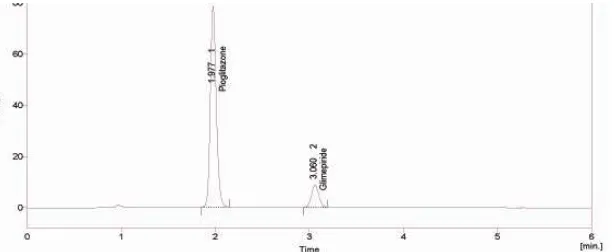
[image:3.595.155.462.220.346.2]for the determination of GLM and PIO in pure form and in pharmaceutical formulations using a150 mm x 4.6 mm, i.d. C18Inertsil 5µ analytical column. The mobile phase consisted of Mixed phosphate buffer: acetonitrile [40:60 v/v] and .The mobile phase was chosen after several trials to reach the optimum stationary /mobile –phase matching. The flow rate is 1.5ml/min.System suitability parameters were tested by calculating the capacity factor, tailing factor, the sensitivity factor and resolution. The average retention times under the conditions described were 3.06 minutes for GLM and 1.97minutes for PIO. Calibration graphs were obtained by plotting the peak area ratios of drug to that of external standard versus concentrations of GLM and PIO, Linearity ranges were found to be 1.32-7.92µg mL-1 for GLM and 10-60 µg mL-1 for PIO.
Fig: 3 Chromatogram under Optimized chromatographic conditions
Assay in formulations
Twenty tablets, Pioglar-G (Ranbaxy Ltd), each containing 15mg of Pioglitazone and 2mg of Glimepiride were weighed and finely powdered. A quantity of powder equivalent to 25mg of Pioglitazone and 3.4mg of Glimepiride (app 0.2002 gm) was weighed and transferred to a Standard flask. The drug was diluted using methanol to get a concentration of 0.136mg/ml of Glimepiride, 1mg/ml of PioglitazoneHcl. The contents were mixed thoroughly and filtered through a 0.45 µ filter. From the above filtrate pipette out 0.5 ml into a 10 ml volumetric flask and diluted with mobile phase. Mix and 20µL of this solution was injected for HPLC analysis.
RESULTS AND DISCUSSION
The proposed HPLC method required fewer reagents and materials, and it is simple and less time consuming. This method could be used in quality control test in pharmaceutical industries. The chromatograms of Glimepiride and Pioglitazone were shown in (fig 3). There was clear resolution between Glimepiride and Pioglitazone with retention time of 3.06 and 1.97 and minutes respectively.
Validation
Accuracy and precision
The accuracy of the method was determined by recovery experiments which were carried out 6times and the percentage recovery and % relative standard deviation was calculated. From the data obtained, recoveries of standard drugs were found to be accurate (table1).
The intraday and interday precision of pioglitazone was 0.16 and 0.21 and Glimepiride was 0.29 and 0.49 respectively. From the data obtained, the developed HPLC method was found to be precise and accurate.
Table 1: Accuracy Data
Accuracy level Mean recovery of Glimepiride (%)
Mean recovery of Pioglitazone Hcl (%)
Accuracy 80 % 99.18 99.01
Accuracy 100 % 99.78 100.10
Linearity
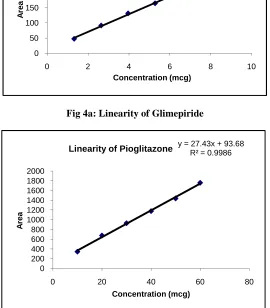
[image:4.595.173.440.131.300.2]The linearity of the method was determined by Preparing serial dilutions of minimum 5 concentration of standard stock solutions each in duplicate. Take the average area of each injection and plot the graph of average peak area versus actual concentration of each solution in µg/ml.
Fig 4a: Linearity of Glimepiride
[image:4.595.171.441.206.514.2].
Fig 4b: Linearity of Pioglitazone Hcl
Linearity ranges were found to be 1.32-7.92µg mL-1 for GLM and 10-60 µg mL-1 for PIO using the following regression equations:
Y = 29.18X +11.96 [r2=0.9987] for GLM
Y = 27.43X +93.68[r2=0.9986] for PIO
Where Y is the peak area ratio, X is the concentration of PIO and GLM [µg mL-1] and r is the correlation coefficient. The mean percentage recoveries were found to be for 99.78% for GLM and 100.10% for PIO.
Robustness
The robustness of the method was studied by changes in the method like alteration in flow rate (0.1 ml/min of set value i.e. 1.4 ml/min and 1.6 ml/min), detection wavelength. (223 and 227) and are evaluated.
Specifity of the method
In formulations, chromatograms with some additional peaks were observed which may be due to excipients present in the formulations. These peaks however did not interfere with the standard peaks .The results revealed that the peak is free from interferences, which shows that the HPLC method is specific.
y = 29.18x + 11.96 R² = 0.9987
0 50 100 150 200 250 300
0 2 4 6 8 10
A
re
a
Concentration (mcg)
Linearity of Glimeperide
y = 27.43x + 93.68 R² = 0.9986
0 200 400 600 800 1000 1200 1400 1600 1800 2000
0 20 40 60 80
A
re
a
Concentration (mcg)
Quantification Limit
The LOD is the lowest concentration of the analyte that can be detected with signal to noise ratio (1:3) and LOQ is the lowest concentration that can be quantified with acceptable precision and accuracy with signal to noise ratio (1:10). The LOD of GLM and PIO are found to be 0.11µg/ml and 0.12µg/ml respectively. The LOQ of GLM and PIO are found to be 0.35µg/ml 0.37µg/ml respectively.
System Suitability
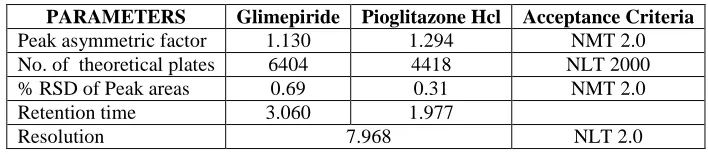
The resolution, capacity factor, theoretical plates/meter, Rt values and peak symmetry were calculated for the standard solutions. The values obtained demonstrated the suitability of the system for the analysis of the above drug combinations System suitability parameters might be fall within ± 3% standard deviation range during routine performance of the method.
Table: 2 system suitability pararameters
PARAMETERS Glimepiride Pioglitazone Hcl Acceptance Criteria
Peak asymmetric factor 1.130 1.294 NMT 2.0
No. of theoretical plates 6404 4418 NLT 2000
% RSD of Peak areas 0.69 0.31 NMT 2.0
Retention time 3.060 1.977
Resolution 7.968 NLT 2.0
[image:5.595.128.482.231.308.2]
The summary of the method validation results were showed in the (table 3)
Table 3: Summary of analytical method validation
Accuracy level Mean recovery of Glimepiride (%)
Mean recovery of Pioglitazone Hcl (%)
Accuracy 80 % 99.18 99.01
Accuracy 100 % 99.78 100.10
Accuracy 120 % 99.44 99.09
CONCLUSION
The proposed method was found to be simple, precise, accurate and rapid for simultaneous determination of Glimepiride and Pioglitazone and from pure pharmaceutical formulations. The mobile phase is simple to prepare and the run time was less than 5min which consumes only less than 5ml of mobile
Phase shows that the method was economical. The sample recoveries in all formulations were in good agreement with their respective label claims suggested non-interference in the estimation. Hence, the method can be easily and conveniently adopted for routine analysis of Glimepiride and Pioglitazone Hcl in combined dosage forms .The simplicity ensures that the RP-HPLC method can be applied for estimation of Glimepiride and pioglitazone in tablet dosage forms. Since the good separation and resolution of the chromatographic peaks, the method was found to be accurate, precise, linear, robust and rugged.
REFERENCES
[1] Tripathi K.D. Essentials of Medical Pharmacology, 4th edition, Jaypee Brothers Medical, New Delhi, India,
1999; 276–83.
[2] Ishan I Panchal, B Panigrahi, K M Modh, C N Patel. J. Chem. Pharm. Res, 2010, 2(5), 609-617. [3] H. H. Gadape , K. S. Parikh. J. Chem. Pharm. Res, 2011, 3(1), 649-664.
[4] Chandana Shveta, Kasture .AV, Yeole. PG. Ind J.Pharm .Sci, 2005, 67, 627-629.
[5] Indrajeet Singhvi, Khushboo Mehta and Nidhi kapadiya. Journal of applied pharmaceutical Science, 01(06),
2011, 159-161.
[6] Safa’M.Riad. Scholars research Library, 3(5), 2011, 176-184.
[7] Karthik A, Subramanian G, Mallikarjuna Rao C, Krishna Murthy Bhatt and RanjitKumar A. Pak. J. Pharm. Sci ,21, 2008, 421-425.
[8] Mamdouh R.Rezk. Der Pharma Chemica, 3(5), 2011, 176-184.
[10] Sane RT, Menon.SN, Shafi Inamdar,Mandar Mote Ajay Menezes, J.planar Chromatography, 2004, 17,154-156.