1
Analysis of the Learning Styles Dimensions for Vocational Students
Mimi Mohaffyza Mohamad, Yee Mei Heong , Nurfirdawati Muhamad Hanafi,
Yusmarwati Yusof
Universiti Tun Hussein Onn Malaysia
Email: [email protected]; [email protected]; [email protected]; [email protected]
Tee Tze Kiong
Universiti Pendidikan Sultan Idris
Email: [email protected]
Abstract
Individual learning preferences and learning styles have been characterized in several
different ways according using a variety of theoretical models. It is not an issue because
much research has been conducted over past decades. The investigations of learning styles
help teachers and educators to know which way student prefer to learn. There are many type
of students with different characteristics based on the type of education that they choose. The
aim of this paper is to analyze data based on Felder-Silverman Learning Styles Model in
order to provide detailed description of learning styles dimensions. This study involved 128
vocational students from three schools. The Felder-Soloman Index of Learning Styles is
chosen as instruments to identifying students’ learning styles. The process of analysis started
with validation stage and the actual filed work data with some empirical results. The analyses
show the most representative characteristics of each learning style dimension as well as how
representative these characteristics are. As a result this paper provides the characteristics
information of vocational students. This information is very useful especially for teachers to
decide the method of teaching when involving cognitive information process.
2
1.
Introduction
The cognitive processes that contribute to student learning require that the student have the ability to manipulate information and ideas to solve problems and produce new knowledge. Many features of current cognitive theories on teaching and learning reflect earlier models of teaching such as Bruner’s, Taba’s, and various group-based and student-centered teaching models (Ruth, 1992). In Vocational Education (VE), the importance of the cognitive process is based on a few factors, namely, the cognitive abilities needed in the current work environment, the ability to adapt to changing VE requirements in a global context, and the demands of cognitive development (Tee et al., 2009). In their cognitive research, John (1995) summarized that learning does not automatically change and that understanding the learning content is difficult. Cognitive processes are not encouraged by passive learning.
Vocational students have their own learning preferences, considering they rely less on their cognitive abilities and more on their psychomotor talents, including physical movement, coordination, and use of motor skills (Bloom, 1956). They need to increase their cognitive abilities with a suitable approach so that they can be creative and innovative workers in order to do well in their work situation. The suitable approach in this case is perhaps the identification of the students’ learning styles (LS) that equal to VE characteristics to produce suggestions on overcoming the problems. Bloom (1989) also states that the ability of students to learn basic principles and their ability to apply knowledge or explained what they learned.
Learners in VE must observe and experience the required cognitive processes to learn them and know how, where, and when to use them. One of the factors debated over the last few decades was the relationship between student achievement and learning
styles. Proponents of
learning styles maintain that adapting
classroom teaching methods to suit students’
preferred styles of learning improves the
educative process (Felder, 1993). However,
opponents of learning style theories maintain
that little empirical evidence is available to
support this proposition LS involved strategies that students tend to apply to a given teaching
situation. Each individual can fit into different styles that can result in students adopting attitudes and behaviors that are repeated in different situations.
2. Identifying Learning Styles
Learning styles can be classified into various categories, for example, sensory, auditory, visual, and tactile. Dunn and Dunn (1992) reported that learning styles is an individual reaction to several environmental, emotional, psychological, and sociological factors. In vocational schools, the VE students have their own characteristics, according to Brennan (2003). They are verbal learners who watch and see rather than read and listen. They are hands-on and learn by doing and practicing. They learn in groups and are dependent learners who need instructor guidance for clear understanding. Considering that the characteristics of students in VE are more hands-on, and that they learn by doing, an understanding of this type of LS will help teachers provide a teaching delivery method that matches their students’ needs.
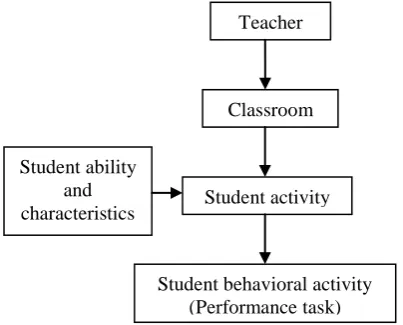
“Students’ needs” is a term described by Posner et.al (1992) as a description of how students deal with curricular tasks by employing relevant learning structures. The goal in teaching VE students is to gain experience and to apply existing knowledge to new situations. The role of the teacher is to create learning environments for students handling the presented tasks. Figure 1 show how a VE student’s learning ability is influenced by various factors (John, 1995).
[image:2.595.313.515.546.708.2]
Figure 1:
Adapting to students learning
Teacher behaviou
r Classroom environme
nt Student ability
and
characteristics Student activity
3 VE encompasses a wide range of courses or skills that help students prepare to enter an occupational-based employment or workplace (International Labour Organization, 2000). The concept behind VE is to bridge theory and practical components, such as lab- and workshop-oriented knowledge to workplace knowledge, with specific skills. As a result, vocational students have their own LS. In here research on learning strategies among vocational students, Briggs (2000) concluded that vocational students benefited from three types of courses, namely, “hands-on courses,” “mixed-courses,” and “paper-based courses.” She also classified the analysis of LS into visual, auditory, and kinesthetic (VAK) to create a basis for innovation in teaching and learning strategies.
[image:3.595.320.534.209.388.2]A visual style relies on seeing and reading, auditory depends on listening and speaking, and a kinesthetic style focuses on touching and doing. Figure 2 shows the use of LS in hands-on courses. Hands-on courses refer to hairdressing, plumbing, professional craft catering, and painting. This group showed that their preference was for visual strategies. The figure illustrated three categories of students’ score as indicating strong, medium, and weak use of visual, auditory, and kinesthetic learning style strategies. The results show that the students most preferred visual learning strategies the results show that the highest number of students scored in visual strategies. This means that the students scored strongly in a range of visual strategies. Meanwhile, 20 students strongly used auditory learning strategies, and only 18 students strongly applied the kinesthetic approach to learning.
Figure 2: Students’ Learning Styles in Hands-on Courses
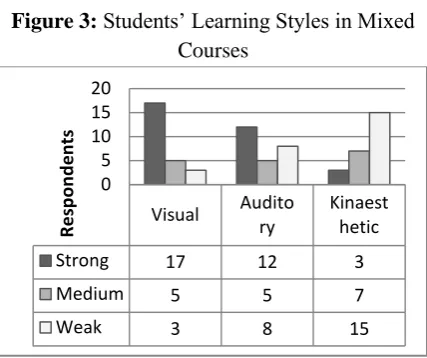
Briggs (2000) used the same method of using learning strategies for “mixed” courses. Mixed courses refer to courses that involve a mixture of paper-based and hands-on materials. Mixed courses represent the course related to engineering education and performing arts. The result showed that this group preferred visual strategies the most and kinesthetic strategies the least. Figure 3 shows that the students preferred visual learning styles (17 students) over both auditory
(12 students) and kinesthetic styles (3 students).
Figure 3: Students’ Learning Styles in Mixed Courses
Figure 4 shows the profiles of LS for
[image:3.595.314.547.582.768.2]students in a paper-based course. The students investigated were involved in business, public service, and health science courses. The results showed a strong use of visual strategies among students in “paper-based” courses. Forty-five students preferred visual study approaches, 20 who preferred auditory and 19 students who preferred kinesthetic. Generalizing course groups is difficult, even when they are aggregated. However, students in paper-based courses appeared to choose visual and auditory strategies more than students did in hands-on courses.
Figure 4: Students’ Learning Styles in Paper-Based Courses
Visual Audito ry
Kinaes thetic
Strong 30 20 18
Medium 10 15 10
Weak 15 10 27
0 5 10 15 20 25 30 35
R
e
sp
o
n
d
e
n
ts
Visual Audito ry
Kinaest hetic
Strong 17 12 3
Medium 5 5 7
Weak 3 8 15
0 5 10 15 20
R
e
sp
o
n
d
e
n
ts
Visual Auditory Kinaesth etic
Strong 45 20 19
Medium 10 25 21
Weak 5 15 20
0 10 20 30 40 50
R
e
sp
o
n
d
e
n
[image:3.595.62.278.596.756.2]4
The concept of LS is understood by VE
teachers as a legitimate way of expressing individual differences in the way their students learn. However, the fundamental concept of LS is and understanding of the characteristics and dimensions of various learning strategies. Research conducted by Peter (2003) indicated that understanding students’ LS and preferences is very important for teachers. Peter also suggested an LS model among VE practitioners. A survey conducted by Muhammad et al. (2010) involved 48 pre-service Engineering teachers with a major in mechanical, electrical, or civil engineering to identify their learning styles. This study was designed to prepare students to become future teachers when they completed their degrees in Technical and Vocational Education. The pre-service teachers were students attending schools during their practicum. They taught engineering subjects containing both task theory and hands-on components. The characteristics of engineering education are similar to VE, meaning that the results could be used to represent how the pre-service teachers accommodated various learning styles and learning preferences. As future teachers, they needed to equip themselves with strong skills in behavioral, cognitive, and constructivist basics so that they will be able to accommodate students’ learning styles.
Richard and Stephen (1998) stated that two methods of assessing learning styles, self-reports and observed behavior, were used. Self-reports use the learning material preferred by the students. They will show whether a student’s awareness is in line with that individual’s actual performance.” Observed behavior requires the teachers to give the students information in a variety of ways and observe what version the student picks. Both these methods contribute in assessing the learning style of the student. They are, however, not without their problems. One way of improving learning performance is to adapt the mode of each student’s style. Research is needed to find the most efficient ways of doing this (Richard and Stephen, 1998).
3. Case Study
The learning process is an interaction between students, teachers, and teaching materials. The emphasis should always be on the process of student learning. Ideally, the way teachers teach should match the way students
learn. Teachers should be concerned with the students’ learning styles. Learning styles have a descriptive range, from the relatively fixed natural disposition of the student to the modifiable preferences for learning and studying. Learning styles are a component of the wider concept of personality. Since LS plays such a critical role in the learning process, teachers should not neglect to address how to relate the learning styles into the teaching and learning process, especially with how these factors can contribute the students’ achievement. In order to investigate the learning styles of vocational students, researchers performed a case study where 128 students participated. The students are from three different vocational schools. To measure the learning styles of the students, they completed a questionnaire developed by Felder and Solomon (1997). In the following section, this questionnaire is briefly introduced and afterwards the results of study are presented.
3.1 Felder-Solomon Learning Styles Index
Students have different preferences in the ways the take information process. Some prefer to work with concrete information by using facts, experimental data while others are more comfortable with abstractions such as theories, symbolic information, and mathematical models. Some are partial to visual presentation of information used pictures; diagrams, flowchart, schematics and others get more verbal explanations. The Index of Learning Styles (ILS) is 44 questions developed by Felder and Solomon (1997) to assess the learning preferences based on Felder-Silverman Learning Styles Model. Each learning style dimension has associated with 11 forced-choice items with each answer either (a) or (b) to represent what type of learner in each dimension measured.
3.2 Descriptive analysis
5 global preferences. Table 1 summarizes the dimension of ILS represented by mean. The description in Table 1 shows that the BCC students tended to be visual (Vis) learners with a mean score .844, followed by active (Ac) learners (.771 mean score), sensing (Sen) with a mean score of .671 and sequential (Seq) learners with a mean score of .555. The other learning styles are as follows; reflective (Rf) (mean score .228), intuitive (Int) (mean score .336,), Verbal (Ver) (mean score .161), and global (Gl) learners (mean score .193). The findings also define the types of learners who would choose the first answer on the ILS. To identify the learner’ type in each dimension of the FSLSM, this study used a number to represent the learning styles of respondents.
Based on the mean score, this study categorized the learning styles into four dimensions within each dimension referring to the one of learning styles. Table 2 shows the learning styles from each dimension. The most common type of learner was visual from the input dimension with a total of 118 students (92.2%). One hundred and four students (81.2%) were active learners from the processing dimension. The sensing learner category was filled by 88 student (68.8%) and 67 students (52.3%) were sequential learners.
3.3 Analysis of Semantic Group
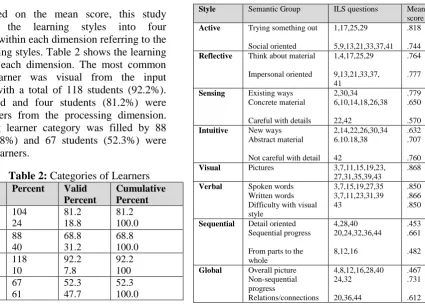
This analysis is to identify the most representative groups in each learning style. The semantic group analysis used the multivariate method to find the most important ILS questions between each dimension coefficients corresponding to answers. Table 3 presents the value of mean score in each category of dimension. The high value indicates strong impact for the respective learning style, it can be seen for visual learning styles the preference of using picture has more impact than other semantic group, for the verbal learning style written words representative semantic group. It also seen, active learning style is other students’ preference. Trying something out has more impact than the social oriented using discussion and explaining learning material to each other or working in group. On the other hand, for reflective learning style, think about material is more relevant than impersonal oriented. For reflective students they need more supporting material to give them opportunity to work individually. Regarding the sensing and intuitive dimension it can be seen that learn in existing ways the most preference for learners while for intuitive learner they prefer not careful with detail.
Table 3: Semantic Group with ILS Questions
Style Semantic Group ILS questions Mean
score
Active Trying something out
Social oriented
1,17,25,29
5,9,13,21,33,37,41 .818
.744
Reflective Think about material
Impersonal oriented 1,4,17,25,29 9,13,21,33,37, 41 .764 .777
Sensing Existing ways
Concrete material
Careful with details
2,30,34 6,10,14,18,26,38 22,42 .779 .650 .570
Intuitive New ways
Abstract material
Not careful with detail
2,14,22,26,30,34 6.10.18,38 42 .632 .707 .760
Visual Pictures 3,7,11,15,19,23,
27,31,35,39,43
.868
Verbal Spoken words
Written words Difficulty with visual style 3,7,15,19,27,35 3,7,11,23,31,39 43 .850 .866 .850
Sequential Detail oriented
Sequential progress
From parts to the whole 4,28,40 20,24,32,36,44 8,12,16 .453 .661 .482
Global Overall picture
[image:5.595.31.291.308.435.2]Non-sequential progress Relations/connections 4,8,12,16,28,40 24,32 20,36,44 .467 .731 .612 Table 1: Dimension of FSLSM
N Processing Perception
128 Ac (a)
SD Rf (b)
SD Sen (a)
SD Int (b)
SD
.771 .2078 .228 .2078 .671 .2097 .336 .2204
Input Understanding
Vis (a)
SD Ver (b)
SD Seq (a)
SD Gl (b)
SD
[image:5.595.113.539.453.759.2].844 .1581 .161 .1599 .555 .1936 .193 .445
Table 2: Categories of Learners
Frequency Percent Valid
6 4. Conclusions
This paper provides an analysis of Felder-Silverman Learning Style Model based on ILS questionnaire developed by Felder-Solomon. It is reasonable to conclude that learning style identified by ILS consistent dependencies between some styles, that the analysis of pair wise coupled dimensions is not able to detect. The result shows a more accurate description of FLSM, pointing out relevant characteristics within the dimensions. Researcher conclude ILS has two principle, first provide guidance to teachers on the diversity of learning style within their classes and to help them design instruction that address the learning needs of all their students. The second is to give students insights into their possible learning strengths and weakness. Understanding of what students need is the first step in working of skills associated with learning preferences. Learning what those strength are can empowering and even transformative (Felder, 1990). ILS may help instructors, teachers and educators achieve balanced instruction and to help students understand their learning strengths and area for achievement.
References
Bloom, B.(1956). Taxonomy of Educational Objectives: The Classification of Educational Goals; Handbook I: Cognitive Domain. New York, Longmans.
Bloom, B.S (Ed) (1989). Taksonomi Objektif Pendidikan. Buku Pedoman
1:Domain Kognitif. Terjemahan Abdullah Junus. Kuala Lumpur: Dewan Bahasa dan Pustaka
Brennan, P. (2003). An Analysis of The Relationship among Hemispheric
Preference and Analytic/Global Cognitive Style, Two Elements of Learning Style, Method of Instruction, Gender and Mathematics Achievement. Doctoral Dissertation St John’s University Jamaica. Dissertation Abstract International 45/11, 3271A
Dunn, R. S. and K.J Dunn (1992).
Teaching
Elementary Students Through Their
Learning Styles.
Boston: Ally &
Bacon
Felder, R. M (1993). Reaching the second tier- Learning and Teaching Styles in College Science Education. Journal of College Science Teaching. 23 (5), pp 286-290
Felder,R. Silverman L.K.(1988). Learning and teaching styles in engineering education. Journal in Engineering Education, 78 (7),pp 674-681
Felder,M,R, and rent,R,(2005).Understanding Student Differences,Journal of Engineering Education,94,1.pp57-72
Felder, R.M and Spurlin, J., (2005). Applications, Reliability and Validity of the Index of Learning Styles. International Journal on Engineering Education, Vol. 21, pp 60-75
Felder, R.M and Soloman B.A (1997), Index of Learning Styles Questionnaire. Retrieved 31 July 2010 from
http:www.engr.ncsu.edu/learningstyles/ils web.html
Felder, R.M and Spurlin, J (2005). Application, Reliability and Validity of the Index of Learning Styles. International Journal in Engineering Education, Vol.21, No.1, pp. 103-112, Great Britain: Tempus
Publication
Felder, R.M., Woods, D.R.,Stice, J.F and Rugarcia, A. (2000). The future
Engineering Education; Part II. Teaching Methods that work. Chemical
Engineering Ed. 34, 1, pp 26-39
International Labour Organization. (2000). Employment Paper. Geneva: International Labour Office
7 Posner, G.J. and Strike, K.A. (1992)., A
revisionist theory of conceptual change. In R.A. Duschl &R.J. Hamilton (Eds.), Philosophy of science, cognitive
psychology, and educational theory and practice Albany, NY: State University of New York Press.
Ruth G.Thomas (1992). Cognitive Theory-Based Teaching and Learning in Vocational Education. University of Minnesota; Thesis Dissertation
Tee Tze Kiong, Jailani Md Yunos,Baharom Mohamad, Widad Othman and Yee Mei Hong (2009). Pengintegrasian
Kemahiran Berfikir Aras Tinggi Menerusi Peta Minda Bagi Matapelajaran
Kemahiran Hidup. University Tun Hussein Onn Malaysia; Proceeding; pp 114-121