5
X
October 2017
Experimenta Study on Strength of Water Hyacinth
Ash as Partial Replacement of Cement in Concrete
Shyam Krishnan. S1, V.Murugesh2 1
PG Student, Dept of Civil Engineering, JCT College of Engineering, Coimbatore, Tamilnadu, India. 2
Associate Professor, Dept of Civil Engineering, JCT College of Engineering, Coimbatore, Tamilnadu, India.
Abstract: Concrete is an artificial material which composed of cement, fine aggregates, coarse aggregates and water. The main constituent of traditional and ordinary concrete is cement. Cement production emits a huge amount of carbon dioxide in the atmosphere. To reduce carbon dioxide, cement is replaced as a supplementary cementitious material in concrete. Water hyacinth grows vigorously in ponds and doubles the quantity within two weeks. The studies have been done to evaluate water hyacinth ash in the replacement of cement. The Present study reveals about the different proportion of water hyacinth ash replacing cement which will affect the properties of workability, compression, and split tensile strength of concrete. Concrete is cast in cubes and cylinders with different percentage (0, 10%, 20% by weight of cement), The casted specimens are removed from the mould, cured and tested for 7, 14 and 28 days. The tested result were compared with conventional concrete and the different ratio of WHA replaces cement concrete in comparing the concrete and WHA replacement concrete, the ultimate strength achieved at 10% for M30 grade.
Keywords: Water Hyacinth Ash, Cement, Concrete, workability, setting time and Strength.
I. INTRODUCTION
Concrete is considerably the world’s largely adaptable and well-liked material produced each year in the construction. Concrete is nothing but a combination of aggregates both fine and coarse, Cement and water. Comparing to all other ingredients in concrete, cement is considered to be the expensive material. This is because cement is manufactured using energy -intensive process. Cement is one of the major producers of carbon dioxide, which is the main cause of global warming. During the manufacturing process of cement the formation of clinker can be achieved only by heating the cement at very high temperature. This leads to the release of enormous amounts of carbon in the atmosphere. This was one among the major problems identified for climatic changes.
Various research works has been carried out for the cost reduction in construction with some of the locally available materials as the partial or full replacement material for cement. Over the last few decades supplementary materials like fly ash, rice husk, silica fume, egg shell, groundnut shell, etc. are used as a replacing material. These supplementary materials have proven to be successful in meeting the needs of the concrete in construction. Water hyacinth is a free floating aquatic plant that grows in still or slow moving fresh water bodies.
Water Hyacinth produces a large biomass by rapidly growing and doubles its population within two weeks. Many problems are caused by the water hyacinth. Some of them are loss of bio diversity, affects water quality, water loss, agricultural implications, damage to infrastructure and it affects health and safety of humans as well as some aquatic species. Hence, the bio – admixture extracted from the water hyacinth can be used as the replacement material for cement and it is cost effective. In this research work, bio waste is utilized as a substitute of cement in concrete.
II. MATERIALS
A. Cement
In this research work the Ordinary Portland Cement 53 grade, confirming to IS 1269-1987 was used.
B. Coarse aggregate
Locally available crushed blue granite stones confirming to graded aggregate of nominal size 20 mm as per IS :383 -1970 are adopted.
C. Fine aggregate
Locally available river sand confirming to grading zone II of nominal size 1.18 mm as per IS:383-1970.
D. Water
Colorless, odorless potable fresh water was used for mixing the concrete.
E. Water Hyacinth Ash
Water hyacinth was collected from a pond located at Nallepilly, Palakkad. The collected samples are washed and cleaned with potable water to remove dirt and impurities. Then the samples were cut uniformly into a small pieces and dried for over a week. The dried sample is kept in an oven for 800○ c for 6 hours to convert the organic matter into an inorganic substance. The samples were ground by a milling machine. The grounded sample was passed through a sieve of size 150micron. The sample collected from the 150 micron sieve has been used as the replacement material for cement.
Fig.2Water Hyacinth Final Products
II. EXPERIMENTAL PROGRAM
Various tests were conducted to check the properties of the coarse aggregate and some of the tests include the specific gravity, water absorption, fineness modulus, crushing strength tests etc. Various tests were conducted for fine aggregate also to find out the finest of sand, specific gravity of sand etc.
The test for cement was carried out to find the specific gravity, fineness, water absorption, Setting time and consistency. Initial and final setting time is founded with and without the replacement of water hyacinth ash in cement by Vicat apparatus. The percentage replacement for cement by WHA was done in the proportion of 0, 10 and 20.
After the various tests done on the materials the concrete is prepared through batching. The selected materials are properly weighed and mixed as per the design mix proportion of 1:1.74:2.40 for M30 grade concrete, the water cement ratio used in the work is 0.45, which is obtained from the IS 10262. The concrete was cast in the form of cubes and cylinders with 0%, 10% and 20% replacement of cement by Water Hyacinth Ash. To find out the workability of concrete the slump test was carried out in the fresh concrete mix. After 24 hours, the specimen is removed from the cube and cylinder mould and cured. The compression and split tensile test was carried out in 7, 14 and 28 days using compression testing machine.
Area in (SQ.MM)
Split Tensile strength = 2PπLD
III. RESULTS AND FINDINGS
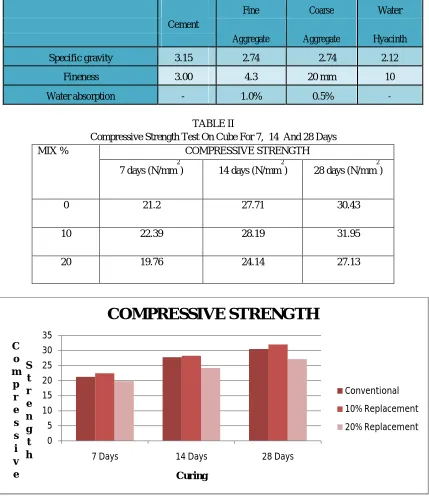
[image:4.612.93.522.196.692.2]The specific gravity test conducted for cement, coarse aggregates, fine aggregates and WHA are carried out as per IS2386 using a parameter. Fineness test for fine and coarse aggregate is found out by I.S.SIEVES. The results obtained are mentioned below
TABLE I Test Report of Materials
Cement
Fine Coarse Water
Aggregate Aggregate Hyacinth
Specific gravity 3.15 2.74 2.74 2.12
Fineness 3.00 4.3 20 mm 10
Water absorption - 1.0% 0.5% -
TABLE II
Compressive Strength Test On Cube For 7, 14 And 28 Days
MIX % COMPRESSIVE STRENGTH
7 days (N/mm 2
) 14 days (N/mm
2
) 28 days (N/mm
2 )
0
21.2 27.71 30.43
10
22.39 28.19 31.95
20
19.76 24.14 27.13
The above chart represent the strength of the cube in 7 days, 14 days and 28 days for both conventional concrete and replacement of cement in concrete by different ratios of Water Hyacinth ash. It is observed that if the curing time increases than the strength of the
0 5 10 15 20 25 30 35
7 Days 14 Days 28 Days
concrete is also increases. From the observation the strength is lower during 7 and 28 days in conventional concrete. However the 10 % replacement of the WHA gains strength more than the conventional concrete.
TABLE III Split Tensile Strength
MIX% SPLIT TENSLIE STRENGTH
7 Days (N/mm2) 28 Days (N/mm2)
0 2.48 2.97
10 2.75 3.50
20 1.95 2.44
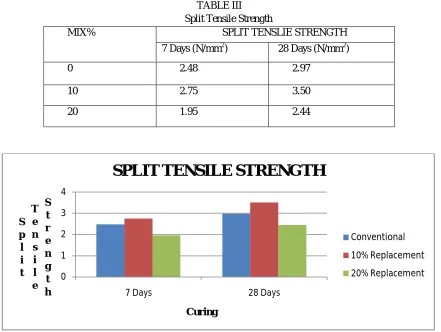
The above chart shows the variation in Split tensile strengths for both conventional concrete and Water Hyacinth replacing concrete cylinders with different proportions. The results show the ultimate strength occurs in 10% of replacement of cement by WHA.
IV. CONCLUSION
This study was carried to obtain the results, test conducted on the water hyacinth ash modified cement concrete mix, in order to ascertain the influence of water hyacinth ash on the characteristic strength of concrete.
A. The most optimal dosage for the partial alternative of cement by water hyacinth ash is 10%.
B. The compressive strength of concrete decreases, when the addition of dosage is more than 10%.The results show if 20% replacement of cement by water hyacinth ash will affect the strength of cocrete.
C. Due to the high absorptivity of ash in water hyacinth, the setting time of the cement gets increased.
D. The workability of the concrete increases based on the percentage of replacement of water hyacinth ash.
REFERENCES
[1] Mohammed S Imbabi, Collettee C, Sean M. Trends and developments in green cement and concrete technology. International Journal of Sustainable Built Environment 2012; 1:194-216.
[2] PayamShafigh ,Hilmi Bin Mahmud, MohdZaminJumaat, MajidZargar. Agricultural wastes as aggregate in concrete mixtures – A review, Construction and Building Materials 2014; 53:110–117.
[3] Sata V, Jaturapitakkul C, Kiattikomol K. Influence of pozzolan from various by-product materials on mechanical properties of high-strength concrete. Construction and Building Materials 2007; 21(7):1589–98.
[4] B A Alabadan, M A Olutoye, M S Abolarin and M Zakariya , Partial Replacement of Ordinary Portland Cement (OPC) with Bambara Groundnut Shell Ash (BGSA) in Concrete, Leonardo Electronic Journal of Practices and Technologies 2005; 6:43-48.
0 1 2 3 4
7 Days 28 Days
S p l i t T e n s i l e S t r e n g t h Curing
SPLIT TENSILE STRENGTH
Conventional
10% Replacement
[5] D Gowsika, S Sarankokila, K Sargunan. Experimental Investigation of Egg Shell Powder as Partial Replacement with Cement in Concrete, International Journal of Engineering Trends and Technology 2014; 14(2):64-68.
[6] D AAdesanya. Evaluation of blended cement mortar, concrete and stabilized earth made from ordinary Portland cement and corn cob ash, Construction and Building Materials 1996; 10(6):451–456.
[7] Ernesto V C , Eduardo V M, Sergio F S, Holmer S Jr., Moisés F. Pozzolanic behavior of bamboo leaf ash: Characterization and determination of the kinetic parameters, Cement and Concrete Composites 2011; 33(1):68-73.
[8] G C Cordeiro , R D Toledo Filho, L M Tavares, E M R Fairbairn. Pozzolanic activity and filler effect of sugar cane bagasse ash in Portland cement and lime mortars, Cement and Concrete Composites 2008; 30(5):410-418.
[9] K. Gunasekaran , P.S. Kumar, M. Lakshmipathy. Mechanical and bond properties of coconut shell concrete. Construction and Building Materials 2011; 25(1):92–98.
[10] T Ozturk, M Bayrakl. The possibilities of using tobacco wastes in producing lightweight concrete, Agricultural Engineering International: the CIGR Ejournal 2005; 5.
[11] Keith Lindsey, Hans-Martin Hirt. Use Water Hyacinth! A Practical Handbook of Uses for Water Hyacinth from Across the World, Anamed International, Schafweide 77, 71364 Winnenden, Germany, 2000.
[12] IS:8112-2013, Ordinary Portland Cement, 43 Grade – Specification, Bureau of Indian standards, New Delhi, India
[13] IS:383-1970, Specification for Coarse and Fine Aggregates from Natural Sources for Concrete, Bureau of Indian standards, New Delhi, India. [14] Harshit Sharma and M.S. Chauhan Water Hyacinth: Control and Utilization. InternationalJournal of Civil Engineering and Technology pp. 765–772.
[15] S. PrakashChandar, S. Manivel, K. Gunasekaran and A. Jothiswaran, An Experimental Investigation of Partial Replacement of Cement Using Micro Silica and Fly Ash In Production of Coconut Shell Concrete. International Journal of Civil Engineering and Technology, 8(4), 2017, pp. 1851-1859
[16] K. Mistry, Kaushal D. Patel, Kunj B. Patel, Kahan P. Ramani and RakshaParolkar, A Review on the Study of Behaviour of Wastepaper Sludge Ash as a Partial Replacement of Cement, International Journal of Civil Engineering and Technology (IJCIET) Volume 8, Issue 4, April 2017, pp. 107–110 Article ID: IJCIET_08_04_015
[17] J Basett, RC Denney, GH Jerrery, J Mendham. Vogel's text book of quantitative inorganic analysis, Longman Group, England, 1986.
[18] :4031(Part-4)-1995, Methods of Physical Tests for Hydraulic Cement - Determination of Consistency of Standard Cement Paste, Bureau of Indian standards, New Delhi, India.
[19] IS:4031(Part-5)-1988, Methods of Physical Tests for Hydraulic Cement - Determination of Initial and Final Setting Times, Bureau of Indian standards, New Delhi, India.
[20] :4031(Part-6)-1988, Methods of Physical Tests for Hydraulic Cement - Determination of Compressive Strength of Hydraulic Cement other than Masonry Cement, Bureau of Indian standards, New Delhi, India.
[21] ASTM C 1403-2005. Standard Test Method for Rate of Water Absorption of Masonry Mortars, ASTM International, PA, USA.