Minimize End-To-End Delay in Delay Tolerant
Enabled Vehicular Ad-Hoc Networks Using Ferry
Selection Approach
Vijander Singh1
Amity University Rajasthan, Jaipur, India
Abstract: An existing approach “FFRDV” performs well without consideration of high speed vehicle than the speed of CF is not present in the scenario and all nearby vehicles are considered as of same category. In this research paper, a new idea for selection of a proper ferry to forward the information is developed which takes into account the type of ferries & current speed of ferries and is based on fastest ferry. The selection of fastest ferry with in variable size blocks makes it robust to entertain high speed vehicles which provide minimum end-to-end delay and maximum packet delivery ratio. This may be used to prevent the accidents and to call emergency services. The advantage of proposed algorithm over existing approaches is validated by the results obtained by MATLAB.
The proposed scheme minimizes the end-to-end delay and thus a message can be arrive at destination early which in turn saves many mishappenings and thus saves lives and money.
Keywords: VANET, DTN, CF, DF
I. INTRODUCTION
Vehicular Ad-hoc Network is a wireless communication network area, which uses cars as mobile nodes for creating a mobile network. The main reason behind this wireless technology is to reform the overall safety of the vehicle as well as traffic. Each passing day, the numbers of vehicles are increasing rapidly, whereas the driving becomes more and more dangerous [1]. All the information is gathered from sensors, which will be reflected to the drivers.
This information is also sent to “RSUs” (Road Side Unit) as well as broadcasted to other vehicles according to necessity of the information.
Applications of other types are also developed for vehicular network besides road safety like a home to car communication, tourism and travel information distribution, Internet connectivity, multimedia applications and game so on.
At present the vehicles are increasing rapidly on the roads, whereas the challenges and dangers are still increasing in the working life of drivers. Worst road condition, heavy traffic congested roads, safety distance and reasonable speeds become more challenging, while the lack of driving attention has another reason of accidents.
To prevent this situation, the leading four-wheeler makers have decided to associate together with government agencies of national level for avoiding bad traffic areas. The companies have introduced a wireless access network called “Wireless Access for Vehicular Environment” (WAVE) [2] The prime objective of this wireless network is to increase the overall safety of vehicular traffic and provides traffic management solutions [3] [4], whereas the on-board entertainment applications can also be used in the highway traffic environment model.
A. VANET and DTN Routing Protocols
Besides providing safety and lifesaving applications, vehicular networks have been an important source of powerful communication tools for their users. VANET is an ad-hoc network including a collection of vehicles and elements on roadside infrastructure. It is viably a subset of MANET with very high node mobility and constraints of road and traffic.
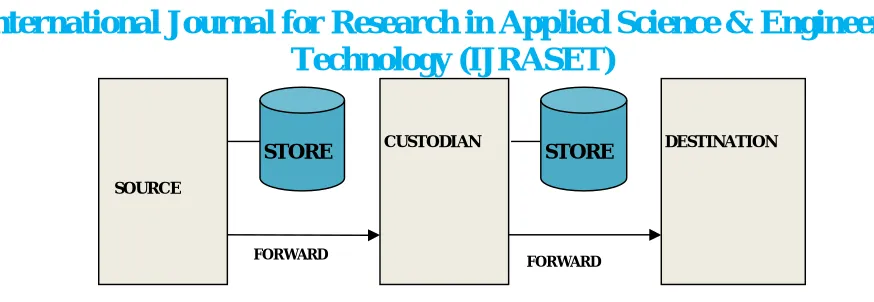
Fig. 1. Information movement in DTN
VANET routing protocols are categorized in two categories: geographic routing and topology-based. The former routing also known as “DTN” based routing protocols which uses neighboring location information for packet forwarding. The later on other researchers used the information about routes that exist in the network for packet forwarding. The FFRDV [6], I [7], VADD [8] and GeOpps [9] etc. are the important examples of DTN based VANET routing protocols.
B. Shortcomings in existing approach
The “FFRDV” (Routing in “VDTN” through Fastest Ferry Concept), proposed by Yu Danlei et al. [6], uses the idea of sending information (from one ferry vehicle to other ferry vehicle on highways) in applications which can endure delay, over fastest ferry. The FFRDV algorithm assumes partition of the road in different logical blocks and size of block is fixed. As soon as the ferry carrying information packet enters in the block, broadcast the HELLO message packet. Each ferry from this logical block send the reply message containing information related to their speed & coordinates. The ferry which has information is called current ferry (CF). CF compares its speed one by one from the speed received in reply HELLO messages & CF elects the fastest ferry among all ferries within the block after receiving HELLO messages from all ferries, and the newly selected fastest ferry (DF) with highest speed will become CF. The old CF after discarding Bundle becomes normal ferry. The FFRDV proposed by Yu Danlei et al. [6] performs well when only low speed vehicles are considered i.e. the vehicles having of relatively high speed as compared to the speed of CF is not available in the scenario and without consideration of vehicles for which traffic lights are preempted from other direction and free lanes are available (either dedicated or for time being). As the negligence by drivers regarding speed limits, which is important concern on highways the possibility of presence of high number of vehicles with high speed can’t be ruled out. Now a days there are number of a special class of vehicles with preemption of traffic light and having a free lane, are also increasing on the highways. As already discussed that FFRDV takes into account the logical blocks of fixed size, due to this the broadcasting of HELLO messages occur after a particular time interval.
With the above mentioned analysis one can conclude that the shortcoming of the FFRDV which shows that the ferry with higher speed will pass through the block and CF will not be aware about this fastest ferry.
C. Providing efficiency by proposed ferry selection approach
The routing algorithm proposed in the current research paper is designed to provide efficient data transmission between different source and destination vehicles on highways by using the DTN architecture and effective ferry selection.
The suggested solution can be executed utilizing the accompanying algorithm:
1) Each vehicle based upon its present speed, generates the block size. As per the value of speed the block sizes may be variable or fixed. While entering in the every block, “HELLO” messages are broadcasted by every vehicle in its individual block. If speed of ferry increases the size of the block decreases
2) Every ferry broadcasts “HELLO” message at the beginning of every fixed or variable size block, depending upon current speed of ferry. “HELLO” message carries the data about vehicle’s present speed (Km/hr), its direction and category.
3) The moment CF gets the broadcast “HELLO” message it begins comparing its speed with the speed of received “HELLO” messages among all other and recognize the category of the vehicle.
4) Ferry forwards the bundle to selected Designated Ferries. If they deny receiving the bundle, CF does not require repeating the procedure for selecting ferry with highest speed.
SOURCE
STORE CUSTODIAN STORE DESTINATION
D. Performance evaluation of proposed approach
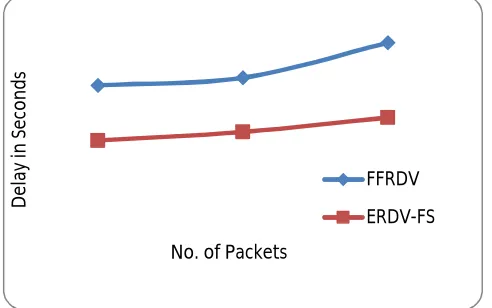
[image:4.612.185.431.132.286.2]The proposed ferry selection algorithm performance has evaluated using MATLAB. Figure 2 & Figure 3 shows that proposed algorithm performs well and provides minimum end-to-end delay when difference in speed increases as compared to FFRDV algorithm under balanced traffic load in simulation.
Fig. 2. End-to-End delay vs No. of Packets Low Traffic (10 Ferries)
Fig. 3. End to End delay vs No. of Packets Heavy Traffic (100 Ferries)
A hybrid approach can also be developed & implemented in which FFRDV remain activated upto a particular threshold value and proposed approach is called whenever the speed of ferries become more than the threshold speed.
II. CONCLUSION
The research paper encapsulates proposal of fastest ferry based algorithm for DTN-enabled Vehicular Ad-hoc Networks (VANETs) and represent comparison between the proposed ferry selection routing protocol with existing routing algorithm i.e FFRDV. The simulation results shows that the end-to-end delay minimized by variable size block selection, special category ferry selection and hybrid approach.
REFERENCES
[1] Wireless Access in Vehicular Environments (WAVE), Available: http://standards.ieee.org/findstds/standard/1455-1999.html.
[2] C2C-CC: CAR 2 CAR Communication Consortium, Available: http://www.car-to-car.org/.
[3] Slawomir Kuklinski, Adrian Matei, Grzegorz Wolny, “NGVN: A Framework for Next Generation Vehicular Networks”, 8th International Conférence on
Communications (COMM), June 2010 pp. 297-300.
[4] Khan, Ajmal, Dong-Won Kum, Jae-Choong Nam, and You-Ze Cho. "Minimum delay routing protocol for DTN-enabled VANETs", 2012 18th Asia-Pacific
Conference on Communications (APCC), 2012.
D el ay in S ec o n d s
No. of Packets
FFRDV ERDV-FS D el ay in S ec o n d s
No. of Packets
FFRDV
Networking Conference, 2008 IEEE Communication Society, pp. 2206 – 2211.
[7] Jing Zhao and Guohong Cao, “VADD: Vehicle-Assisted Data Delivery in Vehicular Ad-hoc Networks” IEEE Transaction on Vehicular technology, May
2008, pp 1910-1922.
[8] Ilias Leontiadis and Cecilia Mascolo “GeOpps: Geographical Opportunistic Routing for Vehicular Networks” IEEE International Symposium on World of