Technology (IJRASET)
Physical Layer Reliability Enhancement based
on Deterministic Multicast Algorithm
Berthila label.H1, Dhanalakshmi.K2, Dhivya Mai.T.U3, Jancy. K4 1,2,3,4
Pondicherry University (SGCET), Puducherry, India
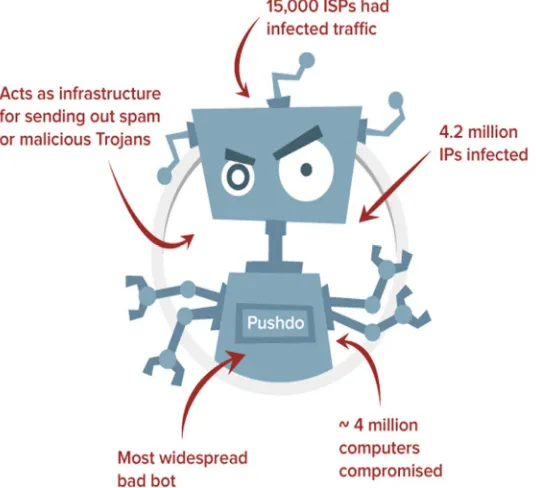
Abstract: Wireless transmission has a major loophole of security. Wireless transmission can be readily overheard by unauthorized users for interception purposes and is thus highly vulnerable to eavesdropping attacks. Physical-layer security is emerging as a promising technique to protect the wireless communications against eavesdropping attacks .We evaluated the security performance of cooperative relay transmission in Rayleigh fading environments in terms of secrecy capacity and intercept probability in our existing works but real-time effect on the network was not analyzed. We present here the eavesdropper identification system in real world approach. In wireless network the hacker enters as the bot. Bot is nothing but the known web robot. It is also termed as the computer application which operates some predefined tasks on internet. It could be used to send spam email or participate in distributed denial-of-service attacks. The word botnet is a combination of the words robot and network.
Index Terms: Bot, Bot net, clustering
I. INTRODUCTION
[image:2.612.173.441.460.704.2]A malicious piece of software used to compromise a host in the network so that it can be remote-controlled by its master is termed as bot. Term botnet is an organized group of bots to perform different malicious activities in the Internet at the behest of the “botmaster” . A botnet operates under common Command &Control (C & C) servers through establishment of C&C channels. For this, botmaster has to define some C&C protocol, which is the most intrinsic part of botnet’s C&C strategy. While bots are often used to simply automate a repetitive online interaction, their ability to mimic actual human conversation and avoid detection has resulted in the use of bots as tools of covert manipulation.On the internet today bots are used to artificially alter, disrupt or even silence legitimate online conversations. Bots are sometimes implemented, for example, to overwhelm the discussion of some topic which the bot's creator wishes to silence.
Technology (IJRASET)
II. DETERMINISTIC MULTICAST ALGORITHM
Deterministic Multicast Algorithm is collaborated with Frequency Hopping Spread Spectrum (FHSS) which is a method of transmitting radio signals by rapidly switching a carrier among many frequency channels, using a pseudorandom sequence known to both transmitter and receiver nodes. It is used as a multiple access method in the frequency-hopping code division multiple access scheme. FHSS is a wireless technology that spreads its signal over rapidly changing frequencies. Each available frequency band is divided into sub-frequencies. Signals rapidly change ("hop") among these in a pre-determined order. Interference at a specific frequency will only affect the signal during that short interval. FHSS can, however, because interference with adjacent direct-sequence spread spectrum (DSSS) systems. A sub-type of FHSS used in wireless data transfer is adaptive frequency hopping spread spectrum (AFH).This identification of fluctuating frequency detects our bot nodes. The overall bandwidth required for frequency hopping is much wider than that required to transmit the same information using only one carrier frequency. However, because transmission occurs only on a small portion of this bandwidth at any given time, the effective interference bandwidth is really the same. Whilst providing no extra protection against wideband thermal noise, the frequency-hopping approach does reduce the degradation caused by narrowband interference sources.
A. Approach towards enhancement of reliability
Eavesdropper detection approach Deterministic Multicast Algorithm works with the concept of collaborative communication among the nodes. If any malicious nodes are damaged or not functional then it can break down the complete process. Our project deals with any kind of bot injection and its effect on overall network. The identification of trackers entering like a genuine node can be easily tracked. One of the challenges of frequency-hopping systems is to synchronize the transmitter and receiver. One approach is to have a guarantee that the transmitter will use all the channels in a fixed period of time. The receiver can then find the transmitter by picking a random channel and listening for valid data on that channel. The transmitter's data is identified by a special sequence of data that is unlikely to occur over the segment of data for this channel and the segment can have a checksum for integrity and further identification. The transmitter and receiver can use fixed tables of channel sequences so that once synchronized they can maintain communication by following the table. On each channel segment, the transmitter can send its current location in the table.
Figure.2 Architecture Diagram
III. OPERATION
A. Module Creation using Matlab
Technology (IJRASET)
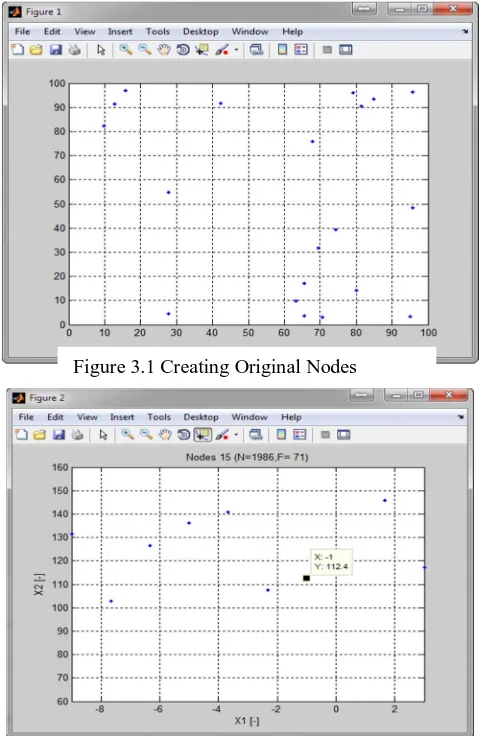
[image:4.612.186.426.99.467.2]to initialize the original node in the mobile ad hoc network. In order to create the network we should create the original node.
[image:4.612.185.428.501.713.2]Figure 3.1 Creating Original Nodes
Figure 3.2 Identifying and setting position
Technology (IJRASET)
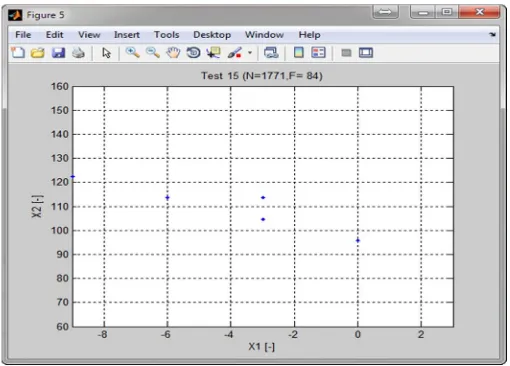
[image:5.612.190.422.77.242.2]We’re going to identify and set the position of the node. After creating the original node we should set the position of the particular node (i.e.) the original node. Then ID number is allocated to each and every individual node. Then Bot Node is inserted corresponding to original node. In the Previous module we have already positioned the original node. Here in the next module we’re going to re arrange the bot. already we have allocated the ID to each and every individual node, then we’re going to allocate the ID to bot node.
[image:5.612.179.434.317.500.2]Figure 3.4 Embed the Bot
[image:5.612.180.434.523.705.2]Figure 3.5 Rearranging position of replica node
Technology (IJRASET)
IV. SIMULATION IN MATLAB
A. Coding
function varargout = M_M(varargin)
% M_M MATLAB code for M_M.fig
% M_M, by itself, creates a new M_M or raises the existing % singleton*.
%
% H = M_M returns the handle to a new M_M or the handle to % the existing singleton*.
%
[image:6.612.167.434.77.540.2]% M_M('CALLBACK',hObject,eventData,handles,...) calls the local
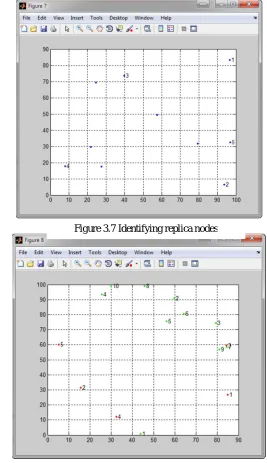
Figure 3.7 Identifying replica nodes
Technology (IJRASET)
% function named CALLBACK in M_M.M with the given input arguments. %
% M_M('Property','Value',...) creates a new M_M or raises the % existing singleton*. Starting from the left, property value pairs are % applied to the GUI before M_M_OpeningFcn gets called. An
% unrecognized property name or invalid value makes property application % stop. All inputs are passed to M_M_OpeningFcn via varargin.
%
% *See GUI Options on GUIDE's Tools menu. Choose "GUI allows only one % instance to run (singleton)".
%
% See also: GUIDE, GUIDATA, GUIHANDLES
% Edit the above text to modify the response to help M_M
% Last Modified by GUIDE v2.5 29-Feb-2016 11:52:31
% Begin initialization code - DO NOT EDIT
gui_Singleton = 1;
gui_State = struct('gui_Name', mfilename, ...
'gui_Singleton', gui_Singleton, ...
'gui_OpeningFcn', @M_M_OpeningFcn, ...
'gui_OutputFcn', @M_M_OutputFcn, ...
'gui_LayoutFcn', [] , ...
'gui_Callback', []);
if nargin && ischar(varargin{1})
gui_State.gui_Callback = str2func(varargin{1});
end
if nargout
[varargout{1:nargout}] = gui_mainfcn(gui_State, varargin{:});
else
gui_mainfcn(gui_State, varargin{:});
end
% End initialization code - DO NOT EDIT
display('//** Project Title:-Physical Layer Realibility Enhancement Based On Deterministic Multicast Algorithm **\\')
display('//** College Name:- SGCET **\\') display('//** Department of ECE **\\') display('//** Final Review **\\')
display('//** Guide Name:- Ms.S.Shobana **\\')
display('//** Batch Member1:- Ms. Berthila lebel.H (12TC2212) **\\') display('//** Batch Member2:- Ms. Dhanalakshmi.K (12TC2215) **\\') display('//** Batch Member3:- Ms. Dhivya mai.T.U (12TC2217) **\\') display('//** Batch Member4:- Ms. Jancy.K (12TC2224) **\\')
% --- Executes just before M_M is made visible.
function M_M_OpeningFcn(hObject, eventdata, handles, varargin)
Technology (IJRASET)
% hObject handle to figure
% eventdata reserved - to be defined in a future version of MATLAB % handles structure with handles and user data (see GUIDATA) % varargin command line arguments to M_M (see VARARGIN) % Choose default command line output for M_M
handles.output = hObject;
% Update handles structure
guidata(hObject, handles);
% UIWAIT makes M_M wait for user response (see UIRESUME) % uiwait(handles.figure1);
% --- Outputs from this function are returned to the command line.
function varargout = M_M_OutputFcn(hObject, eventdata, handles)
% varargout cell array for returning output args (see VARARGOUT); % hObject handle to figure
% eventdata reserved - to be defined in a future version of MATLAB % handles structure with handles and user data (see GUIDATA) % Get default command line output from handles structure
varargout{1} = handles.output;
% --- Executes on button press in pushbutton1.
clc warning off
function pushbutton1_Callback(hObject, eventdata, handles) nodes = [(1:20); 100*rand(2,20)]';
segments = [(1:17); floor(1:0.5:9); ceil(2:0.5:10)]'; figure; plot(nodes(:,2), nodes(:,3),'b.');
grid on; hold on;
% hObject handle to pushbutton1 (see GCBO)
% eventdata reserved - to be defined in a future version of MATLAB % handles structure with handles and user data (see GUIDATA) % --- Executes on button press in pushbutton3.
function pushbutton3_Callback(hObject, eventdata, handles) project = mbcmodel.CreateProject('DieselMulti');
% Define Inputs for test plan
LocalInputs = mbcmodel.modelinput('Range',{[-9 3],[60 160],[1.2 1.9],[1.5 15]}); GlobalInputs = mbcmodel.modelinput('Symbol',{'N','F'},...
'Name',{'measrpm','basefuelmass'},...
'Range',{[1600 2200],[20 200]});
% create test plan
TP = CreateTestplan( project, {LocalInputs,GlobalInputs} );
globalDesign = TP.CreateDesign(2, 'Type', 'Latin Hypercube Sampling');
% Fuel constraint: Maximum 200 at 1600 rpm, 175 at 2200 rpm %%C = globalDesign.CreateConstraint('Type','1D Table'); % set up the 1D Table constraint
Technology (IJRASET)
%%C.Breakpoints = [1600 2000]; %%C.TableFactor = 'F';
%%C.Table = [200 175]; % assign constraint to design %%globalDesign.Constraints = C; % generate a 15 point design
globalDesign = Generate(globalDesign, 15); figure
% set as best design in test plan
TP.BestDesign{2} = globalDesign;
localDesign = TP.CreateDesign(1,'Type','Latin Hypercube Sampling'); localDesignGenerator = localDesign.Generator;
localDesignGenerator.NumberOfPoints = 10; DList = mbcdoe.design.empty( 0, 1);
for i=1:globalDesign.NumberOfPoints; GlobalPoint = globalDesign.Points(i,:); speed = GlobalPoint(1);
% fuel pressure limits dependent on speed
f = (speed-1600)/(2200-1600);
% note because you use the Limits property to specify the input range
% you get LHS designs with exactly 30 points.
localDesignGenerator.Limits(2,:) = (1-f)*[90 120] + f*[110 160]; % grackmea limits dependent on speed
localDesignGenerator.Limits(3,:) = (1-f)*[0.2 0.4] + f*[0.6 0.9];
% set design properties and generate local design
localDesign.Generator = localDesignGenerator;
% Make design name which reflects the global point
localDesign.Name = sprintf('Nodes %2d (%s=%4.0f,%s=%3.0f)', i,...
GlobalInputs(1).Symbol,GlobalPoint(1),....
GlobalInputs(2).Symbol,GlobalPoint(2));
% Plot Design
Scatter2D(localDesign);
V. CONCLUSION
Thus we have shown the feasibility of the proposed protocols with respect to the security requirements and analysis against the bot injection and its mixing in network. The node will be properly identified with duplicity feature. Our system is found a very effective and novel framework which can be used for proactive detection of bots within a monitored network. We implemented the system which can cover the overall network and check the bot and display the bot attack .We can even detect bot and show the number of bots detected in the network with respect to original node. Ours is a system of eavesdropper location and number identification system which is efficient enough to catch the eavesdroppers in real time. We have even simulated a real time network of wireless nodes to check most reliable result of our approach. It efficiently analyze all the features and check the node authentication.
REFERENCES
[1] M. E. Hellman, “An Overview of Public Key Cryptography,” IEEE Commun. Mag., vol. 16, no. 6, May 2002, pp. 42–49.
Technology (IJRASET)
[4] S. K. Leung-Yan-Cheong and M. E. Hellman, “The Gaussian Wiretap Channel,” IEEE Trans. Info. Theory, vol. 24, no. 7, July 1978, pp. 451–56.
[5] G. J. Foschini and M. J. Gans, “On Limits of Wireless Communications in a Fading Environment when Using Multiple Antennas,” Wireless Personal Commun., vol. 6, no. 3, Mar. 1998, pp. 311–35.
[6] Y. Zou, Y.-D. Yao, and B. Zheng, “Opportunistic Distributed Space-Time Coding For Decode-And-Forward Cooperation Systems,” IEEE Trans. Signal Processing, vol. 60, no. 4, Apr. 2012, pp. 1766–81.
[7] F. Oggier and B. Hassibi, “The Secrecy Capacity of the MIMO Wiretap Channel,” IEEE Trans. Info. Theory, vol. 57, no. 8, Aug. 2011, pp. 4961–72. [8] L. Dong et al., “Improving Wireless Physical Layer Security via Cooperating Relays,” IEEE Trans. Signal Processing, vol. 58, no. 3, Mar. 2010, pp. 1875–88. [9] H.-M. Wang et al., “Hybrid Cooperative Beamforming and Jamming for Physical-Layer Security of Two-Way Relay Networks,” IEEE Trans. Info. Forensics
Sec., vol. 8, no. 12, Dec. 2013, pp. 2007–20.
[10] L. Zhou et al., “Joint Physical-Application Layer Security for Wireless Multimedia Delivery,” IEEE Commun. Mag., vol. 52, no. 3, Mar. 2014, pp. 66–72.
BIOGRAPHY
Berthila label.H was born in Puducherry in 1994. She is currently pursuing her UG in Electronics and Communication Engineering from Sri Ganesh College of Engineering and Technology (Pondicherry University), Pondicherry.
Her areas of interests are Computer Communication Networks and Digital communications
Dhanalakshmi.K was born in Puducherry in 1994. She is currently pursuing her UG in Electronics and Communication Engineering from Sri Ganesh College of Engineering and Technology (Pondicherry University), Pondicherry.
Her areas of interests are Computer Communication Networks and Digital communications
Dhivya mai.T.U was born in Puducherry in 1994. She is currently pursuing her UG in Electronics and Communication Engineering from Sri Ganesh College of Engineering and Technology (Pondicherry University), Pondicherry.
Her areas of interests are Digital circuits, Cellular mobile Communication and Digital communications
Jancy.K was born in Puducherry in 1994. She is currently pursuing her UG in Electronics and Communication Engineering from Sri Ganesh College of Engineering and Technology (Pondicherry University), Pondicherry.