Technology (IJRASET)
Investigating Node Deployment In Wireless Sensor
Networks
Ms. Amrita Chaudhary1, Bhawna Garg2
1
Associate professor, GGGI,Dinarpur Ambala
2
M.Tech(CSE Deptt) GGGI,Dinarpur Ambala
Abstract: Many studies have been done in the area of Wireless Sensor Networks (WSNs) in recent years. In this kind of networks, some of the key objectives that need to be satisfied are area coverage, number of active sensors and energy consumed by nodes. While moving the data in the sensor node they were faced many issues occurred due to the reasons of power failure, noise volatility, which harmfully influence the coverage of the WSNs. These problems were occurred due to the coverage problem among the nodes and also node deployment is also a major issue in WSN. This paper focuses on highlighting the strengths and limitations of the earlier proposed classification techniques. The paper provides an insight into the reviewed literature to reveal new aspects of research.
Keywords - WSN, Routing Protocol,LWSN,PDF
I. INTRODUCTION
Recent advancement, in WSN, we know in guided media the electromagnetic waves are guided through a solid medium, such as copper wire , coaxial cable or optical fibber etc likewise[1] unguided media includes the atmosphere and the outer space which do not guide the waves, this form of transmission is referred to as wireless transmission. A wireless network is a type of network where no need of wire for connection of nodes. Here radio communication that is spread spectrum radio, infrared, cellular radio or satellite is used. No need to plug a cable into the computer to connect to the internet. Cell phone networks, Wi-Fi local networks etc are the examples of wireless network.
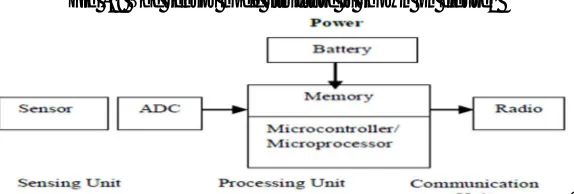
[image:2.612.165.452.615.712.2]A WSN is a wireless network having sensors to sense physical or environmental conditions, like pressure, temperature, sound or pollutants of different places. A SN sense and react to events and phenomena in a specified environment, where the environment can be the physical world, a biological system, or an information technology framework .In other word it can be said that a WSN in an infrastructure consists of sensing(measuring),computing, and communication elements combines into a single tiny device through advanced mesh networking protocols. The mesh networking connectivity will seek out and exploit any possible communication path by hopping data from node in search of its destination. The power of wireless sensor networks[1] lies in the ability to deploy large numbers of tiny nodes that assemble and configure themselves. The most important application of wireless sensor network technology is to monitor remote environments. For example ,a chemical plant could be easily monitored for leaks by number of sensors which automatically form a wireless interconnection network and immediately report the detection of any chemical leaks .For installation of a SN ,installer simply have to place a sensor ,at each sensing point . The network can be extended by simply adding more devices , no need of any rework or complex configuration is needed .For reducing the installation costs , WSN have the ability to dynamically adapt the changing environments that means it can respond to changes in network topologies and also it respond to different mode of operations . For example, the same network in a chemical factory can be used to localize the source of a leak and track the diffusion of poisonous gases. WSNs are not always homogeneous. In heterogeneous WSN some nodes of relatively higher energy are used to prolong the lifetime and reliability of WSNs.
Technology (IJRASET)
II. LITERATURE REVIEW
A. Seyed Mahdi Jameii et al., [3]
proposed a NSGA-II based multi-objective algorithm for optimizing area coverage, number of active sensor nodes and energy consumed by nodes all of these objectives simultaneously. The efficiency of algorithm was demonstrated in the simulation results. This efficiency could be shown as finding the optimal balance point among the maximum rate of coverage, the least energy consumption, and the minimum number of active nodes while maintaining the connectivity of the network.
B. Mayur C. Akewar [4]
presented the different mobile sensor network deployment approaches with their features and drawbacks different approaches had been proposed for the deployment of mobile sensor by considering different issues. Coverage and Connectivity was the main issue of deployment. Mobility of sensor nodes adds additional functionality to the wireless sensor network of node deployment and relocation of sensors. Sensors find their own position and placed themselves over the objective area after initial sensor distribution.
C. Mohammed Alnuem [5]
described the state-of-the-art node placement schemes and analyzed their performance for linear wireless sensor networks (LWSN).The performance of random and uniform placement schemes in linear sequential configuration analyzed while placing the gateway (GW) at the edge of the deployment region. A non-uniform scheme called linearly decreasing distance (LDD) and analyzed its performance. He analyzed to make uniform energy consumption, LDD gradually decreases the distance between nodes and deploy them closer to each other towards the GW. He examined the impact of GW location on the network performance.
D. Y. Bendigeri et al., [6]
proposed the enhanced network industrialized by effective placement of nodes in circular and grid pattern, which called as uniformity of nodes to be compared with random placement of nodes. Each of the nodes was in optimized positions at uniform distance with neighbors, followed by running energy efficient routing algorithm that saves an additional energy to provide connectivity management by connecting all the nodes.
E. Xuemei Sun [7]
proposed node deployment algorithm in wireless sensor networks based on Steiner tree algorithm. This algorithm considered the two aspects algorithm complexity and practical topology to design improvement strategies. The algorithm could ensure high arithmetic speed and better results to solve node deployment based on network connectivity.
F. Smita S. Kharade [8]
proposed the model Support Vector Machine (SVM) which predicted faulty nodes in wireless sensor network and add minimum number of relay nodes. Faults affected on quality of services (QoS), in WSN networks faults produced incorrect data provided by sensor nodes or the network made a misjudgment on nodes or the network and placing relay nodes to endure these faults, to improve Qos and reliability of the network.
G. Subir Halder et al., [9]
analyzed in wireless sensor networks the issue of preserving energy requires utmost attention. One primary way of conserving energy was judicious deployment of sensor nodes within the network area so that the energy flow remains balanced throughout the network and prevents the problem of occurrence of energy holes.
Firstly, analyzed the network lifetime, found node density as the parameter which has significant influence on network lifetime and derived the desired parameter values for balanced energy consumption. Then to meet the requirement of energy balancing, he was proposed a probability density function (PDF), derived the PDF’s intrinsic characteristics and shown its suitability to model the network architecture considered for the work.
Technology (IJRASET)
III. ROUTING TECHNIQUES IN WIRELESS SENSOR
A. Networks
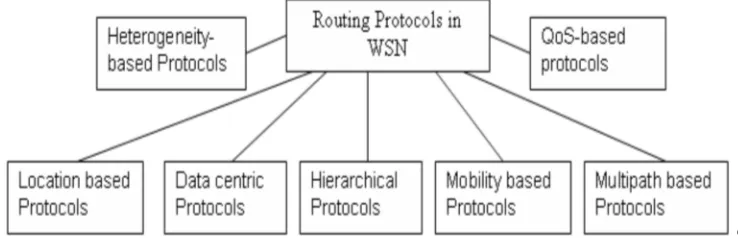
[image:4.612.121.490.161.280.2]WSN Routing Protocols can be classified in four ways, according to the way of routing paths are established, according to the network structure, according to the protocol operation and according to the initiator of communications. Figure 2 shows the classification of WSN routing protocols.
Fig -2: Classification of Routing Protocols in Wireless Sensor Network.
B. Flat Routing (Data Centric Routing protocols)
It is not feasible to assign global identifiers to each node due to the sheer number of nodes deployed in many applications of sensor networks. Such lack of worldwide identification along with random deployment of sensor nodes makes it hard to select a specific set of sensor nodes to be queried. When the primary path fails between the source and the destination an alternate path exists that measured the fault tolerance (resilience) of a protocol. This can be augmented, by maintaining multiple paths between the source and the destination. This increases the cost of energy consumption and traffic generation. The substitute paths are kept alive by sending periodic messages. Due to this, network reliability
can be increased. Also the overhead of maintaining the alternate paths increases.
C. QoS based routing protocols
In order to satisfy certain QoS (Quality of Service) metrics, e.g., delay, energy, bandwidth, etc. when delivering data to the Base Station, the network has to balance between energy consumption and data quality.
D. Query based routing protocols
The destination nodes propagate a query for data (sensing task) from a node through the network and a node having this data sends back the data to the node that matches the query to the query that initiates. Usually these queries are described in natural language, or in high-level query languages.
Therefore, data is usually transmitted from every sensor node within the deployment region with significant redundancy. This consideration has led to data-centric routing. In data-centric direction-finding, the sink leads queries to certain regions and waits for data from the sensors located in the selected regions.
E. Hierarchical protocol
Technology (IJRASET)
Table -1: Comparison of Different Methods
No. Author Year Methods Used Advantages Limitations
1 Rudranath
Mitra1 et al.
2016 three models- Tri-hexagon-tiling
(THT), Uniform Random and Square Grid.
Minimum number of features
depend on the type of sensors, application and the environment where the networks will operate
2 Seyed Mahdi
Jameii et al
2013 NSGA-II based multi-objective
algorithm for optimizing.
optimal balance
point among the
maximum coverage rat
Least energy
consumption, and the
minimum number of
active nodes
3 Mamatha et al. 2013 the optimal placement of nodes for
a WSN. It is impractical to decide the deployment of the nodes separately from WSNs applications
Better correctness
and reduction in
processing time.
Completeness result
better in global
threshold method than the proposed method.
4 Mohammed
Alnuem et al.
2014 the state-of-the-art node placement
schemes and analyzes their
performance for LWSN. First, we analyze the performance of random and uniform placement schemes in
linear sequential configuration
while placing the gateway (GW) at the edge of the deployment region
Increases the performance of classical sobel edge detector along with retaining much relevant information.
Computational cost complexity is high
5 Kirankumar Y.
Bendigeri et al.
2015 develop the optimized network by
effective placement of nodes in circular and grid pattern, which we call as uniformity of nodes to be compared with random placement of nodes.
More accurate and precise results than the method using Mahalanobis distance
additional energy further to provide connectivity
management by
connecting all the nodes.
6 Xuemei Sun et
al.
2015 code deployment algorithm about
wireless sensor networks based on Steiner tree algorithm. On the basis
of the triangle Steiner tree
algorithm, it considers the two aspects algorithm complexity and
practical topology to design
improvement strategies
Curvelet transform is an efficient noise removal method that considers both faint
linear and curvy
linear features.
Results presented are preliminary and requires clinical evaluation.
7 Smita S.
Kharad
2015 propose the prediction model
Support Vector Machine (SVM) to predict faulty nodes in wireless sensor network
recover the network proactively from the
faults and to
continue working
successfully to
improve Qos and
reliability of the
network..
Technology (IJRASET)
Hierarchical direction-finding works in two layers, first layer is used to choose cluster
heads and the other layer is used for routing. To make the WSN more energy efficient, clusters are created and special tasks (data aggregation, fusion) are assigned to them. It increases the general system scalability, lifetime, and energy efficiency.
F. Location-based protocols
In most cases location information is needed in order to calculate the distance between two particular nodes so that energy consumption can be estimated. Mostly two techniques are used to find location, one is to find the coordinate of the neighboring node and otheris to use GPS (Global Positioning System). Since, there is no addressing scheme for sensor networks like IP-addresses and they are spatially deployed on a region, location information can be utilized in routing data in an energy efficient way.
G. Multipath routing protocols
Many paths are used to enhance the network performance. When the primary path fails between the source and the destination an alternate path exists that measured the fault tolerance (resilience) of a protocol. This can be augmented, by maintaining multiple paths between the source and the destination. This increases the cost of energy consumption and traffic generation. The substitute paths are kept alive by sending periodic messages. Due to this, network reliability can be increased. Also the overhead of maintaining the alternate paths increases.
H. QoS based routing protocols
In order to satisfy certain QoS (Quality of Service) metrics, e.g., delay, energy, bandwidth, etc. when delivering data to the Base Station, the network has to balance between energy consumption and data quality.
I. Query based routing protocols
The destination nodes propagate a query for data (sensing task) from a node through the network and a node having this data sends back the data to the node that matches the query to the query that initiates. Usually these queries are described in natural language, or in high-level query languages.
IV. CONCLUSION
From this survey we analyze the various authors’ approach of the WSN. It mainly used for sensing the node to transfer the data among the network. Users of the WSN were face many issues they were occurred due to the reasons of power failure, noise volatility, and these problems were occurred due to the
coverage problem and also node deployment in WSN. This work will be extended to design new algorithm for detection of brain tumor which will provide more efficient result than the existing methods in near future.
REFERENCES
[1] Gayatri Devi, Rajeeb Sankar Bal, Sasmita Manjari Nayak, “Node Deployment and Coverage in Wireless Sensor Network” International Journal of Innovative Research in Advanced Engineering (IJIRAE), Page no-139 Volume 2 (January 2015)
[2] Rudranath Mitra and Diya Nandy, "Node Deployment and the Impact of Relay Nodes in Wireless Sensor Network", International Journal of Computer Science & Communication Networks, Vol 2(3), 358-363.
[3] Seyed Mahdi Jameii and Seyed Mohsen Jameii. " Multi- Objective Energy Efficient Optimization Algorithm for Coverage Control in Wireless Sensor Networks." International Journal of Computer Science, Engineering and Information Technology (IJCSEIT), Vol.3, 2013
[4] Mamatha G,B G Premasudha." Deployment Techniques of Nodes in WSN for Multidomain Applications." International Journal of Advanced Computer Research, Volume-3, 2013.
[5] Mohammed Alnuem."Performance Analysis of Node Placement in Linear Wireless Sensor Networks."Journal of Emerging Trends in Computing and
8 Subir Halder et
al.
2014 a probability density function
(PDF), derived the PDF’s intrinsic
characteristics and shown
itssuitabilitytomodel thenetwork
architectureconsidered for the
work
DF. Performance of
the deployment
scheme is evaluated
in terms of
coverage-connectivity, energy balance and network lifetime.
Applicative where the
parameters must be
Technology (IJRASET)
[6] Kirankumar Y. Bendigeri and Jayashree D. Mallapur ."Multiple Node Placement Strategy for Efficient Routing in Wireless Sensor Networks." 2015 [7] Xuemei Sun. "Node Deployment Algorithm Based on Improved Steiner Tree." International Journal of Multimedia and Ubiquitous Engineering ,Vol.10, 2015 [8] Smita S. Kharade and Simra n R. Khiani. "Fault Prediction and Relay Node Placement in Wireless Sensor Network." International Journal of Innovative
Research in Computer and Communication Engineering, Vol. 3, 201