Fire Detection System using Matlab
Chandrakant Shrimantrao1, Mahesh S K 2, Vivekanand M Bonal3
1
Fourth Sem M.Tech, 2Asst. Professor, Appa Institute of Engineering and Technology Karnataka, 3
Head, R&D, Vivek InfoTehch, Kalaburagi, Karnataka, India
Abstract: Fire detection system in the surveillance system monitors the indoor environment and issues alarm as part of the early warning mechanism with ultimate goal to provide an alarm at early stage before the fire become uncontrollable. Conventional fire detection systems suffer from the transparent delay from the fire to the sensor which is looking at a point. The reliability of the fire detection system mainly depends on the positional distribution of the sensors. This paper proposes novel method of fire detection by processing image sequence acquired from a video. The proposed video based fire-detection system uses adaptive background subtraction to detect foreground moving object and then verified by the rule based fire color model to determine whether the detected foreground object is a fire or not. YCbCr color space is used to model the fire pixel classification. In addition to the motion and color the detected fire candidate regions are analyzed in temporal domain to detect the fire flicker. Some Morphological operations are used to enhance the features of detected fire candidate region. All of the above clues are combining to form the fire detection system. The performance of the proposed algorithm is tested on two sets of videos comprising the fire, fire colored object and non-fire. The experimental results show that the proposed system is very successful in detecting fire and /or flames.
Keywords: Matlab, Fire detection system, Computer Vision, Edge detection, Color detection
I. INTRODUCTION
Fire detection system sensors are used to detect occurrence of fire and to make decision based on it. However, most of the available sensors used such as smoke detector, flame detector, heat detector etc., take time to response. It has to be carefully placed in various locations. Also, these sensors are not suitable for open spaces. Due to rapid developments in digital camera technology and video processing techniques, conventional fire detection methods are going to be replaced by computer vision based systems. Current vision based techniques mainly follow the color clues, motion in fire pixels and edge detection of flame. Fire detection scheme can be made more robust by identifying the gray cycle pixels nearby to the flame and measuring flame area dispersion.
Fire detection system is the most important component in the surveillance system. Fire has been one of the major disasters, even though it is so important to fulfill certain activities in day-to-day life. Fire disasters will cause severe damage to human properties and cause terrible mental and physical injuries, if they are not detected at the right stage [1] Fire detection systems play an important role in safeguarding places against fire. To minimize fire risk and its impact, any company should apply sound fire detection method. A key aspect of fire protection is to identify a developing fire quickly and to alert the building's occupants and fire emergency organizations. A necessity of a Fire Detection System is the detection of fire conditions as early as possible, to provide enough time for Automated Systems/ Fire personnel for effective counter actions [2].
II. LITERATURE SURVEY
Computer vision based fire detection systems have overcome these limitations since it detects the combustible instead of it’s by products. Furthermore, it detects through a camera, which is a volume sensor and covers a wide range from a single camera. Rinsurongkawong et al. [4] have proposed a method for early fire detection based on Lucas Kanade optical flow algorithm in real time in a video stream captured by normal camera. The optical flow techniques implemented to calculate the flow analysis of fire, which used to extract the fire from the other moving objects. The work of Rinsurongkawong et al. [4] consists of four steps. Those are the foreground object detection, chromatic feature detection, growth rate analysis and the fire dynamic and behavior analysis. Moving average method has been used to detect foreground objects. RGB and HSI color spaces have been used to model the Fire pixels. Growth rate analysis and optical flow analysis have been used to extract the real fire from the other moving objects and fire liked colors. This method has improved the accuracy of fire detection for early fire alarming and has reduced false alarm. Toreyin et al. [5] have proposed algorithm for fire and flame detection in color video. Flame and fire flicker has been detected by analyzing the videos in wavelet domain. This video-based fire detection algorithm has used hybrid background estimation method to detect foreground-moving objects and RGB color space has been used to model the fire color pixels. The algorithm not only uses color and temporal variation information , but also checks flicker in flames using 1-D temporal wavelet transform and color variation in fire colored moving regions using 2 –D spatial wavelet transform. This method has successfully reduced the false alarms by temporal and spatial wavelet analysis and can be used for detection of fire in movies and video databases. But this method needs more processing power for its calculation of each frame of each pixel.
The work of True [6] has used color and motion information computed from video sequences to locate fire. This system has used RGB color space to model the fire pixels. Gaussian smoothed color histogram has been used to detect fire pixels and analyzed them in temporal domain to determine which of these pixels are actual fire pixels. Spurious fire pixels are automatically removed by an erode operation and some missing pixels are found using region growing method. This proposed method is insensitive to camera motion. All parameters for features are decided from constrained data; therefore same results cannot be assured if the input data are changed.
Although literature is available on computer vision based fire detection methods, those theories are not converted into practical instruments effectively. There are only a few systems are commercially available for fire detection by processing the images captured from video.
In this paper a computer vision based fire detection algorithm which can run in parallel with the existing conventional sensor based systems (smoke and heat) is proposed to reduce the false alarms and to increase the reliability of conventional system. Since almost all, the important places are equipped with CCTV security surveillance systems, the proposed algorithm can be easily incorporated into a surveillance system monitoring indoor area of interest for early detection of fire. This paper proposes fire detection in a record room by analyzing the image sequences captured by a normal camera.
III. PROPOSED SYSTEM
Extract Images into Frames from Video
Edge Detection
Color Detection
Detect
Motion Detection Gray Cycle Detection Area Dispersion
NO Start
Figure 3.1 Proposed System Flow Diagram
The proposed algorithm is based in the fact that visual color images of fire have high absolute values in the red component of the RGB coordinates. This property permits simple threshold-based criteria on the red component of the color images to segment fire images in natural scenarios. However, not only fire gives high values in the red component. Another characteristic of fire is the ratio between the red component and the blue and green components. An image is loaded into color detection system and mapped with the extracted edge detection image. Color detection system applies the specific property of RGB pixels and gives the output result as an image with a selected area of color detection Color detector use the original image for color detection and gives the corresponding binary image with probable fire pixel area. After getting the output from the color detection we can apply different detection techniques by mapping these detected coordinate on its corresponding original image with different combinations
IV. DESIGN AND IMPLEMENTATION
A. Extracting Frame
A video file consists of frames. These frames when appear before us in a rate more than our perception of vision, gives a sensation of an object moving before us, by looking just at the screen on which frames are appearing at high rate. Thus one can say that frames are the fundamental entity of a video file.
Frames can be obtained from a video and converted into images. To convert a video frame into an image, the MATLAB function ‘frame2im’ is used. To read a video in avi format, the function ‘aviread’ is used. The original format of the video that I am using as an example is .gif file format. I converted the .gif file format image into an avi format video For instance, in the ‘fire.avi’ video I am interested in the frame number 58. So I am converting the 58th frame into an image.
B. Edge Detection
Edge detection method is used to detect the color variance in an image, it also includes a variety of mathematical methods that aim at identifying points in a digital image at which the image brightness changes sharply or, more formally, has discontinuities. The points at which image brightness changes sharply are typically organized into a set of curved line segments termed edges. The same problem of finding discontinuities in one-dimensional signals is known as step detection and the problem of finding signal discontinuities over time is known as change detection. Edge detection is used for image segmentation and data extraction in areas such as image processing, computer vision, and machine vision.
The edges extracted from a two-dimensional image of a three-dimensional scene can be classified as either viewpoint dependent or viewpoint independent. A viewpoint independent edge typically reflects inherent properties of the three-dimensional objects, such as surface markings and surface shape. A viewpoint dependent edge may change as the viewpoint changes, and typically reflects the geometry of the scene, such as objects occluding one another. A typical edge might for instance be the border between a block of red color and a block of yellow. In contrast a line (as can be extracted by a ridge detector) can be a small number of pixels of a different color on an otherwise unchanging background. For a line, there may therefore usually be one edge on each side of the line
C. Image Segmentation
Image segmentation is a further step to separate the background from the foreground object in the image. Lots of image segmentation techniques can be used here such as compression, morphological processing, edge detection and many more advance techniques. This is the hardest part in digital image processing since it involves segmentation procedures to partition the image into the objects desired. Next, the purpose of thresholding is to extract the objects from the background by selecting the best threshold value for the image. In order to differentiate between background and fire, the process will include segmentation of the fire region and thresholding which value can be found using colour thresholding tools in MATLAB. In this process, histogram plays an
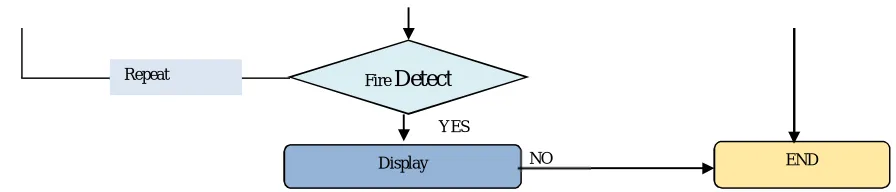
Fire Detect
Display NO END
important role to find the best threshold value. RGB and YCbCr both have different threshold value of fire region. The specific range and pixel value to be classified as fire in RGB and YCbCr color space is highlighted. Then, the most important step will proceed which is feature extraction. Whereby, all the data and threshold value will be used to create rules for fire recognition
D. Feature Extraction
[image:5.612.153.483.183.338.2]Feature extraction is where all the data pixels that represent and describe the desired pixels is been grouped. The set of features will extract relevant information accordingly to the desired task fire pixel had been extracted by using two colour spaces and seven rules that were applied for each of image tested. The rules are listed in Table-1.
Table 1: Seven rules for fire recognition
Each of the rules constructed according to the analysis of 100 sample images. For example, for the Rule 1 and Rule 2, all fire images show that R is the major component in a fire image. However, the R color component reduces significantly during afternoon because of strong sunlight. To overcome this problem, average value of R, G and B was determined based on 100 images used in this work. Hence, generally we can classify that the fire region component R should be greater than G and G should be greater than B component.
E. Fire Pixel Classification
Fire pixel classification is proposed. The model uses YCBCR color space to separate the luminance from the chrominance more effectively than color spaces such as RGB or rgb. In this stage, detection of fire in RGB and YCbCr color space will be combined together for the result to be accurate. That is meant that the image should fulfil all the rules to be considered as fire. In this stage, the output supposed to show the fire region in binary image as if the fire detected. Else, only full black colored image will be displayed.
V. RESULTS AND ANNAYLASIS
The analysis is to decide which colour space (RGB, Grayscale, YCbCr) is suitable to be used in the system. For this experiment, both RGB and YCbCr color space higher fire detection rate and low false alarm rate. However, YCbCr color space provide more advantage compare to RGB color space as YCbCr can separate the luminance from chrominance more effectively. While for grayscale, the results for both color space RGB and grayscale are same. Grayscale is suitable to be used in the case of high or low light intensity and brightness. In grayscale, plane R, G, and B will have same value. RGB and grayscale able to detect fire, but they cannot differentiate between fire and non-fire object. Figure-5 below shows the results for fire detection using RGB, grayscale and YCbCr color space.
[image:5.612.43.564.634.709.2]VI. CONCLUSION
This paper proposed a video-based fire alarming system by analyzing the image sequences acquired from a video source The performance of this system has been verified practically and following salient features were identified. The fire can be detected at its inception. The performance of the system was tested with a video sequence consist of a matchstick fire and it was detected. This gives a strong evidence for its ability to detect fire at its inception. This allows relevant authorities to combat fire immediately minimizing damages caused by fire.
The proposed method does not address the smoke detection, which is an indication for an early fire. Therefore, proposed method cannot detect smouldering fires. Hence the performance of the proposed method further can be improved by integrating the Smoke detection. Performance Limitations are given due to hidden fires (covered by dense smoke or object) not visible to the cameras or camera that have no clear view because of bad illumination or far away from the camera(beyond the field of view of the camera). Therefore, the proposed method can only detect if fire is clearly visible to the camera.
REFERENCES
[1] Natinal Fire Protection Association. (2016). “A Reporter's Guide to Fire and the NFPA: The consequences of fire,” [Online article]. Available:
http://www.nfpa.org/press-room/reporters-guide-to-fire-andnfpa/ consequences-of-fire
[2] N. Artim. “Free Resources:Preservation Leaflets:Emergency Management:3.2 An Introduction to Fire Detection, Alarm, and Automatic Fire Sprinklers,”
North-East Document Conservation Center. [Online]. Available: http://www.nedcc.org/free-resources/preservationleaflets/ 3.-emergency-management/3.2-an-introduction-to-firedetection,- alarm,-and-automatic-fire-sprinklers
[3] X.L. Zhou, F.X. Yu, Y.C. Wen, and Z.M. Lu.G.H. Song, “Early fire detection based on flame contours in video,” Information Technology Journal,vol.9,no.5,
pp 899-908,2010.
[4] S. Rinsurongkawong, M. Ekpanyapong, and M. N. Dailey, “Fire detection for early fire alarm based on optical flow video processing,” in 9th Int. Conf. on
Electrical Engineering/Electronics, Computer, Telecommunications and Information Technology Phetchaburi, 2012, pp.