ScholarWorks @ Georgia State University
ScholarWorks @ Georgia State University
Psychology Dissertations Department of Psychology
Fall 11-12-2013
Informing Moral Decisions with Religious Images: An Examination
Informing Moral Decisions with Religious Images: An Examination
of Associative Priming
of Associative Priming
Sarah Cavrak
Follow this and additional works at: https://scholarworks.gsu.edu/psych_diss
Recommended Citation Recommended Citation
Cavrak, Sarah, "Informing Moral Decisions with Religious Images: An Examination of Associative Priming." Dissertation, Georgia State University, 2013.
https://scholarworks.gsu.edu/psych_diss/118
This Dissertation is brought to you for free and open access by the Department of Psychology at ScholarWorks @ Georgia State University. It has been accepted for inclusion in Psychology Dissertations by an authorized
administrator of ScholarWorks @ Georgia State University. For more information, please contact
AN EXAMINATION OF ASSOCIATIVE PRIMING
by
SARAH CAVRAK
Under the Direction of Dr. Heather M. Kleider
ABSTRACT
Symbols represent information we have previously learned or experienced, but they can
also serve to encourage thoughts and behaviors that are consistent with this
knowledge/experience in order to maintain social cohesion (Guthrie, 1996). Pictures (e.g.,
American Red Cross image) representing moral rules (e.g., ‘save lives’) have been shown to
in-fluence moral decisions (Broeders, van den Box, Muller, & Ham, 2011), but there is no empirical
evidence to demonstrate that religious pictures encourage the same outcome. Four studies
exam-ined whether religious pictures would influence decision making (lexical, moral), and
further-more whether personal belief in religion was a moderating factor. In Study 1, participants viewed
sented the pictures viewed in Study 1), and then made lexical decisions. In Studies 3 and 4,
par-ticipants made decisions about moral actions. Moral decisions were preceded by viewing
pic-tures in Study 3, and by words in Study 4. Self-reported religiosity was assessed last in each
ex-periment. Across the four studies, we found support for the influence of religious pictures on
decision making. In Studies 1 and 2, lexical decisions were faster to religious words when
primed with religious pictures. In Study 3, participants rated morally ambiguous actions as less
appropriate when primed with religious pictures. This occurred to a greater degree for religious
participants. In Study 4, there was a general priming effect of religious words, but this was not
influenced by individual religious beliefs.
INFORMING MORAL DECISIONS WITH RELIGIOUS IMAGES:
AN EXAMINATION OF ASSOCIATIVE PRIMING
by
SARAH CAVRAK
A Dissertation Submitted in Partial Fulfillment of the Requirements for the Degree of
Doctor of Philosophy
in the College of Arts and Sciences
Georgia State University
AN EXAMINATION OF ASSOCIATIVE PRIMING
by
SARAH CAVRAK
Committee Chair: Heather Kleider
Committee: David Washburn
Sarah Brosnan
John Snarey
Electronic Version Approved:
Office of Graduate Studies
College of Arts and Sciences
Georgia State University
ACKNOWLEDGEMENTS
I would like to acknowledge my academic adviser, Dr. Heather Kleider, for her patience
and guidance in the development of this dissertation. This document and my academic
accom-plishments are a reflection of her dedication to her students, and the science of Psychology. I
would also like to acknowledge my entire dissertation committee, Dr. David Washburn, Dr.
TABLE OF CONTENTS
ACKNOWLEDGEMENTS ... iv
LIST OF TABLES ... ix
LIST OF FIGURES ... x
1 INTRODUCTION... 1
1.1 Picture Symbols ... 1
1.1.1 Picture Symbols and Moral Rules ... 3
1.2 Pictures vs. Images ... 4
1.3 Priming ... 6
1.4 Religion ... 9
1.4.1 Religion and Morality ... 10
1.5 Overview of Studies ... 12
2 PILOT STUDY – SELECTION OF PICTURES AND WORDS ... 15
2.1 Method... 15
2.1.1 Participants ... 15
2.1.2 Materials ... 15
2.1.3 Procedure ... 16
2.2 Results ... 17
3.1 Method... 18
3.1.1 Participants ... 18
3.1.2 Materials ... 18
3.1.3 Procedure ... 18
3.2 Results ... 19
3.2.1 Design ... 19
3.2.2 Items Analysis ... 20
3.2.3 Data Preparation ... 20
3.2.4 Manipulation Check ... 20
3.2.5 Primary Analyses ... 21
3.2.1 Follow-up Analyses ... 22
3.3 Discussion ... 22
4 STUDY 2 – WORDS AS SYMBOLS ON LEXICAL DECISIONS ... 23
4.1 Method... 24
4.1.1 Participants ... 24
4.1.2 Materials ... 24
4.1.3 Procedure ... 24
4.2 Results ... 25
4.2.1 Items Analysis ... 25
4.2.3 Manipulation Check ... 25
4.2.4 Primary Analyses ... 25
4.3 Discussion ... 30
5 STUDY 3 – PICTURES AS SYMBOLS ON MORAL JUDGMENTS ... 32
5.1 Method... 33
5.1.1 Participants ... 33
5.1.2 Materials ... 33
5.1.3 Procedure ... 34
5.2 Results ... 35
5.2.1 Manipulation Check ... 35
5.2.2 Data Preparation ... 35
5.2.3 Primary Analyses ... 35
5.3 Discussion ... 36
6 STUDY 4 – WORDS AS SYMBOLS ON MORAL JUDGMENTS ... 37
6.1 Method... 37
6.1.1 Participants ... 37
6.1.2 Materials ... 37
6.1.3 Procedure ... 38
6.2 Results ... 38
6.2.2 Data Preparation ... 38
6.2.3 Primary Analyses ... 38
6.3 Discussion ... 39
7 GENERAL DISCUSSION ... 40
7.1 Review of experimental findings ... 40
7.2 Moral Decision Making ... 41
7.2.1 Religion ... 41
7.2.2 Religious Beliefs ... 42
7.2.3 Imagery ... 45
7.3 Priming ... 46
7.4 Conclusions ... 48
REFERENCES ... 49
APPENDICES ... 59
Appendix A ... 59
Appendix B ... 60
Appendix C ... 69
LIST OF TABLES
Table 1. (Study 1, 3) Pictures used as primes ... 59
Table 2. (Study 1, 2) Words used in the lexical decision task ... 60
Table 3. (Study 2, 4) Words used as primes ... 69
LIST OF FIGURES
Figure 1. (Study 1) Picture Prime x Word Type interaction on average RT to accurate
lexical decisions. Error bars represent standard error. ... 21
Figure 2. (Study 2) Word Prime (concrete) x Word Type interaction on average RT to
accurate lexical decisions. Error bars represent standard error. ... 27
Figure 4. (Study 2) Word Prime (abstract) x Word Type interaction on average RT to
accurate lexical decisions. Error bars represent standard error. ... 29
Figure 3. (Study 2) Religious Prime x Word Type interaction on average RT to accurate
lexical decisions. Error bars represent standard error. ... 29
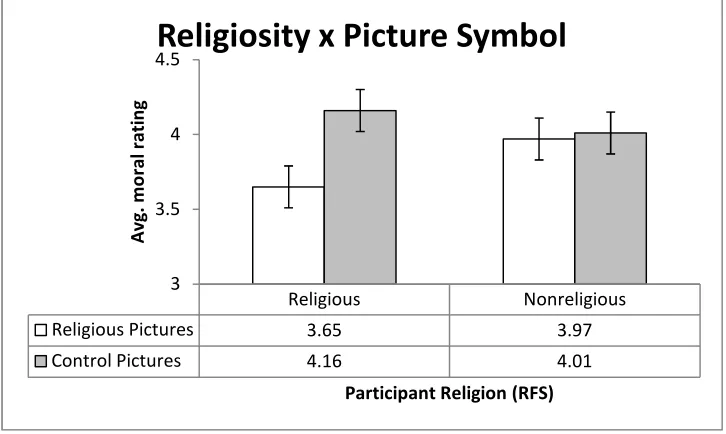
Figure 5. (Study 3) Participant Religiosity x Picture Prime interaction on average rating
1 INTRODUCTION
Symbolic forms (e.g., language, pictures) are routes to representing knowledge. These
representations communicate thoughts, experiences and emotions, are adaptive to different
con-texts and cultures, and potentially are important aids for survival (Benjafield, 1992). Pictures are
unique because they synchronously represent information, that is, elements of an object or event.
This information representation is useful as it then guides behavior. Pictures, therefore, can
be-come icons which communicate an expected behavior (Benjafield, 1992; 2007). For example,
the American flag represents information like freedom and democracy (Ortner, 1973), and,
argu-ably, a host of information related to specific freedoms or affordances located within the bill of
rights and the constitution. Seeing the American flag may simply bring to mind your knowledge
of democracy or it might encourage you to act or vote in a way that is consistent with your
knowledge of what it means to be an “American.” For a religious person in the Christian
tradi-tion, the crucifix may represent information related to the teachings of Jesus such as love, faith,
and peace. Importantly, the latter two image examples represent more than one semantic concept
simultaneously. The current set of studies will test whether religious pictures (e.g., crucifix,
crown of thorns) concurrently prime religious knowledge, thus influencing decision
mak-ing.
1.1 Picture Symbols
Generally speaking, symbols represent information we have previously learned or
experi-enced, but they can also serve to encourage thoughts and behaviors that are consistent with this
knowledge/experience in order to maintain social cohesion (Guthrie, 1996). Carlston and Mae
‘romantic’) alongside a target individual and found that the target was later perceived as having
the traits implied by the symbol. The authors concluded that symbols, due to their ubiquitous
nature, inform impression formation with and without intentionality of the observer. Hassin,
Ferguson, Shidlovski, and Gross (2007) conducted two studies and found that visual exposure to
one’s national flag influenced personal opinions on key political issues, such that right versus
left wing Israeli participants converged on political opinions when primed with the Israeli flag
relative to those primed with a control image.
Geertz (1973) suggested that religion, a unifying set of beliefs and practices that create
moral community (Durkheim, 1995), is further defined by its use of symbology, which activate
long-term goals, in order to motivate people along a religious path, in part because symbols are
culturally important and emotion-provoking (Ortner, 1973). Baldwin, Carrell, and Lopez (1990)
found that female Catholic participants who were primed with a picture of the Pope displaying a
disapproving expression made lower self-evaluations than those who saw a disapproving
expres-sion on the picture of an unknown person. In a series of two studies, Weisbuch-Remington,
Mendes, Seery, and Blascovich (2005) further found that religious pictures influenced
cardiovas-cular responses when performing a subsequent task (i.e., giving a speech about visiting the
den-tist or one’s own death). They found that participants exposed to a negative religious picture
(i.e., demons) exhibited threat-like cardiovascular responses relative to those exposed to a
posi-tive religious picture (e.g., Christ ascending to heaven).
Beyond beliefs and impressions, symbols have also been found to influence behavior.
Bering (2006) and Bering, McLeod, and Shackelford (2005) found that priming supernatural
ide-as (e.g., “ghost”) influenced cheating behavior in three-year olds, ide-as well ide-as in college students.
Nicholas (e.g., miter, staff, book) subsequently engaged in sharing behavior relative to children
who were primed with a neutral picture. Hassin and colleagues (2007) conducted a third study
and found the response gap between right and left wing participants again merged when the
Is-raeli flag was presented, and influenced both voting intentions as well as voting behavior. These
data support arguments that the influence of pictures as symbols occurs automatically (Bargh,
1994), and outside one’s conscious awareness (Guthrie, 1996).
1.1.1 Picture Symbols and Moral Rules
Broeders, van den Bos, Muller, and Ham (2011) examined whether exposing participants
to picture symbols, representing moral rules, would facilitate responses consistent with those
rules or not. Moral rules, according to Looy (2004), are prescriptions of “good” and “bad”,
rep-resenting the purpose of our human nature, and which fluctuate relative to location (e.g., history,
culture, religion). Moral rules may have their origin in genetic expression, such that the
replica-tion of moral rules across social entities is primarily a reflecreplica-tion of our innate biology. Others
argue that moral rules are not bounded by biology, but that they are socially constructed, and
contribute to the longevity of community (e.g., Haidt, 2001). Broeders and colleagues (2011)
had participants complete a small jigsaw puzzle that formed the American Red Cross logo (a
symbol representing the moral rule “save lives”), the Peace logo (representing the rule “do not
kill”), or a bicycle wheel (a neutral symbol not representative of any moral rule). Then
partici-pants were presented with the classic footbridge problem scenario. In this scenario, participartici-pants
are told that a trolley is traveling down a set of tracks and cannot use its brakes. In its
unstoppa-ble course it will kill five men working at the end of the tracks. You are standing on a footbridge
located above the tracks, and have the opportunity to prevent the five workmen from dying, but
His body will stop the trolley from killing the five workmen, but will kill him in the process. In
this scenario, the life of one person is placed in opposition to the lives of five others. Broeders
and colleagues found that participants reported a greater tendency to intervene in the situation if
exposed to the “save lives” symbol relative to either the “do not kill” or neutral symbols.
These data provide additional evidence that pictures are symbolically representative of
information other than what is visible through the image features alone, and furthermore that
they demonstrate the influence of picture symbols on decision making within a moral domain.
Additionally, participants’ decisions were consistent with the rule represented, such that,
partici-pants intervened in the scenario to save the maximum number of lives when shown the “save
lives” moral rule symbol. What remains untested is whether religious symbols will have a
similar influence on moral decision making. Given that religion is viewed by some as the
primary source for one’s moral education (e.g., Winchester, 2008), it follows then that
reli-gious pictures should prime the learned tenets of one’s faith, and thus influence moral
judgments. The current experiments will test this relationship.
1.2 Pictures vs. Images
According to dual-coding theory (Paivio, 1971, 1986, 1991), there are alternate systems
which represent sensory input: logogens and imagens. Logogens are units that represent verbal
input, whereas imagens are units that represent visual input. Because language proceeds
sequen-tially, logogens correspond to sequential perception. Conversely, because units of visual
infor-mation are presented simultaneously, imagens therefore are perceived simultaneously. Although
imagens are internally produced (i.e., mental images), they are associated with external objects
(or elements of external objects). Mental images have been shown to facilitate learning (e.g., of
Benjafield, 1992), imagery is the effortless production of an internal picture prompted from an
external stimulus. Although produced differently, external visual stimuli (hereafter referred to as
pictures) and internal imagery (hereafter referred to as images) are equally as effective at
encour-aging a desired outcome because their representations are functionally the same (as demonstrated
by mental rotation studies), and both can guide overt behavior (Shepard, 1978; Shepard &
Chipman, 1970). Bower (1970) suggested that images are better remembered than words
be-cause they are more distinctive or bebe-cause the relational encoding of the learned image/word
stimulus is stored with more semantic connections in memory. Given the unique role of images
in associative learning and memory, images thus become representative, or symbolic, of the
ex-periences (i.e., objects, events) to which they are associated (Paivio, 1969). Furthermore, visual
input (picture or image) is remembered better than verbal (words) (Roediger, 2008).
Words can also be symbolic of related information and experience (Bower, 1972; Paivio,
1969). Concrete words (i.e., words that evoke an image), relative to abstract words (i.e., words
that do not evoke an image), become meaningful because of their association to external objects
or events, such that presentation of the word may eventually prompt the production of other
as-sociated verbal and visual items (Paivio, 1969). These associations arguably lead to priming,
whereby a concrete item might lead to the production of an abstract (but associated) item. For
example, the concrete word ‘church’ might prime the abstract word ‘religion’. Under other
cir-cumstances, one modality could prompt the other – such that a concrete word may bring to mind
an internal image, or an external picture may conjure its verbal marker. Although pictures, and
verbal markers of these pictures, can both be symbolic representations with regard to associated
items, the influence of pictures has been demonstrated to be stronger (e.g., greater memory;
of effectiveness begins with abstract items on the lower end, followed by concrete items, and is
strongest for visual objects or pictures (Paivio, 1969).
1.3 Priming
The effectiveness of any symbol (picture or word) is directly related to one’s knowledge
(i.e., memory) of the item and its associations. Miller (2009) argued that memory is a
founda-tional element of religion, and seemingly a person could not engage in a religious ritual (e.g.,
baptism, eucharist) without first knowing and remembering the ritual procedure, or apply
reli-gious doctrine to personal circumstances, if they have not learned and understood the tenets.
Thus, it has been argued that religion forms and maintains a moral community, and guides the
construction of our moral selves (Winchester, 2008). The current set of studies test whether
religious symbols (pictures, words) bring to mind (i.e., prime) related associations in
memory, and thus guide moral decisions.
Priming occurs by presenting a stimulus which then facilitates access to other
semantical-ly related content (Benjafield, 2007; Schacter, 1987; Tulving & Schacter, 1990). If conducted in
the confines of a specific task, then the priming stimulus should encourage a semantically related
response. Priming has been shown to impact thought processes, decisions, behaviors, or a
com-bination of these (e.g., Jacoby & Hollingshead, 1990; Jacoby & Kelley, 1992; Kelley & Jacoby,
2000). In a traditional priming experiment, a set of stimuli (e.g., words, names) are presented
first. Then, a recognition task is performed wherein the previously presented stimuli are shown
along with previously unseen (or new) stimuli. If more previously seen stimuli items are
recog-nized relative to the unseen items, then priming is said to have occurred (Tulving & Schacter,
1990). Jacoby and Hollingshead (1990) found that exposing participants to misspelled words
reproduce a series of audio presented words at test. Other examples of priming tasks fall into
two categories: perceptual and conceptual. Examples of perceptual tests include lexical
deci-sions (wherein people perform word/nonword judgments; Meyer & Schvaneveldt, 1971), word
completion tasks (i.e., having studied the word PYRAMID, and then shown the fragment
‘-Y-A-ID’ at test), identification of perceptually degraded words, as well as recall and recognition
memory tests. An example of a conceptual test would include category-associations where one
is given the name of a category (e.g., ‘bird’) and told to identify the first item that comes to mind
that is associated with that category (e.g., ‘eagle’).
Associative priming occurs when seeing one word (‘doctor’) leads to an increase in
pro-ducing a different but related word (‘nurse’). This is different than typical priming examples
discussed previously, because here the concern is not whether previous exposure to ‘doctor’ will
lead to faster identification of ‘doctor’ on a recognition task. Instead, the interest is in the
asso-ciative relationship between words and concepts. Thus, the amount of priming produced is
di-rectly related to one’s knowledge of the relationship between two or more items (McKoon &
Ratcliff, 1992).
According to spreading activation theories, the success of this type of priming is based on
the interconnected relationship between the two words (Anderson, 1983; Collins & Loftus, 1975;
Meyer & Schvaneveldt, 1971; Quillian, 1967), such that ‘doctor’ will only lead to production or
recognition of ‘nurse’ as a function of their previously associated memory traces. Thus,
unrelat-ed words (neutral or foil words; e.g., ‘bread’) would not be identifiunrelat-ed when ‘doctor’ is shown in
the same way ‘nurse’ would be identified. The neutral or foil words would also not produce
According to non-spreading activation (e.g., compound cue) theories, associative priming
is based on a matched cue search in memory (Dosher & Rosedale, 1989; Ratcliff & McKoon,
1988), such that the relationship between ‘doctor’ and ‘nurse’ is based primarily on the
familiari-ty of the stimulus pair. By this account then, ‘doctor’ could arguably prime ‘bread’ if the
‘doc-tor-bread’ pairing was a frequently occurring, and thus familiar, cue. Therefore, it is more likely
that neutral or foil words could be identified when primed with a stimulus word than they would
according to spreading activation theories. Associative priming has been endorsed in both
lexi-cal decision and item recognition tasks, as well as in judgment of spatial locations (McNamara,
1992).
Associative priming extends beyond simple word identification. Priming participants
with well-known information about a social group (e.g., trait, stereotype) has been shown to
in-crease the likelihood of expressing related behaviors (Dijksterhuis & Bargh, 2001). In a classic
study, Bargh, Chen, and Burrows (1996) primed participants with neutral words or with
stereo-typical words characteristic of elderly people (e.g., old, bingo). They found that participants who
viewed the stereotypical words walked significantly slower when exiting the laboratory than
those who viewed the neutral words, suggesting that the words activated associated information
about elderly people (they walk slow) leading to behavior consistent with that information (to
walk slowly themselves). Moreover, priming ‘elderly’ has also been shown to decrease
perfor-mance on a memory task (Dijksterhuis, Aarts, Bargh, & van Knippenberg, 2000). Along a
simi-lar theoretical framework, priming ‘politician’ (versus a no prime condition) led participants to
be more long-winded when constructing essays (Dijksterhuis & van Knippenberg, 2000), and
priming ‘professor’ increased correct responses on a test of general knowledge (Dijksterhuis &
1.4 Religion
Recent research has demonstrated priming within the context of religious information
(e.g., Wenger, 2003; Wenger & Daniels, 2006). Once accessed, this religious knowledge
net-work has been shown to influence comprehension, memory for past events, and judgments. For
example, Lipson (1983) found that children had greater comprehension of religious texts if they
had prior knowledge of the information they were asked to read. Wenger (2003) primed
reli-gious participants with relireli-gious words (or nonwords), and then asked them to list the three
greatest historical events. He found that participants listed more biblical events when primed
with religious words. Using the Implicit Association Test (Greenwald, McGhee, & Schwartz,
1998), other researchers have found implicit associations for religious (Wenger & Daniels,
2006), as well as moral concepts (Hoverd & Sibley, 2007).
These associations can be grounded in physical processes (e.g., vision, audition) and are
in this sense embodied (McCauley & Whitehouse, 2005). Meier, Hauser, Robinson, Friesen, and
Schjeldahl (2007) provided evidence for the embodiment of religious information when they
found that metaphorical representations of God are associated with upward movement, and
met-aphorical representations of the devil are associated with downward movement. Other
associa-tions may represent habits (Miller, 2009) or rituals repeatedly performed, which then leads to a
perseverance of both the associations themselves, as well as the contextual and emotional
sali-ence in which the original (and repeated) associations are performed (McCauley & Whitehouse,
2005). It follows then that if a person references images or icons of their faith, be it a cross on
their necklace or a mezuzah in the doorway of their home, and reference it whenever they are
facing a difficult life event, then the association between variable life circumstances and the
Furthermore, the tendency to reach out towards one’s faith must be learned initially, and
would be the result of a recollective memory process whereby a person intentionally remembers
that they are a spiritual person who engages in spiritual practices, and then applies them
willful-ly. All of which require resources of attention (e.g., Jacoby & Dallas, 1981; Mandler, 1980).
Over time, reaching towards one’s faith may be the result of familiarity, such that repeated
expo-sure to faith practices or rituals have created well-worn cognitive pathways related to the
me-chanics of the practice and to the situations in which engaging in that practice is applied. Thus,
when a situation is encountered an automatic response of applying faith practices may follow. It
follows then, that for a religious person, the automaticity of relying on one’s faith does not
re-quire intention (i.e., attentional resources), and is strengthened by the frequency with which a
person makes the association. Therefore, if a person can look to their faith under any
circum-stances, then every time they do so they are activating a network of stored information related to
these teachings. If religious beliefs influence the strength of associative nodes regarding
religious information (i.e., religious-type information is more familiar for religious
per-sons), then will religious pictures prime this network, and will this primed network
influ-ence general judgments (e.g., lexical decisions) as well as moral judgments?
1.4.1 Religion and Morality
Memory necessitates the confines with which we regulate ourselves across contexts and
communities (Miller, 2009). For example, identifying oneself as a helpful person requires one to
have engaged in helping behavior in the past or to feel that helping behavior is a prescribed tenet
of some belief system. Although religion is arguably a primary catalyst to moral identity
for-mation (e.g., Winchester, 2008), the relationship between religion and morality is empirically
social-ly appropriate behavior in some studies, whereas others have found divergent evidence. Ahmed
and Salas (2011) primed participants with religious words, and then had participants complete
the dictator and prisoner’s dilemma games. They found that priming with religious words
in-creased generosity and cooperation across both tasks. Shariff and Norenzayan (2007) found that
priming of God concepts influenced the amount of money participants left for an unknown
stranger, suggesting that God concepts may refer to “moral actors” and therefore influence
be-havior. Randolph-Seng and Nielson (2007) found that priming participants with religious words
negatively predicted cheating behavior in a prisoner’s dilemma game, that is, they were less
like-ly to cheat when primed with religious (versus sports or neutral) words. Thus, religious primes
again promoted positive behavior, (i.e., honesty). Interestingly, these effects were not influenced
by personal religiosity.
Kohlberg and Power (1981) argued that religion and morality were two independent
con-structs. Lombrozo (2009) had participants complete a moral commitments assessment followed
by the trolley and footbridge problems. Consequentialist participants (i.e., those who evaluate
the acceptability of a behavior based on real or imagined outcomes) judged moral dilemmas as
more permissible than deontologist participants (i.e., those who focus on the behavior rather than
the possible outcomes). These results were robust regardless of religiosity. Fumagalli, et al.
(2010) similarly found that individual religiosity did not impact the reaction time or frequency of
utilitarian judgments to moral situations. Conversely, religious beliefs in other studies have been
found to influence general, as well as moral judgments. The influence of the disapproving Pope
picture (Baldwin, et al., 1990) was only effective for participants who were active practicing
Catholics, and the cardiovascular responses to negative religious pictures were only present for
Rozin (2001) found that participants who self-identified as Protestant (rather than Jewish) were
less accepting of a character in a scenario if the character’s mental state was implicated in the
moral rule violation. Morewedge and Clear (2008) found that Christian participants judged
vi-gnettes (which violated religious doctrine) more morally wrong when they affirmed a belief in
the concept of an anthropomorphic God. Wahrman (1981) further found a moderated link
be-tween religion and morality, such that rigid adherence to religious doctrine resulted in lower
moral judgment development. As previous studies have found that picture symbols were
representative of moral rules, such that these pictures primed moral decisions, the current
experiments seek to further test the relationship between pictures and moral judgments
using religious iconography.
1.5 Overview of Studies
Overall, it is hypothesized that repeated associations between religious pictures and
reli-gious information facilitate their application to life circumstances, not only as contemplative
tools, but arguably as proscriptive guides to decisions and behavior. Although the research is
mixed as to whether religion informs morality at all, and if it does, then how it is informative – it
is hypothesized that for religious persons, the repeated exposure to religious symbolism has
cre-ated an interconnected network of religious information. Whereby anytime a religious symbol is
seen, the full network of religious information becomes activated in memory, via spreading
acti-vation, and that this activated network influences one’s moral judgments. Four experiments
were conducted to explore this relationship.
In Studies 1 and 2, religious pictures (S1) versus religious words (S2) were tested as
ve-hicles of activation for a network of religious information among religious (versus nonreligious)
identifications. To test this, in Study 1, participants were primed with religious or control
pic-tures, and then completed a lexical decision task where words (religious, nonreligious) and
nonwords were presented. Participants identified the true words from the nonwords. Accuracy
and reaction time (RT) were recorded, and self-reported religiosity was assessed last. In Study 2,
participants were primed with religious (versus control) words (half abstract, half concrete), and
then completed a lexical decision task
For Study 1, It was hypothesized that religious pictures would prime religious
infor-mation for religious persons via spreading activation of related nodes in memory. Accordingly,
it was predicted that RT to accurate lexical decisions should be faster when identifying religious
relative to nonreligious words after being primed with religious pictures. If personally held
reli-gious beliefs result in a heightened activation of relireli-gious information and thus influence
deci-sion making based on experienced semantic knowledge activation, then RTs should be faster for
religious than nonreligious participants. For Study 2, and in line with the data cited from the
im-agery literature, the concrete religious words should lead to RT patterns similar to those observed
in Study 1, as concrete words (which conjure a mental image of the object being described) are
functionally similar to actually seeing the object. Abstract prime words should not do this.
Ab-stract words were used as a control group, therefore no specific predictions are outlined. When
comparing the priming effect of pictures (S1) versus words (S2), pictures should more efficiently
prime related religious concepts than words, thereby leading to faster RT although the direction
of the data pattern should be in similar, i.e., participants should have faster RTs to religious
words when primed with religious pictures relative to each of the control groups.
In Studies 3 and 4, the influence of religious pictures (S3) versus religious words (S4) on
con-trol), similar to Study 1, and then they made moral judgments to short action phrases (morally
right, morally wrong, morally ambiguous). In Study 4, participants were primed with words
(re-ligious, control), and then made moral judgments. Following predictions outlined in Studies 1
and 2, in Study 3 religious pictures should activate semantic religious information thereby
influ-encing moral judgments to ambiguous action phrases, as these actions are necessarily uncertain
without additional contextual information. If individual religious beliefs increase the strength of
knowledge pathways due to repeated and frequent use, then for ambiguous phrases, religious
(versus nonreligious) persons should rate ambiguous actions are less appropriate, because
decid-ing to apply religious proscription of moral behavior will arguably dominate judgment
delibera-tion. If belief systems do not matter, then religious and nonreligious participants alike should
demonstrate a similar overall priming effect of religious pictures on moral judgments such that
ratings of moral appropriateness should decrease relative to when a control picture is primed.
Morally right and wrong action phrases should not be influenced by symbol type (pictures,
words), prime type (religious, control) or participant religiosity (religious, nonreligious), because
moral decisions to these actions should be relatively certain regardless of other factors.
In Study 4, concrete religious words should mirror the priming effect of religious
pic-tures, i.e., moral ratings of appropriateness should be lower when primed with a religious (versus
control) word, although when compared to the priming of pictures in Study 3, then the
superiori-ty of pictures should emerge. Moral judgments should be lower when primed with a religious
2 PILOT STUDY – SELECTION OF PICTURES AND WORDS
2.1 Method
2.1.1 Participants
Undergraduate students at GSU (N=49) were recruited for this study using the GSU
Psy-chology Research, Testing and Tutoring site (http://gsu.sona-systems.com). Participants
self-identified their gender (41 female, 8 male), race (15 White, 25 Black, 9 other race), age (range
18-50 years), and religion (33 Christian, 8 other religion, 4 agnostic, 4 religion not identified).
Students voluntarily participated for course credit.
2.1.2 Materials
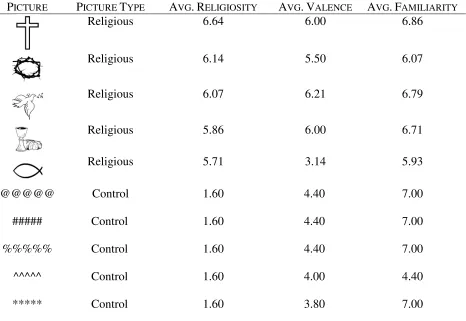
Pictures. Religious pictures were taken from internet searches, and were reformatted for
size and color consistency. Christian pictures (n=9) were included (e.g., crucifix, crown of
thorns). Control pictures (n=13) were chosen as neutral comparisons to the religious pictures.
They include punctuation and editing characters (e.g., asterisk, at sign). See Appendix A.
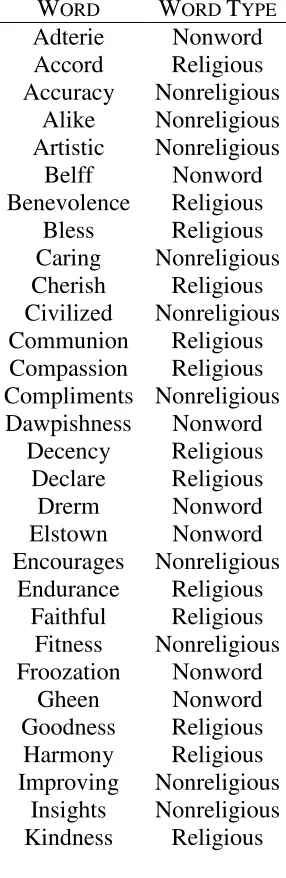
Words. A list of 59 religious words (conceptual and concrete) were derived, and assessed
for character length and frequency (at wordplay.geneseo.org). Then, three nonreligious words
were then selected based on their length and frequency match to each religious word (n=137).
Legal nonwords were matched for length, and were adapted from McCann and Besner (1987).
Religiosity1.
Religious Fundamentalism Scale (RFS; Altemeyer & Hunsberger, 2004).The religious
fundamentalism scale is a 12-item measure that assesses whether a person believes there is one
fundamental set of teachings about the truths of humanity, as well as assessing one’s relationship
to deity. This measure has been shown to measure religious fundamentalism across faith
tradi-tions, and has high internal consistency (r=.80).
2.1.3 Procedure
Participants reviewed and signed consent forms, and then saw two blocks of materials
(pictures, words) to be rated (blocks counterbalanced). Religious and nonreligious items were
randomized within each block. Participants rated the degree to which each item is associated
with religion/spirituality, how familiar the item is to them, and how positive/negative the item is
(all Likert scales; 1=not at all, 7=very). Next, participants answered a series of questions related
to their religiosity (see Materials), and then provided demographic information. Finally,
partici-pants were debriefed and awarded credit for participating.
1
Participant religiosity was also measured by assessing frequency of religious behavior (e.g.,
praying) via Religious Background and Behavior Scale (RBB; Connors, Tonigan, & Miller,
1996), and self-reported denomination (Christian, non-Christian). In all studies reported here,
the influence of religiosity on decisions (lexical, moral) was also examined using these
alterna-tive assessments of religiosity, but neither religious behavior nor denomination yielded any
sig-nificant influence on study outcomes therefore they are not discussed any further in the context
2.2 Results
Average ratings of religiosity, familiarity, and valence were calculated for each picture
and word. As our participant sample was heavily Christian (67%), the five most
spiritually-associated Christian pictures the five least spiritually-related control pictures were selected (see
Appendix A). Pictures were equally familiar, Mrelig=6.47, Mcontrol=6.48, t(8)= -.01, p=.99, and
equally valenced, Mrelig=5.37, Mcontrol=4.20, t(8)=2.01, p=.08, but religious pictures were rated as
significantly more religious than control pictures, Mrelig=6.08, Mnonrelig=1.60, t(8)=28.29, p<.01.
Sixty (20 religious, 20 nonreligious) words were selected for use in the experiments that
follow (see Appendix B). Independent t-tests revealed that religious and nonreligious words do
not differ along familiarity (Mrelig=6.13, Mnonrelig=6.02, t(38)= -.87, p=.39) or valence
(Mrelig=5.78, Mnonrelig=5.61, t(38)= -.78, p=.44) dimensions. They only differ to the extent that
they were rated as religious, Mrelig=6.00, Mnonrelig=4.55, t(38)= -5.50, p<.01.
3 STUDY 1 – PICTURES AS SYMBOLS ON LEXICAL DECISIONS
Overall, it was hypothesized that religious pictures would prime a network of religious
information, and that this should be more pronounced for religious persons. Several predictions
follow. First, and as a manipulation check, participants should be significantly faster and more
accurate at identifying words (religious and nonreligious) versus nonwords. Second, if religious
beliefs matter in regard to spreading activation and subsequent decision making, then only
reli-gious participants should be faster than nonrelireli-gious participants to identify relireli-gious words
when primed with a religious image. Third, nonreligious participants should respond with
equivalent speed to both word types (religious, nonreligious) and picture prime (religious,
activation is contingent upon religious belief. Fourth, if religious beliefs are not influential, then
there should be evidence of an overall priming effect of religious pictures on religious words,
such that everyone identifies religious words faster than nonreligious words when primed with a
religious versus control picture. Fifth, control pictures should not prime responses to either word
type therefore RTs when primed with control pictures serve as a neutral control condition.
3.1 Method
3.1.1 Participants
Undergraduate students at GSU (N=102) were recruited for this study using the GSU
Psychology Research, Testing and Tutoring site (http://gsu.sona-systems.com). Participants
self-identified their gender (72 female, 27 male; 3 participants did not answer this question), race (23
White, 44 Black, 35 other race), age (range 18 - 54 years; M=23.69 years), and religion (51
Christian, 29 none/non-denominational, 10 other religion, 8 agnostic/atheist; 4 participants did
not answer this question). Students voluntarily participated for course credit.
3.1.2 Materials
Pictures. See Materials; Pilot Study. See also Appendix A.
Words. See Materials; Pilot Study. See also Appendix B.
Religiosity. See Materials; Pilot Study.
3.1.3 Procedure
After reviewing and signing consent forms participants completed a task consisting of
two alternating goals, 1) attending to a presented picture on the computer screen, and 2)
deter-mining whether a string of letters formed a word or not (lexical decision task; Meyer &
Each block consisted of 30 trials, and each trial began with a picture (e.g., religious: crucifix)
being shown first, followed by a letter string that formed a religious or nonreligious word or a
nonword. They were told to identify whether the letter string was a “word” or a “nonword” (via
key press) as quickly and accurately as possible.
A fixation point (+) was shown in the middle of the screen (300ms), followed by an
im-age (50ms). Then a randomly presented letter string appeared and remained on the screen until a
word/nonword decision was made. The trial ended with an interstimulus interval (ISI; 300ms).
There were five pictures used in each picture prime condition (religious, control), and each
pic-ture was shown 6 times for a total of 30 trials in each block. The 30 trials included 10 religious
words, 10 nonreligious words, 10 nonwords.
Once all trials were completed participants were asked to write down all pictures they
remembered seeing. Then they answered a series of questions related to their religiosity (see
Materials; Pilot Study), and they identified what they thought the experimental hypothesis was.
Finally, participants were debriefed and awarded credit for participating.
3.2 Results
3.2.1 Design
An overall 2x2x2 [Participant Religiosity: religious, nonreligious x Picture Prime:
reli-gious, control x Word Type: relireli-gious, nonreligious] mixed-subjects model was used. Participant
Religiosity was a between-groups variable, whereas Word Type and Picture Prime were
3.2.2 Items Analysis
The presence of outliers was evaluated by conducting items analyses of picture primes
and words using average accuracy and reaction times as dependent measures. Pictures or words
falling outside two standard deviations around the mean for accuracy or reaction time (RT) were
removed from the analyses that follow. One control picture, six nonwords, and one nonreligious
word were removed. Participant outliers were also evaluated by examining accuracy and RT
collapsed across the other IVs, but none were found consistently to fall outside the two standard
deviation boundary for accuracy or RT. The analyses that follow were all conducted with all
outliers removed.
3.2.3 Data Preparation
Next, average RTs (accurate lexical decision) were calculated for each Word Type x
Pic-ture Prime. Then, RFS scores were calculated for each participant. Of the 12 items on RFS, half
were reverse-scored. The regular- and reverse-scored items were added up separately, then the
sum of the reverse items was subtracted from the sum of regular items giving each person an
RFS final score (range: -48 to 48). Participants with scores below zero were coded as
nonreli-gious (n=50), those above zero were coded as relinonreli-gious (n=48), and those with scores of zero
were not used in the analyses that follow (n=4).
3.2.4 Manipulation Check
Average accuracy was calculated for each word type (collapsed across all other
varia-bles), and then compared using a repeated-measures ANOVA, F(2,194)=18.92, p<.01, ηp2=.18.
Consistent with Prediction 1, lexical decisions were significantly greater for religious (M=.97)
and nonreligious words (M=.97) relative to nonwords (M=.92), ps<.01. Overall, participants
3.2.5 Primary Analyses
A 2x2x2 [Participant Religiosity: religious, nonreligious x Picture Prime: religious,
con-trol x Word Type: religious, nonreligious] mixed-subjects ANOVA was conducted. The
de-pendent variable was average RT to accurate lexical decisions. A significant main effect of
Word Type emerged, wherein participants were significantly faster to accurately identify
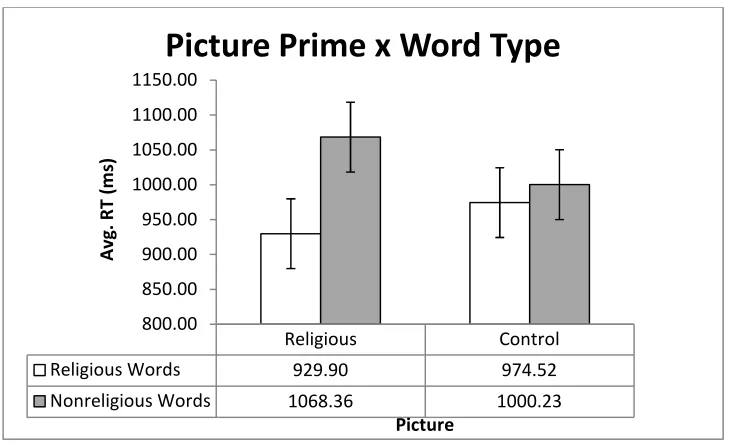
reli-gious (M=952.21 ms) than nonrelireli-gious (M=1034.30 ms) words, F(1,96)=21.37, p<.01, ηp2=.18.
There was a significant Picture Prime x Word Type interaction as well, F(1,96)=8.55, p<.01,
ηp2=.08. Participants were faster to correctly identify a religious than nonreligious word when
primed with a religious picture, t(97)= -5.13, p<.01. The remaining pairwise comparisons were
not significant, ps >.05. See Figure 1.
Figure 1. (Study 1) Picture Prime x Word Type interaction on average RT to accurate lexical
de-cisions. Error bars represent standard error.
Religious Control
Religious Words 929.90 974.52
Nonreligious Words 1068.36 1000.23 800.00
850.00 900.00 950.00 1000.00 1050.00 1100.00 1150.00
A
v
g
.
R
T
(
m
s)
Picture
[image:34.612.144.509.372.595.2]3.2.1 Follow-up Analyses
According to spreading activation theories (Collins & Loftus, 1975), RT to lexical
deci-sions should be faster at the end of the religious picture block than at the beginning. Follow-up
analyses confirm this expectation. Paired-samples t-tests were conducted to determine if there
was activation build-up such that religious words at the end of the lexical task were identified
faster than those at the beginning of the task. For religious pictures, there was a significant
de-crease in RT for the last religious word (M=843.06 ms) versus the first religious word
(M=1028.26 ms) presented, t(96)=3.00, p<.01. This did not occur for control pictures. The first
and last religious word presented were identified equally as fast, p=.29.
3.3 Discussion
The intention for Study 1 was to determine whether religious pictures prime religious
in-formation in semantic memory, and furthermore whether this priming effect would be evident in
all persons or only for participants with personally espoused religious beliefs. The results
sup-ported Predictions 1 and 4. Overall, participants (regardless of religious beliefs) were
signifi-cantly faster to make accurate lexical decisions to religious words than nonreligious words. This
suggests that religious words are salient rather than simply familiar, as religious and nonreligious
words were pre-tested and found to be equally familiar. Participants were also significantly
fast-er to identify religious than nonreligious words when primed with religious pictures
First, these data demonstrate that religious words are salient to all persons possibly
be-cause over half the sample (60%) identified belonging to some faith tradition, and bebe-cause the
sample was gathered in the geographic ‘bible belt’ where Christian-based visual stimuli (e.g.,
churches, billboards) are common. Second, spreading activation via picture presentation (as
re-ligious pictures to rere-ligious information is ubiquitous as self-reported rere-ligious belief did not
im-pact lexical decisions. This might have occurred because religious pictures and associated words
are culturally ingrained, thus these semantic connections are developed for everyone living here
in the south. Furthermore, lexical decisions do not have a proscribed response based on
religi-osity, therefore even if activated with a religious picture; a person’s own belief system may not
guide decisions under these circumstances.
4 STUDY 2 – WORDS AS SYMBOLS ON LEXICAL DECISIONS
In Study 2, concrete words were tested as primes to determine whether they had a
compa-rable or uniquely different influence than pictures on lexical decisions. The imagery literature
has demonstrated that when words are concrete (i.e., verbal labels of a physical object), then they
encourage the same effect on an outcome (e.g., learning, memory) as if the object itself had been
shown. In the current study, participants completed the same priming and lexical decision trials
as was conducted in Study 1, except that prime stimuli were no longer pictures, but were words
that represented concrete objects. As previous experiments have demonstrated that religious
words prime religious outcomes (e.g., Wenger, 2003), religious words should similarly
demon-strate a priming effect here on lexical decisions. However, pictures are predicted to serve a
unique priming role as it has been found that RTs are fastest when a superordinate category (or
concept) versus a related link in the semantic network is primed (Collins & Loftus, 1975). Thus,
when compared to the data from Study 1, RTs to lexical decisions when primed with a concrete
religious word should be slower. There should be no difference in RTs as a result of concrete
4.1 Method
4.1.1 Participants
Undergraduate students at GSU (N=104) were recruited for this study using the GSU
Psychology Research, Testing and Tutoring site (http://gsu.sona-systems.com). Participants
self-identified their gender (90 female, 14 male), race (22 White, 49 Black, 31 other race, 2
un-known), age (range 18 - 31 years; M=19.51 years), and religion (69 Christian, 17
none/non-denominational, 13 other religion, 5 agnostic/atheist). Students voluntarily participated for
course credit.
4.1.2 Materials
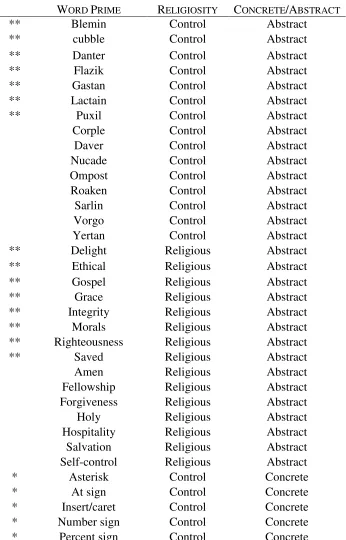
Word Primes. Sixty words or phrases (30 religious, 30 control; half of each concrete vs.
abstract) were selected. Ten of these were the verbal labels for pictures used in Study 1 (e.g.,
“crucifix”, “dove of peace”, “crown of thorns”). The remaining words were pretested to be
high-ly religious (or not) – half of which were associated with a picture image (e.g., church, heaven,
disciple).
Words (Lexical Decision Task). See Materials; Pilot Study. See also Appendix C.
Religiosity. See Materials; Pilot Study.
4.1.3 Procedure
Participants followed the procedure conducted in Study 1 with the exception that words
4.2 Results
4.2.1 Items Analysis
The presence of outliers was evaluated following criteria outlined in Study 1 (i.e.,
aver-age RT and accuracy calculated for word primes, words used in the lexical task, and for each
participant). Three control word primes, one religious word prime, five nonwords, and three
par-ticipants were identified and removed from the dataset as they were beyond two standard
devia-tions of the mean. The analyses that follow were conducted with all outliers removed.
4.2.2 Data Preparation
First, average RTs were calculated for each Word Prime x Concreteness x Word Type.
Then, RFS scores were calculated for each participant (see Results; Study 1). Those with a score
below zero were coded nonreligious (n=45), those with a score above zero were coded religious
(n=55), and those with a score of zero (n=1) were not included in the analyses that follow.
4.2.3 Manipulation Check
Average accuracy was calculated for each word type (collapsed across all other
varia-bles), and then compared using a repeated-measures ANOVA, F(2,200)=41.55, p<.01, ηp2=.29.
Accurate lexical decisions were significantly greater for religious (M=.98) and nonreligious
words (M=.98) relative to nonwords (M=.85), ps<.01. Consistent with Study 1, participants
made highly accurate lexical decisions overall, and across conditions.
4.2.4 Primary Analyses
First, a 2x2x2 [Participant Religiosity: religious, nonreligious x Word Prime (concrete
only): religious, control x Word Type: religious, nonreligious] mixed-subjects ANOVA was
Prime x Word Type emerged as significant, F(1,98)=3.93, p=.05, ηp2=.04; however, the direction
of means was not consistent with predictions (see Figure 2). All participants were significantly
faster to identify religious words when primed with a concrete control word than with a concrete
religious word, t(100)=2.22, p=.03. No other pairwise comparisons were significant. Although
not predicted, concrete religious word primes resulted in longer RTs to religious words relative
to control word primes.
Although previous research has demonstrated that conjuring an image associated with its
verbal label takes time, thereby increasing RT (Paivio & O’Neill, 1970; Paivio & Csapo, 1969),
this would not explain why concrete control words led to significantly faster priming of religious
words. The control words should have also conjured a mental image, requiring time to do so,
just like the concrete religious words. Therefore, priming should have occurred and in the
ex-pected direction unless priming did not occur from the presentation of concrete word primes. To
check this, paired samples t-tests were conducted to compare RT from the first to the last
reli-gious words identified in both the relireli-gious and control prime blocks. For concrete relireli-gious
word primes, RT decreased from the first to the last word confirming that spreading activation
occurred from both religious word primes (Mfirst=1182.29 ms, Mlast=1024.78 ms, t(97)=2.07,
p=.04). When control words were primed, there was no change in RT from the first to last
reli-gious words, which suggests that concrete control word primes did not prime relireli-gious
Figure 2. (Study 2) Word Prime (concrete) x Word Type interaction on average RT to accurate
lexical decisions. Error bars represent standard error.
To examine the absence of religious priming via concrete words, a 2x2x2 [Participant
Re-ligiosity: religious, nonreligious x Word Prime (abstract): religious, control x Word Type:
reli-gious, nonreligious] mixed-subjects ANOVA was conducted on accurate lexical decisions. Here,
the word primes were abstract, such that they were not readily associated with a physical object
or picture, therefore they should not conjure a mental image when presented. If the argument
that concrete words take time to conjure images is evidenced, then abstract religious words
should demonstrate the priming effect originally predicted for concrete words, meaning that
there should be general priming from abstract religious words to lexical decisions of religious
words. A main effect of Word Symbol emerged, such that lexical decisions took significantly
longer when primed with religious words (M=1033.03 ms) than nonreligious words (M=950.93
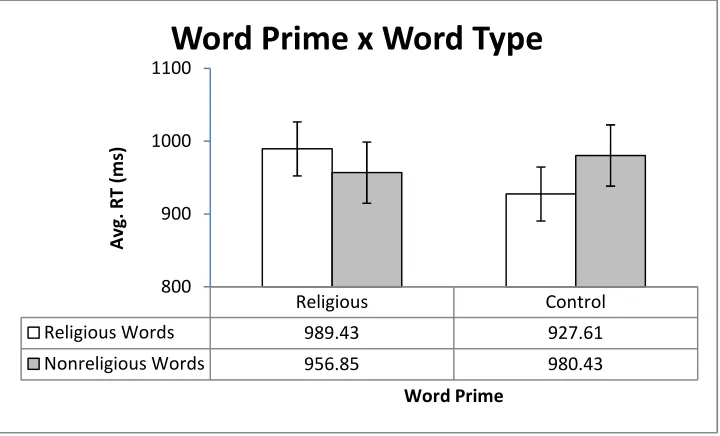
ms), F(1,98)=6.65, p=.01, ηp2=.06. A two-way interaction of Word Prime (abstract) x Word
Type emerged, F(1,98)=20.63, p<.01, ηp2=.17, see Figure 4. Participants were faster to identify Religious Control
Religious Words 989.43 927.61
Nonreligious Words 956.85 980.43 800
900 1000 1100
A
v
g
.
R
T
(
m
s)
[image:40.612.114.474.72.290.2]religious versus nonreligious words when primed with abstract religious words, t(100)= -3.95,
p<.01, and slower to identify religious versus nonreligious words when primed with abstract
con-trol words, t(100)=2.91, p=.01. Participants were also significantly slower to identify
nonreli-gious words when primed with relinonreli-gious versus control words, t(100)=5.35, p<.01.
Paired samples t-tests were conducted to compare RT from the first to the last religious
words identified in both the religious and control prime blocks. Similar to the concrete word
primes, for abstract religious word primes, RT decreased from the first to the last word
confirm-ing that spreadconfirm-ing activation occurred from both religious word primes (Mfirst=1001.36,
Mlast=805.44, t(99)=4.83, p<.01). Moreover, when compared across prime type, abstract religious
words primed religious words faster than concrete religious words at the beginning, t(99)=2.46,
p=.02, and end of the task, t(97)=5.95, p<.01. Once again, when control words were the prime,
there was no change in RT from the first to last religious words.
Religious Control
Religious Words 962.44 1011.28
Nonreligious Words 1103.63 890.57 500
600 700 800 900 1000 1100 1200
A
v
g
.
R
T
Figure 3. (Study 2) Word Prime (abstract) x Word Type interaction on average RT to accurate
lexical decisions. Error bars represent standard error.
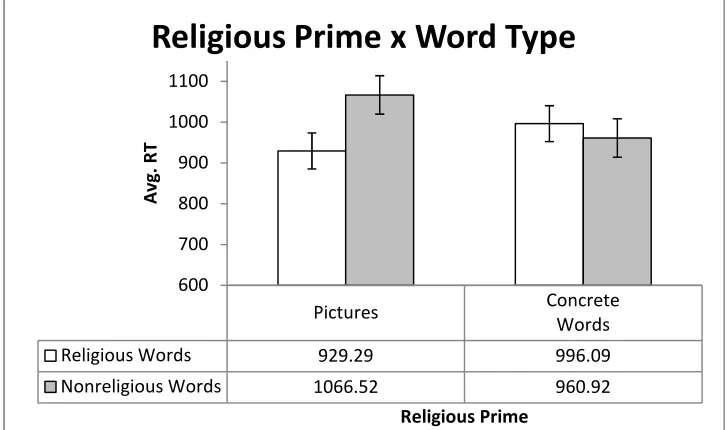
To examine the unique effect of religious pictures versus concrete religious words on
ac-curate lexical decisions, a 2x2 [Prime: religious pictures (S1), concrete religious words (S2) x
Word Type: religious, nonreligious] mixed-subjects ANOVA was conducted. First, a main effect
of Word Type emerged, F(1,196)=7.26, p=.01, ηp2=.04. Consistent with Study 1, participants
were faster to identify religious (M=962.69 ms) than nonreligious (M=1013.72 ms) words.
Se-cond, there was a two-way interaction of Prime x Word Type, F(1,196)=20.70, p<.01, ηp2=.10,
see Figure 3. Participants were significantly faster to identify religious versus nonreligious
words when primed with a religious picture, t(97)= -5.13, p<.01. There was no effect of concrete
religious word primes on RT, p=.19. Unexpectedly, RT did not differ based on Prime Type to
either religious (p=.30) or nonreligious words (p=.12).
Figure 4. (Study 2) Religious Prime x Word Type interaction on average RT to accurate lexical
decisions. Error bars represent standard error.
Pictures Concrete Words
Religious Words 929.29 996.09
Nonreligious Words 1066.52 960.92 600
700 800 900 1000 1100
A
v
g
.
R
T
[image:42.612.110.474.432.647.2]4.3 Discussion
As concrete words arguably conjure a mental image of the object they represent, Study 2
tested whether concrete religious words would influence lexical decisions in a similar fashion to
what was found in Study 1 where actual pictures were used as primes. Prediction 1 was not
sup-ported. Participants took longer to identify religious words when primed with concrete religious
(versus control) words - possibly suggesting that conjuring the mental image of a neutral
con-crete word occurs efficiently, whereas the same process for religious concon-crete words takes more
time. This could possibly occur because the concrete religious words are associated with
verba-tim memory traces (memories that involving conscious recollection; Reyna & Brainerd, 1995)
which may become activated along with other conceptual religious information. Sifting through
the contextual details of these memory traces may require more time to reach a decision on the
lexical task at hand relative to when a concrete word conjures a neutral image with no associated
verbatim traces.
When RT was compared between Studies 1 and 2, partial support was found for the
pre-diction that religious pictures would prime related religious information faster than religious
words. Participants were faster to identify religious (versus nonreligious) words when primed
with a religious picture, but not when primed with concrete religious words. However, there was
no difference in RT to religious words when primed with religious pictures versus concrete
reli-gious words. Potentially, both pictures and concrete words (having conjured mental images)
prime verbatim memory traces equally, which is why there is no difference in RT to religious
words when picture versus concrete word primes are compared; however, because pictures
en-couraged faster RTs to religious than nonreligious words (whereas concrete religious word
prim-ing resulted in quicker lexical decisions for the activated stimuli. This is consistent with
expecta-tions via the picture superiority effect. Because concrete words led to equal RT to religious and
nonreligious words it is possible that the dual activation of visuo-spatial and phonological
mo-dalities resulted in an unexpected taxing of cognitive resources rendering priming across word
type stimuli inconclusive.
Additional possible explanations for the inconsistency in predictions and outcomes may
come from limitations among the word stimuli. Bleasdale (1987) suggested that different word
types, from prime to target, could impact RT to the dependent task. For example,
concrete and abstract-abstract word pairs lead to faster RT than mismatched (e.g.,
concrete-abstract) pairs. In Study 2, all of the lexical task words were abstract, whereas half the prime
words were concrete and half were abstract. This may account for some of the inconsistencies
between predictions and outcomes; however, limitations within the experimental stimuli prevent
full consideration of alternative theoretical accounts to explain these unexpected data. These
limitations include the prime words being subjectively selected and sorted into concrete and
ab-stract categories by the experimenter. Although all words were pre-tested for valence,
familiari-ty, and spiritual-relatedness, they were not assessed for concreteness or imagability. It is
possi-ble that concrete words were not as concrete, and abstract words not as abstract as they appeared.
Similarly, it may be that the differences between the two word types were not statistically
signif-icant.
In sum, these data demonstrate that religious pictures prime religious information by
ac-tivating related pathways that speeds RT to religious versus nonreligious words. Although
fol-low-up analyses of concrete religious word primes also demonstrated a priming effect on
between prime and word type (i.e., concrete religious words should prime lexical decisions to
religious words) did not emerge. Whereas previous studies found that concrete words influenced
outcomes (e.g., memory for word pairs) similar to that of actual pictures, the current data do not
support this finding. Limitations related to the priming stimuli may prevent the comparable
in-fluence of pictures versus concrete words from being fully assessed. Religious words do prime
related religious words, but potentially the process to go from concrete word to mental image to
lexical word identification (in Study 2) takes longer than to go from picture to lexical word
iden-tification (in Study 1). Thus, the effect of priming with concrete words was eliminated due to
this multi-step process resulting in pictures as primes having an advantage relative to concrete
words in concept activation relative to concrete words.
5 STUDY 3 – PICTURES AS SYMBOLS ON MORAL JUDGMENTS
The motivation for Study 3 was such that the semantic pathway activation demonstrated
in lexical decisions from Study 1 should then translate into moral judgments here in Study 3.
The primary prediction was that religious pictures should prime semantic religious information
which should then influence decisions in morally ambiguous action phrases. Although Studies 1
and 2 did not find any effect of participant religiosity on decisions, the decisions being made
were nonmoral. In Study 3, however, the primary task requires participants to decide the moral
appropriateness of a stated behavior. As faith-based guidelines are a reference for religious
per-sons when deciding how to act or what decision to make (e.g., “thou shalt not” type
proscrip-tions), if religious beliefs were to influence decision making, it would be most likely when
mak-ing a moral decision, and when primed with a religious picture. Thus, for a religious person,
a decrease in ratings of moral appropriateness. If the effect of religious pictures is specific to
moral decision making (versus other kinds of decisions, e.g., lexical), then nonreligious
partici-pants should not be influenced by the type of picture prime.
5.1 Method
5.1.1 Participants
Undergraduate students at GSU (N=102) were recruited for this study using the GSU
Psychology Research, Testing and Tutoring site (http://gsu.sona-systems.com). Participants
self-identified their gender (72 female, 27 male, 3 participants did not answer this question), race (23
White, 44 Black, 35 other race), age (range 18 - 54 years; M=23.69 years), and religion (51
Christian, 29 none/non-denominational, 10 other religion, 8 agnostic/atheist, 4 participants did
not answer this question). Students voluntarily participated for course credit.
5.1.2 Materials
Pictures. See Materials; Pilot Study. See also Appendix A.
Religiosity. See Materials; Pilot Study.
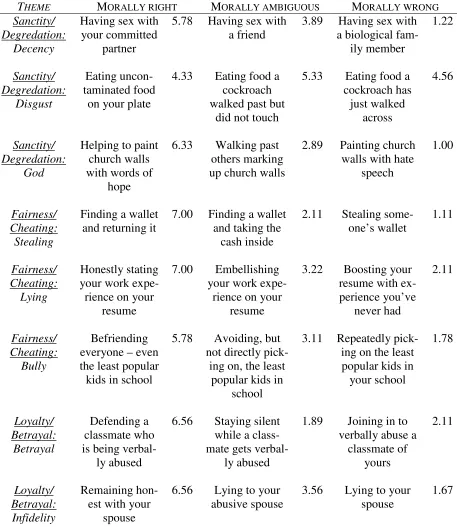
Action Phrases. Phrases were created based on the five themes of Moral Foundations
Theory (Haidt & Joseph, 2004): sanctity/degradation, fairness/cheating, loyalty/betrayal,
care/harm, authority/subversion. Three examples were created for each of the five moral themes
(n=15), and three versions of each phrase were created to reflect three categories of moral
appro-priateness (right, ambiguous, wrong) (n=45). See Appendix D for a list of all phrases used.
Phrases were then pre-tested by a panel of naïve raters (n=9), who viewed each phrase,
and decided as quickly as possible if the behavior was right/wrong (Likert scale, 1= morally