ScholarWorks @ Georgia State University
ScholarWorks @ Georgia State University
Art and Design Theses Ernest G. Welch School of Art and Design
3-23-2010
Ties That Bind
Ties That Bind
Jessica Marie Orlowski
Georgia State University
Follow this and additional works at: https://scholarworks.gsu.edu/art_design_theses
Part of the Art and Design Commons
Recommended Citation Recommended Citation
Orlowski, Jessica Marie, "Ties That Bind." Thesis, Georgia State University, 2010. https://scholarworks.gsu.edu/art_design_theses/60
TIES THAT BIND
by
JESSICA ORLOWSKI
Under the Direction of Mark Burleson
ABSTRACT
I am fascinated by the inner thoughts, the memories, and the cumulative experience that make us each a complex physiological puzzle. From birth, sociological building blocks are constructed forming emotional walls and pected doorways, boundaries and comfortable passageways through the architecture of our personalities. My thesis work, which is comprised of ceramic figures and interactive toys, offers playful memory triggers and evocative spaces in which viewers can deconstruct the building blocks of their social persona.
INDEX WORDS: Masters of fine arts, Ceramics, Clay, High-fire, Sculpture, Figural, Figure, Slip-dipped, Slip,
TIES THAT BIND
by
JESSICA ORLOWSKI
A Thesis Submitted in Partial Fulfillment of the Requirements for the Degree of
Masters of Fine Arts
in the College of Arts and Sciences
Georgia State University
Copyright by Jessica Marie Orlowski
TIES THAT BIND
by
JESSICA ORLOWSKI
Committee Chair: Mark Burelson
Committee: Teresa Bramlette Reeves
Susan Richmond
Electronic Version Approved:
Office of Graduate Studies
College of Arts and Sciences
Georgia State University
DEDICATION
This thesis, as well as the accompanying exhibition, are dedicated my friends and family for being there
to listen and encourage me as I have pursued my artistic dreams. To my sister Megan and her husband
Chris for editing all my papers and their late night phone support. To Justin Gardner for his tough love
and unwavering vision of our future. And to my mother, Leslie Wright, for her unconditional love,
constant support and guidance, and for believing in me and my work when I was unable to believe in
ACKNOWLEDGEMENTS
I would like to express the deepest appreciation to my thesis committee Mark Burleson, Teresa Bramlette
Reeves, and Susan Richmond for their time, patience, and dedication to my success.
In addition, a thank you to Linda Arbuckle and Nan Smith at the University of Florida for nurturing and
encouraging me during my post-baccalaureate studies when I was unsure of my artistic voice, and to my
undergraduate instructors at Alfred University, who taught me to fight for my work and articulate my
TABLE OF CONTENTS
ACKNOWLEDGEMENTS ... vi
LIST OF FIGURES ... viii
1 INTRODUCTION ... 1
2 FROM PLAYFUL INQUIRY TO INTERACTIVE ART ... 4
3 HISTORY OF CHILDHOOD AND TOYS ... 8
4 FIGURE WITHOUT THE FIGURE ... 17
5 FEMININE AESTHETIC ... 22
6 TECHNICAL ... 29
7 CONCLUSION ... 30
ADDITIONAL IMAGES ... 33
[image:8.612.73.539.110.324.2]LIST OF FIGURES
Figure 1. Ties that Bind Solo Exhibition 2
Figure 2. Equilibrium Interrupted by Ilena Finocchi 5
Figure 3. Ring Toy 7
Figure 4. A Family Group by Michael Nouts 9
Figure 5. Where's Spot? by Eric Hill 11
Figure 6. Princess 13
Figure 7. Princess Detail 14
Figure 8. Tree House and Tree House Detail 15
Figure 9. Rocking Horse 16
Figure 10. ME I AM! by Jack Preutsky 17
Figure 11. Trans/form no. 9.1 and no. 10.2 2003 by Sara Tse 19
Figure 12. Hatch 21
Figure 13. Hatch Detail 21
Figure 14. Reflection 24
Figure 15. Reflection Detail 25
Figure 16. My Dolly 27
Figure 17. Bloom and Bloom Detail by Erin Furimsky 28
Figure 18. Puppeteer 32
Figure 19. Ties that Bind Solo Exhibition Detail 1 33
Figure 20. Ties that Bind Solo Exhibition Detail 2 34
Figure 21. Ties that Bind Solo Exhibition Detail 3 35
1 INTRODUCTION
My work explores the developmental importance of play and the eventual loss of childhood
innocence and wonder. By providing the viewer with a variety of ceramic figures paired with interactive
components, different stages of human development or social situations are illustrated. The child-size
figures that composed my thesis exhibition are metaphorically bound or tied to their toys by matching
ribbons. The figures‟ bindings emphasize the importance of the situations that shape our lives. This work
is based upon research into psychological theories as well as personal observations and is the culmination
of ceramic figure studies that depict this research. The work is intended to move viewers though
child-hood memories (created by object and play) to realizations about adult inhibitions and social structures.
The transition from innocence to adulthood is illustrated through interactive toys which serve as tools for
the viewer to explore the work and, by doing so, themselves. Through play the viewer may see
them-selves in the work as I do. The elements of this work which provide the opportunity for personal
discovery include historical and theoretical research which provides the underpinnings of this series, my
technical process, and the aesthetic decisions I have made in correlation with my conceptual intent. These
elements will be discussed in the following chapters.
Juggler was the first work a viewer encountered when approaching the exhibition. Framed by the
gallery‟s front window this piece varied from the other works in the exhibition because it does not focus
on one situation, constraint, or concern, but instead appears to be juggling multiple influences and
Figure 1. Ties that Bind Solo Exhibition by Jessica Orlowski
Through the title of this piece and the playful color of the ribbons that bind its arms and legs I am
hoping to initially distract the viewer from the small child‟s plight. The initial whimsy, however, gives
way as the viewer observes that the objects suspended above the piece are very large in comparison to the
figure. These objects are enlarged toys that are commonly given to children to assist them in their early
development. The societal importance of developmental toys will be discussed further in the history of
toys section. The tension of this scene is reinforced by the constrained folds that surround the ribbons and
the elongation of the figure‟s torso. Though the pretty ribbons make the binding seem almost decorative
or acceptable, they are none-the-less cutting into the form. These bindings reference the way we are tied
to our experiences as well as the societal constraints that we are expected to adhere to from a young age.
Similarly, the layered midsections of the piece initially has a playful appearance, but when compared to
the width of the figure‟s pants and its exposed ankles, the torso height implies a stretching or reaching
figures had internalized the binding‟s restriction and were altering themselves accordingly. Given the
strength of these early lessons it is important to raise the question “Can we change?”
Historically, physiologists have said that change as an adult is impossible. Early developmental
psychologists such as Sigmund Freud developed theories in the late 19th and early 20th century that were
later adapted by ethologists such as John Bowlby (1960s). Though each researcher presented a different
and contradicting adaptation of developmental theory, (ex. nature vs. nurture, Oedipus complex, and
Object relations theories) and each theory promised to explain human nature, my studies of them left me
questioning the validity of their assertions. Freud, along with his predecessors, defined the first three
years of human development as a “critical period.” This period is defined by the appearance of instinctual
reactions and is also a time when Freud believed that the “developing organism is uniquely sensitive or
responsive to specific environmental influences” (Shaffer 68).
Freudian theory concludes that we should embrace (though not always act on) the instinctual.
Essentially he answers my question by saying that change after the “critical period” is impossible and the
best we can hope for is self control.Modern physiological studies, however, disagree and instead
conclude that the first few years of child development are, in fact, only a “sensitive period” (Shaffer 68).
Though still considered paramount in our development the “sensitive period” is a less finite form of the
“critical period” that allows for a less definite time frame. Studies of the “sensitive period” conclude that
though early childhood is an ideal time for development, it is not the only window of opportunity for
personal growth.
The contemporary psychologist David Shaffer, author of Social and Personality Development,
contends that though growth is natural during this sensitive period it is also achievable (under the correct
conditions) later in life. The question then becomes whether an individual can find the correct conditions,
answer in contemporary society is counseling or therapy. However, once we identify personal weaknesses
we wish to overcome, does simply talking about them reinforce the problem? Alternatively, my thesis
work presents figures that represent this “sensitive period” and asks for space and time to quietly relax,
play, and explore. By embracing a playful mode of exploration and returning to a child-like state, some of
the flexibility of our “sensitive period” may emerge, allowing for change or self acceptance.
2 FROM PLAYFUL INQUIRY TO INTERACTIVE ART
In my opinion, a good piece of art work is one with which you can have a relationship. Unlike
utilitarian objects which you can enjoy for their coloration or design and their ability to do their
designated task, art is not so mundanely necessary. To me, meaningful artwork is like a partner or a
friend. It requires time to get to know, whether through revisiting the museum or being fortunate enough
to love it at home- art asks us to spend the time to appreciate its finer details and nuances and, in that way,
art is very human. This relationship to art as an entity is important because it allows the work to provide a
lasting impression, thought provoking question, or prolonged comfort to the viewer. Like friends, we
enjoy certain art at certain times, dislike various artworks from the start, outgrow others, and deepen some
relationships over time.
The type of relationship that I hoping that viewers will have with my art is that of the trusting
confidant. Contemporary artist Ilena Finocchi‟s work exemplifies the subtle and quiet persona with which
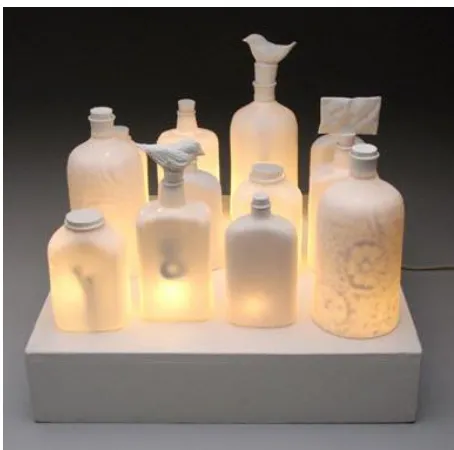
Figure 2. Equilibrium Interrupted by Ilena Finocchi 18" x 28" x 28"
Using translucent porcelain and dim lighting, Finocchi draws her viewers to pedestal pieces
composed of ceramic bottles. These bottles reference domestic uses and collectables as well as a
castaway‟s floating messages. The bottles are “filled” with light that reveals inner objects, the shadows of
which are cast on the bottle‟s exterior. The resulting silhouettes are haunting and invite the viewer to
approach them, touch them, and join in the game of metaphor and memories. Finocchi herself describes
the work as “a metaphorical language… (that) builds narrative through fantasy and play as a child
naturally would” (Finocchi). This notion of child‟s play is emphasized by the bottles‟ stoppers, which
incorporate birds, letters, and other playful, yet meaningful, imagery. The transportation of messages,
perhaps wisdom from the long forgotten days of childhood innocence, is suggested.
Similarly, my work is intended to play upon the memories of youth and personal past to entice
viewers to spend time with it. Through soft coloration and the use of the toys and games paired with each
figure I hope to make my work approachable and interesting individuals worth getting to know. By
touch-ing, explortouch-ing, counttouch-ing, and moving the work, viewers begin, what I hope will be, an intimate and
To achieve this goal of creating a work that is relatable to a wide range of viewers I began to
research how experiences affect us. In many ways humanity has innumerable commonalities; we were all
once children and will inevitably grow older etc., but we also have slightly different building blocks
ensuring that our views and reactions will vary by person. For my thesis work I have, therefore, utilized
play and two learning styles, hands on and visual elements, to create an exhibition that is intended to
reach people on multiple levels (Optimizing).
This method of educational engagement is most frequently employed by elementary school
educators and addresses the short attention span of contemporary individuals. Craftsmanship and patience
are becoming novelties in a culture with information and results effortlessly at hand. Stuart Brown, author
of Play: How it Shapes the Brain, Opens the Imagination, and Invigorates the Soul discusses the
importance of play, saying “it makes animals smarter and more adaptable… it fosters empathy and makes
possible complex social groups … play lies at the core of creativity and innovation” (Brown 5). The use
of play as a curriculum tool is sometimes referred to as “Playful Inquiry.” “Playful Inquiry” and different
learning styles address this modern trend of impatience and attempt to retain viewers‟ interest by
entertaining them while they learn. Studies have indicated that the use of fun and games utilized in
“Playful Inquiry” increases the chance of a thought, memory, or even desire for information to be retained
in our long term memory banks (Elkind 6). David Elkind, author of The Power of Play, offers a
contemporary educator‟s perspective on the importance of play in modern life. “Freud was once asked
what he thought was necessary to lead a happy and productive life. He replied, „Lieben und Arbeiten,‟
loving and working. With all due respect to Freud, I believe he should have included „Spielen,‟ playing.
Love, work, and play are three inborn drives that power human thought and action throughout the life
cycle” (Elkind 1). This belief in the importance of play is one of the driving forces behind this
exhibition‟s use of toys and learning to create an exploratory space. Like an interactive children‟s
museum, learning is done through fun. I am hoping this will attract viewers (or in this case, explorers)
glance. Are viewers more comfortable with one toy than another? Does the empty dress bring up a
surprising memory or visceral response? Though I have created a path, and hope to elicit introspective
experiences for my viewers I cannot control what the viewer takes from the experience. However, by
incorporating interactive and alluring techniques I am hoping to draw attention to, and encourage lasting
[image:16.612.74.506.242.529.2]impressions of my work.
Figure 3. Ring Toy
Slip-dipped fabric, high-fire clay, ceramic under-glaze 11 1/2" x 13" x 18"
by Jessica Orlowski
Ring Toy is a piece in which play and humor are used to engage the audience. In Ring Toy the
figure is paired with a widely popular developmental children‟s stacking toy. The phallic toy is
intentionally placed between the child‟s legs, but not pushed too closely. The figure sits on one of the
and play with the other ceramic ring. The sexual reference in this piece may elude the viewer completely
or may surprise them after they place the ring on the pseudo penis. This work is intended to
simultaneously amuse and make the viewer uncomfortable, while being subtle enough to be over the
heads of young children.
3 HISTORY OF CHILDHOOD AND TOYS
In the twenty-first century, childhood is considered a precious time that must be protected by
social regulations and laws, thereby extending innocence. However, this judicially regulated view of
childhood is a relativity new phenomenon stemming from centuries of societal change. From the sixteenth
century when children demonstrated a family‟s wealth and social standing (Garrard 603), to the
seven-teenth century when children were simply considered smaller versions of adults (Humm 10), to the
present-day model of extended innocence, the role of childhood in society has changed. Art work about
children has expressed this evolving notion of childhood in many ways; by focusing on artistic depictions
of children with toys, dominant societal mores can be traced. The choice of toys and the methods of
depiction illuminate what was considered important to the subjects‟ parents, the artist, and their
contemporary culture. Historical works of art give insight into changing definitions of childhood from the
sixteenth century to the present, creating a lineage which, when examined, conveys not the individual
children and their playthings, but the adult world‟s vision of childhood. My work draws upon this linage
by using child-size figures and modern toys to illustrate my thoughts about contemporary childhood and
the ways in which we are cultivated into modern adults.
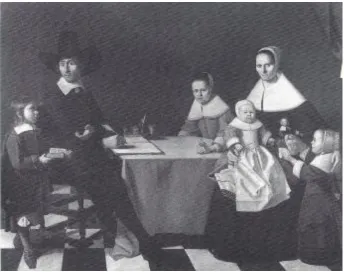
The use of children to discuss adult society is by no means a new tactic in fine art. The painting,
A Family Group (1655) attributed to Michael Nouts, is a good example of a work that exhibits a time in
which children are cast in adult roles. Rosamond Olmsted Humm, author of Children in America: A Study
of Images and Attitudes addresses this social structure by quoting a French historian Philippe Aries.
Europe was „discovered‟ in the seventeenth century. Before children were treated as miniature adults who
[image:18.612.72.416.166.439.2]were part of adult society from infancy” (Humm 10).
Figure 4. A Family Group by Michael Nouts
A Family Group depicts a set of wealthy parents presenting their four children to the society. In
this portrait the children are dressed as adults reinforcing the trend that Aries suggested where children
were treated as miniatures of the adult world. Two of the children are posed with toys. These accessories
serve as a reflection not only of contemporary views of childhood during this period, but also of gender
expectations. The daughter is holding a doll that looks like her mother. Dating to an era before the
popularity of the baby doll, this toy shows the little girl what she is supposed to grow up to be. The noble
father, meanwhile, points to his son who is holding a thick text. To be paired with a book, a common
adult world the children are following in their parents‟ footsteps and taking on adult knowledge as they
prepare for their predetermined life roles.
As views of children and childhood moved from the miniature adult ideal to more contemporary
perceptions, authors began to emerge who touted the importance of viewing children as separate from the
adult world. Jean-Jacques Rousseau, author of Emile or On Education, lived from 1712-1778. His text
marked a crucial turning point which has affected the societal view of child-rearing and, by extension,
childhood. Emile is based upon Rousseau‟s observations of his son Emile and is a precursor to the
modern parenting manual. In this work Rousseau contradicted centuries of theory that viewed children as
smaller and weaker adults and instead considered children of his time innocent “young savages”
(Rousseau 131) from which a thoughtful parent could create a model citizen. In these depictions of
child-hood, Rousseau establishes male children as innocent savages needing to be cultivated into adults, but
perpetuates some of the “miniature adult” attitudes regarding female children by labeling them as
maternal creatures from birth.
The idea of children as possessors of a noble and natural innocence that needs protection
stimulated numerous examples of change in depictions of children and social understanding of childhood
throughout the eighteenth and nineteenth centuries and up to the present day. Rousseau‟s notion that
children had interests that differ from adults also contributed to a new category of literature which was
written for children. Though slow in progressing, children‟s literature hit its stride around the 1820s
(Humm 20). These new books were not as directly instructional as their predecessors, which had served
up school curriculum and strict guidelines for moral behavior. Instead they told stories and included
Figure 5. Where's Spot? by Eric Hill
Modern versions, such as Eric Hill„s Where’s Spot?, tend to be predominantly based in
exploratory actions such as reading and following instruction. This follows their predecessors in the intent
to entertain and educate, but much of the early conveying of moral messages has been left behind.
Today perceptions of childhood have grown from Rousseau‟s theories of the “noble savage” in
need of protection (Rousseau 130) and have surpassed them. With coming-of-age laws and new societal
standards on images of children that are deemed inappropriate, childhood is now monitored more
carefully than ever before.
Anne Higonnet, author of Picture of Innocence: The History and Crisis of Ideal Childhood, calls
the modern child a “Knowing child” and states that “unlike Romantic images, Knowing images, for the
first time in the history of art, endow children with psychological and physical individually”(Higonnet
13). This perceived individuality comes in many forms. The twentieth century saw a renewed interest in
force progress, but rather study it and protect children from the adult world by allowing them to learn at
their own rate. Rosamond Humm, author of Children in America: A Study of Images and Attitudes,
discusses the ramifications of this new view of childhood by citing the creation of “the modern world of
the child, the world of play” (Humm 34).
Photographer Sally Mann uses her own children to comment on the modern definition of
innocence. Mann‟s The New Mothers, photographed in 1989, depicts the “knowing child” as a child who
is no longer underestimated (Higonnet 196). Mann‟s daughters are dressed in frilly outfits and are playing
with baby dolls, a quintessentially feminine toy that gives young girls a chance to prepare for their
maternal role, much like the doll in A Family Group. The comparison stops there, however, as Mann‟s
children boldly stare down the viewer with attitudes that are a far cry from the angelic appearance of
Nout‟s painted children. This is a prime example of Higonnet‟s knowing child who she described as,
“unlike the romantic children… arranged and presented as a delightful spectacle to be enjoyed Knowing
children are neither available nor controllable”(Higonnet 211). Freud was 1st
to acknowledge child
sexuality and its impact on adult life. His studies may explain why this image is disturbing for the modern
viewer- it expresses society‟s greatest fear that the length of childhood innocence is diminishing.
Contrary to any artist‟s intent, an image of a child will never be as simple, beautiful, or innocent
as the subjects themselves. Whether a portrait shows children as miniatures of their parents, as savages
connected to nature, or as symbols of a corrupted society, they are never quite themselves. Even the
candid family photo is a cross section of reality depicting only chosen moments in time. Nor are the toys
with which children are depicted simply playthings. There are very few gender neutral toys, and rather
than being purely entertaining, toys are typically carefully chosen for children‟s art and play. Used as
preparatory tools, as seen in A Family Group by Nouts, dolls, teacups, toy keys and hammers are all
With the history of childhood and toys in mind, it is difficult to separate the joy and innocence of
children from the pressures of the childhood ideal. In my exhibition I have taken this notion of the
child-hood ideal a step further. By incorporating an element of play into each piece I am asking the viewer to
interact with and decode the expectations presented by each toy. It was my goal to chose simple but
meaningful toys that indicate adult expectations or experiences, however if the viewer takes nothing else
from the work, I believe that by filling baskets, pulling strings and winding up toys the viewer will be
reminded of play thus providing an additional layer of recognition to the work.
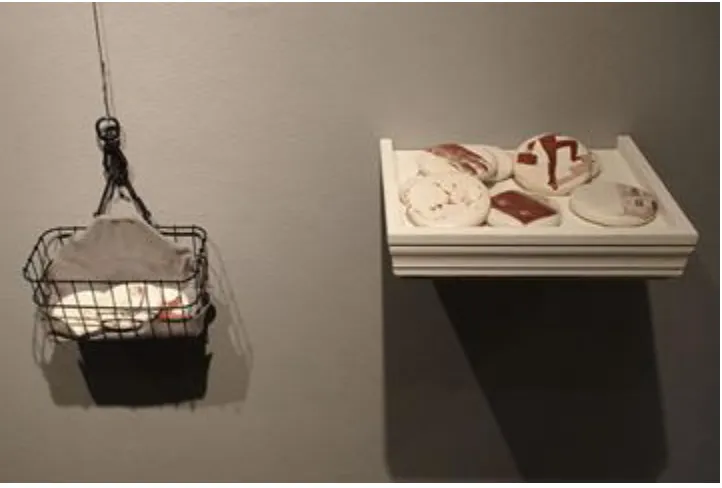
Princess for example, invites viewers to choose tokens to fill a metal basket. These tokens have
[image:22.612.73.507.318.609.2]illustrations of adult aspirations on one side and are stamped with “G-UP” on the other.
Figure 6. Princess
Slip-dipped fabric, high-fire clay, under-glaze, laser decals, found and altered object
Installation- 7 ½’ x 9’ x 1’
Figure- 22” x 16” x 5”
Ceramic Rattle- 22” x 8” x 8”
Figure 7. Princess Detail by Jessica Orlowski
These tokens or awards are intended to mimic the way in which toy companies, such as Playskool,
play-fully (though oddly) label instructional materials. “G-UP” is an abbreviation for “grown-up” and is used
to give value to the tokens as collectables that must be obtained to be considered an adult. Examples of
grown-up attributes are seen in images of adult privileges or responsibilities including cars, houses,
children, and jobs. Viewers may absentmindedly add tokens to the basket or (given the setting and
ceramic material) may take the time to look at the pieces they choose. Because of the pulley system, the
viewer will expect that the figure will eventually reach the rattle, but no matter how many tokens the
figure collects it does not reach its goal. I am hoping that the realization of the ceramic figure‟s situation
will evoke a personal memory or emotional response as the viewer empathizes with the futility of the
pressures of adulthood.
Though my goal for this exhibition is to have viewers play with the work, I understand they may
feel inhibited by the gallery environment or the ceramic medium. To encourage viewers to interact with
a more playful setting. In order to achieve this several measures were taken. First the gallery was painted
grey with a white pattern at the ceiling. The white arches were left ambiguously abstract and could be
read as clouds, curtains, or the sky above waves, all of which have soft and sweeping associations. This
minimal backdrop is derived from those seen in children‟s book illustrations. In this literature, stylized
and minimal backdrops are often used to leave the focus on the characters of the story.
I also applied this idea to the Tree House and Rocking Horse. By including work that is more
approachable, though minimal and stylized, I was adding to the scene in which my figures play. The hand
crafted wooden rocking horse and tree house are fully functional adult size toys which were included in
[image:24.612.72.265.340.632.2]this exhibition as an interactive hook or trigger.
Figure 8. Tree House and Tree House Detail
House- Pine, Felt Curtain, and Milk Paint 8’ 8” x 5’ ½’ x 3’ 5”
Figure 9. Rocking Horse Pine and Milk Paint 5 ½’ x 1’ 3” x 5’ 10” by Jessica Orlowski
Rocking on the horse or coloring in the tree house and looking at the work around them was meant to
encourage a playful and interactive mentality in the viewer, thus relieving some adult inhibitions and
4 FIGURE WITHOUT THE FIGURE
The tradition of figure sculpture spans the history of mankind, as does the history of functional
ceramics. These powerful and proud traditions can be intimidating when attempting to find an innovative
path or authentic voice. From early figures presumed to represent the goddess Venus (and thought to be
fertility talismans) to contemporary self-portraiture, the figure has been worshiped, admired, and
accepted. However, as empathetic as we can feel toward a representation of another person our
subconscious ego insists that we are snowflakes, unique from everyone else.
Though we are inherently very similar, the need to be an individual divides us from the “other,”
and we distance ourselves from any experience outside our own skin. This notion of separation begins
early and is reinforced by children‟s literature such as Jack Preutsky‟s ME I AM!. Though endearing in its
message of self esteem, this book (along with many others) and contemporary parenting styles build
[image:26.612.73.586.445.668.2]fortresses around the individual, making empathy difficult to evoke.
For this egotistical reason, I chose to remove the body itself. By removing identifying anatomical
factors such as skin tone and facial features, I am encouraging viewers to see themselves in the figure.
The difference between putting oneself in another‟s shoes and self exploration is at the heart of my work.
By interacting with the figure, viewers are invited to pour their emotions and inner selves into the scene,
perhaps recalling a younger version of themselves. The vessel that is our adult body is contrasted with the
empty ceramic shell upon which memories and musings may be projected. Higonnet describes how this
pregnant moment may be realized if the viewer truly visualizes themselves in the piece. “We treasure our
own childhood snapshot identities. They give testimony to an imaginary time when we were perfect and
innocent, when we were, we would like to believe, our original and therefore real selves. Any fall from
grace can be measured against the child snapshot standard” (Higonnet pg 95). This assessment of adult
views of childhood is useful when considering my work because it addresses the notion that as children
we were our true selves and allows room to explore the possibility that though we may hide or deviate
from it, that child is still within us.
My use of clothing as a means to express the figure also allows me to incorporate textiles into my
work and to address what clothing means in society. When completely at an artistic loss I have always
turned to textiles. Sewing is a skill my parents taught me as a child and is a process that I find meditative
and calming. When I was a Post-baccalaureate student at the University of Florida I was introduced to
slip-dipping. The use of organic materials (including fabric) in association with ceramics lead me to begin
sewing quilts which were then soaked in ceramic slip and fired. This process burns the original cloth out
of the piece and only the texture remains. The wall quilts I created were beautifully petrified artifacts.
They looked soft and appealing without retaining their original utilitarian warmth. This preservation style
left the objects cold yet hauntingly familiar. Excited by this technical discovery I began to work with slip
dipping clothing as well. My initial explorations were flat wall pieces, but over time they became forms
that referenced the small bodies that had previously inhabited them. The details of the technical process I
Figure 11. Trans/form no. 9.1 and no. 10.2 2003 by Sara Tse Porcelain, fabric dipped in slip and fired
Dimensions variable
This notion of preservation andrepresentation in slip-dipping is also used by contemporary artist
Sara Tse. Tse is a Chinese artist residing in Hong Kong whose work utilizes both unaltered textiles and
clothing that have been covered with ceramic slip. The slip process and her intended use for the ceramics
portion of her work is described by Tse in her artist statement. “I dip objects in slip and fire them. In the
process, the object is consumed by fire and lost… This work is about the conservation of memory”
(Queensland).
My work shares with Tse the use of contemporary remnants preserved in clay as artifacts of our
time. However, I view my work not as sculptural objects of representation but as vessels for memory.
This distinction may seem slight, but as one critic noted “Tse‟s work challenges the reverence for objects
made from porcelain, contrasting it with the throwaway culture of fashion and trends in Hong Kong. Her
objects are powerful in their summoning of a ghostly presence; these items of clothing only hint at the
objects from which they are made” (Queensland). In this way Tse memorializes discarded contemporary
objects to comment on consumer culture and the history of porcelain. My work, meanwhile, is made from
discarded children‟s clothing and illustrates the absence of a child‟s body.
Sociologically, clothing is a consumer item that goes beyond the universal/basic understanding of
way to cultural influences that guide us. It is interesting to think of the pervasive belief that we are what
we wear. Clothing phrases such as “Dress for the job you want” or “Dress for success,” for example, lend
weight to the notion that how we dress our bodies offers clues to our inner selves. As adults, even adults
with limited means, clothing is something we control. We have the choice to wear large or baggy clothing
to conceal or tight clothing to reveal/ show off what we consider positive attributes. Clothes are the first
social clue in a superficial meeting, the first layer of understanding that outsiders perceive as typically
“you.” They indicate to others our commonalities or divergent tendencies and, in many cases, cause us to
seek out our “type” of people.
As very young children we rarely get to choose our apparel. We are put into clothing that is too
big because we will rapidly grow into it and in some cases, when money is tight, we continue to wear
clothing that is too small. Infant and toddlers‟ clothing is specifically used in my work to represent the
objects that are chosen for us during our first years of development or our so-called “sensitive time.” Our
infant clothing and toys belong to us prior to our initial attempts at independence, during the pre-verbal
stage. Our caregivers are concealing or revealing us to the world, just as they are molding our sponge-like
Figure 12. Hatch
Slip-dipped fabric, high-fire clay, ceramic under-glaze, spring mechanism 23” x 14” x 4 ½”
by Jessica Orlowski
The work Hatch addresses the effect that our caregivers‟ choices and societal expectations may
have upon us. This piece is hung unusually high on the wall forcing the viewer to use a set of steps to
fully explore it. In Hatch the figure‟s midsection is open creating a hollow area reminiscent of a miniature
stage. In the center of this void is a small rocket-ship, revealing a youthful dream of being an astronaut.
This ideal, however, can be symbolically replaced with a briefcase at the pull of a string. The rocket-ship
falls to one side suggesting that exterior forces in the adult world caused the death of a childhood dream.
5 FEMININE AESTHETIC
As I became more involved with the use of textiles in my current work I began researching other
artists who use domestic or “feminine” crafts in their art. Not surprisingly, many of the artists I
encountered were women. This sparked questions about my underlying intentions and I began to research
why I am so drawn to domestic and craft media such as the tactile beauty of textiles. I was eager to prove
that I was not simply following a feminine ideal set before me, but was instead presenting comforting and
historically feminine materials in a new way.
In Interweaving Feminist Frameworks, Elizabeth Ann Dobie writes “the cultural significance of
the female body is not only (not even first and foremost) that of a flesh-and blood entity, but that of a
symbolic construct.” Loosely interpreted, due to our ability to bear children, women have historically
been seen as a symbol of domesticity and fertility (Dobie). This societal view of femininity is disturbing
to me especially considering author Lynda Nead‟s statement that “The operations of power are not simply
coercive, exercised from elsewhere over the individual, but are also self-regulatory and organized from
within the subject” (Nead). This notion of the subconscious acceptance of social order is explored in my
work through the elongation of some areas of the figures. However, my acknowledgement of this
phenomena does not assuage the possibility that as a female artist I operate so deeply under social
pressure that I am not aware that I play into a male dominated system. Further concerning evidence is
and women engage in different activities and as classes lead different material lives, they have different
“lived realities” and divergent world views” (Dobie). Simply stated, men and women are different, in
part, because of the social standards placed on them. This implies that, typically, boys learn at an early
age that being a “mamma‟s boy” is unacceptable to their peer group and will therefore separate
them-selves from the apron strings and the home. This does not mean, however, that male viewers will not
understand or find memories of home and maternity comforting or appealing. Young girls meanwhile
often “learn to value „concrete necessities‟ arising from the family and home, and the reproduction and
contribution to substance that takes place there” (Dobie). While not irrevocably tied to domesticity,
female artists may be more adept at understanding and using maternal and domestic references. This early
stage of identity formation, therefore, cannot help but leave a lasting impression on an individual and may
explain the appeal of work that references domesticity not only to me, but also to my viewers.
Art historian Linda Nochlin, author of Why Have There Been No Great Women Artists?, also
discusses the use of the domestic outlet by women by citing the limitations traditionally placed on them,
as well as women‟s historically limited access to art institutions and “fine arts” mediums (Nochlin). Given
these limitations, it is clear why women seeking an artistic outlet turned to the use of “female arts” such
as sewing, quilting, and weaving, which were considered appropriate for them. But as a “modern woman”
with access to a broad range of artistic outlets, could I be using these historical materials and references
simply to comply with out-dated social norms? This reasoning seems flawed when my use of maternal
and domestic ideas is intended to convey social questions to both male and female viewers. In this way
the use of historical disadvantages becomes meaningful commentary that critiques the aforementioned
Figure 14. Reflection
Slip-dipped fabric, high-fire clay, under-glaze decals, hand-sewn and aged quilt
Figure- 19” x 19” x 12”
Figure 15. Reflection Detail
My perception of early female development and the domestic ties that may influence it can be
seen in Reflection. In this piece, as in all of my thesis work, the toy mirror is enlarged to dwarf the adult
viewer and also to emphasize its importance in forming self-identity. The toy here references the “mirror
phase” of childhood development in which our original bodily discovery separates us from our parents.
An additional level of early discovery is that of sexual organ differences. The mirror therefore acts as an
indicator of an innocent discovery, but its placement beneath the dress calls to mind sexual awakenings
later in life. This parallel between initial childhood revelations during the mirror phase and exploration of
sexuality as an adult is derived from Freud‟s theoretical assertions. Shaffer, in his textbook Social and
of Freud‟s theory, but maturation of the sex instinct was said to determine the course (or at least the
stages) of social and personality development” (Shaffer 66). This theory, though imperfect, is useful when
gauging the reaction I could expect from viewers.
The invitation to the viewer to explore beneath the dress could be interpreted as intrusive or
inappropriate. The viewers‟ decision on how they perceive the situation alters the piece radically.
Exploration could cause disgust, amusement, or a myriad of other emotions and memories, but I hope that
the viewer‟s judgment alludes to the influence of outside opinions and authority on our “personal”
construction of self. The quilt that is reflected in the mirror and replaces the figure‟s genitals reinforces
the theory that construction of self and sexuality are dictated by expectation, which we then eternalize
and, in some cases, embody.
I incorporate elements that are recognizable and comforting, but which lack the warmth of
traditional domestic forms. These elements connect the viewer to the work, offering familiarity, yet
care-fully challenging the viewer and twisting social perceptions. My work, with its stereotypical feminine
qualities, illustrates a female aesthetic that, building on a repressive past and exploiting gender
Figure 16. My Dolly
Slip-dipped fabric, high-fire clay, textiles, found and altered object 26" x 16" x 12"
My Dolly embodies my concerns about myself, my aesthetic, and the way in which society
influences female children. In this piece the ceramic figure is bound to a plastic doll. The figure‟s arms
are strangely elongated by the forced attachment, but its pose is also reminiscent of an embrace or
possessive gesture. This toy, like many dolls given to young girls, is not representative of a female child‟s
body type, but the ideal body into which they are intended to grow. The figure‟s gesture is intended to
imply both externally driven ideals and an acceptance of these goals as the young child begins to concede
to the expectations set upon her. By choosing to display this work close to the ground, I am hoping
Figure 17. Bloom and Bloom Detail by Erin Furimsky
Multi-fired cone 6 glaze, cone 04 glaze and stain, and ceramic decals 7” x 11” x 6”
Erin Furimsky is a ceramic artist who also embraces domestic references. Her work is composed
of pillow-like ceramic planes from which bubble forms protrude. Considered abstractions of functional
ceramic forms, Furimsky incorporates a soft, often pastel color palette. Her work, which is carefully
incised and glazed with layers of decorative embellishments (such as brocade patterning), is traditional
and recognizable, yet playful and new. The artist writes that her work “beckons to be held in the hands,
and perhaps brought close to the face, to listen and examine with a greater intensity” (Furimsky).
Furimsky‟s tactile surfaces draw the viewer close to her work, but are suggestive enough that even if the
viewer does not touch the alluring lacy patterning both touch and sight are promoted in this sensory
experience. For Furimsky, these quiet, even intimate, interactions cause the viewer to reminisce about the
feel of home, allowing her to playfully draw the viewer away from the rapid pace of modern society while
suggesting the importance of simple pleasures in daily life. Taking this idea of tactile allurement a step
further, the textile surfaces of the apparel I create are intended as an invitation to the viewer for closer
examination. The detailing of the binding ribbons and the attention to the folds and volumes that the
bind-ings create, also add to the alluring surface detail. I am hopeful that the soft nature of my work allows it to
6 TECHNICAL
My process begins by selecting used children‟s clothing. The importance of the second-hand
clothing is both technical and conceptual. Used clothing has been repeatedly washed allowing for an
easier slip dipping process, but it has also already had a life. This clothing once protected a young child,
was stained, torn and is now imbued with history. Though not always clothing from my own childhood,
my imagination is sparked by the past experiences of each piece of cloth as it is transform into a new
version of the ceramic vessel.
On a technical level, the clothing must be 100% cotton or wool to ensure that during the firing
process the fabric burns away cleanly. Organic fabrics such as silk would burn out well, but do not have
thick enough strand structures to absorb enough slip for my needs. After finding appropriate apparel, the
reconstruction begins. The seams, buttons, zippers, and linings must be removed. In some cases this
means re-sewing the article of clothing entirely. Tags and embroidery which often contain undesirable
materials such as plastic threading must also be removed. I also have to adjust the clothing in anticipation
of expansion. Aside from the strength of sewn areas, when wet or saturated with slip, clothing loses its
shape. A once small tee shirt will therefore expand in width, suddenly becoming an unnaturally wide
child.
After extensive alterations, the clothing is submerged in slip for a week or more. This time allows
the individual strands of thread to begin to break down as they absorb the slip, thus ensuring that I have
fully saturated the cloth. When ready, I create a ceramic armature from high-fire clay. This slab built form
is constructed using the dimensions of the clothing and is then covered with the slipped fabric. Additional
detailing is done after the apparel is applied, including the addition of wrinkles and tweaking of the
figure‟s gesture. Throughout the finishing process, the outer layer of fabric is repeatedly burnished onto
internal clay structure. Once fired, it is important that this process is completed in order to have the
detailed surfaces I am seeking.
Even with cautious preparation, this method can be temperamental. Each piece is once-fired to
cone 6 because at cone 04 the fabric veneer is too fragile to handle. However, during the firing process
the fabric may separate from the infrastructure creating what is sometimes a beautiful molting effect, and
at other times, simply a kiln casualty. The fabric that flakes off is paper thin and too delicate to repair. I
attribute much of this irregularity and unpredictability to modern textile making. A starch or dye that is
used in industry can throw off the entire process. A batch of slip that has been used too many times can
contain more mold than porcelain and can also alter the results. However, if I was to use a single bolt of
fabric and a small batch of slip for each piece and know exactly what I would get, I feel my work would
become boring and predictable. I have never been one to adhere to the easiest course and I believe the
technical challenges of this work are what keep me interested in the construction process. The unexpected
reactions also allow me the space to experiment and develop new ideas. As soon as a piece is “ruined” I
am free to alter it with under glaze, sandblast it, and generally struggle to make it into a final product I
enjoy. To add a textile surface to my figure without this process would be both monotonously time
consuming and would lack the richness of this veneering method. I would no longer be preserving, but
rather creating new vessels, which is counter to my intention.
7 CONCLUSION
The overarching theme of my work is the exploration and understanding of self. By knowing our
own history and weaknesses, I believe that we are better equipped to handle the stresses of modern
society. Though not always able to quickly or fully change, humanity has the ability to analyze itself and
grow. My work is intended to encourage this growth through playful interactions that become meaningful
through the use of a phenomenon that is defined by Freud as the “uncanny,” in which an object or an
(Brewster). Brewster‟s interpretation of Freud‟s theory is that an object is “uncanny” when it causes a
simultaneous feeling of allure and discomfort and “leads back to what is known… and long familiar”
(Brewster). For Freud, this specifically meant the womb, but it can be applied to childhood as well. This
“uncanny” feeling can be triggered by a blanket, an article of clothing, a toy or a book. It may remind you
of your favorite birthday or the time you were lost in a store. Whatever the exact memory or feeling, it is
unique to your life experience, though the specific object is not. I hope to utilize this complex emotional
response that both seduces and repeals the viewer to create work in which the autobiographical is made
universal and personal contemplation translates into societal awareness.
My desire to create work which bridges such lofty ideals is the root of the interactive approach I
have taken. As an artist I feel a responsibility to my audience- not only to create well crafted and
aesthetically interesting work, but to communicate conceptual ideas and societal questions in a palatable
way.
Puppeteer is a piece which begins to explore the next stage of my work. This piece is without a
toy, but instead includes two figures. The interaction between the figures is intended to attract viewers by
referring to a sibling or similar childhood relationship. Whether relating to the puppeteer or the puppet, a
time in childhood or adult life, a situation in which power is clearly one-sided is universally
understandable. This piece allows the viewer to wind up the puppet then let it fall dangerously to inches
above the floor. This aligns the viewer with the power of the puppeteer to partially control the smaller
Figure 18. Puppeteer
Slip-dipped fabric, high-fire clay, under-glaze decals, ribbon, handmade wooden crank
Installed with handmade wooden blocks- 6’7” x 3’ x 1 ½’
Sitting Figure- 24” x 16” x 15”
Hanging Figure- Height variable x 14” x 14” by Jessica Orlowski
I am not sure we will ever fully understand what makes us each individuals, or why we interact
with each other as we do, but the process of discovery and the challenge of understanding myself and
ADDITIONAL IMAGES
BIBLIOGRAPHY
Brown, Stuart. Play: How it Shapes the Brain, Opens the Imagination, and Invigorates the Soul. New York: Penguin Group, 2009.
Campbell, Nancy D. "The Oscillating Embrace." In Genders, 57-74. Texas: University of Texas Press, 1988.
Dobie, Elizabeth Ann. "Interweaving Feminist Frameworks." The Journal of Aesthetics and Art Criticism
48, no. 4 (1990): 381-394.
Elkind, David. The Power of Play. Massachutes: Da Copa Press, 2007.
Frantis, Wayne E. Paragons of Virtue: Women and Domesticity in Seventeenth-Century Dutch Art. New York: Cambridge Press, 1993.
Finocchi, Ilena. http://www.ilenaf.com/statement.html. (Accessed March 24, 2008).
Furimsky, Erin. http://www.erinfurimsky.com/statement.html. (Accessed March 26, 2008).
Garrard, Mary D. “Here‟s Looking at Me: Sofonisba Anguissola and the Problem of the Women Artist.”,
Renaissance Quarterly 47, No. 4 (Autumn, 1994): 603.
Higonnet, Anne. Picture of Innocence: The History and Crisis of Ideal Childhood. New York: Thames and Hudson, 1998.
Hill, Eric. Where’s Spot?. New York: G.P. Putnam‟s Sons, 1980.
Irigaray, Luce. This Sex Which Is Not One. Ithaca: Cornell University Press, 1985.
Humm, Rosamond Olmsted. Children in America: A Study of Images and Attitudes. Georgia: The High Museum of Art, 1978.
King, Martin. A Gallery of Children: Portraits from the National Gallery of Art. Washington D.C.: Acro-polis Books, 1967.
Langmuir, Erika. Imagining Childhood. London: Yale University Press, 2006.
Nead, Lynda. The Female Nude, Art, Obscenity and Sexuality. London and New York: Routledge, 1992.
Nochlin, Linda. "Why Have There Benn No Great Women Artists?" In Women, Art and Power and Other Essays, by Linda Nochlin, 147-158. Boulder: Westview Press, 1988.
Optimizing different Learning Styles. DVD. Produced by Films for the Humanities and Sciences. Prince-ton, NJ: Films Media Group, 2006.
Preutsky, Jack. ME I AM!. New York: Random House, 1983.
Rush, Katy. http://katyrush.com/statement.html . (Accessed March 25, 2008).
Jean-Jacques Rousseau, Emile or On Education, trans. Allan Bloom (New York: Basic Books, 1979), 131.
Shaffer, David R. Social and Personality Development 5th Edition. California: Thomson Learning, 2005.