https://doi.org/10.5194/hess-23-3823-2019 © Author(s) 2019. This work is distributed under the Creative Commons Attribution 4.0 License.
Using nowcasting technique and data assimilation in a
meteorological model to improve very short range
hydrological forecasts
Maria Laura Poletti1, Francesco Silvestro1, Silvio Davolio2, Flavio Pignone1, and Nicola Rebora1 1CIMA Research Foundation, Savona, Italy
2Institute of Atmospheric Sciences and Climate, CNR ISAC, Bologna, Italy
Correspondence:Maria Laura Poletti ([email protected]) Received: 11 February 2019 – Discussion started: 1 March 2019
Revised: 2 August 2019 – Accepted: 11 August 2019 – Published: 18 September 2019
Abstract.Forecasting flash floods some hours in advance is still a challenge, especially in environments made up of many small catchments. Hydrometeorological forecasting systems generally allow for predicting the possibility of having very intense rainfall events on quite large areas with good perfor-mances, even with 12–24 h of anticipation. However, they are not able to predict the exact rainfall location if we consider portions of a territory of 10 to 1000 km2as the order of mag-nitude. The scope of this work is to exploit both observations and modelling sources to improve the discharge prediction in small catchments with a lead time of 2–8 h.
The models used to achieve the goal are essentially (i) a probabilistic rainfall nowcasting model able to ex-trapolate the rainfall evolution from observations, (ii) a non-hydrostatic high-resolution numerical weather predic-tion (NWP) model and (iii) a distributed hydrological model able to provide a streamflow prediction in each pixel of the studied domain. These tools are used, together with radar ob-servations, in a synergistic way, exploiting the information of each element in order to complement each other. For this pur-pose observations are used in a frequently updated data as-similation framework to drive the NWP system, whose out-put is in turn used to improve the information as inout-put to the nowcasting technique in terms of a predicted rainfall vol-ume trend; finally nowcasting and NWP outputs are blended, generating an ensemble of rainfall scenarios used to feed the hydrological model and produce a prediction in terms of streamflow.
The flood prediction system is applied to three major events that occurred in the Liguria region (Italy) first to pro-duce a standard analysis on predefined basin control sections
and then using a distributed approach that exploits the ca-pabilities of the employed hydrological model. The results obtained for these three analysed events show that the use of the present approach is promising. Even if not in all the cases, the blending technique clearly enhances the prediction capacity of the hydrological nowcasting chain with respect to the use of input coming only from the nowcasting technique; moreover, a worsening of the performance is observed less, and it is nevertheless ascribable to the critical transition be-tween the nowcasting and the NWP model rainfall field.
1 Introduction
the evolution of the rainfall pattern at a regional scale, start-ing from the last observed radar rainfall images (i.e. radar-based rainfall nowcasting) and merging different sources of information to provide a short-term forecast (usually a few hours).
Radar-based rainfall nowcasting can be achieved by ex-trapolating the future rainfall distribution from a sequence of radar images; it has been found that the radar-based rain-fall nowcast has good skill for forecasting with a short lead time. The basic techniques to produce quantitative precip-itation forecasts (QPFs) from radar echoes are based on cross-correlation or individual radar echo-tracking (Collier, 1981). Progress in the nowcasting procedure was the devel-opment of nowcasting methods operating in the Fourier do-main (Seed, 2003; Xu and Chandrasekar, 2005) to take into account the fact that the predictability of rainfall depends on the spatial scale of the precipitation structures (Wilson et al., 1998; Germann and Zawadzki, 2002). Among the techniques that follow a probabilistic approach, Metta et al. (2009) de-veloped a stochastic spectral-based nowcasting technique that predicts the future rainfall scenarios starting from the rainfall fields observed by radar and evolving them through Fourier decomposition. Also, Berenguer et al. (2011) pre-sented a method based on the String of Beads model, while Foresti et al. (2016) analysed the performance of a nowcast-ing algorithm that accounts stochastically for the process of growth and decay of rainfall cells.
The main limit of such nowcasting procedures is that the accuracy of rainfall prediction is quite high for very short lead times (20–120 min), but, since it is based only on the ex-trapolation of the observed rainfall field, it rapidly decreases for longer ranges. As a consequence, the hydrological fore-cast is also useful from a hydrological nowfore-casting perspec-tive for limited lead times (Silvestro et al., 2015a), with ap-plications also to urban hydrology (Thorndahl et al., 2017). One of the reasons why the accuracy rapidly decreases with increasing lead times is that radar nowcasting techniques do not model (or models them stochastically) processes such as growth and decay of precipitation (Golding, 1998) that be-come important for longer lead times. So, for a very short range (0–3 h), radar nowcasting performs best, whereas for longer lead times, forecasts based on NWP are better (Kil-ambi and Zawadzki, 2005; Lin et al., 2005; Kober et al., 2012; Wang et al., 2015). On the other hand, NWP does not allow rainfall predictions with sufficient spatial and time de-tail (Davolio et al., 2015; Silvestro et al., 2016).
Therefore, after the very first hours (usually 0–3 h) of radar-based nowcasting, NWP forecasts can be merged to generate a seamless 0–6 h prediction with higher skill. This procedure requires an accurate QPF in the very short term from the meteorological model, at a high resolution of a few kilometres, since the tolerance for timing or location errors is very limited, especially in case of severe storms (Sun et al., 2014). In fact, a correct forecast allows a smooth transi-tion from radar extrapolatransi-tion to model predictransi-tion. To meet
the nowcasting requirements, NWP models have to be run at convection-permitting resolution (1-4 km; Kain et al., 2006; Weisman et al., 2008), starting from a better initial condi-tion that also reduces the spin-up period. Therefore, several methodologies for rapid data assimilation have been devel-oped in order to be suitable for nowcasting application. rapid update cycle procedures have been widely used in an oper-ational framework (Wilson and Roberts, 2006; Benjamin et al., 2004) to provide a “warm start” and, hence, reduce the model spin-up. Also, radar reflectivity has been employed to improve the initial condition, e.g. exploiting the informa-tion on latent heating through the applicainforma-tion of the nudging technique (Sokol and Zacharov, 2012; Dow and Macpherson, 2013; Bick et al., 2016; Davolio et al., 2017a), eventually re-ducing the intensity or position error in rainfall prediction. Also other studies attempted to improve the hydrological forecast by improving the rainfall prediction using both ob-servations and models. Rossa et al. (2010) assimilated radar data in an NWP system; Davolio et al. (2017a) assimilated the rainfall field derived from both radar and gauge observa-tions (Sinclair and Pegram, 2005) in a convection-permitting NWP model and used the rainfall prediction in a probabilistic hydrometeorological forecasting chain. Liechti et al. (2013) and Liechti and Zappa (2019) explored the impact on hy-drological prediction of different techniques of the rainfall forecast based on both NWP and radar data (Panziera et al., 2011). Kyznarova et al. (2012, 2013) tried to use the Inte-grated Nowcasting through Comprehensive Analysis (INCA) system (Haiden et al., 2011) precipitation products as input to a hydrological model, evaluating the benefit with respect to extrapolation techniques.
predictions in a frequently updated flood forecasting system (20 min). Using the forecast rainfall as described above as input, it provides a probabilistic output, with many predicted discharge scenarios, which useful in real-time management operations in an emergency.
Although the elements of the chain are not innovative by themselves, some new elements are introduced within this study. First, the blending is performed not only by combin-ing the rainfall fields forecasted by the nowcastcombin-ing and the NWP model in its spatial distribution, as in more standard approaches (Kilambi and Zawadzki, 2005), but also by mod-ifying the nowcasting rainfall fields along the forecast win-dow according to the information related to the time variation in rainfall volume derived from the NWP model, and this could be considered to be a matter of fact, a sort of blend-ing of the rainfall volume. Second, the NWP model forecast is frequently “updated” with observations through a data as-similation technique before its information content is used to trigger the nowcasting model. Finally, verification is done in a hydrological perspective following both a point approach and a distributed approach in order to enhance the sample of data. The system is applied to three major flood events that occurred in the Liguria region in autumn 2014; results are presented, comparing streamflow forecasts obtained us-ing rainfall predictions from different configurations of the system in order to evaluate the benefit of using some mod-ules rather than others.
The paper is organized as follows: in Sect. 2 the area of study and the data used are introduced. In Sect. 3 the mod-els, the methods and the type of analysis performed are ex-plained. The results of the work are presented in Sect. 4, while the conclusions are drawn and final considerations are made in Sect. 5.
2 Study area and input data
The area of study is the Liguria region, which is located in north-western Italy (Fig. 1a) and is mainly mountainous; it faces the Ligurian Sea, and most of its urban areas were developed along the coast. The presence of a large number of catchments, characterized by a small drainage area (often less than 100 km2) and short response time (a few hours at most), with outlet to the Ligurian Sea, represents a critical factor that increases the risk of floods. Therefore, it is clear that high-resolution precipitation and hydrological measure-ments are crucial in urban areas like Genoa and that new ap-proaches to modelling urban catchment properties and hy-drological and hydraulic response are needed.
The main input for the hydrological forecasting chain is the observed rainfall. This observed rainfall field comes from the Doppler polarimetric C-band radar, located on Mount Settepani (Fig. 1a) at an altitude of 1386 m, that works oper-ationally with a 10 min scansion time and 1 km×1 km spatial resolution. The rainfall field is estimated through the
algo-rithm described in Silvestro et al. (2009), currently used by the Meteorological Weather Service in the Italian regions of Piedmont and Liguria and by the Italian Civil Protection De-partment. The observed rainfall field is also the input for the nowcasting model, and it is used in the assimilation scheme, as described in the following section.
The analysis has been performed according to a distributed approach all over the Liguria region domain, considering all the points with a drainage area larger than 15 km2. In addition, some control sections have been used for a de-tailed analysis. The relevant sections analysed belong to three basins (highlighted in Fig. 1c) mainly affected by the anal-ysed events of 2014: in particular, results for 9 October, at the Bisagno creek (drained area 97 km2), which flooded the municipality of Genoa during that event; for 11 November, at Graveglia (42 km2), a tributary of Entella; and for 15 Novem-ber, at Polcevera (140 km2), are shown.
3 Model and algorithms
3.1 The meteorological model and the assimilation scheme
The NWP model used in this work is MOLOCH (de-tails in Malguzzi et al., 2006; Buzzi et al., 2014; Davolio et al., 2017b), which integrates the non-hydrostatic, fully compressible equations for the atmosphere on a latitude– longitude rotated Arakawa C grid, with a resolution of 0.02◦, equivalent to about 2.2 km, and on 60 vertical levels (hy-brid terrain-following coordinates). The integration domain (Fig. 1b) covers northern and central Italy, and initial and boundary conditions are provided at a 1 h interval by the BO-LAM model forecasts, as in the current operational practice at CNR ISAC. BOLAM is a limited-area hydrostatic model (Buzzi et al., 2004) based on primitive equations, with a convective parameterization derived from Kain (2004). Ini-tial and boundary conditions for BOLAM (domain shown in Fig. 1b) are defined with ECMWF (European Centre for Medium-Range Weather Forecasts) analyses. MOLOCH is nested in a 3 h forecast of BOLAM to avoid direct downscal-ing from the global analysis to the high-resolution grid and runs for 21 h. BOLAM and MOLOCH differ mainly in the dynamical core, including the fact that MOLOCH resolves explicitly deep convection, while the following parameteri-zation schemes are common in the two models: atmospheric radiation, the atmospheric boundary layer and surface layer, soil processes, and, to a large extent, microphysical pro-cesses.
Figure 1.Area of interest.(a)Location of the radar in the Liguria region and its covered area.(b)BOLAM and MOLOCH (blue shapes) integration domains.(c)The Liguria region and the drained area of the analysed basins for the three events: Polcevera and Bisagno, flowing inside the urban area of Genoa, and Graveglia, one of the main tributaries of Entella basin, the biggest basin of the Liguria region.
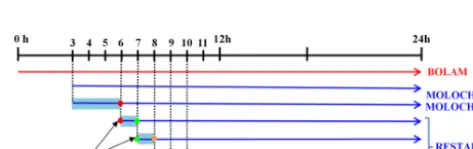
the Settepani radar are used as observations. The assimila-tion scheme is explained in detail in Davolio et al. (2017a). The set-up conceived for the present application takes into account the time requirements for an operational implemen-tation. Considering the timing for global data availability and radar estimates of delivery and processing, the first assimila-tion windows covers the first 6 h of the forecast. At the end of this period, the model state is stored and a free forecast is run to cover the following hours. In this way, once a new hourly rainfall observation is available, an additional 1 h as-similation is performed, restarting the model from the stored condition. This procedure can proceed for several hours, at least until the following global analysis is available, and al-lows for updating and improving forecasts, as a consequence of a longer assimilation period. In the present application, an appropriate time window for frequent assimilation was
cho-Figure 2.MOLOCH forecasts and data assimilation implementa-tion. The first assimilation (MOLOCH CNTR; on the top) is per-formed during the first 6 h of forecast, while after that a 1 h assimi-lation is conducted, restarting the model from the stored conditions of the previous run (dots).
[image:4.612.309.546.512.587.2]3.2 The nowcasting technique
The nowcasting technique used in this paper is a radar-based probabilistic technique, PhaSt (Metta et al., 2009). PhaSt is a “phase stochastic” spectral-based nowcasting procedure that, starting from two following rainfall fields observed by radar, realizes a nonlinear–empirical transformation and stochasti-cally evolves the fields within the spectral space. The use of the spectral space allows for preserving the spatial cor-relation within the rainfall fields. The evolution of Fourier phases through the stochastic process generates many real-izations to be used as members of an ensemble of precipita-tion nowcasts. All the ensemble members are characterized by the same amplitude distribution and very similar power spectra. However, the phase evolution (i.e. the positioning of rainfall structures) evolves differently in the altered realiza-tions, providing an estimate of the probability of occurrence of precipitation at a given point in space and a given instant in time. The main equations of the algorithm are reported below (Eq. 1):
ks=
kx2+ky2 1 pwr
,
d8ks =ωksdt,
dωks = − ωks−ω
0dt T +
q 2σ2
T q
1− dt 2TksdW
(Ornstein–Uhlenbeck process),
(1)
whereks is the spectral phase, dependent on the wave num-bers kx andky. Through this relation, it is possible to give more weight to the smaller scales and less weight to the larger ones;T is the decorrelation time after which the rainfall field is assumed to stop,σ2is the variance in the process, and dW
is a random increment drawn from a normal distribution with a zero mean and second-order moment (W is a Wiener pro-cess).
To allow for the presence of time correlations in the an-gular frequencies, a Langevin-type model is used: the tem-poral evolution of the Fourier phase φ (kx, ky) at a given wave number (kx,ky) is written in terms of a linear Ornstein– Uhlenbeck stochastic process for the angular frequency. The Ornstein–Uhlenbeck process generates angular frequencies that have a Gaussian distribution with a zero mean and vari-anceσ2and an exponentially decaying temporal autocorre-lation. The representation of the noise of the forecast rain-fall field is disentangled into two components, one related to a noise constant in time and the other to a noise changing in time and space in order to have different forecast rainfall fields, but is coherent with the initial observed rainfall. 3.3 Modification of nowcasting technique with NWP
information
To improve the nowcasting algorithm, its original formula-tion (Metta et al., 2009) is modified in a constraint regarding the spectral amplitude of the rainfall field. This spectral am-plitude was previously kept constant along the forecast
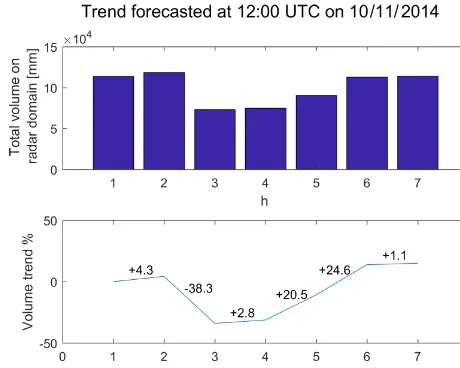
hori-Figure 3.Volume trend for rainfall field modification (example for 10 November 2014 at 12:00 UTC). The total volume on the domain considered is summed for each time step of MOLOCH forecast with data assimilation (DA). The trend volume is applied to the first rain-fall forecast by the nowcasting technique.
zon, which means fixing, in the real space, the total volume of the forecast rainfall fields equal to that of the last observed radar image. This hypothesis of constant volume is relaxed. Therefore, the volume is modified according to the informa-tion provided by the NWP model corrected through the data assimilation technique. The volume trend is calculated for the hours of the forecast, using the information about the to-tal volume of precipitation on the radar domain (Fig. 3), ac-cording to the following formula (Eq. 2):
Rainfall fieldVol Mod(x, y,en, T )=
Rainfall fieldPhaSt Forec(x, y,en, T )×Volume Trend(T ), (2)
wherex andy are the coordinates in the radar rainfall field, en identifies the ensemble member (20 members in this ap-plication), andT is the lead time of the forecast (from 10 min to 6 h).
In this way, the information about the potential growth and decay of the rainfall structures is provided as additional infor-mation to the nowcasting rainfall field. The idea is to make the forecast able to include, in a simple way, the tendency of decreasing or increasing precipitation volume, leaving the task of describing the spatial and temporal distribution of the rainfall field to the original scheme.
3.4 Blending method
[image:5.612.314.544.65.249.2]growth and decay of the precipitation systems becomes pro-gressively more important with an increasing lead time (Ger-mann et al., 2006). These physical processes are represented in the NWP model so that it is worth connecting the nowcast-ing and the meteorological model in a resultnowcast-ing rainfall fore-cast that is possibly more accurate. The blending technique tries to overcome this limit, connecting these two compo-nents. Blending has been previously analysed in some studies with the purpose of improving the rainfall forecast (Golding, 1998; Kober et al.,2012; Atencia et al., 2010; Kilambi and Zawadzky, 2005; Nerini et al., 2018). In this application, a blending function is written in order to balance the forecast reliability of the two models.
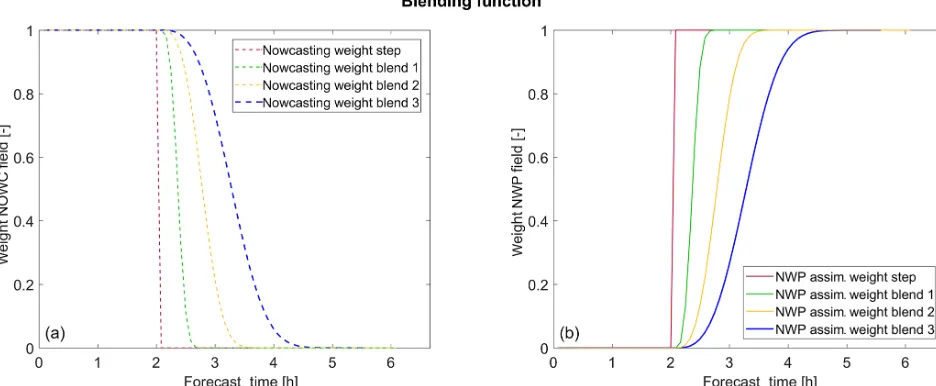
Many of the previous methodologies to estimate the blend-ing function started from the statistical indices computed on the forecast rainfall field for the two models. These indices allow the calculation of the weight for the two different fore-cast rainfall fields. This strategy cannot be applied in this case due to the scarcity of the rainfall events considered: having only three case studies, it is not possible to have representa-tive scores for the two methodologies. In this work, while be-ing aware of the blendbe-ing functions already presented in the literature and according to the arguments presented before concerning the capacity of the model to represent the physi-cal processes after the first hours of forecasting, a first guess of the blending functions is selected, as shown in Fig. 4.
It is worth noting that the weight of the NWP model forecast rainfall is calculated as the complementary function (Eq. 3)
WeightNWP=1−WeightNOWC. (3)
The first function, which will be hereinafter referred to as the “step function”, gives all the weight to the nowcasting rain-fall field for the first 2 h and then, up to the end of the fore-cast, gives it to the NWP model as an on–off switch between the two models. The other three functions are a progressive smoothing of this step function, trying to produce an inter-mediate forecast rainfall field between the nowcasting and the NWP through a linear combination of them.
At first glance it could seem that all blending functions give too much weight in the first time steps to the nowcast-ing model. However, it must be kept in mind that the now-casting rainfall field is obtained by exploiting the informa-tion from the NWP model corrected with data assimilainforma-tion to modify the radar rainfall volume (as described in Sect. 3.3). Moreover we expect that forecasts derived by extrapolation from observation can capture the spatio-temporal pattern bet-ter than NWP during the first 2 h of the forecast (Metta et al., 2009; Collier, 1981; Seed, 2003; Xu and Chandrasekar, 2005; Berenguer et al., 2011). In this way more weight is given to the information of the nowcasting model regarding the positioning of the rainfall structures, and a first correc-tion of the forecast is done through the modificacorrec-tion of the volume. Then, for longer forecast times, less weight is given to the nowcasting rainfall field in favour of the NWP model
forecast. The latter gains progressively more importance up to almost 5 h ahead of the event. After this, the rainfall field is entirely provided by the meteorological model. Hence, the blended rainfall field at a certain forecast timeT results from the linear combination as follows (Eq. 4):
Rainfall fieldblended(T )=
weightNOWC(T )×rainNOWC(T )
+ weightNWP(T )×rainNWP(T ), (4) and it is used as input for the hydrological model for 6 h of the forecast.
Since the forecast of the NWP model is deterministic (rainNWP), the rainfall field that is combined with the 20 members generated with PhaSt (rainNOWC) is always the same. As a consequence, for a short forecast time (values of weightnowc close to 1), PhaSt leads to different rainfall sce-narios, while, as long as the forecast time increases (values of weightnowc close to 0), each rainfall scenario will tend to be equal to the only one NWP QPF.
3.5 The hydrological model
Continuum is a continuously distributed hydrological model that relies on a morphological approach that identifies the drainage network components from a digital elevation model (DEM; Giannoni et al., 2000, 2005). The DEM resolution generally coincides with the model spatial resolution. Flow in the soil is divided into a sub-surface flow component that is based on a Horton schematization (Gabellani et al., 2008) and that follows the drainage network directions and a deep flow component that moves based on the hydraulic head ob-tained by the water-table modelling. The energy balance is solved explicitly at the cell scale by using the force–restore equation. A complete description of the model is reported in Silvestro et al. (2013).
The hydrological model is implemented at a spatial reso-lution of 0.005◦(about 480 m) and with a time resolution of 10 min. The implementation and calibration of the model in the testing area is described in detail in Davolio et al. (2017a) and Silvestro et al. (2018); the latter work evidenced good values of the employed statistics during the calibration and validation process.
It is worth noting for the scope of the present study that the model is distributed so that the streamflow is available in each point of the modelled drainage network; this char-acteristic is exploited for the verification (presented in the Sect. 4). Due to the limited horizontal resolution of the model in this application, the grid points, and, as a consequence, the basins with drainage area lower than 15 km2, are not consid-ered (Silvestro et al., 2018).
3.6 The hydrological nowcasting chain
Figure 4.Different blending functions analysed: in panel(a)is the weighting function applied to the nowcasting rainfall field, and in panel(b)
is the complementary function, used to weight the NWP model forecast. The first weighting function (red line) is a step function, while the other functions are increasingly smoother.
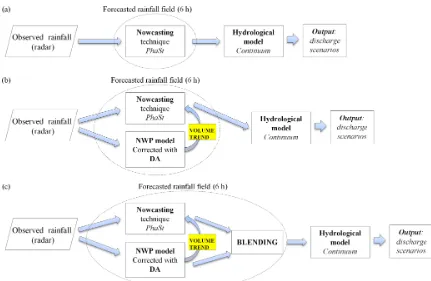
The main input is the observed radar rainfall, which is used up to the “now” as is; then it is used to evolve the last radar image within the nowcasting phase, and it is used in the data assimilation process of the NWP model. Then, for the rain-fall forecasting time window, three configurations are con-sidered and compared. These configurations differ for the 6 h forecast rainfall field that is provided as input to the same hydrological model (Fig. 5), which is computed as follows:
1. Nowcasting is done with PhaSt without volume varia-tion (as described in Sect. 3.2) and no blending with the NWP model (Fig. 5a). This is hereinafter referred to as NOWC.
2. Nowcasting is done with PhaSt with volume variation according to the NWP model with data assimilation (as described in Sect. 3.3); there is no blending with the NWP model (Fig. 5b). This is hereinafter referred to as NOWC VOL.
3. Blending occurs between rainfall fields from nowcast-ing with volume variation (as in step 2) and from the NWP model (deterministic forecast), using a blend-ing function varyblend-ing in time, as presented in Sect. 3.4 (Fig. 5c). This is hereinafter referred to as NOWC BLEND; specifically, it uses the observed rainfall fields to build the rainfall scenarios in the recent past and the nowcasting model with volume correction for the first 2 h of forecast. Then, from the second to the sixth hour, the rainfall field is a linear combination between now-casting and NWP model outputs according to the blend-ing function.
For all the configurations, the hydrological model takes, as input, the rainfall scenarios and produces the forecast in
terms of streamflow. The output of the chain is an ensemble of possible discharge scenarios (20 ensembles) for the fol-lowing 12 h.
3.7 Methodology of analysis
The comparison against observations is done in terms of the final output of the chain, namely the discharge forecast. This comparison is performed, taking, as a reference, the dis-charge forecast obtained using the radar rainfall estimates as input to the distributed hydrological model (hereinafter referred to as the “reference hydrograph”). This approach does not consider errors in the hydrological model, since it is aimed at evaluating possible improvements in the rainfall forecast (Borga, 2002; Vieux and Bedient, 2004; Berenguer et al., 2005).
Before comparing the three configurations described in Sect. 3.6, a preliminary analysis is performed to evaluate dif-ferent blending functions (as described in Sect. 3.4). This al-lows us to identify the best function for every event and an overall (on average) best function. Then the comparison is made between the three configurations in order to investigate the importance of each element used to build the rainfall sce-narios in the streamflow prediction.
A first analysis evaluates the performances of the hydro-logical forecast in three control sections, with one for each considered event. In this analysis, three scores are used: the Nash–Sutcliffe (NS) coefficient (Nash and Sutcliffe, 1970), the variance of the discharge (Var) and the continuous rank probability score (CRPS).
per-Figure 5.The hydrological nowcasting chain in its three configurations: the first one, which is used only the nowcasted rainfall field without volume modification(a), the second one with the nowcasted rainfall field modified with the trend retrieved by the NWP model(b), and the last one in which the nowcasted rainfall fields with volume modification are combined through blending with the fields forecasted by NWP model corrected with DA(c).
formance, especially for streamflow reproduction:
NS=1− T P
t=1
(Qm(t )−Qobs(t ))2
T P
t=1
Qobs−Qobs 2
, (5)
where Qm(t ) and Qobs(t ) are the modelled and reference streamflow at timet. In order to compare the discharge fore-cast at different lead times, we used the approach presented in Berenguer et al. (2005). Using a probabilistic forecast, the index is calculated for each of the 20 realizations, and then a mean value is considered.
To relate this index to the spread of the ensemble of the discharge forecast, the variance is calculated for the analysis on the punctual section (Eq. 6):
Var(X)=Eh(X−µ)2i, (6)
whereXis the forecasted discharge andµis the mean of the forecast.
The reduced continuous rank probability score (RCRPS; Eq. 7; Trinh et al., 2013) is computed as the CRPS (Brown, 1974; Matheson and Winkler, 1976; Unger, 1985; Stanki et al., 1989; Hersbach, 2000), reduced with the standard devia-tion of the observed discharge over the analysed time period
(hereafterσ2):
RCRPS(F, x)= 1
σ2 ∞ Z
−∞
(F (y)−1(y−x))2dy, (7)
whereF (y)is the probability cumulative distribution func-tion (CDF) for the forecast and1is the step function of the observed value. A value of RCRPS that equals zero means a perfect forecast: observations and the forecast coincide. In-creasing values correspond to a bigger distance between ob-servations and the forecast.
The NS coefficient and Var(X) are applied to the mean of the streamflow ensemble following a deterministic approach in the comparison, while the RCRPS is used to evaluate re-sults in a probabilistic perspective (Trinh et al., 2013; Davo-lio et al., 2017a). The values of all the scores are expressed as function of lead time; to cope with the large number of values of the RCRPS, its visualization was done using a box plot, as shown in Sect. 4.
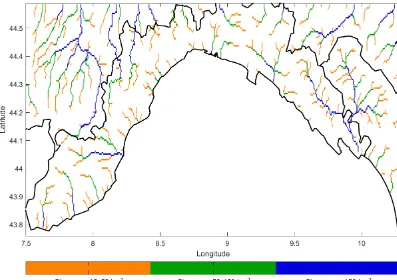
[image:8.612.84.515.61.342.2]Figure 6.River network grid points divided in three classes of drained area for the Continuum computational domain: small catchments of 15–50 km2, medium size catchments of 50–150 km2and big catchments>150 km2.
– points with an upstream drainage area in the range of 15 to 50 km2(small catchments),
– points with an upstream drainage area in the range of 50 to 150 km2(medium-sized catchments),
– points with an upstream drainage area in the range of 150 to 500 km2(big catchments).
This distinction is made by the concentration time related to the different size of catchments: a longer-lasting influence of the forecast rain can be found for the basins with a greater drained area and a bigger concentration time. Hence, when analysing the performance indices and relating them to the lead time, a longer lead time will be considered in calculat-ing the indices for the bigger catchments. In particular, be-yond the 6 h of lead time corresponding to the rainfall fore-cast, a further window of forecast discharge is considered: 1 additional hour for the first class of catchments, 2 additional hours for the second class and 3 additional hours for the third class.
The distributed analysis, executed on the entire domain on which the hydrological model is run, provides more general information about the performance of the hydrological now-casting chain. The score used for the distributed analysis is the RCRPS, calculated for each point of the domain inter-ested by the event (a filter on the pixel in which the forecast discharge does not exceed a threshold is performed). Also
the RCRPS is expressed as a function of lead time and for the three classes of drained areas.
4 Results
4.1 Impact of the blending function on hydrological forecasts
A first analysis is performed to evaluate the performance of the complete chain implemented using four different blend-ing functions to linearly combine nowcastblend-ing and NWP rain-fall fields. This analysis is done by evaluating the discharge forecast using the RCRPS score; the distributed approach is applied, and hence the predictions in all the points of the do-main are considered. The results are then analysed for the three classes of drainage area presented in Sect. 3.7.
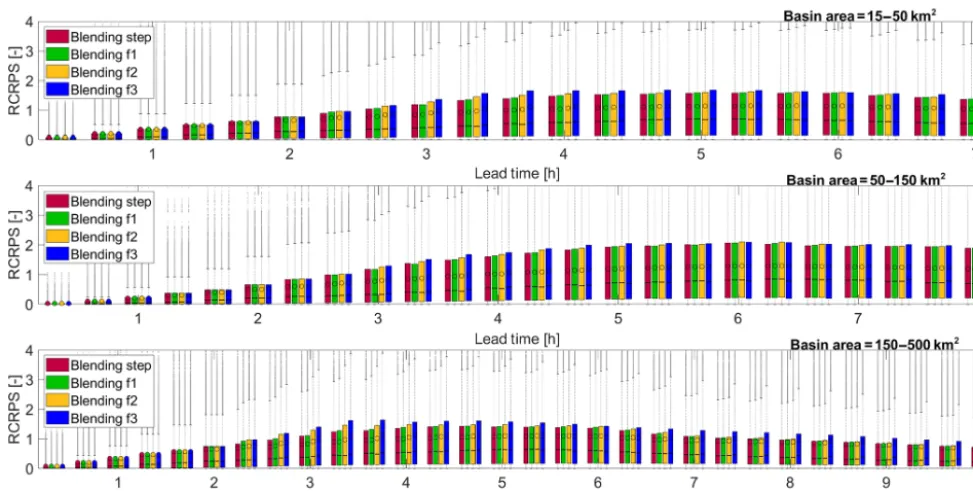
Figure 7.RCRPS for all the events: analysis of the discharge output with the four different blending functions. The red column represents the results obtained by applying the step function, and the other three columns refer to the other three smoothed blending functions (see Sect. 3.4). Inside each box, the circle indicates the mean value, while the line indicates the median. The results are presented in the form of a box plot for the three classes of drainage area (15–20 km2, 50–150 km2and 150–500 km2).
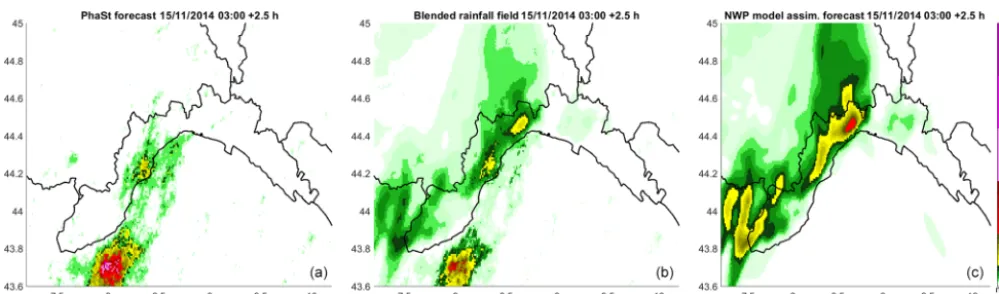
and the outliers are plotted individually with points. The four columns represent the results related to the use of the dif-ferent blending functions: the first column (dark red) is re-lated to the step blending function, the second (green; here-after defined as f1) and the third (yellow; f2) refer to the use of intermediate functions, and the last column (blue; f3) is related to the smoothest blending functions, as presented in Sect. 3.4. Results show clearly that there are no large dif-ferences among the four configurations of the blending func-tions, but in general it seems ideal to rapidly move from now-casting to the NWP model forecast, avoiding long smoothing periods. In fact the scores for all the classes of the drainage area indicate a worse performance (large values of RCRPS) around 4–5 h of lead time. This result is probably due to the fact that, even if data assimilation in the NWP model is per-formed with hourly updating, often PhaSt rainfall scenarios and NWP rainfall fields are not seamless (Fig. 8). These dis-continuities can affect the blending process, generating a fi-nal rainfall scenario which may result in rather different re-sults from both PhaSt and NWP rainfall fields.
In general, the best score is obtained with the step function. However, this is an average behaviour for the three events; each event has its own best blending function, as shown in Sect. 4.2 and 4.3.
4.2 Basin-scale analysis at river sections
Figure 8.Example of transition from a rainfall field forecast through nowcasting(a)and another forecast by the NWP model corrected with DA(c)through the linear combination of the field obtained by applying a blending function. Since the two forecast rainfall fields show relevant differences between each other, the rainfall field resulting from blending(b)is rather different with respect to the other two fields.
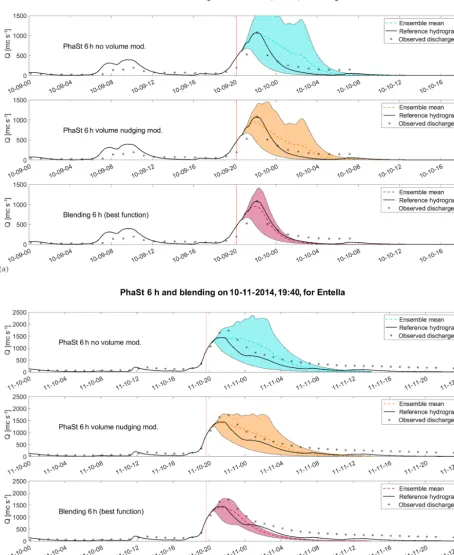
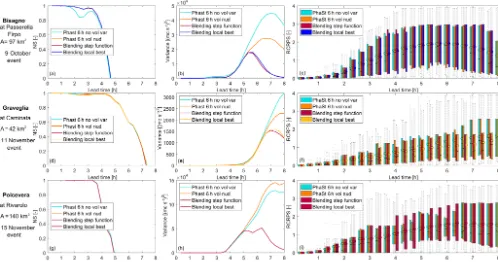
Results clearly indicate that the spread of the discharge forecast ensemble is markedly smaller when input rainfall is provided by blending, instead of nowcasting alone (with or without volume trend modification). This is possibly as-cribable to the fact that, while nowcasting provides a prob-abilistic forecast (20 ensembles) of different rainfall scenar-ios, blending connects a deterministic forecast from the NWP model with the nowcasting ensemble. Since each member of this ensemble is blended with the same NWP model forecast, the spread of the final ensemble is smaller.
Figure 10 summarizes the results for some representative basins for each event, using the statistical scores described in Sect. 3.7. The three configurations of the hydrological chain presented in Sect. 3.7 are compared; for the blending con-figuration, the best blending function (for the blending step, see Sect. 4.1) and the local best blending function, which is different for each event, are applied.
The event of 9 October is sadly known for the flood that affected the municipality of Genoa during the evening. The main creek interested by the flood was the Bisagno creek, and the results at the Passerella Firpo section (A≈97 km2) are shown in Fig. 10a, b and c. While for the NS the per-formances of the hydrological nowcasting chain are really similar among each other, the variance in the forecast ob-tained using the blending is smaller than that obob-tained using nowcasting, thus providing a forecast with less variability, which could be an advantage because it theoretically reduces false alarms or a disadvantage because it can increase the missed warning, depending on the single case. The RCRPS shows variable behaviour for different lead times: in the be-ginning, the best performing configuration is NOWC VOL. In the intermediate phase, when nowcasting and the NWP model forecast are combined with blending, there is no con-figuration overperforming the others; for longer lead times, the configuration NOWC produces the best performance. For this event, the forecast of the meteorological model, even cor-rected with data assimilation, is not able to improve the QPF.
Although the event on 11 November affected the whole re-gion of Liguria, the main effects on the ground were caused by the Entella river, which flooded the urban area of Chiavari, and by its tributaries Lavagna and Graveglia. The scores for the Graveglia basin at the Caminata section (A≈42 km2) are shown in Fig. 10d, e and f. Unlike the previous case, here the use of the NWP model has a clearly positive impact. In this event the rainfall fields from nowcasting techniques lead to an overestimation of the discharge, while the rainfall fields obtained through the blending improve markedly the discharge forecast.
For the event of 15 November, the performance of the system is evaluated for Polcevera at the Rivarolo section (140 km2) and shown in Fig. 10g, h and i. It is worth not-ing that the RCRPS box plot shows that the performance of the system fed with blending becomes worse between 4 and 6 h lead time. As already explained, this can be related to the unrealistic rainfall field produced by the blending when the nowcasting and the NWP model forecast differ too much between each other.
4.3 Distributed analysis
While in the previous section the scores were computed for single punctual sections of the basins, here the distributed analysis is carried out, aimed at giving a more general pic-ture of the performance of the hydrological nowcasting chain fed with different rainfall inputs. In fact, with the distributed analysis, it is possible to compute the score, in this case the RCRPS, over all the points of the domain, increasing the data sample used for the analysis.
4.3.1 9 October 2014 event
Figure 10.Analysis at basin scale for the three events, namely 9 October 2014 at Bisagno creek(a–c), 11 November 2014 at Graveglia(d–f)
and 15 November 2014 at Polcevera(g–i). The following scores are shown: Nash–Sutcliffe (NS) efficiency(a, d, g), variance(b, e, h)and RCRPS(c, f, i). Four configurations of the system are evaluated (Phast 6 h no vol var – PhaSt no-volume variation; Phast 6 h no vol nud – PhaSt no-volume nudged; blending step function; blending local best function; see text).
be due to the peculiar type of event characterized by station-ary and persistent heavy precipitation on the same portion of territory that was not forecasted precisely by the NWP model but reproduced well by the nowcasting model. However, even if the information regarding the location of the rainfall, com-ing from the meteorological model, is misleadcom-ing for the hy-drological forecast, the information about the total volume on the domain adds value to the nowcasting rainfall field. 4.3.2 11 November 2014 event
For this event the best blending function is f2. As al-ready pointed out in the previous basin-scale analysis, the distributed analysis (Fig. 12) confirms, even more clearly, that for this event the system using the blending performs markedly better. Especially for the bigger basins, due to their response time, the effects of a proper rainfall forecast pro-vided with blending are beneficial for longer lead times, probably due to the slow response of the basins.
4.3.3 15 November 2014
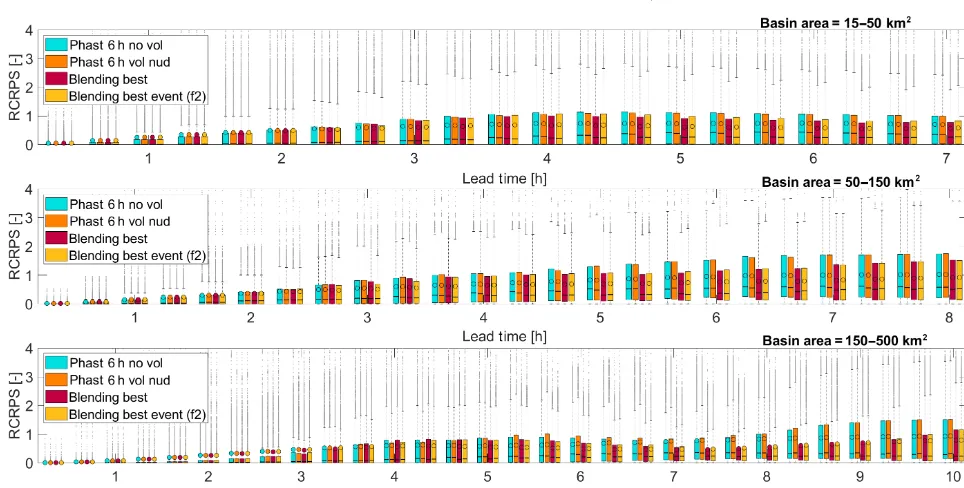
For this event the best blending function coincides with the best on average for all the three events, which is the step func-tion. In this case (Fig. 13) the differences among the config-urations can be noticed mostly in the first two classes of the area, where the use of the blending technique improves the
rainfall forecast: the column related to the NOWC BLEND configuration is always lower and presents less spread with respect to NOWC and NOWC VOL configurations. In the last class of the area (larger basin) the behaviour is different, especially at the lead time corresponding to the transition in the blending between the rainfall field from nowcasting and from the NWP model. This transition is confirmed to be the most critical phase for the blending, as it can produce unre-alistic rainfall fields.
5 Conclusions
A hydrological nowcasting chain is a useful instrument for flood and flash flood warnings. The use of an accurate QPF for input to the hydrological model is essential in extending the lead time of the hydrological forecast. The aim of this study is to improve the single elements in order to provide, in real time, an accurate forecast of the rainfall field which is able to improve the performance of the hydrological predic-tion at a temporal scale of up to 6–8 h.
Figure 11.9 October 2014 event: RCRPS for three distinct classes of area. Each column refers to a different configuration of the forecasting system: NOWC (light blue), NOWC VOL (orange), NOWC BLEND using the step blending function (red) and NOWC BLEND using the best local blending function (blue), which in this case is the function f3.
[image:14.612.57.539.422.666.2]Figure 13. 15 November 2014 event: RCRPS for three distinct classes of area. Each column refers to a different configuration of the forecasting system: NOWC (light blue), NOWC VOL (orange), NOWC BLEND using the step blending function (red) and NOWC BLEND using the best local blending function, which in this case coincides with the step function (red).
observations, and the hydrological distributed model Contin-uum, which predicts the ground effects of the precipitation in terms of streamflow over all the basins of the studied region. The way in which these elements are combined with each other and integrated with observations from radar and avail-able rain gauges represents the major novelty of the present study with respect to similar existing nowcasting procedures. Instead of just combining the spatial distribution of two rain-fall fields, obtained independently of a nowcasting algorithm and an NWP model, first the nowcasting fields are modified according to information provided by the NWP. This can be considered to be a first blending step, during which the pre-dicted rainfall fields produced by PhaSt are modified along the forecast horizon according to the predicted variation in rainfall volume from the NWP model corrected with assim-ilation. Specifically the rainfall volume trend by the NWP model is used to overcome the current limitation of the PhaSt algorithm, which is based on the hypothesis that the most re-cent observed rainfall volume is kept constant along the pre-diction. This first blending is aimed at better taking into ac-count the processes of growth and decay of the precipitation structures as described by the NWP model that progressively gain importance at increasing lead times and cannot be re-alistically reproduced by nowcasting alone. Then a standard blending technique is applied to linearly combine the rain-fall fields from nowcasting and the NWP model, based on a blending function that gives different weight to the QPF,
depending on the lead time. The probabilistic QPF obtained (20 rainfall ensembles) is the input of the distributed hydro-logical model Continuum, which produces an ensemble of discharge forecasts in a frequently updated flood forecasting system (every 20 min).
The meteo-hydrological chain is tested for three main floods occurred during the autumn of 2014 that affected different areas of the Liguria region: the 9 October event with the flood of the Bisagno creek that hit the municipality of Genoa, the 11 November event, involving the Graveglia catchment, and the 15 November event, in which the flood of Polcevera occurred. Even if the number of analysed events is restricted, the resulting distributed maps produced by Con-tinuum allow us to verify the performance of the chain on a large data sample.
nowcasting, with or without volume modification, while in the third one the blended rainfall fields are used.
Statistical scores show that in various cases the use of the rainfall fields resulting from the blending process leads to an improvement in the performances of the whole chain with re-spect to the use of nowcasting alone. In other cases, the bene-fit gained using the complete configuration with the blending is not so evident, and the performances results are similar to the use of the nowcasting for the whole lead time. How-ever, a worsening of the performance is rarely observed and occurs in the time window corresponding to the transition be-tween nowcasting and the NWP model forecast rainfall field. Hence, there is added value in the use of the blending be-tween nowcasting and the NWP model, as it produces bet-ter or equal scores with respect to the use of the nowcasting alone.
A limitation of the presented study is related to the reduced number of considered events, which is mainly due to compu-tational costs. A direct consequence is that it is not possible to provide a complete and exhaustive evaluation of the system performances, especially in terms of false alarms (Antonetti et al., 2019). In any case, this study can be considered to be a first step in the implementation and evaluation of a novel nowcasting procedure, which provides positive and encour-aging results but still requires a much more robust validation, already planned for the future. However, it is worth noticing that the distributed analysis tries to partially overcome this issue because it considers a large number of grid points, in-creasing the sample size for the analysis, although in many cases the sample elements are evidently not independent, so it should be desirable in any case to increase the number of events for further analysis.
Future works and improvements to the chain presented in this work will be always explored in terms of improvement of the elements that compose it. Other techniques of data assim-ilation with increasing degrees of complexity can be used to assimilate not only the observed precipitation field but also other variables in the NWP model. Following recent works (Atencia et al., 2010), further investigations can be carried out using another type of blending, called spatial blending, which introduces spatial dependence of weights as a distance function to rainfall structures.
Data availability. MOLOCH forecast rainfall data are avail-able through a THREDDS Data Server upon request to [email protected], while the radar rainfall data used can be requested from the Regional Environmental Protection Agency of Liguria, Italy (ARPAL; https://www.arpal.gov.it/, last access: 4 March 2019).
Author contributions. MLP, FS and SD designed the study. MLP and FS planned and coordinated the collection of data and per-formed the research activity related to the nowcasting, the blending
technique and the hydrological application including the analysis of the results. SD carried out radar data assimilation into the NWP and meteorological simulations. All authors contributed to the analysis and to writing and revising the paper.
Competing interests. The authors declare that they have no conflict of interest.
Special issue statement. This article is part of the spe-cial issue “Hydrological cycle in the Mediterranean (ACP/AMT/GMD/HESS/NHESS/OS inter-journal SI)”. It is not associated with a conference.
Acknowledgements. This work is a contribution to the HyMeX in-ternational programme, and it is supported by the Italian Civil Pro-tection Department. We acknowledge the Regional Environmental Protection Agency of Liguria, Italy (ARPAL), for fruitful discus-sions and for providing the data.
Financial support. This research has been developed within the 2017–2019 framework agreement stipulated between the CIMA Re-search Foundation and the Civil Protection Department.
Review statement. This paper was edited by Uwe Ehret and re-viewed by Massimiliano Zappa and one anonymous referee.
References
Acquaotta, F., Faccini, F., Fratianni, S., Paliaga, G., and Sac-chini, A.: Rainfall intensity in the Genoa Metropolitan Area: secular variations and consequences, Weather, 73, 356–362, https://doi.org/10.1002/wea.3208, 2018.
Antonetti, M., Horat, C., Sideris, I. V., and Zappa, M.: En-semble flood forecasting considering dominant runoff pro-cesses – Part 1: Set-up and application to nested basins (Emme, Switzerland), Nat. Hazards Earth Syst. Sci., 19, 19–40, https://doi.org/10.5194/nhess-19-19-2019, 2019.
Atencia, A., Rigo, T., Sairouni, A., Moré, J., Bech, J., Vilaclara, E., Cunillera, J., Llasat, M. C., and Garrote, L.: Improving QPF by blending techniques at the Meteorological Service of Catalonia, Nat. Hazards Earth Syst. Sci., 10, 1443–1455, https://doi.org/10.5194/nhess-10-1443-2010, 2010.
Berenguer, M., Corral, C., Sánchez-Diezma, R., and Sempere-Torres, D.: Hydrological validation of a radar-based nowcasting technique, J. Hydrometeorol., 6, 532–549, https://doi.org/10.1175/JHM433.1 , 2005.
Berenguer, M., Sempere-Torres, D., and Pegram, G. G.: SBMcast – An ensemble nowcasting technique to assess the uncertainty in rainfall forecasts by Lagrangian extrapolation, J. Hydrol., 404, 226–240, https://doi.org/10.1016/j.jhydrol.2011.04.033 , 2011. Bick, T., Simmer, C., Trömel, S., Wapler, K., Hendricks Franssen,
Y., and Potthast, R.: Assimilation of 3D radar reflectivities with an ensemble Kalman filter on the convective scale, Q. J. Roy. Meteor. Soc., 142, 1490–1504, https://doi.org/10.1002/qj.2751, 2016
Borga, M.: Accuracy of radar rainfall estimates for streamflow sim-ulation. J. Hydrol., 267, 26–39, https://doi.org/10.1016/S0022-1694(02)00137-3, 2002.
Bowler, N. E., Pierce, C. E., and Seed, A. W.: STEPS: A probabilis-tic precipitation forecasting scheme which merges an extrapo-lation nowcast with downscaled NWP, Q. J. Roy. Meteor. Soc., 132, 2127–2155, https://doi.org/10.1256/qj.04.100, 2006. Brown, T. A.: Admissible scoring systems for continuous
distribu-tions. Manuscript P-5235, The Rand Corporation, Santa Monica, CA, USA, 22 pp., 1974.
Buzzi, A., Davolio, S., D’Isidoro, M., and Malguzzi, P.: The im-pact of resolution and of MAP reanalysis on the simulations of heavy precipitation during MAP cases, Meteorol. Z., 13, 91–97, https://doi.org/10.1127/0941-2948/2004/0013-0091, 2004. Buzzi, A., Davolio, S., Malguzzi, P., Drofa, O., and Mastrangelo,
D.: Heavy rainfall episodes over Liguria in autumn 2011: numer-ical forecasting experiments, Nat. Hazards Earth Syst. Sci., 14, 1325–1340, https://doi.org/10.5194/nhess-14-1325-2014, 2014. Cenci, L., Laiolo, P., Gabellani, S., Campo, L., Silvestro, F.,
Del-ogu, F., Boni, G., and Rudari, R.: Assimilation of H-SAF Soil Moisture Products for Flash Flood Early Warning Systems. Case Study: Mediterranean Catchments, IEEE J. Sel. Top. Appl., 9, 5634–5646, https://doi.org/10.1109/JSTARS.2016.2598475, 2016.
Collier, C. G.: Objective rainfall forecasting using data from the United Kingdom weather radar network. In Nowcasting: Mesoscale Observations and Short-Range Prediction. Proceed-ings of International Symposium, Hamburg, Germany, 25– 28 August, 1981, edited by: Battrick, B. and Mort, J., ESA SP-165, p. 201, 1981.
Davolio, S., Silvestro, F., and Malguzzi, P.: Effects of increas-ing horizontal resolution in a convection-permittincreas-ing model on flood forecasting: The 2011 dramatic events in Liguria, Italy, J. Hydrometeorol., 16, 1843–1856, https://doi.org/10.1175/JHM-D-14-0094.1, 2015.
Davolio, S., Silvestro, F., and Gastaldo, T.: Impact of Rainfall Assimilation on High-Resolution Hydrometeorological Fore-casts over Liguria, Italy, J. Hydrometeorol., 18, 2659–2680, https://doi.org/10.1175/JHM-D-17-0073.1, 2017a.
Davolio, S., Henin, R., Stocchi, P., and Buzzi, A.: Bora wind and heavy persistent precipitation: Atmospheric water balance and role of air–sea fluxes over the Adriatic Sea, Q. J. Roy. Meteor. Soc., 143, 1165–1177, https://doi.org/10.1002/qj.3002, 2017b. Delrieu, G., Nicol, J., Yates, E., Kirstetter, P. E., Creutin, J. D.,
Anquetin, S., Obled, C., Saulnier G. M., and Payrastre, O.: The catastrophic flash-flood event of 8–9 September 2002 in the Gard Region, France: a first case study for the Cévennes–Vivarais Mediterranean Hydrometeorological Observatory, J. Hydrome-teorol., 6, 34–52, https://doi.org/10.1175/JHM-400.1, 2005. Dow, G. and Macpherson, B.: Benefit of convective-scale data
as-similation and observing systems in the UK models, Forecasting Research Technical Report 585, Met Office, UK, 2013. Drobinski, P., Ducrocq, V., Alpert, P., Anagnostou, E., Béranger, K.,
Borga, M., Braud, I., Chanzy, A., Davolio, S., Delrieu, G., Es-tournel, C., Filali Boubrahmi, N., Font, J., Grubisic, V., Gualdi,
S., Homar, V., Ivancan-Picek, B., Kottmeier, C., Kotroni, V., Lagouvardos, K., Lionello, P., Llasat, M. C., Ludwig, W., Lut-off, C., Mariotti, A., Richard, E., Romero R., Rotunno, R., Rous-sot, O., Ruin, I., Somot, S., Taupier-Letage, I., Tintore, J., Ui-jlenhoet, R., and Wernli, H.: HyMeX: A 10-year multidisci-plinary program on the Mediterranean water cycle, B. Am. Mete-orol. Soc., 95, 1063–1082, https://doi.org/10.1175/BAMS-D-12-00242.1, 2014.
Ducrocq, V., Nuissier, O., Ricard, D., Lebeaupin, C., and Thou-venin, T.: A numerical study of three catastrophic precipitat-ing events over southern France. II: Mesoscale triggerprecipitat-ing and stationarity factors, Q. J. Roy. Meteor. Soc., 134, 131–145, https://doi.org/10.1002/qj.199, 2008.
Faccini, F., Piccazzo, M., and Robbiano, A.: Natural hazards in San Fruttuoso of Camogli (Portofino Park, Italy): a case study of a debris flow in a coastal environmen, B. Soc. Geol. Ital., 128, 641– 654, https://doi.org/10.3301/IJG.2009.128.3.641, 2009. Faccini, F., Robbiano, A., and Sacchini, A.: Geomorphic hazards
and intense rainfall: the case study of the Recco Stream catch-ment (Eastern Liguria, Italy), Nat. Hazards Earth Syst. Sci., 12, 893–903, https://doi.org/10.5194/nhess-12-893-2012, 2012. Fiori, E., Comellas, A., Molini, L., Rebora, N., Siccardi, F.,
Gochis, D. J., Tanelli, S., and Parodi, A.: Analysis and hind-cast simulations of an extreme rainfall event in the Mediter-ranean area: The Genoa 2011 case, Atmos. Res., 138, 13–29, https://doi.org/10.1016/j.atmosres.2013.10.007, 2014.
Foresti, L., Reyniers, M., Seed, A., and Delobbe, L.: Development and verification of a real-time stochastic precipitation nowcasting system for urban hydrology in Belgium, Hydrol. Earth Syst. Sci., 20, 505–527, https://doi.org/10.5194/hess-20-505-2016, 2016. Gabellani, S., Silvestro, F., Rudari, R., and Boni, G.: General
cal-ibration methodology for a combined Horton-SCS infiltration scheme in flash flood modeling, Nat. Hazards Earth Syst. Sci., 8, 1317–1327, https://doi.org/10.5194/nhess-8-1317-2008, 2008. Germann, U. and Zawadzki, I.: Scale-dependence of the
pre-dictability of precipitation from continental radar images. Part I: Description of the methodology, Mon. Weather Rev., 130, 2859–2873, https://doi.org/10.1175/1520-0493(2002)130<2859:SDOTPO>2.0.CO;2, 2002.
Germann, U., Zawadzki, I., and Turner, B.: Predictabil-ity of precipitation from continental radar images. Part IV: Limits to prediction, J. Atmos. Sci., 63, 2092–2108, https://doi.org/10.1175/JAS3735.1, 2006.
Giannoni, F., Roth., G., and Rudari, R.: A Semi – Distributed Rain-fall – Runoff Model Based on a Geomorphologic Approach, Phys. Chem. Earth, 25, 665–671 https://doi.org/10.1016/S1464-1909(00)00082-4, 2000.
Giannoni, F., Roth., G., and Rudari, R.: A procedure for drainage network identification from geomorphology and its application to the prediction of the hydrologic response, Adv. Water Resour., 28, 567–581, https://doi.org/10.1016/j.advwatres.2004.11.013, 2005.
Golding, B. W.: Nimrod: A system for generating auto-mated very short range forecasts, Meteorol. Appl., 5, 1–16, https://doi.org/10.1017/S1350482798000577, 1998.
the Eastern Alpine region, Weather Forecast., 26, 166–183, https://doi.org/10.1175/2010WAF2222451.1, 2011.
Hersbach, H.: Decomposition of the continuous ranked prob-ability score for ensemble prediction systems, Weather Forecast., 15, 559–570, https://doi.org/10.1175/1520-0434(2000)015<0559:DOTCRP>2.0.CO;2, 2000.
Kain, J. S.: The Kain–Fritsch convective pa-rameterization: An up-date, J. Appl. Meteo-rol., 43, 170–181, https://doi.org/10.1175/1520-0450(2004)043<0170:TKCPAU>2.0.CO;2, 2004.
Kain, J. S., Weiss, S. J., Levit, J. J., Baldwin, M. E., and Bright, D. R.: Examination of convection-allowing configurations of the WRF model for the prediction of severe convective weather: The SPC/NSSL Spring Program 2004, Weather Forecast., 21, 167– 181, https://doi.org/10.1175/WAF906.1, 2006.
Kilambi, A. and Zawadzki, I.: An evaluation of ensembles based upon MAPLE precipitation nowcasts and NWP precipitation forecasts, in: Preprints, 32nd Conf. on Radar Meteorology, 22– 29 October 2005, Albuquerque, NM, USA, Amer. Meteor. Soc., vol. 4, P3R, 2005.
Kober, K., Craig, G. C., Keil, C., and Dörnbrack, A.: Blend-ing a probabilistic nowcastBlend-ing method with a high-resolution numerical weather prediction ensemble for convective pre-cipitation forecasts, Q. J. Roy. Meteor. Soc., 138, 755–768, https://doi.org/10.1002/qj.939, 2012.
Kyznarova, H., Salek, M., and Novak, P.: Preliminary results of use of INCA system in the Czech Hydrometeorological Institute, Proceedings of ERAD2012, 25–29 June 2012, Toulouse, France, 2012.
Kyznarova, H., Novak, P., Brezkova, L., Janal, P., and Salek, M.: Precipitation output of INCA system: evaluation and use. In EGU General Assembly Conference Abstracts, vol. 15, EGU General Assembly, 7–12 April 2013, Vienna, Austria, 2013EGUGA..15.9089K, 2013.
Liechti, K. and Zappa, M.: Verification of Short-Range Hydro-logical Forecasts, Handbook of HydrometeoroHydro-logical Ensemble Forecasting, Springer, Berlin, Heidelberg, Germany, 953–975, 2019.
Liechti, K., Panziera, L., Germann, U., and Zappa, M.: The potential of radar-based ensemble forecasts for flash-flood early warning in the southern Swiss Alps, Hydrol. Earth Syst. Sci., 17, 3853– 3869, https://doi.org/10.5194/hess-17-3853-2013, 2013. Lin, C., Vasi´c, S., Kilambi, A., Turner, B., and Zawadzki, I.:
Pre-cipitation forecast skill of numerical weather prediction mod-els and radar nowcasts, Geophys. Res. Lett., 32, L14801, https://doi.org/10.1029/2005GL023451, 2005.
Malguzzi, P., Grossi, G., Buzzi, A., Ranzi, R., and Buizza, R.: The 1966 “century” flood in Italy: A meteorological and hydrological revisitation, J. Geophys. Res., 111, D24106, https://doi.org/10.1029/2006JD007111, 2006.
Matheson, J. E. and Winkler, R. L.: Scoring rules for contin-uous probability distributions, Manage. Sci., 22, 1087–109, https://doi.org/10.1287/mnsc.22.10.1087, 1976.
Metta, S., von Hardenberg, J., Ferraris, L., Rebora, N., and Proven-zale, A.: Precipitation nowcasting by a spectral-based non-linear stochastic model, J. Hydrometeorol., 10, 1285–1297, https://doi.org/10.1175/2009JHM1120.1, 2009.
Nash, J. E. and Sutcliffe, J. V.: River flow forecasting through con-ceptual models part I – A discussion of principles, J. Hydrol., 10, 282–290, https://doi.org/10.1016/0022-1694(70)90255-6, 1970. Nerini, D., Germann, U., and Foresti, L.: A Bayesian framework
based on the ensemble Kalman filter for flow-dependent integra-tion of weather radar extrapolaintegra-tion nowcasts and NWP precipi-tation fields, in: EGU General Assembly Conference Abstracts, vol. 20, p. 4865, EGU General Assembly, 4–13 April 2018, Vi-enna, Austria, 2018EGUGA..20.4865N, 2018.
Panziera, L., Germann, U., Gabella, M., and Mandapaka, P. V.: NORA – Nowcasting of Orographic Rainfall by means of Analogues, Q. J. Roy. Meteorol. Soc., 137, 2106–2123, https://doi.org/10.1002/qj.878, 2011.
Parodi, A., Boni, G., Ferraris, L., Siccardi, F., Pagliara, P., Trovatore, E., and Kranzlmueller, D.: The “perfect storm”: From across the Atlantic to the hills of Genoa, Eos, Transactions American Geophysical Union, 93, 225–226, https://doi.org/10.1029/2012EO240001, 2012.
Rebora, N., Molini, L., Casella, E., Comellas, A., Fiori, E., Pignone, F., Siccardi, F., Silvestro, F., Tanelli, S., and Par-odi, A.: Extreme rainfall in the Mediterranean: What can we learn from observations?, J. Hydrometeorol., 14, 906–922, https://doi.org/10.1175/JHM-D-12-083.1, 2013.
Rossa, A. M., Del Guerra, F. L., Borga, M., Zanon, F., Settin, T., and Leuenberger, D.: Radar-driven high-resolution hydro-meteorological forecasts of the 26 Septem-ber 2007 Venice flash flood, J. Hydrol., 394, 230–244, https://doi.org/10.1016/j.jhydrol.2010.08.035, 2010.
Seed, A. W.: A dynamic and spatial scaling ap-proach to advection forecasting, J. Appl. Mete-orol., 42, 381–388, https://doi.org/10.1175/1520-0450(2003)042<0381:ADASSA>2.0.CO;2, 2003.
Silvestro, F. and Rebora, N.: Operational verification of a frame-work for the probabilistic nowcasting of river discharge in small and medium size basins, Nat. Hazards Earth Syst. Sci., 12, 763-776, https://doi.org/10.5194/nhess-12-763-2012, 2012.
Silvestro, F., Rebora, N., and Ferraris, L.: An algorithm for real-time rainfall rate estimation by using polari-metric radar: RIME, J. Hydrometeorol., 10, 227–240, https://doi.org/10.1175/2008JHM1015.1, 2009.
Silvestro, F., Gabellani, S., Giannoni, F., Parodi, A., Rebora, N., Rudari, R., and Siccardi, F.: A hydrological analysis of the 4 November 2011 event in Genoa, Nat. Hazards Earth Syst. Sci., 12, 2743–2752, https://doi.org/10.5194/nhess-12-2743-2012, 2012.
Silvestro, F., Gabellani, S., Delogu, F., Rudari, R., and Boni, G.: Exploiting remote sensing land surface temperature in distributed hydrological modelling: the example of the Continuum model, Hydrol. Earth Syst. Sci., 17, 39–62, https://doi.org/10.5194/hess-17-39-2013, 2013.
Silvestro, F., Rebora, N., Cummings, G., and Ferraris, L.: Experi-ences of dealing with flash floods using an ensemble hydrolog-ical nowcasting chain: implications of communication, accessi-bility and distribution of the results, J. Flood Risk Manage., 10, 446–462, https://doi.org/10.1111/jfr3.12161, 2015a.
remote-sensing data, Hydrol. Earth Syst. Sci., 19, 1727–1751, https://doi.org/10.5194/hess-19-1727-2015, 2015b.
Silvestro, F., Rebora, N., Giannoni, F., Cavallo, A., and Ferraris, L.: The flash flood of the Bisagno Creek on 9th October 2014: An “unfortunate” combination of spatial and temporal scales, J. Hy-drol., 541, 50–62, https://doi.org/10.1016/j.jhydrol.2015.08.004, 2016.
Silvestro, F., Parodi, A., Campo, L., and Ferraris, L.: Analysis of the streamflow extremes and long-term water balance in the Liguria region of Italy using a cloud-permitting grid spac-ing reanalysis dataset, Hydrol. Earth Syst. Sci., 22, 5403–5426, https://doi.org/10.5194/hess-22-5403-2018, 2018.
Sinclair, S. and Pegram, G.: Combining radar and rain gauge rainfall estimates using conditional merging, Atmos. Sci. Lett., 6, 19–22, https://doi.org/10.1002/asl.85, 2005.
Sokol, Z. and Zacharov, P.: Nowcasting of precipitation by an NWP model using assimilation of extrapolated radar reflectivity, Q. J. Roy. Meteor. Soc., 138, 1072–1082, https://doi.org/10.1002/qj.970, 2012.
Stanki, H. R., Wilson, L. J., and Burrows, W. R.: Survey of common verification methods in meteorology, WMO/TD 358, World Me-teorological Organization, Geneva, Switzerland, 114 pp., 1989. Sun, J., Xue, M., Wilson, J. W., Zawadzki, I., Ballard, S. P.,
Onvlee-Hooimeyer, J., Joe, P., Barker, D. M., Li, P.-W., Golding, B., Xu, M., and Pinto, J.: Use of NWP for nowcasting convec-tive precipitation. Recent progress and challenges, B. Am. Me-teorol. Soc., 95, 409–426, https://doi.org/10.1175/BAMS-D-11-00263.1, 2014.
Thorndahl, S., Einfalt, T., Willems, P., Nielsen, J. E., ten Veldhuis, M.-C., Arnbjerg-Nielsen, K., Rasmussen, M. R., and Molnar, P.: Weather radar rainfall data in urban hydrology, Hydrol. Earth Syst. Sci., 21, 1359–1380, https://doi.org/10.5194/hess-21-1359-2017, 2017.
Trinh, B. N., Thielen-del Pozo, J., and Thirel, G.: The reduction continuous rank probability score for evaluating discharge fore-casts from hydrological ensemble prediction systems, Atmos. Sci. Lett., 14, 61–65, https://doi.org/10.1002/asl2.417, 2013. Unger, D. A.: A method to estimate the continuous ranked
probabil-ity score. Preprints, Ninth Conf. on Probabilprobabil-ity and Statistics in Atmospheric Sciences, 9–11 October 1985, Virginia Beach, VA, USA, Amer. Meteor. Soc., 206–213, 1985.
Vieux, B. E. and Bedient, P. B.: Assessing urban hydrologic pre-diction accuracy through event reconstruction, J. Hydrol., 299, 217–236, https://doi.org/10.1016/j.jhydrol.2004.08.005, 2004. Wang, G., Wong, W. K., Hong, Y., Liu, L., Dong, J.,
and Xue, M.: Improvement of forecast skill for severe weather by merging radar-based extrapolation and storm-scale NWP corrected forecast, Atmos. Res., 154, 14–24, https://doi.org/10.1016/j.atmosres.2014.10.021, 2015.
Weisman, M. L., Davies, C., Wang, W., Manning, K. W., and Klemp, J. B.: Experiences with 0-36-h explicit convective fore-casts with the WRF-ARW model, Weather Forecast., 23, 407– 437, https://doi.org/10.1175/2007WAF2007005.1, 2008. Wilson, J. W. and Roberts, R. D.: Summary of convective
storm initiation and evolution during IHOP: Observational and modeling perspective, Mon. Weather Rev., 134, 23–47, https://doi.org/10.1175/MWR3069.1, 2006.
Wilson, J. W., Crook, N. A., Mueller, C. K., Sun, J., and Dixon, M.: Nowcasting thunderstorms: A status report, B. Am. Meteorol. Soc., 79, 2079, https://doi.org/10.1175/1520-0477(1998)079<2079:NTASR>2.0.CO;2, 1998.