Respiratory Therapy Theses Department of Respiratory Therapy
Fall 11-13-2015
Respiratory Therapists’ Knowledge, Skills, and
Attitudes Regarding MERS-CoV Disasters
Naif Alruwaili
Follow this and additional works at:https://scholarworks.gsu.edu/rt_theses
This Thesis is brought to you for free and open access by the Department of Respiratory Therapy at ScholarWorks @ Georgia State University. It has been accepted for inclusion in Respiratory Therapy Theses by an authorized administrator of ScholarWorks @ Georgia State University. For more information, please [email protected].
Recommended Citation
Alruwaili, Naif, "Respiratory Therapists’ Knowledge, Skills, and Attitudes Regarding MERS-CoV Disasters." Thesis, Georgia State University, 2015.
Respiratory Therapists’ Knowledge, Skills, and Attitudes Regarding MERS-CoV Disasters
By
Naif Makmi Alruwaili
A Thesis
Presented in Partial Fulfillment of the Requirement for the
Degree of
Master of Science
In
The Department of Respiratory Therapy
Under the supervision of Dr. Lynda Goodfellow
In
Byrdine F. Lewis School of Nursing and Health Professions
Georgia State University
Atlanta, Georgia
ACCEPTANCE
The Thesis: RESPIRATORY THERAPIST’S KNOWLEDGE, SKILLS, AND ATTITUDE
& MERS- CoV DISASTER was prepared under the direction of the Master’s Thesis Advisory
Committee. It is accepted by the committee members in partial fulfillment of the requirements
for the Master’s of Science in in Byrdine F. Lewis School of Nursing & Health Professions at
Georgia State University.
The Master’s Thesis Advisory Committee, as representatives of the faculty, certify that this
thesis has met all standards of excellence and scholarship as determined by the faculty.
_______________________________________
Dr. Lynda T. Goodfellow Ed.D. RRT, FAARC
Committee Chair
_______________________________________
Dr. Douglas S. Gardenhire, Ed.D, RRT-NPS, FAARC
Committee Member
_______________________________________
Mr. Ralph Zimmerman, M.S., RRT-NPS
Committee Member
_______________________________________
AUTHOR’S STATEMENT
In presenting this thesis as a partial fulfillment of the requirements for the advanced degree from
Georgia State University, I agree that the library of Georgia State University shall make it
available for inspection and circulation in accordance with its regulations governing materials of
this type. I agree that permission to quote, copy from, or to publish this thesis may be granted by
the professor under whose direction it was written, or by me. Such quoting, copying, or
publishing must be solely for scholarly purposes and will not involve potential financial gain. It
is understood that any copying from or publication of this thesis, which involves potential
financial gain, will not be allowed without my written permission.
Signature of Author
NOTICE TO BORROWERS
All theses deposited in the Georgia State University Library must be used in accordance with the
stipulations prescribed by the author in the preceding statement. The author of this thesis is:
Naif M. Alruwaili, BS.
2143 Lake Park Drive, Apt: P
Smyrna, Georgia 30080
The director of this thesis is:
Dr. Lynda T. Goodfellow Ed.D. RRT, FAARC
Professor and Associate Dean for Academic Affairs Division
Byrdine F. Lewis School
Georgia State University
P.O. box 4019 Atlanta, GA 30302
Users of this thesis not regularly enrolled as students at Georgia State University are required to
attest acceptance of the preceding stipulation by signing below. Libraries borrowing this thesis
for use of their patrons are required to see that each user records here the information requested:
Curriculum Vitae
Naif M. Alruwaili, BS.
2143P Lake Park Drive, Apt: P
Smyrna, Georgia 30080
EDUCATION
Georgia State University - Atlanta, GA
Master of Science, Health Science, Respiratory Therapy, Candidate
Graduate Certificate, Disaster Management, August 2015
King Faisal University - Dammam, Saudi Arabia.
Bachelor of Science, Applied Health Sciences, Respiratory Therapy, May 2007.
WORK EXPERIENCE
Prince Mohamed Medical City (PMMC), Aljof, Saudi Arabia, 2013- Present
Riyadh Care Hospital, Riyadh, Saudi Arabia. January-March 2012: Part Time
Prince Salman Hospital, Riyadh, Saudi Arabia. March- June 2011: Part Time
Prince Sultan Cardiac Center (PSCC), Riyadh, Saudi Arabia, 2007-2013
CERTIFICATIONS
COPD-Educator:140864000 (AARC)
Certified Nonprofit Professional (CNP), Candidate
Emergency Planning, Federal Emergency Management Agency (FEMA)
Introduction to the Incident Command System (ICS 100) for Healthcare/Hospitals, (FEMA)
National Incident Management System (NIMS) An Introduction, (FEMA)
Applying ICS to Healthcare Organizations, ICS-200 for Health Care/Hospitals, (FEMA)
Leadership and Influence, (FEMA)
Influenza in Children: Infection, Treatment, and Prevention, Harvard Medical School
PROFESSIONAL SOCIETIES
American Association for Respiratory Care (AARC)
Saudi Thoracic Society (STS)
Georgia Society for Respiratory Care (GSRC)
International Association of Emergency Managers (IAEM)
Nonprofit Leadership Alliance (NLA)
SPECIAL RECOGNITION
Certificate of Honor in Outstanding Performance for Summer volunteer work, 2005, National Guard
DEDICATION
To my family: my father Makmi, my mother Sharifa, my wife Sahar, and my son Faisal.
ACKNOWLEDGMENTS
Special thanks are due to my thesis chair Dr. Lynda T. Goodfellow for her steadfast,
effective guidance and supervision during the preparation period. Also, I wish to express my
deep appreciation to my thesis committee members: Dr. Douglas Gardenhire and Mr. Ralph
Zimmerman for their efforts and honest comments on all earlier drafts of this work. Similarly, I
have to express my genuine gratitude to Mr. Robert J. Harwood the former committee member
who retired before the thesis complete. I would also like to acknowledge Dr. William L. Waugh
Jr. for his consultation, guidance, and gracious discussions in Disaster Management. Dr.
Mohamed Alahmari equally has to be acknowledged for his genuine support before and during
survey distribution. I should thank Dr. Holly Seale, the senior lecturer at University of South
Wales, Australia for sharing her experience in the intended Behavior of Health Care Workers
intended Behavior during pandemic influenza. Indeed, I appreciate the commendable
contribution of the Georgia State University fraternity for providing exceptional technical
ABSTRACT
To understand the impact of recurrent pandemics such as MERS-CoV on Respiratory
Therapists (RTs) behavior and commitment has become an extremely important and relevant
exercise because of the unprecedented MERS-CoV occurrences in Saudi Arabia. The purpose of
this study was to assess RTs knowledge, attitudes, and skills, in order to examine the differences
in RTs readiness level, training status, and the association and during MERS-CoV disasters.
Method used Cross-sectional survey. A web-link survey was emailed to Saudi Society for
Respiratory Care (SSRC) members, (N 750). The survey consisted of two parts: knowledge,
skills, and attitudes, and the readiness to come to work. Data was collected and analyzed using
SPSS 23.0.
Findings showed a significant difference between the different levels of work positions (p =
0.027), a gender and work position (p = 0.012). There was a significant moderate correlation
between readiness to work and knowledge (r = .407, p < 0.05), a significant low correlation
between readiness to work and skills (r = 0.261, p = .05). There was a significant substantial
correlation between skills and knowledge (r = .521, p < 0.05).
In conclusion, this study showed the importance of establishes effective disaster health
bureaucracy by performs periodic health policy analysis for epidemic and pandemic influenza. It
called for planning, preparedness to respond effectively using all hazard-approach for potential
influenza disasters. It revealed the significance of capability building for first line responders in
term of HCWs Check-list education and training programs. Moreover, it supported the
establishment of independent local CDC and Disaster Management panel. It recommended
flexible bureaucracy and leadership enhancement for HCWs strike teams to increase likelihood
Table of Contents
CHAPTER I 7
INTRODUCTION 7
PURPOSE 9
RESEARCH QUESTIONS 9
SIGNIFICANCE OF THE STUDY 9
CONCLUSION 10
CHAPTER II 2
LITERATURE REVIEW 2
INTRODUCTION 2
MERS-COV 3
HEALTHCARE WORKERS BEHAVIOR IN EPIDEMICS 5
AVAILABLE WORLD HEALTH PLANS 10
World Health Organization (WHO) plan 10 United States Department of Health and Human Services (DHHS) plan 11 Saudi Ministry of Health (MOH) plan 12
SUMMARY OF LITERATURE REVIEW 14
CHAPTER III 15
METHODOLOGY 15
INTRODUCTION 15
STUDY PARTICIPANTS 15
RESEARCH INSTRUMENT 15
PROCEDURE 16
DATA ANALYSIS 16
SUMMARY OF METHODOLOGY 17
CHAPTER IV 18
RESULTS 18
INTRODUCTION 18
SAMPLE POPULATION 18
Attitudes, Knowledge, Skills and Readiness Level 19
READINESS LEVEL TO COME TO WORK AND RTS GENDER, AND JOB POSITION 20
DIFFERENCES BETWEEN TRAINED AND NON-TRAINED RTS IN TERMS OF KNOWLEDGE, SKILLS AND
ATTITUDE 23
THE ASSOCIATION BETWEEN RTS READINESS AND KNOWLEDGE, SKILLS AND ATTITUDE 25
Correlation 25
SUMMARY OF THE FINDINGS 26
CHAPTER V 27
DISCUSSIONS 27
READINESS LEVEL TO COME TO WORK AND RTS GENDER, AND JOB POSITION 27
DIFFERENCES BETWEEN TRAINED AND NON-TRAINED RTS IN TERMS OF KNOWLEDGE, SKILLS AND
IMPLICATIONS 29
FUTURE DIRECTIONS 30
LIMITATIONS 30
REFERENCES 32
APPENDIX 1: SURVEY QUESTIONNAIRE 35
APPENDIX 2: COVER LETTER 43
APPENDEX 4: RECRUITMENT EMAIL 47
List of Tables
TABLE 1 FREQUENCY AND PERCENTAGES FOR SAMPLE DEMOGRAPHICS ... 19
TABLE 2 MEANS, STANDARD DEVIATIONS, AND CRONBACH'S ALPHA (Α) RELIABILITIES FOR THE
THREE COMPOSITE SCORES ... 20
TABLE 3 FACTORIAL ANALYSIS OF VARIANCE FOR READINESS LEVEL TO COME TO WORK AND RTS
GENDER ... 21
TABLE 4 POST HOC ANALYSIS FOR FACTORIAL ANOVA ... 22
TABLE 5 MANOVA OF TRAINING AGAINST ATTITUDE, SKILLS, AND KNOWLEDGE SCORES. ... 24
TABLE 6 PEARSON CORRELATION RTS READINESS AND KNOWLEDGE, SKILLS, AND ATTITUDES . 25
List of Figure
DEINITIONS OF TERMS AND VARIABLES
Pandemic: Widespread outbreak of a disease.
Epidemic: Outbreak of a disease in limited geographical reach.
Emergency: An event, usually sudden, that puts at risk the life or well being of at least one
person. Local emergency response resources are adequate to meet the immediate needs of those
who are affected by the incident (Bissell, 2013).
Disaster: An emergency involving multiple people, of such magnitude that those local response
resources are not adequate to meet the immediate needs of those who are affected by the event,
requiring that additional resources be brought in from outside jurisdictions. The response is
directed/coordinated by personnel from within the jurisdiction where the event occurred, but
many of the responders may be from other jurisdictions, increasing the challenge of response
coordination (Bissell, 2013).
Catastrophe: Use one or a combination of the definitions offered above. The response is from so
many different jurisdictions, levels of government, and different kinds of organizations and the
needs of the affected population are so diverse and spread out, that no single entity can
coordinate it all. Many needs will go unmet, at least in the short run (Bissell, 2013).
Knowledge: Source of information and understanding that come from education, to protect
Respiratory Therapy and patients contracting MERS-CoV.
Skill: The ability f RTs to practice their jobs that come from training and experience during
MERS-CoV epidemic.
Attitude, Behavior: is the perception of Respiratory Therapists toward protecting themselves
from MERS-CoV epidemic.
ACRONYMS
RTs: Respiratory Therapists.
CDC: Center for Disease Control.
MOH: Saudi Ministry of Health.
HCWs: Health care workers.
WHO: World Health Organization.
DHHS: Department of Health and Human Services.
MERS-CoV: Middle East Respiratory Syndrome, Corona Virus
SARS: Sever Acute Respiratory Syndrome.
H1N1: Swine Flu virus.
CHAPTER I
Introduction
Since the influenza pandemics have shown disruptive events for the human society, the
job of respiratory therapy become fundamental in overcoming such pandemic disasters’
scenarios. Starting from SARS and H1N1 to MERS-CoV, the respiratory therapists (RT) role
emerges to be crucial in managing emergency situations. In spite of previous lessons learned
from other influenza groups, the MERS-CoV has shown a high level of psychological stress
among RTs during the tragedy. This is because of reoccurrence coupled with direct contact and
exposure of the healthcare workers when handling the sick persons. Health care workers’
commitment to assigned duties takes precedence. However, RTs who have dealt with suspected
patients, specifically with a disease that has an unclear method of transmission, might become an
area of great concern.
MERS-CoV is a recent respiratory disease that claimed to be zoonotic, with high
possibility of being transmitted from human to human. It is unclear whether or not its origin can
be traced in bats or camels. Moreover, it’s not clear if it uses any other sources as a reservoir
before transmission to humans. There are several questions that need to be answered before
going forward. The disease has an enigmatic reservoir that indicates unclear period of incubation
before the symptoms are manifested. Cases of high prevalence have been reported in the Middle
East, specifically in Saudi Arabia. The SARS-like diseases, such as MERS-CoV, lacks effective
vaccine as well as efficient anti-viral drugs, and its periodic outbreaks in the Middle East, poses a
great potential of a dangerous global pandemic crisis (Hilgenfeld & Peiris, 2013).
The MERS-CoV is described as severe pneumonia and renal failure. The illness is caused
MERS-CoV patients’ appear with respiratory symptoms, and most of the patients have cardiac,
renal, liver and possibly immunosuppression disorders (Assiri et al., 2013), (Al-Tawfiq, 2013).
The Center for Disease Control (CDC) and the World Health Organization (WHO) have
declared MERS-CoV a specious virus, with the potential to transmit between human beings;
however, there is no sufficient information concerning the source and the method of
transmission. During the last decade, the problem was raised from the health care workers who
cared for patients suffering from pneumonia in SARS or MERS-CoV diseases, which showed a
high level of vulnerability. The health care workers have dealt with cases including some of their
work colleagues as patients. At the present time, there is no consistent knowledge about the virus
and its susceptibility to the antiviral drugs (Hilgenfeld & Peiris, 2013). Thus far, no efficient and
safe vaccine has been discovered for MERS-CoV. On the other hand, no antiviral therapeutic
agent has been found effective in treating the disease. In fact, most of cases have received
palliative treatments. Similarly, MERS-CoV has augmented the presence of vulnerability within
health care society, due to the same issues of the previous SARS disease (Lu, Liu, Du, & Jiang,
2013).
There is evidence for corona viruses spread from human to human. There is a significant
increase in numbers of confirmed cases in the Middle East with majority in Saudi Arabia, which
warn for a chance of potential wide-ranging pandemic (Chan, Lau, & Woo, 2013). Although
infection control measurements, implementations, and enforcement would be needed, the
mystery of MERS-CoV with the gap in knowledge of the origin, reservoir and method of
transmission are probably overwhelming the health care society. Accordingly, the patients, close
family members and the health workers, can experience an emotional stress during that
The panic is a psychological behavior that subsequently results from threat-related beliefs
during disasters and catastrophes (Waugh، 2000). It is noticed that behavioral implications of
influenza epidemic diseases are population-dependent, which emphasized the importance of an
educational intervention to a particular target of the population (Wong & Sam, 2011).
Purpose
Hospitals strive to protect and educate their patients, family members, and healthcare
workers before and during the crisis. There is confusion resulting from outbreaks of diseases
with unknown origin; it is important to study the RTs’ behavior and their response to the
assigned duties at the time of crisis to learn lessons for the future. The purpose of this study was
to assess the RTs knowledge, attitudes, and skills, in order to examine the differences in RTs
readiness level, training status, and the association of their knowledge, skills, and attitudes
during MERS-CoV disaster.
Research questions
1. What is the readiness level to come to work?
2. Are there any differences between gender, and job level for RTs?
3. What are the differences between trained and non-trained RTs in terms of
knowledge, skills and attitudes?
4. Do there an association, if any, between RTs readiness and knowledge, skills and
attitudes regarding MERS-CoV disasters?
Significance of the study
While the recent studies investigated the profound nature of the disease, there exists a
lack of literature investigating the response of the RTs as emergency providers during pandemic
understand the limitations of RTs to respond effectively. Also, study the association between the
RTs readiness and their knowledge, skills and attitude during MERS-CoV disasters. This study
can be important because of lack of literature knowledge in policy evaluation for the Saudi
ministry of health MERS-CoV guidelines and policy. It might be important to contribute to the
lack of literature knowledge for providers’ reactions toward global pandemic challenges, which
is supporting the idea of sharing the responsibilities in the global village society during a
pandemic event. As evidenced by previous and recent influenza catastrophes, there is an urgent
need for emergency mitigation, preparedness, and planning to respond effectively for future
pandemic disasters.
Conclusion
This chapter is an introduction to the MERS-CoV epidemic crisis in Saudi Arabia, and its
impact on RTs attitudes and their commitment to come to work. Furthermore, it shows the
potential gaps in literature knowledge in first-line emergency health responder’s reactions
towards potential pandemic challenges. Finally, it presents an important background, the study
CHAPTER II
Literature Review
Introduction
A literature review on RT’s behavior during an epidemic disaster was performed from
collection of Georgia State University electronic resource database and search engines:
CINHAL, MEDLINE, PUBMED, and GLOBAL HEALTH. For an exhaustive search the
research study questions were formulated and the key words used for the research were:
healthcare provider and MERS- CoV in Saudi Arabia, healthcare provider and MERS-CoV and
Saudi Arabia, MERS-CoV infection and Saudi Arabia, MERS-CoV and Saudi Arabia and
healthcare workers, Pandemic and Influenza and Disasters, Panic or Vulnerability and Disasters
and Influenza. This chapter will present the background of MERS-CoV, healthcare workers
behavior during epidemics, and the available world health plans.
According to Bissell in his work on preparedness and response for catastrophic disasters,
influenza is a serious disease that has caused deaths of persons exceeding 30,000 every year with
a significant hospitalization rate in U.S (Bissell, 2013). The literature also establishes one week
as the period within which the infected persons can fully recover. However, the high fever,
respiratory distress, encephalopathy may complicate the situation further leading to possible
deaths. According to Bissell, (2013) the first pandemic occurred in 1918 and 1919 and was not as
a result of the viruses but from pneumonia, which resulted from a certain opportunistic
secondary bacterial infection (Bissell, 2013). The influenza death occurred in elder people with
co-morbidity as well as in kids under two years, as the major victims for the virus (Morens,
The 1918 - 1919 pandemic influenza was also referred as (Spanish flu) and killed more
than 100 million persons around the world. Waves of the virus were highly transmitted among
troops during the World War I with major occurrence reported in Spain. According to Bissell,
the Spanish flu spread fast and vastly due to the mass movements and assembly of crowded
groups who had never been exposed to this type of infection before. He continued to state that
pandemic disasters are characterized as unique and can be very disruptive for all human society.
In fact the pandemic disasters have a relatively high potential of killing more persons if they are
not well managed and controlled (Bissell, 2013). Worse still is the likelihood of a reoccurrence
of the major pandemic disaster that claimed millions of lives in the early 1800s. The influenza
virus is an airborne, infinite small and extremely dangerous microorganism. Moreover, the
influenza virus keeps evolving and mutating in RNA or DNA to produce more generations of
resistant viruses that human bodies have not only experienced before but also will not have the
ability to recognize the viruses. Such realities and findings prompt the need by emergency
planners to understand the psychological fear and behavioral response of the patients, healthcare
workers, families of the sick persons and the general human society as a whole. The inevitable
fear response by people can impede the coordination process between different jurisdictions
during a pandemic disaster response. Since pandemic does not only fall under a single
jurisdiction, coordination is paramount. In this context MOH, PH and HCWs would play a
crucial role in effective planning, emergency response, and management of recurrent influenza
pandemic attacks in the predictable and unpredictable future.
MERS-CoV
According to Lu et.al, (2013) MERS-CoV is an emerging infectious epidemic disease
Mohamed Zaki who served as a virologist at Dr. Fakeeh Hospital in Jeddah first reported
MERs-CoV infection on 20th September 2012. The case report by Zaki described a 60-year-old man
who suffered from acute pneumonia following renal failure with a fatal outcome. Furthermore,
Zaki et al established corona viruses as a possible source of the widespread although there were
possibilities to track traces of the viruses in species of mice, horses, whales, birds, and humans.
Zaki et al continues to argue that four different corona viruses are known to be endemic in
human beings. Unknown corona virus caused the SARS outbreak of 2003. The high frequency of
RNA recombination and the large genomes of RNA virus is considered the cause of known and
the newly emerging corona viruses. Moreover, Zaki et.al emphasize the risk of further
development of newer traits that would allow the viruses’ organism to adapt to various host
environment and ecological places possibly resulting to zoonotic events (Zaki et al, 2012).
In support of Lu et.al studies, another study finding emphasizes the fact that MERs-CoV infects
broad mammalian species. The Author links the source of MERs-CoV to bats before infections
traced in human beings. Nonetheless, the reservoir and the intermediate host of the viruses have
not been identified. As such, it is difficult to develop more effective strategies to control the
corona viruses and overcome the potential pandemic disaster.
Another study conducted by Haagmans et .al, (2014) that investigated the presence
MERS-CoV in camels at a farm in Qatar found the traces of the virus in camels. However, the
author recommends caution when using the results as an absolute conclusion to confirm the
infection of people from camels, the reason being the mode of transmission of the virus between
the persons infected and camels is yet to be established. Haagmans et al, (2014) suggest a 3rd
of detailed history of exposure cases to animal products can play a crucial role in establishing the
risk factors associated with human infections (Haagmans et al, 2014).
Lu et al., show concern in terms of safety for previous SARS-CoV vaccines as the DNA-based
vaccines have the potential to induce immunopathology. Furthermore, the receptor-binding
domain (RBD) in the SARS-CoV spike protien is more effective and safer than DNA-based
vaccines. However Lu et al,reiterate the vaccine might not be effective in the case of its cousin
the MERS-CoV, and probably there is a doubt whether these vaccines could help in protection
against MERS-CoV. Currently, no effective antiviral therapy that has been discovered however,
supportive medical management such as organ support for both respiratory and renal failure is
recommended. The findings of a study conducted by Cowden et al, (2010) shows the majority of
HCWs strongly believe they are entitled to hazard pay and equal work schedules regardless of
gender and marital status and also they should be given priority in receiving vaccines alongside
their families. (Cowden et al, 2010). To this extent, the available literature points the need to
rethink about a re evaluation of work worforce related concerns and pandemic disasters response
policies.
Healthcare Workers Behavior in Epidemics
Hazard is “a process that poses a threat to human life or property” (Bissell, 2013). In
simple form when hazard factors interact with vulnerability the disaster will occur (Bissell,
2013). The vulnerability has two definitions. First, the definition of social vulnerability states
that some individuals in a specific society might be unprepared to disasters as the rest (Bissell,
2013). Second, the holistic definition of vulnerability accepts the social idea but adds that there
are countless variables, which make individuals, groups, communities, and nation vulnerable to a
Disasters can be complex in any given situation; the interaction between hazards and
vulnerability would be overwhelming (Bissell, 2013). Therefore, the human activities have a
behaviore on the attributes of the physical and social enviroments (Bissell, 2013). Attributes of
disaster are identified as liabilities and capabilities (Bissell, 2013). First, the liabilities increase
the level of vulnerability by increasing risk exposure, and susceptibility to be harmed (Bissell,
2013). Second, the capabilities are factors that can reduce the vulnerability by increase resistance
and resilience to a risk (Bissell, 2013). All four factors in the model interact in complicated ways
(Bissell, 2013. However, the Liability and Capability factors are independent on their
relationship. Over time, these factors may compound the need for effective plans learned from
pandemics which may warrant invention of newer policies with sound rationale and guidelines of
practically dealing with such complicated variables (Bissell, 2013).
Bissell (2013) continues to note that even basic public safety will become a challenge
especially when HCWs fail to come to work due to a disease, death, family needs, or fear. All
these challenging issues place risk on the healthcare quality and perhaps the whole healthcare
system during epidemics and pandemics in the future (Bissell, 2013). The increase of the liability
and a decrease in capability would result to further vulnerability (2013). Therefore, the
emergency responders, such as RTs, are not isolated from their environment, they need to rely on
preparedness, and response plans rather than just-in-time response to counter outbreaks of
epidemic disasters (Bissell, 2013).
Bringing another substantial issue into focus, Waugh, (2000) states, the first-line
emergency responders might show resistance through avoidance behavior in dealing with
mass exit of experienced emergency response workforce will impact the effectiveness of
organizations in dealing with different disasters (Waugh, 2000).
Schneider, (2011) describes disasters as a sudden, and significant disruptions that can
occur. This occurrence of pandemic disasters disrupts and changes human behavior. People may
further develop new norms and behavioral pattern that guide their behaviors in response to a
certain unconventional event. Schneider, (2011) continues to explains these newly designed
norms which produce conflict between the people and the bureaucratic norms due to the existing
difference between the organizational policies and procedures as compared to people selected
behavior, which can be described well as an emergency situation or panic attack towards the
public.
Schneider, (2011) identifies four basic components of collective behavior during the
occurrence of any disaster: Milling, Rumor circulation, Keynoting, and Emergent norms. Firstly,
the milling is the phase, which should be dealt with ease and effective behavior. The phase
involves expertise and a widespread appropriate behavior. The phase is considered as the most
pronounced and most common criteria when organization and intuitional procedures are
inadequate, insufficient, and also inappropriate for handling the situation of disaster. This phase
may result to complete or could exacerbated breakdowns in communication and transport means.
Secondly, rumors are the basic complication-creating factor propelled by the people. It is seen
that during milling quit number of new forms of communication and interaction pattern may
develop between the populations. Thirdly, Schneider also discusses keynoting as a consequence
of milling and rumor process. He states that rumors may change with time to time and create
different ideas and thinking in the minds of the viewers which means that different kinds of
selection of specific ideas, and the concurrent elimination of others, is called “keynoting”.
Rumors may appear random or malicious, but are also a means of transmitting critical
information about the nature of the disaster within the affected population. The nature of the
event and the existence of preexisting ideas can cause keynoting to occur quickly. Keynoting
identifies the specific themes and symbols that will eventually give meaning the disruptive
situation. Lastly, Schneider, discusses the emerging norms that are known for their dominant
symbols and especially the ideas and the key points that emerge; nonetheless, keynoting activity
serves as a new set of norms for guiding behavior. These emergent norms help disaster-stricken
individuals understand what has happened to them. As the situation stabilizes and pre-disaster
conditions are restored, traditional norms come back into play, and emergent norms are
discarded (Schneider, 2011).
Seale, Leask, Po, and Macintyre, (2009) conducted a study that discusses the behavior
of HCW during pandemics states. On its findings, some HCWs avoided their responsibilities in
treating patients during pandemic, although many of them showed willingness to work. The
research results establish absenteeism from duty as a common trend resulting from the fear for
personal and family safety during pandemic with a possible double infection in an event where a
family member gets infected. According to Seale, Leask, Po, & MacIntyre, the ancillary HCWs
avoidance behavior is significantly associated with the lack of knowledge concerning pandemic
disasters , while the reason for innappropriate work behavior is significantly associated with the
perceived seriouseness of the pandemic disaster. (Seale, Leask, Po, & MacIntyre, 2009)
Another study done by Hellyyer et.al (2011) discusses the attitude of HCWs in
vaccination perception and indicates how the perceptions and attitudes could influence the
perception on the side effects of vaccines, is associated with lower rates in vaccination among
HCWs. The researchers indicate that the professional norms, information sources, variety of risk
perceived may impact the HCWs reaction in response to pandemic plans, and the misconceptions
in vaccination sides effects (Hellyyer et.al, 2011).
Although a high-mortality of influenza pandemics will not destroy the physical
infrastructure, most most of the disaster scientists agree it could massively affect the human
infrastructure, which are the capital assets for all the human needs such as: healthcare, banking,
transportation, energy services, security services and food services (Bissell, 2013). Furthermore,
in case of a severe pandemic outbreak scenario, the government might apply extreme isolation
policies to minimize` spreading the disease, which could shut down the delivery of human
services. The situation may become worse, when there is vulnerability among the HCWs from a
pandemic disaster, with predicted shortage in trained healthcare personnel. On such basis,
Bissell, argues that there might be an association between the vulnerability and the lack of work
commitment when the healthcare personnel fail to show up to work as a result of the fear of
being exposed to the disease. As such, the finding underscores the critical nature of the
consequences of pandemic disasters, and the significant impact to the human fabric (Bissell,
2013).
Schneider, (2011) discusses two distinct sets of norms that guide human behavior
response during a disaster. On the one hand, bureaucratic norms provide the foundation for the
governmental response system in terms of policy and procedure. On the other hand, emergent
norms serve to structure behavior within the affected population. Both are necessary, but they
may not be consistent with one another. If they are not, there can be serious consequences for the
during disasters may lead to management crisis and lots of disturbance may occur in order to
make people safe and stay away from performing their own selected behavior, which is not the
part of bureaucracy’s procedures and policies. The size of the gap between emergent and
bureaucratic norms may have a direct influence on the success of the disaster response process.
The bureaucratic norms may include response to disaster, which are replaced by social responses
in emergent conditions. Schneider continues to state that the norms includes explicit objectives,
which may comprise of mitigation, preparedness, and response (Schneider, 2011).
According to Seale, Leask, Po, & MacIntyre, (2009) HCWs should be targeted in
educational and training programs including psychological concerns. HCWs should participate in
pandemic planning: communications in resources logistics and planning, and have priority for
accessing the national stockpile for their family, which would increase the level of staff
confidence in the time of pandemic disasters. Seale, Leask, Po, & MacIntyre, (2009) emphasize
that unwilling of health department employee’s to report to their work stations may become a
threat to the national emergency health care response infrastructure. The reaserchers declare that
adressing these issues is significance because of the vital HCWs roles in ensuring an effective
response in health care organizations. (Seale, Leask, Po, & MacIntyre, 2009)
Available World Health Plans
World Health Organization (WHO) plan
The WHO strives to implement an early warning and response guidelines for global
pandemic, especially influenza that killed millions in Europe in the last century. WHO focus its
efforts on: virus properties, population vulnerability, subsequent waves of spread, healthcare
system capacity, and current situation assessment (“WHO | Assessing the severity of an
Pandemic scenarios are unique and could not be predicted as easy as some natural disasters,
the HCWs including RTs and other teams needs to be aware about the WHO alert tool, and the
severity of the a pandemic intensity which more often will be in an ordinal scale of 1-6. The six
WHO alert phases are:
1. Low risk of human cases.
2. Higher risk of human cases.
3. Not any, or very limited, human-to-human transmission.
4. Evidence of increased human-to-human transmission.
5. Evidence of significant human-to-human transmission.
6. Efficient and sustained human-to-human transmission
Bissell, (2013) states, this tool can measure the pandemic intensity phases and its
transmission method, which is an effort made by expert of public health PH in up-to-date
basis and when applying this step the HCWs should be able to infer the stage of the influenza
issue (Bissell, 2013).
United States Department of Health and Human Services (DHHS) plan
The US. Department of Health and Human Services (DHHS) has a fundamental role in
mitigation planning, response, and recovery during pandemics. It collaborates with WHO and
CDC in implementing a national strategy for potential pandemics. Since the WHO alert phases
tool is significant for the process of planning, the DHHS includes it on its planning process. The
DHHS is responsible for all coordination of Public Health (PH) and emergency response during
pandemics. It has guidance in infection control measurement, treatment strategies to all US
in ongoing epidemiologic assessment, research in the influenza virus, and rapid diagnostics
(HHS, n.d.).
Saudi Ministry of Health (MOH) plan
The Scientific Advisory Council formed by acting Minister of Health, Engineer Adel
Fakeh, calls for the urgent need to develop evidence-based recommendations. On June 2014, it
developed its 1st Edition, for safe care of patients with suspected, probable, or confirmed
MERS-CoV infection. The guidelines were a modification efforts of the Council members who carried
out the revision for the previous WHO and CDC guidelines (“Coronavirus Website - Ministry of
Health,” n.d.).
Guidelines for MERS-CoV patients
Following several studies conducted in Saudi Arabia, the researchers detected high
concentrations of MERS-CoV nucleic acids in nasal swabs of camels through recovering virus
through culture. Over time, high prevalence of the corona viruses has been reported frequently in
camels and not other animals domesticated. As such, it is important to take into concern the
epidemiological impact of the period within which human came into contact with the suspected
MERs-CoV infection. The contact may either be direct through coming into contact with camels
or indirect where a patient comes in contact with a healthy person. In addition, cases of humans
transmitting the corona virus to others are well documented. In other words, contact history with
the virus or ill patient suffering from acute respiratory illness provides an important
epidemiological clue to suspecting MERS-CoV infections. The first version of the guidelines
that existed previously which were formulated by scientific advisory council in 2014 required the
adoption of standard contact precaution in general for sick people who are already confirmed as
required aerosol procedures or critically sick, the advisory council recommended airborne
precautions for such categories.
The second version of the guidelines, which was developed after re-evaluation in
December of 2014 upgraded the isolation precaution as a standard measure and resorted to
airborne precautions for each category (“Coronavirus Website - Ministry of Health,” n.d.).
However in the absence of negative pressure rooms’ scenarios, the council recommended that the
sick persons be placed in properly ventilated room with a filter put on to the maximum operating
capacity and placed near the sick persons beds. Also a sealed mask should be worn when
entering the room of a suspected patient (MOH, 2014).
The re-evaluation of standard precautions to the second version was as a result of the
following reasons:
1. Some of the patients and Health workers were infected without direct contact with the
corona viruses’ patients. Besides, the possibility of airborne transmission cannot be ruled
out completely considering the contamination of the environment or droplet transmission
among other likely transmission routes (MOH, 2014).
2. One recent study findings confirmed traces of MERS-CoV RNA in samples of air that
were collected from a camel barn of camels infected with the virus (MOH, 2014).
3. Another study that was carried out by the council established that healthcare workers who
use surgical masks when attending to MERS-CoV virus are more exposed as compared to
those who use N95 respirators (MOH, 2014).
4. The High mortality and morbidity rates related with the corona viruses (MOH, 2014).
6. The lack of chemoprophylaxis or a vaccine and the fact that many cases require aerosol
generated procedures (MOH, 2014).
Nonetheless, the most recently revised guidelines for corona patients; the council recommends a
certain minimum distance between the sick people beds in a number of hospital units, seal
checks as well as fit and test (MOH, 2014). For the lack of experience in dealing with epidemic
influenza emergencies, the WHO guidelines drive the Saudi Arabian plan.
Summary of literature review
The in-depth review of available literature not only identifies the challenges and describe
the mitigation efforts but also underscores the need for further formulation and evaluation of
epidemic disaster’s mitigation, preparedness and response policies as well as the review of the
workforce related issues that, greatly affects their behavioral response and commitment
CHAPTER III
Methodology
Introduction
This chapter describes the methods used to answer the research questions. There are four
questions that need to be answered by the survey. First, the research questions will be presented.
Second, the methods used to collect data included: Cross-sectional survey, which is organized
under: study participants, research instrument, procedure, and data analysis.
The research questions are:
1. What is the readiness level to come to work?
2. Are there any differences between gender, and job level for RTs?
3. What are the differences between trained and non-trained RTs in terms of knowledge,
skills and attitudes?
4. Do there an association, if any, between RTs readiness and knowledge, skills and
attitudes regarding MERS-CoV disasters?
Study Participants
All subjects were RTs working in Saudi Arabia who were members of the Saudi Society
for Respiratory Care (SSRC). A total of 750 participants had the same chance to receive as
emailed confidential survey through the directory of SSRC. The inclusion criteria were members
of the SSRC. The exclusion criteria were SSRC student’s members who never graduated or
worked in hospitals.
Research Instrument
The survey for this study was developed by the student researcher and emailed to the
includes demographic questions, yes/no questions, Likert-scale with four-level Likert items, and
comments section added at the end of the survey. After approval, the research proposal was sent
to the institutional review board (IRB). The survey consisted of 32 questions. The questions were
designed to assess RTs knowledge, skills, and attitudes in order to examine the association with
MERS-CoV disaster in Saudi Arabia. All the questions used in the questionnaire were drafted
from two previously published studies that assess health care workers knowledge, skills and
attitude during pandemic influenza (Seale, Leask, Po, & MacIntyre, 2009) and (Xiaochun Ma et
al., 2011). Permission to use both survey questionnaires was granted. The survey used in this
study can be viewed in Appendix-1.
Procedure
Following IRB’s approval an email was sent for the chair of Saudi Society of Respiratory
Care (SSRC) and requested consent to administer the questionnaire. A cover letter introduced the
study to participants during spring semester of 2015, and asked them to participate. The survey
ended after two weeks from first day of distribution. A reminder email was sent to the
participants after one week to remind participants to complete the survey.
Data Analysis
Data was analyzed using SPSS 23.0. Descriptive statistics included percentage and
frequency to evaluate the RT’s response to the survey questions. Factorial ANOVA were used to
examine the difference between: gender and work status. Multivariate analysis of variance
(MANOVA) was used to examine the difference between trained and non-trained RTs in terms
of knowledge, skills, and attitude. Correlation coefficient was used to measure association
the magnitude of correlations between variables was interpreted using Davis conventions (Davis,
1971). To establish significance a p value (< 0.05) was used.
Summary of Methodology
The questionnaire was used to examine the Respiratory Therapists’ Knowledge, Skills,
and Attitude & MERS-CoV Disaster. A web-link survey was emailed to Saudi Society for
Respiratory Care (SSRC) members with a total number of 750 members. The survey consisted of
two parts: knowledge, skills, and attitudes, and the readiness to come to work.
Chapter IV
Results
Introduction
This chapter represents the findings in order to answer the following research questions:
1. What is the readiness level to come to work?
2. Are there any differences between gender, and job level for RTs?
3. What are the differences between trained and non-trained RTs in terms of knowledge,
skills and attitudes?
4. Do there an association, if any, between RTs readiness and knowledge, skills and
attitudes regarding MERS-CoV disasters?
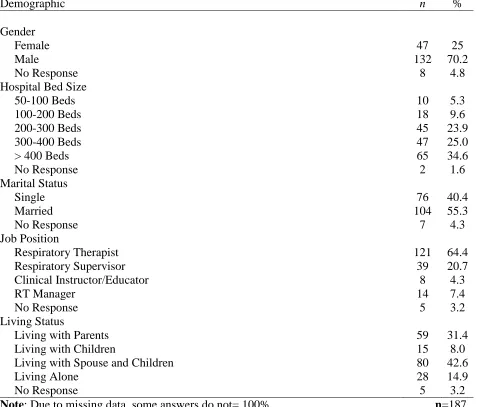
Sample population
Seven hundred and fifty surveys were emailed and 192 subjects responded, which yielded
a 74% response rate (“Sample Size Determination Using Krejcie and Morgan Table,” n.d.). Five
respondents were eliminated because they were students or medical doctors. The final
respondents count was 187. A majority of the respondents were married (55%), male (70%),
Respiratory Therapist (64%), working in hospital size more than 400 beds (35%), and living with
their spouse and children (43%). Mean age for the respondents was 31 (SD= 6.04). Table 1
Table 1 Frequency and Percentages for Sample Demographics
Demographic n %
Gender
Female 47 25
Male No Response 132 8 70.2 4.8 Hospital Bed Size
50-100 Beds 10 5.3
100-200 Beds 18 9.6
200-300 Beds 45 23.9
300-400 Beds 47 25.0
> 400 Beds No Response 65 2 34.6 1.6 Marital Status
Single 76 40.4
Married No Response 104 7 55.3 4.3 Job Position
Respiratory Therapist 121 64.4
Respiratory Supervisor 39 20.7
Clinical Instructor/Educator 8 4.3
RT Manager 14 7.4
No Response 5 3.2
Living Status
Living with Parents 59 31.4
Living with Children 15 8.0
Living with Spouse and Children 80 42.6
Living Alone 28 14.9
No Response 5 3.2
Note: Due to missing data, some answers do not= 100%. n=187
Attitudes, Knowledge, Skills and Readiness Level
Mean and Standard Deviations were calculated to describe the Attitudes, Knowledge,
Skills, and Readiness Level see Table 2. The Attitude x̅ is 10.6 (SD=3.12); the RTs show more
avoidant behavior towards their duties but with low “coefficient alpha” (α) = .37 that shows
towards MERS-CoV with α = .80 that shows a strong reliability. The skills x̅ is 14.47 (SD=2.26);
[image:38.612.70.547.182.272.2]the RTs show low skills but with α = .25 that indicates low reliability.
Table 2Means, Standard Deviations, and Cronbach's Alpha (α) Reliabilities for the Three
Composite Scores
Score x̅ SD No. of Items α
Knowledge 13.84 3.12 5 .80
Skills 14.47 2.26 8 .25
Behavior/Attitude Readiness Level 10.06 2.32 1.17 1.52 7 5 .37 .65 n=187
Note: It was not possible to compare coefficient α with the original sources. Therefore,
comparisons were not possible.
Readiness Level to Come to Work and RTs Gender, and Job Position
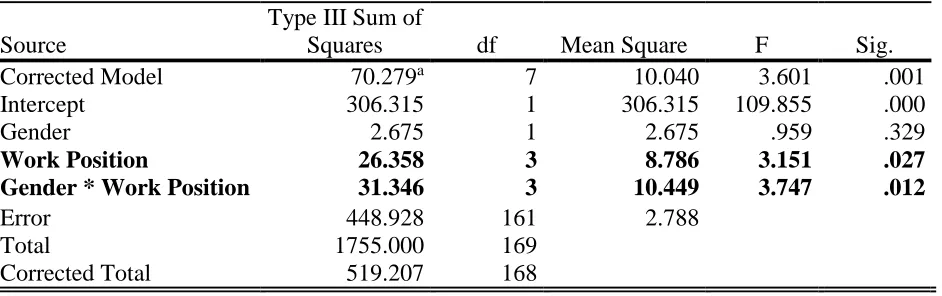
A factorial ANOVA was conducted to compare the effect of the Gender (Male, Female)
and Work Position (Respiratory Therapist, Respiratory Supervisor, Clinical Instructor/Educator,
and RT Manager) on participants Readiness to work, see Table 3.
The main effect of Gender yield on F ratio of, F (1, 161) = 0.959, p = 0.329 indicating
there was no significant difference between male (x̅ = 2.93, SD= 1.75) and female (x̅= 2.02, SD=
1.63) readiness to work.
The second main effect of Work Position yielded a F ratio of, F (3, 161) = 3.15, p = 0.027
indicating there was significant difference between the different level of work positions. A
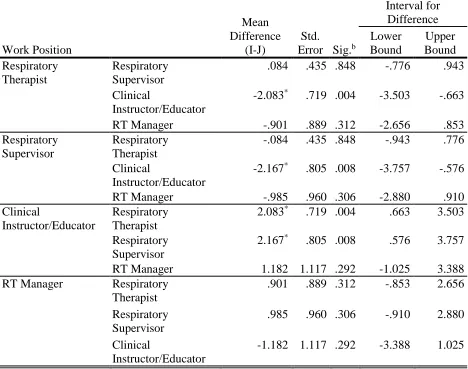
“Least Significant Difference” (LSD) post-hoc analysis was conducted see Table 4, and there
was a significant x̅ difference between Clinical Instructor/Educator (x̅= 3.85), Respiratory
supervisor (x̅ = 2.57) and Respiratory Therapist (x̅= 2.67). The Clinical Instructor/Educator had
= 0.008). However, there is no significant x̅ difference between RT Manager and any of other
work positions (p = 0.312, p = 0.306, p = 0. 292).
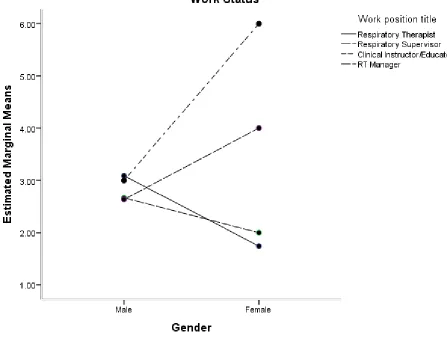
There was significant interaction between Gender and Work Position, F (3, 161) = 3.74, p
= 0.012. The Female Clinical Instructor/Educator (x̅ = 6.00) and Female RT Managers (x̅= 4.00)
have the highest significance for willingness to work in comparison to Male RT Managers
(x̅ =2.63) Male Respiratory Therapist (x̅= 3.09), and Male Clinical Instructor/Educator (x̅= 3.00).
However, Female Respiratory supervisor (x̅ = 1.74) and Respiratory Therapist (x̅= 2.00) in
[image:39.612.75.546.322.470.2]comparison to their Male counter part had the lowest willingness to work, see Figure 1.
Table 3 Factorial Analysis of Variance for Readiness level to come to work and RTs Gender
Source
Type III Sum of
Squares df Mean Square F Sig.
Corrected Model 70.279a 7 10.040 3.601 .001
Intercept 306.315 1 306.315 109.855 .000
Gender 2.675 1 2.675 .959 .329
Work Position 26.358 3 8.786 3.151 .027
Gender * Work Position 31.346 3 10.449 3.747 .012
Error 448.928 161 2.788
Total 1755.000 169
Corrected Total 519.207 168
Table 4Post hoc Analysis for Factorial ANOVA Work Position Mean Difference (I-J) Std. Error Sig.b
95% Confidence Interval for Difference Lower Bound Upper Bound Respiratory Therapist Respiratory Supervisor
.084 .435 .848 -.776 .943
Clinical
Instructor/Educator
-2.083* .719 .004 -3.503 -.663
RT Manager -.901 .889 .312 -2.656 .853
Respiratory Supervisor
Respiratory Therapist
-.084 .435 .848 -.943 .776
Clinical
Instructor/Educator
-2.167* .805 .008 -3.757 -.576
RT Manager -.985 .960 .306 -2.880 .910
Clinical
Instructor/Educator
Respiratory Therapist
2.083* .719 .004 .663 3.503
Respiratory Supervisor
2.167* .805 .008 .576 3.757
RT Manager 1.182 1.117 .292 -1.025 3.388
RT Manager Respiratory
Therapist
.901 .889 .312 -.853 2.656
Respiratory Supervisor
.985 .960 .306 -.910 2.880
Clinical
Instructor/Educator
-1.182 1.117 .292 -3.388 1.025
Figure 1 Estimated Marginal x̅ of RTs Readiness to come to work
Differences between trained and non-trained RTs in terms of knowledge, skills and attitude
A multivariate ANOVA was conducted with three dependent variables and one
independent variable. The independent variable is training (Training, Non-training). The
dependent variables are compost scores of Knowledge, Skills, and Attitude. There was no
significant effect between training level and total attitudes score, F (1,170) = 1.67, p = 0.198.
There was a significance between training level and total Skills score, F (1,170) = 4.32, p =
(x̅ = 15.04) than who have not attended Training program (x̅= 14.26). Participants, who have
attended Training program, have higher Knowledge scores (x̅ = 15.40) than who have not
[image:42.612.73.564.184.540.2]attended Training program (x̅ = 13.17) see Table 5.
Table 5MANOVA of Training against Attitude, Skills, and Knowledge scores
Source
Dependent Variable
Type III Sum
of Squares df Mean Square F Sig.
Corrected Model
Attitude 2.397a 1 2.397 1.671 .198
Skills 22.079b 1 22.079 4.320 .039
Knowledge 180.226c 1 180.226 20.346 .000
Intercept Attitude 14549.793 1 14549.793 10141.333 .000
Skills 31138.405 1 31138.405 6092.115 .000
Knowledge 29630.946 1 29630.946 3345.141 .000
Q4 Attitude 2.397 1 2.397 1.671 .198
Skills 22.079 1 22.079 4.320 .039
Knowledge 180.226 1 180.226 20.346 .000
Error Attitude 243.899 170 1.435
Skills 868.915 170 5.111
Knowledge 1505.844 170 8.858
Total Attitude 17667.000 172
Skills 37025.000 172
Knowledge 34674.000 172
Corrected Total Attitude 246.297 171
Skills 890.994 171
The association between RTs Readiness and knowledge, Skills and Attitude
Correlation
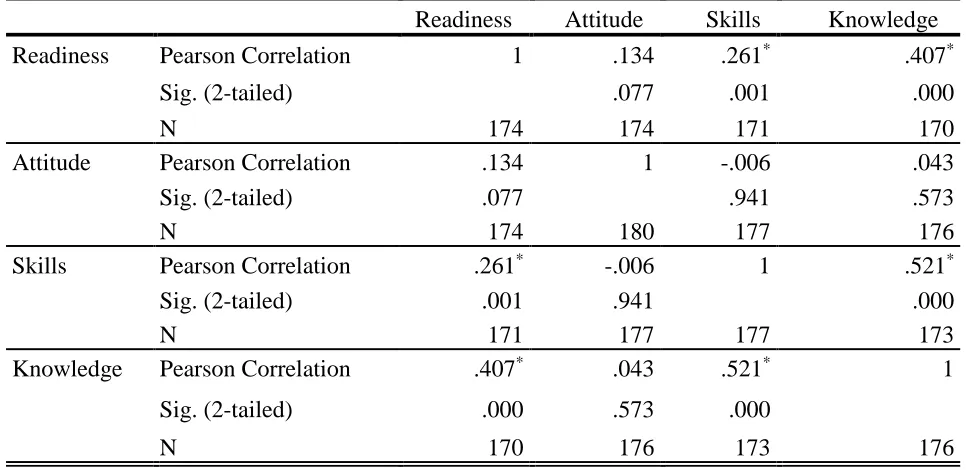
A Pearson R correlation was conducted to investigate the association between
Knowledge, Skills, and Attitude with RTs Readiness to work. There was a significant positive
moderate correlation between Readiness to work and Knowledge, r = .407, p < 0.05. As the RTs
Knowledge increases their Readiness to come to work increases. There was a significant positive
low correlation between Readiness to work and Skills, r = .261, p = 0.05. As the RTs Skills
increases their Readiness to work increases but the relationship is weak. There was a significant
positive substantial correlation between Skills and Knowledge, r = .521, p< 0.05. As the RTs
[image:43.612.69.552.410.645.2]Knowledge increases their Skills increase see Table 6.
Table 6Pearson Correlation RTs Readiness and Knowledge, Skills, and Attitudes
Readiness Attitude Skills Knowledge
Readiness Pearson Correlation 1 .134 .261* .407*
Sig. (2-tailed) .077 .001 .000
N 174 174 171 170
Attitude Pearson Correlation .134 1 -.006 .043
Sig. (2-tailed) .077 .941 .573
N 174 180 177 176
Skills Pearson Correlation .261* -.006 1 .521*
Sig. (2-tailed) .001 .941 .000
N 171 177 177 173
Knowledge Pearson Correlation .407* .043 .521* 1
Sig. (2-tailed) .000 .573 .000
N 170 176 173 176
Summary of the findings
There is no significant difference between male and female in readiness to work. There is
significant difference between the different levels of work positions. The Clinical
Instructor/Educator has more willingness to work comparing to Respiratory Supervisor and
Respiratory Therapist. However, there is no significant mean difference between RT Manager
and any of other work positions. There is significant interaction between Gender and Work
Position. The Female Clinical Instructor/Educator and Female RT Managers have the highest
significance for willingness to work in comparison to Male RT Managers Male Respiratory
Therapist, and Male Clinical Instructor/Educator. However, Female Respiratory supervisor and
Respiratory Therapist in comparison to their Male counter part have the lowest willingness to
work. There was no significance effect between training level and total Attitude score.
Participants, who have attended training program, have higher skills scores than who have not
attended training program. Participants, who have attended training program, have higher
knowledge scores than who have not attended training program. There was a significant positive
moderate correlation between Readiness to work and Knowledge. There was a significant
positive low correlation between Readiness to work and Skills. There was a significant positive
CHAPTER V
Discussions
This chapter discusses the research results and findings of the research questions. The
research questions:
1. What is the readiness level to come to work?
2. Are there any differences between gender, and job level for RTs?
3. What are the differences between trained and non-trained RTs in terms of knowledge,
skills and attitudes?
4. Do there an association, if any, between RTs readiness and knowledge, skills and
attitudes regarding MERS-CoV disasters?
A discussion of findings reviewed by the implications, limitations, recommendations for
future study, and conclusion will be presented.
Readiness Level to Come to Work and RTs Gender, and Job Position
The first and second research questions, the readiness level to come to work is vital for
effective organizations, and within the context of knowledge, skills, and attitude, it was clear that
there was no significance difference between different genders. But, it is not surprising to have a
significant difference between the different levels of work positions. The more capability in
terms of knowledge and skills, such as clinical instructor, you have the more willing to come to
work (Bissell, 2013). The Clinical-Educator (M= 3.85) had more willingness to work compared
to the RT supervisor and RTs not mangers had no differences among all job positions. The first
line-responders show less willingness to work. It is supported by (Bissell, 2013) study, which
emphasized the importance of increasing the capabilities of emergency first-line responders, and
emergency responders. The RTs could show a resistance through their avoidance behavior in
dealing with MERS-CoV disaster, absent from duty and worst of all change careers, which is
consistent with Waugh, (2000) study. The results are also consistent with the study of Seale,
Leask, Po, & MacIntyre, (2009), which emphasizes that unwilling of health department
employee’s to report to work might become a threat to the national emergency health care
response infrastructure, and there is a consistent with the same study, that asserts that HCWs
avoidance behavior is significantly associated with the lack of knowledge concerning pandemic
disasters.
Differences between trained and non-trained RTs in terms of knowledge, skills and attitude
The third research question, “What is the difference between trained and non-trained RTs
in terms of knowledge, skills and attitudes?” The training program was important for seek of
capability building RTs during epidemic emergency. There was significance between Training
level and total Knowledge score, (p < 0.05), which is consistent with Seale, Leask, Po, &
MacIntyre, (2009). However, there was not a significance effect between training level and total
attitude score, (p = .198), which is inconsistent with the Seale, Leask, Po, & MacIntyre, (2009)
study but the results are still consisistent with study Bissell, (2013). The results controversy are
because of different prospective of different professions, which support the importance of
emergency management consultation during epidemic disaster planning. There was significance
between training level and total skills score, (p = .039). It is clear that RTs who attended training
programs have more skills than those did not attend training program, which is supported by
The association between RTs Readiness and knowledge, Skills and Attitude
The fourth research question, “Do there an association, if any, between RTs readiness and
knowledge, skills and attitudes regarding MERS-CoV disasters?” It investigated the Saudi
RTs readiness within the context of knowledge, skills, and attitude. The findings show a
positive moderate correlation between Readiness to work and Knowledge, (r = .407, p <
0.05), which is supported by (Seale, Leask, Po, & MacIntyre, 2009) study. As the RTs
Knowledge increases their Readiness to come to work increases. The findings show positive
low correlation between readiness to work and skills, (r = .261, p = .05). It is consistent with
Seale, Leask, Po, & MacIntyre, (2009) that the reason for inappropriate work behavior is
significantly associated with the perceived seriouseness of the pandemic disaster. As the RTs
skills increases the readiness to work increases but the relationship is weak. It is consistent
with Hellyyer et.al, (2011), which asserts that the professional norms, information sources,
variety of risk perceived may influence the HCWs response to pandemic plans. The findings
show there was a significant positive substantial correlation between skills and knowledge, (r
= .521, p< 0.05). As the RTs knowledge increases, their skills increase, which is consistent
with (Hellyyer et.al, 2011) and (Seale, Leask, Po, & MacIntyre, 2009).
Implications
It is believed this population has not been studied before within the context of epidemic
influenza emergencies and disasters. These results could become useful to health policy makers
because it participates in evaluating the MOH guidelines and policy for MERS-CoV epidemic
disasters. More flexible bureaucracy, coordination versus command, and enhancement to the role
of leadership in health care system is needed. Furthermore, these results would help to engage
programs for HCW Check-list. These results might show the necessity for establishing an
independent Disaster Management panel, which might increase community capabilities, and
offer consultation, mitigation, preparedness, and response strategies. Finally, these results could
show the need to establish an independent Public Health body (local CDC) for the role of
measures taking, risk analysis, capability enhancement for effective response.
Future Directions
Replication of the study, and retesting and modifying the survey tool is highly
recommended. Rethink MOH healthcare policy and plans for different epidemic emergencies
and disasters in terms of forms of flexible bureaucracy, the coordination versus command is
highly recommended. Investigate the role of the (Faith-based organization) Red Crescent and
Red Cross role in offering “influenza epidemic and pandemic scenarios” education and training
in terms of HCWs Check-list is highly recommended. Study the potential gap between policy
and procedure (bureaucratic norms), and emergent norms in guiding HCWs behavior during
response to epidemic and pandemic emergencies and disasters and the importance of leadership
in minimizing this potential gap is highly recommended. Study RTs potential role as healthcare
officials in emergency mitigation, planning, preparedness, and response for potential influenza
disasters is recommended.
Limitations
This study was a Cross-Sectional design, and the survey questions have been adapted to
measure the variables of the targeted population. There was limited available of survey
questionnaire and no calculations for reliability. The SSRC email directory, and email uses
Conclusion
This study showed the importance of establishes effective disaster health bureaucracy by
performs periodic health policy analysis for epidemic and pandemic influenza. It called for
planning, preparedness to respond effectively using all hazard-approach for potential influenza
disasters. It revealed the significance of capability building for first line responders in term of
HCWs Check-list education and training programs. It recommended coordination rather than
command by engaging multi-partners such as (Faith-based organizations) Red Crescent and Red
Cross in the Check-list education and training programs. Moreover, it supported the
establishment of independent local CDC and Disaster Management panel for measures taking
and consultation. It recommended flexible bureaucracy and leadership enhancement for HCWs
strike teams, which help in improvisation, creativity, and increase likelihood success in response
for unconventional scenarios. Finally, it suggested study RTs potential role as healthcare officials
REFERENCES
Al-Tawfiq, J. A. (2013). Middle East Respiratory Syndrome-coronavirus infection: An overview.
Journal of Infection and Public Health, 6(5), 319–322. http://doi.org/10.1016/j.jiph.2013.06.001
Assiri, A., Al-Tawfiq, J. A., Al-Rabeeah, A. A., Al-Rabiah, F. A., Al-Hajjar, S., Al-Barrak, A.,
… Memish, Z. A. (2013). Epidemiological, demographic, and clinical characteristics of
47 cases of Middle East respiratory syndrome coronavirus disease from Saudi Arabia: a
descriptive study. The Lancet Infectious Diseases, 13(9), 752–761. http://doi.org/10.1016/S1473-3099(13)70204-4
Bissell, R. (Ed.). (2013). Preparedness and Response for Catastrophic Disasters (1 edition). Boca Raton: CRC Press.
Chan, J. F.-W., Lau, S. K.-P., & Woo, P. C.-Y. (2013). The emerging novel Middle East
respiratory syndrome coronavirus: The “knowns” and “unknowns.” Journal of the Formosan Medical Association, 112(7), 372–381.
http://doi.org/10.1016/j.jfma.2013.05.010
Coronavirus Website - Ministry of Health. (n.d.). Retrieved April 8, 2015, from
http://www.moh.gov.sa/en/CCC/
Davis, J. A. (1971). Elementary survey analysis. Englewood Cliffs, N.J., Prentice-Hall [1971]. HHS. (n.d.). United States Department of Health and Human Services. Retrieved December 7,
2014, from http://www.hhs.gov/
Hilgenfeld, R., & Peiris, M. (2013). From SARS to MERS: 10 years of research on highly