ISSN 2250-3153
The Impact of Diagnostic Methods of PSA on The
Prevalence of Prostatitis Using Qualitative And
Quantitative In Two Cities of South Eastern Nigeria.
Ogwuegbu1, H. O., Nwaugo1, V. O., Mbanaso2, A. U., Esu,3 D. O. and Anthony3, N.I. 1
Faculty of Biological and Physical Sciences, Department of Microbiology, Abia State University Uturu. 2
Faculty of Medicine, Department of Medicine and Surgery, Abia State University Uturu. 3
Science Laboratory Technology (SLT) Ukana, Federal Polytechnic Ukana, Akwa Ibom State.
Corresponding author: [email protected], +2348064131288.
DOI: 10.29322/IJSRP.8.11.2018.p8364
http://dx.doi.org/10.29322/IJSRP.8.11.2018.p8364
ABSTRACT
The impact of diagnostic methods of PSA on the prevalence of prostatitis using qualitative and quantitative in two cities of South Eastern Nigeria was carried out in Okigwe L.G.A of Imo State and Umuahia North L.G.A in Abia State, Nigeria. A total of 1000 patients were examined in the two locations, 800 for Umuahia and 200 for Okigwe. Blood specimen was collected aseptically using standards microbiological laboratory techniques. The patients were examined for, prostate specific Antigen (PSA) both for quantitative and qualitative tests. Out of 200 patients tested for PSA in Okigwe, 119 (59.5%) and 129 (64.5%) were the results obtained for quantitative and qualitative tests respectively while PSA test in Umuahia was 416 (52.0%) and 433 (54.1%) for quantitative and qualitative tests respectively. In Okigwe, the diagnosis difference with qualitative method was 10(5.0%) and in Umuahia 17(2.1). showing the total percentage diagnosis difference of 24(2.4%). InOkigwe, out of 200 patients tested for PSA using quantitative method 119(59.5) patients are positive with PSA level of 4.0ng and above and 81(40.5) patients were negative with PSA level below 4.0ng. From the 71-80 years of age had the highest number of positive PSA of 45(21.0) while 21-30 years of age were all negative to PSA testing. In Umuahia, out of 800 patient tested for PSA using quantitative method, 416(52.0) patients are positive and 384(48.0) patients were negative. From 70-80 years of age had the highest level of PSA while the age brackets of 21-40 years had the lowest PSA positive patients of 1(0.23). Statistical analysis showed significant variation in the values obtained. (P. > 0.05) as there were variations according to the location examined. Generally, the prevalence of PSA associated with increase in age, low social-economic status and poor dwelling environment were found as demographic risk factors to aggravating prostatitis. This calls for thorough/proper medical checks for men of 40 years and above to avoid the chances of developing prostatitis. The later stages of prostatitis have been associated with infertility which could have been avoided by proper diagnosis and medication because inability to urinate leads to inability to ejaculate.
Key words: prostatitis, diagnosis, qualitative and quantitative.
INTRODUCTION
Prostatitis is an infection or inflammation of the prostate gland that presents as several syndromes with varying clinical features. It
is the microscopic inflammation of the tissue of the prostate gland and it’s a diagnosis that spans a broad range of clinical
conditions. (Paul, 2017a). Prostatitis is a common urological condition that many clinicians find it difficult to treat effectively.
(Gerald and Wayne, 1998).
The rate of false diagnosis of prostatitis syndrome is no longer a faceless myth. It is a reality and the new awareness and its
importance may give new hope for patients suffering from prostatitis and this false positive in diagnostic method. The human
prostate increases in size and develop histological evidence of stimulated growth during three stages of life; before and at birth,
during puberty, and with achievement of advancing in age.Older men also have a longer time to develop prostatitis disease than
their younger counterparts. If time is not critical and appropriate equipment is available, quantitative method of PSA screenings is
preferable to detect the exert level of prostatitis (Nickel, 2003).
When the PSA level is high (> 10ng/ml) the variability for qualitative is less relevant, as this qualitative method will mislead in
ISSN 2250-3153
Qualitative method can lead to repetitive of PSA testing in an individual patient to confirm or disagree with the diagnosis
difference of qualitative over quantitative method. Strip method of PSA testing are good for quick detection of increased
concentrations of prostate specific antigen in blood (Lein, et al., 1996). While quantitative method will give the exert level of the
prostate in the blood (Cheng-Ching, et al., 2015). The level of PSA results gotten through quantitative method help both the
patient and the urologist by knowing how the patient can be managed (Paul, 2017b).
MATERIALS AND METHODS
STUDY AREAS
The study population came from two cities in South Eastern Nigeria; Okigwe L.G.A of Imo State and Umuahia North of Abia
State, Nigeria. They are patients referred and patient attending Healing Cross Hospital Umuahia and God Heals Hospital Okigwe
for urological cases. (The tests were analyzed at Healing Cross Diagnostic Center Umuahia)
ETHICAL CLEARANCE: The clearance to obtain specimens and work with the people in the various hospitals was given by
the Heads Medical Directors in charge of the locations after submitting the clearance letter from the Abia State University, Uturu
ethical clearance committee to the various hospitals.
STUDY POPULATION
A total of 1000 people were sampled in the two locations:- 800 were screened from Umuahia while 200 were screened from
Okigwe. ( okigwe is a semi-Urban city). Their ages range from 21- 80 and above with 7 class intervals and they were placed in
age bracket of 10 intervals (eg, 21-30, 31-40 etc).
SPECIMEN COLLECTION FOR PROSTATE SPECIFIC ANTIGEN (PSA) TEST
1. About 3ml of Venous Blood of the target individual was withdrawn and put into a clean serum gel test tube (plan) and
allowed to stand for 10-15minutes to clot.
2. The blood specimen was capped and labelled.
3. This serum was collected with pipette and stored at 200C. until required for use according to the manufacturer’s of the
equipment instruction (ACON).
EXAMINATION OF BLOOD FOR PSA USING ACON CASSETTE
MATERIALS
Test cassettes
Droppers pipette
Buffer
Serum specimen.
Timer.
PROCEDURE
The PSA cassettes were removed from their sealed paunch
The PSA cassettes were placed on a cleaned and leveled surface.
With the dropper pipette, about 1ml of serum (approximately 40ul) was transferred onto the specimen area of the cassette.
One drop of buffer was transferred to the sample well on the PSA cassette to allowed the serum to migrate membrane and
generate colour line.
The test was interpreted within 5 minutes.
(A single line on the Acon cassette shows negative while double lines shows positive) (Cheng-Ching et al., 2015).
MATERIALS AND REAGENT FOR PSA TEST USING MICROPLATE READER
ISSN 2250-3153
2. Zero buffer, 12 ml
3. Reference standard containing 0, 2, 4, 15, 50, and 100 ng/ml PSA,Liquid standard.
4. Enzyme Conjugate Reagent. 12 ml
5. TMB Substrate, 12 ml
6. Stop Solution, 12ml
7. Wash Buffer Concentrate ,15 ml
8. Control Set.
9. Precision pipette, 0.04 - 0.2 and 1.0 ml
10. Distilled water.
11. Absorbent paper.
12. A microtiter plate reader with a bandwidth of 10nm and optical density range at 450nm (Cheng-Ching et al., 2015).
EXAMINATION OF PSA USING MICROTITER PLATE READER
All reagents were brought to room temperature and mixed by gently inverting the containers severally before use. The washing
buffer was prepared by mixing 1 volume of wash buffer Concentrate into 60 ml of distilled water. The desired number of coated
wells for the test were secured in the holder 50ul of standards, specimen and control was dispensed into the appropriate wells.
100ul of Zero Buffer was dispensed into each well. They were thoroughly mixed for 30 seconds. The mixed samples were
incubated at room (18-250C) for 60 minutes in an incubator. The incubated mixture was removed by emptying the plate contents
into a suitable waste container for disposal. The emptied microtiter wells were rinsed 5 times with distilled water. The wells were
strike sharply onto absorbent paper to removed all the residual water droplets used. 100ul of Enzyme Conjugate Reagent was
dispensed into each well and gently mixed for 10 seconds. The wells were incubated at room temperature (18-250C) for 60
minutes. The incubated mixture was emptied into a suitable waste container. The well was rinsed and emptied 5 times with
distilled water with washing buffer. The wells was stroked sharply onto absorbent paper to removed residual water droplets used.
100ul of TMB Reagent was dispensed into the wells and gently mixed for 10 seconds. It was incubated at room temperature for
20 minutes. The reaction of the mixture was stopped by adding 100ul of Stop Solution in each well and gently mixed for 30
seconds to make sure that the blue color changes to yellow color completely. It was read using microtiter plate reader at 450
density within 15 minutes (Cheng-Ching et al., 2015).
RESULTS.
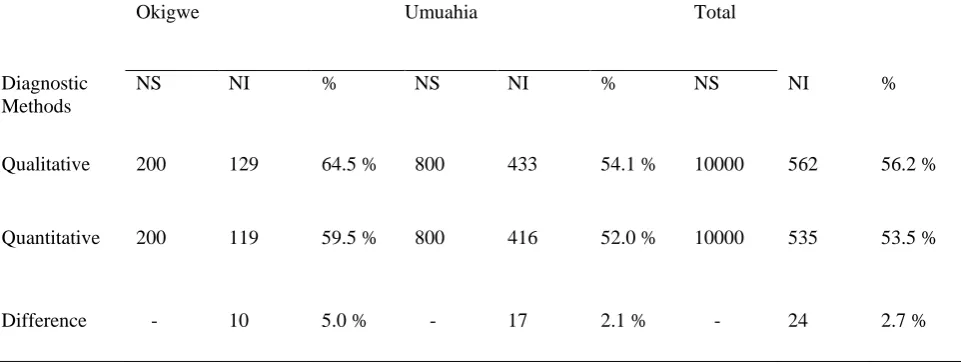
The Impact of diagnostic method on the prevalence of prostatitis in the study areas was shown in (table 1) using quantitative and
qualitative methods. In Okigwe, the diagnosis difference with qualitative method was 10(5.0%) and in Umuahia 17(2.1). showing
the total percentage diagnosis difference of 24(2.4%).
The Prostate Specific Antigen quantitative results in Okigwe and Umuahia are presented in Tables 2 and 3. Table 1 InOkigwe,
out of 200 patients tested for PSA using quantitative method 119(59.5) patients are positive with PSA level of 4.0ng and above
and 81(40.5) patients were negative with PSA level below 4.0ng. 71-80 years of age had the highest number of positive PSA of
45(21.0) while 21-30 years of age were all negative to PSA testing. In Umuahia, out of 800 patient tested for PSA using
quantitative method, 416(52.0) patients are positive and 384(48.0) patients were negative. From 70-80 years of age had the
highest level of PSA while the age brackets of 21-40 years had the lowest PSA positive patients of 1(0.23). Statistical analysis
showed significant variation in the values obtained. (P. > 0.05) as there were variations according to the location examined.
(Table 3).
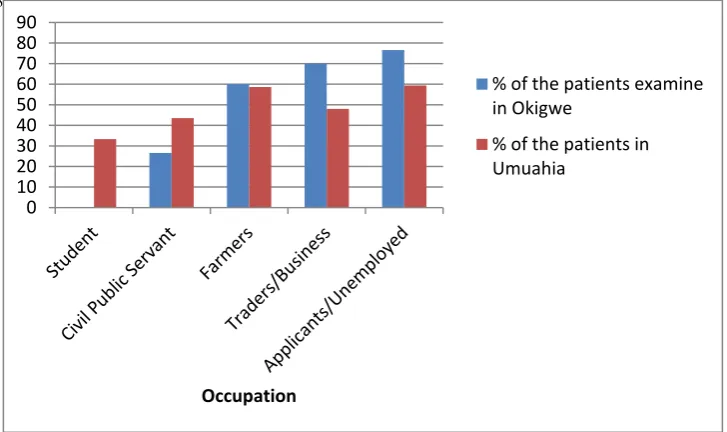
The occupational influence of PSA in Prostatitis patients in Okigwe using quantitative method was shown in (fig 1). Out of 200
ISSN 2250-3153
servant had the lowest result with 8 (26.6%). In Umuahia, out of 800 patients tested. Farmers has the highest PSA positive patient
results with 130 (59.6%) result while civil servant and student had the lowest result with 10 (33.3%).
The prevalence of the PSA level in prostatitis patients according to age in Okigwe and Umuahia using qualitative method (using
Acon strip) was shown in (fig 2). Out of 200 patient tested in Okigwe, 129 (64.5%) wee positive with 80 years and above had the
highest positive result of 18 (90.0%) while 21-30 years had the lowest with 1 (20.0%). In Umuahia, out of 800 patient tested with
PSA strip 433 (54.35) patient were positive. Patients in 80 years and above had the highest PSA value of 40(80.0%) while 21-30
years of age had the lowest positive result of 3(15.0%)
Fig 3: The occupational influence on PSA levels in Prostatitis in Okigwe and Umuahia using qualitative method. In Okigwe, 200
patients were tested using kit (Acon) the farmers had the highest value of 35 (81.5%) while student had the lowest value of
3(30.0%). In Umuahia, applicant and unemployed had the highest with (107) 59.4%, while student had the lowest with
10(33.3%).
[image:4.595.36.517.333.515.2]Impact of Diagnosis Difference on Prostatitis Patients in Okigwe And Umuahia.
Table 1: Impact of diagnostic method on the prevalence of prostatitis in the study areas.
NS - Number of patients screened.
N I- Number of patients infected.
Okigwe Umuahia Total
Diagnostic Methods
NS NI % NS NI % NS NI %
Qualitative 200 129 64.5 % 800 433 54.1 % 10000 562 56.2 %
Quantitative 200 119 59.5 % 800 416 52.0 % 10000 535 53.5 %
ISSN 2250-3153
Table 2: Age distribution of PSA levels in target population in Okigwe, Imo State
• Positive PSA level refers to those with PSA value of 4.0ng/l and above • Those in brackets are the percentage values.
Age No.
Patient Examine d
Normal
0-4ng/dl 4.1-10 10.1-20 20.1-30 30.1-40 40.1-50 50.1-60 70.1-100 Above 100ng/dl PSAPositive
patient
21-30 5(2.5) 5(6.1) 0(0.0) 0(0.0) 0(0.0) 0(0.0) 0(0.0) 0(0.0) 0(0.0) 0(0.0) 0(0.0)
31-40 12(6.0) 11(13.6) 1(5.9) 0(0.0) 0(0.0) 0(0.0) 0(0.0) 0(0.0) 0(0.0) 0(0.0) 1(0.8)
41-50 18(9.0) 10(12.3) 1(5.9) 1(6.2) 2(16.7) 1(5.3) 1(5.0) 2(12.5) 0(0.0) 0(0.0) 8(6.7)
51-60 35(17.5) 15(18.5) 4(23.5) 5(31.2) 2(16.7) 2(10.5) 4(20.0) 3(18.7) 0(0.0) 0(0.0) 20(16.8)
61-70 50(25.0) 22(27.1) 8(47.0) 5(31.2) 2(16.7) 7(36.8) 3(15.0) 2(12.50) 1(11.1) 0(0.0) 28(32.5)
71-80 60(30.0) 15(18.5) 3(17.6) 5(31.2) 5(41.7) 7(36.8) 10(50.0) 5(31.20) 5(55.5) 5(50.0) 45(21.0)
Above 80
20(10.0) 3(3.7) 0(0.0) 0(0.0) 1(8.3) 2(10.5) 2(10.0) 4(23.50) 3(33.3) 5(50.0) 17(14.3)
ISSN 2250-3153
Table 3: Age Distribution of PSA levels in the target population in Umuahia, Abia State.
• Positive PSA level refers to those with PSA value of 4.0ng/l and above • Those in brackets are the percentage values.
Age No. patient
tested
Normal
0-4
4.1-10 10.1-20 20.1-30 30.1-40 40.1-50 50.1-60 70.1-100 100 & above PSA
positive patients
21-30 20(2.5) 19(4.9) 1(0.9) 0(0.0) 0(0.0) 0(0.0) 0(0.0) 0(0.0) 0(0.0) 0(0.0) 1(0.23)
31-40 50(6.2) 43(11.2) 5(4.8) 1(1.1) 1(1.4) 0(0.0) 0(0.0) 0(0.0) 0(0.0) 0(0.0) 7(1.7)
41-50 100(12.5) 60(15.6) 17(16.2) 10(11.5) 6(8.4) 5(11.9) 2(5.1) 0(0.0) 0(0.0) 0(0.0) 40(9.6)
51-60 150(18.5) 82(21.3) 10(9.5) 18(20.7) 20(28.2) 11(26.1) 9(23.1) 0(0.0) 0(0.0) 0(0.0) 68(16.3)
61-70 180(22.5) 80(20.8) 28(26.7) 22(25.3) 17(23.9) 5(11.9) 10(25.6) 10(32.2) 5(25.0) 3(14.3) 100(24.00
71-80 250(31.2 92(23.9) 40(38.1) 32(36.8) 23(32.4) 15(35.7) 13(33.3) 17(54.8) 10(50.0) 8(38.1) 158(37.9)
Above 80 50(6.2) 8(2.1) 4(3.8) 4(5.6) 4(5.6) 6(14.3) 5(12.8) 4(12.9) 5(25.0) 10(47.6) 42(10.0)
ISSN 2250-3153
http://dx.doi.org/10.29322/IJSRP.8.11.2018.p8364 www.ijsrp.org
[image:7.595.77.441.49.265.2]Fig 1: Occupational influence of PSA in Prostatitis patients in Okigwe and Umuahia Using quantitative method.
Fig. 2: Prevalence of the PSA level in Prostatitis patients according to age in Okigwe and Umuahia using qualitative methods.
0 10 20 30 40 50 60 70 80 90 100
21-30 31-40 41-50 51-60 61-70 71-80 80 above
% of the patients examined +ve in Okigwe % of the patients tested +ve in Umuahia
0 10 20 30 40 50 60 70 80 90 Occupation
% of the patients examine in Okigwe
% of the patients in Umuahia 0 10 20 30 40 50 60 70 80 90 100 PSA
Level % of the patient in
okigwe
[image:7.595.78.448.309.538.2]ISSN 2250-3153
Fig. 3: Occupational influence on PSA levels in Prostatitis patients in Okigwe and Umuahia using qualititative method.
DISCUSSION
In this study, prostate specific Antigen (PSA) screening test was carried out in Okigwe and Umuahia for a period of 12 calendar
months. A total of one thousand specimens were screened (two hundred from Okigwe and eight hundred from Umuahia) using
both qualitative and quantitative tests. A total prevalencies of 562(56.2%) was recorded for qualitative and 535(53.5%) for a
quantitative. In Okigwe, the prevalencies was 129(64.5%) for qualitative and 119(59.5%) for quantitative while in Umuahia it
was recorded 433(54.1%) for qualitative and 416(52.0%) for quantitative. The diagnostic methods of quantitative and qualitative
diagnosis of prostatitis in the studied areas showed the variations with diagnostic difference of 10(5.0%) in Okigwe and 24(2.7%)
in Umuahia. This study corresponded with the observation of Cheng-Ching et al., (2015) and Nickel (2003) who did not believe
that a PSA rapid test and clinical chemistry test are mutually exclusive methods.
The results found in this work showed that age effects the levels of PSA and the oldest group had prostatitis often, this is in
accordance with those of Sharp et al., (2010). Whereas Nickel et al., (2005) found a slightly higher prevalence of prostatitis in the
age group below 50 years than among man over 51 years age. Anyway, older men also have a longer time to develop the disease
than their younger counterparts. If time is not critical and the appropriate equipment is available, quantitative method of PSA
screenings may still be preferable to detect the exert level of prostatitis. Strong disparities was observed with regard to access to
care, education and PSA screening between social economical status related to PSA in Okigwe and Umuahia in both quantitative
and qualitative methods of testing PSA. In Okigwe, the highest occupational prevalence was observed in applicant and
unemployed with 46(76.65) for quantitative and farmers with the highest positive result of 35(81.5) for qualitative. While in
Umuahia, the highest quantitative occupational results was observed from the farmer with 130(33.3) and the qualitative highest
result was seen in applicant and unemployed. It is assured that the farmers and applicant/unemployed are highly unaware of
prostate and consequences with alcohol consumption smoking, proper nutrition, strong exercise, tight dressing sitting for a period
of time and inability to ejaculate. Those in the rural dweller was observed to have the highest positive PSA results values in
Okigwe with 94(78.3) and Umuahia 283(67.4). The result findings was in accordance with Ku, (2005) who observed that farmers
have the chance of developing prostatitis due to their daily and hard exercise activities.
REFERENCES
Cheng-Ching, W. U., Hung, Y. U., Chao-Ping, W. S. & Li-Fen L. U. (2015). Evaluation of a rapid quantitative determination method of PSA concentration with gold immunochromagraphic strips. Journal of Bio-Medical Central., 3:55-109.
Gerald, G. D & Wayne, J. G. (1998). Prostatitis. American society for Microbiology., 11(4) : 604-613.
Ku, J. H. (2005). Epidemiology risk factors for chronic prostatitis. International journal of Andrology., 28: 317-327.
Nickel, J. C. (2003)a. Classification and diagnosis of prostatitis: a gold standard? Journal of Andrologia., 35(3): 160-167.
Nickel, J. C. (2003)b. Clinical evaluation of the patient presenting with prostatitis. European Journal of Urology., 2(2): 11014.
Nickel, J. C. & Moon T. (2005). Chronic bacterial prostatitis: an evolving clinical enigma. Urology., 66(1): 1-8.
Oberpenning, F., Hetzel, S., Weining, C., Lein, M., Fornara, P., Brandt, B., Angelis, G., Heinecke, A., Schnid, H., Hertile, L. & Semjohow, A. (2003). Semi-quantitative immunochromatographic test for prostate specific antigen in whole blood: tossing the coin to predict prostate cancer. European Journal of Urology., 43(5): 478-484.
Paul, J. T. (2017a). Prostatitis. European Association of Urology., 2: 16-19.
ISSN 2250-3153