Evaluation of Anti-inflammatory Activity of Ethanolic
Extract of the Root of
Chamaecyparis pisifera
(Siebold & Zucc.) Endl.
Arnt Win
*, Aye Mon Thida Nyo
**, Thida Cho
****
Department of Chemistry, Kyaukse University, the Republic of the Union of Myanmar **
Department of Chemistry, University of Mandalay, the Republic of the Union of Myanmar *** Department of Chemistry, Forest Research Institute (FRI), Yezin, the Republic of the Union of Myanmar
DOI: 10.29322/IJSRP.9.01.2019.p8553 http://dx.doi.org/10.29322/IJSRP.9.01.2019.p8553
Abstract - In this research work, one of Myanmar indigenous medicinal plants, Chamaecyparis pisifera (Siebold & Zucc.) Endl., Myanmar name Kyauk pan was selected for chemical analysis. It was collected from Forest Research Institute (FRI) campus, Yezin, Zaeyar Thiri Township, Naypyitaw Region, Myanmar. Moreover, a potent anti-inflammatory activity of the root of C. pisifera was determined by carrageenan induced inflammation method. This plant showed remarkable inhibitory activity in high dose and also the activity followed by the remaining medium and low dose. High dose was found to possess significant anti-inflammatory activity, which supported the traditional application of the test plant in acute inflammatory activity.
Index Terms- Anti-inflammatory activity, Carrageenan induced inflammation method, Chamaecyparis pisifera (Siebold & Zucc.) Endl., indigenous medicinal plants, Kyauk pan.
I. INTRODUCTION
nflammation is a severe response by living tissue to any kind of injury. There can be four primary indicators of inflammation: pain, redness, heat or warmness and swelling. When there is injury to any part of the human body, the arterioles in the encircling tissue dilate. This gives a raised blood circulation towards the area (redness). Vasoactive chemicals also increase the permeability (increase pore size) of these arterioles which allows blood cells, chemical substance, blood proteins and fluid to accumulate in that region. This fluid accumulation causes swelling and may compress nerves in the area resulting in pain. In addition, prostaglandins, that might also result in ‘irritation’ of the nerves and further contribute to pain. Most people who take anti-inflammatory drugs have no side-effects, or only minor types. When taken appropriately, the advantage usually far outweighs the possible harms. In particular many people have a short course of an anti-inflammatory for all sorts of painful conditions. However, side-effects, and also occasionally very severe possible adverse effects, can occur. There are a number of anti-inflammatory herbs that could help to achieve similar results without the harmful effect [1]. Inflammation is either acute or chronic inflammation. Acute inflammation may be an initial response of the body to harmful stimuli. In chronic inflammation, the inflammatory response is out of proportion resulting in damage to the body. Cyclooxygenase (COX) is the key enzymes
in the synthesis of prostaglandins, prostacyclins and thromboxanes which are involved in inflammation, pain and platelet aggregation [2]. Inflammatory diseases are major worldwide problem. Many researchers reported that inflammation and several human diseases including heart attack and Alzheimer’s disease and cancer [3],[4],[5],[6].
Steroidal and non-steroidal anti-inflammatory drugs (SAIDs and NASIDs, respectively) are currently the most widely used drugs in the treatment of acute inflammatory disorders, despite their renal and gastric negative secondary effects [7]. NSAIDs, steroidal anti-inflammatory drugs are being used till now. As a result long term uses of these drugs cause adverse side effects and damage human biological system such as liver, gastrointestinal tract, etc. As a result of adverse side effects, like gastric lesions, cardiovascular, renal failure and gastrointestinal damage [8] [9],[10] .
Now there is a need for the new safe, potent, nontoxic or less toxic anti-inflammatory drug. Plant medicines are great importance in the primary healthcare in many developing countries. According to World Health Organization (WHO) still about 80% of the world population rely mainly on plant-based drugs. In Ayurveda, Siddha, and Unani, utilizing a large number of medicinal plants were used for the treatment of human diseases [11].
Plants have the ability to synthesize a wide verity of phytochemical compounds as secondary metabolites. Many of the phytochemicals have been used to effectively treat the various ailments for mankind. World Health Organization has made an attempt to identify all medicinal plants used globally and listed more than 20,000 species. Most of the medicinal plant parts are used as raw drugs and they possess varied medicinal properties [12]. Plants have a great potential for producing new drugs and used in traditional medicine to treat chronic and even infectious diseases [13]. The medicinal plants occupied a unique place in human life. It provides more information about the use of plants or plant parts as medicine [14]. Plant-based drugs used in the traditional medicine have paid great attention because it is easily available, less expensive and also have no side effects [15].
Myanmar is rich in natural resources. Among them, plants are essential for human being. They are important sources for the preparation of natural remedies, food additives, and other
ingredients, as they contain many biologically active compounds and other very important phytochemicals. In Myanmar, the local communities of different regions have been using medicinal plants as a primary source of their health care system and in fact these medicinal plants are used to cure a large number of diseases. This practice is usually based on experiences, less scientific evidence and therefore, need proper validation on scientific research [16]. Thus, the potent anti-inflammatory activity of 95% ethanol extract of the root of C. pisifera (Siebold & Zucc.) Endl. was determined by carrageenan induced paw edema model in which standard drug aspirin was used.
The present investigation on the root of C. pisifera has led to the capacity of anti-inflammatory activity.
II. MATERIALS AND METHODS 2.1 Sample Collection
The roots of C. pisifera (Siebold & Zucc.) Endl. were collected from Forest Research Institute (FRI) campus, Yezin, Zaeyar Thiri Township, Naypyitaw Region, Myanmar. Firstly, the root samples were cleaned. Then they were chopped into tiny pieces, and dried in shade at room temperature for about three weeks. These air dried samples were stored in a well stoppered glass bottle and used throughout the experiment.
2.2 Study on Anti-inflammatory Activity on the Ethanolic
Extract of the Root of C. pisifera (Siebold & Zucc.) Endl. Study Design
Laboratory based experimental animals study was used in this anti-inflammatory experiment.
2.2.1 Study Period and Site of Study
This experiment was done on June to August, 2018 at Pharmacology Research Division, Department of Medical Research, Pyin Oo Lwin Branch (DMR, POLB).
2.2.2 Anti-inflammatory Activity Study
Anti-inflammatory activity study was carried out on ethanolic extract of root of C. pisifera (Siebold & Zucc.) Endl. using mice as the experimental model. The study protocol is give below.
Name of the study - Anti-inflammatory activity study
Test material - 95% ethanol extract of root of C. pisifera (Siebold & Zucc.) Endl.
Animal model - Albino ICR strain mice
Animal strain - ICR strain
Animal produced from - Department of Medical Research, Pyin Oo Lwin Branch (DMR, POLB)
Sex - Male and Female (Both Sexes)
Weight of animals - Between 22 g to 40 g
No. of dose group - Five groups
Animals per group - 4 male and 4 female
Standard group administration - Asprin (Acetyl Salicylic Acid)
Control group administration - Vehicle (Distilled water)
Test group administration - 95% ethanol extract of root of C. pisifera (Siebold & Zucc.) Endl.
Concentration of doses - 250, 500 and 1000 mg/kg body weight
Injected material - 0.1mL of 1% Lambda (ʎ) carrageenan suspended in
sterile 0.9% NaCl
Measured paw volume time interval- 1, 2, 3, 4 and 5 hour
Calculation - Percentage of inhibition 2.3 Acute-inflammation
2.3.1 Use of Drug, Chemical and Machine
Aspirin (Acetyl Salicylic Acid) tablet were manufactured by PT Medifarma Laboratories, Indonesia, Lambda (ʎ) carrageenan 22049-5G-F from Sigma Aldrich, Switzerland and Plethysmometer, Model LE 7500, Spain (Panlab).
2.4 Anti-inflammatory Activity Experimental Procedure Anti-inflammatory activity was assessed by carrageenan induced paw edema method in mice. In this study, mice ICR (Institute of Cancer Research) were taken from Laboratory Animal Services Division, DMR (POLB). The non-fasted mice of both sexes in the weight range 22-40 g were used. Food and water were withheld during the experimental period. The screening was done on 40 albino mice. They were divided into five groups (negative control group, positive control group, three tested groups) and each group contains eight mice. The negative control group was given (vehicle) 10 ml/kg body weight orally; positive control was given Aspirin (Acetyl Salicylic Acid) in a dose of 300 mg/kg. The rest groups were treated with 95% three doses of the ethanolic extract of the root of C. pisifera (Siebold & Zucc.) Endl. as low dose (250 mg/kg), medium dose (500 mg/kg) and high dose (1000 mg/kg body weight) respectively. Animals were marked with marker pen at the lateral malleous. Then, basal paw volumes were measured by volume displacement method using Plethysmometer (Model LE 7500) immediately prior to the induction of carrageenan. After one hour of drug administration, freshly prepared suspension of Lambda (ʎ) carrageenan 0.1 mL (1% in 0.9% NaCl) was injected into plantar tissue of the right hind paw. The volumes of paw were again measured by taking baseline volume (0 hour) and then 1, 2, 3, 4 and 5 hour (hr) time interval [17]. The volume of paw was expressed in terms of milliliter (mL). The difference of mean paw volumes between test groups and control group were evaluated for each time interval. The percent inhibition of edema was calculated by using the formula as follow.
% inhibition = [1- (Vt/Vc) ] ×100 Where, Vc = Edema volume of control group
Vt = Edema volume in the drug treated group
2.5 Statistical Analysis
Figure 1: Injection of lambda (ʎ) carrageenan
Figure 2: Administration of aspirin (Acetyl salicylic acid)
Figure 3: Measuring paw volume
III. RESULTS AND DISCUSSION
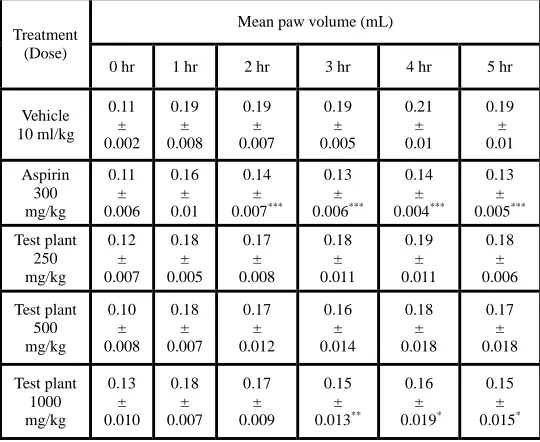
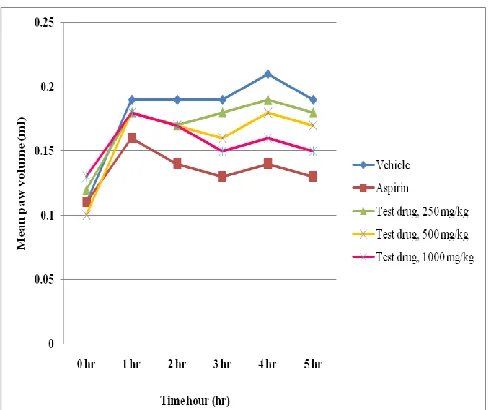
In acute inflammation models, the groups were orally administered with 95% ethanol extract of the root of C. pisifera (Siebold & Zucc.) Endl. in the dose of 250 mg/kg, 500 mg/kg and 1000 mg/kg. Paw edema volume was measured before (0 hour) and hourly up to 5 hour after injection of carrageenan by digital Plethysmometer. The paw volumes of treated groups were compared with negative control group (vehicle, 10 ml/kg). In this study, aspirin 300 mg/kg was used as a positive control group. The results of mean paw edema volume in mL after treatment with positive control (Aspirin, 300 mg/kg) were 0.16 ± 0.01 at 1 hour, 0.14 ± 0.007 at 2 hour, 0.13 ± 0.006 at 3 hour, 0.14 ± 0.004 at 4 hour 0.13 ± 0.005 at 5 hour respectively, compared to that of the negative control group (vehicle). Statistically significant decrease in paw edema volumes of mice
were found at 2 hour after carrageenan injection (p < 0.001) and it has same significant levels from 3 hour and up to 5 hour (p < 0.001).
The results of mean paw volumes after treatment with ethanolic extract of 250 mg/kg and 500 mg/kg were 0.18 ± 0.005 and 0.18 ± 0.007 at 1 hour, 0.17 ± 0.008 and 0.17 ± 0.012 at 2 hour, 0.18 ± 0.011 and 0.16 ± 0.014 at 3 hour, 0.19 ± 0.011 and 0.18 ± 0.018 at 4 hour, 0.18 ± 0.006 and 0.17± 0.018 at 5 hour respectively. When compared to the negative control group (vehicle) with 95% ethanol extracts of C. pisifera (Siebold & Zucc.) Endl., low dose (test drug, 250 mg/kg) and medium dose (test drug 500 mg/kg), significant anti-inflammatory effects were not showed from 1 hour after carrageenan injection up to 5 hour.
The results of mean paw edema volume in mL after treatment with ethanolic extract of 1000 mg/kg were 0.18 ± 0.007 at 1 hour, 0.17 ± 0.009 at 2 hour, 0.15 ± 0.013 at 3 hour, 0.16 ± 0.019 at 4 hour and 0.15 ± 0.015 at 5 hour respectively. When compared to the negative control group (vehicle) with the highest dose (test drug, 1000 mg/ kg), significant anti-inflammatory effects had showed to start at 3 hour (p < 0.01), 4 hour and 5 hour (p < 0.05) after carrageenan injection.
[image:3.612.57.279.374.510.2]In the comparison between the anti-inflammatory effects of 95% ethanol extracts (test drug, 250 mg/ kg, 500 mg/ kg, and 1000 mg/ kg), more significant increase in anti-inflammatory effect had been observed with 1000 mg/ kg at 3 hour up to 5 hour than the dose of the 250 mg/kg and 500 mg/kg after carrageenan injection. Thus, it was observed that 95% ethanol extract of C. pisifera (Siebold & Zucc.) Endl. (test drug, 1000 mg/ kg) was found better action from 3 hour after injection of carrageenan up to 5 hour. The results of mean paw volumes of negative control, positive control and the test plant were shown in Table 1 and Figure 4.
Table 1: The mean paw volumes of negative control, positive control and the test plant in carrageenan induced mice
Treatment (Dose)
Mean paw volume (mL)
0 hr 1 hr 2 hr 3 hr 4 hr 5 hr Vehicle 10 ml/kg 0.11 ± 0.002 0.19 ± 0.008 0.19 ± 0.007 0.19 ± 0.005 0.21 ± 0.01 0.19 ± 0.01 Aspirin 300 mg/kg 0.11 ± 0.006 0.16 ± 0.01 0.14 ± 0.007*** 0.13 ± 0.006*** 0.14 ± 0.004*** 0.13 ± 0.005*** Test plant 250 mg/kg 0.12 ± 0.007 0.18 ± 0.005 0.17 ± 0.008 0.18 ± 0.011 0.19 ± 0.011 0.18 ± 0.006 Test plant 500 mg/kg 0.10 ± 0.008 0.18 ± 0.007 0.17 ± 0.012 0.16 ± 0.014 0.18 ± 0.018 0.17 ± 0.018 Test plant 1000 mg/kg 0.13 ± 0.010 0.18 ± 0.007 0.17 ± 0.009 0.15 ± 0.013** 0.16 ± 0.019* 0.15 ± 0.015*
[image:3.612.313.583.473.694.2]Figure 4: Effect of the root of C. pisifera (Siebold & Zucc.) Endl., aspirin and vehicle on mean paw volume of mice after
carrageenan induced edema
Percent Inhibition of Lambda Carrageenan Induced Paw Edema of 95 % Ethanol Extract of the Root of C. pisifera
(Siebold & Zucc.) Endl. and Aspirin
[image:4.612.49.293.70.275.2]Percent inhibition of paw edema with positive control (Aspirin, 300 mg/kg) were found to be 16%, 26%, 32%, 33% and 32% inhibition for 1 hour, 2 hour, 3 hour, 4 hour and 5 hour respectively. The percent inhibition of right hind paw edema was observed at 1 hour 16% and maximal inhibition was 33 % and it was shown that at 5 hour. The results were shown in Table 2 and Figure 5.
The study of anti-inflammatory effect of 250 mg/ kg and 500 mg/kg of 95% ethanol extract of C. pisifera (Siebold & Zucc.) Endl. had shown that its action started from 1 hour after carrageenan injection up to 5 hour. Significant anti-inflammatory effects were not shown from 1 hour after carrageenan injection up to 5 hour. Percent inhibition of paw edema with 95% ethanol extracts of C. pisifera (Siebold & Zucc.) Endl. of low dose and medium dose were found to be 5%, 11%, 5%, 10% , 5% inhibition and 5%, 11%, 16%, 14%, 11% inhibition for 1 hour, 2 hour, 3 hour, 4 hour and 5 hour respectively. According to these results, the maximal inhibitions were 11% for 250 mg/kg at 2 hour and 16% for 500 mg/kg at 3 hour. Hence, low dose and medium dose of plant extract have low inhibition.
On the other hand, percent inhibition of paw edema with 95 % ethanol extract of C. pisifera (Siebold & Zucc.) Endl. (1000 mg/kg) were found to be 5%, 11%, 21%, 24% and 16% inhibition for 1 hour, 2 hour, 3 hour, 4 hour and 5 hour respectively. The maximal % inhibition of high dose of plant extract was 24% at 4 hour.
The percent inhibition on carrageenan induced inflammation in mice were highest in the concentration of the test sample 1000 mg/kg at 4 hour (24%). According to the present study, the test plant has high anti-inflammatory effect at high dose 1000 mg/kg at 3 hour up to 5 hour. Thus, this experiment may provide one of
the useful information in the development of Myanmar Traditional Medicine from natural plants.
Table 2: Percent inhibition of lambda carrageenan induced paw edema after treatment with aspirin and 95 % ethanol extract of C.
pisifera (Siebold & Zucc.) Endl.
Treatment
(Dose) 1 hr 2 hr 3 hr 4 hr 5 hr
Aspirin
(300 mg/kg) 16% 26% 32% 33% 32%
Test plant
250 mg/kg 5% 11% 5% 10% 5%
Test plant
500 mg/kg 5% 11% 16% 14% 11%
Test plant
1000 mg/kg 5% 11% 21% 24% 16%
Figure 5: Anti-inflammatory effect of the root of C. pisifera (Siebold & Zucc.) Endl. and aspirin in carrageenan induced mice
IV. CONCLUSION
In this research work, one Myanmar indigenous medicinal plant, C. pisifera (Siebold & Zucc.) Endl. was chosen for chemical analysis. A potent anti-inflammatory activity was determined against carrageenan induced inflammation for the root extract sample of the test plant showed remarkable inhibitory activity in high dose and also the activity followed by the remaining medium and low dose. These results concluded that the roots of C. pisifera (Siebold & Zucc.) Endl. have potential for the development of the treatment against inflammatory conditions.
ACKNOWLEDGEMENTS
[image:4.612.329.565.139.483.2]anti-immflamatory. Thanks are also due to Daw Swe Swe, Deputy Director (Research), Daw Ei Ei Htway, Research officer and all staff members in Pharmacology Research Division, Department of Medical Research, (Pyin Oo Lwin Branch), Mandalay Region, Myanmar, for their kind understanding and cooperation throughout the determination of anti-inflammatory.
REFERENCES
[1] Burke, A., Smyth, E., & FitzGerald, G.A. Analgesicantipyretic agents; pharmacotherapy of gout. In L.B. Brunton, J.S. Lazo & K.L. Parker (Ed.) Goodman & Gilman's the Pharmacological Basis of Therapeutics (pp. 671-715). New York: McGraw-Hill. 2005. [2] Pilotto A, Sancarlo D, Addante F, Scarcelli C, Franceschi M. Nonsteroidal anti-inflammatory drug use in the elderly. Surgical Oncology 2010; 19: 167-172.
[3] McGeer PL,McGeer EG.Local neuro inflammation and the progression of Alzheimer's disease. J Neurovirology 2002;8(6): 529-538.
[4] Woodward M, Lowe GDO, Campbell DJ, Colman S, Rumley A, Chalmers J et al. Associations of inflammatory and hemostatic variables with the risk of recurrent stroke. Stroke2005;36(10): 2143-2147.
[5] Howes MJR, Houghton PJ. Plants used in Chinese and Indian traditional medicine for improvement of memory and cognitive function. PharmacolBiochemBehav 2003; 75: 513-527.
[6] Mueller MM.Inflammation in epithelial skin tumours: Old stories and new ideas. EurJ Cancer2006; 42(6): 735-744.
[7] Pulok K Mukherjee, Peter J Houghton. Evaluation of Herbal Medicinal Products, (Pharmaceutical press). 2009, 13-22.
[8] Huerta C, Castellsague J, Varas-Lorenzo C and García Rodríguez LA. Nonsteroidal Anti-Inflammatory Drugs and Risk of ARF in the General Population. Am J Kidney Dis. 2002, 45(3): 531-539.
[9] Wallace J.L. PathogenesisofNSAIDinducedgastroduodenalmucosalinjury. Best Practice Res Clinical Gastroenterology. 2001, 15: 691-703.
[10] Shih SC, ChangCW. Nonsteroidal Anti-Inflammatory DrugRelated Gastrointestinal Bleeding in the Elderly. Int J Gerontology. 2007, l (1): 40-45.
[11] Valsaraj R, Pushpangadan P, Smitt UW, Adersen A, Nyman U. Antimicrobial screening of selected medicinal plants from India. J Ethnopharmacol1997; 58: 75-83.
[12] Mahesh B,Sathish S. Antimicrobial Activity of some important medicinal plant against plant and Human Pathogens. World J AgriSci 2008; 4(suppl):839-843.
[13] Panda SK, Thatoi HN, Dutta SK. Antibacterial activity and phytochemical screening of leaf and bark extracts of Vitex negundo from Similipal biosphere reserve Orissa. J Med Plant Res 2009; 3(4):294-300.
[14] SaikiaB. Ethanomedical plants from Gohpur of Sonitpur district, Assam. Ind j Traditional knowledge 2006; 5(4): 529-530.
[15] Cathrine L, Prabavathi N. Preliminary Phytochemical Analysis and Antibacterial Activity of leaf extracts of Vitex leucoxlon L.F. Int J Curr Pharm Res2011; l3: 71-73. [16] Swe Swe and et.al., (2015), “Anti-inflammatory Activity of Alstonia scholaris (L.) R.Br. on Carrageenan induced Albino Rats”.
[17] Winter C.A, Risely E.A &Nuss G.V (1962), “Carrageenan-induced edema in hind paw of the rat as an assay for anti-inflammatory drugs”. Processing of Social Experimental and Biological Medicine.
First Author - Arnt Win, PhD, Associate Professor, Department of Chemistry, Kyaukse University, [Myanmar],
PH-+95-92021984.
e-mail: [email protected]
Second Author - Aye Mon Thida Nyo, PhD, Associate Professor, Department of Chemistry, University of Mandalay,
[Myanmar], PH-+95-9977256425. e-mail: [email protected]
Third Author - Thida Cho, PhD, Assistant Research Officer, Forest Research Institute (FRI), Yezin, Naypyitaw, [Myanmar], PH-+95-9971646999.
e-mail: [email protected]
Correspondence Author - Arnt Win, PhD, Associate Professor, Department of Chemistry, Kyaukse University, [Myanmar], PH-+95-92021984.
e-mail: [email protected]