CHALLENGES ENCOUNTERED BY SINGLE
PARENTS IN THE LEARNING AND
DEVELOPMENT OF CHILDREN
KudengaMugove
Senior Lecturer, Faculty of Applied Social Sciences, Department of Psychology. Zimbabwe Open University, Harare, Zimbabwe
Abstract: Children are supposed to grow in a family setting where both mother and father take their respective roles in the upbringing of the child. In recent years there has been a sudden rise in the phenomenon of single parent families. Single parent families face challenges in properly raising their children. This research sought to find out the challenges encountered by single parents in the learning the learning and development of their infant children. The research employed mixed methodologies. It used questionnaires, observation checklist and document analysis as research instruments. The sample of research participants consisted of 30 school teachers, 18 school heads and 20 parents and 20 children in grade 1 and 2. The data is presented in the form of tables and excerpts. The study found out that single parents faced challenges in paying fees for their children, supplying their children with adequate stationery, monitoring the school attendance of their children and providing their children with emotional support. The exercise books of the children were in a bad state. The academic performance of the children was poor. The single parents faced challenges in supervising their children’s home assignments and their behaviour. The study recommends that the schools organise support groups for single parents so that they share information on how to improve their situation. The study also recommends that the government legislation and policies should assist low income single parents in their parenting problems. There is need for schools to set up guidance and counselling programmes to assist children from single parents and their children so that they are able to cope with challenges they face and are able to compete with children from intact families.
Key Terms: Single parent family, ECD children, Ecological Systems Theory, Children’s right and Education.
INTRODUCTION
Children are supposed to grow in an intact family where there are both parents who play their expected roles. Recently there has been an increase in the phenomenon of single parent family world over. One parent is present to bring up the children without the assistance of the other parent.This phenomenon presents challenges to the parent whose custody the children are in. The parent faces challenges in adequately providing for the child alone. The single parent may face resource challenges and ways of properly nurturing for the children. This research study intends to find out the challenges faced by single parents in the learning and development of their children.
RESEARCH QUESTION
What challenges are faced by single parents in the learning and development of the learning and development of their infant children?
LITERATURE REVIEW
families in the US sites divorce and death as some of major causes of single parent families. In recent years the phenomenon of teen pregnancies has given rise to single parent families as both parents will be immature to make a lasting family. New York Times (2004) made studies in the southern part of Africa and found out that poverty and teenage pregnancies poverty led to a rise in single parent families. These teenage pregnancies actually perpetuate the poverty cycle as the children born will likely be unable to get good education. Single parenting family system can be as a result of a death, divorce or having children out of wedlock.
Provision of children’s learning and development needs, care and support is one of the parents’ most important responsibilities in the upbringing of a child and supporting his or her learning. Bruce and Meggit (2005) explain that during Early Childhood Development children depend on their parents in school readiness, preparation and learning and development provision care and support. Anthony, Glanvile, Naaman, Waander and Shaffer (2005) in their studies point out that children learn best when they are given adequate learning and development materials and psychosocial support. It then follows that parents are obliged to fend for their children’s education needs. It is most likely that single parents face challenges in the provision care and support of their children’s learning and development needs.
Tassoni (2002) in his findings on causes of single parent families in the US sites divorce and death as some of major causes of single parent families. New York Times (2004) made studies in the southern part of African and found out that poverty and teenage pregnancies led to a rise in single parent families. Therefore the current study sought to establish the major cause of single parent families in Zimbabwe.
Due to poverty, illness or unemployment most single parent families fail to provide adequate financial and material resources for their children’s learning and development. Marther (2009) explains that a family is defined as poor when their family income is less than 100% of their official poverty threshold. Studies by Tassoni (2002) shows that most single families in the USA fall into low income bracket where they did menial work as a way of raising their income. The authority above goes on to explain that due to low income most single parent families may not afford to pay bills, buy food and provide adequately for their children’s education resources such as computers, books and other various learning materials to help their children learn concepts at home to achieve success at school. Marther (2009) reveal in her research findings that some single parents may fail to provide their children’s basic needs because of unemployment. The studies reveal that some single parents may not have the opportunity to take their children to various education sites such as museums, zoos, educational centre and other places to equip their children with various educational concepts they learn at school. Marther (2009) also supports Tassoni (2002) that because of economic hardships and unemployment some single parents fail to provide their children’s educational material needs, for their children to acquire academic and skills competence during their childhood development period. From the above previous findings it is clear that it is difficult for most single parents to provide for their children‘s education in order for the children to experience quality learning and development at home during the early years of life for children to perform well at school. The current study sought to go deeper into analyzing the extent to which single parents in the high density area of Glenview/Mufakose in Harare can afford to adequately provide for their children’s educational material resources both at home and school.
supportive the parent may fail to supervise, control, monitor and guide their children’s socio emotional aspects which enhance positive school achievements and positive behaviour too. Craig (2005) in his research studies on single parent families in Australia found out that parental stress has direct impact on children’s learning and social competences thus compromising quality child care. Craig (2005) explains that quality child care means consistent response to children’s signals, being available for communication, stress alleviation and creating a base for attachment bond with child. Quality child care enables the child to have confidence in the parent as well as other care givers as teachers whom the child interacts with during school time. Craig (2005) is supported by Musiiwa and Muzembe (2011) who clarify Mary Ainsworth’s ethological theory as supporting the need to have positive attachment bond between the child and parent in order for the child to develop a sense of security and trust in later life. It is imperative from previous studies that as a family unit the parent should be there for the needed child rearing practices. It was then the purpose of this current study to investigate whether the single parents of the targeted areas were always available for their children to provide the needed psychosocial support for their children to develop a sense of security and trust in other adults such as teachers.
METHODOLOGY
The research adopted a descriptive survey research design. According to Belensky (2010) a descriptive research design obtains information concerning the current status of the phenomena and to find out what exists in respect to variables or conditions in a situation. Sage (2010) views that descriptive survey research designs help provide answers to questions who, what, when, where and how with a particular research problem. In the current study the descriptive research design was suitable since it sought to establish the teachers’ views and perceptions towards the impact of single parenting challenges towards the learning and development of their infant children. It focused on problems likely to be faced by children from single parent families and the impact of the problems in the children’s class performance and attendance during the early childhood stage of grade1 and 2.
In the study of human relationships such as parenting techniques or family issues the experimental designs are less suitable as they require strict control of variables which is only suitable in natural sciences thus the descriptive survey is most suitable in the current study. It was the researcher’s intention to probe into how challenges faced by single parents affect their children’s education and how the children can be helped to attain high education achievement despite coming from single parenting families.
Ideally the research strove to investigate the problems faced by children from single parent families during the early childhood education which is the foundation for their future learning. One advantage of this design is that the respondents are the people who are directly in contact with the particular children from single parent homes. They witness the problems faced by the children in the real classroom environment thus making the collected information valid. Sage (2003) noted that descriptive studies can yield rich data collected from individuals who are in direct contact with the issue at hand that leads to important recommendations. This research design becomes suitable since findings can be generalised to the whole population.
The instruments used in the research were questionnaires, interviews, observation checklist and document analysis. It was important to use the instruments for purposes of triangulation. The information got from questionnaires needed to be verified using observation checklist and document analysis. Interviews gave the researcher opportunity further probe information that was not quite clear.
RESULTS
Table 1.DEMOGRAPHIC DATA FOR ALL PARTICIPANTS. (N=68)
Variable Descriptor Frequency Percentage
Teachers
Age range
21-30 years 2 7%
31-40 years 9 30%
41-50 years 12 40%
Over 50 years 7 23%
Total 30 100%
Gender Female 28 98%
Male 2 7%
Total 30 100%
Professional Qualification Certificate in Education 5 17%
Diploma in Education 16 53%
Degree 9 30%
Total 30 100%
Teaching Experience 0-10 years 9 30%
11-20 years 15 50%
Over 20 years 6 6%
Total 30 100%
Variable Descriptor Frequency Percentage Heads Deputy Heads Teachers In Charge Professional Qualifications Diploma in Education 2 11%
Degree 16 89%
Total 18 100%
Parents Age Range 21-30 12 60%
31-40 5 25%
Over 40 3 15%
Total 20 100%
Gender Female 16 80%
Male 4 20%
Total 20 100%
Professional Qualifications No Qualification 14 70%
Certificated 4 20%
Degree 2 10%
There were more female teacher respondents than male teacher respondents. There were more teachers who had diploma in education than other professional qualifications. The table also reveals that a high number of teachers had above 11 to 20 years teaching experience.
Of the single parents interviewed, 60% of them were in the range of 21-30yrs being the majority of the respondents. The single mothers comprised of 80% of the gender of single parents. 70% of the respondents had education qualification of below 3 O’ Level passes. Most of the single parents who participated in the research study were unemployed.
Table 2.Questionnaire responses of challenges faced by single parents. N=30
Descriptor/Narration Positive % Negative % Total %
Children have inadequate fees 25 83% 5 17% 100%
Children have inadequate stationery 21 70% 9 30% 100%
Most children have inadequate school attire 16 53% 14 47% 100%
Most children do not attend school regularly 17 57% 13 43% 100%
Some children have poor health 16 53% 14 47% 100%
Class performance is good 12 40% 18 60% 100%
Most children’s homework is not monitored 20 66% 10 34% 100%
Most respondents indicated that most children in the target area had inadequate fees, stationery and school attire. The school attendance of children was said to be irregular by most respondents. A number of
respondents indicated that most children’s homework was not supervised and children’s class performance was generally low.
Table 3. Observation findings of challenges faced by single parents N=30
Descriptor/Narration Positive % Negative % Total %
Children with good health 15 50% 15 50% 100%
Presentable school and sports attire 13 43% 17 57% 100%
Presentable exercise books 12 40% 18 60% 100%
Children showing good behaviour 14 47% 16 53% 100%
Children showing positive attitude towards the teacher
18 60% 12 40% 100%
Children showing positive interaction with peers
15 50% 15 50% 100%
Observations showed that half the children in the target group had good health. The school and sports attire of observed children were not quite adequate and presentable. The observed children did not quite show positive behaviour although most had positive attitude towards their teachers.
.
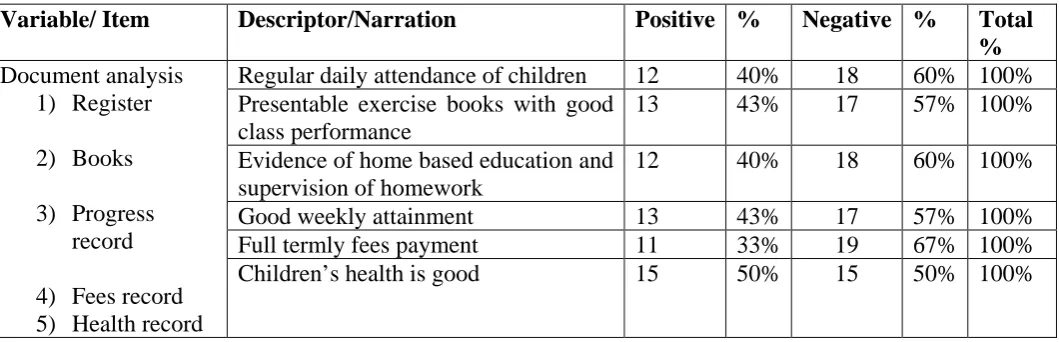
Table 4.Document analysis of children’s attendance and performance N=30
Variable/ Item Descriptor/Narration Positive % Negative % Total %
Document analysis 1) Register
2) Books
3) Progress record
4) Fees record 5) Health record
Regular daily attendance of children 12 40% 18 60% 100%
Presentable exercise books with good class performance
13 43% 17 57% 100%
Evidence of home based education and supervision of homework
12 40% 18 60% 100%
Good weekly attainment 13 43% 17 57% 100%
Full termly fees payment 11 33% 19 67% 100%
The documents observed indicated irregular school attendance by most children in the target group. Most of the exercise books indicated low class performance by most of the children. There was little evidence of home based education and supervision of home work. Termly fees payment for most children was not up to date.
INTERVIEW RESPONSES ON THE CHALLENGES FACED BY SINGLE PARENTS.
The interviews carried out with single parents revealed that most of them had problems in paying fees and affording adequate stationery, school and sports attire. Findings revealed that it is just half the children in the target group who had good health. The following excerpts below highlighted parental responses:
Excerpt 1
“I find it difficult to pay term fees for my children. The work that I do does not give me enough money to provide for my children.” Parent 1
Excerpt 2
“My children do not have adequate and presentable school and sports attire. At times they absent themselves from school because they will be shy to go to school without the required attire.” Parent 5
Excerpt 3
“I find it difficult to adequately feed my five children. Some of them are having behaviour problems. It is hard for me to control them when the father is absent.” Parent 3
Excerpt 4
“My children sometimes do not attend school due to lack of school stationery. When they are not in school they end up being involved in unbecoming behaviour. There is nothing I can do as I have to work to get money for food.” Parent 2
Excerpt 5
“I find little time to supervise my children’s homework as I am often busy away selling vegetables for my family income. When I come home I will be too tired to assist my children with their homework. I will just sleep so that I have energy to work the following day” Parent 4
DISCUSION
providing for their educational material needs of their children which compromised the learning and development needs of their infant children.
The research study found out that single parents in most instances had no time to supervise their children’s homework. The type of work they did was time consuming and involved a lot of physical activity like vending where they walk from one station to another looking for customers. The returns in such activities were very little. The research results are in agreement with those of Tassoni (2002) who found out that most single parents were either unemployed or involved in work that involved doing menial activities. The activities would be so tiresome that the single parent had no time to assist their children with school work.
The results from the research study indicated that children of single parents had problems with behaviour. 53% of the respondents indicated that the behaviour of children of single parents did not have good behaviour. Most of the time the children will be alone thereby lacking guidance on acceptable behaviour from responsible adult figures. The parents in most instances will be out working in an effort to get some money to provide for the family. This predisposes the children to a situation where they behave in ways that are not acceptable by society. Case (2009) states that sound parent-child relationship contributed positively to children’s learning and development. In situations where the parent is always committed by work means there will be no time to build that sound relationship.
The findings of the research show that the books of children of single parents were mostly unpresentable. The results show that 60% had exercise books that were dirty showing that the children did not get assistance in maintaining them and in doing their school work. 66% of the respondents indicated that the homework of children of single parent showed that it was unmonitored. This was because the children did not get proper guidance on how to maintain their books from home as the single parents did not have enough time to look at their children’s work. The parents come home so exhausted that they did not have time to look at their children’s work. Kail (2002) found similar results in a study conducted in Asia. The single parents did not have adequate time to properly provide and supervise their children due to lack of resources and time.
It is also noted from the findings of the current research that most single parents did not adequately supervise their children’s homework due to busy daily schedules and lack of knowledge in assisting their children’s homework. The single parents in most instances lacked of knowledge in assisting their children in educational concepts such as reading, mathematical concepts and other school work. The other reasons for lack of parental assistance by most single parents in providing home based education to their children could be due to parental stress from parenting pressure. They have to fulfil their usual role as mother and in addition compensate that of the missing parent. The other parenting burdens such as household chores and doing various income earning activities and lack of knowledge to teach their children negatively impacted on their ability to assist their children. The current findings agreed with those of Kail (2002) who attributed parental stress to inhibiting single parents’ monitoring of their children’s learning and development talents. The findings revealed that it is to a great extend that most single parents in Glenview-Mufakose district of Harare cannot afford to provide for their children’s material and psychosocial education needs.
CONCLUSION
The research study came up with the following conclusions:
Single parents faced challenges in paying the school fees for their children. This was because they were unemployed or if they were employed they were involved in lowly paid jobs.
Single parents had problems in monitoring their children’s school work. This was as a result of their tiresome work schedule and limitations in their capability to assist their children academically. The academic performance of children single parents was below that of children from intact
families.
The exercise books of children of single parents were in most cases in a bad state.
RECOMMENDATIONS
In view of the results of the study the following recommendations are being made:
Schools should organise support groups for single mothers so that they share information and
experiences on how to improve their situation.
The Government should make legislation and policies that aim at assisting low income single parents maintain their children.
Schools need to set up guidance and counselling platforms for assisting children from single parents so that they cope with academic work and compete on an equal footing with children from intact families..
Single parents need to be counselled so that they are in a position to take their responsibilities as single parents with confidence.
Single parents need to be given training on ways of starting income generating programmes so that they are able to provide for their children.
REFERENCES
Ainsworth, P.andDaker, E. (1999).Children from Single Families.Research Journal. USA
Anthony, L., Anthony, B., Glanvile, D., Naaman, D., Waander, Q. and Shafer, S. (2005).Relationship
Between Parenting Stress and Pre-scholar Social Competence. USA
Barajas, M.S. (2011).Academic Achievement of Children in Single Parent Homes: A Critical Review.
Michigan
Borgers, A. (1996).Children from Single Families.Netherlands. Biblatz and Rafley.
Bruce, T. and Maggit,C. (2005).Child Care and Education. London.Hodder and Shoughten.
Case, C. (2003).Explaining Trends in Child Support Demography:New York.Sage.
Casey, A.E. (2002).Foundation Kids Count Data Centre. New York. Sage.
Chingovo, L. and Manyati, M. (2012).Family Health and Life Skills. Harare. Zimbabwe Open University
Cook, R, and Aunert, T (2006).Adopting Early Childhood Curriculum for Children in Inclusive
Settings. Englewood. Merrill
Craig, L. (2005).The Money or Care: A Comparison of Couple and Sole Parent Household. Australian
Journal. Australia
Creswell, J.W (2009). Educational research: Planning, conducting, and evaluating quantitative and
qualitative research. Boston. Pearson.
Gillham, B. (2008).Developing a Questionnaire.London. Continuum.
Griggs, B. (2006).Introduction to Research Methods.Sydney. Longman.
Kail, R. (2002).Children Care.New Jersey.Prentice Hall.
Lincoln, B. and Denzin, D. (2005).The handbook of qualitative research.Michigan.Sage.
Marther, M. (2009).US Children in Single Mother Families. USA.Longman.
Mason, J. and Bramble, J. (1997).Research in Education and Behavioural Sciences.London. Brown and
Benchmark.
Mellenberg, G.J. (2008).Advising on research methods: a companion.Huzein. Johannes van Kessel
Publishing.
Morrison, G.S. (2012).Early Childhood Education Today.Texas. Pearson.
Mufflin, M (2000) Mathematical Application for the Management life and Social.Houghton. Mufflin.
Munn, P., &Drever, E. (2004). Using questionnaires in small-scale research: A beginner's guide.
Glasgow, Scottish Council for Research in Education.
Musiyiwa, M. and Muzembe, C. (2011) Theories of Child Development. Harare.Zimbabwe Open
University.
New York Times (2004) Cultural Practices in line With Marriages. New York. Dolphyne.
Oakes, A. and Sage, B. (2003).Research MethodsLondon. Sage Publications.
Odom, S. (2005).Topics in Early Children Special Education.Indiana. Bloomington.
Oppenheim, A. N. (2000). Questionnaire design, interviewing and attitude measurement (New ed.):
New York. Continuum International Publishing Group Ltd.
Rani, N. (2006) Winter Child Care by Poor Single Mothers. Family Journal. India
Tassoni, P. (2002).Certificate in Child Care and Education.London. Heinemann.UNICEF. (2008) The
State of the World’s ChildrenNew York.UNICEF.