A Psychological Perspective
Henrik Svedsater
Submitted for the Doctorate Degree in Psychology at the London School of
Economics and Political Science, April 2001. Supervisor: Professor George
All rights reserved
INFORMATION TO ALL USERS
The quality of this reproduction is dependent upon the quality of the copy submitted.
In the unlikely event that the author did not send a complete manuscript and there are missing pages, these will be noted. Also, if material had to be removed,
a note will indicate the deletion.
Dissertation Publishing
UMI U615211
Published by ProQuest LLC 2014. Copyright in the Dissertation held by the Author. Microform Edition © ProQuest LLC.
All rights reserved. This work is protected against unauthorized copying under Title 17, United States Code.
ProQuest LLC
789 East Eisenhower Parkway P.O. Box 1346
This thesis addresses the validity of the Contingent Valuation (CV) methodology.
Unlike conventional economic approaches, this is based on stated preferences in
hypothetical market scenarios and is used in attempts to estimate economic benefits of
non-marketed public goods, most notably natural resources. However, the methodology
is not without controversy and many researchers question people’s ability to provide
valid economic values for environmental amenities in these contexts. The present
research applies a psychological perspective to this area, and hence adopts a different
approach than mainstream work in the field that has traditionally been more concerned
with methodological procedures and how well data fit with economic theory. The first
section presents the rationale of the CV methodology and reviews a number of
conceptual problems and empirical anomalies that have been demonstrated across
studies and contexts. It sets these within a theoretical framework that, it is envisaged,
will contribute to our understanding of people’s responses to CV questions.
In the empirical section a number of hypotheses derived from this theorising are tested.
The results indicate that statements of economic value, particularly for complex
amenities, are unresponsive to the magnitude or importance of the resource being
valued. Some people also tend to provide, often seemingly ‘reasonable’ responses,
irrespective of their ambivalence toward the valuation procedure. It is further
demonstrated that there is a high degree of uncertainty involved in reported economic
value, indicating that CV responses are quite imprecise representations of underlying
preferences. Finally, hypothetical willingness to pay are shown to be a poor indicator of
real economic commitments, resulting partly from the self-image people strive to
achieve in these contexts, particularly when choices appear inconsequential. The major
conclusions of the thesis are that responses in CV studies to a large extent are motivated
by expressive rather than instrumental considerations, that respondents’ interpretations
of the valuation task do not always correspond with the intention by the researcher, and
that situational and contextual factors have important implications for the assessment of
First of all I would like to thank my supervisor, Professor George Gaskell, for guiding
me through this thesis and sharing with me his insights and perspectives in social
psychology, in particular those related to social research methods. For similar reasons I
am most grateful to Dr. Olof Johansson-Stenman at the Department of Economics,
Gothenburg University, who with his extensive knowledge of environmental economics
and public economic theory has been a vital support to my research. His genuine and
profound interest of linking economics with other disciplines also provided great
encouragement and has resulted in the emergence of ideas, some of which that have
been incorporated in this research. Additionally, I wish to thank Dr. Fredrik Carlsson
and Professor Thomas Sterner for valuable discussions related to my work.
Completing this thesis has been a long journey. What is equally valuable therefore is the
enthusiasm of colleagues and friends, who have been indispensable in making the
process more encouraging and less lonely. I am most thankful to Patrick Sturgis, both as
a friend and colleague, who actively took part in reading the thesis and provided
valuable comments of how it could be improved. My deepest gratitude is also paid to
Mia. Without forgetting anyone, I am thankful to Niklas, Fredrik Nikolajeff, Rakesh
and Osse, and colleagues at both Gothenburg University and the London School of
Economics, including Rene, Jon, Caroline, Nick and HSkan. My parents, and sister and
brothers with their families supported me along the way. Last but not least, I owe far too
much to recount here the inspiration and love provided by Sarah.
Many people assisted me along the way, including Susie, Vanessa, and Ulla with
practical matters, and all subjects who participated in my experiments and interviews,
without whom this research would not be possible. This research has been financially
supported by Tom Hedelius Stiftelse, KommunikationsforskningsrMet, Svenska
Institutet, Forskningsr&dsnamnden, Stiftelsen Lars Hiertas Minne, C. C. Soderstroms
A b stract...2
Acknowledgements...3
List of Tables...9
List of Figures... 10
Overview of Thesis... 11
1. Introduction... 16
1.1. Objectives and Structure of Thesis... 17
1.2. Economic Valuation of Natural Resources... 20
1.3. The Contingent Valuation M ethod... 22
1.3.1. Structure o f a Contingent Valuation Questionnaire... 24
1.3.2. Guidelines and Recommendations fo r Conducting CV Studies... 25
1.3.3. Advantages o f the Contingent Valuation M ethod... 27
1.4. Alternative Approaches to Benefit Estim ation...28
1.4.1. Choice Experiments...29
1.4.2. Multi-Attribute Utility Theory...30
1.4.3. Revealed Preference Methods...32
1.5. Theoretical Framework of Economic V aluation...33
1.6. Conclusions... 38
2. Criticism of the Contingent Valuation Method: Conceptual Problems and Sources of Bias...40
2.1. The Inclusion of Non-Use values...40
2.2. Divergence Between WTP and WTA Estimates...42
2.3. Hypothetical Bias...45
2.3.1. Origins o f Hypothetical Bias...46
2.3.2. Correspondence with Real Economic Commitments... 48
2.4. Strategic Behaviour... 50
2.5. Anchoring Effects...51
2.7. Compliance and Interviewer E ffects...55
2.8. Embedding Effects...56
2.8.1. Perfect Embedding...57
2.8.2. Regular Embedding...60
2.9. Sequence Effects...61
2.10. Population and Sample-Selection B ias...63
2.11. Conclusions...64
3. Theoretical Fram ew ork...68
3.1. Economic Rationality and Preference F o r m a t i o n 68 3.1.1. Heuristics o f Economic Decision Making...69
3.1.2. Prospect Theory...72
3.1.3. Implications fo r Environmental Benefit Estimation... 74
3.2. Attitudes and Social Psychological Perspectives...76
3.2.1. The Attitude-Behaviour Link... 77
3.2.2. Value Construction and Non-Attitudes’... 79
3.2.3. The Functional Value o f Attitudes... 82
3.2.4. Mental Models and Interpretation o f Valuation Scenarios... 85
3.2.5. Communicative Processes o f Attitude and Value Formation...88
3.3. Conclusions...91
4. Test of Perfect and Regular Embedding...94
4.1. Internal Consistency of Stated Willingness to Pay... 95
4.1.1. Empirical Demonstration o f Embedding...95
4.2. Design of Field Study...100
4.2.1. Interview Procedure and Questionnaire Design...101
4.2.2. In-Depth Interviews... 104
4.3. Results... 105
4.3.1. Descriptive Statistics...105
4.3.2. Parametric and Non-Parametric Analysis...107
4.3.3. Qualitative Analysis... 113
5. How People Make Sense of Contingent Valuation Questions...118
5.1. Thought Processes and Interpretation of WTP Questions...119
5.2. Conversational Norms... 122
5.2.1. Making Sense o f Valuation Scenarios... 123
5.2.2. Social Context and Environmental Valuation...125
5.3. Research Hypotheses...126
5.4. Design of Interviews and Focus-Group Discussions...127
5.5. Results...131
5.5.1. Interpretation o f and Identification with the Valuation Scenario 132 5.5.2. Appropriateness o f Economic Value...i...i...i..\2>A 5.5.3. Credibility o f the Hypothetical Market...135
5.5.4. Strategies and Considerations o f Willingness to P ay...136
5.5.5. Uncertainty o f Value Assessment... 141
5.6. Conclusions...142
6. Imprecise Economic Preferences: Response Formats and Giving Respondents Time to T h in k ... 145
6.1. Ambivalence and Imprecise Willingness to Pay Estim ates... 146
6.1.1. Response Format and Uncertainty o f Willingness to P a y...147
6.2. Multi-Dimensional Approaches and Avoidance of ‘Yes-Saying’ ... 148
6.3. Social Processes and the Establishment of Economic Preferences... 149
6.3.1. Social Interaction and Post-Influence... 151
6.3.2. Internalisation and Pre-Influence... 152
6.4. Design of Experiment and Model... 153
6.4.1. Experimental Design...154
6.4.2. The Model... 158
6.5. Results... 159
6.5.1. Ambivalence Bounds o f PC Formats...159
6.5.2. Qualitative Analysis... 163
6.5.3. Open-Ended versus PC Responses with Certainty Thresholds...164
7. Choice Experiments and Self Image:
Hypothetical and Actual Willingness to Pay...172
7.1. External Validity of Stated Preferences...173
7.2. Within-Subject versus Between-Subject Test of External Validity...175
7.2.1. Cogn itive Dissonance and Self-Image... 176
7.3. The Model...180
7.3.1. The Extended Model with Self-Image... 181
7.3.2. Hypothetical Willingness to P ay... 182
7.3.3. Real Willingness to P a y... 183
7.4. Empirical Hypotheses ...v...v..v.v...v..v...185
7.5. Experimental Design and M ethod... . 185
7.5.1. The Empirical Model... 190
7.6. Results...192
7.6.1. Hypothetical versus Real Willingness to Pay... 193
7.6.2. Testing fo r the Influence o f Scale... 196
7.7. Conclusions...197
8. Discussion and Conclusions... 200
8.1. Summary of Main Findings... 201
8.1.1. Embedding Effects and Methodological Procedures... 201
8.1.2. People’s Representations o f Contingent Valuation Scenarios... 204
8.1.3. Precision o f Economic Value...206
8.1.4. Hypothetical and Real Willingness to Pay... 208
8.2. Caveats and Lim itations... 210
8.3. Implications and Directions for Future Research... 212
8.3.1. Affective Processes o f Valuation... 213
8.3.2. Comprehension o f the Valuation Task...214
8.3.3. Contextual and Social Factors...216
8.3.4. Rational Decision-Making and Philosophical Concerns... 218
8.3.5. Methodological Limitations and Recommendations... 220
Appendix A. Questionnaire Design Chapter 4 ...225
Appendix B. Design of Interviews and Focus-Groups Chapter 5 ... 233
Appendix C. Design of Experiment Chapter 6 ... 243
Appendix D. Design of Choice Experiments Chapter 7 ... 260
List of Tables
Table 1.1. Examples of conducted CV studies... 23
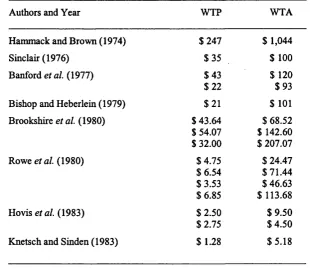
Table 2.1. Disparities between WTP and WTA estimates... 43
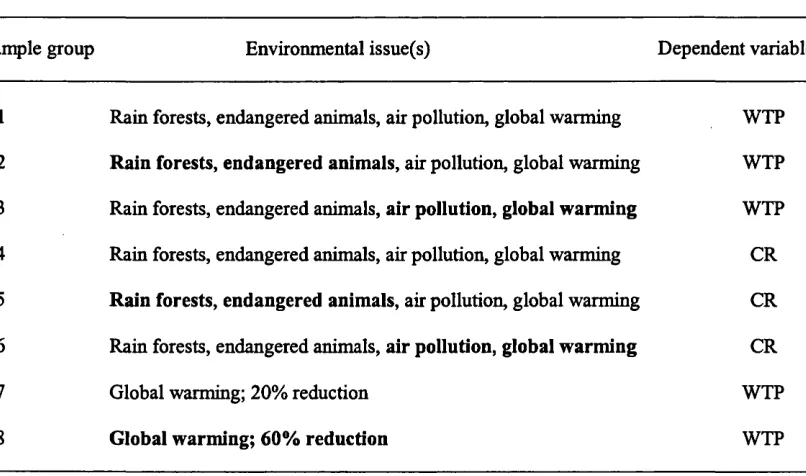
Table 4.1. Division of sample groups... 103
Table 4.2. Mean and median W TP...106
Table 4.3. Differences between WTP for each environmental issue... 108
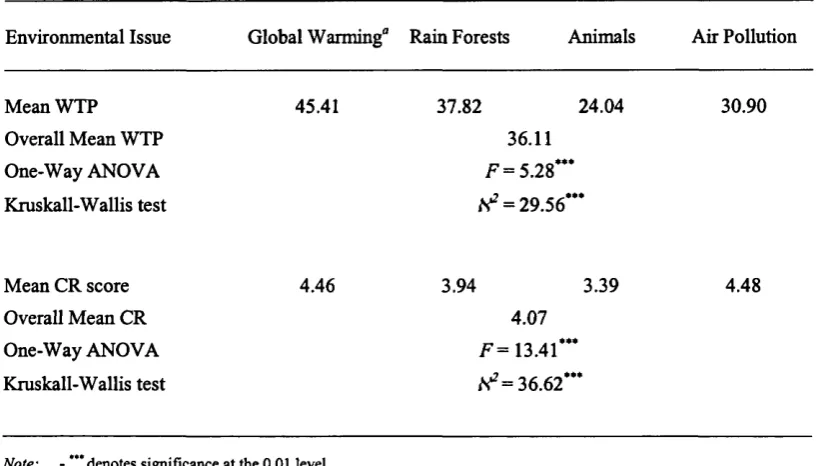
Table 4.4. Determinants of WTP...109
Table 4.5. Examination of part-whole effects...111
Table 4.6. Examination of insensitivity to scope... 112
Table 5.1. Considerations and motivations of WTP... 137
Table 6.1. Multiple-bounded response format... 155
Table 6.2. Parameter estimates for various certainty thresholds... 160
Table 6.3. Mean and median W TP... 167
Table 7.1. Level of attributes... 188
Table 7.2. Example of a choice set... 189
Table 7.3. Parameters of utility functions associated with different samples...193
Table 7.4. Likelihood-ratio tests of pooled and restricted models... 195
List of Figures
Figure 1.1. Relations between value domains and motivational orientation... 31
Figure 1.2. Maximisation of utility...34
Figure 1.3. Optimal rate of output...38
Figure 2.1. Concave utility function...59
Figure 2.2. Satiation point...59
Figure 3.1. Prospect theory and the framing of values... 73
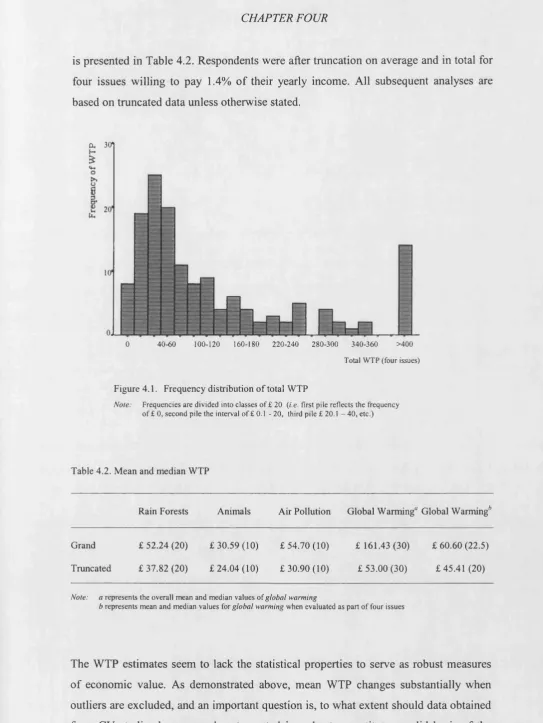
Figure 4.1. Frequency distribution of total WTP...106
Figure 6.1. Ambivalence of WTP...146
Figure 6.2. Ambivalence bounds of W TP...162
Figure 6.3. Logit distributions - PC time to think valuation format...165
Figure 6.4. Logit distributions - PC standard valuation format... 165
In environmental economics there has been an increasing interest over the last decade in
order to assign economic values to natural resources. The argument is that
environmental policy-decisions will be better informed if the ‘economic’ benefits
accrued to these resources are compared to their costs of provision. This has lead
economists to seek and develop methodologies that are capable of measuring citizens’
Willingness To Pay (WTP) for a variety of amenities, such as air quality, wildlife and
recreation sites. By far the most popular approach of economic benefit estimation is the
Contingent Valuation Method (CVM), which deduce economic value of a particular
amenity on the basis of respondents’ WTP statements in hypothetical market scenarios.
It thus facilitates a valuation of non-marketed goods, and has the advantage of also
including benefits that extend beyond a use of the resource. The first attempt to assign
economic values to natural resources through the CVM dates back to the early 1960’s,
but its popularity did not take off until the late 1980’s, spawned by the investigation of
lost passive use-values resulting from the Exxon Valdez oil spill in Alaska. In the same
year the methodology was acknowledged by U.S. courts as a legitimate basis for
assessing natural resource damage liabilities (Mitchell and Carson, 1989).
Notwithstanding its potential merits, the CVM has encountered widespread criticism
(e.g., Kahneman and Knetsch, 1992; Diamond andHausman, 1994; Vatn and Bromley, 1994; Blarney, 1998; Kahneman et al., 1999), and the frequent use of the method has given rise to a vehement debate that exceeds most other controversy in social research.
Scepticism, both within the economic profession and in other branches of social
science, is maintained by a variety of anomalies that have been demonstrated in
empirical research. Many of these were realised in early research, which was attentive
to problems such as strategic behaviour, anchoring effects, sponsor bias, hypothetical
bias, etc. The main concern among Contingent Valuation (CV) practitioners was
therefore how these could be overcome by methodological refinements, because “if the
CV study is well designed and carefully pre-tested, the respondents’ answers to the
valuation questions should represent valid Willingness To Pay (WTP) responses”
assertion that the failure to assess valid and consistent welfare estimates is mainly due
to flawed methodological procedures. The central theme of this objection is that CV
responses may not be anchored in economic preferences, and as such represent
something different than economic value. Thus, this perspective entails a shift in focus
from methodological concerns to the basic nature of stated economic value.
Unfortunately, this interest in examining whether data corresponds to the intended
theoretical construct is yet to be fully integrated with mainstream research on CVM, and
too often, the fundamental problems of preference assessment are neglected by CV
practitioners Attending a conference-session on CVM today one is more likely to see
presentations revolving around statistical analysis and technicalities of established
methodological procedures, with no serious attempts to scrutinise the essence of
economic values in these contexts. The aim of this thesis is to renew the debate
regarding what people’s responses in CV studies really involve. It adopts a perspective
that facilitates an investigation of the extent to which statements of economic value are
‘intuitively plausible’, and conducts empirical research on the validity of the underlying
value construct. A key starting-point of the thesis is that, before we ask how much
citizens value environmental resources, we ought to ask how and why they provide economic values for these in hypothetical market scenarios. Thus, emphasis is placed on
the content validity of CVM and other Stated Preference Methods (SPMs), with the
objective of investigating widely overlooked, yet important issues that, it is envisaged,
will enhance our understanding of economic value in these contexts.
In chapter one the objectives and perspectives of the present research are presented. A
brief history of monetary valuation of environmental resources is provided, along with a
summary of valuation techniques in general and CVM in particular. This includes a
description of the procedures of a standard CV study and those of alternative
approaches to benefit estimation that will be applied throughout the thesis. The chapter
also sets out the theoretical framework of the estimation of welfare effects associated
with public goods. Chapter two presents a state-of-the-art survey of conceptual
problems and sources of bias of the CVM. It reviews empirically based criticism and
theoretical objections that have been put forward against a monetary valuation of non
and provides a discussion about its feasibility and appropriateness. On the basis of this,
relevant aspects of validity that set the agenda for later chapters are put forward.
Chapter three presents the theoretical underpinnings, both from an economist’s and a
social psychologist’s perspective, relating to anomalies of preference formation and
decision-making. Hence, a more in-depth analysis of the conceptual problems and
sources of bias presented in chapter two is set out here. The chapter is divided into two
parts. In the first, axioms of standard economic theory are presented, including a review
of empirical findings that challenge specific assumptions of the dominant theory.
Additionally, it illuminates the research paradigm in economics that has given rise to
these assumptions, whereby the aim is to make their foundations more explicit. On the
basis of this, the second part of the chapter aims to put the CVM in a broader context by
incorporating insights from other areas of research. It offers an account of how
alternative perspectives from psychology and social psychology are likely to result in
different approaches to testing the validity of CV responses, and that ultimately may
improve our understanding of economic values in these contexts. Cognitive, affective
and contextual processes of survey measurement and human decision-making are
explored in this section.
The remaining part of the thesis presents the findings of four separate, but theoretically
linked, case studies. The first, presented in chapter four, examines the internal
consistency of WTP estimates, investigating if and to what extent stated values are
responsive to the scope {i.e., magnitude, urgency or importance) of the environmental problem. It further addresses if the WTP for one particular amenity varies with how
many other public goods are included in the valuation scenario and valued
simultaneously. The study originates from a considerable body of research that has
specifically examined these issues (e.g., Desvousges et al., 1993; Hoevenagel, 1996), but which has failed to provide a conclusion about the matter due to different views
among advocates and critics of the methodology regarding what constitutes a ‘proper’
CV design. Whereas studies demonstrating insensitivity to scope and ‘part-whole’
effects have been criticised for flawed methodological procedures and for not following
established guidelines for CV studies, those suggesting that respondents are capable of
insufficient or inappropriate. This study relies on a design similar to a typical CV study,
and employs experimental procedures that minimise the influence of external factors. It
thus aims to constructively contribute to the debate on whether these effects are
behavioural regularities, or if they may be overcome by an improved survey design.
The empirical approach in chapter five builds on the findings of the former and
performs a qualitative analysis of people’s thought-processes when confronted with a
CV questionnaire. The objective is to reveal the strategies used by lay people when
assigning economic values to global environmental resources, and to investigate if these
correspond to rational models of economic behaviour. It is based on the findings by
Schkade and Payne (1994) and Vadnjal and O'Connor (1994) who show that CV
respondents are quite unresponsive to factors that ought to be relevant according to
these models, but tend to be largely influenced by irrelevant considerations. Apart from
merely taking notice of these results, the present study carefully examines the basis and
motivations of WTP. An indication will implicitly be provided of whether the public
understand and comply with the principles of an economic valuation of natural
resources, and if economic values in these contexts are pre-defined concepts, or if
people construct their preferences at the time of being interviewed. It argues that WTP
assessed in CV studies should not be taken at face value since respondents’
interpretation of the valuation question may be radically different from that of the
researcher.
Chapter six presents the results of a study that focuses on the respondents’ uncertainty
when faced with a CV question. The ambivalence over trade-offs between money and
environmental changes that the respondent feels has been analysed by Dubourg et al.
(1994), Gregory et al. (1995), Ready et al. (1995), and Ready et al., (1999). A general conclusion of these papers is that people only have a vague idea as to within which
range their WTP is situated, which leads to imprecise estimates. However, previous
research has not investigated to what extent varying conditions and contexts of
valuation are responsible for such imprecise representations of economic value. Here a
more inclusive response format is introduced in which the respondents express attitudes
toward multiple dimensions of the public good, rather than only stating their support
are given extra time to think about the valuation issue before a response is elicited,
which may facilitate important social processes of opinion formation. Overall, the study
provides specific tests in order to understand how various response formats and
contextual factors contribute to the preciseness of WTP in CV studies.
The last empirical study, presented in chapter seven, employs a choice experiment in
order to estimate the economic value of selected environmental issues. The rationale is
to investigate whether, as argued by various researchers (e.g., Hanley et al., 1998; Carlsson and Martinsson, 2001), this alternative approach to benefit estimation
generates more valid responses, or if these are likely to suffer from the same limitations
as the CVM. In particular, the experiment examines the correspondence between
hypothetical and real WTP. Previous studies indicate that CV responses are poor
indicators of real WTP, although no unambiguous conclusion can be drawn from these,
partly due to different characters of the good being valued and varying methodological
designs across studies. The experiment uses a public good, and is designed in order to
investigate whether respondents try to act in an internally consistent way when
expressing both hypothetical and real WTP in subsequent order. By using a split-sample
design, a tool is provided to test the impact of self-image and cognitive dissonance in
these contexts, which will indicate whether within-subject tests are appropriate ways of
testing for various anomalies. An underlying aim of the study is also to assess the
impact of the financial incentives introduced in the experiment.
Chapter eight provides the overall conclusions of the thesis, where the results of
separate empirical studies are summarised. On the basis of what has been found,
implications for the current and future application of the CVM are discussed. The
discussion centres on the possibility and limitations of assigning economic values to
non-marketed environmental resources, and to what extent alternative theoretical
perspectives and notions, most notably from social psychology, may contribute to our
understanding of observed anomalies and problems with the methodology. The thesis
concludes by suggesting some directions for future research in the area, addressing both
" What is a cynic? A man who knows the price o f everything and the value o f nothing”
(Oscar Wilde)
Over the last decade monetary valuation of environmental resources has become a
common practice in the field of environmental economics. Innumerable attempts at
making economic impact analyses of environmental deterioration and improvement
have been made in order to inform policy decisions, and by far the most popular
approach of benefit estimation is the Contingent Valuation Method (CVM). This is a
survey- or interview-based technique by which respondents are posed Willingness To
Pay (WTP) questions for environmental amenities in hypothetical market scenarios.
Hence, the approach enables an economic valuation of non-marketed public goods and
services. On the basis of the results from Contingent Valuation (CV) studies, the
prospects of environmental preservation are indeed promising; relatively large WTP
amounts have been demonstrated for preserving various types of environmental
resources in a variety of contexts (e.g., Mitchell and Carson, 1989; Carson et al., 1992; Kramer and Mercer, 1992).
However, the CVM has encountered strong criticism (e.g., Kahneman and Knetsch, 1992; Diamond and Hausman, 1994; Vatn and Bromley, 1994; Fischhoff, 1997;
Blarney, 1998), and the frequent use of the method has given rise to a heated debate
among researchers in various fields. The scepticism, both within the economic
profession and in other branches of social science, is maintained by the variety of
anomalies and biases that potentially pose a threat to the validity of the methodology. In
early CV research the main concern was that respondents would act strategically in
hypothetical survey contexts in accordance with Samuelson's (1954) exposition of the
‘free-rider* problem, but more recently the critique has focused on a variety of other
sorts of problems that represent more fundamental difficulties. Some of these are
common for many types of measurement in social research (e.g., anchoring, order effects, compliance, context and framing-effects), whereas others are more specific to
been indicated to be insufficiently associated with the specific characteristics of the
resource (Kahneman and Knetsch, 1992), assessed economic values are conditioned by
the suggested payment scheme (Mitchell and Carson, 1989) and depend on whether the
environmental change is pictured as a loss or a gain (Diamond et al., 1993), and hypothetical statements seem to correspond poorly with real economic commitments
(Seip and Strand, 1992; Neill et al., 1994).
1.1. Objectives and Structure of Thesis
The purpose of this thesis is to examine the Validity of WTP estimates derived from
hypothetical market scenarios, particularly the CVM. It adopts a social psychological
perspective to address some key aspects of economic value assessment that have been
widely overlooked in the CV literature. In addition to conducting quantitative analyses
of some conceptually important anomalies, focus will also be placed on whether
statements of economic value in these contexts are plausible, which includes an
examination of whether these correspond to the underlying theoretical construct. Thus, I
will not merely investigate the predictive quality of WTP responses, but also illuminate
their motivational basis, which hopefully will provide insights into the possibility of
assigning economic values to complex non-marketed public goods.
A tremendous amount of work has been devoted to the CVM throughout the last
decades, covering a whole range of topics, but although there are a number of examples
that have been more concerned with the foundations of CV results (e.g., Anderson, 1993; Diamond and Hausman, 1993; Sagoff, 1994; Barry, 1995; Arrow, 1997), insights
from and perspectives among these efforts have not been fully intertwined with
mainstream research in the area. Consequently, the overwhelming majority of CV
papers have either solely dealt with rather specific and technical methodological issues,
such as optimal bid-design, theoretical justifications of substitution and income effects,
the development of sophisticated econometric models, etc., or have on other occasions
been written purely from an economist’s perspective, pertaining to theoretical
underpinnings of neo-classical economic theory. This thesis attempts to address some, I
will argue, of the more fundamental issues that lay the foundation of CVM. This
• What motivates people in their responses to CV studies?
• Do they adequately understand the valuation procedure, or how do they otherwise
make sense of this?
• Are respondents committed to their stated WTP, and do hypothetical statements
correspond with actual (economic) behaviour?
• To what extent is value assessment determined by situational and contextual factors?
I believe that answers to such questions are crucial for the future application of the
CVM. They address the core question of whether more valid responses can be elicited
by improving the methodology, or if observed anomalies are behavioural regularities,
thereby implying that hypothetical value assessments of environmental resources are
‘inherently’ flawed. Put in other words, before asking how much citizens are willing to pay for environmental improvements, we need an answer to how and why people value these, because only then is it possible to judge on what occasions and in what contexts
CVM may be applied, how the methodology can be improved, or if economic value,
given that it exists in the minds of people, could be better captured by alternative but
conceptually similar methodologies.
As far as I am concerned, the mainstream research on CVM has to a large degree lost its
relevance since, by and large, it tends to overlook such fundamental questions. In this
respect there must be a greater willingness among CV practitioners to pay attention to
factors traditionally viewed as outside the field of economics, since concepts such as
altruism, socialisation and political action may not be adequately understood within the
standard economic framework. If we do not understand the basis of the values people
hold toward the environment, and furthermore, if we do not seriously consider the social
and psychological mechanisms underlying a monetary valuation in the CV context, the
prospects of deriving ‘acceptable’ welfare estimates of such public goods are
undermined. Rather than relying on misdirected attempts at developing sophisticated
quantitative models and rigorous analytical tools in order to fit data with standard
economic theory, we need to ask: Do we ask the right questions? Are our questions
interpreted as intended by the respondents, and are they meaningful to people? Are the
implied property rights plausible and likely to be accepted? Do the public perceive the
as CV practitioners do? What is a relevant framework within which these questions
should be analysed? The aim of this research is not necessarily to provide precise
answers, but to clarify these and other relevant questions for the CVM.
The thesis is separated into eight chapters. In this first chapter, the history and rationale
for economic valuation of environmental resources is provided, followed by a
description of various approaches to benefit estimation, in particular the CVM. Chapter
two provides a state-of-the-art survey of conceptual difficulties and various anomalies
that have been discussed and demonstrated in previous research. In chapter three I will
discuss the theoretical underpinnings, both from an economist’s and a social
psychologist’s perspective, relating to anomalies of preference formation and economic
decision-making. This is aimed to provide a framework for understanding the nature of
hypothetical value statements, and it thus constitutes a theoretical background for the
empirical research in this thesis.
The remaining part presents the findings of four separate but for the purpose of this
thesis coherent case studies. The first of these examines if and to what extent stated
economic value is responsive to the scope (i.e., magnitude, severity or importance) of the environmental problem, and whether WTP depends on how many other resources
are valued simultaneously. The second study builds on the former and performs a
qualitative analysis of people’s thought processes when presented with a valuation
scenario. It aims at revealing how people make sense of CV questions, the strategies
they use in order to assign economic values, and whether these correspond to the
assumptions of standard economic theory. The third study captures the uncertainty
people feel when providing their responses, and how this varies with various contextual
factors of valuation. In particular, it addresses the role o f social processes in value
formation. In the final empirical study, an alternative approach to CVM is applied in
order to examine the correspondence between hypothetical statements and actual
monetary payments. Chapter eight presents the conclusions o f the thesis. In addition to
summarise the findings of each empirical chapter, it discusses the implications of this
research regarding the possibility and limitations of environmental benefit estimation,
1.2. Economic Valuation of N atural Resources
The public’s concern for the natural environment has evidently increased over the last
decades, arising from awareness o f the side effects resulting form the development of
the modem industrial welfare state. Today, the support for increased efforts at reducing
pollution, along with a more sustainable approach to the use of natural resources, have
become settled and widely shared, at least in the Western world, although the trend is
cyclical according to economic fluctuations and does not rank highest among public
concerns (Department of the Environment, 1992; Ladd and Bowman, 1996; Office for
National Statistics, 1998).
However, our commitment to a cleaner and safer environment is not unproblematic.
Although public opinion is arguably legitimate and, at least to some extent, must be
taken into account in environmental policy-making, the matter is far more complicated
than that. Firstly, in a number of cases the environmental effects and consequences are
not clear-cut, leading to disagreements in the natural and medical sciences. Secondly, in
the light of finite (public) resources and reluctant taxpayers, some difficult policy
questions inevitably arise as the costs of accomplishing various environmental
improvements are realised. For example, how much should be spent on cleaning up the
North Sea? To what extent should we increase the safety standards for nuclear power
plants in order to reduce the risk of future radioactive catastrophes? Should we have car-
tolls in major cities, and if so, what would be an adequate fee? How high a level of
impurity should we tolerate in our drinking water? Are we willing to make the trade-off
between the construction of a hydroelectric power plant and higher electricity bills? By
reflecting over comparable issues, the question of how much resources society should
allocate to these and similar problems is not entirely clear. The allocation problem is
further reinforced by the fact that we may not only want to consider our own well-being,
but also incorporate that of future generations; what weight should we give to our
descendants, and how far into the future could the analysis reasonably be extended?
Similarly, to what extent and how should non-human welfare be accounted for?
The core logic in economics is that public goods, such as environmental amenities,
According to principles of Cost-Benefit Analysis (CBA), whenever the sum of benefits
across all involved agents exceeds the aggregated costs, it would be economically
worthwhile to provide the good. In addition to the weighting of costs and benefits in
order to make environmental decisions, in many cases values are estimated in order to
form a basis for subsequent actual payments. For example, licence-fees for fishing may
be introduced to cover the estimated costs for a decrease of the fishing stock that this is
causing, a higher charge for environmentally unfriendly activities creates an incentive
for people to reduce such, and compensation may be paid to people who live nearby or
enjoy the benefits of a recreational area that is diminished due to urban development.
As a result of these objectives, the last decades have witnessed the development of
various environmental valuation techniques in order to facilitate an economic impact
analysis of environmental improvements and deterioration. Unfortunately, such attempts
are rarely without pragmatic difficulties. There are few endeavours more difficult than
estimating the cost of the environmental damage caused by a run-a-ground tanker, the
value of the establishment of a national park, or the preservation of a species on the
verge of extinction, simply because no markets exist for these resources. In economics,
welfare estimates are normally based on how much people pay for goods and services
routinely bought and sold on markets, but for these kinds of environmental amenities,
either there is no charge, or this would not be feasibly implemented due to their public
character.1 This has lead economists to search for new methodological approaches for
1 Public goods differ from private goods in that they are characterised by the conditions of non
excludability and non-rivalry between people who wish to use the good. A good is non-excludable if
other individuals cannot be excluded from consuming it, whereas non-rivalry is defined as the case
when one person’s consumption o f the good does not reduce the amount available to others. Examples
o f pure public goods are streetlights, police, national defence, clean air, etc. There are also many
in-between cases. Take for instance cable TV broadcasting, which is a non-rival good since one person's
consumption does not reduce the consumption possibilities o f other people. On the other hand, it is
excludable in the sense that people who do not have a decoder will not have access to the broadcast.
These types o f goods are commonly called club goods. There are also goods that are rival but not
excludable, for instance highways; anyone, assuming no car tolls exist, can use this, but heavy traffic
reduces the space available to other motorists. Finally, some kinds o f goods are essentially private in
estimating the willingness among the public to sacrifice other consumption
opportunities in the trade-off with improved (or unaltered) environmental quality.
1.3. The Contingent Valuation Method
The CVM relies on surveys or in-person interviews in order to elicit people’s
preferences when markets are absent, imperfect or incomplete. Preferences are assessed
simply by asking for either people’s Willingness to Pay (WTP) for an improvement, or
their desired compensation for a deterioration of a specific amenity. The latter is termed
Willingness to Accept (WTA), but more correctly refers to the compensation people
require, rather than the compensation people would accept, for a deterioration of a
resource. The social welfare effect is then estimated as the total sum of WTP (or WTA)
across all individuals that have an interest in or somehow derive a benefit from the
amenity. The term contingent valuation derives from the fact that estimates are contingent upon the hypothetical market presented to the respondents. Furthermore, its
is conditioned by what is specified in the valuation scenario in terms of involved
environmental changes, which may be varied according to the extent and character of
future policy interventions.
The application of Contingent Valuation (CV) studies has increased dramatically over
the last decade, and an inventory made by Carson et al. (1996b) comprises more than 2,000 studies, ranging from attempts to estimate the economic value of a wide variety of
environmental services, to papers mainly concerned with theoretical and methodological
issues.2 The methodology dates back to the early 1960’s when Robert K. Davis used
surveys in order to estimate the benefits of outdoor recreation in Maine (Mitchell and
Carson, 1989). However, its popularity did not take only off until the late 1980’s,
spawned by the investigation of lost passive use-values resulting from the Exxon Valdez
oil spill in Alaska, estimated to the staggering sum of 2.8 billion dollars over the whole
2
Apart from environmental resources, the CV method has been applied in attempts to value various other
public and quasi-public goods, such as cultural heritage (Hansen, 1997), road safety (Dubourg et al.,
population in the United States (Carson et a l, 1992).3 In the same year the methodology was acknowledged by U.S. courts as a legitimate basis for natural resource damage
liabilities (Mitchell and Carson, 1989).4 As mentioned previously, in many cases there
is thus an underlying aim to introduce fees or pay compensation on the basis of CV
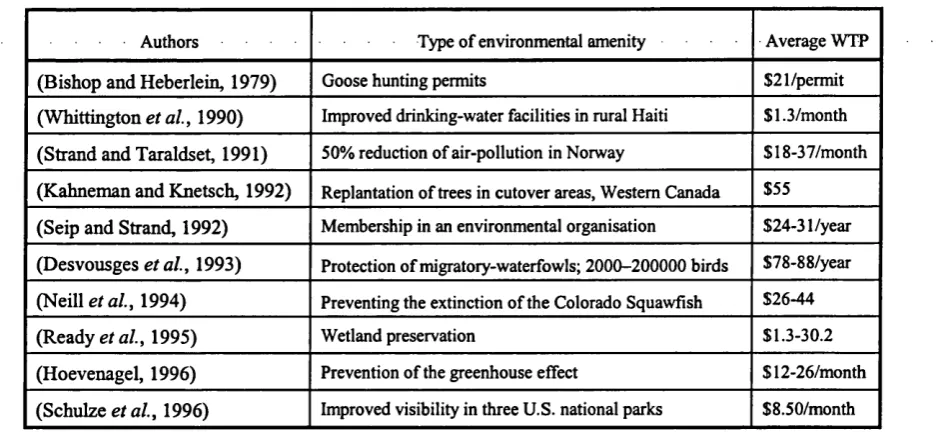
results. Table 1.1. illustrates some examples of CV studies applied to various
environmental resources.
Table 1.1. Examples o f conducted CV studies (WTP implies a one-time fee unless stated)
Authors Type o f environmental amenity Average WTP
(Bishop and Heberlein, 1979) Goose hunting permits $21/permit
(Whittington etal., 1990) Improved drinking-water facilities in rural Haiti $ 1.3/month
(Strand and Taraldset, 1991) 50% reduction o f air-pollution in Norway $ 18-37/month
(Kahneman and Knetsch, 1992) Replantation o f trees in cutover areas, Western Canada $55
(Seip and Strand, 1992) Membership in an environmental organisation $24-31/year
(Desvousges etal., 1993) Protection o f migratory-waterfowls; 2000-200000 birds $78-88/year
(Neill etal., 1994) Preventing the extinction o f the Colorado Squawfish $26-44
(Ready etal., 1995) Wetland preservation $1.3-30.2
(Hoevenagel, 1996) Prevention o f the greenhouse effect $ 12-26/month
(Schulze et al., 1996) Improved visibility in three U.S. national parks $8.50/month
3
In this study, which is possibly the most cited CV study of lost passive use values, a median WTP o f
$31 was estimated among the interviewed respondents (Carson et al., 1992). In another study about rain
forests, people were on average willing to pay between $24 to $31, depending on the question format,
for preserving 110 million hectares o f tropical rain forests. Aggregating these amounts over the total
number o f households in the United States gives a total WTP o f 2.18 and 2.82 billion dollars
respectively (Kramer and Mercer, 1992).
Eventually, the environmental damage-suits brought forward by the federal state and the State o f
Alaska against Exxon settled at $ 1.15 billion, to be paid over a period o f 11 years (Portney, 1994). The
study resulted in a heated debate between researchers regarding the validity o f the methodology, and as
a consequence, the legitimacy o f basing policy decisions and damage liabilities on hypothetical value
[image:25.595.67.537.283.500.2]1.3.1. Structure o f a Contingent Valuation Questionnaire
A conventional CV questionnaire has three parts. Although the order of these differ
across studies, most commonly, the first section is focused on views and opinions
toward the environment in general, as well as items relating to the respondents’ attitudes
and knowledge of the particular amenity that is to be valued. The main purpose of these
questions (apart from illuminating the respondents’ use and experience of the good that
can be valuable input to policy decisions) is to examine the link between WTP estimates
and non-economic opinions, which sometimes are used in order to validate obtained
results. A common assumption is that people who are generally concerned with
environmental issues, and those who have a direct interest in the resource, are willing to
pay more for this.
In the core section of the questionnaire, the respondents are presented a scenario in
which the amenity, its character and terms of provision, are described. The hypothetical
scenario that precedes the valuation question seeks to present sufficient information in
order for the respondents to carefully consider their personal value of the proposed good
or service. This value is subsequently captured by asking how much the respondents are
willing to pay for the specific provision or improvement of the environmental service
(or what they are willing to accept in compensation for a withdrawal or deterioration of
the same), other things being equal. Some important information should be included in
the valuation scenario:
• the good, its qualities and reliability
• when and under what conditions it will be provided
• the payment vehicle, that is, in what way respondents are supposed to pay for it
• who is responsible for providing and maintaining the resource
• how many other people are deriving benefits of the good and thus are involved in
paying for it
There are principally two different ways of eliciting the economic value of the resource.
An Open-Ended (OE) question asks ‘What is the maximum amount you are willing to
be worth to you?’ A Closed-Ended (CE) format, on the other hand, suggests a price to
be accepted or rejected by the respondents. This may take the form of a single
Dichotomous Choice (DC) question in a referendum format where one specific amount
is presented that the respondent is asked to accept or reject, or as Multiple Bounded
(MB) questions, presented either in a step-wise process whereby the amount is
increased or decreased depending on a yes or no answer to the preceding amount, or in
some other manner. In these formats the respondents are presented a question similar to
‘Are you willing to pay x dollars for the environmental service?’, or ‘Would you
support the project if it would cost you x dollars?’5 The valuation procedure is in some
cases aided by an array of questions or items, such as ‘Are you willing to economically
support some or any of these initiatives?’, or, ‘Would you favour a public intervention
of this kind, for example through higher taxes?’
The final section of the questionnaire contains a structured series of questions about
respondents’ socio-economic and demographic characteristics, such as gender, age,
income, educational background, etc. The aim is to trace the determinants of the
dependent variable and evaluate whether these factors explain WTP according to
theoretical assumptions, that is, are consistent with rational choice as postulated in
standard economic theory, or do behave in some other logical manner. This information
is later used as a means of examining the internal validity of stated WTP.
1.3.2. Guidelines and Recommendations fo r Conducting CV Studies
The status of the methodology was significantly enhanced by the commission of a state-
of-the-art assessment in 1983 by the U.S. Environmental Protection Agency, which
included a review-panel of a number of eminent economists and other social scientists.
The overall conclusion of the panel was that the method is a promising tool for future
5 The Open-Ended format is sometimes supported by a ‘payment card’, which contains an array o f
numbers ranging from zero to a large amount. This could either be based on estimated values in a pre
test, or some other relevant benchmark, such as the average household spending on public goods, in
welfare estimation of environmental goods and services, but some important challenges
remain (Arrow et al., 1993). Therefore, future research on the CVM should be given highest priority, and today this assessment combined with later evaluations are
summarised in the NOAA panel’s report on the CVM, which sets out the
recommendations and guidelines on how to carry out a CV study (Arrow et al., 1993). Some of the most important of these are:
• CV studies should be conducted as in-person interviews rather than as telephone
interviews or mail-surveys
• pre-testing of the questionnaire is essential and should include tests for interviewer
effects and other biasing factors
• the scenario must accurately describe the environmental amenity in question, and
the expected effects of the environmental change must be defined in a way that is
relevant for damage assessment
• there should be an adequate time-lapse between the value assessment and the
environmental damage or the project implementation
• a measure of WTP should be elicited instead of WTA
• the WTP question should be posed as a dichotomous choice question in a
referendum context, rather than as an open-ended question
• respondents must be reminded of their budget constraint and possible substitutes of
the environmental resource
• a ‘no-answer’ option should be explicitly allowed in addition to the ‘yes’/ ’no’ vote
• follow-up questions related to the WTP question and the overall understanding of
the procedure should be asked
Apart from some general remarks on survey methodology, what these recommendations
reflect is the establishment of a conservative design. The NOAA panel states that
“generally, when aspects of the survey design and the analysis of responses are
ambiguous, the option that tends to underestimate willingness to pay is preferred”
(Arrow et a l, 1993; p. 4608). The major reason for this recommendation is to avoid the over-assessment of eventual damage liabilities that follow from CV-based welfare
1.3.3. Advantages o f the Contingent Valuation Method
The CVM is located in the category of hypothetical/direct approaches to benefit estimation. Apart from the obvious advantage that it enables a monetary evaluation of
non-marketed public goods and services, three important arguments are commonly put
forward by proponents of the methodology. Firstly, economic value has the advantage
of providing a relative measure of importance; monetary resources are limited, and therefore assumed to prevent an infinite assignment of importance that may result if
other ratings and scales are used. It may further be considered as a widely familiar
metric that does not need extensive explanation to the respondents. Thus, economic
value is assumed to possess some desirable properties compared to, for instance, notions
and scales of attitudes that are invented by the researcher, not necessarily with bearing
in ordinary life, and hence which require additional information about their meanings
and interpretation of relative importance.
Another advantage put forward is the flexibility of the direct hypothetical approach
(Mitchell and Carson, 1989). The CV researcher can easily specify various states of the
good to be valued and the conditions of its provision, and thereby estimate what type
and extent of the environmental resource people want and do not want in the future. The
approach hence allows ex-ante judgements of planned but not yet realised
environmental projects. The resource can further be provided under ‘novel’ institutional
arrangements. Alternative methodological approaches all rely on observed behaviour
among people; either the preferences for the targeted commodity are derived from the
effective demand for another good (implicit markets), or the measures need to be
translated into monetary terms before they can be interpreted within an economic
framework.6 CV studies measure benefits and consumer trade-offs directly in monetary
terms. Thus no complicated transformation of physical measures into economic value,
with the risk of making wrong assumptions about the respondent’s utility function, is
necessary.
6 For example, the price people pay for bottled water may be used as basis for estimating their demand for
O f particular importance, and which has been routinely stressed in the literature, is the
anticipated capacity of the CVM to capture the total economic value of the
environmental amenity (e.g., Mitchell and Carson, 1989; Kopp, 1992). It is hence regarded as a ‘catch-all’ approach. By definition, the total value of an environmental
amenity is constituted by use-value, option-value and existence value. Whereas the
former two refer to a use of the good (either at present or in the future), existence values
arise from the knowledge of the mere existence of a natural resource. An alternative
categorisation that will be frequently used in this thesis separates use from non-use
o #
values, the latter category which incorporates ‘option’ values. Moreover, in a CV
scenario both the present and future benefits are assumed to be intuitively included in
people’s WTP responses, while other methods necessitate the discounting of future
benefits and costs, which involves the difficulty of choosing an adequate discount rate.
Accordingly, the price of the amenity is set after assessing the total and future change in welfare that it represents to people, whereas approaches based on observed behaviour
only capture value related to a present use of the resource.
1.4. Alternative Approaches to Benefit Estimation
Techniques of benefit estimation are distinguished into Stated Preference Methods
(SPMs) and Revealed Preference Methods (RPMs). Whereas the former relies on direct
inquires related to the good or service being valued, for instance through interviews, the
7
An environment confers benefits on users and those who, while not using it directly, are glad that it is
there. A key insight into this is commonly traced back to Krutilla (1967), who argued that there are
people who obtain satisfaction from the knowledge that various environmental resources remain, even
though there is no prospect that they will be exposed to them Thus, even if the individual does not
intend to consume the service, she may still be concerned about its existence (Rosenthal and Nelson,
1992). For instance, there are perhaps a number o f citizens who value and support the preservation of
the Siberian Tiger, although most will never see one or otherwise enjoy any o f its benefits. Existence
values are further separated into bequest values (which pertain to the enjoyment o f a site by others, for
instance by future generations), and intrinsic values (which are unrelated to human use o f the resource).
‘Option value’ refers to the possible future use o f the resource. Thus, although not deriving any benefits
latter extrapolates preferences from market behaviour, or actual choices made in other
relevant contexts. A review of alternative SPMs to CVM and modifications of these
applied in this thesis is provided below. In addition, the section briefly describes various
RPM that sometimes are used in order to validate CV estimates.
1.4.1. Choice Experiments
Choice Experiments (CEs), or Contingent Choice Methods (CCMs), seek to measure
the utility attached to a particular good by presenting choice sets in which the
characteristics or attributes attached to this are varied. They involve asking people to
choose between alternatives in such choice sets, and by modifying the attributes in a
systematic manner, factors influencing people’s choices are highlighted. By explicitly
stating the cost or price associated with alterations of the good, the welfare effect
involved is thus estimable. These methods are similar to the CVM direct hypothetical
approaches to benefit estimation since choices are direct expressions of an individual’s
value, although this is elicited as a discrete rather than a continuous measure. The use of
CEs to estimate economic benefits of natural resources have increased over the last
decade and are considered by its pioneers as more viable approaches to environmental
valuation (e.g., Adamowicz et al., 1994; Hanley et al., 1998).
Among the several advantages of CEs advocated, probably the most important is that
they are less hypothetical in their structure than CVM. Rather than directly asking
people to assess the value of a, possibly, complex and unfamiliar environmental
amenity, they are asked to make choices on the basis of project-like scenarios, a
procedure that is thought to enrich the valuation context. Thus, they differ from CVM
by investigating the trade-offs people are making between alternative scenarios instead
of focusing on a single and fixed outcome. The procedure is therefore believed to be
more realistic; rather than stating a value out of pure invention, respondents are asked to
make judgements between (several) specific interventions and the costs they carry, an
act more similar to ordinary market behaviour (e.g., Mitchell and Carson, 1989).
Moreover, by including private as well as public goods in the choice-set, a comparison
of what people otherwise may achieve or could afford with their monetary budgets is
and the easiness of assessing the value of isolated and specific attributes rather than
complete amenities (Hanley et al., 1998).
Nevertheless, there are two obvious drawbacks of this technique of preference
assessment. Firstly, in order to derive meaningful and fairly continuous welfare
estimates of the amenity and judge how these vary with different levels of the
attribute(s), a considerable number of choice sets must be elaborated. This implies that
the procedure is cumbersome to carry out as long as the choice problem is not simple.
Secondly, research in decision theory suggests that people only have thoughtful or pre
defined opinions on a very limited number of topics (e.g., Harris et al., 1989; Fischhoff,
1991). If presented with many types of issues, or variations of these, an informed choice
may be made between the most and least important issue, but the relative importance of
intermediate items is likely to be arbitrary (Svedsater, 1996). Choices may for this
reason only be meaningful for a limited number of alternatives and levels of attributes.
1.4.2. Multi-Attribute Utility Theory
The methodological techniques developed on the basis of Multi-attribute Utility Theory
(MUT) are similar to CEs in the sense that both attempt to identify and value specific
attributes of a broader and more inclusive good. An important difference is however
that, whereas CEs isolate various physical characteristics, such as the money to be
spent, the type of good and the extent of environmental projects, MUT suggests various
dimensions of value that serve as criteria to evaluate events and justify actions. This
definition stems from research indicating that people form judgements on the basis of a
vast array of motivations (Gregory et al., 1993). These dimensions are further assumed to be shared within a culture or society, and thereby they function as types of social
cognitions that are used in order to organise and make sense of the world (Grunert and
Juhl, 1995). A more pragmatic modification of MUT is provided by Keeney and Raiffa
(1976), which presents respondents with separate aspects and attributes of an event to be
evaluated and that are assumed to reflect different motivational bases.
There are three steps needed in order to categorise the definitions discussed above.
as universalism, conformity, power, or tradition (Schwartz and Bilsky, 1987). These are hypothesised to result in certain interests and objectives among individuals. The
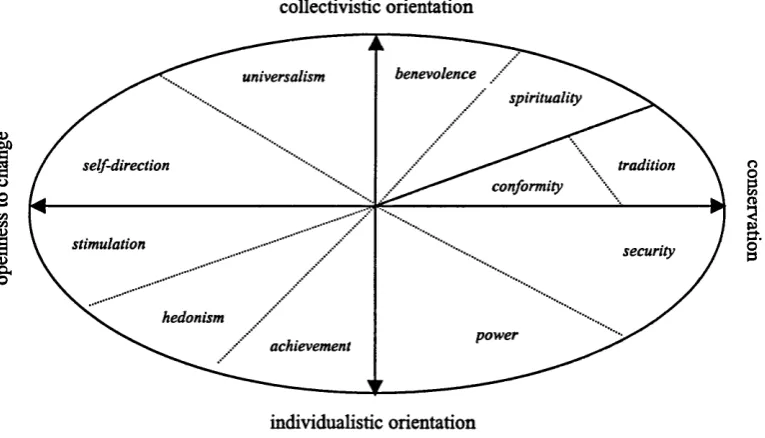
importance of each of these domains is then evaluated for each individual. Finally, a set of individualistic or collectivistic principles that subsequently guide attitudes and behaviour are distinguished.9 Motivations are assumed to be structured in a circular
two-dimensional space as illustrated by Fig. 1.1., with separate regions representing
different value-domains. These are positioned according to what interest they serve; the
‘value-neutral’ individual is situated in the origin of the schema, and the further out
from the centre we move, the more importance is attached to that particular motivational
domain. Adjacent regions in the figure are most compatible, whereas opposite regions
indicate high conflict.
collectivistic orientation
benevolence universalism
spirituality
00
self-direction tradition conformity
stimulation
security
hedonism
pow er achievement
individualistic orientation
Figure 1.1. Relations between value domains and motivational orientation (Grunert and Juhl, 1995).
9
Schwartz and Bilsky (1987) have defined eleven motivational domains that guide value formation; five
are solely associated with individualistic action (self-direction, stimulation, hedonism, achievement and
power), four exclusively linked with collectivistic action (conformity, tradition, spirituality and
benevolence), and two are related to both an individualistic and a collectivistic action {security and
[image:33.595.107.490.362.581.2]Grunert and Juhl (1995) have applied MUT specifically to environmental issues, albeit
not within the context of CVM. Nevertheless, due to the multidimensionality and
complexity of natural resources it seems fruitful to apply MUT and other conceptually
similar approaches as support to CVM. Not only do these serve as tools for improving
the validity of economic values assigned to environmental amenities by allowing for
conflicting views to be expressed, but multiple responses may also prove vital in
learning what motivates individuals in their valuation. They also provide policy makers
with valuable information regarding how people think about and act in relation to these
issues. Although support is measured on a single monetary scale, as in CV studies, by
informing the respondents about underlying objectives, motives and purposes o f
valuation, or by asking them to explicitly consider each of these aspects before a
response is elicited, they may be more capable of making informed decisions about their
WTP.
1.4.3. Revealed Preference Methods
These methodologies are based on observations of actual choices and behaviour among
the public. They are distinguished into Observed/Direct (OD) or Observed/Indirect (01)
methods. Some rare examples of OD methods are found in simulated market
experiments (e.g., Bishop and Heberlein, 1979), and so called ‘parallel’ markets. The latter approach implies that preferences are derived from the prices of another but
similar good that is marketed. An example is to estimate the economic value of a lake
on the basis of fishing licenses. However, there are few instances when the marketed
good encompasses exactly the same benefits as the targeted amenity. For instance, in
the above example we may argue that fishing permits capture some but not all utility
aspects of the targeted resource.
In 01 methods the value is inferred from another good to which the amenity has an
established link. One example is hedonic pricing. The price of a property, say a house or
a piece of property, reflects the value of a variety of facilities and benefits, including
communications, access. to schools and, possibly, environmental qualities. If two
properties are very similar on all but the latter aspect, the one with a higher