Bermudian Educators' Perceptions of the Roles and Functions of School Psychologists
By
Lana V. Talbot University of East London
Abstract
A sequential mixed-method study was used to explore educators’ views of the services provided by school psychologists in Bermudian schools. The views of teachers (regular and special education) were compared with the views of principals. The aim of the study was to determine the extent to which the current services of school psychologists are helpful to teachers. The findings of this research provided information about aspects of the school psychologist’s role that are perceived by teachers and principals as providing the best outcomes for students, and as ensuring the accountabilty of effective services in Bermuda’s education system. Results of this study influenced decision-making and policy formation through the provision of
empirically-driven feedback regarding the school psychology programme.
A randomized sample of participants was selected from the regular and special education teachers and principals from the 26 public schools in Bermuda. A revised version of the School Psychology Perception Survey (SPPS), developed by Gilman and Gabriel (2004), was used to assess participants’ (1) knowledge about school psychology services, (2) satisfaction with school psychology services, (3) and helpfulness of school psychology services, as well as (4)
participants’ future desired roles and functions of school psychologists. The survey also asked participants to identify the activities engaged in by the school psychologists that they viewed as most important. Responses of teachers were grouped according to their years of teaching experience, and then how often they utilized the services of the school psychologists.
From: TurnitinUK No Reply [[email protected]] Sent: Monday, February 17, 2014 8:50 PM
To: Lana Viomme TALBOT
Subject: This is your TurnitinUK Digital Receipt
Dear LANA TALBOT,
You have successfully submitted the file "Bermudian Educators Perceptions of the Role and Function of School Psychologists" to the assignment "PhD Thesis SUbmission" in the class "Psychology Noticeboard" on 18-Feb-2014 02:50AM. Your full digital receipt can be downloaded from the download button in your class assignment list in Turnitin or from the print/download button in the document viewer.
________________________________ Thank you for using TurnitinUK, The TurnitinUK Team
Submission Info
SUBMISSION ID 30235662
SUBMISSION DATE 18-Feb-2014 02:50AM
SUBMISSION COUNT 1
FILE NAME les_and_functions_Feb_...
FILE SIZE 6.34M
CHARACTER COUNT 236101
WORD COUNT 40979
PAGE COUNT 183
ORIGINALITY
OVERALL 23%
Internet 14%
Publications 16%
Student Declaration form
Student Name Lana V. Talbot
Student Number: 100269
Sponsoring Establishment: N/A
Degree for which thesis submitted: Doctoral Educational and Child Psychology
Concurrent registration for two or more academic awards: (* Please complete/delete as appropriate)
* I declare that while registered as a research degree student at UEL, I have
not been a registered or enrolled student for another award of this university
or of any other academic or professional institution
Award title: Doctoral Degree in Educational and Child Psychology
Material submitted for another award: (* Please complete/delete as appropriate) * I declare that no material contained in the thesis has been used in any other
submission for an academic award
Award and Awarding:
Doctoral degree in Educational and Child Psychology
Acknowledgements
The successful completion of this dissertation would not have been possible without the assistance and support of others. The author wishes to acknowledge the following individuals for their significant contributions to this study. I could not have completed this enormous task without them.
Special thanks to Dr. Mark Fox, my Advisor and Chair of the Dissertation Committee, who provided the continuous assistance and guidance essential for the successful completion of this dissertation. Even when I did not believe in myself, he encouraged me on and provided me with positive motivation.
The stress which inevitably accompanies the entire dissertation process could not have been managed without the love and support provided by the members of my immediate and extended family. Thanks to my family members who endured and sustained me through the numerous sacrifices inherent in this process. Also, special thanks to my sisters Marva and Kathie for their lifelong support and confidence in my ability to accomplish what I had set out do. Special thoughts of my pet Mia whom did not live to see the end of this journey, but inspired me daily. Special thanks to my lifelong friend, Dr. M. Smith, who was truly my source of
motivation and encouragement every step of the way, and who believed that I could complete this journey.
TABLE OF CONTENTS
CHAPTER 1. INTRODUCTION
Background .………...1
The Bermuda Education System………3
The School Psychological Services in Bermuda ………..5
The Research ……….7
Positioning as a Theoretical Perspective ………7
CHAPTER II. LITERATURE REVIEW Introduction to the Literature Review………11
Systematic Literature Review………12
Table 2:1 on Inclusion and Exclusion of Literature Review………...14
Historical Overview of the Roles and Functions of the School Psychologist………...15
The Legislative Impact on Role and Functions of School Psychologists ……….17
Perceptions of Regular Teachers …………...20
Perceptions of Experienced vs. Less Experienced Teachers………23
Perceptions of the Traditional Roles, Helpfulness and Value of School Psychologists....27
Perception of Special vs. Regular teachers………....32
Conclusion ………35
Overview of Perceptions of School Principals in the USA………...36
Perceptions of Services Valued by School Principals ………...………...39
Conclusion ………44
Current Perceptions of the Roles and Functions of School Psychologists in the UK .……...45
Perceptions of Psychological Services Valued by Educators in the UK………...49
Perceptions of Roles and Functions in Other Countries………....52
Perceptions of Educators in Australia………...52
Perceptions of Educators in Norway ………56
Perceptions of Educators in Various Countries……….57
Conclusion……….59
CHAPTER III. METHODOLOGY Purpose of the Research ………....62
Research Design ………62
Quantitative Research Questions (Phase 1)………...63
Qualitative Research Questions (Phase 2) ………...64
Diagram of Sequential Exploratory Mixed Method Diagram ………..65
Conceptal Theoretical and Epistemological Frameworks ...…....……….65
Participants - Phase 1………67
Participants – Phase 2… ..………67
Qualitative Sample Size ………...68
Ethical Issues - Phase 1 ……….69
Ethical Issues - Phase 2 ……….70
Data Collection ……….70
Phase 1: Quantitative - Survey……….. 71
The Instrument ………. 72
Validity and Reliability of the School Psychologists Perception Survey (SPPS) ..……… 74
Data Analysis ………78
Quantitative ………...78
Preliminary Analysis ……….78
Research Questions………79
Qualitative ……….83
CHAPTER IV. FINDINGS Quantitative Results ………. 85
Data Screening ………. 85
Demographics of Respondents ……… 85
Research Questions ………...96
Qualitative Results ………..107
Research Questions ………...107
Interview Questions ………....107
Summary of Findings………...121
CHAPTER V. DISCUSSION Introduction……….124
Quantitative and Qualitative Results …………...………..125
Limitations of Study ………...139
Implications for Further Research ………..141
Implications for Practice ……….142
Conclusion ………..144
Appendices
Appendix A. Table 5.1 The Importance Index of Psychological Services …...………...164
Appendix B. Table 5.2 Counselling vs Psychology Services ……….………..165
Appendix C. Ministry of Education Letter of Request ……….. 166
Appendix D. Letter of Approval from the Ministry of Education ………..168
Appendix E. Letter for Educators ………...169
Appendix F. Ethical Approval from the University of East London ………..171
Appendix G. Reminder Letter to Educators ……….. 172
Appendix H. Statement of Purpose and Confidentiality – Focus Group ………173
Appendix I. Informed Consent Statement Attached to Survey……….. 175
Appendix J. Process of Thematic Analysis for Focus group ………..176
Appendix K. School Psychological Perception Survey………...192
CHAPTER I INTRODUCTION
Background
Over the last few years, the Bermuda Education System has undergone various changes, most recently in 2007 when the Bermuda Ministry of Education conducted a review of the Bermuda public education system. The study was conducted by Dr. John
Hopkins and his team, two of whom were Bermudian educators. As a result of this study,
the Review of Public Education in Bermuda was published. The reviewer’s brief was to
evaluate the effectiveness of public education in Bermuda by (a) identifying strengths and
areas for improvement, (b) providing evidence for a thorough reform of the public
education system; and (c) using a transparent methodology with very clear
recommendations for action that would result in rapid improvement of this sector of
government within a short period of time (Hopkins, Matthews, Matthews, Wood-Smith,
Olagjde & Smith (2007). Two of the most significant findings of the study were that (a)
there is a greater need for accountability across the system, and (b) there is a need for
improvement in teaching.
A more recent evaluation of special needs education within the Bermuda school system was conducted in 2010 by Bermuda’s Ombudsman, Arlene Brock (Ombudsman for Bermuda Interim Report, 2010). This evaluation emanated and derived from a parent who expressed concern to Brock regarding the provision of education and support for students with special education needs. Brock conducted an investigation into the
period from August 1, 2010 to December 31, 2010. The parent maintained that the Ministry of Education had failed to provide an adequate education in Bermuda for her special needs child, in accordance with the Education Act 1996 and the National Policy on Disabilities. As a result of this review, Brock recommended that the Department of Education develop a “Special Education Policy” to comply with both the Education Act 1996 and the National Policy on Disabilities. The Ministry of Education agreed with the recommendations of the Obmbudsman. As a result, the Ministry of Education
commissioned the government’s Department of Internal Audit to identify important gaps that needed to be addressed in the provision of appropriate special education for
Bermuda’s public school students. As of this writing, the Ministry of Education is in the process of drafting a Green Paper on Special Education to determine the final policy and the subsequent likely legislation.
The development of this new special education legislation has implications for the role of school psychologists. Special education legislation often can have a great influence on the roles and functions of the school psychologist (Reschly, 2000). Hopkins et al. (2007) had reported that the process of assessing and making decisions regarding students’ needs did not always involve input from school psychologists at various schools. There apparently was no agreed-upon criteria in Bermuda for determining whether or not a child has learning difficulties, or whether he or she is simply hard to teach. Thus, the findings of Hopkins et al.’s study suggest that teachers and
particularly in regard to special education eligibility decisions, and in supporting the development of children. Consequently, this research evaluated the school psychologists’ programme as to its ability to meet the needs of teachers and students, and to what extent psychological services are meeting the needs of the school system in Bermuda.
The Bermuda Educational System
There is a sense of urgency for the Bermuda Public School System to deliver a 21st-Century education, which ensures that students will be able to compete locally and globally (Blueprint to Education, 2009). The Bermuda government’s educational system originated from the Schools Act of 1879, and is based on the traditional British pattern. The Education Act of 1949 established the right of all children within, what was then, the compulsory school age of 7 to 13, to receive free primary education. By 1969, the
compulsory school age had expanded to 5 to 16, and all children within that age range were entitled to free primary and secondary education. A revision of the Education Act was passed in 1985, and was more recently (1996) amended to entitle children to remain in secondary school up to the age of 19 years, in order to complete the secondary
programme. The Education Act of 1996 is the most recent Education Act reflecting all the changes over the years in Education.
children in Bermuda.At the senior level, students enter one of two public schools, both of which are considered state-of-the-arts facilities, given that they have been constructed within the past 10 years. Prevocational and technical education is provided to students studying in the general secondary schools. The Bermuda Education System has adopted the Cambridge International Curriculum in the three core subject areas of English, Mathematics and Science (Blueprint to Education, 2009).
Bermuda closed all special schools during the late 1980s and early 1990s, and adopted the model of inclusion to provide services to children with special needs. All students, with the exception of those with complex needs, are now educated in regular classroom settings. Support for these students, in the form of learning support teachers and para-educators, has been put in place in order to increase the opportunities for the success of the students. Special education provides a continuum of services that are appropriate to the range of individual needs of the students concerned.
In 2000, the Ministry of Education undertook a survey of parents of students with
severe-to profound needs to assert if they believed their children’s needs were best
addressed within regular school settings. The survey indicated that parents had mixed
feelings about how well their children’s needs were being addressed. As a result, the
Minister of Education put forward a recommendation to establish a special school for this
particular population. The students who have a number of disabilities, physical and
sensory, are assisted in a specifically unique and better-equipped school, named the
“Dame Marjorie Bean Hope Academy.” This special school was established in 2003, and
curriculum which places emphasis on developing personal living skills, communication skills, career/vocational skills, community skills and recreation/leisure activities. Formalized instruction is offered to students in reading and math. Students with more intensive needs participate in a program that focuses on sensory skills, communication, socialization, gross and fine motor skill development.
The School Psychology Services in Bermuda
Throughout this dissertation, the term school psychologist is used to refer, not only to educational psychologists, but also to other titles used by psychologists working in schools in different countries around the world. At present, school psychologists are primarily employed within the division of Student Services, by the Bermuda
Department of Education, Bermuda government. The Department of Education’s job description for school psychologists requires that a psychologist have a minimum of a Master’s degree in School Psychology or a related field. School psychologists have specialized training in both psychology and education (School Psychology Handbook, 2004). School psychologist training can be undertaken in the United States, Canada, United Kingdom or another country; however, the programme must be accredited in School Psychology and meet the requirements of the Bermuda Psychological
Practitioners Act 1998. School psychologists must be eligible for registration in accordance with the Bermuda Psychological Practitoners Act 1998.
service delivery model for meeting the needs of the schools (School Team Process Handbook 2002). Psychologists work in families of schools that are divided into five zones on the Island. Five of the psychologists provide services to seven or eight schools, ranging from preschool to middle school. One psychologist provides services to the two senior high schools in Bermuda. In 2011, the Minister of Education and Commissioner of Education recommended that school psychologists be moved from a central office location within the Department of Education, and placed in schools within the five zones, in order to provide more direct support to schools.
The Research
The aim of this research was to understand the perceptions of educators (teachers and school principals) regarding the role of school psychologists. Due to the fact that special education teachers make the majority of student referrals to school psychologists, it is vital to consider and understand how the teachers perceive the effectiveness of the service given to the students in their schools. If teachers have an understanding of the work that psychologists do, they are more likely to value that work – and not to have alternative expectations (Farrell, Jimerson, Kalambouka & Benoit, 2005). According to Reger (1964), one of the significant factors affecting the efficiency of the school
psychologists is the teachers’ attitude towards the school psychologists and their perception of them.
Positioning as a Theoretical Perspective
This study uses the discursive lens of positioning theory as its theoretical
contribution to the understanding of educators’ perceptions of the role and function of the school psychologists and how psychologists view their own roles. How the educators view the role of the psychologists can be viewed as part of a relational process, whereby perceptions are created through social interactions that they have had with the school psychologists. Within a social constructionist paradigm, positioning theory is a
conceptual and methodological tool by which to study how psychological phenomena are produced in social relations or interactions (Harre & van Langenhove, 1999).
features: the participants’ rights and duties or moral positions, their conversational history or sequence of interactions, and the specific dynamic of that one single episode. This study focuses on the dynamics of episodes involving educators’ interactions and perceptions of the school psychologists’ role and functions. Educators’ perceptions of the roles and functions of the school psychologists in social interaction can be interpreted in terms of how they are positioning the school psychologists and how school
psychologists position themselves.
Often there can be a pattern, or history, of similar positions that fit the concept of role, positioning theory allows for people to position, or to be positioned, variably with the course of social interactions. Harre and van Langenhove (1999) believed that the concept of ‘positioning’ has been highlighted as an alternative to focusing on the role of the psychologists as something static; but rather, it is more important to review how school psychologists’ position themselves, and are positioned by others, to act in particular ways within a continually developing larger context of society.
Fox (2013) further suggested that educational psychologists’ (EPs’) positioning takes place within a moral world, as does the positioning of the other applied
psychologists and other professionals. EPs have clusters of moral and ethical beliefs about their rights and duties on particular contemporary issues. Positioning theory, however, suggests that such moral and ethical positioning is local and transitory, in terms of the immediate social world, and is interconnected with the positions that others hold. However, Fox (2013) proposed that this moral right of any position can be challenged, which can often result in EPs’ having to position and reposition themselves, in light of conflicting moral positions changing.
the problem lies within the child. Fox (2013) believed that there is an explicit or implicit moral position that EPs attach to their positions, which is often difficult for them to change. Often, the EPs’ moral standings have shifted and changed to best meet the needs of the wider society.
The importance of positioning theory for this research is that it recognises that the role of the EP is dynamic and subject to a variety of influences. How Bermudian
educators view the role of the psychologists can be viewed as part of a relational process, whereby perceptions are created through social interactions they have had with the school psychologists. These social interactions happen within both personal moral frameworks and larger society influences. As these all shift and change, so will the perceived
CHAPTER II
LITERATURE REVIEW Introduction to the Literature Review
In this chapter, a review of relevant literature is presented as background to this research study. The roles and functions of school psychologists today are considerably more complex than in the past. A brief overview of the research studies from very early years to the present will be presented. Following this, a detailed critical review of the diversity in role and function of school psychologists in the United States, United Kindgom and other countries will be examined. The literature review will also examine the differences between teachers’ and administrators’ (head teachers’) perceptions of the roles and functions of school psychologists, and typically how teachers utilize
educational support services available to them through the school psychologist. These studies have been conducted over a period of more than 50 years, and their findings help to provide an understanding of how the functions and positioning of EP services have changed and will continue to change.
Systematic Literature Review
A systematic literature review exploring previous research into Educators’ perceptions of the role and functions of School psychologists and the history of school psychology was conducted.
The initial literature search on “the history of school psychology in the USA and UK” produced 18,517 records. This was narrowed down to 3,898 studies and further reduced down to key studies. . This initial search was conducted using EBSCO
databases which included ‘Psycinfo’, ‘Academic Search Complete’, ‘Education Search Complete’, ‘PsycArticles,’ and ‘Teacher Reference Center’. Only peer reviewed journals were selected. This initial search used the terms, “history of school
psychology”, “role and function”, “traditional roles”, and “educational psychology”. Most of the research studies reported an overview of the historical aspect of the development of the role and function of school psychologists. The studies also
highlighted the concerns around the value, changing roles, traditional roles, and barriers to school psychology role and function as well as the perceptions of school psychology.
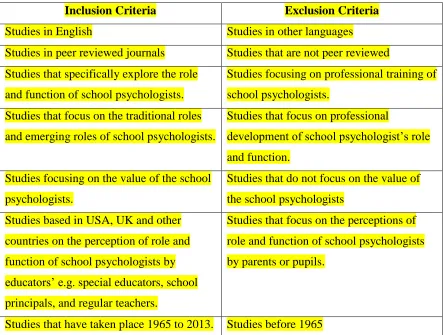
psychology in the USA and UK’. This identified 15 books on the history of school psychology and the role and function of school psychologists. Additional books were identified from the review of research articles. Applicable studies were selected in reference to the following inclusion and exclusion criteria is outline on Table 2.1
A third stage of the review focused on articles published between 1965 and 2013 on ‘Teachers and Educators perception of school psychologists’ role and functions’ in the USA. The search was conducted using EBSCO databases which included ‘Psycinfo’, ‘Academic Search Complete’, ‘Education Search Complete’, ‘PsycArticles,’ and
‘Teacher Reference Center’. Only peer reviewed journals and reference were selected. Initial searches using the terms, “perceptions of school psychology”, “attitudes”,
“perceptions of role of school psychology by special educators/teachers/educational personnel. This yielded a total of 20 articles - 17 of which were relevant. A detailed in-depth reviews of the 9 landmark studies based in the USA were discussed on teachers’ perceptions of school psychologist’s role and function, while 8 articles were reviewed in-depth on school principals and administrators’ perceptions.
A final search was done to look at articles published between 1965 and 2013 on the perception of the roles and functions of school psychologist in the UK and other countries. The search was conducted using EBSCO databases which included ‘Psycinfo’, ‘Academic Search Complete’, ‘Education Search Complete’, ‘PsycArticles,’ and
school psychologist’s role and function. In addition 4 articles were reviewed in-depth on school principals and administrators’ perceptions in other countries.
[image:24.612.103.546.248.583.2]The general inclusion and exclusion criteria for all the above searchers are outlined in Table 2.1. below.
Table 2:1 Inclusion and Exclusion Criteria
Inclusion Criteria Exclusion Criteria
Studies in English Studies in other languages
Studies in peer reviewed journals Studies that are not peer reviewed Studies that specifically explore the role
and function of school psychologists.
Studies focusing on professional training of school psychologists.
Studies that focus on the traditional roles and emerging roles of school psychologists.
Studies that focus on professional
development of school psychologist’s role and function.
Studies focusing on the value of the school psychologists.
Studies that do not focus on the value of the school psychologists
Studies based in USA, UK and other countries on the perception of role and function of school psychologists by educators’ e.g. special educators, school principals, and regular teachers.
Studies that focus on the perceptions of role and function of school psychologists by parents or pupils.
Studies that have taken place 1965 to 2013. Studies before 1965
Historical Overview of the Roles and Functions of the School Psychologist Over the years, the role of the psychologist has changed since its professional beginnings. The roles and functions of the school psychologists today are considerably more complex than in the early years. Consequently, a diverse number of roles have been assigned to school psychologists over the years. Researchers have written
extensively on the changing role of the school psychologist for more than over 50 years, and offered consistent ideas for change, generally to expand the role beyond that of assessment of special education to include more emphasis on prevention and intervention, among other services (Bradley-Johnson & Dean, 2000). Franklin (1995) proposed that the role of the school psychologist has evolved from that of direct services provider, which incorporates the more traditional diagnostic, consultative, and therapeutic functions, to one of indirect services provider, which tends to encompass the system-level consultative functions of policy development and overall evaluation of service delivery models.
The traditional role involved school psychologists’ spending most of their time in testing, writing reports and responding to referrals for special education eligibility
(Abidin, 1996; Reschly, 2000; Gutkin, 1980). Reschly (2000) indicated that, although the traditional role of the school psychologist will continue, broader roles will
prevention programs, workshops and administerng psychological assessments (Abidin, 1996. Reschly, 2000; Gutkin, 1980).
According to Fagan (2000), by the 1920s early psychological practitioners in the USA worked under several titles and practiced a generic form of clinical psychology, relating to the problems of individuals. Fagan (2000) reported that school psychologists were primarily responsible for determining special education eligibility through the examination of the results of standardized tests of cognitive ability and academic
achievement. Fagan (1992) stated that, even as early as the 1920s, the assessment role of the school psychologist was firmly established. School psychologists were also often viewed as psychometrists, whose role was to interpret the statistical results on cognitive tests, in order to assess a student’s cognitive functioning (Davis, McIntosh, Kehle & Phelps, 2004). In the 1930s, some states began to estabish certification requirements for school psychologists, and the traditional assessment role was beginning to be expanded to one of “mental health specialist” (Gray, 1963). Fagan and Wise (1994) reported that, in the 1940s, the main role for psychologists continued to be that of psychometrician, administering assessments to determine intelligence quotient (IQ score) and achievement scores, for the main purpose of determining Special Education eligibility (Fagan, 2004).
testers. Fagan and Wise (1994) reported that, during the 1970s, there was a growing increase in school consultation and organization/systems development, but slowly the psychologist’s role seem to fall back into the traditional models of asssessment.
Sheridan and Gutkin (2000) indicated that role expansion of the school psychologist lies at the feet of federal special education legislation, which has been a powerful force in mandating some of the roles of school psychologists. During the 1980s and 1990s, there began to be more of a role expansion and a strengthening of the
consultative role through the process of training, and a demand for improvements in the credentials of the school psychologists (Smedley & Wheeler, 2009). A new emphasis on role expansion was beginning to take shape amongst school psychologists and Fagan and Wise (1994) affirmed that two major factors had an impact upon the changing role of the school psychologists in the United States. The US, and other countries, had
legislation and educational health care reform initiatives, both of which had contributed to the restructuring of school and other public agencies. Fagan and Wise (1994) argued that, despite the role expansion, the major role of the school psychologist continues to be connected to special education students, programs, and teachers, just as it has been for the past 60 or more years. Reschly (2000) proposed that, while the traditional roles will continue, the expansion of alternative assessment procedures and consultative processes will begin to open the door for school psychologists to utilize their other abilities to a greater degree.
psychologists are recognised as having an important and highly valued role within schools (Farrell, Jimerson et al; 2005; Gibson, 1990). However, often a common problem is that there is lack of clarity and understanding amongst educators, and amongst psychologists themselves, regarding the roles and functions of the school psychologists (Gibson, 1990; Jacob-Timm, 2002).
The demand for clarity about the role of school psychologists is partly due to the high level of accountablity demanded within the educational system. In cases where educators do not understand the roles and functions of school psychologists, it can often lead to barriers to school psychology practice. Farrell, Woods, Lewis, Rooney, Squires, and O’Connor (2006) have shown that good working relationships and clear
communication can provide an understanding of the services that the psychologist can provide, and prevent such barriers from occurring. Another barrier is that there exists a misunderstanding of ethical issues involved in the provision of psychology services. Glosoff and Pate (2002) argued that, when educators do not understand the role of school psychologists, they often demand certain practices of the psychologists that could be deemed unethical; such as, releasing confidential information about a student.
In the USA, the legislation that has exerted a great deal of influence over the roles and functions of school psychologists in the 2000s and beyond consists of revisions to the Individuals with Disabilities Education Act of 1997 (IDEA, 1997). The act revised the special education regulations regarding procedures for evaluating children suspected of having specific learning disabilities (Individuals with Disabilities Education Act of 2004 [IDEA, 2004]).
Gilliham (1978), Dessent (1992), and Frederickson (2002), reported that
educational psychologists (EPs) in England have an almost enduring preoccupation with reflecting on their roles, due to the differences in role requirements among counties, and within counties, regarding services and the positions of individual EPs. Boyle and
Lauchian (2009) reported that today’s EP faces a number of challenges; such as increased accountability and the introduction of Best Value Reviews in Scotland and HMIE (Her Majesty’s Inspectorate of Education) inspection of psychological services. In England, the implications of Every Child Matters (ECM) Department of Education and Skills (DfEE, 2002), and the change in the training of EPs from a one-year Master of Science (MSc) degree to a three-year doctoral degree have also led to changes in the role.
In the UK, the implementation of the Every Child Matters (ECM) legislation epitomizes, for educational psychologists (EPs), the most significant national strategic development since the publication of the DfEE (2000) report on the role of educational psychology services. The ECM agenda makes outcomes for children central to integrated children's services that form a team around the child and family in the context of
main areas. This new and rapidly changing context presented challenges and opportunities for the evolving role of the profession of educational psychology.
The DfEE Report and Farrell, Woods et al. (2006) recognized that the core functions of the EP’s work occur in the following domains: (i) work with early school years, (ii) work with schools (primary, secondary and special), and (iii) multi-agency work. Moreover, this work is to be done at the following levels: (a) the individual child level, (b) the groups of children level, (c) the whole-school level, and (d) the local education authority LEA level. The findings described in the DfEE (2000) report on the roles and functions of educational psychologists changed the direction of EPs’ work. The findings led to the recommendation that there be an integration of children’s services that form a team around the child and family in the context of community and school. The impact of these changes on the future roles and functions of educational psychologists in the future suggested that EPs were more likely to become more community-focused, with a reduction in school-based work (Farrell, Woods et al., 2006).
Perceptions of Regular Teachers
Many surveys have been done to examine the perceptions of teachers regarding the roles and functions of school pscyhologists. Despite the changes, outlined above, within the profession’s perceptions the review of the literature indicates that there is some consistency among teachers of their perceptions on the role and function of school
psychologists
role functions of school psychologists by means of a questionnaire. The educators were required to rate their desired roles, actual roles, or the potential roles of the psychologist on a 7-point scale on a continuum. All the school psychologists in the state of Iowa (N =135) were invited to take part in the study. A randomly selected sample of elementary school teachers from 21 of the largest school districts in the state of Iowa were also invited to participate. The return rate was fairly high. From 315 teachers, there was return rate of 94%, and from the total number of school psychologists there was a return rate of 74%.
Robert’s study revealed that the psychometric role was seen by both school psychologists and teachers as the most important function; however, to varying degrees. Robert (1970) found similarities between school psychologists’ own perceptions of their actual and desired roles and teachers’ perceptions of the actual and desired roles of school psychologists. Psychologists and teachers differed somewhat in their opinions of the functions that school psychologists should perform. The psychologists felt that they could spend less time in this role of psychometric, whereas teachers felt that, not only is the role important, but that more time could be spent in this particular activity.
Gilmore and Chandy (1973a and 1973b) conducted two landmark studies in the U.S. that examined educators’ perceptions of the roles and functions of school
psychologists. The goal of the studies was to explore teachers’ perceptions of what school psychologists actually do, their competencies, and teachers’ recommendations for change. Gilmore and Chandy also examined if the actual degree of contact and teaching experience teachers had with psychologists influenced their views on school
psychologists roles and function. The first study (Gilmore & Chandy, 1973a) consisted of structured interviews with 34 teachers from two elementary schools regarding their perceptions of school psychologists’ roles and functions. The first part of the interview included five open-ended questions which allowed teachers time to describe their perceptions of the school’s psychometrists and psychologists. The other part of the interview consisted of 26 specific questions which required teachers to select a single response on a five-point scale.
with more experience reported greater teacher-psychologist contact than less-experienced teachers did. The more-experienced teachers also expected more from school
psychologists than just recommendations, and credited the psychologist with actually conducting the treament more than did less-experienced teachers.
A limitation of Gilmore and Chandy’s first study was that the sample size was small, despite 97% of educators’ taking part in the small group interviews. The sample was representative of only two schools, and there were no comparisons of the economic status of the school. The authors stressed that that principals and psychologists were not included in this research, and as a result no comparison of role perceptions between the groups could not be done.
Perceptions of Experienced vs. Less-Experienced Teachers
Gilmore and Chandy’s (1973b) second study, however, examined the perceptions of teachers, school psychologists and school principals based upon their years of
experience. They evaluated the effects of school size and economic status on the perceptions of the psychologists’ role. They conducted the study in nine schools, of which five schools were located in an upper middle-class area, and four were located in an economically challenged area. A total of 87% of the educators, 7 of the 9 school prinicpals, and all 12 school psychologists completed a questionnaire. The questionnaire was group-administered by a staff member for each school, and it consisted of 37
multiple-choice questions, each of which used a 5-point scale and allowed for anonymity. Teachers were grouped according to years of teaching experience and the degree to
Results indicated that perceptions of differences among the three groups existed. Teachers of varying experience agreed on the type of child who most needs
psychological referral. Teachers also pointed out that the perceived role of psychologists was mostly that of testing. The moderately experienced and senior teachers, in
comparison to less-experienced teachers, expected the psychologist to conduct
assessments and talk with the school principal in response to a referred problem. Further, results indicated that teaching experience affected perceptions of type of treatment likely to occur as a consequence of the psychologist’s involvement. Less-experienced teachers expected less curricular change than moderately experienced teachers. Senior teachers perceived that psychologists’ involvement would lead to recommendations which might include the referral of parents to a counseling programme, exclusion, or the child’s being placed outside the regular class. Teachers with less teaching experience had just the opposite perception, and believed that psychologists’ involvement would lead to more utilization of special in-school programs, such as language learning support. Overall, moderately experienced teachers, in comparison to more experienced teachers, frequently perceived the pschologists as helpful to the child and teachers.
An interesting finding of Gilmore and Chandy’s second study was that teaching experience itself apparently was not related to the way in which the psychologist was viewed. Instead, the prior use of the psychologist was found to be a significant factor that affects the teachers’ perceptions of the psychologist in the specific role of test
administrator, in comparison to the more general role of psychoeducational consultant. Teachers who had frequent contact with the school psychologists perceived the
psychologist contact considered the psychologist to be of greater help to children than did those teachers who had more contact with the psychologist.
However, the study indicated also that principals and psychologists view the pschologists as a consultant more often than do teachers. The principals also felt that the school problem had to reach a high level before the school psychologist was called in, while teachers did not. Principals and psychologists attached greater skills and knowledge to the psychologist than did the teachers in the study.
The following studies examine the value that educators place on the role and functions of school psychologists. In their second study, Gilmore and Chandy differentiated in their sample to ensure they represented different types of educators (including psychologists). This study also allowed for additonal factors to be measured, thus ensuring that a variety of factors that impacted on the roles and functions of
‘very important’ on a 5-point Likert scale. For example; a question required educators’ to rate how valuable the services were to them on a five-point Likert scale.
The research revealed that teachers viewed the psychologist’s most important functions to be screening students for placement in special education, conducting psychodiagnostic evaluations, and counseling students. Teachers who reported using ‘open education’ methods were significantly more likely to value more indirect, preventive, and collaborative school psychology services than their colleagues. Grade level taught, gender, experience, and teaching specialty had virtually no effect on respondents’ ratings of the school psychologists’ roles. In other words, there were no significant differences among the teachers at different experience levels in their ratings of each school psychologist role. There were no differences among special education teachers, English, social studies and/or reading teachers, and nonacademic or speciality area teachers (physical education, industrial arts, home economics, art, music, business). This indicates that curriulum areas were not a significant determinant of teachers’
preferences for school psychologists’ role. The researchers concluded that teachers viewed the most crucial role of school psychologists to be conducting assessments. A limitation of this study was the low return rate of the questionnaires. Further, the sample was representative of only one school district, and therefore the study may not be
Perceptions of the Traditional Roles, Value and Helpfulness of School Psychologists.
Several studies were conducted to examine Educators perception of the traditional roles and helpfulness of psychologists over the years. Abel and Burke (1985) developed the School Psychological Service questionnaire and analyzed responses from regular education teachers, special education, principals, and school psychologists in an urban southwest district in the US. Items for sections (c) and (d) were adapted from Gilmore and Chandy’s questionnaire (1973). The questionnarie was designed to examine educators’ perceptions in the following areas: a) allocation of time by school
psychologists, b) knowledge possessed by school psychologists, c) school situations in which school psychologists should become involved, and d) overall helpfulness of school psychologists.
Abel and Burke’s (1985) study also revealed that educators believed that the primary, or traditional, role of school psychologists should be that of diagnosis/evaluation and report-writing activities. Educators believed that the traditional role of the school psychologists should continue to be the primary responsibilities of the school
psychologists. The educators placed high value on assessment services. In contrast, the school psychologists expressed a desire to move away from a ‘stereotypic psychometric role’ (Sewell, 1981), in order to provide more consultation and counseling services. The teachers and administrators recommended that additional staff should be hired as a way to provide more, or more frequent, school psychological services. Knowledge ratings across the groups differed, due to the role demands placed on school psychologists by teachers, special educators, and school principals. Abel and Burke believed that teachers rated the knowledge of psychologists relatively lower than those of the school principals, because they perceived the school psychologists to be psychometric gatekeepers
primarily serving the interests of administrators. The fairly higher ratings by the principals in comparison to those of regular and special education teachers seem to confirm this finding.
More recent studies by Watkins, Crosby and Pearson (2001), and Gilman and Medway (2007), however, have indicated that educators’ perceptions of the school psychologist has not changed very much. Watkins et al. (2001) analysed 522 school staff situated within a southwestern school in a suburban area in the USA about the specific roles of school psychologists. The return rate was 42.8%, and included 419 regular education teachers, 18 administrators, 52 special education teachers and 33 support staff. The staff were asked questions regarding the necessity of varying school psychology services – nine in total. Watkins designed a questionnaire in which the educators had to rate the school psychologists on a five-point scale. School staff gave ‘important’ ratings to six of the nine services: counselling, assessment, special education input, behaviour management, consultationand crisis intervention with assessment being rated as the most important role. School-community liaison and parental education roles were viewed as only ‘fairly important,’ and staff development was voted ‘least important’, with the most frequent answer being ‘somewhat important.’ School staff also wanted a school
psychologist to be available on a daily basis at their schools. Results indicated that 79% of elementary teachers and 85% of secondary staff wanted five days, or more, per week of school psychological services at their school. Open-ended questions supported these findings, as teachers mentioned an additional need for more psychological services. Many of the educators reported that they recognized the heavy caseload of the school psychologist, but contributed that problem to the educational system, which often resulted in them not receiving services that they wanted.
Teachers still preferred the psychologists’ number one role to be that of
for a reduction in their concentration of assessment activities, and that this be replaced with various other service delivery roles. However, teachers and administrators stated that they did not want a decrease of input in assessment services. Instead, teaching staff requested more school psychology services in general. A limitation of this research was that it was designed to be specific to one school system. It is less applicable to those school psychologists who provide services outside a school setting. The research also failed to take into consideration psychologist/student ratios, training, and service delivery models of other school psychology programmes.
In a major piece of more recent research, Gilman and Gabriel (2004) compared the perceptions and viewpoints of the teachers and administrators with respect to the functions and roles of the school psychologists in the United States. They surveyed 1,700 teachers, administrators and school psychologists from school districts in four states in the USA using the School Psychology Perception Survey (SPPS). The participants consisted of 1533 teachers, 87 school psychologists, 4 superintendents, 11 assistant superintendents, 56 principals and 19 assistant principals. Teachers from Georgia, Nebraska, Arizona, and Florida completed the survey that used rating scales to report satisfaction with the services of the school psychologists during the past year of school. Teachers and administrators responded to items pertaining to knowledge of school psychology, satisfaction with their schools’ psychological services, and the future or desired roles and functions of school psychologists.
more time in assessment, and 62% desired that school psychologists spend more time in consultation with teachers. The researchers found that teachers and administrators hold different perceptions of school psychological services. Overall, teachers reported being somewhat satisfied with the school psychological services, and they rated the services to children and educators as moderately helpful. Administrators knew significantly more about the practice of school psychology than the teachers did. Administrators also reported a significantly higher amount of satisfaction with school psychological services than the teachers did. Teachers rated helpfulness of school psychologists to educators and children significantly lower than administrators did, regardless of their years of experience. It should be noted that, of the total number of teachers, about 20% were special education teachers.
Both teachers and school psychologists agreed that school psychologists should become more involved in group or individual counseling services, and also work with general education teachers. Teachers wanted school psychologists to undertake more consultation-based activities. However, administrators believed that these areas should remain the same, and were not in favour of consultation, indicating that an individual assessment for special education was the most important function of the school psychologists. Gilman and Gabriel (2004) reported that the teachers’ desire for more assessment and consultations may have lowered the teachers’ satisfaction rating of the school psychologists. The role of assessment and consultation were viewed by teachers as the key roles of the school psychologists.
different beliefs and influences. Also, the survey did not allow for any comprehensive explanation of the dynamics around the perceptions of school psychological services. Perceptions of Special Educators vs. Regular teachers
Three years later, Gilman and Medway (2007) addressed the issue of the differences between regular and special teachers. They compared the perceptions of conventional education teachers to those of unique and specialized education teachers regarding school psychologists in Georgia, Nebraska, Florida, and Arizona. A total of 1533 regular education and special education teachers from eight school districts in four states rated their knowledge of, and satisfaction with, school psychological services. Perceived helpfulness of psychological services to teachers and children was also assessed. Both groups also rated their perceptions of the roles of school psychologists and school counsellors. The School Psychology Perceptions Survey (SPPS) (Gilman & Gabriel, 2004) was again used. Separate versions were used for school psychologists, teachers, support specialists, and administrators.
showed that special educators often had more contact with school psychologists, because they were actively involved in the diagnostic and decision-making process, which
included complying with recommendations for psychoeducational reports. The special educators found that the recommendations were key factors in their own educational practices. Regular teachers were less knowledgeable about the roles and functions of school psychologists, and perceived their services to be less helpful to teachers. Due to their limited understanding of school psychology services, regular and special education teachers often perceived school counsellors as delivering more services. Overall, the results of the study indicated that school psychologists would be perceived by teachers as more helpful if their services were expanded to providing more consultative services, dedicating more time to the services, monitoring the interventions they developed, and engaging more in individual and group counselling services.
percentage of the meetings led by any of the following professionals: school
administrators, school psychologists, school counsellor,s special education coordinators, special education teachers, or ‘others’ (e.g., social workers, outside consultants). Educators were required to rate on a five-point scale the helpfulness/importance of the presence of the school psychologist at the meetings.
The results of the study revealed that special educators’ view of school
Gilman and Gabriel’s (2004), studies, in that they rate school psychologists as being very important in IEP meetings.
Conclusion
In conclusion, research studies on the perceptions of school psychologists over the past few decades indicated that school psychologists desire an expansion of their role and involvement in additional services and activities, but that no real change has occurred over the past few decades. Studies have indicated that school psychologists still spend the majority of their time on assessments. Overall, teachers identify assessment as the primary activity of the school psychologist, are generally satisfied with the services, and desire additional services to be provided, especially consultation (Farrell, Jimerson et al., 2005; Watkins et al., 2001). The above research also indicated that teachers were
generally satisfied with the services of the school psychologists, but desired an increase in services. Teachers who did not utilize school psychological services beyond
assessment may not believe that additional services are part of the role of a school psychologist, or they may have had limited access to, and contact with, the school
psychologist (Gilman & Medway, 2007 & Hagemeier, Bischoff, Jacobs & Osmon 1998). Research which compared teachers and administrators have indicated that their
The special education teachers reported that the common roles for a school
psychologist were assessment for special education and behavior modification, but would like to see more of school psychologists’ time spent in prevention, intervention and consultation.
The above studies show that school psychologists tend to have more contact with special educators, who also give them higher favorability ratings than regular teachers do. This may be because of more contact time, as school psychologists spend time
collaborating in special education eligibility meetings, in which Individual Education Plans (IEPs) are developed (Hubbard & Adams, 2002; Fagan & Wise, 1994).
In the study by Abel and Burke, regular and special education teachers rated school psychologists as slightly helpful. Gilman and Gabriel (2004) and Abel and Burke (1985) found that teachers rated school pychologists’ services to children and teachers positively. Research has also shown that teachers with more experience were more satisfied with the services that school psychologists provide than those with less experience (Gilman and Gabriel 2004; Severson, Picket & Hetrick, 1985).
These studies all took place in the US, and the present study aims to see if there are similarities in Bermudian educators’ perceptions of school psychologists.
sector, but also the private sector. There have not been any recent studies that examine principals’ perceptions of the roles and functions of school psychologists. Research from the 1970’s and 1980’s showed that principals identified assessment as the primary
activity of the school psychologists, and were generally satisfield with the services but desired additional services to be conducted (Abel & Burke, 1985; Hartshorne & Johnson, 1985; Senft & Snider, 1980).
A review of the perceptions of school principals in the USA provides a
background for gaining insight into how Bermudian school principals are likely to view the roles and functions of school psychologists in Bermuda’s school system. While there have been few recent studies that examine the perceptions of school principals, the studies help to provide a historical context of the how school principals perceive the roles and functions of school psychologists.
Fifty years ago, Tindall (1964) proposed that school prinicpals have a major influence on the roles, functions and services of the school psychologists. Studies by Gilman & Gabriel, 2004; and Fagan, 2002 indicated that one of the many factors influencing the decision about the exact role of the school psychologist has been the opinions of school principals and head teachers.
Numerous studies have explored the perceptions of school prinicpals and administrators about the amount of actual time school psychologists spend completing specific activities, and what they believe would be the most beneficial amount of time for school psychologists to spend in completing those activities (Abel & Burke, 1985;
(Hartshorne & Johnson, 1985). However, findings of research studies on the school admiminstrators’ perceptions in relation to their satisfaction with the school psychologists indicate that, in general, school prinicipals and administrators were satisfied with the way school psychologists spent their time, and with their level of knowledge; as well as the effectiveness of the school psychology services (Abel & Burke, 1985; Hartshorne & Johnson, 1985; Thomas, Levinson, Orf, and Pinciotti, 1992; Levinson, Thomas and Orf, 1996). Beauchamp (1994) found that, the more time school psychologists spent
consulting with school administrators, the more satisfied they tended to be. A common finding is that principals and administrators of schools identified assessment as the primary activity of the school psychologists (Abel & Burke, 1985; Beauchamp 1994). One study found that, the more time school psychologists spent consulting with teachers, the more satisfied school administrators were with their school psychologists
(Beauchamp, 1994). Principals also desire more time from the school psychologist and an increase in individual and group counselling treatment, in-service training and preventative mental health services, as well participating in organizational design and school climate (Abe; & Burke, 1985; Hartshorne & Johnson, 1985; Landau & Gerken, 1979; Senft & Snider, 1980; Hagemeire, Bischoff, Jacobs & Osmon, 1998; & Hughes, 1979).
Perceptions of Services Valued by School Principals
Senft and Snider (1980) surveyed 400 elementary school principals in the US to assess their perceptions regarding role and function of the school psychologists. A one-page questionnaire was designed to obtain responses to structured questions regarding 14 services provided by the school psychologist, including personality and emotional
assessment, individual counseling, group counseling, psychotherapy, consultation, educational programming, behavioural development, preventive mental health and in-service training. The principals had to evaluate how helpful each of the in-services were by checking ‘yes’, ‘no’, ‘uncertain’ or ‘not available’. If the service was not available, the principals had to indicate if they believed the service should be provided. There was a fairly high return rate of 77% of the questionnaires. Findings from the study indicated that school principals who returned the questionnaire viewed the traditional role of school psychologists as helpful. The majority of the principals found personality and emotional assessment, consultation, and screening services of the school psychologists as been very helpful. School psychological services perceived by the principals as not been very helpful were group counseling, research, preventive mental health, and programme development.
Group counselling was viewed as not helpful by 20% of the principals as a desired service. One-fourth of the elementary principals did not find research service available to them. However, only 22% found it helpful when the service was available, while 33% indicated the service as not helpful. These findings seem to suggest that school principals believe that school psychologists should have a complete range of techniques at their disposal, and these should at least include treatment, assessment and consultative services.
Hartshorne and Johnson’s (1985) early study surveyed 203 secondary school principals to examine their perceptions of the role of school psychologists. The focus of the study was to determine the secondary school principals’ perceived differences between actual and ideal roles of the school psychologists. The various functions include psychological testing, staffing for special education, consultation with staff, consultation with parents, counseling, consultation with administrators, case follow-up, program development, lead in-service training, and research.
The results of the study showed that there was little difference in rank order between actual and ideal roles. Psychological assessment was ranked first, but a lower ideal ranking that principals would like to see school psychologists spending less time doing. There were significant rank order differences in the areas of counseling with students and staffing for special education. Staffing for special education involved school psychologists’ allocating schedules to ensure that staff services the needs of all special education students, as well as identifying the appropriate levels of support each student required. School principals in this sample clearly desired more involvement of psychologists with counseling and less with staffing. Findings also indicated that school principals believed that special educators’ regulations appeared to be the most
influencing factor impacting the role and function of the school psychologists. Ranking by the principals revealed that special education regulations was a big influence on the amount of time that school psychologists spent on the 11 functions. The findings regarding actual and ideal rankings on roles were similar to those found by Hughes (1979) in the desire to see less time spent in assessment-related activities and more time in counseling. Sneft and Snider (1980) also found counseling to be highly regarded by elementary school principals. Overall, the findings suggested that secondary school principals viewed school psychologists’ roles and functions fairly positive.
Beauchamp (1994) conducted a study on the perceptions of early childhood administrators’ perceptions of the school psychologists’ roles in their program.
years of experience. Beauchamp developed two questionnaires based upon a previous surveys developed by Mowder, 1986. Only 67 administrators returned and completed the questionnaire, yielding a return rate of only 25%. Beauchamp contributed the low rate to the timing of the mailing.
Results indicated that the administrators were generally satisfied with their school psychologist’s role, with 54% ‘very satisfied’ and 36% ‘satisfied’, and 10% ‘dissatisfied’ or very ‘dissatisfied’. Those administrators who were dissatisfied reported that they would like to see the psychologist do more class observations, spend more time doing assessments, be better trained in approaches to developmental disabilities, develop better working relationships with teachers, and be more knowledgeable about child
development. Results also indicated that the primary reason to consult with school psychologists was for psychological assessment. Administrators reported that they would also like to see the role expanded to include training in consultation skills and team-building skills for more effective work with educators. Also, it was noted that, the more time school psychologists spent consulting with teachers, the more satisfied school administrators were with their school psychologists. The majority of administrators identified assessment as the first priority in consultation. Overall, administrators in special education reported satisfaction with the roles and functions of school
psychologists in the area of early childhood.
Levinson and his colleagues conducted a study of 512 elementary and secondary administrators in Ohio on their perceptions of actual and desired time spent by the school psychologists in 15 roles and functions, and their level of satisfaction with school
administrators asking them to estimate the number of multifaceted evaluations conducted by their school psychologists in a year, to rate overall satisfaction with their school psychologists, and to provide comments concerning the activities or projects that their school psychologists were involved with which they were most and least satisfied. The role functions such as counselling students individually or in groups, learning problems and career or vacational problems, working with special education students, working with regular education students, addressing specific social problems/academic or learning problem, consulting with teachers, working with gifted children, working with parents or families, inservice training of teachers, and system-level work. A total of 3,143
questionnaires were mailed out, and a total of 527 were returned, yielding a return rate of 17%. There were only 512 surveys that could be used to collect data. Of the 512
and families, actual and desired time spent performing administrative duties, actual and desired time spent doing inservice, and the actual and desired time spent on counselling for career and vocational issues.
A limitation of Levinson et al.’s (1996) study was that the return rate was relatively low, and therefore allowed for a possible presence of response bias. The results of the study also must be interpreted with some caution, and only limited
generalizability of the findings can be done. There was no attempt by the researchers to mail a followup letter to the non-respondents to improve the response rate, and no comparisons were made between respondents and non-respondents to determine the likelihood of a response rate bias. A followup study with a larger sample size of administrators may be needed to gain more information.
Conclusion
In conclusion, most of the studies reviewed support the fact that administrators have a satifactory and positive perception of school psychologists (Sneft and Snider; 1980; Beauchamp, 1994; Hartshorne & Johnson, 1985; Levinson et al., 1996). Review of the research revealed that administrators believed that psychometric assessment was the most prevalent role (Landau & Gerken, 1979; Levinson et al., 1996; Beauchamp, 1994). There was, however, disagreement about whether the time given to it should be reduced. Certainly, adminstrators felt more time should be given to other roles (Sneft & Snider, 1980; Hartshorne & Johnson, 1985; Levinson et al., 1996). The reviewed research provides a rationale for the movement of psychologists’ role from that of purely
activities. The above studies also indicated that such variables as the amount of contact a educator had with the school psychologist, and years of working/teaching, had a great influence upon how educators viewed the roles and functions of school psychologists.
Perceptions of the Roles and Functions of School Psychologists in the UK Several studies conducted in the UK that examined the perceptions of educators’ roles and functions of the Educational Psychologists (EP) have indicated changes in the perceptions of the teachers regarding the roles and functions of school psychologists (DfEE, 2000; Ashton & Roberts, 2006; Farrell, Jimerson et al., 2006; MacKay & Vassie, 1998; MacKay, 1997, MacKay & Boyle, 1994; Boyle & MacKay, 2007).
Boyle and MacKay (1997) and MacKay and Boyle (1994) undertook a series of studies that revealed that, while EPs were seeking to carry out a wider role involving consultation, inservice training, preventative approaches and research, teachers
continued to primarily value the traditional role of individual assessment and counselling. The purpose of MacKay and Boyle’s (1994) study was to determine to what extent schools vary in their perceptions of the effectiveness of educational psychologists, and the relationship between present roles and expectations by educators. The study also attempted to examine if primary schools and secondary schools differ on a systemic level in what they want a psychologist to do with regard to pupils with learning difficulties.
MacKay and Boyle mailed a survey to 117 head teachers in the primary schools in Dunbarton division of Stathclyde region in Scotland. The geographical areas consisted of urban and rural communities. There was a high return rate of the questionnaires -