THE EFFECT OF MEGAEVENTS ON THE EDUCATIONAL ENVIRONMENT:
PERCEPTIONS OF LONDON 2012
THESIS SUBMITTED FOR THE DEGREE OF DOCTOR OF EDUCATION AT THE UNIVERSITY OF EAST LONDON
BY
NEIL HERRINGTON
Abstract
The thesis explores the way in which a megaevent, such as the Olympics, interacts with the educational environment –those aspects of culture, politics and economics that define the field within which educational institutions exist. The study critically reflects upon the processes that operate within the field of education, drawing on the conceptual work of Bourdieu to do so. The Olympics are used as a lens to make explicit aspects of practice within the field through the ‘disruption’ that the opportunities of the Games bring. These disruptions are characterised within the thesis as ‘event structures’ which change location factors for a number of activities (Preuss, 2006) including education. Consideration is given to the ways in which education has engaged with the social change that is inherent within regeneration efforts and considers ways in which a more active engagement might be
promulgated. In doing so an appreciation is offered of: the difficulties that are inherent in this active engagement; the importance of context in the sustainability of changes in practice; and the need to develop an understanding of ‘place’ within educational discourse.
This understanding of practice is built around a timeline of empirical investigations which began in 2009 when a Q methodological study focused on the perceptions of likely legacy held by a group of educational stakeholders drawn from East London. It concluded in 2013 when key informant interviews elicited perceptions on legacy momentum in the post-event phase as well as reflecting, in a deliberative manner, on the perceptions of the educational stakeholders.
Contents
Abstract ... ii
Contents ... iii
List of Tables and Figures ... vii
Acknowledgements ... viii
Chapter 1 – The Olympics: A Good Thing to Think With
... 1Introduction ... 1
The Development of the Olympic Games ... 2
Characterising the Games ... 4
A Typology for the Games ... 5
The Benefits of Hosting the Games ... 6
Governing the Games ... 7
Events and Regeneration ...11
The Educational Environment ...12
Research Aims and Questions ...16
The Structure of the Thesis ...17
Conclusion ...19
Chapter 2 – Legacy ... 20
Introduction ...20
Defining Legacy...20
Forecasting, Planning and Evaluating Legacy ...24
Legacy as Commodity – Legacy as Gift ...26
Olympic Games Impact Study ...28
‘Event Structures’ of the ‘Catalyst for Regeneration’ Games ...30
Conclusion ...32
Chapter 3 – London and Legacy ... 34
Introduction ...34
The East London Context ...35
The Promise of Legacy...36
Focusing on the Knowledge, Skills Development and Education ‘Event Structure’ ...38
Focusing on the Infrastructure ‘Event Structure’ ...42
Focusing on the Networks ‘Event Structure’ ...46
Focusing on the Culture ‘Event Structure’ ...47
Focusing on the Image and Emotion ‘Event Structures’ ...49
Chapter 4 – Explaining Practice: Field, Habitus and Capital
...53Introduction ...53
Field and Habitus ...53
Forms of Capital ...55
Cultural Capital ...57
Social Capital ...58
The Interaction between Habitus, Field and Capitals ...61
Conclusion ...62
Chapter 5 – Regeneration, Community and Education
...64Introduction ...64
Community and Education ...65
Urban Regeneration ...66
Engaging Communities ...68
School Approaches to Community Engagement ...70
Developing School/Community Engagement through Curriculum Design ...71
Schools and Area Development ...75
Trust and Values ...78
Conclusion ...79
Chapter 6 - Methodology
...81Introduction ...81
Research Strategy ...81
Structure and Agency – A False Dichotomy?...83
Research Design: An Overview of Approach ...85
The Study Interviews ...88
The Development and Scope of Q Methodology ...96
The Stages of Q Methodology ...98
Developing the Concourse...99
Generating the Q Set ... 101
Participants – The P Set ... 101
The Q Sort ... 106
Analysing the Q Sort ... 109
Factor Interpretation ... 112
Ethical Considerations ... 114
Chapter 7 – The Q-Sort Findings
... 121Introduction ... 121
Analysing the Q Sort and Extracting the Factors ... 121
Interpreting the Factors ... 127
Factor 1 ... 129
Factor 2 ... 135
Factor 3 ... 140
Factor 4 ... 146
Factor 5 ... 151
Factor 6 ... 156
Conclusion ... 159
Chapter 8 – Interviews with Key Informants
... 161Introduction ... 161
Knowledge, Skills and Education ... 162
Infrastructure... 169
Networks ... 172
Culture ... 175
Image and Emotion ... 177
Conclusion ... 181
Chapter 9 – Exploring the Perceptions of Legacy
... 182Introduction ... 182
Exploring Knowledge, Skills Development and Educational Legacy ... 183
Exploring Infrastructure Legacy ... 189
Exploring Network Legacy... 193
Exploring Cultural Legacy ... 195
Exploring Image and Emotional Legacy ... 197
Responding to the Perspectives ... 200
Conclusion ... 207
Chapter 10 – Conclusion
... 209Introduction ... 209
Reflecting on the Responses to the Research Questions ... 210
Challenges and Limitations of this Study ... 223
The Contribution of this Research to the Field: empirical, methodological and conceptual ... 225
Outcomes from the Study ... 228
Directions for Further Research ... 229
Reflections on the Research Process ... 230
References
... 236Appendices
... 258Appendix 1: Ethical Approval ... 258
Appendix 2: Exampled of Letters to Participants and Consent Forms. ... 268
Appendix 3: Interview Schedules ... 270
Manchester Participants ... 270
Key Informant Interviews Summer 2013 ... 271
Appendix 4:Aspirations and Concerns: Local Authority Workshop Outcomes ... 275
Aspirations ... 275
Concerns ... 277
Appendix 5: Statement Cards Generated at the Golden Opportunity Workshop ... 278
Appendix 6: Notes on Interviews with Manchester Participants ... 280
Andrew ... 280
Sarah ... 281
Appendix 7: The Pilot ... 285
Developing the Q-sample for the pilot Q-sort ... 285
The Statements ... 285
Participants for the pilot Q-sort ... 286
Instructions for the pilot participants ... 286
Evaluation of the pilot Q-sort ... 287
Appendix 8: Written Instructions for Q Sort ... 288
Appendix 9: Factor Arrays ... 289
Statement Array for Factor 1. ... 290
Statement Array for Factor 2 ... 291
Statement Array for Factor 3. ... 292
Statement Array for Factor 4. ... 293
Statement Array for Factor 5. ... 294
Statement Array for Factor 6 ... 295
Appendix 10: Tables of Distinguishing Factors ... 296
Distinguishing statements for Factor 1... 296
Distinguishing statements for Factor 2... 296
Distinguishing statements for Factor 3... 297
Distinguishing statements for Factor 4... 298
Distinguishing statements for Factor 5... 298
Distinguishing statements for Factor 6... 298
List of Tables and Figures
Tables
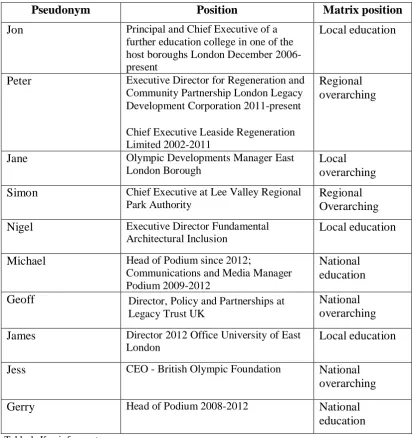
Table 1: Key informants ... 92
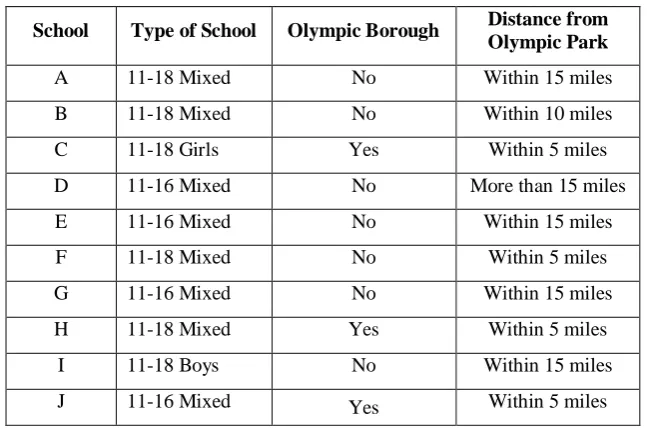
Table 2: The schools from which participants were drawn...103
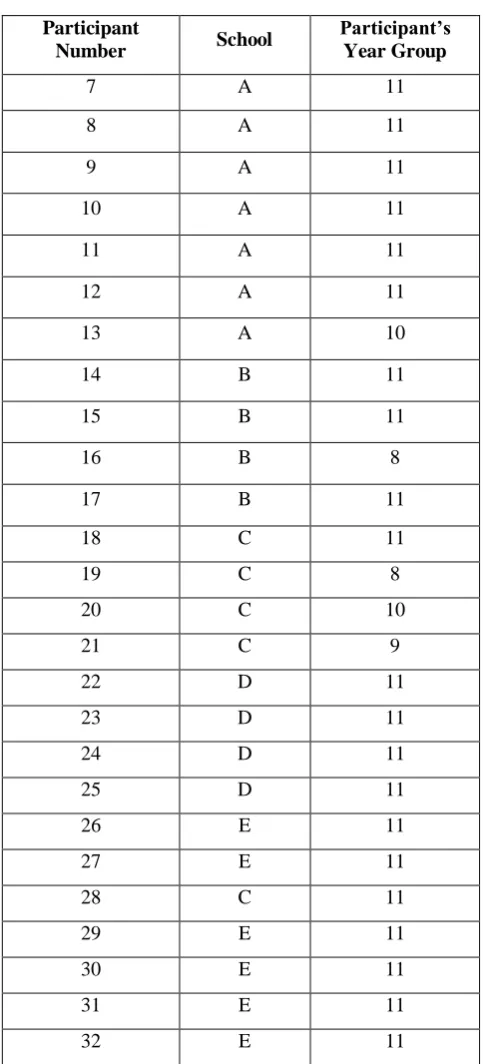
Table 3: Participants: school students ... 104
Table 4: Participants: teachers ... 105
Table 5: Participants: informal educators, consultants and advisors... 105
Table 6: Percentage explanatory variance and calculated Eigen value for the rotated Factor matrix ... 122
Table 7: Factor Q-sort values ... 123-126 Table 8: Participants loading onto Factor 1 ... 130
Table 9: Participants loading onto Factor 2 ... 136
Table 10: Participants loading onto Factor 3 ... 140
Table 11: Participants loading onto Factor 4 ... 146
Table 12: Participants loading onto Factor 5 ... 151
Table 13: Participants loading onto Factor 6 ... 156
Figures
Figure 1: The regulated Olympic system ... 8Figure 2: Impact matrix of the Sydney 2000 Olympic Games ... 22
Figure 3: The legacy cube ... 23
Figure 4: Economic output of megaevents and event structures ... 31
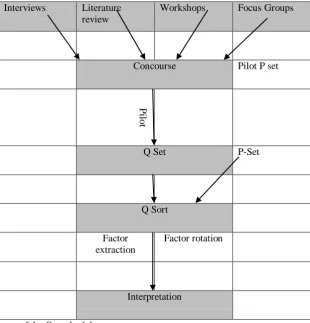
Figure 5: Summary of the Q methodology process ... 98
Acknowledgements
I must first acknowledge the encouragement I received at the beginning of this study from Peter Martin, my first supervisor. Peter sadly passed away during the first year of the research.
I would like to thank my supervisors, Gerry Czerniawski and Gavin Poynter, for their constant encouragement, support and feedback during the course of the study, and for their belief in me even when I doubted myself.
I would like to thank Joy Coogan for introducing me to Q methodology and to the ‘Q community’ who have always been willing to offer advice.
I extend my gratitude to my colleagues within the Cass School of Education and Communities who have shown an interest in my studies, put up with my stresses and enabled me to complete this work through cover during study leave.
The study reports on work done with a number of participants and I am grateful to them all for giving freely of their time and for engaging with the research.
Chapter 1 – The Olympics: A Good
Thing to Think With
Introduction
For a few weeks in 2012 an unprecedented focus fell on East London. The world watched as athletes performed ‘superhuman’ feats at the Games of the 30th
Olympiad. There is little doubt that the Games were a spectacle and for the majority of the watching world this was all that they required, but ‘spectacle’ was not the only aspiration contained within the bid.
This thesis explores these aspirations, in particular the way in which the London 2012 Games impinged on the educational environment – that complex adaptive system of policy, practice and social context within which particular institutions and organisations operate. As a teacher-educator working with secondary schools within East London this is of particular professional interest as it is likely to affect those with whom I work. The exploration of these effects is mindful that
developments associated with the Games are a sub-set of more general regeneration activity, the Olympics becoming a lens through which the issues associated with regeneration and the challenges and opportunities of urban living, can be brought into our field of vision.
Olympics and other international sporting events are extensions of the once popular World Fairs (Horne and Whannel, 2012). The World Fairs were never just trade fairs, instead they were about:
selling ideas: ideas about the relations between nations, the spread of education, the advancement of science, the form of cities, the nature of domestic life, the place of art in society (Benedict, 1983, p2).
In this study the term megaevent (Roche, 1992; Spezia, 1992) is used to indicate a large-scale cultural event of international significance and with popular appeal. For the purposes of this thesis consideration will be given, primarily, to the Summer Olympic Games, for the simple reason that I live and work in East London and that was where the 2012 Summer Games were held (at points, though, the narratives around other events will be drawn upon).
The Development of the Olympic Games
Although the wider historiography (Miller, 2003; Girginov and Parry, 2005; Guttmann, 2002; Senn, 1999; Toohey, 2003; Payne, 2005; Shaw, 2008) of the Games is beyond the scope of this thesis, it is useful to have some understanding of how the current iteration of the Olympics and its governance structures has
emerged. The Games of the Modern era, under the direction of Coubertin, have a relatively short history. Indeed, Coubertin’s interest began as a response to the debate surrounding France’s defeat in the Franco-Prussian War. Some of that debate centred on the ideas of English and American educators around the
interdependence of sport, education and the emergence of a national character (Gold and Gold, 2005b; Hunter, 2012; Girginov and Parry, 2005). Coubertin’s exposition of this view marked him out as an educational reformer and gave him a platform to explore the potential role of sport in international affairs. He called for the
– a meeting that both supported this restoration and set out key organising
principles (Hunter, 2012; Barney, 2004; Gold and Gold, 2005b) which is codified in the philosophy of Olympism, defined initially in the Olympic Charter of 1908 and appearing in subsequent iteration of the Charter as:
a philosophy of life, exalting and combining in a balanced whole the qualities of body, will and mind. Blending sport with culture and education, Olympism seeks to create a way of life based on the joy found in effort, the educational value of good example and respect for universal fundamental ethical principles (International Olympic Committee, 2011, p10).
This is of particular interest in terms of the current study in that this gives an appreciation of the importance that education has occupied in the evolution of the concept.
It is worth noting that Penny Brooks and Coubertin were in contact in 1889
following Coubertin’s request for advice and information to support his work as the founding secretary of the ‘Committee for the Propagation of Physical Exercise in Education’, which he had set up in July 1888. Coubertin visited Much Wenlock in 1890 (Girginov and Parry, 2005), when the two men discussed their similar
ambitions and Penny Brookes, then aged eighty one, further shared with the young twenty-seven year old Coubertin his dream of an Olympic revival, an international Games to be staged in Athens. On his return to France, Coubertin gave a glowing account of his stay in Much Wenlock and later referred to his host's efforts to revive the Olympics:
...and of the Olympic Games which modern Greece has not yet revived, it is not a Greek to whom one is indebted but rather to Dr W.P. Brookes...still active, organising and animating them...athletics does not count many partisans as convinced as W.P. Brookes (Coubertin, 1894, p15).
Within the history of the Olympic Games can be seen responses to the grand historical narratives of nation, war and globalisation. This is why this event is a good thing to think with (Cohen, 2006), a lens through which to examine the current narratives of regeneration, sustainability, community and education. This is the aim of this thesis.
Characterising the Games
There is a case for viewing the development of the Games in terms of defined periods (Preuss, 2004; Poynter, 2009b). Preuss (2004, p7-8) offers such a
increase in the commercialisation of the Games and in sponsorship rights. Within this time period the then President of the International Olympic Committee (IOC), Juan Samaranch, went about putting the IOC on a sound financial footing for the first time (Pound, 2004). The fourth period (2003-) has seen a reassertion of the Olympic values as a way to protect the movement from over-commercialisation. Pound (2004) writes that “[h]ow well, and even whether, the modern Olympic movement will survive depends on its integrity [which] creates a desirable set of values that youth and society in general can accept” (p272). The next chapter gives consideration to the way in which legacy has assumed an important part in this reassertion of values; how this legacy is conceptualised, used and measured; and how this fits into the broader context of the development and emergence of global cities.
A Typology for the Games
The way in which the Games have evolved in response to the challenge of increasing urbanisation is part of a wider movement where:
increasingly, sports events are part of a broader strategy aimed at raising the profile of a city ... Often the attraction of events is linked to a re-imaging
process and, in the case of many cities, is invariably linked to strategies of urban regeneration and tourism development (Gratton et al, 2006, p44).
altogether different characteristics to its predecessors. The disjuncture between the nature of the activities associated with the Games and their chronological
positioning has led to another classification of the Games (Poynter, 2009c) seeing them as being one of the following: The ‘Commercial Games’; the Games as ‘Catalysts of Regeneration’; and the ‘Dynamic Games’.
The ‘Commercial Games,’ which include Los Angeles and Atlanta, are seen by Poynter as being marked out by their marketing of place and city branding; the ‘Dynamic Games’ are characterised by Seoul and Beijing where “staging the Olympics signifies entry as a major player in the world economy” (Poynter, 2009c, p37). Chapter 3 will consider the third category – those Games that were used as a catalyst for regeneration: Barcelona, Sydney and Athens. This exploration will sit alongside some consideration of the aspiration for the London Games which have a clear regeneration theme (MacRury and Poynter, 2008; MacRury, 2011).
The Benefits of Hosting the Games
An exploration of the benefits of hosting the Games will be given greater
consideration in the next two chapters. However, as we move towards defining the scope of this thesis it is important to give some indication of the context within which the project resides.
that legacy does not flow automatically nor is it necessarily self-evident. There is also a potential for negative legacy, for example securing Olympic funding by delaying capital funding on non-Olympic budgets. Hall (2004) feels that:
investment in accessible and affordable education, health and communications technology, along with a diversified job creation strategy is far more likely to have long term benefits for urban economic and social well being than investment in elite mega sports events and infrastructure (Hall, 2004, p68).
While acknowledging this position, it is also the case that the hosting of megaevents is something that is actively sought. The reasons for this are explored more fully below and in subsequent chapters.
Governing the Games
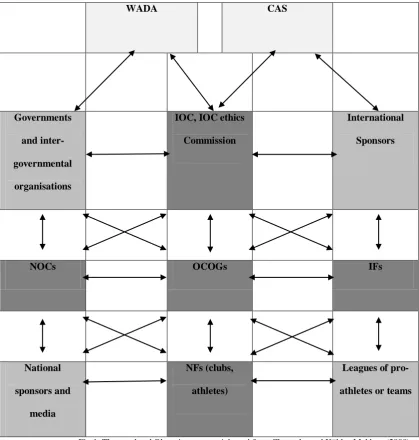
WADA CAS
Governments
and
inter-governmental
organisations
IOC, IOC ethics
Commission
International
Sponsors
NOCs OCOGs IFs
National
sponsors and
media
NFs (clubs,
athletes)
Leagues of
[image:16.595.128.548.67.508.2]pro-athletes or teams
The International Olympic Committee (IOC) is the supreme authority within the Olympic movement, holding full legal rights to the Olympic Games thanks to the worldwide registration of the numerous Olympic related trademarks. It aims to promote the Olympic movement and to reinforce the unity amongst the various entities who accept the guidance of the Olympic Charter (Girginov and Parry, 2005; Chappelet and Kubler-Mabbott, 2008). The Olympic Games are awarded to the National Olympic Committee (NOC) of the country in which they will be held. They are legally independent of the IOC, but in effect the IOC’s territorial representative; the NOCs are the only bodies able to qualify athletes from their territory to take part in the Games (Chappelet and Kubler-Mabbott, 2008).
International Sports Federations (IFs) govern their respective sports, whilst National Sports Federations (NFs) unite the clubs for a specific sport in a given country. Olympic IFs receive part of the broadcasting and marketing rights generated by the Games; the National Sports Federations may be recognised by the NOC and/or by the IF for their sport. Individual sports federations, whether they are national or international, are concerned with their own sport and are largely technical organisations, with the potential to think and act only within their silo (Pound, 2004). All of these are non-profit making organisations and constitute the classical Olympic system (Chappelet and Kubler-Mabbott, 2008) which has been joined by a number of actors whose legal status is different from the original five.
contracts restricted to a national territory. Another emergent actor is constituted of leagues of professional teams and athletes.
To this mix are added the regulators: the Court of Arbitration for Sport (CAS) founded by the IOC in 1983 and set up to resolve, through arbitration, disputes concerning sports; and the World Anti-Doping Agency (WADA) whose objective is to promote, coordinate and supervise, on an international basis, the fight against all forms of doping in sport (Chappelet and Kubler-Mabbott, 2008).
responsibility for delivering the Games ... and a large number of bodies involved presents significant risks, for example to timely decision making” (House of Commons Committee of Public Accounts, 2007, p1). The reason for the concern was understandable, but was framed from a perspective which focused on the managerial needs of the project while not necessarily addressing the necessity for wider social engagement with the legacy-related process of urban renewal and regeneration. This accords with the experience of previous hosts where the legislative processes put in place and the powers given to the Games organisers have tended to diminish local forms of accountability (LERI, 2007; Poynter, 2009a).
Events and Regeneration
A city will often seek to embed a high-profile event into development plans as it tries to attract economic activity to itself, (Ritchie, 2000; Sassen, 1996; Preuss, 2006, 2007). These events are expensive to stage, carry financial risks (Gratton and Preuss, 2008; Preuss, 2007) and not all legacies are positive – even if that is the broad assumption (Ritchie, 1984). Nevertheless, a wide range of commentators have intimated that the Olympics provides an opportunity for urban regeneration (Hiller, 1998; Tribe, 2005; Hall, 1992) even though cities bid “with only a vague idea about the complexity of event legacy and its uncertain nature” (Preuss, 2007, p207).
The catalytic action of hosting the event on the acceleration of development plans can be seen in a positive light, but brings with it the dangers of ignoring planning constraints, lower quality and higher cost of developments, disregard for existing communities and justifications for projects which would not normally be
may lead to inauthentic development (Zukin, 2010), a topic that is returned to in Chapter 5.
This event-led regeneration is characterised by an instrumentalisation of large-scale cultural and sports events to support image building and to catalyse urban
development and has been termed ‘festivalisation’ (Steinbrink,Haferburg and Ley, 2011; Häußerman and Simons, 2000). This instrumentalisation could be seen as an inevitable result of a commodification of the Games through dominant, market-led ways of thinking (MacRury and Poynter, 2008), and as such would repay a “greater interrogation, by citizens, politicians and academics than is currently the case” (Preuss, 2007, p207). One area for interrogation that is beyond the scope of this thesis is the extent to which the urban development effects are comparable between the global North and South, given the increasing number of events that are being hosted in emerging economies (Steinbrink, Haferburg and Ley, 2011). One area that will be examined and that is central to this thesis is the way in which legacy is defined. This will be explored in the next chapter.
The Educational Environment
metaphors act as embellishments to discourse, Morgan (1986) makes the important point that their significance:
is much greater than this. For the use of metaphor implies a way of thinking and a way of seeing that pervade how we understand our world generally (p12). Thus the metaphors used to describe and explain reality also become ways in which we construct our actions and our views of that reality. These actions are also structured by our beliefs about the purposes and desirable outcomes of the
education system that we are trying to describe. These beliefs are often expressed as dichotomous positions, for example, traditional versus progressive education (Meighan and Harber, 2007), with the purposes of education resolving themselves into four broad categories (Sterling, 2001):
To replicate society and culture and promote citizenship – the socialization function
To train people for employment – the vocational function
To develop the individual and his/her potential – the liberal function To encourage change towards a fairer society and better world – the transformative function (p25).
The interaction between the structure and agency is clear in this characterisation of the system. This is also true of the way in which the constraints of the field, including the purposes ascribed to that system, serve to define the actions of those within the field. These actions, under certain circumstances, serve to change the constraints of the field. The ways in which this might occur are discussed more fully in Chapter 4.
politics and economics that define the field within which educational institutions exist. The power of using such a metaphor is that ‘ecology’ allows a multi-level exploration of embedded systems. Each of these levels, for example ecosystem, community, population and individual, is constrained and defined by certain characteristics but these exist in a dynamic relationship with the systems within which they are embedded.
The neo-liberal rhetoric of globalisation is the dominant political, cultural and economic ecosystem framing much of the educational environment. As Bottery (2003) points out, this discourse is not merely descriptive, but also normative and often seen as an inevitability. Any changes that might flow from globalisation are often presented as neutral and rational rather than as an ideological position with strong social and psychological components. This resonates with Bourdieu’s concept of doxa which is explored in Chapter 4. Educational adaptation to this ecosystem has led to increased marketisation and the increasing standardisation of the outcomes of education (Hartley 2002). This standardisation is often linked to a culture of performativity (Jeffrey, 2002) within individual institutions with, for example, an emergence of pronounced technical approaches to management in the schools in England (Wright and Bottery 1997: Bottery 2002). Jeffrey (2002) sees the effects of performativity in changes in the relationships between teacher and pupil, including in pedagogic relations, these being explored more fully in Chapter 5.
to provide their students with the critical constructive voice of citizens in a democracy…[to ensure] that students have the educational time and facility to reflect upon what is fundamental to the human condition, and the search for meaning and purpose in their lives (p133).
Thus, there is a need to engage dynamically with curriculum policy and what informs it, seeking meaning in negotiation with other actors within that community, rather than settle for the straightforward delivery of a commodified curriculum (Ball, 2007). The Games, as a major event, may create opportunities to disrupt this dominant discourse. The potential for this disruption is something that is explored further in Chapter 5, and empirically through interviews and Q methodology. One of the key messages of an ecological metaphor is that of adaptation and the mechanisms by which this occurs, the complex way in which interactions between the levels occur and impinge on each other. Although there might be a tendency to see this as a process of imposition, Hall (2003) discusses the concept of metapower within an interactionist perspective as a framework by which it is possible to show how “future and distant social conditions” (p36) could be created by social actors. Thus people, both as individuals and as groups of individuals, are capable of
causing their own acts and can cause others to act in particular ways. Hence, “while structures are consequential, acting humans cause social structures” (Maines 2003, p11). The interaction of structure and agency are further discussed in subsequent chapters, particularly through the conceptual frameworks of Pierre Bourdieu. There is an imperative for those who operate systems to understand the processes of the system as well as its outcomes and to acknowledge that:
people possess consciousness and can think communication is intrinsic
the activity is situated
Hence, the focus of this thesis is not just on the outcomes of the Games, nor on the way in which educational outcomes might be impinged upon by changes brought about by the Games. Rather it is about making explicit some of the processes that are inherent in the action within the operation of the education system through the lens of the Olympic Games. In this it will also be possible to assess the extent to which the Games can progressively disrupt the educational environment to change the nature of the activity within it. Whilst there is consideration, through key informant interviews, of the wider educational community, within this thesis the majority of the exploration of the effects will be done through schools as, to continue the ecological metaphor, a single indicator species of how adaptation to change provoked by the Olympics occurs.
Research Aims and Questions
The aim of this thesis is to examine the way in which the educational environment interacts with the hosting of a megaevent, such as the Olympic Games, and to explore the ways in which these interactions are viewed by a range of stakeholders involved in education within East London.
1. How do megaevent structures interact with the educational environment? 2. What perceptions do stakeholders have of the interactions between
megaevent structures and the educational environment?
3. What are the implications of these perceptions in terms of the legacy of the 2012 Olympic Games in London?
In answering these questions this study will explore the dynamic between formal education, informal education and place-making – the development of the urban environment and the communities within that environment. It is also hoped that the outputs of the study, this thesis and its dissemination, will lead to real outcomes in terms of enhanced engagement of communities with the opportunities offered by the 2012 Games.
The Structure of the Thesis
This chapter acts as an introduction to this thesis and as such offers an overview of a number of areas. Subsequent chapters develop these in the following manner:
Chapter 2 explores the complexities of legacy and introduces a framework of ‘event structures’ that will be used to frame aspects of legacy.
Chapter 3 discusses the way in which legacy is being configured for London 2012. It gives some contextual detail and explores, using the framework of ‘event structures’, legacy promises in light of narratives from previous Games.
consideration to the exploration of social phenomena which effect the educational environment.
Chapter 5 acknowledges legacy as part of wider regeneration activity and tests some of the assumptions around this activity. In doing so, it highlights some of the tensions that are evident in the discourse, especially the way in which education interacts with the regeneration effort.
Chapter 6 describes the methodology used in this study. It considers the interaction of structure and agency and how one can explore these.
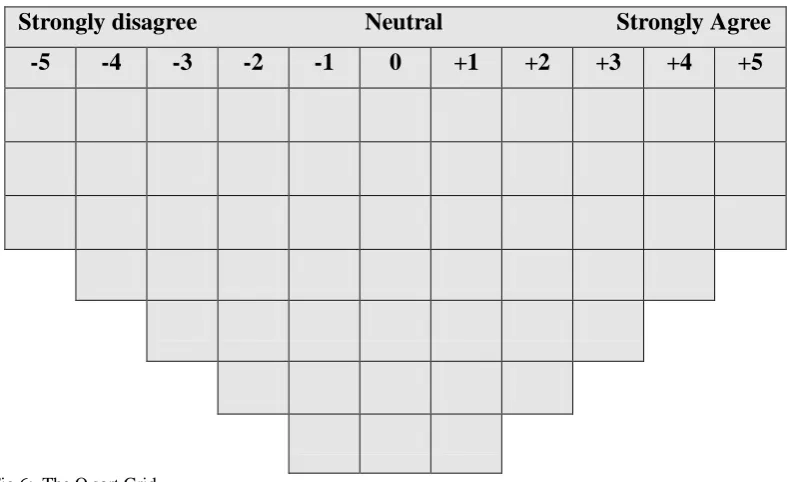
Beginning with a general consideration of the research strategy, locating this in debates around epistemology and ontology, it continues with a description of the development and deployment of the research instruments used, the participants involved in the study and the analysis of the data derived. Chapter 7 draws on the analysis of the Q Sort carried out as part of this study. The six factors that emerged from the statistical analysis are characterised through a penportrait of each factor written from the table of normalised scores for each statement and through a consideration of the distinguishing statements for each factor.
Chapter 8 reports on the interviews carried out with key informants about their perspectives on the Games and their legacy structured through a thematic analysis based upon the ‘event structure’ framework.
Chapter 10 restates the research questions set out above and rehearses the answers to these questions that have emerged from the literature and the study’s empirical work, addressing particularly the implications of these answers both to the legacy and to future research work. The chapter describes the contribution that this thesis has made to the field in empirical, methodological and conceptual terms. The chapter considers the limitations of the study and reflects on the research process in more general terms.
Conclusion
This chapter has made explicit the aims of the study and the research questions that will be addressed within this thesis. These aims were discussed alongside a number of other key issues: aspects of the development of the Olympic Games were
Chapter 2 – Legacy
Introduction
The last chapter introduced the key strands that this thesis will weave together: it defined the concept of the educational environment, the scope and the level of the interactions that take place within such an environment; it gave a brief overview of the evolution of the Olympic Movement, describing how this movement is
organised; and offered some typologies of the Olympic Games (Preuss, 2004; Poynter, 2009c). Pound (2004) makes the point that the survival of the Olympic Movement will depend on its ability to “create a desirable set of values” (p272). Legacy has assumed an important part in the reassertion of this value position and is the topic of this chapter. Consideration will be given to the various
conceptualisation and complexities associated with legacy, an area of policy which is characterised by scientific uncertainties and high stakes. As such it qualifies as one of Rittel and Webber’s (1973) ‘wicked problems’.
Defining Legacy
Cashman (2006) feels that the term ‘legacy’ is used by Games Organising
Committees as if it were unproblematic. As such a precise definition of legacy is not sought and it is often assumed to be self-evident. However, given the
importance of legacy in modern Olympic discourse this lack of clarity is not a satisfactory position (Preuss, 2007), especially when ‘delivering legacy’ as “a one-note chord on what the International Olympic Committee (IOC) cares most about today” (MacAloon, 2008, p2064).
Kennett and Puig, 2003). MacAloon (2008) draws our attention to the importance of cultural capital, further discussed in Chapter 4, when he points out that the seeming linguistic correspondence between ‘legacy’ and the French word ‘héritage’ hides a subtle but important difference in that ‘héritage’ has a “semantic emphasis on the accumulated historical, cultural and moral capital that comes to the present from the past” (MacAloon, 2008, p 2067). Thus, whilst only being a relative recent addition to Olympic discourse (MacRury, 2011), the term ‘legacy’ emerges from the literature as a multi-dimensional concept. This sets up a tension in discussions about legacy, even when, ostensibly, people are giving consideration to the same phenomenon.
Rule two, article 14 of the Olympic Charter (International Olympic Committee, 2011) makes it clear that a ‘positive’ legacy for a Games is a key concern for the IOC. There are a number of reasons for this, amongst them as a means to justify expense and as a way of encouraging other cities and nations to bid for future events (Gratton and Preuss, 2008; Poynter, 2009b). The IOC uses the term to encompass the sports facilities and public works turned over to communities and/or sports organisations after the Games (Preuss, 2007). However, the wider literature gives consideration to aspects of legacy including: sport infrastructure,
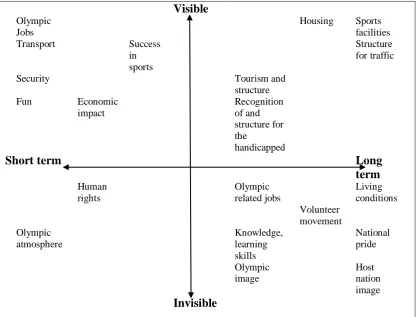
emergence of the effects – even if some of the short term effects are within areas that are long term issues.
Visible
Olympic Jobs
Housing Sports facilities Transport Success
in sports
Structure for traffic
Security Tourism and
structure Fun Economic
impact Recognition of and structure for the handicapped
Short term Long
[image:30.595.128.545.163.480.2]term Human rights Olympic related jobs Living conditions Volunteer movement Olympic atmosphere Knowledge, learning skills National pride Olympic image Host nation image Invisible
Fig 2: Impact matrix of the Sydney 2000 Olympic Games. Adapted from Preuss (2004)
A number of commentators (Cashman 2006; Chappelet, 2006; Preuss, 2007) have attempted categorisations of legacies, with Preuss (2007) providing the broadest of these considering five dimensions of legacy:
Considering these dimensions as a whole Preuss proposes the following definition of legacy:
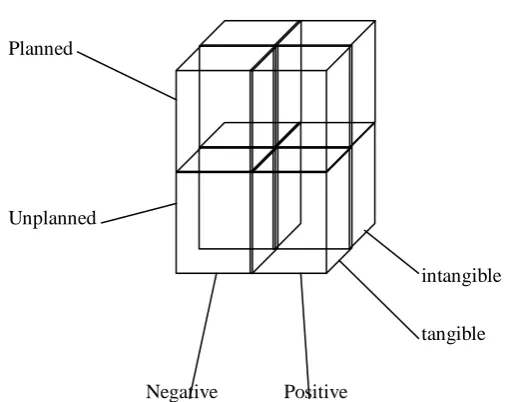
Irrespective of the time of production and space, legacy is all planned and unplanned, positive and negative, tangible and intangible structures created for and by a sport event that remain longer than the event itself (Preuss, 2007, p211).
This definition means that there is a need to think in five dimensions. The difficulties around such an endeavour led to the adoption of a cube as a heuristic device (Gratton and Preuss, 2008; Preuss, 2007). Using the dimensions
‘planned/unplanned’, ‘negative/positive’ and ‘tangible/intangible’, the legacy cube offers eight sub-cubes within which to map legacy effect (Gratton and Preuss, 2008).
The multidimensional evaluation of legacy afforded through such a heuristic device offers a counterweight to those:
Planned
Unplanned
[image:31.595.161.414.404.605.2]intangible tangible Negative Positive
who are preoccupied with a ‘legacy planning’ that consists of lists of possible future pay-offs and projects, and who are dismissive of or at best indifferent to the ... need to acquire real knowledge of the Olympic heritage (MacAloon, 2008, p2067)
or, indeed, those resistant to engaging with the heritage of the place where the Games is taking place. Multi-dimensional exploration of perceptions of legacy is possible through Q methodology which forms the basis of part of this thesis.
Forecasting, Planning and Evaluating Legacy
Despite the potential to explore legacy in this multidimensional way, there is a tendency in the literature to concentrate on one ‘sub-cube’, the ‘planned, positive and tangible’ (Gratton and Preuss, 2008; Preuss, 2007; Cashman, 2006). This, allied to the interest in the economic dividend from hosting the Games, has led to a large number of studies exploring these aspects of legacy (Kirkup and Major, 2006). There are a number of issues with such studies: they are difficult to carry out, often reflect only the objectives of the commissioning agent and can easily be
misinterpreted and misrepresented (Kirkup and Major, 2006; Baum and Mudambi, 1999; Tribe, 2005; Kasimati, 2003; Crompton, 1995, 2006; Delpy and Li, 1997), with a tendency to exaggerate the economic impact on local communities (Lee, 2001). A deeper issue inherent in such models is that they tend to operate on a cost/benefit basis and are derived from marginalist economics “consistent with the currently fashionable public/private “model of working between state and private enterprise” (MacRury and Poynter, 2008, p2073).
Whilst economic indicators are often to the fore in the literature on legacy it would be wrong to characterise these studies as being narrow in scope as they cover a wide range of areas, urban development, employment and tourism, for example
between events which are “by definition unique to the location in which they are held, and strictly temporary” (Rose, 2002), makes it very difficult to predict event legacy.
Many of the pre-event feasibility and economic impact studies that consider legacy are potentially biased, because the ambition of those commissioning the studies is to favour the hosting of the event (Kasimati, 2003; Crompton, 2006). Economic impacts are often inflated because the studies tend not to take into account supply-side constraints (Gratton and Preuss, 2008; Kasimati, 2003). This is an important omission as:
Long-term economic growth requires a constant influx of autonomous money. In terms of economic growth related to events, this can better be reached if the event has changed the host city’s structure – in other words, its supply side. It should be the aim of politicians to initiate structural changes that improve the ‘location factors’, which are the basis of new post-event impacts (Gratton and Preuss, 2008, p1925)
One such location factor is the educational level of the workforce within a particular area. The interaction between education and regeneration is explored in Chapter 5. There are clearly a number of difficulties in measuring the extent of event legacy, particularly because of issues around opportunity costs (Preuss, 2007), the
This presupposes an alignment between non-event and event infrastructure planning. Such an alignment is not a given as a redistribution of resources, for example, could slow some developments and be considered a negative externality (Preuss, 2007; Baade and Matheson, 2002).
It would seem that a number of the ‘problematics’ with an assessment of legacy are only “rarely publically and explicitly recognised or debated” (Kirkup and Major, 2006, p292). This is compounded by the fact that the ‘event structures’(described below) that are under consideration can be viewed from multiple, sometimes conflicting perspectives (Preuss, 2007; Searle, 2002). Making the range of
perspectives explicit is part of the purpose of this thesis, and a methodology which allows a researcher to do this is explored in Chapter 6.
Whilst making a judgment about whether or not to ascribe a negative or positive value to a legacy does not affect the measurement of legacy, it does raise questions about how that judgment is reached (Preuss, 2007) and the perspective from which it is made. This perspective will be, at least partially, governed by the nature of the accountabilities involved – “whether these are accountabilities to, and engagements of, community and political visions and imperatives, [or] accountabilities of
standard corporate style accounting” (MacRury and Poynter, 2008, p2083) – these accountabilities will flow from the view that is taken of legacy.
Legacy as Commodity – Legacy as Gift
Olympic Games, adopting the language of the gift economy” (MacRury and Poynter, 2008, p2081).
The importance of the ‘gift’ in human relations is well documented (Gregory, 1983; Mauss, 2002; Hyde, 2006; Sahlins, 1972) and sits in contrast to relationships based on commodity exchange:
Commodity exchange is an exchange of alienable objects between people who are in a state of reciprocal independence that establishes a quantitative
relationship between the objects transacted, whereas gift exchange is an
exchange of inalienable objects between people who are in a state of reciprocal dependence that establishes a qualitative relationship between the subjects transacting (Gregory, 1983).
The concept of the gift economy is embedded in socio-cultural life and relations. As such it replaces alienation through exchange with obligation arising “from social interactions that confer authenticity and social regard or respect – non-market related attributes of positive human relations” (MacRury and Poynter, 2008,
p2081). These obligations are implicit in the term legacy “which owes its semantic potency to socially embedded (familial) economies” (MacRury and Poynter, 2008, p2073), something that underpins Bourdieu’s conceptualisations described in Chapter 4.
Olympic Games Impact Study
The IOC saw a need to operate an analysis that offered some transparency and standardisation within evaluations (Kirkup and Major, 2006), and has attempted to address the lack of a rigorous basis for evaluating how the hosting of a megaevent is linked to long term urban development (Jones, 2001; Kirkup and Major, 2006) through a greater focus on Olympic Knowledge (Cashman, 2006).
The Olympic Games Impact (OGI) Study was developed by the IOC, in collaboration with a number of partners, to objectively measure and assign attribution to the potential effects of the Olympic and Paralympic Games on the host city, region and country, their environment and their citizens (VanWynsberghe, 2012; IOC, 2006; Kirkup and Major, 2006). The principal objectives of the OGI are: to measure the overall impact of the Games; to assist bidding cities and future Olympic Games organisers; through the transfer of strategic direction obtained from past and present Olympic Games; to identify potential legacies and thereby
maximise the benefits of their Olympic Games; and to create a comparable benchmark across all future Olympic Games (International Olympic Committee, 2006). This has been done through the development of an analytical tool that aims to offer a consistent approach between host cities (Preuss, 2007). This tool is used over an 11 year period, from the bidding stage to two years after the hosting of the Olympics. During this time four reports are produced by a host city.
Gateway Institute for Sustainability, 2010, p6). They can also be categorised as being either context or event indicators. The former relate to those measures that are not directly related to the Games, but rather describe the environment in which the Games will take place. The latter are those that are directly related to the Games.
Some examples of the indicators are given below: Economic indicators
o Accommodation infrastructure
o Tourist nights
o Real estate market
o Public debt
o Jobs created in Olympic and context activities Environmental indicators
o Land use changes
o Transport networks
o Air quality
o Public open air leisure centres
o Protected areas Socio-cultural indicators
o Educational level
o Sport and physical activities
o School sports
o Available sports facilities
o Consultation with specific groups
o Olympic educational activities
o Volunteers
needed for the gift economy being developed through this knowledge exchange between host cities.
The value of the gift might be somewhat compromised by the fact that the model ends two years after the Games and this means that not all legacy dimensions will have developed within this timescale (Gratton and Preuss, 2008; Mangan, 2008; Preuss, 2007; Kirkup and Major, 2006; Cashman, 2006). Whilst there are difficulties in defining the ‘right time’ for an evaluation, the ongoing scrutiny, which is built into this model, is seen as being useful with the potential of raising constructive concerns (Mangan, 2008; Toohey, 2009):
by analysing the environment, global trends and the particular event
infrastructure, the opportunities and risks for the long-term development of the city become visible. This is a positive legacy. Grievances, shortcoming and gaps in the infrastructure of the city are revealed, and as a result these can be embedded in the development strategy (Preuss, 2007, p220).
Time will tell, as the OGI is still in its infancy, with the 2010 Winter Games held in Vancouver the first to have OGI built into the formal planning requirements. London 2012 is the first host of the Summer Games to have to carry out the study.
‘Event Structures’ of the ‘Catalyst for Regeneration’
Games
Adapted from Preuss (2006) and Gratton and Preuss (2008)
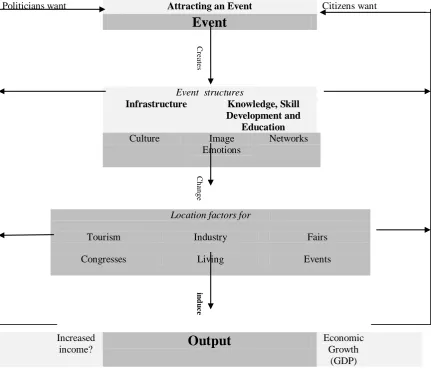
The six ‘event structures’ are further described by Gratton and Preuss (2008) as follows:
Infrastructure: includes the sports and general infrastructure: roads, rail, housing, telecommunication
Knowledge, skill development and education: the host population gains knowledge and skills in a wide range of activities and areas such as event organisation, human resource management, security and hospitality. These instrumental developments can be seen alongside gaining knowledge of wider cultural and historical issues
Politicians want Attracting an Event Citizens want
Event
Cre
a
te
s
Event structures
Infrastructure Knowledge, Skill Development and
Education
Culture Image Emotions Networks Ch a n g e
Location factors for
Tourism Industry Fairs
Congresses Living Events
in d u c e Increased
income?
Output
Economic Growth
[image:39.595.126.558.105.478.2]Networks: International sport federations, media, and politicians need to cooperate in order to stage an event successfully. Their interactions create networks
Culture: Mega-sport events produce cultural ideas, cultural identity and cultural products. The cultural presentation educates the host population and can enable them to address their history
Image: the symbolic significance of the event and its ability to form, reposition or solidify the image of a city, region and country
Emotions: the effect that both positive and negative emotions associated with hosting the event has on the behaviour of individuals, organisations and markets
(Gratton and Preuss, 2008) These ‘event structures’ are used in the subsequent chapter to examine some of the putative outcomes in relation to London 2012 and real outcomes in terms of what have characterised in the typology above as the ‘Catalyst for Regeneration Games’ (Poynter , 2009c) namely Barcelona, Sydney and Athens. This ‘event structure’ framework will also be utilised in the discussion of this study’s empirical work.
Conclusion
A megaevent such as the Olympics brings together many different interests. There is a need to be able to represent these interests in any exploration of legacy and to respond sensitively:
The thinking around these issues is compromised by a narrow compliance mentality (MacAloon, 2008; MacRury and Poynter, 2008).
There is scope for recognising the process of carrying out the OGI as being part of a gift economy, something that is passed on along with the torch and the flag,
building the movement and gifting expertise to the hosts of the future. There is certainly a clear attempt, through the OGI, to spot patterns and trends in the effects and legacy of each Games, “in turn this will allow the IOC to fulfil two of its principal objectives as enshrined in the Olympic Charter, to:
Encourage and support a responsible concern for environmental issues, to promote sustainable development in sport, and require that the Olympic Games are held accordingly
Promote a positive legacy from the Olympic Games for the Host Cities and Host Countries”
(UEL and Thames Gateway Institute for Sustainability, 2010, p6). However, the use of these quantitative indicators tends to marginalise the role of the actors within the development of legacy. This might go some way to explain the observation that whilst:
a major sporting event may serve to catalyse a form of post-industrial urban renewal, the contemporary popularity afforded sport culture is an inadequate and passive substitute for the loss of personal and human agency that underlies the often fatalistic response of local people to such patterns of social change (Poynter 2009, pp147-148).
Chapter 3 – London and Legacy
Introduction
The previous chapters have discussed the importance of legacy in the reassertion of the Olympic values that Pound (2004) states are essential for the continuance of the Olympic movement. A number of commentators (Colomb, 2007; MacCrury and Poynter, 2008; Poynter, 2009b) state that the legacy of the London Games is linked to challenging the underlying social and economic problems of East London. These views echo the statement made by Jack Straw and recorded in Hansard (2005) that:
London’s bid was built on a special Olympic vision. That vision of an Olympic Games that would not only be a celebration of sport but a force for regeneration. The Games will transform one of the poorest and most deprived areas of
London. They will create thousands of jobs and homes. They will offer new opportunities for business in the immediate areas and throughout London…One of the things that made the bid successful is the way in which it reaches out to all young people in two important respects: It will encourage many more to get fit and to be involved in sport and, whatever, their physical prowess, to offer their services as volunteers for the Olympic cause (Hansard, 2005).
This statement conveys a sense in which policy makers sought to use the Games to change the environment of the area and within which the aspirations and activity of young people (not just those living locally to the Games) operate.
report’ (UEL and Thames Gateway Institute for Sustainability, 2010) and the ‘Strategic Regeneration Framework’ (Host Borough Unit, 2009) published by the host boroughs. The chapter begins with an appreciation of the East London context.
The East London Context
The introduction of ‘Pevsner’s Guide to the Built Environment of East London’ (Cherry et al 2005) paints a picture of East London, often at odds with the popular conception formed through media presentation and popular fiction, pointing out:
The scale of both the natural and man-made landscape of East London ... offering broad vistas and exhilarating horizons unmatched in other parts of London. ...In the old 18th Century suburbs, Hawksmoor's proud churches have the grandest Baroque towers in London. Further out at Wanstead, the great 18th Century park rivalled Hampton Court, eating into the fringes of Epping Forest... From here there is a clear view across some fifteen miles of suburban growth to the City of London and Canary Wharf towers on the site of the West India docks (Cherry et al, p1).
This heritage forms part of a cultural richness that is added to by the diversity of the area’s inhabitants. This cultural richness is in contrast to the fact that most East London households have lower incomes and higher rates of poverty and deprivation than the national average (Lupton and Sullivan, 2007). The Strategic Regeneration Framework (2009) describes aspects of the host borough sub-region:
64.2% of the population are employed in the sub region compared with 70.4% in London, which equates to 77,000 fewer people in employment in the host boroughs;
overcrowding varies from 18% to 38% of households in the five boroughs against a London average of under 7%;
Vocational Qualification Level Four (NVQ4) qualifications (equivalent to degree level and above) compared to 40.6% in London
there is almost an 8% gap in GCSE attainment from the London average; an extra 15 people per 100,000 population die prematurely in the host boroughs than in London overall;
one in four children are classified as obese by Year Six, this is above the London average (Host Borough Unit, 2009, p11)
This picture of deprivation forms part of the negative perception of the area which is compounded by a “deficit view of the cultural forms associated with specific areas of the city, particularly the inner city, or of cultural forms associated with racial or ethnic groups in the city” (Grace, 1984, p 19). This deficit view, almost a pathologising of the inner city, is part of the dynamic framing of the educational environment and flows from what Grace (1984) characterised as the limitations of urban education as a field of study. This framing is deficient because of these limitations: an inadequate theorisation of the urban; an overemphasis upon the cultural as an explanatory category at the expense of the structural; an inadequate sense of the historical in the understanding of urban phenomena; and concepts of power and resources expressed in a limited sense of the political. These limitations will be explored in later chapters as will the way in which they might be reduced.
The Promise of Legacy
The Strategic Regeneration Framework (2009) seeks to resolve some of these tensions through the principle of convergence. Stated simply this is the principle that over a 20-year period the conditions of those people living within the host boroughs will converge with the social and economic conditions of people in London as a whole. The Framework was accepted by the Mayor of London, the Minister for the Olympics and the Secretary of State for Communities, as the basis for the legacy regeneration of the host boroughs. As such the principle is extended into the relevant planning and policy development of local and regional
government.
The presence of the Games throws the spotlight on the issues that the Strategic Regeneration Framework hopes to address in terms of social trends in labour markets, housing, transport and public life. The 2012 Games are seen as being one of the key regeneration catalysts for the rehabilitation of an urban landscape which is fragmented and constrained by transport infrastructure – busy roads and
trainlines- which separate communities from each other and from the large amounts of space and water in the Lower Lea Valley (Prior, 2007). How this regeneration of physical infrastructure can influence the educational environment is the focus of this thesis.
The Department of Culture, Media and Sport outlined a series of promises for the Games which included to:
Make the UK a world leading sporting nation Transform the heart of East London
Inspire a generation of young people to take part in local volunteering, cultural and physical activity
Demonstrate the UK is a creative, inclusive and welcoming place to live in, visit and for business (DCMS, 2007)
These sat alongside commitments made by the Mayor of London and LOCOG (Livingstone, 2008; LOCOG, 2007) and are complemented by a range of
publications detailing how the UK regions might benefit from the Games and in-depth studies of specific issues (Poynter, 2009a). To a certain extent these ‘promises’ will be tested against specific indicators within the Olympic Games Impact Study, however, the feeling around the promise is at least as important as the officially reported measure. This is what builds the emotional ‘event structure’ and will be a determinant in engagement with legacy projects. These perceptions are explored in this thesis through the empirical work described in later chapters. The sections below focus on how the ‘promise’ of previous Games has manifested itself alongside some more contextual information relevant to London 2012.
Focusing on the Knowledge, Skills Development and
Education ‘Event Structure’
The hosting of an Olympic Games gives the host population an opportunity to gain knowledge of, and skills in, a wide range of activities that are linked to the Games (Gratton and Preuss, 2008). These include areas such as event organisation, security and hospitality. These instrumental developments can be seen alongside gaining knowledge of wider cultural and historical issues, both about the area where the Games are being held and about the event itself. This section explores how the ‘Catalyst for Regeneration Games’ have engaged with this ‘event structure’.
into their curricula. Toohey, Crawford and Halbwirth, (2000) contend that the resourcing of the programme showed an understanding of the significance that a promotion of the Olympic ideals could have on a nation’s youth with an increased “understanding of the Olympic movement and its values” (Cashman, 2006, p238). An evaluation conducted after the Games showed that all of the Olympic education programmes were rated positively, but it is difficult to go much further with the claim as no impact evaluation of any aspect of the education programme was undertaken. This was similar to the situation for the Athens Games of 2004
(Grammatikopoulos et al., 2004) where the programmes were well received but not evaluated. Although indicators relating to education are included in the OGI study set, it is still the case that currently the evidence about whether the educational programmes linked to the Olympics work is lacking (Smith, 2012). This clearly limits the use that can be made of any resource or description of best practice by future OCOGs (Cashman, 2006).
The Olympic education resource for London 2012 was called ‘Get Set’ and was run by LOCOG in partnership with the Department of Education, the Olympic sponsors and other national education providers (Chen, 2012). The resource was an online presence with a library of materials and a range of options for interaction. The resource set out to provide a framework to facilitate the linking of learning to the Games and their associated values. Allied to this was the ‘Get Set+’ programmes
which supported learning through a number of strands: Enterprise; Communication,
collaboration & citizenship; Culture & creativity Sustainability & regeneration;
Practical learning; Healthy & active lifestyles; Internationalism and school linking; and
In terms of the host boroughs, the OGI pre-Games Report (2009) showed that at the end
of primary schooling, pupils lagged behind the whole London baseline figure for
performance in English and Mathematics by 3.8% (68.2% cf 72% level 4 at Key Stage
2). In secondary schools, pupils within maintained secondary schools were 7.8%
behind the London baseline in A*-C grades (including English and Mathematics)
(42.8% cf 50.6%). This should be seen in a context of the deficit in adult qualifications
that is detailed above. The 8.4% deficit between the host boroughs and the London
average for 19 year olds reaching the level 3 threshold (42.5% cf 50.9%) is of concern
for the post-compulsory educational sector.
The effect of the Sydney Games on tertiary education was explored by Cashman and Toohey (2002) who found that outcomes were lower than expectations in all of the areas considered, which included community service, staff/student
opportunities, financial gain and promotion of the institution. Despite this, there are examples of institutions that secured ongoing benefits after the Games. For
example, Monash University drew upon its positioning as an international university with a network of overseas campuses to secure a commercial contract from the IOC. This was to operate as an exclusive knowledge management
company facilitating the transfer of knowledge about running the Games to the next Organising Committee. In another example, The University of Technology, Sydney (UTS) worked with Democritos University in Thrace and accepted 120 Greek students in both 1999 and 2000 to their Sports Management Masters degree (Cashman, 2006):
both the IOC and the Organising Committee for the Athens Games (ATHOC) benefited as the programme advanced the IOC’s Olympic education agenda in an innovative way and ensured that tacit Olympic knowledge would be
In the example given above there is a straightforward link between the opportunity that the Games presents and the skill area, sports management, that is being
developed. This is not always so evident. The opportunities that are offered by the Games do not necessarily impact on the skill base of the city’s population
(Panagiotopoulou, 2009). The focus on the event and the short-time scales mean that the skill-base has little time to grow, often being supplemented by skills from outside of the area. This is illustrated by the limited positive impact of the
Barcelona Games on the skills or knowledge base of the Barcelona workforce: First, in the construction sector the system of sub-contracting made labour market interventions designed to improve the local skills base very difficult to implement. Second, in service industries, most of the temporary and permanent jobs created were unskilled and, finally, Barcelona had a long term historic deficit in higher skilled and professional occupations arising from its industrial past (LERI, 2007, p31).
A way in which the Games can operate to change the existing conditions is by skill development through volunteering. There is a clear recognition of the importance of the considerable number of volunteers involved in the operation of a megaevent (Cashman, 2006; Pegg, 2002; Nichols and Ralston, 2011). London 2012 recruited 70,000 volunteers, the so-called ‘Games Makers’ to a variety of roles across the Olympic venues. Recruitment began in September 2010 and some 240,000 applications were received (IOC, 2012).
A study of the volunteering programme associated with the 2002 Commonwealth Games revealed the enriching effect of voluntary activity on the lives of volunteers as well as an increase in the skills base within the community, allowing an
in voluntary activity (Bourner and Millican, 2011; Townsend, 2009) the evidence for this is at best partial, with no overwhelming evidence linking volunteering to entry into employment (Hirst, 2001). However, the enrichment noted in the study mentioned above moves beyond this narrow instrumental view and recognises the other effects that volunteering can make at an individual and community level. Given this wider view of legacy, volunteering can be seen as being of benefit in supporting on-going self-development, in impacting on social inclusion and in the development of community infrastructure (Hirst, 2001; Nichols and Ralston, 2011; Nichols and Ralston, 2012). These in turn will effect the educational environment of aspiration and community-orientation. Perceptions of volunteering are
empirically explored and discussedin the latter parts of this thesis.
This section has given consideration to how the formal educational sector, schools, colleges and universities have engaged with the Olympic Games through curricular interventions and through initiatives around knowledge exchange. It also explored how the opportunities for volunteering that emerge from hosting an Olympic Games could be used to develop the skills of those engaging in volunteering. Other
informal educational opportunities are afforded through the cultural ‘event structure’ which is explored in one of the sections below.
Focusing on the Infrastructure ‘Event Structure’
The infrastructure ‘event structure’ framework of Gratton and Preuss (2008) includes both the general infrastructure – roads, rail, housing, telecommunication – and the sports infrastructure, for example stadia, associated with any given Games. This section explores how hosting the Games has affected the structure of the city, how the Games have been incorporated into the long term plans for urban
developments required by the Games. It does this by considering the cases of the Barcelona, Sydney and Athens Games.
the central area. Taken together, these have maintained the legacy momentum beyond the immediate effect of the Games (Brunet, 2009; LERI, 2007). For Muñoz (2006), this approach clearly indicates how:
Olympic urbanism can represent new opportunities for the hosting city in dealing with both the reinforcement of urban centrality and higher social integration. These are goals that can be achieved simultaneously if Olympic Urbanism is conceived from the outset as a catalyst for future urban growth and development and as a generator of urban strategies rather than of specific Olympic projects alone (Munoz, 2006, p186).
Others are less fulsome in their praise: “the poor had to be content with the open space and access to the sea” (Gold and Gold, 2005, p208), raising the issue of gentrification which is returned to in Chapter 5.
For the host boroughs, the forecasts - contained within the Strategic Regeneration Framework (2009) document - that the population of the host boroughs will increase by some 260,000 people over the next twenty years makes the
development of infrastructure of key importance. The interaction between the mixed housing development, educational establishments and the community are discussed in the following chapters.
The environmental impacts of hosting the Olympic Games and the development of the associated infrastructure have been, and continue to be, a source of concern to a range of commentators (Chappelet, 2008; Toyne, 2009). In the 1990s, this concern led to the adoption by the IOC of a formal environmental position, largely based on the outcomes of the 1992 United Nations Conference on Environment and
Development. This in turn led to an Olympic Games Agenda 21 published in 1999, in time for the Sydney Games (Toyne, 2009). This document states that:
economic, social and political development particularly geared to the benefit of the poorest members of society...in view of its universal nature, the Olympic movement accepts that it has a special responsibility to share in the
implementation of this concept of sustainable development (IOC, 1999, p17). The Sydney Olympic Park is located in Homebush, to the west of the city and a place of population growth that had been a site of regeneration activity since the 1980s. The use of a ‘Green Games’ to continue the remediation of this heavily polluted site was an attractive part of the Sydney bid (Cashman, 2009). A number of commentators have written about the way in which the area has been
transformed, both physically and symbolically (Dunn and McGuirk, 1999;
Winchester, Kong and Dunn, 2003; Gordon, 2003). However, the planning for the use of the Park subsequent to the Games was not adequately thought through (Toohey, 2008; Cashman, 2009). Cashman (2009) questions whether the ongoing development of the Sydney Olympic Park, wit