University of East London Institutional Repository: http://roar.uel.ac.uk
This paper is made available online in accordance with publisher policies. Please scroll down to view the document itself. PleaBse refer to the repository record for this item and our policy information available from the repository home page for further information.
Author(s): MacCallum-Stewart, Esther
Article title: ‘What sort of Fish was it?’ How Players Understand their Narrative in
Online Games.Year of publication: 2009
Citation: MacCallum-Stewart, E. (2007) ‘‘What sort of Fish was it?’ How Players
Understand their Narrative in Online Games.’ Breaking New Ground: Innovation in Games, Play, Practice and Theory Proceedings of DiGRA 2009,London: Brunel University, September, 2009Breaking New Ground: Innovation in Games, Play, Practice and Theory. Proceedings of DiGRA 2009
‘What sort of Fish was it?’ How Players Understand their
Narrative in Online Games
Esther MacCallum-Stewart
The University of Chichester and SMARTlab, The University of East London.
[email protected]
ABSTRACT
Online worlds have become a fundamental element of the virtual landscape. The development of MMORPGs has helped give credence to the idea that online spaces can support valid social communities. Having proved that these communities exist, scholars must now decide whether these communities are different to those in the 'real' world.
What makes gaming communities stand out? This paper looks at how players contextualise their behaviour within game narratives. In particular, the ways that players manipulate the divergent narratives of each game, and the paradoxes that these structures create is investigated. MMORPGs are rife with social tension. Players appear to use a series of different social codes when they justify their behaviour, borrowing from different rules sets dictated by circumstances in the game according to their need. To contextualise this, this paper examines how players express and argue their ideas through their understanding of the game world and narrative. Like fan communities , players appropriate the MMORPG text for themselves, reinscribing it according to their own conceptions. However, whereas fans must do this away from their key source, in MMORPGs, players discuss the text as they enact it. Narratives are deliberately dynamic – purporting to give players agency to move at their own pace or to chose the routes and standpoints they take throughout each game. Thus fans actively work upon the text in a much broader context, and their discussions are often visible to large amounts of people within the game. If all players consider themselves as fans, then how does this affect the perception of the text itself?
Author Keywords
MMORPG, online games, narrative, fans, textual poaching, virtual worlds, social communities.
INTRODUCTION
Teppy: IRL I like to blow glass. And I TA'ed a class here, and at the start of the class everyone went around and said what they did in real life... And after I introduced myself, one of the students said "You're
Teppy? I'm getting my PhD in Sociology at the University of Pittsburgh. Do you realize that every sociologist follows your game?" Anyway, so to all the sociologists lurking out there, your cover is hereby blown :) [18]
Social interaction within online games is a popular subject. In particular, because games academics usually become players in order to discover, much work has been done from within virtual communities. Pioneering studies including but by no means limited to T.L Taylor, Lisbeth Klastrup, Constance Steinkeuhler and Torill Mortensen have helped to argue that the existence of online gaming communities adds to the complexity of gaming, and that these groups comprise valid, complex social entities. However, this work has often had to be explanative; Games Studies is not a new discipline, but often the resistance to these ideas from beyond the field has been a crucial factor. As T.L Taylor says in Play Between Worlds, ‘while creators of MMOGs have actively designed for sociability, this aspect of them does not commonly filter out into how the public understands what it means to play a computer game.’ [17].
2 but over time, a central core of group members tends to remain. The meet-up that T L Taylor describes is typical of thousands of others that have taken place around the world as a result of connections made in online worlds. From couples who have met online to official conventions with thousands of users attending, the validity of extending social bonds made in virtual environments is becoming an accepted part of modern life.
How can this sociality be extended towards the collective understandings by these groups of the complex worlds that they inhabit? In online games, the player is usually encouraged to exist in a series of different ways; as a solo player, within a series of permanent and temporary groups, and sometimes as an antagonist against others. Within this sphere social rules can be flexible, unstated, absent or often deviant. In particular, rules and behaviour regarding the treatment of others is often moot. In games players are often encouraged to kill each other, to fight for limited resources, and in extreme cases it is sometimes in their interests to steal or otherwise hamper each other. Finally, games, by their very nature, encourage players to act in the spirit of play [17], a state where experimentation often goes hand in hand with actions such as griefing, hacking or otherwise subverting the game’s central precepts.
We have seen definitions of individual player types [3], [20] and of guild formations, leadership, demographics and group composition [20]. But what of the players as a thought community – a group that shares information individually in order to pool it collectively when required as part of the gaming experience? This type of behaviour is integral to guilds, where many people must often act in concert in order to achieve a given task within each game, and where individualised roles are crucial to a strong composite group. Thought communities are a fundamental part of these guilds as working environments, where tasks need to be delegated and shared in order for the whole to function. Yet in online spaces, these groups may not be immediately visible, may not include all users, and may not even be what many wish for as part of their gameplay. Whilst all this interaction is taking place, players are still navigating around a fully fledged virtual space. This space has its own narratives. The environment of the game is a rich text in itself, and presents this atmosphere to the players through the quests, NPCs, tasks to be carried out and even through the ways in which dynamics such as grinding, trading or resource sharing allow players to interact with both the world around them and each other are facilitated.
This paper examines how these two conflicting formations affect the behaviour of groups in understanding the worlds in which they exist. In particular it examines how they understand the narrative constructions of MMORPGs. Players are asked to act one way, but often presented with conflicting ideals within each world that often suggest group behaviour is antithetical to personal gain. As close knit groups form their own social rules, so too do they
become isolated from the social whole of each virtual world. They form instead into a series of esoteric groups, which are mutually exclusive and often do not communicate with each other. Thus shared behaviour is not transmitted, except in the broadest of senses. This can cause huge differences in the ways that narratives in MMORPGs are understood by groups, as well as significant tension. Players are in this respect like Jenkins’ textual poachers; they appropriate and rewrite the text to their own ends. However, unlike Jenkins’ fans, players are still at large within the text when they do this – they do not move away from the original source material as Jenkins suggests. Jenkins argues that fannish reclamation is ‘a type of play’ [10]. In the case of MMORPGs, this is quite literally true. Thus the text is in flux in multiple ways, and is also reinterpreted through player behaviour as others read it.
Using chatter to share knowledge.
A good example of how this conflict occurs can be seen in the general chat channels of most MMORPGs, where any player can air their views and be heard by others. One of the strengths of World of Warcraft (2004-present) has been its ability to attract many different types of players and thus it is a particularly good example to use. As time has passed, some of these channels have become so integral to the game that they have been stratified. Channels for chatter, for trading and for guild recruitment are all standard, whereas the ‘looking for group’ channel became a separate function of its own. This means that there is not only a certain degree of self policing, with players telling those who post incorrectly to move their topics into the right channel, but it also enables a very common, almost territorial type of conversation where players question each others’ rights to tell each other what to do. Public chat channels often act as voice pieces where disagreement takes place about the nature of the game, the ways in which can be interpreted, and the meaning of the text itself.
These conversations derive from a fundamental clash between players who confuse the ludic or social rules of the world with the EULAs (End User License Agreements – here I also use this acronym to include any Terms of Service or Rules of Conduct which the player must also sign when entering the game for the first time) which set down codes of conduct, mainly relating to real life legal concerns. In actual fact, there are rarely consistent rules about actions such as griefing – companies tend to act retrospectively because they would rather keep players than lay down prohibitive social laws for them to follow. In worlds where the internal narrative is often shifting, these can also be difficult to define. Age of Conan is specific about griefing in that:
You may not harass or threaten other players in any form while online in Age of Conan.
The use of excessive and /or extremely sexually explicit, abusive, defamatory or obscene language is not allowed. Racially or ethnically offensive language is strictly prohibited. The game is M rated, not Adult Only rated. It is up to the GMs to determine if something is over the line in order to protect the community at large.
The first step in dealing with the above should be to use /ignore <name>
[9]
This might seem relatively clear cut until one considers that the first quest that any player must undertake involves rescuing a prostitute in a chainmail bikini who has been raped by bandits. The world is intentionally hard natured, but by the same token, this type of moral signifier in-world versus guidelines in the EULA outlining good behaviour means the line becomes more complex. It is also unsurprising, given this sort of conflicting internal/external narrative, that definitions over what constitutes good behaviour are blurred. A final problem is the shifting cultural values that exist between players themselves, coming as they do from a wide demographic of social, cultural, political, racial, chronological and sexual backgrounds. Given this plural demeanour, it is unsurprising that players comprehend and respond to the world around them in different ways, and that games companies are more likely to be flexible in order to accommodate such a diverse user base.
This climate of disagreement, coupled with a lack of clear behavioural guidelines, often means that areas for discussion and the sharing of joint narratives are difficult to come by within the game. Most games provide players with meeting points such as taverns or inns as well as the chat channels in which players can meet and talk. However, these areas are still usually in play; meaning that anyone can join in or move through them and that there are few areas of privacy. It is at this point that Henry Jenkins’ understanding of textual poachers comes into play [10]. If players, as Jenkins suggests, appropriate the elements of a text where they see resonance as their own, and reinterpret them accordingly, this can be seen through player action. Players withdraw from the text in order to understand it. They take with them the elements that they wish to work with and reintegrate them at a later date into the text. As with other elements of the game, they often do this collectively, so a group may set up a roleplaying community and post their own stories to it, may build forums to organise their guilds in which they set down behavioural codes of conduct, or may try to define points of law on wikis or other information giving sites. However, unlike Jenkins’ fan, players are able to re-enter the text with these devices in hand. They apply mods to the source code, they stage roleplay events, they carry out their codes of practise within the world, and in some worlds, their comments and criticism of the game is noted, and coded
into later patches. However at the same time there is a degree of frustration; stemming from earlier perceptions of fans as critical without having influence. MMORPG worlds are so large, and development is so rapid, that there are always errors and some elements are prioritised over others. These range from disparities in classes, making some characters more powerful than others, to things that are simply broken or coded incorrectly. Players often fixate upon these elements as they provide common ground for ‘discussion’, especially if they feel they are being ignored. Since not all belong to active fan communities but are simply players, there is a disparity between those who complain about the text, and those who are working to change it, often with the latter players remaining unrecognized by the whole. So for example, whilst a mod might make the location of certain quests or narrative strains more obvious, there may still be players complaining that they cannot find these objects.
Whilst the appropriation of chat in order to complain is interesting, the impact that these complaints have is also important. If players are so overtly critical, and they are understood to be changing the text whilst reading it, how has this affected game development?
Blind: How Onyxia fell from power.
In a previous paper, Justin Parsler and myself argued that it was extremely difficult to carry out roleplaying in any depth because of the inherent constrictions on MMORPG worlds [13]. Whilst player experience the same quests, conquer the same dungeons and carry out group tasks together, there is often a very little understanding of the stories behind each situation. Many players, more focused on the ludic content than its narrative, are happy to consume the text passively without really paying attention to the related narrative. Options allowing them to scroll quickly through quest dialogue, or to ‘tab out’ of cut scenes and continue playing immediately, also curtail the interaction between narrative and player. In World of Warcraft, some players pay so little attention to the backstory that they are unaware that the two sides; Horde and Alliance, are sharing an uneasy truce.
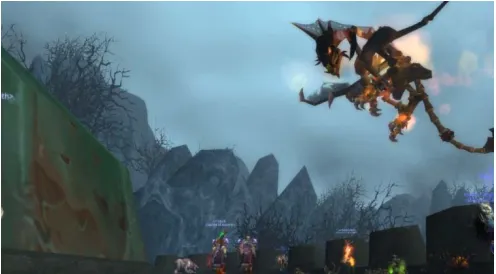
4 Fig. 1. Players watch the descent of Nightbane during a cut scene in World of Warcraft. Players are still able to interact
with each other here, but tend instead to watch the animation on a personal level, point out things that other players should notice, or prepare themselves for combat.
Players must usually respond to the narrative through creative means outside the text, since history continues around them without much direct intervention. The necromancer Abercrombie in Darkshire will always remain uncaught, the heroes of Lord of the Rings will still destroy the ring in Lord of the Rings Online, and so on. However, arguing that players appropriate the text goes some way towards alleviating this, and there is evidence that it is noted by designers. When Tanya Krzywinska argued that Onyxia always remains in the throne room of Stormwind in 2006, thus both supporting and destroying the mythologies of the self/avatar in World of Warcraft, she did not anticipate that two expansion packs later would literally change history [12]. In 2008, the Wrath of the Lich King expansion pack advanced this particular story. The figure of Onyxia (as Lady Prestor) was removed and princeling Arduinn Wyrnn became an older avatar in order to correlate with his role in the Lich King story arc. The boy king had grown up; and the game’s previous narrative stasis is satirised by a coin in the Dalaran fountain that reads; ‘I wish I would grow up, it feels like I’ve been ten for years’.
[image:5.595.45.293.78.215.2]This type of narrative development is unusual, but it may be indicative of the huge amount of fan texts that have surrounded the figure of Onyxia. The machinima Blind: The Art of War [14] is typical of this; a reinscription of the Onyxia story whereby a blood elf assassin tries to kill Onyxia. The assassin (possibly Mathias Shaw, an NPC involved in several Alliance quests) who tries to defend her is blinded at the crucial moment by a spell, failing to see Onyxia grow a massive pair of wings and thus remaining unaware of her true identity.
Fig. 2. Lady Katrana Prestor and guards prepare to defend themselves in Blind: The Craft of War
Blind is regularly voted in the top 10 of all ‘must see’ machinima, and when host Vimeo deleted it in May 2009, there was an outcry. In 2009, the EU section of Blizzard also ran a lore competition in which one of the questions was ‘who slays Onyxia?’, and a version of the story has in the accompanying world of Warcraft comic book series (#9) [21]. As peripheral texts, these texts all qualify under Jenkins’ depiction of fan text, and all rewrite what is considered an aberrant piece of material. As Jenkins also argues in his chapter on Star Trek authors, this rewriting to a more satisfactory version is also typical fan behaviour.
In the case of Onyxia, a collective understanding that an event was being represented wrongly; or that it should at least be addressed after it had happened, has changed the way that the game narrative has developed. Perhaps this was intentional, but given the duration of the World of Warcraft franchise, it is also likely that the incredulity of fans to the story arc (how could the Alliance possibly turn a blind eye to the fact that a member of the king’s high council kept turning into a dragon and attacking people?) helped to change the plot.
not transmit itself between groups, and in particular, that it goes virtually ignored until something dramatic which requires a reaction occurs. If fans are appropriating texts, they are also forming themselves into knowledge groups where the transmission of information stops occurring.
Phile’s Concern.
WoW is not unique in suffering such narrative difficulty. As a large world, one might expect this type of difference to emerge, but in smaller spaces it appears that the problematic appropriation and transmission of information can remain the same. One such game is eGenesis’ A Tale in the Desert (Atitd). This game prides itself on its intellectual complexity and small, dedicated user base. However, despite having a generally friendly community of players, who are used to working cooperatively together and to debating over the more public channels, it is also one with an unusual lack of roleplaying narrative. The game also one largely lacks NPC characters or the usual quest narratives that inform the narrative activities of many other MMORPGs.
Atitd is largely based on construction – the ultimate aim of each ‘Telling’ (a period which lasts approx 18-24 months) being to construct an ideal society; from the ground up. Players are concerned largely with world building – from simple brickracks to huge pyramids, aqueducts and monuments. The game is structured so that it is very difficult indeed to ‘solo’; especially in the late stages of each Telling. Instead, players are encouraged to act cooperatively, even to support individuals over themselves in order to succeed. However, there are no quests, and levels are achieved instead by completing various Tests which usually require further building or resource acquisition. These Tests are not related in any way to narrative elements, for example, the Test of the Raeli Mosaic simply states ‘Fracture brittle Raeli Tiles into unusual shapes, and fit them together to form a handsome mosaic. Your fellow Egyptians will judge you both on Color and Composition’ [2].
Roleplay within the game is largely lacking, partly because the game is so predicated around scientific development, minigames which do not allow the player to type quickly, and the relative difficulty of getting from place to place. Finally, the small community of the game are not really all that interested (or experienced) in roleplaying; thus they tend not to support it in for example, the chat channels or in personal meetings with other players. Therefore the dominant exoteric thought community does not endorse roleplay, and without structured experiences within the game, it does not take place frequently.
Previous narratives had also been very basic and can be summarised thusly;
Pharaoh. An NPC played by Tepper who set Egyp’s citizens tests, challenged them to competitions, and lead their struggles to populate
Egypt. In Tales 1-3 Pharaoh was the main narrative protagonist of the game.
The Stranger. An NPC who struck deals with players and caused considerable mayhem as a result. It was the Stranger who allowed Egypt access to explosives and who caused the Lung Spore Plague.
The Lung Spore Plague. A disease transmitted from player to player after several boxes belonging to the Stranger were discovered (and opened) on the shores of Egypt.
Malaki. A sexist antagonist who condoned slavery and derided the rights of women. Malaki also traded useful goods for chaff and was eventually jettisoned from the game by players.
The two sons. In Tale 4, Pharaoh (an NPC played by Tepper) was declared dead. Instead his two sons, Sami and Wahim (also both played by Tepper) replaced Pharaoh. It is currently assumed by players that by the end of the Telling that one will become the new Pharaoh.
Most notably, all of these ‘events’ or characters had a direct effect upon the game. The Lung Spore plague caused players to suffer depleted abilities, and to have a negative effect upon players wishing to meet each other (for example, to trade goods). The ease of transmission meant that many players left until it was over. The competitions and trials presented by Pharaoh, Wahim, the Stranger and Sami, all allowed players to progress somehow within the game, or gifted them with prizes. As a result, roleplay would often develop in a freeform manner around these characters, with the expectation that this would be rewarded somehow. Since most roleplay is simply acting out in conversations or physical actions, this somewhat stymied the perception of what, and how roleplay should be ‘used’ within the game.
However, this did not mean that players did not have an imaginative, narrative engagement with the world; that they did not reappropriate this rather thin narrative with ones of their own that developed these stories. The best example of these acts are the wonderful ‘diaries’ written in Tale 4 by B, who decided that it was her duty to marry Sami (partly to subvert her aversion to a test which required players to marry), and would propose to the avatar every time she saw it. The diaries, published on the player run Atitd wiki, are also an excellent example of the ludic/roleplay/real life crossover in a world where few people were consensually roleplaying, and thus it was seen as rather aberrant:
6 A: B is a traitor of the egyptian government I think. That must be why sami pays her no attention.
Many further statements were made by A and fortunately my loving friends were there to defend me. I of course am not a traitor of the government. Unless displaying my inclination towards romance with Sami (who is not to be confused with Teppy, Wahim, or anyone else) is being a traitor. I throw myself upon the ground confused and sad that A could be so heartless as to believe that I, little B, would do anything against the wonderful government of which I love so dearly. And on that note: Happy Sunday. [2]
In early 2009, the game developer, Andrew Tepper (‘Teppy’), held one of his regular live discussions with players regarding this issue. He mooted two ideas; one that roleplay should be linked to ludic gain (most notably, the rewarding of certain unavailable flowers in the game), and the second suggesting that players write and host their own events, which could be fitted into the game itself [1]. Such an act implies that there is no grand narrative, but it also allows players room to create one.
Phile’s Concern was the first player run event in response to the call for more role-play events, and an attempt to formalise the roleplaying within the game. The event was relatively simple and ran over one evening. The plot involved an NPC called Phile, who arrived in Egypt looking for her missing husband, Akkisos (or ‘Akki’). The players responded to the call and searched Egypt according to her clues, eventually finding the unfortunate Akki’s tombstone. The tombstone was marked ‘by the royal decree of Egypt’ and made by Nikomedes, a previous minor NPC who had been used for earlier storylines and announcements. Phile (and some of the players) swore revenge.
Fig.3. Players stand by the tomb of Akkisos during the Phile’s Sorrow event.
The event brought up some interesting challenges. The first was that communication severely hindered the event, as
players need to both stay within range of Phile in order to hear her – ‘audible’ (typed) speech was affected by range, and to search the land at the same time. The players were not prepared for this and eventually a player intervened by scribing Phile’s words onto a designated channel. The second realisation was the lack of defined criteria for roleplaying itself. With no delineations that a player was in or out of character, this meant that some players were fully roleplaying themselves as Egyptians, and others were asking semi out of character questions in order to understand what was going on. This was typified by the name of the event, which was called Phile’s Concern on the wiki, but named ‘The widow wails’ within the game. Therefore the conclusion seemed rather foregone; Phile was already widowed when the event began, and thus finding her husband’s body was an out of character assumption that was easy to make.
Phile’s Concern was subject to an extensive debrief by the players, which continued sporadically for several weeks. Having taken matters into their own hands, the debrief was surprisingly acrimonious. The player who ran the event was both disappointed that players had shown very little initiative during the search, and that there was relatively little follow-up afterwards. Most of the players who had taken part were surprised that there was potential for further actions, and unsure how these should be initiated. The debate devolved into a more general one about various disparities in the game; most notably returning to the common theme of the relative lack of developers and the bugs currently within the game. In this respect the community returned itself to a traditional communicative mode; absolving itself of responsibility and restoring the more common modes of discourse about more well known game mechanics, bugs and debates.
Giving the players more opportunity to subvert existing structures within the game (combat is impossible in the game, for example) was a far more successful method than trying to enforce traditional roleplaying narratives (the hunt for a lost person) from elsewhere. The players proved to be ultimately more interested in producing their own deviant narratives than gaining the customary prizes, with hilarious consequences.
Conclusion
‘Readers are travelers; they move across lands belonging to someone else, like nomads poaching their way across fields they did not write, despoiling the wealth of Egypt to enjoy it for themselves’. [8]
Atitd’s roleplaying events demonstrate shades of De Certeau’s original description of textual poaching. If we insert the word ‘players’ for ‘readers’, the analogy of A Tale in the Desert as a land pillaged for best use seems particularly appropriate. The reappropriation of the Phile event into something that suited a greater percentage of the Egyptian populace can be seen as a clear indication of the ways in which fannish behaviour can positively influence the development of a play text. Similarly, changes in larger MMORPGs such as the extensive use of beta testing by existing high-end guilds, or the alterations of storylines to develop over time, show that players take an active part in developing narratives, even if they do not always fully engage with them in the way that was first intended. Game designers, at pains to please their user base, are also more flexible to this approach, although they are well aware that the nature of online worlds means that you cannot please all of the people, all of the time. The perception of the player as a fan who can change the nature of the text is one however, that is receiving greater attention, heralded by the increasing role that social behaviour and negotiation plays [sic] in these worlds.
REFERENCES
1.A Tale in the Desert: ‘ENN’ at
http://services.atitd.org//log.php (May 2009).
2. A Tale in the Desert Wiki. ‘Users’ at
http://www.atitd.org/wiki/tale4/Main_Page (accessed July 2009)
3. Bartle, Richard. Designing Virtual Worlds. New York: New Rider Press. 2003.
4. Bonk, Curtis and Dennen, Vanessa. “Massive Multiplayer Online Gaming: A Research Framework for Military Training and Education”. 2005. Available at http://www.animationworkbook.com/230/GameReport_Bo nk_final.pdf
5. Castronova, E. Synthetic Worlds, Chicago, The University of Chicago Press, 2005.
6. Castronova, Eric. Exodus to the Virtual World. New York: Palgrave: Macmillan, 2007.
7. DC Universe. World of Warcraft #9. DC Universe Inc. 2009.
8. de Certeau, Michel. The Practice of Everyday Life.
Berkeley: University of California Press. 1984.
9. Funcom. Age of Conan Rules of Conduct. 2008 Available at
http://support.ageofconan.com/article.php?id=169
10. Jenkins, Henry. Textual Poachers: Television Fans and Participatory Culture. New York: Routledge. 1992.
11. Klastrup, Lisbeth. ‘A Poetics of Virtual Worlds’. In Proceedings of the Fifth International Digital Arts and Culture Conference, RMIT, Melbourne, Australia. 2003.
12. Kryzwinska, Tanya. ‘Blood Scythes, Festivals, Quests and Backstories: World Creation and Rhetorics of Myth in World of Warcraft’ in Games and Culture. vol 1. # 4. 2006.
13. MacCallum-Stewart, Esther, and Parsler, Justin.‘Role-play vs GameJustin.‘Role-play. The difficulties of Justin.‘Role-playing a role in World of Warcraft in Digital Culture, Play and Identity: The World of Warcraft Reader (eds. Corneliussen, Hilde and Walker, Jill) Massachusetts: MIT Press. 2008.
14. Percula. Blind: The Craft of War at
http://www.youtube.com/watch?v=JWgW3ogaV84. 2009.
15. Salen, K, and Zimmerman, E. Rules of Play. Massachusetts: MIT Press, 2003
16. Smith,Lesley ‘The Daily Grind: Greener Grass’ at Massively, http://www.massively.com/2009/07/05/the-daily-grind-greener-grass/ (5 July 2009).
17. Taylor, T L. Play Between Worlds. Massachusetts: MIT Press, chapter 1 and p. 10. 2007. chapter 1.
18. Tepper, Andrew (as ‘Teppy’). A Tale in the Desert ‘E’ log http://services.atitd.org//log.php (13 March 2009).
19. Tulloch, John. ‘”We’re only a speck in the ocean”: the Fan as powerless elite’ in Liquid Metal: the science fiction film reader. ed. Redmond, Sean. 2004. p. 281-297
20. Yee, Nick. The Daedalus Project at http://www.nickyee.com/daedalus/ 2003-2009.