Munich Personal RePEc Archive
Evaluations of infinite utility streams:
Pareto-efficient and egalitarian
axiomatics
Alcantud, José Carlos R. and García-Sanz, María D.
Universidad de Salamanca, Universidad de Salamanca
12 January 2010
Online at
https://mpra.ub.uni-muenchen.de/20133/
Evaluations of Infinite Utility Streams:
Pareto-Efficient and Egalitarian Axiomatics
Jos´e Carlos R. Alcantud
∗
,1, Mar´ıa D. Garc´ıa-Sanz
1,2Facultad de Econom´ıa y Empresa, Universidad de Salamanca, E 37008 Salamanca, Spain
Abstract
Two factors influence the resolution of the conflict among infinite generations: the consistency/ethical postulates requested; and the utilities that each generation can possess. We contribute to qualifying the Basu-Mitra approach to this problem, that concerns social welfare functions. Firstly we examine efficiency and strengthened forms of Hammond Equity for the Future both when the feasible utilities are [0,1] and natural numbers. This complements Banerjee (2006) and Alcantud and Garc´ıa-Sanz (2010). Secondly, we analyze the possibility of combining Pareto-efficiency and the spirit of the Hammond Equity principle for both specfications of the feasible utilities. Here the case study is richer since we analyze four different versions of this principle. We conclude that the Anonymity, Hammond Equity for the Future, and Hammond Equity ethics can be combined with weak specifications of the Pareto postulate at a time even through explicit social welfare functions.
Key words: Social welfare function, Equity, Pareto axiom, Intergenerational justice
∗ Corresponding author
Email addresses: [email protected](Jos´e Carlos R. Alcantud), [email protected]
(Mar´ıa D. Garc´ıa-Sanz).
URL: http://web.usal.es/jcr(Jos´e Carlos R. Alcantud).
1 Both authors acknowledge financial support by the Spanish Ministerio de Cien-cia e Innovaci´on under Project ECO2009-07682, and by Junta de Castilla y Le´on under Project SA024A08. Thanks are due to Geir Asheim for comments and a very careful reading of a previous draft, and to the participants of the SCW08 meeting at Montreal, the XIII FUR conference at Barcelona, and seminar presentation at Bilbao for their suggestions.
1 Introduction
The problem of “evaluating a stream” emerges from some economic problems that have the common characteristic of “not having a natural termination date”, like the optimization of the economic growth with streams (of con-sumption, for example) which extend over an infinite future, or the analysis of infinitely repeated games. The resolution of distributional conflicts among an infinite and countable number of generations or periods is subject to in-tense debate and research. We contribute to qualifying the approach to this aggregation problem based upon numerical evaluations of the streams.
With respect to the resolution of such kind of problems this is not the only position that can be taken. The Diamond approach –after Diamond (1965)– appeals to the use of social welfare relations that are continuous with respect to suitable topologies. This author established that Strongly Paretian welfare relations, continuous in the sup norm, can not treat all generations equally. In the present work we adhere to a second position that is concerned with the possible existence of social welfare functions (SWFs). No topological consid-eration is made in this case, that we call the Basu-Mitra approach: this line of inquiry is inspired by Basu and Mitra (2003), whose main result implies that one can dispense with the continuity axiom in Diamond’s impossibility theorem.
Two other type of factors must be mentioned in the resolution of the conflict among infinite generations. One includes the version of the Pareto criterion that is imposed in order to account for efficiency, plus the equity-related pos-tulate that is requested. The other factor is the domain of utilities that each generation can possess and in particular, if it is discrete or not. We call that do-main thefeasible utilitiesor sometimesfeasible social states. The use of discrete sets of feasible utilities is backed by the recognition that human perception is not endlessly fine. It is a natural setting if the utilities have a well-defined smallest unit (as happens when they measure monetary amounts), or if we are concerned with payoffs of infinitely repeated finite games.
to endorse any concrete structure for such set.
We introduce our setting and present our axioms in Section 2. Some sim-ple relationships among the requirements we employ are collected in Section 3. Then in Section 4 we examine if strengthened forms of Hammond Equity for the Future (HEF) are compatible with efficiency under the Basu-Mitra approach. In this regard Subsection 4.1 investigates if relaxing the efficiency requirement in Banerjee’s (2006) impossibility theorem –under HEF no SWF verifies Weak Dominance when X = [0,1]N– allows for compatibility with
HEF or even strengthened forms of it. Subsection 4.2 complements the anal-ysis initiated by Alcantud and Garc´ıa-Sanz (2010) when the feasible states are N∪ {0} by proving that anonymity and strengthened forms of HEF can be combined into explicit evaluations under weaker forms of efficiency. In a similar line of inquiry in Section 5 we wonder whether different versions of the Hammond Equity postulate can be combined into an efficient social welfare function. Both the continuous [0,1] and the discrete N∪ {0} instances are analyzed too, and normative implications of a weak variation of Hammond Equity are explored in Subsection 5.3. Our conclusions and related results are summarized in Section 6.
2 Notation and definitions
Let X denote a subset of RN, that represents a domain of utility sequences
or infinite-horizon utility streams. We adopt the usual notation for such util-ity streams: x = (x1, ..., xn, ...) ∈ X. By (y)con we mean the constant
se-quence (y, y, ....), (x,(y)con) holds for (x, y, y, y, ....), and (x1, ..., xk,(y)con) =
(x1, ..., xk, y, y, ....) denotes an eventually constant sequence. We write x> y
if xi >yi for each i = 1,2, ..., and x≫y if xi > yi for each i= 1,2, .... Also, x>y meansx>yand x6=y. We use the notationN∗
=N∪ {0}
Asocial welfare function (SWF) is a function W: X−→R. In this paper we are concerned with two sets of axioms of different nature on SWFs. Firstly we introduce some consequentialist equity axioms of two different classes.
Axioms 1a to 1d below are variations of a common equity principle: when there is a conflict between two generations, every other generation being as well off, the stream where the least favoured generation is better off must be weakly preferred. The precise meaning of the term “conflict” produces different formal requirements.
Axiom 1a(Hammond Equity, also HE). If x,y∈X are such that xj > yj >
Axiom 1b (Hammond Equity -Lauwers’ version-, also HE(L)). If x,y ∈ X
are such thatxj >yj >yk >xkfor somej, k ∈N, andxt=ytwhenj 6=t6=k,
then W(y)>W(x) .
Axiom 1c (Hammond Equity (a), also HE(a)). If x,y ∈ X are such that
xj > yj > yk > xk for some j, k ∈ N, and xt = yt when j 6= t 6= k, then W(y)>W(x) .
Axiom 1d (Hammond Equity (b), also HE(b) 3). If x,y ∈ X are such that xj > yj = yk > xk for some j, k ∈ N, and xt = yt when j 6= t 6= k, then W(y)>W(x) .
We also discuss some implications of the following axiom that was introduced in Asheim and Tungodden (2004a).
Axiom 2 (Hammond Equity for the Future, also HEF). If x,y ∈ X are such that x = (x1,(x)con) and y = (y1,(y)con) (x1 > y1 > y > x) , then W(y)>W(x) .
HEF states the following ethical restriction on the ranking of streams where the level of utility is constant from the second period on and the present gen-eration is better-off than the future: if the sacrifice by the present gengen-eration conveys a higher utility for all future generations, then such trade off is weakly preferred. Asheim and Tungodden (2004a) and Asheim et al. (2007), Section 4.3, explain that it is a very weak equity condition –under certain consistency requirements on the social preferences “condition HEF is much weaker and more compelling than the standard ‘Hammond Equity’ condition”– that can be endorsed both from an egalitarian and utilitarian point of view.
As a reinforcement of HEF we introduce a consequentialist equity axiom in the spirit of Lauwers’ (1998) Non-Substitution property. It captures a very demanding ethical principle: a large improvement in a finite number of gener-ations can never compensate a sustained improvement for all remaining gen-erations.
Axiom 2′
(Restricted Non-Substitution, also RNS). If x,y∈Xare such that
x = (x1, ..., xk,(x)con) and y = (y1, ..., yl,(y)con) with y > x, then W(y) > W(x) .
We do not intend to endorse this strong principle. However because we intend
to obtain possibility results it is technically better to deal with the strongest possible version of the postulates. A particular and more acceptable specifica-tion of RNS is the following:
Axiom 2′′
(1-Restricted Non-Substitution, also 1RNS). If x,y∈X are such that x= (x1,(x)con) and y= (y1,(y)con) with y > x, then W(y)>W(x) .
We see axioms 1RNS and HEF as necessary conditions for equity, in line with e.g. Asheim et al. (2007), p. 65. A reason for this restrictive consideration is that they are implied by dictatorship by a future generation i > 2 in the following sense: xi > yi implies W(x1, x2, x3, ...) > W(y1, y2, y3, ...). On the
contrary RNS is clearly incompatible with any similar dictatorship.
Remark 1 In line with the accepted status of HEF one can wonder if Ax-iom 1d can be considered a necessary condition for equity too, because it only requests that when there is a conflict between two generations –every other generation being as well off–, the stream where both generations receive the same must be weakly preferred. Nonetheless we are aware that if this argu-ment is taken further we must concede the same status to HE under either WD or MON in view of Lemma 1 (2) below. This position does not appear to have any other support in the literature.
Notation.In all the axioms above, when W(y)>W(x) is requested in place of W(y) >W(x) we refer to HE+, HEF+, RNS+, ... Property HE+ is used
by d’Aspremont and Gevers (1977) under the term extremist equity. HE(a)+
is called strict equity preference in Bossert et al. (2007).
Of course, in addition we intend to account for some kind of efficiency. In this sense the stronger axiom we deal with is the following.
Axiom 3 (Strong Pareto, also SP). If x,y ∈ X and x > y then W(x) >
W(y) .
The next efficiency axiom is implied by Strong Pareto.
Axiom 4 (Monotonicity, also MON). If x,y∈X and x>y then W(x)> W(y) .
Other axioms that are succesively weaker versions of Strong Pareto follow.
Axiom 5 (Partial Pareto, also PP). If x,y∈X and eitherx≫yor there is
Axiom 6 (Dominance, also D). If x,y ∈ X then (a) if there is j ∈ N such that xj > yj and xi =yi for all i6=j, then W(x) >W(y), and (b) if x ≫y
then W(x)>W(y).
Axiom 7 (Weak Dominance, also WD). If x,y∈ X and there is j ∈N such that xj > yj, and xi =yi for all i6=j, then W(x)>W(y).
On occasions even Weak Dominance is incompatible with interesting equity axioms. In case we want to implement some efficiency-type condition other than MON one can try to impose sensitivity properties like the following.
Axiom 8 (Sensitivity, also S). W(y,(x)con)>W(xcon) for each y > x.
Axiom 8 (Restricted Sensitivity, also RS). There are y, x ∈ R such that
y > x, W(y,(x)con)>W(xcon).
Axiom 9 (Lower Sensitivity, also LS). W(ycon) > W(x,(y)con) for each
y > x.
LS is also called Restricted Dominance (RD).
Axiom 10(Restricted Lower Sensitivity, also RLS). There are y, x∈R such that y > x, W(ycon)>W(x,(y)con).
Weak Dominance
Lower Sensitivity/Restricted Dominance Sensitivity
Restricted Lower Sensitivity Restricted Sensitivity Dominance
Partial Pareto Strong Pareto
3 Some relationships and other auxiliary results
We have mentioned that 1RNS implies HEF+. Besides 1RNS is stronger than
Weak Non-Substitution (cf., Asheim et al., 2008) and in the presence of either WD or MON, 1RNS implies Non-Substitution (cf., Lauwers, 1998).
Our next Lemma states further relationships among HE-related requirements.
Lemma 1 The following statements hold for any SWF on X:
(1) HE(L) ⇒ HE(a) ⇒ HE(b), and HE(a)=HE+HE(b) ⇒ HE. (2) HE(b) ⇒ HE under either WD or MON.
(3) Suppose X=l∞ or X=YN with Y ⊆R order-dense, |Y|>1. Then: (a) Under WD, HE+ and HE are equivalent.
(b) Under WD or MON, HE ⇒ HE(a)+ thus HE, HE(a)+ and HE(b)+
are equivalent.
Proof: Item (1) is straightforward. To prove (2) assume that Wis a Weakly Dominant or Monotonic SWF that satisfies HE(b). In order to check for HE take x,y ∈ X such that xj > yj > yk > xk for some j, k ∈ N, and xt = yt
when j 6= t 6= k. Define z ∈ X such that zj = yk, and zt = yt when t 6= j.
Due to HE(b), W(z) > W(x). Under WD, W(y) > W(z). Under MON, W(y)>W(z). The conclusion W(y)>W(x) follows.
Let us now assume the setting given by (3).
Firstly, assume thatW is a Weakly Dominant SWF that satisfies HE. Let us take x,y ∈ X such that xj > yj > yk > xk for some j, k ∈ N, and xt = yt
when j 6= t 6= k. HE implies W(y) > W(x), we need to check that this inequality is strict. We generate z ∈ X such that zt = xt when t 6= k, and
yk > zk > xk. Then WD implies W(z) > W(x), and the conclusion follows
because W(y)>W(z) under HE.
Finally, assume that W is a Weakly Dominant or Monotonic SWF that sat-isfies HE. In order to check for HE(a), i.e., for HE(b), take x,y ∈ X such that xj > yj = yk > xk for some j, k ∈ N, and xt = yt when j 6= t 6= k. We
generate z∈X such thatzt=xt whent 6=k, and yk> zk > xk. Due to HE+, W(z) > W(x). Under WD, W(y) > W(z). Under MON, W(y) > W(z). The conclusion W(y)>W(x) follows. ✁
We now recall other relationships between HE and HEF under Monotonicity or Dominance.
Proof: Asheim et al. (2008), Proposition 3, states a result alike the first statement for social welfare relations. Its proof is direct and can be mimicked here.
Suppose now that W is a SWF on either X = l∞ or X = YN with Y ⊆ R
order-dense, and also that W agrees with HE(b) and D. In order to check that W satisfies HEF too, take x,y ∈ X such that x = (x1,(x)con) and y = (y1,(y)con) with x1 > y1 > y > x. There is z such that y > z > x.
Define z = (z, z, x, x, x, ...), thus y≫ z and by D we obtain W(y)>W(z). Because x1 > z = z1 =z2 > x =x2 and xi = zi for each i > 2, HE(b) yields W(z)>W(x) thus W(y)>W(x) . ✁
Remark 2 One can readily check that HE(L) is incompatible with Restricted Sensitivity in virtually any useful instance ofX. By contrast, an explicit evalu-ation on l∞ that agrees with HE(L), AN, LS and HEF is provided in Theorem
1 below. Further, an explicit evaluation that agrees with HE(L), AN, LS and RNS when l∞ is provided in Proposition 3 below. ✁
Combining MON with reinforcements of HEF or variations of the HE principle is not complicated, as the next example shows.
Example 1 The Rawlsian criterion WR(x) = inf{xi : i = 1,2,3, ....} sat-isfies a reinforced version of MON (but not WD), generic Anonymity (i.e., it attaches the same value to all permutations of a given stream), HEF+, and
all four versions of Hammond Equity (Axioms 1a, 1b, 1c, and 1d) that we have stated. It does not agree with even Weak Non-Substitution. However a modified version, namelyWF R(x) = inf{xi : i= 2,3, ....}, does satisfy MON and 1RNS. Further, the limit inferior provides a MON and RNS evaluation of the streams. Its formal expression is:
lim inf(x) =limn→∞(inf{xi : i=n, n+ 1, ....})
We end this Section with a technical result that is used later on.
Lemma 3 Suppose that W : YN −→ R satisfies HE (resp., HE(b)) and
MON.
(a) If x,y∈ X are such that xj > yj > yk > xk (resp., xj > yj = yk > xk) for some j, k ∈N and yt>xt when j 6=t6=k, then W(y)>W(x).
(b) If we further assume ys > xs for some j 6=s 6= k and SP, then W(y) >
W(x).
Proof: Pick z∈X such that zt =xt when j 6=t6=k,zj =yj, zk=yk.
W(y) > W(z). In each instance the conclusion follows because HE (resp.,
HE(b)) yields W(z)> W(x). ✁
4 Existence of RNS and Efficient Social Welfare Functions
Basu and Mitra (2003), Theorem 1 states that no SWF is Strongly Paretian and Equitable or Anonymous (theAnonymityaxiom, denoted AN for simplic-ity, states that a finite permutation of a utility stream produces a utility stream with the same social utility) when X ={0,1}N. Under Hammond Equity for
the Future no SWF verifies Weak Dominance when X = [0,1]N (Banerjee,
2006). In this regard Subsection 4.1 is devoted to investigate if relaxing the efficiency requirement allows for compatibility with HEF or even adequate reinforcements of it. By contrast, when the set of feasible social states is the natural numbers 4 Alcantud and Garc´ıa-Sanz (2010) proves that the situation
is far more favourable: explicit expressions accounting for RNS and SP can be given, and there are evaluations that verify RNS and PP in the presence of AN. Subsection 4.2 completes this analysis by proving that anonymity and RNS can also be combined into explicit evaluations under weaker forms of efficiency.
4.1 The domain restriction X=l∞
In this Subsection we prove that relaxing WD to either S or LS in Banerjee’s (2006) theorem produces compatibility by explicit evaluations of the streams that are quite egalitarian, since they not only display HEF+ but also AN
and suitable reinforcements of HE. In addition we prove that this is the best we can do as to the HEF ethics in the sense that reinforcing HEF to 1RNS results into incompatibility with either S or LS numerical evaluations, even if we restrict ourselves to X = [0,1]N. Thus in this context and with respect to
the Basu-Mitra approach one can not obtain much efficiency under AN, but we can guarantee a much more equitable assessment at the cost of efficiency by means of explicit expressions.
Theorem 1 There are explicit SWFs on X = l∞ that satisfy HEF+, AN, HE(a) –resp., HE(L)–, and S –resp., LS–.
Proof: Define the following correction functions:
CU(x) =
0 if x= (xcon) for some x
1 if supn{xn}> lim inf{xn : n∈N}=infn{xn}
infn{xn} −supn{xn} if lim inf{xn: n ∈N}> infn{xn}
CL(x) =
1
1 + 12(supn{xn} −infn{xn})
Then CU satisfies HE(a), HEF, AN and S, and WL =lim inf +CL satisfies
HE(L), HEF+, AN and LS. Besides W
U = lim inf +CU satisfies HE(a),
HEF+, AN and S. ✁
Proposition 1 There are not SWFs on X= [0,1]N that combine 1RNS with
either S or LS.
Proof: For both cases we proceed by contradiction. Let W : X −→ R be 1RNS and LS. For each 0 < x < 1 we let L(x) := W(x
2,(xcon)) and R(x) :=
W(xcon). Then I(x) := (L(x), R(x)) is nonempty because W is LS. Besides,
1> y > x >0 implies I(x)∩I(y) =∅:
L(y) = W(y
2,(ycon))>W(xcon) =R(x)
by virtue of 1RNS. This is impossible because an uncountable number of different rational numbers are assigned.
Suppose now that W : X −→ R is 1RNS and S. For each 0 < x < 1
2 we let L(x) := W(xcon) and R(x) := W(2x,(xcon)). Then I(x) := (L(x), R(x)) is
nonempty because Wis S. Besides, 12 > y > x >0 implies I(x)∩I(y) =∅:
L(y) = W(ycon)>W(2x,(xcon)) =R(x)
by virtue of 1RNS. This is impossible because an uncountable number of different rational numbers are assigned. ✁
4.2 The domain restriction X=YN, Y ={0,1,2, ....}
In Alcantud and Garc´ıa-Sanz (2010) the following Proposition is proven (cf., Theorem 1 and Proposition 1).
Proposition 2 Let X=YN, where Y ={0,1,2, ....}.
(b) There are SWFs on X that satisfy PP, AN, and RNS.
The question remains if AN and RNS can be jointly combined with weaker specifications of Pareto-efficiency by means of explicit evaluations that can be employed for policy purposes. We proceed to solve this question in the positive.
Proposition 3 There are explicit SWFs on X=YN, whereY ={0,1,2, ....},
that satisfy AN, S (resp., HE(L) and LS), and RNS.
Proof: Recall that the application
ψ(n) = n
1 +n for each n ∈N
∗
maps N∗
into [0,1) and satisfies: m < n if and only if ψ(m)< ψ(n) for every possible m, n (Bridges and Mehta, 1996, p. 30). Now for any L∈N we take
φL : [0,1]−→[0, ψ(L+1)−ψ(L)) strictly increasing (e.g.,φ(t) =tψ(L+1)
−ψ(L) 2 ).
Define φ−∞= 0.
We let L(x) =lim inf{xn : n ∈ N} when such limit point exists, and
other-wise we write L(x) =−∞.
For anyx= (x1, x2, x3, ....)∈X let
LU(x) =lim inf{ψ(xn) : n ∈N}+φL(x)(supnψ(xn))
LL(x) =lim inf{ψ(xn) : n∈N}+φL(x)(infnψ(xn))
Then LU (resp., LL) satisfies AN, S (resp., HE(L) and LS), and RNS. ✁
5 Hammond Equity and the existence of efficient Social Welfare Functions
As happens with HEF, the problem of combining the ethics that the Hammond Equity principle incorporates with efficiency under the Basu-Mitra approach depends on the domain of utility streams. In Subsection 5.1 we show that the problem when the domain is X = [0,1]N has been ellucidated in part and
we complete the corresponding study. An analysis of the case where X =
YN with Y = N∗
5.1 The domain restriction X=l∞
The next consequence of Lemma 2 follows immediately after Banerjee (2006), Theorem 1.
Corollary 1 There is no Dominant SWF on [0,1]N that satisfies any of the
axioms 1a to 1d.
Proof: We have argued that if a Dominant SWF satisfies any of the axioms 1a to 1d then it satisfies HE(b). But Lemma 2 ensures that such SWF must satisfy HEF, which is impossible by virtue of Banerjee (2006), Theorem 1. ✁
Despite this Corollary, one may wonder if there exist SFWs that are both HE(b) and WD when either X = [0,1]N or X = l
∞. We now show that the
answer to this latter question is negative in both instances, thusno version of the Hammond Equity postulate under inspection is compatible with a Weakly Dominant SWF when the domain is [0,1]N (cf., 3 (b) in Lemma 1). This
conclusion is unsurprising since HEF is much weaker than HE in the presence of either MON or D, and HEF is already incompatible with WD under the Basu-Mitra approach.
Proposition 4 There are not SWFs on X = [0,1]N that satisfy both HE(b) and WD.
Proof: We proceed by contradiction. Let W : [0,1]N −→ R be HE(b) and
WD. For each 0 < x < 1 we let L(x) := W(x, x,0,0, ....) and R(x) :=
W(1+2x, x,0,0, ....). ThenI(x) := (L(x), R(x)) is nonempty becauseWis WD.
Besides, 12 > y > x >0 implies I(x)∩I(y) = ∅:
L(y) = W(y, y,0,0, ....)>W(1 +x
2 , x,0,0, ....) =R(x)
by application of HE(b) to 1+x
2 > y > x. This is impossible because an
un-countable number of different rational numbers are assigned. ✁
5.2 The domain restriction X=YN, Y ⊆ {0,1,2, ....}
Now we wonder if it is possible to reconcile any version of Hammond Equity with WD (or stronger axioms) under the Basu-Mitra perspective when X =
YN and Y ={0,1,2, ....}.
In Theorem 2 below we show that the answer to that question is in the negative when SP and either HE, HE(L), HE(a) or HE(b) is required. In fact in order to reach such negative conclusion we only need that Y has enough elements as to make the Hammond Equity principle meaningful.
Theorem 2 There are not SWFs on X=YN, where|Y|>3(resp.,|Y|>4), that satisfy both HE –resp., HE(b), HE(a), HE(L) – and SP.
Proof: The HE(L) case is dealt with in Remark 2. We proceed to prove that HE and SP are not displayed by any WonX. Then Lemma 1 can be used to show that HE(b) and HE(a) can not be combined with SP either.
We use a standard construction to produce a suitable uncountable collection {Ei}i∈I of infinite proper subsets of N. We request that ∀i, j ∈ I [i < j ⇒
Ei (Ej and Ej−Ei is infinite ]. We also need that there is an index q∈ Ei
for all index i ∈ I. In order to justify that such collection exists, we take {r1, r2, ....} an enumeration of the rational numbers in (0,1) and set E(i) = {n ∈N: rn < i} for each i∈ I = (r1,1) in order that q =r1 ∈E(i) for each
i∈I.
To simplify notation we assume without loss of generality that{0,1,2,3} ⊆ Y. Let us define the following two utility streams associated with eachi∈I:
r(i)p =
1 if p∈Ei, p6=q
3 if p=q
0 otherwise
l(i)p =
1 if p∈Ei, p6=q
2 if p=q
0 otherwise
By SP, the open interval (W(l(i)), W(r(i))) is not empty.
We intend to check thatj < i⇒W(l(i))>W(r(j)), which is impossible be-cause an uncountable number of distinct rational numbers would be obtained. Let us fixk ∈Ei−Ej. We claim that Lemma 3 (b) applies to coordinatesqand
Also, when q 6= p 6= k we have: l(i)p = r(j)p when either p ∈ Ei ∩ Ej or
p /∈ Ei∪Ej, and l(i)p = 1 >0 = r(j)p for every p ∈ Ei, p /∈ Ej (recall that
there are an infinite number of elements in Ei−Ej). This ends the argument
for the case HE plus SP, which suffices to complete the proof. ✁
Despite this negative result, Theorem 3 below assures that PP can be com-bined with HE+/ HE(a)+/ HE(b)+even in the presence of Anonymity. In order
to prove it we state the following auxiliary result.
Lemma 4 The function ν(n) = P
i=0,1,...,n 21i (n = 0,1,2, ...) is strictly
in-creasing in n and satisfies: x > y2 >y1 > z⇒ν(y1)−ν(z)> ν(x)−ν(y2).
Proof: Fix x > y2 >y1 > z. Some straightforward computations yield
ν(y1)−ν(z) = 1 2z+1
1 + 1
2 +...+ 1 2y1−z−1
> 1
2z+1
and
ν(x)−ν(y2) = 1 2y2+1
1 + 1
2 +...+ 1 2x−y2−1
< 1
2y2 since
1 + 1
2+...+ 1
2x−y2−1 <2
Because y2 >z+ 1 the conclusion follows. ✁
Theorem 3 There are SWFs on X = YN, where Y = {0,1,2, ....}, that
satisfy both HE(a)+, Anonymity, and PP.
Proof: We closely follow Mitra and Basu’s proof in (2007) that there are PP and Anonymous SFWs on X = YN. 5 The binary relation on X given
by x ∼ y if and only if xi = yi eventually is an equivalence relation. The
equivalence class of x is denoted by [x]∼. We select an element g([x]∼) from
each equivalence class [x]∼ in the quotient set X∼. For simplicity we write
gx = g([x]∼), and as usual gx = (gx1 , g2x, ...). Thus when x,y satisfy that
xi =yi eventually one hasgx=gy.
Let us denote AN(x) = ν(x1) +....+ν(xN)−(ν(g1x) +...+ν(gNx)) for each
N ∈N and x∈X, and consider the function h(x) = limN→∞(AN(x)), which
is well defined because AN(x) is eventually constant (for any fixed x). Then
h is clearly Anonymous and Weakly Dominant. We now prove thath satisfies HE(a)+.
If x,y∈ X are such that xj > yj > yk > xk for some j, k ∈ N, and xt = yt
when j 6= t 6= k, our construction entails gx = gy. Therefore there is an index N0 such that AN(y)−AN(x) =ν(yj)−ν(xj) +ν(yk)−ν(xk) for each
N > N0. Now Lemma 4 yields AN(y)−AN(x) > 0 whenever N > N0 and
thus h(y)> h(x) .
Finally, we define the SWF that satisfies our requirements by the expression:
LAH(x) =
1 2 ·
h(x)
1 +|h(x)| +min{x1, x2, ...}
It is clear that LAH is Anonymous because so is h. By mimicking Mitra and
Basu’s argument, we can check that it is PP: the key point is that
H(t) := 1 2 ·
t
1 +|t| is strictly increasing, with values in (− 1 2,
1 2)
and thus whenever y ≫ x because min{y1, y2, ...} > min{x1, x2, ...}+ 1 we always get LAH(y)>LAH(x). In order to prove that LAH is HE(a)+, let us
select x,y ∈ X such that xj > yj > yk > xk for some j, k ∈ N, and xt = yt
when j 6= t 6= k. Now LAH(y) > LAH(x) is enforced due to the following
two inequalities: h(y)> h(x) as was proved above, thus H(h(y))> H(h(x)) because H is strictly increasing; andmin{y1, y2, ...}>min{x1, x2, ...}. ✁
5.3 Normative background for HE(b)
Much of the appeal of the Hammond Equity principle in social choice with a finite population is due to Hammond’s (1976) characterization of the lex-imin principle as the only social welfare ordering that satisfies Strong Pareto, Anonymity, and Hammond Equity. Further variations of this result were given e.g., by d’Aspremont and Gevers (1977), or by Mariotti and Veneziani (2009) when the setting is Rn. According to the latter reference, the Mariotti-Veneziani
Harm Principle (see also Lombardi and Veneziani, 2009a, 2009b) can replace HE in Hammond’s characterization provided that X = Rn. We proceed to show that the obvious finite-dimensional version of HE(b) plays the same role in the sense that for any specification of X the next equivalences hold true:
Theorem 4 (Characterizations of the leximin) For a given social order-ing <, the following statements are equivalent.
(1) < is the leximin ordering. (2) < agrees with SP, AN, and HE. (3) < agrees with SP, AN, and HE(b).
Proof: The equivalence of (1) and (2) is Hammond’s characterization. The fact that (1) implies(3)–i.e., that the leximin ordering agrees with HE(b)– is easy to check. Because the finite-dimensional version of Lemma 1 (2) proves that SP plus HE(b) imply HE, (3) ⇒(1) obtains.
The last assertion is the main result in Mariotti and Veneziani (2009). ✁
In comparison to HE it may seem that the finite version of HE(b) embodies a more limited load of aversion to inequality: it only requires that allocating different amounts in place of equal endowments should not be socially favoured if such inequality produces a conflict between two agents, every other agent being as well-off. However the implications of HE(b) under SP in a finite-population setting are wider than Hammond Equity’s (by adapting Lemma 1
(2) to this context), and introducing AN or treating with social states that are order-dense yields their equivalence.
6 Summary of results and conclusions
We have produced new arguments to contribute to the following debate: in combining equity and Pareto-efficiency under the Basu-Mitra position, what properties can be guaranteed? and, what is the influence of the choice of the set of feasible utilities? If we are bound by the HEF/RNS ethics we conclude that the set of feasible utilities is the determinant factor for at least Weakly Dominant efficiency: when the social states are a non-degenerate interval even the weakest possible combination ends in impossibility, but when it is included in N∗
there is an explicit criterion that accounts for their strongest versions. It was known that this is not the case when Anonymity is the equity principle under inspection: we can not assure that a given structure produces compat-ibility or incompatcompat-ibility without considering the amount of Pareto-efficiency we want to reach. In addition, we have proved that if we are interested in imposing the HE spirit instead then the existence of a non-degenerate interval as potential social states obliges to incompatibility for at least Weakly Dom-inant efficiency, while the appeal to N∗ does not (and the other factors must
be examined: namely, the precise form of the HE postulate and the version of the Pareto axiom in use).
The following tables gather results that have served us to motivate our dis-cussion, and permit to compare differences in the approaches when we vary the feasible utilities. We have emphasized it when a criterion can be explicitly constructed, since recent evidences like Zame (2007, Theorem 4′
) or Lauwers (2010) 6 make this feature especially valuable.
Table 1. Summary of results for domains of utility streams YN under
Anonymity
Y =N∗
Y = [0,1]
SP Non-existence ⋆ Non-existence
PP Existence † Non-existence
D Existence Non-existence ⋄
WD or weaker Existence Existence ‡
S/LS or weaker Explicit § Explicit §
Statement ⋆ is proven in Basu and Mitra (2003) when |Y| > 1. All †, ‡ and ⋄ appear in Basu and Mitra (2007). We emphasize that the construction proving ‡ holds in X = l∞ and fulfils HEF. Cases § appear in Table 2. The
other statements in the table derive from ⋄ and †.
Some questions remain open. For example, it is not yet known whether WD and anonymous SWFs can be explicitly described in these settings. Further, in each of the four cases where compatibility is guaranteed one can try to identify the class of groups of permutations for which extended anonymity (or Q-Anonymity as introduced by Mitra and Basu, 2007) is compatible with the respective efficiency axiom under the Basu-Mitra approach.
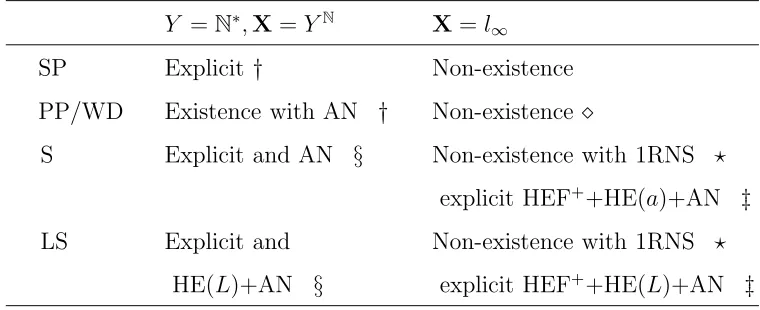
Table 2. Summary of results for domains of utility streams X under RNS
Y =N∗
,X=YN X=l
∞
SP Explicit † Non-existence
PP/WD Existence with AN † Non-existence ⋄
S Explicit and AN § Non-existence with 1RNS ⋆
explicit HEF++HE(a)+AN ‡
LS Explicit and Non-existence with 1RNS ⋆
HE(L)+AN § explicit HEF++HE(L)+AN ‡
Banerjee (2006) proves that⋄holds even if RNS is weakened to HEF. Cases ‡ are proved in Theorem 1. Proposition 1 accounts for assertions⋆. Proposition 3 proves §.
[image:18.595.98.478.475.630.2]Statements † are justified in Alcantud and Garc´ıa-Sanz (2010) as recalled by Proposition 2. The other statements in the table derive from them.
[image:19.595.91.492.218.395.2]These results add to Asheim et al. (2007), where incompatibilities of HEF with the Pareto postulate are obtained under continuity assumptions.
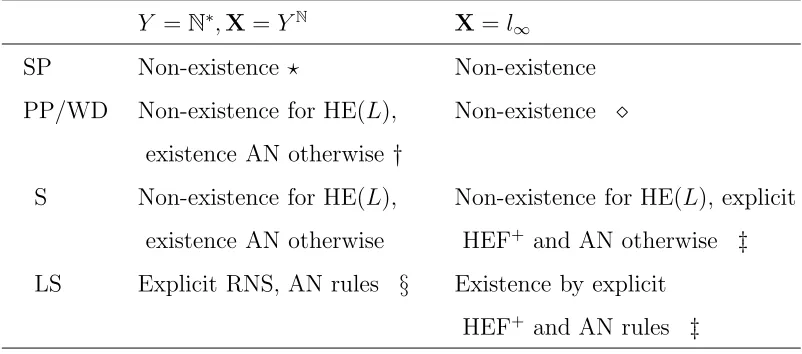
Table 3. Summary of results for domains of utility streamsX under different versions of HE
Y =N∗,X =YN X =l
∞
SP Non-existence ⋆ Non-existence
PP/WD Non-existence for HE(L), Non-existence ⋄
existence AN otherwise †
S Non-existence for HE(L), Non-existence for HE(L), explicit
existence AN otherwise HEF+ and AN otherwise ‡
LS Explicit RNS, AN rules § Existence by explicit
HEF+ and AN rules ‡
With respect to HE(L), all the combinations that imply S are impossible as is stated in Remark 2.
Proposition 4 conveys statement ⋄ irrespective of the version of HE that we require. Cases ‡ are proved in Theorem 1.
Case ⋆is non-existence for all the versions of Hammond Equity that we have dealt with by Theorem 2. In fact it produces non-existence as long as Y has enough elements as to make the equity axiom meaningful. Combinations † hold by Theorem 3. Table 2 shows case§.
7 Bibliography
Alcantud, J.C.R. and Garc´ıa-Sanz, M.D. (2010): Paretian evaluation of infinite utility streams: an egalitarian criterion. Forthcoming in Economics Letters.
Asheim, G. B. and Tungodden, B. (2004a): Do Koopmans’ postulates lead to discounted utilitarianism?. Discussion paper 32/04, Norwegian School of Economics and Business Administration.
Asheim, G. B. and Tungodden, B. (2004b): Resolving distributional conflicts between generations, Economic Theory 24, 221-230.
Asheim, G.B., Bossert, W., Sprumont, Y. and Suzumura, K. (2006): Infinite-horizon choice functions, CIREQ, working paper no. 05-2006.
Asheim, G. B., Mitra, T. and Tungodden, B. (2006): Sustainable recursive social welfare functions. No 18/2006, Memorandum from Oslo University, De-partment of Economics.
Asheim, G. B., Mitra, T. and Tungodden, B. (2007): A new equity condition for infinite utility streams and the possibility of being Paretian. In: Roemer, J., Suzumura, K. (Eds.), Intergenerational Equity and Sustainability: Conference Proceedings of the IWEA Roundtable Meeting on Intergenerational Equity (Palgrave).
d’Aspremont, C. and Gevers, L. (1977): Equity and the informational basis of collective choice. Review of Economic Studies 44, 199209.
Banerjee, K. (2006): On the equity-efficiency trade off in aggregating infinite utility streams. Economics Letters 93, 63-67.
Basu, K. and Mitra, T. (2003): Aggregating infinite utility streams with in-tergenerational equity: the impossibility of being paretian. Econometrica 71, 1557-1563.
infi-nite utility streams equitably. In: Roemer, J., Suzumura, K. (Eds.), Inter-generational Equity and Sustainability: Conference Proceedings of the IWEA Roundtable Meeting on Intergenerational Equity (Palgrave).
Bossert, W., Sprumont, Y. and Suzumura, K. (2007): Ordering infinite utility streams. Journal of Economic Theory 135, 579-589.
Bridges, D. S. and Mehta, G. B. (1996): Representations of Preference Order-ings. (Springer-Verlag, Heidelberg–Berlin-New York).
Diamond, P. A. (1965): The evaluation of infinite utility streams. Economet-rica 33, 170-177.
Epstein, L.G. (1986): Intergenerational Preference Orderings. Social Choice and Welfare 3, 151-160.
Fleurbaey, M. and Michel, P. (2003): Intertemporal equity and the extension of the Ramsey principle. Journal of Mathematical Economics, 39, 777-802.
Hammond, P.J. (1976): Equity, Arrow’s conditions and Rawls’ difference prin-ciple. Econometrica 44, 793-804.
Koopmans, T.C. (1960): Stationary ordinal utility and impatience. Economet-rica 28, 287-309.
Lauwers, L. (1997): Rawlsian equity and generalized utilitarianism with an infinite population. Economic Theory 9, 143-150.
Lauwers, L. (1998): Intertemporal objective functions: strong Pareto versus anonymity. Mathematical Social Sciences 35, 37-55.
Lauwers, L. (2010): Ordering infinite utility streams comes at the cost of a non-Ramsey set. Forthcoming in Journal of Mathematical Economics.
Principle. Working Paper No. 649, Department of Economics, Queen Mary (University of London).
Lombardi, M. and Veneziani, R. (2009a): Liberal egalitarianism and the Harm Principle. Working Paper No. 649, Department of Economics, Queen Mary (University of London).
Lombardi, M. and Veneziani, R. (2009b): Liberal principles for social welfare relations in infinitely-lived societies. Working Paper No. 650, Department of Economics, Queen Mary (University of London).
Mariotti, M. and Veneziani, R. (2009): ‘Non-interference’ implies equality. So-cial Choice and Welfare 32, 123-128.
Mitra, T. and Basu, K. (2007): On the existence of Paretian social welfare relations for infinite utility streams with extended anonymity. In: Roemer, J., Suzumura, K. (Eds.), Intergenerational Equity and Sustainability: Conference Proceedings of the IWEA Roundtable Meeting on Intergenerational Equity (Palgrave).
Ramsey, F. P. (1928) A mathematical theory of savings. Economic Journal 38, 543-559.
Sakai, T. (2003): Intergenerational preferences and sensitivity to the present. Economics Bulletin 4, 1-6.
Sakai, T. (2006): Equitable intergenerational preferences on restricted do-mains. Social Choice and Welfare 27, 41-54.
Sakai, T. (2008): Intergenerational equity and an explicit construction of wel-fare criteria. Mimeo.
Shinotsuka, T. (1998): Equity, continuity and myopia: A generalization of Di-amond’s impossibility theorem. Social Choice and Welfare 15, 21-30.
Paretian and egalitarian evaluation of infinite utility streams. Andrew Young School of Policy Studies Research Paper Series. Working Paper 07-12 2007.
Svensson, L.G. (1980): Equity among generations, Econometrica 48, 1251-1256.