EUR 5159 e
COMMISSION OF THE EUROPEAN COMMUNITIES
SABINE - 3
AN IMPROVED V E R S I O N ^
OF THE SHIELDING CODE SABINE
by
C. PONTI and R. VAN HEUSDEN
E S I S
1 9 7 4
Joint Nuclear Research Centre
Ispra Establishment - Italy
LEGAL NOTICE
Thia document was prepared under the sponsorship of the Commission of the European Communities.
Neither the Commission of the European Communities, its con tractors nor any person acting on their behalf:
make any warranty or representation, express or implied, with respect to the accuracy, completeness, or usefulness of the information contained in this document, or that the use of any information, apparatus, method or process disclosed in this document may not infringe privately owned rights; or
assume any liability with respect to the use of, or for damages resulting from the use of any information, apparatus, method or process disclosed in this document.
This report is on sale at the addresses listed on cover page 4
at the price of B.Fr. 25.
Commission of the European Communities
O.G. ΧΠΙ - C.I.D. 29, rue Aldringen L u x e m b o u r g September 1974
EUR 5159 e
SABINE-.'i AN IMPROVED VERSION OF THE SHIELDING CODE SABINE
by C. PONTI and R. VAN HEUSDEN Commission of the European Communities
Joint Nuclear Research Centre — Ispra Establishment (Italy) Nuclear Studies Division
Luxembourg, September 1974 — 14 Pages — B.Fr. 25.—
This report describes the new version of the programme SABINE, for one-dimensional bulk shielding calculations. The main improvements implemented into SABINE-.'i are: the complete test of input data before starting the execution of a problem; a more accurate and flexible calculation of gamma-ray fluxes, that allows to save computer time; and an up-dated library that includes also data for gamma-rays arising from neutron inelastic scattering.
EUR 5159 e
SABINE-.'i AN IMPROVED VERSION OF THE SHIELDING CODE SABINE
by C. FONTI and R. VAN HEUSDEN Commission of the European Communities
Joint Nuclear Research Centre — Ispra Establishment (Italy) Nuclear Studies Division
Luxembourg, September 1974 — 14 Pages — B.Fr. 25.—
This report describes the new version of the programme SABINE, for one-dimensional bulk shielding calculations. The main improvements implemented into SABINE-.'i are: the complete test of input data before starting the execution of a problem; a more accurate and flexible calculation of gamma-ray fluxes, that allows to save computer time; and an up-dated library that includes also data for gamma-rays arising from neutron inelastic scattering.
EUR 5159 e
SABINE-.'i AN IMPROVED VERSION OF THE SHIELDING CODE SABINE
by C. PONTI and R. VAN HEUSDEN Commission of the European Communities
Joint Nuclear Research Centre — Ispra Establishment (Italy) Nuclear Studies Division
Luxembourg, September 1974 — 14 Pages — B.Fr. 25.—
EUR 5159 e
COMMISSION OF THE EUROPEAN COMMUNITIES
SABINE - 3
AN IMPROVED VERSION
OF THE SHIELDING CODE SABINE
by
C. PONTI and R. VAN HEUSDEN
E S I S
1974
Joint Nuclear Research Centre
Ispra Establishment - Italy
ABSTRACT
This report describes the new version of the programme SABINE, for one-dimensional bulk shielding calculations. The main improvements implemented into SABINE-3 are: the complete test of input data before starting the execution of a problem; a more accurate and flexible calculation of gamma-ray fluxes, that allows to save computer time; and an up-dated library that includes also data for gamma-rays arising from neutron inelastic scattering.
TABLE OF CONTENTS
Page
1. Introduction 5
2. Neutronic Calculation 5 3. Calculation of the Gamma-ray Fluxes 5
4. New Structure of the Gamma-ray Data Library 6
5. SABINE-3 Data Libraries 6 6. Input Specifications 7
References 12
List of Tables
Table 1
Table 2
Table 3
Identification of the Materials in the Library
Layout of Input Data
1. Introduction
The code SABINE11 i* used since 1967 to calculate neutron and gamma-ray attenuation in
bulk shielding problems. It is widely used in European countries both in research centres and in private industries. It is applied for heating, damage, dose, and activation calculations in several types of thermal reactors and also in fast reactors.
This report describes the modifications which have been worked out to remove some
inconsistency, to improve the accuracy of the results and to speed up the calculation time.
As requested by many users, the input of the code is now tested before execution, and
several diagnostics are provided to point out possible input errors.
Finally the cross section library has been improved by updating the gamma-ray data and
including for some elements the gamma radiation produced by inelastic scattering.
This report should be considered as a supplement of 1 ): it describes the new features and the differences between the new and the previous version. For all subjects not mentioned in
this report, reference is made to what written in 1 '. Examples of application of SABINE, as well as useful information on the check of the results for different types of shields, on
comparisons between calculation and experience, on comparisons with other programs, may
be found in 6 t o 1 2 ).
2. Neutronic Calculation
In the part of the code where the calculation of the neutron fluxes is performed, no important modifications have been introduced. The formula that determines the
dependence of the thermal absorption cross section from the temperature, in the subroutine NEUTRO, has been improved.
3. Calculation of the Gamma-Ray Fluxes
Changements into this part of the program have been made in order to eliminate some
sources of errors, to get a better accuracy of the results, and to simplify input data
preparation.
■ The temperature dependence of the thermal radiative capture c.s, which was not taken
into account in the previous versions, has been introduced, with the same formula as for
thermal absorption c.s.
■ After having completed the neutron flux calculation, SABINE-3 may be used to compute the gamma-ray source distribution (to be introduced for instance in other computer
codes), or to compute also the gamma-ray fluxes.
■ Gamma-ray fluxes are now calculated at the points which are requested by specifying their abscissa ζ (distance from the core boundary). These points need not be equidistant or regularly distributed; they can be within the core (negative z) or within the shield
(positive z).
■ For each point where the gamma-ray flux is requested, the user may specify which regions should be taken into account as source regions for that point. In this way the computer effort may be minimized and important savings may be realised.
■ The numerical integration over the source volume which is executed to compute the gamma-ray flux, has been improved; the errors that sometimes occurred when calculating fluxes at the interfaces (errors of 50% were pointed out) have now been removed.
■ Division by zero were also frequent with the previous versions; they had no effect on the results, but produced sometimes a number of diagnostics or even stopped the running of the code. These have also been removed.
■ The input data for this part of calculation has been simplified; in particular the number of
- 6
4. New Structure of the Gamma-Ray Data Library
The program SAB LIB that writes the unformatted library tape for SABINE has been modified to provide a new structure for the gamma-ray data. Furthermore it writes the library tape in a new way (with a smaller number of longer records). Previous library tapes read from SABINE are no more suitable for SABINE-3; new library tapes shou'd be generated with the new SAB LI Β and the new data library.
The data needed to calculate the neutron induced gamma-ray sources may be provided for each element in to ways:
a) av i = 1 , 2 6 microscopic (n/y) c.s. in barns c«, g = 1,7 capture gamma spectrum, MeV/cap
In this way the gamma-ray spectrum is assumed to be independent from the neutron energy.
b) Ojg i = 1 , 2 6 ; g = 1 , 7 (n/v) matrix. MeV· barn
This complete 26x7 matrix can account for gamma radiation produced by capture, inelastic scattering, or any other reaction that neutrons may produce with the element.
The neutron induced gamma-ray sources are calculated by SABINE-3 in the following way:
Sg
<X>
"¡J;"
Φ\
«Χ» P¡,g
Sg(X) is the gamma-ray source density at x, for the group g, in MeV/cm3 .sec.
0¡ (X) is the neutron flux of the it n group at X.
L = IFGAM (see card 4 of input data), and
Ρ : . = Σ Neof c * + Σ Neo f . (MeV/cm) '»9 e(a) I 9 elb) '<9
e = index of the element
Ne = nuclear density in the region considered in atoms/barn.cm
The first sum is extended to those elements of the region considered, that are described as shown in (a); the second sum is extended to the elements described as shown in (b). This distinction is automatically operated by the code through the parameters contained in the data library.
B. SA81NE-3 Data Libraries
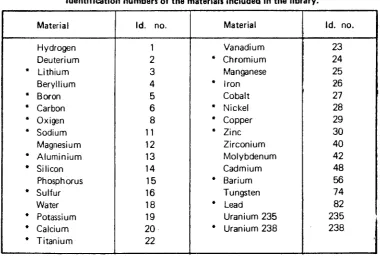
The code is delivered together with two new data libraries; they differ only in the gamma ray data. The neutron data library is essentially the same as that previously in use, except for a few corrections interesting the elements Calcium and Barium. The content of the gamma-ray data libraries is described below. The two libraries contain the same elements; they are listed in Table 1.
6.1 First Library (A)
In this library the gemma-ray data are described for all the elements in the way (a) of section 4. The changements contained as compared to the old library are listed below.
1 ) Gamma-ray spectra from thermal neutron capture
For S, T i , Ni, Cu, Zn, Ba, these data are taken from 2 ); for Na, A l , Si, K, Ca, Fe, they are taken from 3 ). The data for Pb have not been modified because the differences versus the data published in 3 ) are irrelevant.
2) Neutron capture cross sections
3) Other changements
For the natural Boron, the library data account for the photon of 0.478 MeV emitted in 94% of (n, a) reactions.
5.2 Second Library (B)
This library contains complete (n, 7) matrices for ten elements: Li, C, Na, A l , Si, Fe, Ni, Cr, Cu, Pb. These matrices (see point (b) of section 4) have been generated by POPOP44'
taking into account all the reactions for which data were available in the POPOP4 library 5 ).
The gamma-rays arising from inelastic scattering with Oxigen, may be produced only by neutrons of the first energy group; this gamma-source may be described in the way (a) of section 4.
[image:11.595.124.505.324.581.2]A part from these elements, the content of this library is the same as that in library A. Note that within the gamma data library, the data of the "type (b)" elements precede the data of the other elements.
TABLE 1
Identification numbers of the materials included in the library.
Material Hydrogen Deuterium * Lithium Beryllium * Boron * Carbon * Oxigen * Sodium Magnesium * Aluminium * Silicon Phosphorus * Sulfur Water * Potassium * Calcium * Titanium Id. no. 1 2 3 4 5 6 8 11 12 13 14 15 16 18 19 20 22 Material Vanadium * Chromium Manganese * Iron Cobalt * Nickel * Copper * Zinc Zirconium Molybdenum Cadmium * Barium Tungsten * Lead Uranium 235 * Uranium 238
Id. no. 23 24 25 26 27 28 29 30 40 42 48 56 74 82 235 238
77>e elements indicated by * have been corrected or updated in the gamma-ray data library.
6. Input Specifications
An important new feature of S A B I N E - 3 is the fact that before starting the calculations, the code checks the input data for consistency; if an error is found in a problem, the code prints a message, completes the check of the input data of that problem, and then goes to look for the following problem, if there is any.
Each problem is terminated by an "end card". If errors are pointed out in the input of a problem, the code looks for the "end card" of that problem, and starts reading the data for
the following one.
A description of the formats and variable definitions is given below.
The cards that contain some changements compared to the original version of SABINE 1
are underlined.
Further details on the meaning and effects of the input data, have to be found in 1 '.
- 8
Card 1 (110)
N Number of problems to be solved
Card 2 (18 A4) Title card.
Card 3(4/10)
IGRC Index of the core geometry; 0, 1, 2, 3 for plane, cylindrical, spherical and disk geometry respectively.
IGRS The geometry of the shield assumed for the calculation of removal neutrons and primarv gamma radiation is
0 plane slabs 1 cylindrical shells 2 spherical shells
IGDS Geometrical index for the solution of the diffusion equation (0. 1 , 2 as above)
IGSS Shield geometry for the calculation of secondary gamma-ray flux ( 0 , 1 , 2 , 3 , as for IGRC).
C*rd 4(5110)
NREG Number of regions (3 < NREG < 22)
IFGAM Neutron induced gamma-ray are taken into account only if generated by neutron groups with index I > IFGAM. When IFGAM,> 26 no gamma-ray calculation is performed.
NBUC The build-up factor applied to gamma radiation from core is comouted assuming
1 homogeneous shield 2 Broder's formula 3 Kitazume's formula
NBUS Similarly for gamma radiation from the shield.
MOP 0 Uranium 235 fission spectrum is assumed for the neutron source inside the core.
1 Source spectrum is input (card 5).
When MOP = 1, the code reads three cards defining the spectrum of the neutron source. When MOP = 0 cards 5 are omitted.
Card δ (7E1Q.QÍ
FS¡; i = 1, 19 fraction of source neutrons released into the it n removal group.
A monoenergetic source e.g. in group 10, with strength 1 neutron/cm3 sec, may be defined by F S J O ~ 1/ FS¡ e 0 for i Φ 10, and S = Mv in card 12; ν * 2.46 neutrons/fission.
One card 6 is required for each region (NREG cards). They need not be ordered.
Card6(l10,4F10.0f3l5)
J index of the region
ZR thickness of the region (cm) Η transversal size
Τ temperature (centigrades) DEN density (g/cm3 )
IGAP 1 normal region
2 air gap in P1 approximation
3 air gap with α and β values in input.
MBU Build-up factor to be applied to the region. See Table 6 of 1 '. 1 < MBU < 7 NEMR Number of elements in the region. NEMR < 10.
9
-Card 7 (110, 315. 5X, E 10.0, 415)
J index of the region
M ø , M o , Μ ψ Parameters that determine the mesh path of the numerical integration. If blank, the code will use 1, 1, 1.
ETHA Relation accuracy for numerical integration. If blank, 0.001 will be used. NDIF d = ZR/NDIF is the mesh path for the solution of the diffusion equation.
Recommended values are given in Table 9 o f1 ·.
4 < NDIF < 250'No more than 250 meshes per region, and 1000 in the whole shield are allowed.
NREM Removal flux is calculated at each N R E Mt n point, and in no more than 100
points of the shields. NREM < 50
NPRT Neutron fluxes are printed at any N P R Tt n mesh point, and in no more than
200 points of the shield.
NGS Gamma sources are alculated at each N G St n point; no more than 50 source
points per region and 500 for the whole shield are allowed. Not needed when no gamma calculation is required.
In the case of an air gap H and Τ need not be specified, set MBU = 1 and NREM = NPRT= NGS = 1.
All the parameters entered into card 7 are checked by the programme; if any of the conditions mentioned above is not verified, a message is printed.
Card 8 describes the composition; it must be entered also for the gaps. A list of ID numbers for the new library is given in Table 1.
Card 8 (15, 5 (13, E10.0))
J Index of the region (in increasing order)
ID, FREM a couple of values, identification and weight fraction, must be given for each element of the region; if NEMR > 5 two cards 8 should be entered for that region.
SABINE-3 offers the possibility of using removal cross sections other than the standard ones included in the SABINE-library. In this case they are entered in the following cards.
Card 9 (15)
NRC number of removal c.s. sets to be read. If NRC = 0 omit cards 10 and 1 1 .
Card 10 (1415)
I D j identification of the elements whose removal c.s have to be read in. NRC entries.
NRC sets of c.s. are expected, corresponding in order to the ID numbers entered in card 10.
Card 11 (7 E 10.0)
RCSj 19 entries per element. Each element starts on a new card; NRC sets of 3 cards are read in.
Cards 12-14 are needed for each core region, i.e. twice; they describe the fission source distribution.
Note that the number of neutrons emitted per unit volume at the core boundary, into the jt n removal group is assumed to be the product S ν FS¡, where ν = 2.46. When the source is
not a fission source, FS¡ should sum to one and S should be such that 2.46 S be the number of source neutrons per unit volume.
Card 12 (E10.0, 6110)
S Fissions/cm3 .sec at the outer boundary of the region. If S < 0 no other
information is needed for this region (omit cards 13, 14). ISR How the radial distribution is specified?
1 the coefficients of a polynomial are given 2 pointwise
- 10
NCFR Number of coefficients of the polynomial (if ISR = 1); not used if ISR = 2 or NCFR <5 3.
NWFR If the radial distribution is given pointwise (ISR « 2), NWFR < 51 values at equidistant points must be entered. Not used if ISR » 1 or 3.
The above three quantities refer to the radial distribution and are not used in plane geometry (IGRC = 0). The three following ones refer to the source distribution vs. Z, and are not used in spherical geometry (IGRC = 2).
ISZ How the Ζ distribution is specified? 1 the coefficients of a polyn. are given. 2 pointwise.
NCFZ Number of coefficients « 5) to be given (ISZ » 1); not used if ISZ - 2. For infinite cyl. geom. NCFZ should be 1.
NWFZ If ISZ = 2, NWFZ < 51 values at equidistant points mutt be entered. Not used if ISZ = 1 or for infinite cylinder.
Card 13 has to be omitted in case of piene geometry (IGRC = 0), and inserted in the other cases.
Card 13 (7E10.0)
AR j First coefficient or tabulated value or value of k in the case of exponenetial radiei distribution (exp. ( - k r'), see section 2.2 of1 ' )
AR2,etc Other coefficients or tabulated values.
If core geometry is not spherical (IGRC Φ 2) card 14 is necessary.
Card 14 (7E10.0)
AZ], AZ2,... Coefficients or tabulated values for the Ζ distribution.
Card 15 (7E10.3)
BSQi Transverse buckling of the jt n region; j = 3, NREG.
Specification of the response functions is entered into the following cards.
Card 16 (2/6)
NTH Number of reaction rates of threshold detectors to be calculated. NFRD Number of region dependent responses to be calculated.
Cards 17,18 are entered for each threshold detector (NTH times); omit if NTH - 0.
Card 17 (15A4)
Name Name of the detector; the content of this card Is printed as headline of the calculated reaction rate.
Card 18 (7E10.3)
TCSj Macroscopic c.s. of the detector for the energy range corresponding to the Macroscopic c.s. of it n removal group; 19 values
For each region dependent response function enter cards 19, 20; omit if NFRD * 0.
Card 19 (2/5, 15A4)
I I , 12 Response function values are entered for the energy groups 11 to 12 included.
Label To be printed as identification of the response.
One card or set of cards 20 is needed for each shielding region.
Card 20 (7E10.3)
F(I1) These are the f¡ values of eq. 13 in section 2.9 of1 ' F01 + 1)
11
One set of cards 21,22, 23 (if requested), has to be entered for each neutron group. If there is any air gap for which the method described in 2.8.2 of 1 ' is used (IGAP = 3 in card 6),
than card 21 is needed,
Card 21 (6E10.3)
αϊ, βι One couple of values for each of the air gaps for which IGAP = 3 in card 6. α2, j32 No more than 3 gaps of this type may be present.
Oti.ßi
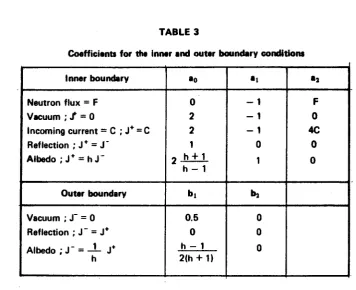
Card 22 specifies, for the neutron group to which it refers, the boundary conditions at the two boundaries of the shield. Diffusion coefficients other than those computed by the code, may be applyed; if so, the DOP (D option) switch and card 23 are used.
Card 22 (6E10.3)
b i , b 2 Coefficients that determine the outer and inner boundary conditions
a0 ' a1 ' a2 respectively. Some examples may be found in Table 3.
DOP < 0 no effect
> 0 read diffusion coefficients for this neutron group, in card 23.
Card 23 (7E10.3) Omit if DOT < 0.
D3, D4,... (NREG-2) values of the diffusion coefficient are read in for the shielding regions; use as many cards as necessary.
If Dj is positive, it will be used as diffusion coefficient of the it n region; if D: < 0 the value
calculated by the code will be used. In any case, if DOT is positive the code will print all the diffusion coefficients actually used for that group.
Cards 24 to 26 define the region independent response functions.
Card 24 (2/5)
NRIR Number of region independent responses to be calculated. If NRIR = 0, omit cards 25, 26.
IFDOSE Shall neutron dose rate be computed? ONo
1 Yes
NRIR sets of cards 25, 26 are entered.
Card 25 (2/5, 15A4)
11, I2 Response function values are entered for the neutron groups 11 to I2 included.
Label Headline for the results.
Card 26 (7E10.3)
F(I1), F(I1 + 1) ...F(I2) Response function values.
If gamma source rates are not needed (IFGAM > 26), cards 27 to 32 are omitted.
Cards 27-29 describe the space distribution of the gamma sources inside the core; one set of cards must be given for each core region. Their description is the same as that of cards
12-14, and will not be repeated here; but the colums 1-10 in card 27 (fission density at the outer boundary of the region) are not read in. If the shape of the gamma-ray source is the same as that of the neutron source, cards 27-29 are the copy of cards 12-14.
Note that if S1 — fission density at the outer edge of the first region — is zero, the cards for the first region must not be entered, and no gamma ray source is taken into account there. The source description for the second region must always be provided: if S2 = 0, only the neutron induced secondaries gamma sources are calculated.
12
-Card 30 (215, 6E10.0)
J Index of the region
NCF Number of coefficients of the polynomial « 5) A i , Ao, — Coefficients of the polynomial
For infinite cylindrical regions, only one coefficient (A j = 1 ) should be given.
Card3UI1Q)
NPG Number of points where the gamma-ray fluxes have to be computed.
If NPG = 0 the code will end the problem after printing the gamma-source distributions; in that case cards 32 are omitted. If NPG > 0, there are NPG cards 32, one for each point to be computed.
Card 32 (E10.0.215. (17/3))
Ζ distance of the point from core-reflector boundary; shield-points will have
positive Z, core-points will have negative Z.
NRS number of source regions to be taken into account (all the regions, if NRS ■ 0).
NR: The gamma-ray flux at Ζ will be computed taking into account only the
radiation originated into the regions NR:, j = 1, NRS.
The region to which the point Ζ belongs is determined and printed by the programme. The last card of each problem must always be card 33. Before reading the input of the following problem, the code looks for card 33, that is the end-card of the problem.
Curd 33 (A4) Gndwd
Enter · · · · in colums 1-4
New input, if any, begins with card 2.
References
1. C. Ponti, Η. Preusch, Η. Schubart. SABINE - A One Dimensional Bulk Shielding Program. EUR 3636 (67).
2. R.E. Maerker, F.J. Muckenthaler. Gamma-ray Spectra Arising from Thermal Neutron Capture in Elements Found in Soils, Concretes and Structural Materials. ORNL-4382 (69).
3. W.E. Ford I I I . Comparison of (nt h, 7) Yields from the Current ENDF/B-I »I Data with Published Data. O R N L - T M - 3 9 1 0 (ENDF-172)T72).
4. W.E. Ford, D.H. Wallace. POPOP4, a Code for Converting Gamma-ray Spectra to Secondary Gamma-ray Production Cross-Section. CTC-12 (69).
5. W.E. Ford. The POPOP4 Library (DLC-12) of Neutron Induced Secondary Gamma-ray Yield and Cross Section Data. CTC-42 (70).
6. J.Y. Guezenec, M. Hot, P. Pepin. Etude de la validité du code SABINE pour les calcul de protection des réacteurs à eau lourde et légère. CEA 1354 (70).
7. J. Chapus. Comparaison des programmes MAC-RAD et SABINE avec les expériences réalisées sur maquettes Graphite-Fer-Béton. DEP/SEPP 930/70.
8. C. Dupont. Programme COSANI, comparaison de plusieurs résultats SABINE et ANISN. CEA-N-1384 (70).
9. M. Lott et al. Etude expérimentale de l'atténuation des neutrons dans différents matériaux de protection a l'aide du dispositif NAÏADE I du réacteur ZOE. C E A - N - 1 3 8 6 (70).
10. W. Futtermenger et al. Control of Shielding Calculation by Test Measurements in the Biological Concrete Shield of Three German Power Reactors. CONF. 721018 Paper C3-3.
11. V. Herrnberger, A.S. Tai, J.F. Zuber. Application des méthodes de déplacement et diffusion a des problèmes concrets de blindage de réacteurs. CON F.721018 Paper C3-2.
TABLE 2 - Layout of input data Card no. 1 2 3 4 5 6 7 8 9 10 11 12 13 14 15 16 17 18 19 20 21 22 23 24 25 26 27 28 29 30 31 32 33 Columns 1 10 N 20 title card IGRC NREG
F S1
J
J
J ID NRC
ID, ID2
RCS, S AR, AZ, BS03
NTH NFRD
IGRS IFGAM
FS2
ZR
ΜΘ MR
FREM 1 ID3 RCS2 ISR AR2 AZ2 BSQ4
name of threshold detector TCS, 11 I2 FOD αϊ b, D3 NRIR IFDOSE
11 12
F(I1) AR, AZ, J NCF NPG Ζ * * · * TCS2 30 IGDS NBUC Η Μψ D FREM NCFR
name of region dependent response F01+D
ft b2
D4
a0
14
-TABLE 3
Coefficients for the inner and outer boundary conditions
Inner boundary
Neutron flux = F Vacuum ; / = 0
Incoming current = C ; J * = C Reflection ; J * = J "
Albedo ; J+ = h J "
Outer boundary
Vacuum ; J~ = 0 Reflection ; J " = J * Albedo ; J ~ = - L J*
h
•o 0 2 2 1 n h + 1
h - 1 b, 0.5
0 h - 1
2(h + 1)
• ι - 1 - 1 - 1 0 1
b, 0 0 0
■a F 0 4C
[image:18.595.96.453.86.376.2]NOTICE TO THE READER
All scientific and technical reports published by the Commission of the European Communities are announced in the monthly periodical "euro-abstracts". For subscription (1 year : B.Fr. 1 025,—) or tree specimen copies please write to :
Office for Official Publications of the European Communities
Case postale 1003 Luxembourg 1
(Grand-Duchy of Luxembourg)
S.>B$
¡sf-
5«ί.1
IÌ;Ì;Ì;ÌÌ;Ì!Ì!ÌÌ!IÌ;Ì;ÌÌH;I::.
,'»*:
! To disseminate knowledge is to disseminate prosperity — I mean I general prosperity and not individual riches — and with prosperity j disappears the greater part of the evil which is our heritage from | darker times.
• ! p
| rfifia,,
SALES OFFICES
The Office for Officiai Publications sells all documents published by the Commission of t h e European Communities at the addresses listed below, at the price given on cover. W h e n ordering, specify clearly the exact reference and the title of the document.
UNITED KINGDOM
H.M. Stationery Office P.O. Box 569
London S.E. 1 — Tel. 01 -928 69 77, ext. 365
ITALY
Libreria dello Stato
Piazza G. Verdi 10
001 98 Roma — Tel. (6) 85 08 CCP 1/2640
BELGIUM
Moniteur belge — Belgisch Staatsblad
Rue de Louvain 40-42 — Leuvenseweg 40-42 1000 Bruxelles — 1000 Brussel — Tel 12 00 26 CCP 50-80 — Postgiro 5 0 - 8 0
Agency :
Librairie européenne — Europese Boekhandel Rue de la Loi 244 — Wetstraat 244 1040 Bruxelles — 1040 Brussel
DENMARK
J.H. Schultz — Boghandel
Montergade 19
DK 1116 København K — Tel. 14 11 95
IL·
FRANCEService de vente en France des publications des Communautés européennes — Journal officie/
26, rue Desaix — 75 732 Paris - Cedex 15» Tel. (1) 306 51 00 — CCP Paris 2 3 - 9 6
NETHERLANDS
Staatsdrukkerij- en uitgeversbedrijf
Christoffel Plantijnstraat
's-Gravenhage — Tel. (070) 81 45 11 Postgiro 42 53 00
UNITED STATES OF AMERICA
European Community Information Service
2100 M Street, N.W. Suite 707
Washington, D C , 20 037 — Tel. 296 51 31
SWITZERLAND
Librairie Payot
6, rue Grenus
1211 Genève — T e l . 31 89 50 CCP 12-236 Genève
GERMANY (FR)
Verlag Bundesanzeiger
5 Köln 1 — Postfach 108 006 Tel. (0221) 21 03 48
Telex: Anzeiger Bonn 08 882 595 Postscheckkonto 834 00 Köln
SWEDEN
Librairie C.£. Fritze
2, Fredsgatan Stockholm 16
Post Giro 193, Bank Giro 7 3 / 4 0 1 5
GRAND DUCHY OF LUXEMBOURG
Office for Official Publications of the European Communities
Case postale 1003 — Luxembourg
Tel. 4 79 41 —CCP 191-90
Compte courant bancaire: BIL 8-109/6003/200
IRELAND
Stationery Office — The Controller
Beggar's Bush Dublin 4 — Tel 6 54 01
SPAIN
Libreria Mundi-Prensa
Castello 37
Madrid 1 — Tel. 275 51 31
OTHER COUNTRIES
Office for Official Publications of the European Communities
Case postale 1003 — Luxembourg Tel. 4 79 41 — C C P 191-90
Compte courant bancaire: BIL 8 - 1 0 9 / 6 0 0 3 / 2 0 0
OFFICE FOR OFFICIAL PUBLICATIONS OF THE EUROPEAN COMMUNITIES
Case postale 1003 — Luxembourg 6579