ISSN Online: 2153-1293 ISSN Print: 2153-1285
Current-Controlled CFTA Based Fractional Order
Quadrature Oscillators
Tada Comedang
1*, Pattana Intani
21Department of Electrical Engineering, Pathumwan Institute of Technology, Bangkok, Thailand 2Electric and Energy Research (EER), Pathumwan Institute of Technology, Bangkok, Thailand
Abstract
This paper presents a study of fractional order quadrature oscillators based on cur-rent-controlled current follower transconductance amplifiers (CCCFTA). The design realisation and performance of the fractional order quadrature oscillators have been presented. The quadrature oscillators are constructed using three fractional capaci-tors of orders α = 0.5. The fractional capacitor is not available on the market or in the PSPICE program. Fortunately, the fractional capacitor can be realised by using the approximate method for the RC ladder network approximation. The oscillation fre-quency and oscillation condition can be electronically/orthogonally controlled via input bias currents. Due to high-output impedances, the proposed circuit enables easy cascading in current-mode (CM). The PSPICE simulation results are depicted, and the given results agree well with the anticipated theoretical outcomes.
Keywords
Fractional Order, Quadrature Oscillator, Current-Controlled Current Follower Transconductance Amplifier
1. Introduction
Fractional calculus, the branch of mathematics that addresses non-integer order diffe-rentiation and integration, is a field that is over 300 years old. Fractional calculus gained considerable attention in the late sixties because it provides a more accurate de-scription of real objects, and many structures found in nature can be modelled by frac-tals [1]. Fractional calculus addresses the generalization of differentiation and integra-tion of non-integer orders. The rapid growth of the applicaintegra-tion of fracintegra-tional calculus to the fields of science and engineering is noteworthy. The integer-order models have been used for a long time, not because they were more accurate or better, but because of
How to cite this paper: Comedang, T. and Intani, P. (2016) Current-Controlled CFTA Based Fractional Order Quadrature Oscil-lators. Circuits and Systems, 7, 4201-4212.
http://dx.doi.org/10.4236/cs.2016.713345
Received: September 22, 2016 Accepted: November 18, 2016 Published: November 21, 2016 Copyright © 2016 by authors and Scientific Research Publishing Inc. This work is licensed under the Creative Commons Attribution International License (CC BY 4.0).
http://creativecommons.org/licenses/by/4.0/
their ability to solve fractional differential equations [2]. This issue has changed over the past few years as several methods of fractional derivative and integral approxima-tion have been developed [3][4][5]; therefore, fractional calculus can be used to easily model a wide area of applications. Fractional calculus plays a major role in physics [6] [7], control systems [8][9][10], signal processing [11], and electrical engineering [12]- [17].
Traditional differentiation takes the form
(
d dn tn)
f t( )
, where n is an integer;however, using fractional calculus, the value of n can be a non-integer order, such as 1.1, 2 or any other real or imaginary order. The Riemann-Liouville definition [18]
[19][20] of a fractional derivative, where n− < <1
α
n, is defined as:( )
( )
(
)
( )
(
)
1 0d d 1
d
d d
t
n
f
f t D f t
n
t t t
α α
α
α α α
τ τ
α τ − +
≡ =
Γ − −
∫
, (1)and the definition of a fractional integral, where 0< <
α
1, is given as:( )
( )
( )
(
)
1 0 1d
t
f
D f t
t α α
τ
τ
α
τ
− − =Γ
∫
− . (2)where Γ
( )
. is the gamma function. One of the most frequently used definitions forthe general fractional derivatives is the Caputo definition, which can be expressed as follows [21]:
( )
(
)
( )( )(
)
00
1
1 t m m
t
t
D f t f u t u
m α α
α
− − = −Γ −
∫
. (3)where m is an integer, such that
(
m− < <1)
α m. The Laplace transform is a veryuse-ful tool in the design and analysis of electronic circuits, transforming the circuit from the time domain to the frequency domain. This transformation is particularly useful because it allows for the analysis of circuits using algebraic rather than differential equ-ations. The Laplace transform of (3) under zero initial conditions is given by [16]:
( )
{
D f t0}
s F s( )
α = α
. (4)
where sα is the fractional Laplacian operator. The use of the fractional Laplacian
op-erator allows for the design and analysis of systems using concepts from fractional cal-culus without having to solve the difficult time domain representations.
cur-rent-controlled current follower transconductance amplifier (CCCFTA), in which the parasitic resistance at the input terminal is electronically tuned. The CCCFTA can be used as an active block in an analogue circuit design with a minimum number of resis-tors.
Sinusoidal oscillators are widely used in various applications, such as tion, instrumentation, measurement and signal processing. Particularly in communica-tion systems, the sinusoidal oscillator is frequently used to generate the carrier signal for the modulation system [31][32][33][34], such as AM, FM, and ASK. With the use of the fractional elements, the design equations of the well-known oscillators could be generalized from the tight integer order domain to the general fractional order domain.
In this paper, a study of a generalized fractional order CCCFTA-based oscillator cir-cuit is introduced. The general CO and FO for this oscillator are derived with the use of the RC ladder network.
2. Fractional Capacitor
A realization using Carlson’s method [15] was selected to model the fractional capaci-tors. The approximation of the fractional capacitors (1/s)1/n was conducted using a
reg-ular Newton process. The order of these approximations increases as the number of iterations in the Newton process increases. The function used in the regular Newton process for these approximations is:
( )
(
(
1)
)
(
(
1 1)( )
)( )
1 1 1
n
n
n x n s
F x x
n x n s
− + +
=
+ + + . (5)
where x is the previous iteration. Using this process to approximate a fractional capaci-tor when n = 2 or α = 0.5, the initial assumption x0 = 1 yields:
1 3 3 1 s x s + =
+ . (6)
as the first iteration approximating 1s. The second iteration approximating 1s
is:
4 3 2
2 4 3 2
36 126 84 9
9 84 126 36 1
s s s s
x
s s s s
+ + + +
=
+ + + + . (7)
The magnitude response of this approximation is provided in Figure 1, which creates an approximation of the fractional capacitor centred around the angular fre-quency 1 rad/s. Using the approximation of (7), the fractional Laplacian operator can be physically realized using the RC ladder network shown in Figure 2. The impedance of this RC ladder network is:
3
1 2 4
1
2 1 3 2 4 3 5 4
1
1 1 1
1 1 1 1
in
C
C C C
Z R
s s s s
R C R C R C R C
= + + + +
+ + + + . (8)
Figure 1. Magnitude response of the approximated fractional capacitor compared to the ideal fractional capacitor of impedance Z(s) = 1/s0.5.
Figure 2. Approximated model for the fractional capacitor.
0.5
1 1 0.2291313787 0.2962962975
9 0.03109120413 0.3333333333 1.899696037 0.5378392488
. 7.548632170 1.420276625
s s
s
s s
≈ + +
+ +
+ +
+ +
(9)
Then an approximate CFE with any desired capacitance (C), which is centred around any angular frequency (ωc), by applying magnitude and frequency scaling factors to the component values in the ladder realization. The resistor and capacitor values become:
s m
R =Rk . (10)
s f m
C C
k k
= . (11)
where Rs and Cs are the scaled resistor and capacitor values, respectively; R and C are the unscaled resistor and capacitor values, respectively; and 1 1n
m c
k = Cω is the
frequency scaling factor.
3. Description of the CCCFTA
[image:5.595.156.555.149.537.2]The schematic symbol and the equivalent circuit of the current-controlled current fol-lower transconductance amplifier (CCCFTA) [30] are shown in Figure 4. The properties
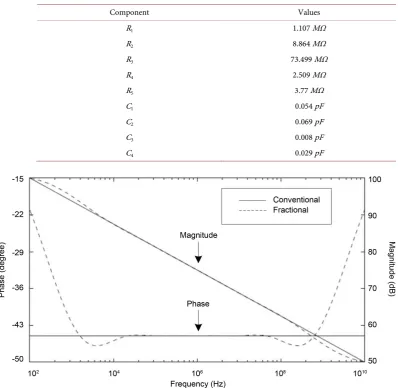
Table 1. Component values to realize approximated fractional capacitor of 40 pF using RC ladder.
Component Values R1 1.107 MΩ
R2 8.864 MΩ
R3 73.499 MΩ
R4 2.509 MΩ
R5 3.77 MΩ
C1 0.054 pF
C2 0.069 pF
C3 0.008 pF
C4 0.029 pF
[image:5.595.166.554.154.539.2]Figure 3. Phase and magnitude of the fractional capacitors compared with the conventional capacitor.
[image:5.595.222.517.569.689.2]of the CCCFTA are similar to the conventional CFTA except that the input voltage of CCCFTA is not zero, and the CCCFTA has a finite input parasitic resistance Rf at the f
input terminal, which can be controlled by the bias current Io as shown below. The
cha-racteristics of the ideal CCCFTA are represented by the following hybrid matrix.
1
2
1
2
0 0
1 0 0
0 0 1 0 0 0 0 0 0 f f z f x m x m z x m x m v R i i i g i g v i g i g + + − − + = + − −
. (12)
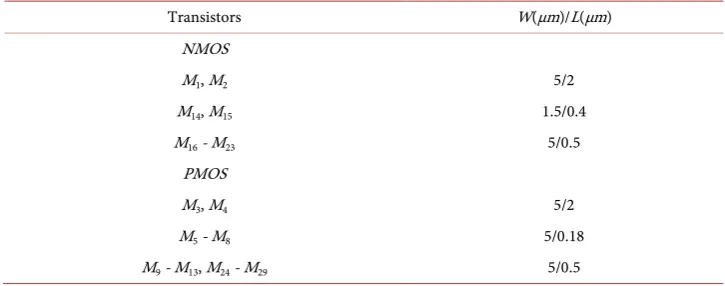
The CMOS 0.18 µm implementation based on the second generation current con-trolled conveyor (CCCII) with a grounded y terminal and a balanced output operation-al transconductance amplifier (BOTA) [38] is shown in Figure 5. The dimensions of the transistors are shown in Table 2. The DC power supply voltages are equal to ±0.8 V. All transistors operate in the saturation region. For CMOS CCCFTA, the Rf and gmmi
are written as:
(
)
0
2 4
1
, 2
f mmi O OX i
mm mm
R g I C W L
g g µ
= =
+ , (13)
where gmmi (i = 2, 4) are the transconductances of transistors M2 and M4, forming the
[image:6.595.195.555.399.513.2]f stage. In (13), the current IOis used to adjust the Rf; µ0 is the free electron mobility
Figure 5. CMOS internal structure of CCCFTA.
Table 2. Scaling of MOS transistor dimensions.
Transistors W(µm)/L(µm) NMOS
M1, M2 5/2
M14, M15 1.5/0.4
M16 - M23 5/0.5
PMOS
M3, M4 5/2
M5 - M8 5/0.18
[image:6.595.191.554.562.705.2]in the channel; COX is the gate oxide capacitance per unit area; and W and L are the
channel width and length, respectively. Similarly, the transconductances gm of
CCCFTA can be given by:
(
)
0
m B OX
g = I
µ
C W L . (14)where the current IB is used to control the transconductance gm.
4. CCCFTA Based Fractional Order Quadrature Oscillators
The proposed fractional order quadrature oscillator is shown in Figure 6. Because the parasitic resistance of the f terminal of CCCFTA is used as an active resistor in this cir-cuit, this fractional order quadrature oscillator only consists of two CCCFTAs and three fractional capacitors.
Using Equation (12), a routine analysis of the circuit yields the following characteris-tic equation:
1 2 3 1 2 2
1 1 2 3 1 2 1 2 1 2 0
f F F F F F m F m m
sα α α+ + R C C C +sα α+ C C +s g Cα +g g = , (15)
From Equation (15), the CO and FO can be expressed as:
2 2 1 3
F m f F
C =g R C , (16)
1
1 1 3
m o
f F F
g R C C
ω
= , (17)Moreover, because of the multiple-output CCCFTAs, the circuit can provide two in-verted output currents, iout2 and iout4. Thus, the relationship of all of the output currents
can be expressed as:
1 2
3 4
out out
out out
i i
i i
= −
= − (18)
[image:7.595.229.523.491.688.2]The circuit provides four phase quadrature outputs of equal magnitudes.
5. Simulation Results
The CCCFTA is realized in Figure 5, and the performance of the proposed circuits is verified using PSPICE with a standard chartered 0.18 µm TSMC CMOS process. The bias currents of CCCFTA1 and CCCFTA2 are IO1 = IO2 = 300 µA and IB1 = IB2 = 1 mA,
respectively. Some cases are chosen to be simulated to show the reliability of the pro-posed design.
For case 1 (α1 = α2 = α3 = 1), the simulation parameters chosen are CF1 = CF2 = CF3 =
40 pF. Figure 7 is the simulated quadrature outputs iout1, iout2, iout3 and iout4 at steady
state. From the simulation results, the oscillation frequency of 3.50 MHz is obtained, which agrees well with the theory, as expected.
For case 2 (α1 = α2 = 1, and α3 = 0.5), the simulation parameters chosen are CF1 = CF2 =
CF3 = 40pF, and the frequency of the oscillation equals 35.50 MHz. Figure 8 is the
si-mulated quadrature outputs iout1, iout2, iout3 and iout4 at steady state.
[image:8.595.194.555.300.476.2]For case 3 (α1 = α2 = α3 = 0.5), the simulation parameters chosen are CF1 = CF2 = CF3 =
Figure 7.iout1, iout2, iout3, and iout4 at steady state.
[image:8.595.196.550.508.685.2]Figure 9.iout1, iout2, iout3, and iout4 at steady state.
Table 3. The performance comparison table.
Case Frequency Phase difference α1 = α2 = α3 = 1 3.50 MHz 90.00˚
α1 = α2 = 1, and α3 = 0.5 35.50 MHz 99.21˚
α1 = α2 = α3 = 0.5 1.02 GHz 123.13˚
40pF, and the frequency of the oscillation equals 1.02 GHz. Figure 9 is the simulated quadrature outputs iout1, iout2, iout3 and iout4 at steady state.
In each case, the experimental result is compared with the simulated results obtained through PSPICE. In the latter case, the fractional orders capacitors are approximated using the RC ladder networks as shown in Figure 2. The parameters of the fractional order quadrature oscillator for the simulation are divided into three cases in Table 3. Table 3 shows that the phase also increases with an increase in the order. It also shows the relationship between the frequency and the phase, which is an advantage that the fractional order can provide, such as a design for a specific phase.
6. Conclusion
This study presented the design of a fractional order CCCFTA-based four-phase sinu-soidal oscillator. The proposed circuit consists of two CCCFTAs and three fractional order capacitors. The oscillation frequency and oscillation condition can be electroni-cally/orthogonally controlled via input bias currents. The fractional order parameter gives extra degree of freedom to the design, and it increases the flexibility of the design and adds more fundamentals. PSPICE simulations are included to verify the theoretical analysis. Simulated and theoretical results are in close agreement.
References
[1] Bunde, A. and Havlin, S. (1995) Fractals in Science. Springer, Berlin.
Oscil-lator with Independent Control of Phase and Frequency. 2nd International Conference on Electronic Design (ICED), Malisia, 19-21 August 2014, 224-229.
[3] Oldham, K.B. and Spanier, J. (2006) The Fractional Calculus: Theory and Applications of Differentiation and Integration to Arbitrary Order. Dover Books on Mathematics, New York.
[4] Kilbas, A.A., Srivastava, H.M. and Trujillo, J.J. (2006) Theory and Applications of Fraction-al DifferentiFraction-al Equations. Elsevier, Amsterdam.
[5] Ortigueira, M.D. (2006) A Coherent Approach to Non Integer Order Derivatives. Signal Processing, 86, 2505-2515. http://dx.doi.org/10.1016/j.sigpro.2006.02.002
[6] Nemat-Nasser, S. (2002) Micromechanics of Actuation of Ionic Polymermetal Composites. Journal of Applied Physics, 92, 2899-2915. http://dx.doi.org/10.1063/1.1495888
[7] Nemat-Nasser, S. and Wu, Y. (2003) Comparative Experimental Study of Ionic Polymer- Metal Composites with Different Backbone Ionomers and in Various Cation Forms. Jour-nal of Applied Physics, 93, 5255-5267. http://dx.doi.org/10.1063/1.1563300
[8] Axtell, M. and Bise, E.M. (1990) Fractional Calculus Applications in Control Systems. Pro-ceedings of the IEEE National Aerospace and Electronics Conference, New York, 21-25 May 1990, 563-566. http://dx.doi.org/10.1109/NAECON.1990.112826
[9] Vinagre, B.M., Podlubny, I., Hernandez, A. and Feliu, V. (2000) Some Approximations of Fractional Order Operators Used in Control Theory and Applications. Fractional Calculus and Applied Analysis, 3, 231-248.
[10] Dorcak, L. (1994) Numerical Models for the Simulation of the Fractional Order Control Systems. The Academy of Sciences, Institute of Experimental Physic, Slovakia.
[11] Tseng, C.C. (2007) Design of FIR and IIR Fractional Order Simpson Digital Integrators. Signal Processing, 87, 1045-1057. http://dx.doi.org/10.1016/j.sigpro.2006.09.006
[12] Comedang, T. and Intani, P. (2014) A±0.2 V, 0.12 μW CCTA Using VTMOS and an Ap-plication Fractional-Order Universal Filter. Journal of Circuits, Systems and Computers, 23, Article ID: 1450126. http://dx.doi.org/10.1142/S0218126614501266
[13] Radwan, A.G., Elwakil, A.S. and Soliman, A.M. (2008) Fractional-Order Sinusoidal Oscil-lators: Design Procedure and Practical Examples. IEEE Transactions on Circuits and Sys-tems I: Regular Papers, 55, 2051-2063. http://dx.doi.org/10.1109/TCSI.2008.918196 [14] Radwan, A.G. and Salama, K.N. (2011) Passive and Active Elements Using Fractional Lβ Cα
Circuit. IEEE Transactions on Circuits and Systems I: Regular Papers, 58, 2388-2397. http://dx.doi.org/10.1109/TCSI.2011.2142690
[15] Carlson, G.E. and Halijak, C.A. (1964) Approximation of Fractional Capacitors (1/s)1/n by a Regular Newton Process. IEEE Transactions on Circuit Theory, 11, 210-213.
http://dx.doi.org/10.1109/TCT.1964.1082270
[16] Nakagava, M. and Sorimachi, K. (1992) Basic Characteristics of a Fractance Device. IEICE Transactions on Fundamentals of Electronics, Communications and Computer Sciences, E75-A, 1814-1819.
[17] Sugi, M., Hirano, Y., Miura, Y.F. and Saito, K. (1999) Simulation of Fractal Immittance by Analog Circuits: An Approach to the Optimized Circuits. IEICE Transactions on Funda-mentals of Electronics, Communications and Computer Sciences, E82-A, 1627-1635. [18] Oldham, K. and Spanier, J. (1974) The Fractional Calculus: Theory and Applications of
Differentiation and Integration to Arbitrary Order. Academic Press, New York.
[20] Samko, S., Kilbas, A. and Marichev, O. (1987) Fractional Integrals and Derivatives: Theory and Application. Gordon and Breach, New York.
[21] Miller, K.S. (1995) Derivatives of Non-Integer Order. Mathematics Magazine, 68, 183-192. http://dx.doi.org/10.2307/2691413
[22] Toumazou, C., Lidgey, F.J. and Haigh, D. (1990) Analog IC Design: The Current-Mode Approach. Peter Peregrinus Press, London.
[23] Ozcan, S., Toker, A., Acar, C., Kuntman, H. and Cicekoglu, O. (2000) Single Resistance- Controlled Sinusoidal Oscillators Employing Current Differencing Buffered Amplifier. Mi-croelectronics Journal, 31, 169-174. http://dx.doi.org/10.1016/S0026-2692(99)00113-5 [24] Mijat, N., Jurisic, D. and Samson Moschytz, G. (2013) A Novel Third-Order Leap-Frog
Ac-tive Filter. Automatika, 54, 217-230. http://dx.doi.org/10.7305/automatika.54-2.308 [25] Horng, J.W. (2005) Current Conveyors Based All Pass Filters and Quadrature Oscillators
Employing Grounded Capacitors and Resistors. Computers and Electrical Engineering, 31, 81-92. http://dx.doi.org/10.1016/j.compeleceng.2004.11.006
[26] Minaei, S. and Yuce, E. (2010) Novel Voltage-Mode All-Pass Filter Based on Using DVCCs. Circuits, Systems, and Signal Processing, 29, 391-402.
http://dx.doi.org/10.1007/s00034-010-9150-3
[27] Ibrahim, M.A., Minaei, S. and Yuce, E. (2012) All-Pass Sections with Rich Cascadability and IC Realization Suitability. International Journal of Circuit Theory and Applications, 40, 461-472. http://dx.doi.org/10.1002/cta.738
[28] Ibrahim, M.A., Minaei, S. and Yuce, E. (2011) All-Pass Sections with High Gain Opportu-nity. Radioengineering, 20, 3-9.
[29] Jin, J., Wang, C. and Sun, J. (2015) Novel Third-Order Quadrature Oscillators with Grounded Capacitors. Automatika, 56, 207-216.
http://dx.doi.org/10.7305/automatika.2015.07.669
[30] Herencsar, N., Koton, J. and Vrba, K. (2009) Electronically Tunable Phase Shifter Employ-ing Current Controlled Current Follower Transconductance Amplifiers (CCCFTAs). 32nd International Conference on Telecommunications and Signal Processing, Hungary, 26-27 August 2009, 54-57.
[31] Couch, L.W. (2001) Digital and Analog Communication Systems. Prentice Hall Inc., Upper Saddle River.
[32] Tomasi, W. (1998) Electronic Communications System. Prentice-Hall Inc., Upper Saddle River.
[33] Yucel, F. and Yuce, E. (2014) CCII Based More Tunable Voltage-Mode All-Pass Filters and Their Quadrature Oscillator Applications. AEU—International Journal of Electronics and Communications, 68, 1-9. http://dx.doi.org/10.1016/j.aeue.2013.06.012
[34] Yucel, F. and Yuce, E. (2015) A New Single CCII-Based Voltage-Mode First-Order All-Pass Filter and Its Quadrature Oscillator Application, Scientia Iranica Transaction D: Computer Science & Engineering, Electrical, 22, 1068-1076.
[35] Freeborn, T. (2010) Design and Implementation of Fractional Step Filters. MSc Thesis, University of Calgary, Calgary.
[36] Haba, T., Loum, G., Zoueu, J. and Ablart, G. (2008) Use of a Component with Fractional Impedance in the Realization of an Analogical Regulator of Order 1/2. Journal of Applied Sciences, 8, 59-67. http://dx.doi.org/10.3923/jas.2008.59.67
326. http://dx.doi.org/10.1109/94.598289
[38] Tsukutani, T., Edasaki, S., Sumi, Y. and Fukui, Y. (2006) Current-Mode Universal Biquad Filter Using OTAs and DO-CCII. Frequenz, 60, 237-240.
http://dx.doi.org/10.1515/FREQ.2006.60.11-12.237
Submit or recommend next manuscript to SCIRP and we will provide best service for you:
Accepting pre-submission inquiries through Email, Facebook, LinkedIn, Twitter, etc. A wide selection of journals (inclusive of 9 subjects, more than 200 journals)
Providing 24-hour high-quality service User-friendly online submission system Fair and swift peer-review system
Efficient typesetting and proofreading procedure
Display of the result of downloads and visits, as well as the number of cited articles Maximum dissemination of your research work