Munich Personal RePEc Archive
Spending Patterns in Youth
Hasan, Syed Akif and Subhani, Muhammad Imtiaz and
Osman, Ms. Amber
Iqra University Research Centre (IURC), Iqra university Main
Campus Karachi, Pakistan, IQRA UNIVERSITY
2012
Online at
https://mpra.ub.uni-muenchen.de/37657/
Published in
American Journal of Scientific Research (AJSR), 2012
Spending Patterns in Youth
Muhammad Imtiaz Subhani
Iqra University Research Centre-IURC , Iqra University- IU, Defence View, Shaheed-e-Millat Road (Ext.) Karachi-75500, Pakistan
E-mail: [email protected]
Tel: (92-21) 111-264-264 (Ext. 2010); Fax: (92-21) 35894806
Syed Akif Hasan
Office of Vice President, Iqra University- IU,
Defence View, Shaheed-e-Millat Road (Ext.) Karachi-75500, Pakistan
E-mail: [email protected]
Tel: (92-21) 111-264-264 (Ext. 1513); Fax: (92-21) 35894806
Amber Osman
Iqra University Research Centre-IURC, Iqra University, Defence View, Shaheed-e-Millat Road (Ext.) Karachi-75500, Pakistan
E-mail: [email protected]
Tel: +92(21) 111 264 264 (Ext. 2010); Fax: +92(21) 5894806
Abstract
The age of juvenility i.e. the youth has become emerged with new personality characteristics, which has made them more powerful than ever before. Similarly, the youth has become more spendthrift in their daily routine to satisfy their self-concept and social circle they belong to or wish to move in to. From yester years, spending pattern of youth has increased at large and they have now more autonomy at making buying decisions. This research is giving a clear answer of youth spending behavior and factors which influence this behavior. The findings of this paper present a precise glimpse on the factors which decides the increasing spending patterns in youth. It is noted that both the male and female youth have different spending patterns with a slight similarity. Thus, this paper is a healthy insight for the marketing professionals focusing their brand inventions for the youth as their target market.
Keywords: Youth, Spending Patterns, Consumer Behavior, Brands
1. Introduction
a major part of the population and is always a attraction for marketers to tap the population in proper segmentation and target market.
It is fruitful to investigate the spending pattern and their behavior of spending their out of their income budget will help understand youth’s need recognition and choices towards a certain product/service. There is clutter of brands and has become even more difficult to sustain the recall ability in the mind of consumers and keep them focused as youth is quite unpredictable and has a spontaneous behavior.
2. Literature Review
There has been various studies and research analysis on the consumption level of consumers and understanding the characteristics of the consumers to produce and target the brands right. This research has gone into great detail to answer one sample of population i.e. the Youth, which is essential for the manufacturing companies and the marketing people to handle their product, planning and its strategies accordingly. The precise spending pattern of the youth of Pakistan has changed than before and this has been assessed and analyzed. We have taken all the possible characteristics of the youth, which influences their spending pattern.
Demographic changes happen frequently and according to such changes, the composition of the specific product/service has to be tailored accordingly to effect the product/service price, placement and production assessments. Population has been increasing in certain age-groups, which is also a point for the marketers to work on with their marketing tools and strategies.
The Baby Boom has been an important era for the marketers and has taught them a lot about the youth market. In short, it gave the manufacturers new way to envisage product development for the new identified markets.
Different households have different way of living and similarly different spending patterns. In the western culture, the young individual are more independent at the age of 18 and start their earning and living separate than their parents home and this is known as the transitional nature of the young individual (Jones & Martin, 1997).
Other research studies have indicated the age and compulsive buying are strongly related to each other in respect to the younger consumers. It is also seen that when there is impulse and compulsive buying situation then the younger consumers are the answer (Subhani, Hasan, Osman & Nayaz, 2011). With the passage of time, the percentage of younger consumers has increased in compulsive buying and overall buying behavior (O’ Guinn & Faber, 1989). This certain behavior is due to their impulsive tendency towards unrestrained ability towards the advertising and marketing activities they are surrounded by. They have not much of self-control on their actions. One can see less compulsive buying/spending pattern in the collectivist cultures than individualist cultures (Kacen & Lee, 2002).
The amount that is the budget of the young individual was ascertained by segregating the variables, which are basically the factors on which the young individual is spending his/her money. The most significant factors out of the lot were income, satisfaction, friends’ information, advertisements information, entertainment and age of respondents (Subhani, Hasan & Osman, 2011).
3. Research Methodology
3.1. Description of Sampling, Data & Econometrical Tool
4. Findings and Results
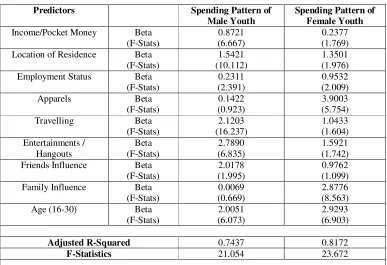
[image:4.612.120.507.304.569.2]Elementarily the prime focus of this paper was to look into the possible various spending patterns in male and female youth. It was noted and revealed in the findings of this paper that both in the male and female gender, the youth have a clear mind set to spend money for various and multiple reasons. As highlighted in table 1, the female youth do more spending for the reasons of apparels, the age bracket to which they belong and also for family reasons as their coefficients (betas) are empirically husky and significant (i.e. beta= 3.9003 at t > 1.5 for apparel reason; beta= 2.929 at t > 1.5 for the reason of their age bracket; beta= 2.8776 at t > 1.5 for family reasons). While the male youth do spending more for the some different reasons which include Entertainments/ hangouts, travelling, friends influence and also for the age bracket to which they belong, as the coefficients of these constructs are also thick and significant (i.e. beta= 2.789 at t > 1.5 for hangout reason; beta= 2.120 at t > 1.5 for the reason of travelling; beta= 2.017 at t > 1.5 for friends reasons; beta= 2.005 at t > 1.5 for the reason of their age bracket). The table 1 also confirmed that the Pakistani male youth have more reasons to spend more than the female youth. Whereas, the other predictors which include pocket money, location of residence, employment status, they also matter in explaining the increasing spending patterns in both the youths, as their t-stats are > 1.5.
Table 1: Spending Patterns of Youth
Predictors Spending Pattern of
Male Youth
Spending Pattern of Female Youth
Income/Pocket Money Beta
(F-Stats)
0.8721 (6.667)
0.2377 (1.769)
Location of Residence Beta
(F-Stats)
1.5421 (10.112)
1.3501 (1.976)
Employment Status Beta
(F-Stats)
0.2311 (2.391)
0.9532 (2.009)
Apparels Beta
(F-Stats)
0.1422 (0.923)
3.9003 (5.754)
Travelling Beta
(F-Stats) 2.1203 (16.237) 1.0433 (1.604) Entertainments / Hangouts Beta (F-Stats) 2.7890 (6.835) 1.5921 (1.742)
Friends Influence Beta
(F-Stats)
2.0178 (1.995)
0.9762 (1.099)
Family Influence Beta
(F-Stats)
0.0069 (0.669)
2.8776 (8.563)
Age (16-30) Beta
(F-Stats)
2.0051 (6.073)
2.9293 (6.903)
Adjusted R-Squared 0.7437 0.8172
F-Statistics 21.054 23.672
Note: Spending Patterns = increasing or decreasing spending patterns where +ve symbol translates an increasing pattern, while –ve symbol for decreasing pattern.
The further finding of this paper concludes that the both the models (model for explaining spending patterns in male and model for explaining spending patterns in female) which are comprised upon the predictors i.e. Income/Pocket Money, Location of Residence, Employment Status, Apparels, Travelling, Entertainments/ Hangouts, Friends Influence, Family Influence and Age of youth for age bracket of 16-30, predict and explain the increasing spending patterns in both male and female youth substantially and significantly, where for both models F >3.84 which implies that the outlined models are significant.
5. Discussions & Conclusions
enjoy their lives while, mixing and mingling with their colleagues and friends which allows them to have a feel to be looked good, to travel and to go for hangouts. These outlined constructs do not only decide to their socializing patterns but they also do decide to their spending patterns as confirmed by the findings of this paper. This paper presents a precise glimpse on the factors which decides the increasing spending patterns in youth. It was noted that both the male and female youth have different spending patterns with a slight similarity. Jones and Martin (1997) agreed with the findings of this study as they empirically commented that youth is a different human being, they act at times so spontaneously, while, spending time and money specifically. It is next to impossible to enumerate their behaving patterns but in spending patterns the apparels, traveling, and entertainments are the major constructs which matters for the increasing spending patterns in youth. This paper is a help to understand youth’s need recognition and choices towards a certain product/service while keeping the idiosyncrasy that the youth is always quite unpredictable and have the spontaneous behaviors of variety of colors.
References
[1] Jones, G & C.D., Martin. (1997). The Social Context of spending in Youth. University of Cambridge. Retrieved January 20, 2012, from
http://www.ces.ed.ac.uk/PDF%20Files/Brief011.pdf
[2] Kacen, J., J. & J.A., Lee. (2002). The Influence of Culture on Consumer Impulsive Buying Behavior. Journal of Consumer Psychology, 12(2):163-176.
[3] O'Guinn, T., C & R.J., Faber. (1989). Compulsive Buying: A Phenomenological Exploration. Journal of Consumer Research, 16(2): 147-157.
[4] Subhani, M.I., S.A., Hasan, A., Osman & M., Nayaz. (2011). Plastic Money/Credit Cards Charisma for Now and Then (A Thin Line between Easy Money and Risky Money). European Journal of Scientific Research , 62(1): 123-127.
[5] Subhani, M.I., S.A., Hasan & A., Osman. (2011). Marketing is All about Taking Money from Customers (An Application of Tobit Model). International Research Journal of