On the Relationship between Statistical and
Phenomenological Models of the Thermodynamic Systems
Igor Samkhan
Department of Heat Engines, Yaroslavl State Technical University, City of Yaroslavl, Russia Email: [email protected]
Received May 3, 2013; revised June 6, 2013; accepted July 3,2013
Copyright © 2013 Igor Samkhan. This is an open access article distributed under the Creative Commons Attribution License, which permits unrestricted use, distribution, and reproduction in any medium, provided the original work is properly cited.
ABSTRACT
The paper deals with the performing of a critical analysis of the problems arising in matching the classical models of the statistical and phenomenological thermodynamics. The performed analysis shows that some concepts of the statistical and phenomenological methods of describing the classical systems do not quite correlate with each other. Particularly, in these methods various caloric ideal gas equations of state are employed, while the possibility existing in the thermo- dynamic cyclic processes to obtain the same distributions both due to a change of the particle concentration and owing to a change of temperature is not allowed for in the statistical methods. The above-mentioned difference of the equa- tions of state is cleared away when using in the statistical functions corresponding to the canonical Gibbs equations in- stead of the Planck’s constant a new scale factor that depends on the parameters of a system and coincides with the Planck’s constant in going of the system to the degenerate state. Under such an approach, the statistical entropy is transformed into one of the forms of heat capacity. In its turn, the agreement of the methods under consideration in the question as to the dependence of the molecular distributions on the concentration of particles, apparently, will call for further refinement of the physical model of ideal gas and the techniques for its statistical description.
Keywords: Thermodynamics; Classical Systems; Description Models; Statistical Functions; Phase Space; Probability Distribution; Particle Concentration
1. Introduction
At present, two methods are used to describe the ther- modynamic systems being an assemblage of randomly moving microparticles [1]. In one of them represented by the phenomenological classical thermodynamics, such systems are considered as a single whole without regard for their internal structure, with the properties of the sys- tem being characterized by several macroscopic parame- ters.
In another method being referred to as statistical ther- modynamics or statistical physics, the models of the sys- tem’s internal structure allowing for changes in energy and coordinates of individual molecules in their interac- tion between themselves and the environment are treated. The results of such interaction are usually represented as the probability of distribution of the molecules according to energies, momenta, coordinates and the like micro- parameters of a system. In this case the macroscopic pa- rameters of the system are determined by the statistical methods as mean factors of the molecular ensemble, which can appear with the highest degree of probability
during a long period of observation.
It is generally suggested that both methods comple- menting each other agree nicely with one another, thus demonstrating the unity of the thermodynamic approach and the reliability of well-known thermodynamic con- cepts.
However, such an agreement cannot be yet accepted as sufficiently complete because of the existence in the sta- tistical thermodynamics of a number of the concepts, which do not quite correlate with the principles of the phenomenological thermodynamics and the existing practice.
Specifically, various caloric ideal gas equations of state [2] are employed in these techniques, besides the assumption of the statistical method about the independ- ence of the classical distributions by velocities and mo- menta from the concentration of particles is hard to fit to possible change of the distributions in the thermody- namic cycles.
explicit form or are justified to some extent with refer- ences to a partial agreement of the theory with the ex- perimental measurements or to a possibility of refine- ment of the classical approaches in the quantum statistics, for example, in the Bose-Einstein or Fermi-Dirac statis- tics. However, the experimental investigations do not cover every possible case, and the physical models of the quantum and classical statistics do not correlate very well with each other. In particular, in the quantum statistics as distinct from the classical ones the identical particles are deemed indistinguishable, and the molecules can be con- sidered in energetically excited states which are not taken into consideration in the classical systems, e.g. in the translational motion of the ideal gas molecules [3].
The presence of similar problems in the agreement and substantiation of the thermodynamic techniques makes necessary a search for further ways of their development. One of the steps in this direction pertaining to the re- finement of the entropy behavior in the adiabatic proc- esses of the open thermodynamic systems has been ex- amined comparatively recently in paper [4].
In the present paper, some problems and possible ways associated with a more comprehensive agreement of va- rious branches of the thermodynamics are treated from the standpoint of the statistical method.
2. Dependence of the Statistical Functions of
the Thermodynamic Systems on the
Scale Factor
One of the problems hampering the matching of the phe- nomenological and statistical models of the thermody- namics is the lack in the former case of such notion as the absolute entropy S, whereas it forms the basis of the statistical method.
This circumstance seems at first sight to be of small importance because the statistical entropy is usually de- termined only to an accuracy of the arbitrary constant or otherwise the scale factor α, for example, using the for- mula
3 2
2
e 2 mkT
a
N V
T m
k
3
33 3 34
6.6 10 ,Js .
h p
e v
e h
5 2 lnV
S kN N
(1)
where is the number of particles, is the volume, is the temperature of the thermodynamic system, is the mass of molecules, and e are the Boltzmann con- stant and the base of natural logarithm, respectively [3].
In so doing, the effect of this constant when calculat- ing the entropy difference can be eliminated by assuming that the value of α does not depend on the parameters of the system and is equal for various systems.
However, such an assumption leads to additional diffi- culties. In particular, it is generally supposed that the Planck’s constant raised to the third power can be chosen
as such constant for classical (molecular) systems
(2)
This coefficient is typically used for the description of the quantum phenomena of the microworld and, particularly, for the relations between the quantum energy and the oscillation frequency of electromagnetic radiation
, (3)
or between the de Broglie wavelength and the mo- mentum of particle p
h p. (4)
In so doing, the application of the Planck’s constant to the description of classical systems seems logically at- tractive for developing a general thermodynamic concep- tion.
At the same time such an approach does nevertheless not quite conform to the physical nature of the classical systems and to the relationships between their parameters obtained using the molecular-kinetic theory.
Thus, it is common knowledge that the degeneracy temperature Tg characterizing the possibility of the
quantum effects appearing in the classical systems
2 2 3
3
2 8
g
h n T
km
0.05 K
T
, (5)
is for the majority of ideal gases very small; it depends on the concentration n and the mass m of particles and makes up, e.g. for helium at standard conditions,
g , decreasing for the gases with greater mo-
lecular mass [5].
Moreover, such choice of the scale factor entails the employment in the phenomenological thermodynamics and classical statistics of various caloric equations of state, which do not quite correlate with each other. In particular, the caloric ideal gas equation of state
p v
TC U PV C R T
U V
(6)
incorporates only macroscopic parameters of the system, such as the internal energy , the volume , the pres- sure P and the heat capacity p at or the
heat capacity C at V
C Pconst
v const, and the gas constant
.
R
TS U F U PV N Whereas the canonical Gibbs equation of state
(7)
involves additionally a number of statistical parameters, including the free energy of the system
FPVN (8)
2 3 2 2 V mkT N N , , ln kT
(9)
for finding of which, apart from the mass m and the number of the particles, such parameters of the in- ternal structure of the system as the coordinates of the particles x y z , the projection of their momenta
, ,
x y z
p p p
on the axes of a rectangular coordinate system as well as the elementary volumes
x y z of the imaginary multidi-
mensional phase space, are taken into account too [1]. dg dg dx dydzdp dp dp
It may appear thereby that canonical Equation (7) as compared with Equation (6) contains far more complete information about the system, incorporating also the data on the internal structure of the system and its possible microstates.
However, this opinion is not quite justified because with allowance made for the formulas (6) and
5 2C kN
p
TC N
p the canonical Equation (7) can be repre-
sented as Equation (10)
TS N
, (10)
in which the statistical summand should be taken equal to zero or to another constant magnitude. This cir- cumstance emerges from the thermodynamic determina- tion of change in the entropy of the system, for example, in an isobaric process
2 1
ln p
S C T T
N
, (11)
in which the summand is not taken into considera- tion at all, and from the necessity of an identical notion of the entropy in both methods of the thermodynamics.
One way to surmount this difficulty may lie with the assumption, which appears not to be considered previ- ously, about the advisability of using in the statistical description of the classical systems the variable scale factor depending on the parameters of the system.
To realize such an approach let us represent the scale factor a3 c for classical systems as Equation (12)
3
h
c c
h p, (12)
determining the dependence of this factor on the average statistical parameters of the system: the length c of the
elementary volume с3V N falling at one molecule of ideal gas, and the momentum of particles p mv .
Equation (12) is similar in form to the known de Broglie relationship
hp
h
, (13)
correlating the Planck’s constant , the de Broglie wavelength and the momentum of particle p.
,
c
h h
Both above formulas coincide with each other when the value of the scale factor becomes equal to the Planck’s constant what from a physical point of
view signifies the transformation of the classical gas into the degenerate state in which quantum effects manifest themselves.
With due regard for Equation (12) the scale factor for the classical systems having a three-dimensional motion of gas molecules may be represented as Equation (14)
33 3 2
2
c
V
a h mkT N
, (14)
in which the multiplier 3 3 2
2
p mkT
c corresponds to
the herein accepted projection of the average statistical momentum of particles of the system on the axes of a rectangular coordinate system
1 2 2
c
p mkT p
. (15)
In so doing, the accepted value c coincides with the
magnitude of the known statistical integral in the Max- well’s and Gibbs distributions
2 2 e d i p mkT c x
p
p
(16)
and differs from the known root-mean-square projection of such momentum
1 2 3
m
p mkT (17) only by a near-one numerical coefficient.
Equation (14) derived here is virtually analogous to a known criterion of the statistical physics
2 3 2 2 V mkT N h
, (18)
generally applied along with Tg to the assessment of the degree of manifestation of the quantum effects in the ideal gas, i.e. to the determination of the question as to a possibility of considering the behavior of gas from a clas- sical
1
, quantum
1
or intermediate
1
However, contrary to Equation (18) in which the Planck’s constant is used as scale factor, Equation (14) has another physical meaning, determining the de- pendence of the scale factor on the parameters of the classical systems, both of these expressions coinciding at
standpoint [6].
h
a h .
The employment of the variable scale factor enables a number of the known statistical functions of the classical systems to be interpreted in a new fashion. In particular, the known statistical functions of the monoatomic ideal gas, when substituting in them for the Planck’s constant the scale factor according to Equation (14), are rear- ranged to the form:
2 3 2 2
lnV mkT 0
kT
N a
3 2
2 2 lnVe mkT
F kTN
N a
kTN pV (20)
2 3 2 5 2
2
ln 5
2 p
Ve mkT S kN
N a
kN C
0
, (21)
showing that in this event the chemical potential of the system is equal to zero ( ), the free energy of the system is equal to FpV , while the system entropy S may be identified with the heat capacity at a constant pressure p.
In this interpretation as well as in [2,4] such parame- ters as the heat capacity p v
S C
C C R, the heat capacity
v at a constant volume and the gas constant are con-
sidered as the functions depending not only on the tem- perature, but also on the specific volume of the system.
C R
2
In this case, it is enough to imagine that the distribu- tion of the particles of an ideal gas by velocity, momen- tum of the gas molecules satisfies the normal distribution of the random variables with the center µо and dispersion . Suppose also that it is represented not in terms of the absolute values of the coordinates, as usual, but in terms of the normal coordinates normalized with a linear con- version of y
x o
0
M
to the standard form with the center and
In that event the known canonical Equation (7) of ideal gas state being a consequence of the statistical method is rearranged to a similar Equation (6) of the classical ther- modynamics, what eliminates the discrepancies existing currently between them.
Moreover, Equation (6) of the ideal gas state can be obtained by a statistical method without using the con- ventional concepts about the phase space of thermody- namic systems and their elementary cells (the scale fac- tor).
y 1.
Then the employment of the statistical integral of the normal standardized (normal coordinates) distribution
2
1
1 2
exp d 2
2
y Z y
1 ln 1 , 1
(22)
brings about the derivation of the thermodynamic func- tions of the form
F kTN Z PV S Cp, (23)
correlating with Equation (6).
Whereas in using the statistical integrals of the normal distribution with absolute coordinates
1 22 2
2
exp d 2
2
x
Z y
2 ln 2 ln , 2 p ln , ln
F kTN Z PV kTN S C kN kN
(24)
the thermodynamic functions have the known form
(25)
analogous to Equation (7).
Although nowadays the question as to the dependence of the statistical functions on the choice of the scaling factor and coordinate systems still remains open, the em- ployment of the statistical integral in the form Z1 as compared to Z2 is more preferential. Specifically, in
this instance the Equation (26)of state
TS U PV (26) becomes common to both the classical systems and the quantum ones. For example, this Equation (26) is appli- cable to the degenerate boson gas, for which
3 2 5 2
5 25 3 , and 2 3 , when const,
S AVT UAVT P AT A
and to the equilibrium photon gas [7], for which
3 4
44 3 o , o and 1 3 o , when о const
S VT U VT P VT .
3. Dependence of the Molecular
Distributions on the Concentration of
Particles
Besides, in this case the thermodynamic functions
Fand (as opposed to similar known functions) be- come additive, what eliminates the known Gibbs paradox and the need to “improve” the classical distributions through introduction of arbitrary correction multipliers
S
At present, the dependence of the probability density of the molecular distributions (for brevity sake, molecular distributions) by velocities or momenta on the concentra- tion of particles in the Maxwell-Boltzmann statistics is denied in principle even in the action on the system of the external force field [6].
3
1æ N!N
0
S C T 0
S T0
into them.
In that event the condition p at required under the third law of thermodynamics is car- ried out too. It substitutes the previously known result at of classical distributions, which does not agree with experimental observations.
i 1 2m f v
kT
2
exp
2 2
i
mv kT
(27)
or momenta
1 1 2i
f p
mkT
2
exp
2 2
i
p mkT
. (28)
the concentration of particles is not taken into account, while in the Boltzmann statistics determining the distri- bution of molecules by coordinates in the external force field the velocities of particles are not taken into consid- eration
, , e .
p U
kT
y z B
, , , ,
f x (29)
In these expressions f v
i f i
, ,
U x y z
p f x y z is the probability density of the distribution of particles on pro- jections of velocities, momenta and coordinates respec- tively, p is the potential energy of the parti-
cles in the external force field, v pi i
is the projectionsof velocities (momenta) in the rectangular coordinate system, B is the normalization multiplier.
However, this concept does not quite agree with the classical thermodynamics. Such a conclusion is sugges- ted by the consideration of probable molecular distribu- tions in the ideal gas cycle incorporating the adiabatic (1-2), isochoric (1-3) and isothermal (2-3) processes, it is represented in Figure 1.
On the one hand, in that event one may assume that the distribution curves in the points 1 and 2 are alike by virtue of the constancy of entropy in the adia- batic process (1-2), though it does not agree with the known dependence of distributions on the temperature in the Maxwell statistics. Then an equilibrium distribution by velocities (momenta) in the point 3 can be obtained both owing to a change of temperature in the isochoric process (1-3) occurring at constant concentration of par- ticles , and due to a change of the concentra-
0
S
const
[image:5.595.54.287.81.167.2]n
Figure 1. Ideal thermodynamic gas cycle.
tion of particles in the isothermal process (2-3) occurring at constant internal energy of the system and in the absence (or at constancy) of the external force fields.
const
U
const
n
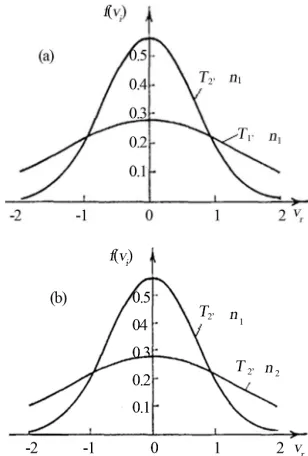
In this case the relationship of the probability density of the molecular distributions by the projections of ve- locities in the characteristic points of this cycle may be represented as curves in Figure 2 showing a possibility of obtaining the identical (equal) distribution curves both at temperature change and at concentration change.
At that, the comparison of the Maxwell distribution curves in the points 1 and 3 at temperatures T1 and T2 respectively (the concentration of molecules is alike
) is represented in Figure 2(a). In addition, the comparison of the distribution curves in the points 2 and 3 at the concentration of molecules n2 and n1, respec- tively (the temperature is alike T2 = const) is shown in Figure 2(b).
[image:5.595.343.497.444.672.2] [image:5.595.119.223.559.714.2]On the other hand, to analyze the distributions in the cycle of Figure 1 one may take another assumption ac- cording to which the distribution curves in the points 1 and 2 of the adiabatic process 1-2 are diverse and cor- respond to a temperature change in the Maxwell statistics. However, such an assumption leading to the conclusion about the independence of the distributions from the concentration of particles should be supposedly rejected because of the contradictions regarding the determination of the statistical entropy and its association (correlation) with the molecular distributions.
Figure 2. Comparison of the projection distributions of velocities
vi in the characteristic points of the ideal cycleThe problems coming about thereby cannot be cleared away completely in the Gibbs statistics too. In this statis- tics one considers the distribution of the molecules (to be more specific, the distribution of their representation points) in the imaginary multidimensional phase space generated by the product of the coordinates of the mole- cules and their momenta.
In the source prerequisites of these statistics as well as in the Maxwell-Boltzmann statistical model the principle of independence of the molecule distributions by coordi- nates and momenta for closed systems is adopted.
However, despite a formal denial of such dependence, it nevertheless is partially provided for, though in an im- plicit form, in the ultimate results obtained thereby. Thus, for example, the entropy in the Gibbs statistics, as may be seen from Equation (1), is a function of both the mo- menta and the concentration of particles, what is achi- eved owing to a correction of the primary results obtain- ed thereby by inserting into them additional assump- tions, specifically the assumption of a necessity of im- proving the initial distributions by application of correc- tion multiplier æ.
Moreover, the thesis on the independence of the mo- lecular distributions in the coordinate space (of the parti- cle concentrations) and in the momenta space does not agree with the great canonical Gibbs distribution for the systems with a variable number of particles. In that event, the probability distribution density of particles f N E
,
, even in the absence of external force fields, is represen- ted as a function
,
eN E kT
E С
f N , (30) depending both on the chemical potential and the number of particles in the system and on the energy of the subsystem i i
N N
E incorporating i number
of particles with
N
i
energy (C is here the normaliza- tion multiplier).
However, in this case also the known statistical meth- ods cannot explain sufficiently enough the interrelation of the entropy with the changes of the molecular distri- butions in the adiabatic and polytropic thermodynamic processes.
4. Conclusion
The performed analysis shows that some concepts of the statistical and phenomenological methods of describing the classical systems do not quite correlate with each other. Particularly, in these methods, various caloric ideal gas equations of state are employed, while the possibility of obtaining the same distributions both due to a change of concentrations and owing to a change of temperature in the thermodynamic processes is difficult to explain from the standpoint of a statistical method.
The above-mentioned difference of the equations of state may be cleared away using in the statistical func- tions corresponding to the canonical Gibbs equation a variable scaling factor instead of the Planck’s constant. The proposed factor depends on the parameters of a sys-tem and coincides with the Planck’s constant in a par- ticular case in going of a classical system to the degener- ate state. Under such an approach, the statistical entropy is transformed into one of the forms of heat capacity, what correlates with the determination of the entropy in representing normal molecular distributions with the use of the normalized coordinates.
In its turn, the agreement of the methods under consid- eration in the question as to the dependence of the mo- lecular distributions on the concentration of particles, apparently, will call for further refinement of the physical model of ideal gas and the techniques for its statistical description.
In this regard, it is interesting to note that as one of the causes of difficulties arising in the harmonization of ther- modynamics can be considered the deterministic approach based on the possibility of determining the coordinates and momenta of individual particles at every instant by application of the equations of the classical mechanics.
Presumably, these assumptions cannot be met enough strictly in all possible thermodynamic systems owing to a randomness of the heat motion occurring with a possibil- ity of the initiation thereby also of the forces of collective interaction in case of a departure of the particle’s para- meters from their average statistical values.
To further refine the statistical conception of classical systems, the development of the statistical models based on the idea of the molecular distributions as a result of thermal fluctuations of the particle matter, i.e. on the idea of a random departure of the particles’ parameters from their equilibrium values, can turn out to be more prefer- ential.
In this instance, the functional relation between the ge- neralized coordinates g
x y z, ,
and momenta
x, y, z
p p p p of the particles, which is characteristic for the known classical models, is not required, and the iden- tical molecules of the classical systems, just as in the quantum statistics, will be considered as indistinguish- able.
REFERENCES
[1] M. Kardar, “Statistical Physics of Particles,” Cambridge University Press, Cambridge, 2007.
doi:10.1017/CBO9780511815898
[2] I. Samkhan, Phisiks-Doklady, Vol. 41, 1996, pp. 16-18. [3] P. W. Atkins, “Physical Chemistry,” Oxford University Press,
Oxford, 1978.
No. 2, 2009, pp. 8-17.
http://www.benthamscience.com/open/toefj
[5] D. V. Sivukhin, “Thermodynamics and Molecular Phys- ics,” 5th Edition, FITMAZLIT, Moscow, 2005.
[6] Yu. B. Rumer and M. Sh. Ryvkin, “Termodinamika, sta-
tisticheskayafizikairinetika (Thermodynamics, Statistical Physics, and Kinetics),” Nauka, Moscow, 1977.